Showing posts with label devil. Show all posts

Friday, 7 February 2014

Daily Cycling Facts 07.02.2014

Learco Guerra
Learco Guerra, who died on this day in 1963, started out as a footballer. However, he turned out not to be very good at it and so he decided to have a go at cycling instead. He turned out to be very good at that, earning himself the nickname "Locomotive" for his ability to keep on for kilometre after kilometre at high speed.

Born in Bagnolo san Vito on the 14th of October 1902, Guerra's football ambitions meant that he came to cycling unusually late when he was 26. It took him just a year to become National Champion in 1930, the same year he entered the Giro d'Italia for the first time and won two stages (8 and 11), coming 9th overall. Even more remarkably, he also entered the Tour de France for the first time, where he won three stages (2, 13 and 15), wore the maillot jaune for seven days and finished in 2nd place overall and retained his National title. He kept it again in 1931 and added the World Road Race Championship for good measure, having won another four stages in the Giro too. He wasn't World Champion in 1932 but remained National Champion, this time winning six Giro stages (1, 4, 6, 8, 9 and 13). In 1933, he took Stages 1, 3 and 5 at the Giro, then went back to the Tour where he won Stages 2, 6, 7 and 18, once again finishing 2nd overall, won Milan-San Remo and became National Champion for the fourth consecutive year.

Guerra's best year was 1934, when he won 13 major races including the Giro di Lombardia and ten stages at the Giro d'Italia (2, 3, 4, 5, 6, 9, 10, 11, 12 and 14) - more than enough for an overall win - and won the National Championship for the final time. He settled for 4th overall at the 1935 Giro, this time having to make do with Stages 3, 4, 7, 8 and 10, then had a quieter year in 1936 during which his only notable win was the  Giro della Provincia Milano in which he teamed up with Gino Bartali. His last Giro came a year later and he won Stage 9, polishing off his career in 1940 when he became National Track Stayer Champion.

Sadly, Guerra's enormous success was hijacked by the Italian Fascist government who used him as a heroic figurehead in propaganda. His own politics are not known, but most historians feel he was probably not a fascist himself - his popularity in the peloton, among cyclists of various nations and at a time when many were beginning to develop real suspicions and fear of what was taking place in Italy and Germany, may confirm this; as would his work after retiring as a cyclist when he became a team manager for, among several others, Charly Gaul, a rider who would have made one of the most unlikely fascists ever.

He died aged 60, having been diagnosed Parkinson's Disease some time previously.

Franco Ballerini
Franco Ballerini, who died on this day in 2010, first found fame as a cyclist before becoming a cycling team manager. Born in Florence, his greatest success came in the Classics - he won Paris-Roubaix, the single-day race so hard it's known as commonly by its nicknames "The Hell Of The North" and "A Sunday In Hell" as often as by its real name, on two occasions, first in 1995 and then again in 1998. He also won Paris-Brussels in 1990, the Giro della Romagna in 1991, the Omloop Het Nieuwsblad in 1995 and the Grand Prix de Wallonie in 1996.

Franco Ballerini, 1964-2010
(image credit: Eric Houdas CC BY-SA 3.0)
He was far less effective as a stage racer, finishing the Tour de France 115th overall in 1992 and 61st the following year, when he also took Stage 14 at the Giro d'Italia. He would win Stage 5 in the 1996 Tour of Austria, but that was as far as his stage race success went. He did far better as manager of the Italian team, training among others Mario Cippolini who holds the Giro record of 42 stage wins. He also managed Paolo Bettini, who would become known as the greatest Classics rider of his generation before retiring in 2008.

Ballerini loved rally racing as much as he loved cycling, and it was while participating in that sport that he met his untimely end when he was 45. He was acting as navigator for a driver named Alessandro Ciardi during a race at Larciano when the car went out of control and crashed, leaving him with the horrific injuries that caused his death a short while later.

Elia Viviani
Elia Viviani
Born in Isola della Scala, Italy on this day in 1989, Elia Viviani began to compete in cycling races both on road and track at the age of eight; for five years, he also played football and didn't decide to concentrate on cycling until he was thirteen. He first came to attention by winning the Juniors Criterium and Novices Road Race events at the European Youth Olympics in 2005, also coming second in the Novices National Road Race Championship that year. The following season he became European Junior Scratch Champion and was third in the Madison at the World Junior Championships, then in 2007 he won the Points race at the European Junior Championships and rode with the winning team in the Pursuit and Sprint events at the Junior Nationals. 2008 was his first year racing as in the Under-23 category; he won the U-23 European Scratch and Madison (with Tomas Alberio) Championship.

Viviani turned professional with Liquigas-Doimo in 2010, having proved himself an able sprinter on the road, and won stages at the Vuelta a Cuba and Tour of Turkey before taking victory at the Marco Pantani Memorial; then in his second professional season he performed well at the Tour Down Under, won the Omnium at the Manchester round of the World Track Cup,  won a stage at the Tour of Slovenia, two stages at the USA ProCycling Challenge, became U-23 European Points Champion and National Elite Madison Champion (with Davide Cimolai), then won a stage at the Tour of Beijing.

His first General Classification victory came in 2012 at the Giro della Provincia Di Reggio Calabria and he twice finished stages in second place at the Tour of Poland, performances that persuaded Liquigas managers to give him a place at his first Grand Tour, the Vuelta a Espana: he did very well indeed with fourth place on Stage 2, fifth place on Stage 5 and second place on Stages 7 and 21 - however, his finishes on the mountain stages were far lower and he ended the race in 128th place overall. Towards the end of the season he won another stage at the Tour of Beijing and came third in the overall Points competition, then returned to the track to become European Elite Points race Champion. He continued to race for the same team - renamed Cannondale, with the US-based manufacturer becoming main sponsor - in 2013 and won the Tour of Elk Grove, Stage 2 at the Critérium du Dauphiné and Stage 1 at the Tour of Britain in addition to enjoying a very successful year on the track where he won the Points race and the Madison at the European Championships.


Belgian Wim Arras, born today in 1964, was considered destined for great things after winning Paris-Brussels in 1987, also achieving podium finishes and stage wins in numerous other events. However, his career was cut short by a motorcycle accident in 1996.

The Devil
The Devil sometimes appears at other events, such as
the Koln Marathon in 2011.
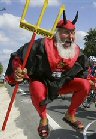
Today is also the birthday of Didi Senft, the legendary Tour de France Devil. Born at Reichenwalde in Germany in 1952, Didi began to earn his strange sort of fame in 1993, when he went to watch the Tour and decided to dress as the Devil - he says he was inspired to adopt the costume by a German cycling commentator, Herbert Watterot, who always called the final lap of a criterium race the "Red Devil's Lap." His costume may have been eye-catching, but standing in the crowd could never have been enough for Didi - soon, he began to run alongside the race, waving his pitchfork and getting noticed by the TV cameras. Fans, in general, loved it; riders were in many cases less impressed, some would throw their bidons at him.

However, in 1994 he was back, with a new and improved costume, and fans who recognised him from the previous year welcomed him back. He has been at every Tour since (except for 2012, when he underwent brain surgery; he returned in 2013 with a yellow costume to celebrate the Tour's 100th edition) and has become a fixture - some people watch the Tour not for the racing, but to look out for the Devil.

Britain's First Cycle Lane
On this day in 1934, the Queensland Times newpaper in Australia printed a short article on the opening of a new road in London. What was notable about the new road? Running alongside it for two-and-a-half miles was an innovation borrowed from Continental Europe - a segregated cycle lane, the first in Britain. Wide enough for two riders to pass in opposite directions, the lane cost £7000 to design and construct.
Cyclists in Britain had previously been opposed to cycle lanes, believing that they would become mandatory and thus cost cyclists their right to use the highway; however, more than 1,300 riders had been killed on the roads in the previous year, prompting Minister of Transport Leslie Hore-Belisha (he of the Belisha beacons, which can still be seen at zebra crossings in Britain to this day) to write "The challenge presented by the figures of cyclists killed and injured is so formidable that I would be guilty of dereliction of duty if I did not do something to try and protect them."

A little after the cycle lane was opened, surveyors spoke to cyclists using it and found that 80% of them were now in favour; within four years there were 120 miles of cycle lane in the country.

Other cyclists born on this day: Fridrihs Bošs (Russia, 1887, died 1950); Andrejs Apsītis (Latvia, 1888, died 1945); Jairo Díaz (Colombia, 1945); Michael Marx (Germany, 1960); George Corsar (Scotland, 1886); Franco Testa (Italy, 1938); Pedro Pablo Pérez (Cuba, 1977); Yuriy Krivtsov (Ukraine, 1979); Marcel Grifnée (Belgium, 1947); Józef Stefański (Poland, 1908, died 1997); Jo Geon-Haeng (South Korea, 1965); Jo Seong-Hwan (South Korea, 1943).

Thursday, 7 February 2013

Daily Cycling Facts 07.02.2013

Learco Guerra
Learco Guerra, who died on this day in 1963, started out as a footballer. However, he turned out not to be very good at it and so he decided to have a go at cycling instead. He turned out to be very good at that, earning himself the nickname "Locomotive" for his ability to keep on for kilometre after kilometre at high speed.

Born in Bagnolo san Vito on the 14th of October 1902, Guerra's football ambitions meant that he came to cycling unusually late when he was 26. It took him just a year to become National Champion in 1930, the same year he entered the Giro d'Italia for the first time and won two stages (8 and 11), coming 9th overall. Even more remarkably, he also entered the Tour de France for the first time, where he won three stages (2, 13 and 15), wore the maillot jaune for seven days and finished in 2nd place overall and retained his National title. He kept it again in 1931 and added the World Road Race Championship for good measure, having won another four stages in the Giro too. He wasn't World Champion in 1932 but remained National Champion, this time winning six Giro stages (1, 4, 6, 8, 9 and 13). In 1933, he took Stages 1, 3 and 5 at the Giro, then went back to the Tour where he won Stages 2, 6, 7 and 18, once again finishing 2nd overall, won Milan-San Remo and became National Champion for the fourth consecutive year.

Guerra's best year was 1934, when he won 13 major races including the Giro di Lombardia and ten stages at the Giro d'Italia (2, 3, 4, 5, 6, 9, 10, 11, 12 and 14) - more than enough for an overall win - and won the National Championship for the final time. He settled for 4th overall at the 1935 Giro, this time having to make do with Stages 3, 4, 7, 8 and 10, then had a quieter year in 1936 during which his only notable win was the  Giro della Provincia Milano in which he teamed up with Gino Bartali. His last Giro came a year later and he won Stage 9, polishing off his career in 1940 when he became National Track Stayer Champion.

Sadly, Guerra's enormous success was hijacked by the Italian Fascist government who used him as a heroic figurehead in propaganda. His own politics are not known, but most historians feel he was probably not a fascist himself - his popularity in the peloton, among cyclists of various nations and at a time when many were beginning to develop real suspicions and fear of what was taking place in Italy and Germany, may confirm this; as would his work after retiring as a cyclist when he became a team manager for, among several others, Charly Gaul, a rider who would have made one of the most unlikely fascists ever.

He died aged 60, having been diagnosed Parkinson's Disease some time previously.

Franco Ballerini
Franco Ballerini, who died on this day in 2010, first found fame as a cyclist before becoming a cycling team manager. Born in Florence, his greatest success came in the Classics - he won Paris-Roubaix, the single-day race so hard it's known as commonly by its nicknames "The Hell Of The North" and "A Sunday In Hell" as often as by its real name, on two occasions, first in 1995 and then again in 1998. He also won Paris-Brussels in 1990, the Giro della Romagna in 1991, the Omloop Het Nieuwsblad in 1995 and the Grand Prix de Wallonie in 1996.

Franco Ballerini, 1964-2010
(image credit: Eric Houdas CC BY-SA 3.0)
He was far less effective as a stage racer, finishing the Tour de France 115th overall in 1992 and 61st the following year, when he also took Stage 14 at the Giro d'Italia. He would win Stage 5 in the 1996 Tour of Austria, but that was as far as his stage race success went. He did far better as manager of the Italian team, training among others Mario Cippolini who holds the Giro record of 42 stage wins. He also managed Paolo Bettini, who would become known as the greatest Classics rider of his generation before retiring in 2008.

Ballerini loved rally racing as much as he loved cycling, and it was while participating in that sport that he met his untimely end when he was 45. He was acting as navigator for a driver named Alessandro Ciardi during a race at Larciano when the car went out of control and crashed, leaving him with the horrific injuries that caused his death a short while later.

Elia Viviani
Elia Viviani
Born in Isola della Scala, Italy on this day in 1989, Elia Viviani began to compete in cycling races both on road and track at the age of eight; for five years, he also played football and didn't decide to concentrate on cycling until he was thirteen. He first came to attention by winning the Juniors Criterium and Novices Road Race events at the European Youth Olympics in 2005, also coming second in the Novices National Road Race Championship that year. The following season he became European Junior Scratch Champion and was third in the Madison at the World Junior Championships, then in 2007 he won the Points race at the European Junior Championships and rode with the winning team in the Pursuit and Sprint events at the Junior Nationals. 2008 was his first year racing as in the Under-23 category; he won the U-23 European Scratch and Madison (with Tomas Alberio) Championship.

Viviani turned professional with Liquigas-Doimo in 2010, having proved himself an able sprinter on the road, and won stages at the Vuelta a Cuba and Tour of Turkey before taking victory at the Marco Pantani Memorial; then in his second professional season he performed well at the Tour Down Under, won the Omnium at the Manchester round of the World Track Cup,  won a stage at the Tour of Slovenia, two stages at the USA ProCycling Challenge, became U-23 European Points Champion and National Elite Madison Champion (with Davide Cimolai), then won a stage at the Tour of Beijing.

His first General Classification victory came in 2012 at the Giro della Provincia Di Reggio Calabria and he twice finished stages in second place at the Tour of Poland, performances that persuaded Liquigas managers to give him a place at his first Grand Tour, the Vuelta a Espana: he did very well indeed with fourth place on Stage 2, fifth place on Stage 5 and second place on Stages 7 and 21 - however, his finishes on the mountain stages were far lower and he ended the race in 128th place overall. Towards the end of the season he won another stage at the Tour of Beijing and came third in the overall Points competition, then returned to the track to become European Elite Points race Champion. He will continue to race for the same team - now renamed Cannondale, with the US-based manufacturer becoming main sponsor - in 2013.


Belgian Wim Arras, born today in 1964, was considered destined for great things after winning Paris-Brussels in 1987, also achieving podium finishes and stage wins in numerous other events. However, his career was cut short by a motorcycle accident in 1996.

The Devil
The Devil sometimes appears at other events, such as
the Koln Marathon in 2011.
Today is also the birthday of Didi Senft, the legendary Tour de France Devil. Born at Reichenwalde in Germany in 1952, Didi began to earn his strange sort of fame in 1993, when he went to watch the Tour and decided to dress as the Devil - he says he was inspired to adopt the costume by a German cycling commentator, Herbert Watterot, who always called the final lap of a criterium race the "Red Devil's Lap." His costume may have been eye-catching, but standing in the crowd could never have been enough for Didi - soon, he began to run alongside the race, waving his pitchfork and getting noticed by the TV cameras. Fans, in general, loved it; riders were in many cases less impressed, some would throw their bidons at him.

However, in 1994 he was back, with a new and improved costume, and fans who recognised him from the previous year welcomed him back. He has been at every Tour since (except for 2012, when he underwent brain surgery; he returned in 2013 with a yellow costume to celebrate the Tour's 100th edition) and has become a fixture - some people watch the Tour not for the racing, but to look out for the Devil.

Other cyclists born on this day: Fridrihs Bošs (Russia, 1887, died 1950); Andrejs Apsītis (Latvia, 1888, died 1945); Jairo Díaz (Colombia, 1945); Michael Marx (Germany, 1960); George Corsar (Scotland, 1886); Franco Testa (Italy, 1938); Pedro Pablo Pérez (Cuba, 1977); Yuriy Krivtsov (Ukraine, 1979); Marcel Grifnée (Belgium, 1947); Józef Stefański (Poland, 1908, died 1997); Jo Geon-Haeng (South Korea, 1965); Jo Seong-Hwan (South Korea, 1943).

Tuesday, 3 July 2012

The Devil misses the Tour

The Devil sometimes appears at other events, such as the
2011 Koln Marathon
Didi "The Devil" Senft - the 60-year-old German eccentric, inventor and devil who has haunted the roadsides of the Tour since the early 1990s - is not at the race this year after undergoing an operation to drain fluid from his brain.

Didi has become as much a part of the race as the riders themselves since he first appeared in 1993 and follows the Tour in a minivan sponsored by the LUK carparts company. While not liked by all the riders (one notable fan is Andy Scleck), Didi is almost universally popular among spectators and many people around the world tune it to race footage in order to try to spot him.

Get well soon, Didi.

Tuesday, 26 July 2011

What's with... The Tour Devil?

The Devil Rides Out!
Surer than awful weather, surer than Cav getting points docked for "irregular sprinting" and surer than high-speed crashes and broken collar bones, he's there every year - the Tour de France Devil. He's become such an iconic symbol of the Tour than there are people with no interest in the sport yet watch the Tour just to be able to catch an occasional glimpse of him.

But who is this Dark Prince of Sandals and Beards, also known as Tourteufel and El Diablo?

He is 60-year-old Didier "Didi" Senft and, when not haunting the roadsides of the Tour and Giro d'Italia, he lives in Storkow, Germany, where his time is spent inventing record-breaking bikes and guitars and being a professional eccentric.

Didi has been into cycling for many decades, having been an amateur club cyclist in East Germany. He dreamed of being selected to the national team but never made it - becoming a professional sportsman was one of the few ways of getting out of the GDR to see the rest of the world in those days and he wanted to travel, so it wasn't long after the Wall fell that he started travelling around Europe to experience racing. However, Didi is not the sort of personality who would ever be content with remaining just another face in the crowd: after visiting the Tour for the first time in 1992 he decided he'd do something to help liven up the long stretches when spectators are waiting for the peloton to arrive. He says that the devil persona came about due to East German commentators: "They always called the final kilometre of a criterium the Red Devil's Lap. I never saw a red devil, so I became one."

So that was that sorted. Now he purchased a miniscule camper van and, after customising it in his own unique fashion, he set off for the Tour.

A large, bearded German dressed in skin-tight leggings, a cloak and fully-fitted with horns on his head was always going to be noticed fairly quickly, but Didi is one of the world's natural entertainers - he ran up the road after the riders, waved his pitchfork and clowned around, delighting the crowds. Unlike some of the other "characters" who appear along the roads during the Tour, the Devil never has any controversial message he attempts to get across and takes great care to neither endanger anyone nor do anything that might disrupt the race - which meant that very soon he even had a few fans among the riders themselves, who have traditionally taken a rather dim view of any spectator who feels the need to get in the road with them.

Didi takes the role, which has become a strange sort of career, very seriously: he's out and about on the Tour route before some riders are even training, scouting out the perfect places to install himself and the enormous bikes he tows around with him. He says that he would like to appear within the final kilometre - the Red Devil's Lap - but is not able to do so for safety reasons: this is usually the most crowded part of the race and his giant bike would be a danger to spectators.

Once there he parks up and begins painting the road, a custom far older than the Devil but one that he has made very much his own, taking some 50 litres of white emulsion to every Tour. If you see pitchforks, giant wheels and pictures of bikes painted on the tarmac, you can be certain that he's lurking somewhere nearby. Unlike many road painters, he never includes the names of riders in his designs - he's most certainly not the sort to cast aspersions, as are those who leave messages suggesting that a rider they dislike is doping, and aims to entertain while supporting the sport he loves as a whole rather than limiting himself to backing individual competitors.

What we don't get to see on television is that Didi has become an important part of the Caravan, the cavalcade of trucks and promotional floats that travels around with the Tour and drives each stage a few hours before the race, distributing free gifts such as pens, posters, t-shirts, bidons and baseball caps. He leaps on and off the vehicles, chasing the gift-throwing girls who pretend to be afraid and run away, but not so fast that he can't catch them - at which point, he gets covered in lipstick. It goes without saying that the companies involved in the Caravan love it, because he attracts attention and provides more publicity than the vehicles alone ever could.

Unlike many of the "characters" who clown around at the
Tour, the Devil has many fans among the riders. Among
them is Andy Schleck, seen here awarding him a medal.
Of course, not everyone has such a well-developed sense of humour as Didi's. There are those who don't like him - some of the riders cross to the other side of the road to avoid him. However, being the rather nice sort of devil that he is, he doesn't chase those that he knows find him a nuisance and lets them get on with the race. The majority of the riders welcome him though - Andy Schleck, known as one of the nicest people in the sport, even awarded him a medal for his services to cycling. One group of people famous for their total lack of a sense of humour is the Swiss Police who, during the 2006 Tour de Suisse fined him, threatened him with prison and made him remove a pitchfork he'd painted on the road.

If you've ever been fortunate enough to follow the Tour, you'll know that although it's unique among the world's largest sports events in that it can be watched for free, doing so nevertheless becomes very expensive - there's the cost of more than 3000km-worth of fuel and the food you'll need along the way for a start. Fortunately for the Devil, his celebrity has grown so much that he now receives small payments from various companies that sponsor him, including the car transmission manufacturer LUK whose corporate logo can be seen on his costume and campervan. Other fans at the races donate money to him, as do those who visit his museum at Storkow. Although he still gets around in a camper far smaller than the enormous ones you see parked throughout the Alpine stages (some of them looking more like trains),  he's moved up in the world - it's now a shiny, sponsored Volkswagen with a picture of himself on the side.

The Royal Wedding rickshaw, complete with William,
Kate - and a baby.
When not doing his bit to keep the crowds happy, Didi can sometimes be found in person at his museum which is home to more than 120 of the bikes and other things he has designed and built, some of them earning him official world records. Among them are the world's smallest tridem (a bike for three people), the world's biggest bicycle, the world's tallest bicycle, the world's longest two-wheeled scooter (18.28m), the world's longest bike (38m with 76 rear wheels), the world's longest pedal car and the world's largest movable, playable guitar. He has also built a 12.4m rickshaw which seats the passenger more than 6m off the ground and a remarkable tricycle that he rode at soccer's European Cup championships with wheels made of 88 footballs. Last year, he built a bizarre rickshaw to commemorate Prince William and Kate Middleton's wedding, with a bike's front wheel, the back end of a Trabant car and a cardboard cut-out of the happy couple and a baby seated within.

So all in all, you can't really explain what's with the Tour Devil because he's far too odd for most to understand; but one thing's for sure - cycling would be far poorer without him. Long may his reign continue!


Tuesday, 19 July 2011

Tour de France: Stage 16 Preview

LATEST: A Tour official was found dead in a river near the finish line at Gap early this morning. An investigation has begun.

Following a much-needed rest day - involving such relaxing activities as transporting teams, bikes and the tons of equipment carried about France during the Tour over the 125km from Montpellier to Saint-Paul-Trois-Châteaux, no mean feat in itself - Stage 16 is aimed straight into the heart of the French Alps, considered by many riders and spectators to be the highlight of a Tour and the most likely location for the eventual victor to reveal himself. The parcours is highly representative of the next few days - starting at 99m above sea level, it begins to head skywards right from the start line and then continues to do, climbing all the way until it reaches the 1268m Col de Manse before plunging 524m in 11.5km to the finish at Gap. For those of us who take an interest in the sights and locations along the route of the Tour, this stage is of as much interest for its geology as its history and takes in a number of interesting features.

Saint-Paul-Trois-Châteaux, on the edge of the beautiful department of Drôme, is home to around 8200 people and acts as a stage town for the very first time today. Like the majority of towns in the region, recorded history begins with the Romans who named it Augusta Tricastrinorum, a Latinised version of Tricastin which was the name the Gallic tribes living here before the Romans arrived used. Saint-Paul was added at some point in the 4th Century and, later, Tricastinorum was mistranslated as "three castles," thus giving rise to the modern name. and the town's heraldic emblem featuring three castellated towers and a crown. The town was fortified in ancient times and remnants of the Roman walls can still be seen at some sites around the medieval town centre, which is clear on maps as a roughly circular shaped area inlcuding the catehdral, Notre-Dame de Saint-Paul-Trois-Chateaux which is today considered one of the finest examples of Provençal Romanesque architecture and is of particular interest to archaeologists for the large number of mason's marks still visible on its stonework. To the south is a small mountain rising to around 270m and offering excellent views of the region including towards the south-east-east and - or so I'm informed - cycling's holiest mountain Mont Ventoux.

Chances are that the stage will see an early breakaway, as has every stage thus far this year, but the first few attempts are probably prone to fail when inexperienced riders underestimate gradient leaving the start town and can't keep ahead while the peloton gathers momentum. Sooner or later, the gene pool will have been reduced, leaving only the more experienced super-domestiques attacking the peloton; at which point a breakaway has a chance of success - we'd expect it to build up a small gap and maintain it for a good part of the course today, at least until the halfway point. Their target will once again be the intermediate sprint, but since that doesn't come until three quarters of the way to Gap and it's uphill all the way, whether or not they can get there first is debatable. Since the stage follows a rest day, we think they probably will.

Château de Suze-la-Rousse
Leaving Saint-Paul-Trois-Chateaux, the D59 passes between more forested ridges as it heads south-east for 8km to Suze-la-Rousse. Standing on an outcrop at the north-western corner of the town is the remarkable château which, much modernised in the 16th Century, perfectly combines the aesthetic qualities of a medieval fortress with those of a fine Renaissance stately home. It now houses a university of wine and viticulture. Immediately to the west is the castle's park, known as La Garenne, which contains a 16th Century real tennis court and Neolithic remains, evidence of a local culture predating the castle by thousands of years. The view from here to Mont Ventoux is famous.

The road into Suze-la-Rousse isn't technical as it emerges from a plane-lined avenue and across a bridge, offering one of the best views of the chateau, but the negotiates a roundabout. Shortly after this, riders will cross the road before turning left onto the D94 which is straight and flat. Looking back - which the riders won't - this road provides a good opportunity to comprehend the sheer scale of the chateau just passed; while looking forward it's possible to try to comprehend the even more impressive scale of Ventoux, which looms above the horizon like the malevolent presence that it is - this the riders will do, and be thankful that they don't have to climb it this year. The road sweeps north-east via a simple junction and, 16km from the start, reaches Tulette. The road continues through the middle of the town, straight at first before a couple of right-hand bends that are sharp enough to cause problems if conditions are wet. It then heads east, where it's called the Avenue des Alpes, and past the enormous bottling plant (not far off 400m wide!) which has made Tulette wealthy. Having crossed another roundabout it enters Saint-Maurice-sur-Eygues, an important centre of wine making. Just to the south is the Drôme river - its course is wide as it splits into a number of rivulets flowing through the gorges cut into the rocks. Another large roundabout takes us out of town and onto another plane-lined avenue - still the D94 - north-east past the le Sagittaire leisure park.

34km from the start is a large junction leading south onto a bridge across the river, then onto the D539 which passes the large town of Nyons and follows the line of a ridge of hills past vineyards and woodland. Although the parcours doesn't pass through Nyons, it should be possible to see the 13th Century Tour Randonne, which is topped with an unusual tiered detail with a statue of Mary: the tower is believed to have originally been defensive - it certainly looks like it - but it was purchased in 1862 by a local pastor and converted into a chapel, this being the purpose it still serves. As we approach the eastern end of the town where ridges face on another across the river is the Pont Roman, a graceful single-arch bridge, still in use after a little over six centuries.

The road then becomes the D94 again and continues north-east, crossing the river before skirting Les Clots and following the banks to Aubres and its ruined castle, then makes a large inverted U  and travels east once more to Les Pilles which marks 42.5km travelled. Les Pilles is named after two rocks said to resemble pyramids. The road turns north, following a narrow strip of land between the ridge and the river, then north-east and after 8.5km reaches Sahune, the entry to the Gorges of Saint May, an area of great natural beauty, and the route twists around in all directions for the next 20km to follow their course.

Verclause is located 71km from the start, meaning that there are a further 91.5 to the finish line. A picturesque ruined tower, all that's left of the castle, stands on the rocks high above and a sort time after the peloton passes through the village the road becomes the D994, marking the point where they officially enter the Haute Alpes; the hills to the north becoming noticeably craggier as though to prove the point. As it approaches the village of Rosans (76km), the gradient becomes much steeper and soon reaches over 750m above sea level.


At a flatter section is Moydans, the location of the feeding station and the halfway point. This tiny village is home to just 50 people, so it's entirely possible that the entire population will be waiting on the short main street to see the Tour pass through. Soon, the terrain starts to rise again and by the time the riders pass south of Ribeyret they'll be around 820m up. After another 4.5km, they reach L'Épine in the Buëch Valley where an abbey building atop a small rise north of the village gives the impression of a miniature Glastonbury Tour, passing just to the south of the village. Montclus, at 81km, has the same population as  Moydans but packs them into a smaller physical area sandwiched between higher ground to the north and south. In the centre of the village is a ruined tower dating from the 11th Century and built to provide a look-out point so the locals could prepare for imminent raids by the bandits that in those days infested the area. In 1994, several houses in the village were damaged by a landslide. Just to the east of the village is a small but very beautiful waterfall which plunges down the cliff and through a culvert under to road, the a sort distance further on a sharp left then right-hand corner as the parcours travels over a bridge to the opposite side of the narrow valley.

3km from Montclus is Serres (left), apparently one of just five French towns with names that are palindromes (oh alright, that's not really relevant - but you never know when knowledge of this type might prove useful). Serres can guarantee a good turn-out of spectators because visitors to the Serres Jazz Festival, currently in full swing, will be looking for something to do during a one-day break from the party. If you happen to be in the area, you can see a programme by clicking this link and Klezmer Kaos (whom I've seen a couple of times) have the Cyclopunk Seal of Approval.

The road through Serres is straight and reasonably wide with no hazards other than a roundabout, which shouldn't cause problems, as it joins the D1075 clinging to the cliff alongside the river and heads out of town towards the north, crossing the river opposite a imposing 350m cliff. Soon, the route comes to a large roundabout by an airfield where it rejoins the D994 and heads north-east, passing by yet more gorges. It follows alongside a railway, soon reaching a large station at Veynes where the peloton will have to tackle two roundabouts in quick sucession. Veynes was a small and quiet town until the railway came, but has since become a centre for the development of solar energy. Until the 14th Century, it was home to a Jewish community of whom many worked in local tanneries (Jews in Medieval Europe were banned from working in many industries and had to find jobs in those that other people found distasteful - tanneries not being the most pleasant places in which to work). Sadly, they were exterminated during violent attacks that we would nowadays term pogroms after they were blamed for causing the plague - a common flaspoint for antisemitism at the time.

Today, Veynes is home to the intermediate sprint - organisers have found  quite a challenging stretch of road featuring a first roundabout and right-hand corner towards the end of the first thousand metres, another roundabout immediately after entering the second thousand metres and series of traffic calming devices for good measure, along with an upwards kick of about 24m towards the end. What happens here depends entirely on whether or not a breakaway has formed and if it's still going by this point - if it is, the top points will go to whoever is the fastest: Delaplace, Delage, perhaps Zandio or Uran are likely lead group members and would all be likely winners of the 20 points. If not, expect any of the fast sprinters who isn't too tired from getting here.

La Roche-des-Arnauds
A little way out of town the road turns dead east and enters a long and straight section, passing La Plaine before reaching La Roche-des-Arnauds where, in the middle of the town, it turns sharply right and heads off in another straight line to the south east. The road in and out has central reservations, but is at no point narrow enough to cause problems and, being so straight, will have no effect on riders' times no matter which way they go around them. At Saint-Andre, Berne and La Selle is a twisty section of road which connects the three hamlets in a long loop and from which there are excellent views across the large Gap valley.

5km further on is Gap itself, arrival being marked by a very large roundabout with four exits. The town is home to 45,000 people, making it the largest town in the Southern Alps and an important administrative centre. There are several theories attempting to explain the name with the most likely being that it was orginally named Vapincum by the Celts or pre-Celtic speakers of an Indo-European tongue, subsequently shortened to Vap and then modified by the Franks or Goths. The cathedral - Cathédrale Notre-Dame-et-Saint-Arnoux de Gap - is much younger than it at first looks, having been built between 1866 and 1905; the very successful neo-Gothic design making it appear to have stood since the Middle Ages, as did the genuine medieval cathedral it replaced and which itself stood on the spot of a Roman temple to Apollo. Gap hosts the finish line of the stage, but since only 139km have been covered so far there's obviously more riding to be done - and since the remainder includes the 1268m Col de Manse, quite a bit more.

The road into Gap features several obstacles including roundabouts and sharp bends which only require a little rain and a patch of spilled diesel to become deadly, especially to tired cyclists: the N85  through town, being a major urban route, is likely to be especially hazardous due to the buses which use it and the large number of trees depositing wet leaves on the tarmac during the current windy weather. There are excellent views across the town and valley as the road skirts the northern edge at an altitude of about 820m and a series of potentially hazardous switchbacks shortly before Les Bumats. Soon, the peloton turns off the N85 via a tight right-hander onto the D944 which leads up to and over the Category 2 Col, the summit rather disappointingly being dotted with farms and homes - this is not really one of the Haute-Alpes, but there'll be plenty of those in the coming days.

Just after the summit the parcours switches to the D14 which carries it back south towards La Rochette, a fast descent where the bravest riders - those willing to trust in their tyres whilst gravity drives their speed up and up - will do well, and possibly have the best chances of getting down in one piece, too: modern tyres are very good indeed and most crashes on wet roads are caused by braking rather than the tyres. It was near here in 2003 that Joseba Beloki, a rider with the ONCE team who had started his career with Euskaltel-Euskadi, crashed badly and broke his elbow, hip and wrist, forcing him to abandon the race and subsequently retire. Lance Armstrong had been right behind him at the time and, to avoid the crash, went for a spot of mountain biking across the field next to the road, rejoining the peloton on the other side; which has been featured in just about every "Greatest Tour de France Moments" compilation produced ever since. Beloki later returned to professional racing with BBox for a short time before a row over the drugs used to treat his asthma saw him depart for Saunier Duval-Prodir and then Astana, becoming embroiled in the notorious Puerto doping scandal which left Astana unable to compete in the 2006 Tour and finding himself without a team in 2007 when he retired for a second time.

A short way on from La Rochette is a very sharp right-hand bend onto the D314 which, as today is likely to be wet and the riders are going to be travelling at high speed on the descent will be perhaps one of the most dangerous points on the entire stage; and if that one claims no victims there's an even sharper left-hand bend coming up, followed by a right-hand bend only a little less challenging - in both cases, fields immediately due to the north and a few metres higher may see the rain wash mud onto the road, making the surface even more slippery.

Just outside Gap is Domaine de Charance is
dedicated to the study and conservation of
alpine plants.
Two switchbacks a few kilometres on in a wooded section are likely to be every bit - if not even more - of a hazard and the junction onto the N94 at Pont Sarrazin will come as a great relief to the riders at the end of a hairy descent, but it too is not without its dangers - a large lorry depot just outside Gap is another spot where diesel spills, as invisible as they are lethal to both cyclists and motorcyclist, are very likely and there's a big roundabout just next to a carpark as the road enters the town. The final kilometre runs along the straight Avenue de Marechal Foch, making this another finish ideal for sprinters - assuming can make it to the front of the peloton and have any energy left after the climb.

Predictions: Cadel Evans is obvious contender, a great climber and fast all-rounder who is looking to be a far more dangerous challenger to the Schlecks than Contador in the hills this year - and he's very fast on the flat too, which could see him defeat the Col and then light the afterburners for a blast back down into Gap. Sylvain Chavenel is also very fast, but he seems to have a particular talent for maintaining high speed in heavy rain when others reduce speed to cope with the slippery conditions and become demoralised. Then there's always the possibility that a chancer  will try his luck, like Jelle Vanendert did the other day: don't forget that long, straight final sprint to the finish at Gap's town centre park - any sprinter who can make it in good shape up, over and down Col de Manse will have a huge advantage over the climbers here.

Weather: Easily summed up today - horrible. There's a possibility that the final loop up and over the Col de Manse could even be cancelled as a result. St.-Paul-Trois-Châteaux is already looking pretty grim and it's raining in Saint-Maurice-sur-Eygues at the time of writing. It's apparently not raining at the present in Aubres, but heavy showers are forecast throughout the day. Verclause looks set to be much the same, but wind gusting at up to 27kmph from the east is going to mean a very unpleasant ride as it drives the rain straight into the faces of the riders as they battle their way into it. Moydans and Serres are no better, but conditions could become even worse around Veynes where a north-easterly wind is touching 37kmph at times - more than enough to cause problems and blow riders across the road. The fastest winds predicted today for Gap are a slightly more manageable 22kmph, but heavy rain is forecast throughout the day. It's not going to be a pleasant ride at all.

DEVIL WATCH: The Devil usually shows up un the upward slope of a climb approaching the finish, so Col de Manse is the most obvious place for him today. On the other hand, there are quite a few very pretty locations along the way - Moydans, situated on a small climb, is also a possibility.

Wednesday, 6 July 2011

Tour de France: Stage 5 Preview

It's funny that the Festival des Vieilles Charrues, which takes place annually in Brittany, isn't better known over here in Blighty. It's not that far across the water and, among many attractions, offered Snoop Dogg, Lou Reed, the Chemical Brothers, Barrington Levy, Kaiser Chiefs and the extremely talented Polly Jean Harvey - sufficient to attract no less than 240,000 fans which is significantly more than Glastonbury. It being France, the food was probably better than the sweaty lentil burgers you get at British festivals, too. I bet the toilets were grim though.

Stage profile for today: not that hilly but not that flat either.
Anyway, the festival takes place just outside Carhaix in the Finistère department of Brittany, a part of France with more than a few similarities to the far west of Cornwall which lies not too far to the north and with which the Bretons have maintained trade and cultural links since prehistoric times, which also happens to host the start of today's Stage 5 of the Tour de France. Yesterday saw the first hills of the race, tiny ones in comparison to what's coming when the riders reach the Massif Central and virtually non-existent compared to the real biggies when they get to the Haute Pyrenees and Alps admittedly, but hills they definitely were; that this was the case been made plain by Alberto Contador, a man who gains altitude like a BAC Lightning, choosing it as the stage upon which he was going to claw back some of the time lost during a decidedly unfortunate start to the Tour. That he did, too, coming a very close second place and giving stage winner Cadel Evans a scare. Today is more of the same: the hills are little ones, rising to no more than 281m at Côte de Gurunhuel - which despite lack of altitude is a Category 4, so it won't be without challenge - but there are plenty of them.
It's a well-known fact that the Bretons
like their menhirs.

As is always the case, the parcours takes plenty of French sights and this part of the world is particularly interesting for those who like to look at big bits of stone stuck into the ground for unknown purposes - the road passes by the unusual limestone (most are granite) menhir known as Min ar Groac'h which is worth looking out for at the side of the D54 road leading past Plourac'h. The distinctly-not-very-French placenames, incidentally, arise from the fact that the Breton language Brezhoneg is a Brythonic Celtic language closely related to Welsh and Cornish. The first climb of any note, albeit uncategorised, comes just past the 25km point at Callac where there is a picturesque ruined church (those ancient Celts who erected Min ar Groac'h might take some pleasure were they still around to see that their menhirs are in much better shape overall than the monuments of this newly-come Christianity) and a Gallo-Roman bridge. A few kilometres further north-west is the uncommonly attractive village of Plougonver, home to around 700 people and the location of beautiful granite houses surrounding the church. The village is spread out along the road, meaning that there are fields literally a stone's throw from the centre which makes it feel even smaller than it is and the locals have taken great care to retain the beauty and character of the place.

There's no chance for the riders to stop for a spot of sight-seeing though because they'll soon be upon that Category 4 climb which comes at the 45km point. The cruise downhill - longer than the ascent, look out for the three towers at Guingamp along the way, all that remain of the three castles which once stood in the town  - will be a welcome chance to recharge the batteries because it's not much further to the start of the intermediate sprint at Goudelin, a bit of  pity because the cameras will be concentrating on what Mark Cavendish is up to (winning it, we suspect, as any early breakaways who fancy getting the points like they have done in the last stages may find themselves pulled back in on Côte de Gurunhuel) rather than letting us see the Chapelle Notre Dame de L'Isle which has some Flamboyant (a 14th/15th Century architectural style, known as Decorated in England) ogee arch doorways and is thus of interest if you happen to find that sort of stuff interesting. However, this is a bike race, so the cameras are doing what they should.

Bet you'd like to live here - but you don't. Er - unless you do, that is, in which case you probably consider yourself rather fortunate to live in Guingamp.
Shortly afterwards is the feeding station at Pludual, site of le Manoir de Périmorvan which is either ruined or still inhabited, depending on which source you choose to believe. No doubt today's footage shall reveal the truth because if there's one thing the camera operators in the helicopters like, it's chateaux. It's then just a little way further until the route swings to the east and joins the D786 at Plouha, following the coastline for the remainder of the stage. This is an exceptionally beautiful region even by French standards with long, sandy beaches and dramatic rocks which must have taken more than their fair share of ships that sought shelter from Atlantic storms along this part of the coast. About a kilometre off the coast are the tiny Iles-Saint-Quay, which are even tidier at high tide when they become a series of rocky outcrops, the largest and driest of which have tiny cottages perched on top. You seriously do not want to miss this bit.

St.-Brieuc cathedral looks as much like Nosferatu's
castle as the home of saintly relics.

There are a few smallish climbs, as would be expected from a rocky coast, leading on to Saint-Brieuc which is named after a medieval Welsh monk who brought Christianity to the area in the 6th Century and founder of the local cathedral which today houses some of his relics. Two years ago, large quantities of algae washed up on the beach here and began to rot, emitting gases so noxious that they killed a couple of dogs and a horse (and, indirectly, the driver of a truck carrying a load of the algae who was overcome and crashed). Some kilometres further on is Pleneuf val Andre, a built-up resort with one of the most beautiful beaches anywhere in Northern Europe and, just off the coast, the rocky islet of Le Verdelet which, if the weather continues being windy (and it looks like it will) promises dramatic scenes. There's an S-shaped causeway leading to the islet which, after the fun on Passage du Gois a few days ago, the riders will be glad they're not required to ride.

Erquy. Devil country.

Next up is more winding coastal roads, taking in Erquy which is situated around a picturesque bay and has a very flirtatious-looking mermaid on its coat of arms.

DEVIL WATCH: Being located around 12km from the finish with small hills and wooded sections, Erquy looks the ideal place to spot German devils as well as flirty mermaids. We reckon he'll make an appearance just as the Tour leaves the town for the headland seen on the right of the photo. On the other hand, for sheer dramatic effect he might show up somewhere on Cap Fréhel, though as the location of the finish it's not natural Devil country.

Cap Fréhel looks to be the highlight of the stage. Unusually, it's not a reasonably-sized town as is typical of Tour finishes but a windswept, rocky peninsula with two lighthouses which is well worth looking up on Google Earth ( 48°41'13.07"N  2°19'3.51"W). The helicopters are going to get some stunning footage of the cliffs here and it may well prove to be the most beautiful stage finish of the 2011 Tour.

Weather - Local weather looks set to be much the same as yesterday. The wind is 30kmph in Carhaix right now, and though it's not raining light-to-moderate rain is forecast throughout Brittany by early afternoon. The wind should drop slightly, but crosswinds along the coastal sections will liven things up a bit. However, it looks like the wind is pretty much settled into blowing from the south west, which means for a lot of the route it's going to be a tailwind.

Big, strong and fast is what you need to
be to win a stage like this one. That's
your cue, Thundergod.

Predictions: Alberto Contador made an heroic effort to claw his way up the standings yesterday and finished to close to winner Cadel Evans that it's wasn't immediately apparent who had won. He's now in 41st overall and may want to improve that further today - if he does then, well, he's Contador and if he avoids accidents he'll probably be in at least the top three. This could be a good stage for Thor Hushovd too, since he's no doubt rather enjoying his time in the yellow jersey and would probably like to wear it for a bit longer. He may be better known as a sprinter, but while this stage does have climbs it's not really one for the grimpeurs and a sprinter with his physical strength could do well here. Mark Cavendish is the most likely lad for the intermediate sprint. He's not won one yet this year, but over the last couple of days he's left nobody in any doubt that he'll win one before too long and he does have a habit of beginning to do so on the fifth day in stage races. Frank Schleck will do well, we think - in fact, we wouldn't be too surprised if he's moved up to second place overall by the end of the day. The Schlecks seem to have learned how to ride fast on the flat over the winter which when combined with their phenomenal ability in the hills makes them even more of a force to be reckoned with than they were last year, so Andy might do alright for himself too - but he'll be more interested in saving himself for the proper climbs, the first of which comes on Saturday, when even he will need to work hard to keep up with Contador. We also think that today might be the day we see Bradley Wiggins on the podium. We know he can climb, we know he can sprint and we know he can keep going for as long as it takes, all things necessary today, and he's let it be known that he's "feeling strong" this morning. British fingers should be kept crossed.

Sunday, 3 July 2011

Tour de France: Stage 2 Preview

Yesterday's Stage 1 was a total crash-fest with rider after rider going down, which means the team masseurs will have been working hard all evening soothing aching muscles in preparation for the rigours of today's team time trial which, being almost entirely flat over its 23km course and not especially technical, is likely to encourage pedal-to-the-metal extreme high speed.

No signs of the climbs which will, ultimately, decide the 2011 Tour in today's team time trial stage.
The race remains in the Vendee region with the start and finish in Les Essarts, a town noted for its 11th Century castle (there's some disagreement on the age - Vendee tourist info says 11th C., the Tour de France website says 12th C.) and St. Peter's Church which has every appearance of a cathedral picked up in a city and then set down again in this town of a little over 5000 people and which the Tour website insists is built on the site of a 12th C. Roman church, despite the fact that the Western Roman Empire had come to an end some seven centuries prior to the 12th C. That aside, Les Essarts is one of those quintessentially French towns, popular with British visitors seeking an authentic French experience, and residents have always provided a very warm and enthusiastic welcome for the Tour's numerous visits so they'll be really pushing the boat out in celebration today when their town serves as both start and finish.

The 11th C. Old Chateau in Les Essarts.

From Les Essarts, the road is almost poker-straight to Boulogne, an attractive small town 8.5km from the starting line which, though claiming to have a "modest" economy on its website, has won a number of awards for its public flower beds. All French towns consider it a very great honour to be visited by le Tour, so a town known for its flowers in one of the most cycling-obsessed parts of the country is likely to be colourful to say the very least. Next comes a road that, but for one sweeping bend, is perfectly straight and made for helicopter footage as the teams build up to full speed, then a sharp left-hander taking them through the tiny Ste. Melanie des Gats as they turn back towards Les Essarts. Travelling along the D98 road, they'll pass patchwork fields and a small wooded section before coming to La Merlatière, a quiet country town with around 800 residents. The road then remains straight, passing La Maison Neuve des landes, site of a new village which when complete will feature 650 homes,  until one final sweeping bend heads back into Les Essarts with several corners requiring concentration as the riders make their way at high speed through town to the finish line.

Team time trials have a habit of changing General Classification standings dramatically, because it's all about the team rather than the individual. In this instance, the time awarded to each team will be that recorded as the fifth rider crosses the line and so they must work together, swapping places and slipstreaming according to each rider's strength and specialities, in order to maintain maximum efficiency. Enormous amounts of time are spent and data examined in pursuit of this goal, but cycling is not an exact science - it only takes one rider to be having a slightly off day and the very best laid plans can begin to crumble, causing riders and team bosses to have to think fast and on the fly if the team is to perform as well as possible.

With well-rehearsed tactics and highly specialised bikes, team time trials encourage high speeds.
Team Sky have stated that doing well in the time trial is one of their main objectives in this Tour, and with Bradley Wiggins and Geraint Thomas - both excellent time trialists - on the squad they can be expected to record an impressive time. HTC-Highroad, Garmin and RadioShack will also likely put on an impressive display as each team has some riders who excel int his sort of competition: TeJay van Garderen, David Millar and Dimitry Muravyev are all names that spring to mind. LeopardTrek are a team dominated by the big name mountain specialists Andy and Frank Schleck but it would be a serious mistake to underestimate them today because they have a fearsome weapon in the shape of Fabian Cancellara, considered by many to be the finest time trialist in the world today and who is more than capable of getting his team across the line with an impressive time.

When it gets down to it, we think today is going to be all about Sky and LeopardTrek, but while we're hoping for the British team to win we really wouldn't want to put a bet on it.

Local weather looks set to be very warm by the time the racing starts with maximum temperatures up to around 26 degrees celsius. Wind speed should vary with gusts between 19 and 30kmph - the parcours is described as largely sheltered, but crosswinds may cause problems in some sections.


Devil Watch: that wooded bit just before La Merlatière may prove a likely spot - in general, the Devil prefers a climb near the finish but with the total lack of hills today he could opt for tree cover instead. Look out for his trademark trident symbols painted on the road, an indicator that he's haunting the roadside somewhere nearby.