Showing posts with label racer. Show all posts

Friday, 16 May 2014

Daily Cycling Facts 16.05.2014

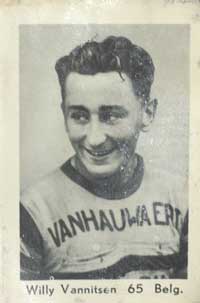
The 25th edition of La Flèche Wallonne took place on this day in 1961, running from Liège to Charleroi for a second consecutive year. However, the parcours had been altered and as such was 15km shorter at 193km - the shortest in the 76-year history of the event. The winner was Willy Vannitsen who won more than 110 races during his 13 professional years, including Stage 1 at the 1958 Giro d'Italia and Stages 10 and 15 at the 1962 Tour de France, yet is virtually forgotten outside his native Belgium.

Liège-Bastogne-Liège, the oldest and - according to some - greatest Classic of them all took place on this day in 1909. Eugène Charlier was the first over the line, but when officials discovered he hadn't finished the race on the same bike he started with his victory was disallowed - rather than being disqualified, as some sources claim, his time was recorded as being the same as that of Victor Fastre (and the next seven men, this being the first time that the race had ended with a bunch sprint) and he was relegated to second place. In third place was Paul Deman, winner four years later of the Ronde van Vlaanderen and then Paris-Roubaix in 1920 and Paris-Tours in 1923.

Alfredo Binda
The Giro d'Italia began on this day seven times - 1925, 1936, 1959, 1969, 1974, 1985 and 1998. The 1925 edition started and ended in Milan, with twelve stages covering a total of 3,520km. It is remembered - by those few people fortunate to have seen it and still be with us - as one of the most exciting ever due to an epic battle between Costante Girardengo, who fought long and hard through the mountains and won five stages, and Alfredo Binda who matched every attack he made to take the race lead from him and keep it for the final eight stages to win by 4'58".

1936 covered 3,745km in 19 stages, though Stages 15 and 17 were split - 15a was a short road stage, 15b an individual time trial, 17a and 17b were short road stages. Gino Bartali, who had won the Mountains classification the previous year, returned and performed even better to win the Mountains and his first General Classification, leading the race through the final twelve stages and winning two of them. Olimpio Bizzi won Stage 6 at the age of 18 years and 299 days, making him the youngest Giro stage winner ever.

Charly Gaul
1959 was made up if 22 stages and 3,657km - another epic year in which Luxembourg's Charly Gaul once again proved himself unbeatable in the mountains (or, as many will point out, proved himself capable of consuming larger quantities of la bomba), driving hard over the snowy peaks and continuing to push himself when others had exhausted themselves. Gaul was almost as good in a time trial as he was in the climbs, but he wasn't quite as good as Jacques Anquetil who took a 1'30" lead after Stage 2, then proceeded to slowly grind down his opponent's advantage until the race leadership passed to him in Stage 15. Going into Stage 20, the Frenchman still had the lead and many believed the race was as good as his. Then, in Stage 21, Gaul crushed him. Pushing so hard over three challenging mountain that nobody could get near him, he won by 9'48" and took back the leadership. Rolf Graf won the final stage, but Ancquetil may as well have not bothered - bettering what Gaul had done was far beyond even his capabilities.

1969 covered 3,851.3km in 22 stages and would be one of the most controversial editions ever due to a sample provided during Stage 16 by Eddy Merckx, found to be positive for N-ethyl-3-phenyl-norbornan-2-amine, a stimulant prescribed under the name Reactivan and still used, though rarely, in medicine today. For reasons that remain unknown, news of the sample and the rider's expulsion from the race was supplied to the press before he and his team management were notified and when he revealed that he had been offered money to throw the race by an un-named Italian rider the day before, suspicions that something nefarious was going on began to pick up speed. Prince Albert of Belgium sent his own aeroplane to bring him home and the government got involved, demanding an investigation from the Italian Foreign Minister. The Italian Federation continued to insist it had acted correctly and, while Merckx was subsequently given the go ahead to ride in that year's Tour de France, which he won, the official reason for his Giro expulsion has never been retracted. Many believe that the Belgian rider would have won but, with him out of the way, Felice Gimondi dominated the remainder of the race and took the overall General Classification. 43 years later, Merckx still says that the stage was such an easy one that he had no reason to resort to cheating, as does appear to be the case when we take his abilities into account, and to this day he insists he is innocent. So does the official who was in charge of the positive sample.

From left to right: Hinault, Maertens, Merckx and de Vlaeminck
(unknown copyright)
In 1974, Merckx won for the fifth time after 22 stages and 4,001km. While he led from Stage 14 to the end, it was noticeable at several points during the race, especially when Jose-Manuel Fuente and Gianbattista Baronchelli got into a duel in Stage 20 and raised the pace so high that Merckx nearly exhausted himself in his attempts to keep the leadership (in fact, Baronchelli was "leader on the road" for a while during the stage), that his reign was beginning to crumble. He would win the Tour as well that year, becoming for the fourth time one of the few riders to have won two Grand Tours in a season.

1985 came during the reign of the man commonly considered the second greatest cyclist after Merckx, Bernard Hinault who won for a third time. Taking third place after the 22 stages and 3,998km was Greg Lemond, who would slay the Badger the following year when he became the first American to win the Tour de France. When Hinault won the Tour later in the year, he won two Grand Tours in a season for the third time. Strangely, when the Giro next started on this date in 1998, winner Marco Pantani took the first step in adding his name to the list too because he also won the Tour that year. 1998 covered 3,868km in 22 stages.

Simon Gerrans
Simon Gerrans, born in Melbourne on this day in 1980, took up cycling after injuring his knee during childhood; the sport having been recommended to him by his neighbour, who was a reasonably successful rider himself - Phil Anderson, the first non-European to wear the maillot jaune at the Tour de France. It soon turned out that he wasn't bad at it either and he was awarded a scholarship at the Australian Institute of Sport, where he began to develop into a world-class road racer.

Simon Gerrans
(image credit: GreenEDGE)
Gerrans' first major success was the Under-23 title at the National Championships of 2002, where he also took 5th in the Elite race. The big European teams were not slow in taking note and in 2003 he was invited to join Carvalhelhos-Boavista as a trainee after spending a short while with the Norwegian team Ringerike, then a year later AG2R Prévoyance with whom he turned professional in 2005 and entered the Tour de France for the first time, surprising many by coming third in Stage 17 and leaving no doubt that he was a new talent - one that could very easily have been ended in February the next year with a crash at the GP d'Ouverture la Marseillaise which left him with pins in his collarbone and shoulder as well as several stitches to repair flesh wounds to his head. He recovered quickly and rode his second Tour that year, improving his General Classification result from 126th to 79th, then dropped to 94th in 2007.

In 2008, having moved on to Crédit Agricole, he won Stage 15 after sprinting to the finish without challenge from the other surviving two riders of a four-man break that had escaped early in the stage and managed to stay out in front. The next year he joined the legendary Cervelo Test Team, but managers mystified fans by failing to pick him for the Tour squad. However, he did go to the Giro d'Italia, where he won Stage 14 (Cervelo's first Grand Tour stage win), and the Vuelta a Espana where he won Stage 10; thus becoming the first Australian rider to have won a stage at all three Grand Tours. 2010 saw him depart for the new British team Sky, with whom he went back to the Tour. Another crash ended his chances in Stage 8 and left him with a broken arm. He stayed with Sky through 2011 and began to show promise as a Classics rider, taking third at the Amstel Gold, second at the Waalse Pijl and 12th at Liège-Bastogne-Liège, then third for Stage 2 at the Tour.

In 2011, it was announced that a new team, GreenEDGE, was being put together and stood a very good chance of being the first Australian team to receive a ProTour licence from the UCI. Gerrans was invited join and did so - which, in 2012, looked to have been a very wise decision. With them, he became National Champion for the first time, won a second Tour Down Under and then added the highlight of his career so far - victory at the legendary Milan-San Remo Monument when he beat Fabian Cancellara. The following year, Gerrans won stages at the Tour Down Under, Volta a Catalunya and Tour of the Basque Country before going to the Tour de France, where he achieved another career highlight by winning Stage 3 and then the Stage 4 team time trial. In 2014, he became National Road Race Champion and won Stage 1 and the overall General Classification and Points competition at the Tour Down Under, then enjoyed more Classic s success with a victory at Liège-Bastogne-Liège.

Matthias Kessler
The German rider Matthias Kessler, born in Nuremburg on this day in 1979, was little known outside his own nation until 2000 when he turned professional with Deutsche Telekom. In 2001 he finished in the top 5 for two stages at the Giro d'Italia but remained little known - until he was widely proclaimed an outside favourite for the Classics in 2003 on the strength of 6th place at Liège-Bastogne-Liège in 2002 and soon caught the public's attention for his habit of unzipping his jersey and deliberately ripping his undershirt to keep cool. He finished the Amstel Gold Race in 5th place in 2003, then La Flèche Wallonne in 3rd a year later.

Unfortunately, what could have been a great career was marred by bad luck and doping. In the 2004 Tour de France he was left in agony after a bad crash and, while he finished the stage, didn't start the next day. In 2007, he provided a sample that was shown to contain unusually high levels of testosterone; leading to his dismissal from Astana a short while later. Things began to fall apart from that point on and he experienced difficulty in finding a new contract once his two-year ban came to an end. In 2010, while on a training ride in Algaida, Mallorca, he accidentally collided with a cat. The resulting crash left him with serious head injuries., ending his career.

Other cyclists born on this day: Roger de Beukelaer (Belgium, 1951); Roberts Plūme (Latvia, 1897, died 1956); Im Sang-Jo (South Korea, 1930); Pål Henning Hansen (Norway, 1953); Juan Reyes (Cuba, 1944); Wilhelm Rabe (Germany, 1876); Antonio Hernández (Mexico, 1951); Lennie Kristensen (Denmark, 1968); Gustavo Guglielmone (Argentina, 1971).

Tuesday, 13 May 2014

Daily Cycling Facts 13.05.2014

Stefano Garzelli
(image credit: Sebastián García CC BY-SA 3.0)
The Giro d'Italia started on this date five times - 1909 (see below), 1981, 1982, 1995 and 2000. In 1981, the race consisted of 22 stages and covered 3,895km. The winner was Giovanni Battaglin who had also won the amateur version of the race nine years earlier and would go on to win the Vuelta a Espana five months later, one of only three men to have won both races in a single season. The 1982 edition was again 22 stages, but it had grown to 4,010.5km. Bernard Hinault won, then won the Tour de France - the Giro/Tour double being considered a more impressive achievement than the Giro/Vuelta though seven men have achieved it, three of them twice (Hinault became one of them in 1985) and one three times (that, as tends to be the case with unique road racing achievements, being Eddy Merckx).

By 1995, the race had shrunk down to 3,736km but retained the 22 stage format. Marco Pantani had been a favourite but was kept away by injury, which left the unusual spectacle of sprinter and a climber battling one another for victory: Mario Cipollini was the sprinter and Tony Rominger was the climber, and they fought one another tooth and nail but on different stages all the way to the end. In the end, Rominger's secondary ability in the time trials stood him in good stead and he won the race. In 2000 there were 21 stages and a prologue, adding up to 3,676km in total. Stefano Garzelli won with 98h30'14".

The First Giro d'Italia
Luigi Ganna, photographed
shortly after finishing Stage 8
at the first Giro d'Italia
1909 was the very first edition of the Giro d'Italia. Organised like most races of the day to advertise a newspaper (La Gazzetta dello Sport on this case; which like L'Auto, the paper that organised the Tour de France, wanted to out-sell and ideally completely crush a rival title - the difference being that whereas L'Auto's rival Le Vélo was dead and buried within a year of the first Tour, Corriere della Sera sells around 220,000 more copies each day than La Gazzetta.

The race covered 2,445km over eight stages which, despite the daunting prospect of stages an average of 306km in length (the longest was in fact 397km, Stage 1), makes it the shortest edition ever held. Stage racing was a new concept when the Tour started in 1903 and as a result only 60 riders took part - and then only because director Henri Desgrange halved the entry fee and increase the prizes - but six years later the idea was both established and popular with a number of smaller events having sprung up in the intervening years (sadly, none have survived. The Volta Ciclista a Catalunya, first run in 1911, is the world's third oldest stage race), so 123 Italians and four Frenchmen showed up at the start line. Another similarity with the Tour was that the results were decided on points in early editions, rather than on overall elapsed time as is the case today, with the lowest number of points getting the win. Luigi Ganna, born in Induno Olana in 1883, was declared victor with 25 - had it have been decided in the modern manner, his time of 89h48'14" would have seen Giovanni Rossignoli (third place with 40 points) take the honour.

The race started and finished in Milan, the riders setting off on Stage 1 at 02:53 in the morning. Ganna's prize was 5,325 lira, while La Gazzetta editor and race director Eugenio Costamagna was paid the princely sum of 150 lira. La Gazzetta, incidentally, was and still is printed on pink paper - which is why the race leader's jersey, known as the maglia rosa and first adopted in 1931, is pink; just as the Tour de France's maillot jaune is yellow to reflect the yellow paper used by L'Auto.

Marianne Vos - very possibly the greatest
cyclist in the history of the sport
(image credit: Maarten Thys CC BY 3.0)
Marianne Vos
If you've been reading these Daily Cycling Facts and wondering, as I did while writing them, why it is that an apparently smaller number of notable professional professional cyclists were born in May than any other month, here's the reason: when Marianne Vos was born on this day in 1987, she was given the entire month's-worth of talent for several years in either direction.

A native of 's-Hertogenbosch in the Netherlands, Vos' father and brother were both keen cyclists and, when she was five, she decided that she'd like to have a go too. Her first bike was too big for her, but even then she refused to give up. By the time she was six she was out training two nights a week. A few years later, she was taken to see the Alpe d'Huez stage of the Tour de France and spent much of her time hanging around the hotels to meet riders - it's tempting to wonder any of them remember the little Dutch girl who asked them for their autograph, now that her career has eclipsed all of theirs. In fact, and with the arguable exception of Eddy Merckx, Vos has now eclipsed all those who came before her; she is quite simply a phenomenal athlete and very welcome to younger fans who missed out on seeing the greats of days gone by, riders such as Hinault, Ancquetil, Burton, Bartali, Coppi and, of course, Merckx himself.

Vos has won all of the most prestigious races in women's road cycling including three World Road Race Championships (2004 Junior Championships, 2006 and 2012 Elite Championships, two European Championships, six National Championships and an Olympic Road Race gold medal in 2012. In addition, she has won two National Time Trial championships (despite claiming not to be very good at time trials), more than 70 stages, 18 criteriums and 30 general classifications. By her 27th birthday, on this day in 2014, her total number of victories in road racing, cyclo cross, track and mountain biking added up to 307. Merckx clocked up 525 by the time he retired shortly before his 33rd birthday: the great Belgian has been asked for his thoughts on her by several journalists and makes it clear that he admires her enormously, perhaps even expecting her to beat his tally sooner or later.

Vos is also known for being one of the most personable professional cyclists around. Highly intelligent and articulate, she regularly talks to fans on Twitter and is as popular among the riders who race against her as she is with her supporters. If you don't already follow women's cycling, Vos is one of many reasons to start doing so - all indications suggest that we have not seen her like in professional cycling before, one who is limited not by her own abilities but by the number of races available to her.

Johnny Hoogerland 
Johnny Hoogerland
(image credit: Thomas Ducroquet
CC BY-SA 3.0)
Born in Yerseke, Netherlands on this day in 1983, Johnny Hoogerland became one of the stars of the 2011 Tour de France for his repeated attacks, five days in the polka dot jersey as leader of the King of the Mountains classification and a horrific crash that could very easily have ended his career.

Nicknamed The Bull of Beveland due to a large tattoo depicting a bull on his arm, Hoogerland came to international attention when he won the Junior Tour of Flanders in 2001 and then followed it up with numerous wins over the next few years, including the tough GP Briek Schotte - a race designed to reveal those riders who can be aid to be Flandriens, the toughest cyclists of them all, of which Schotte is considered to be the definitive example.

Hoogerland - a Flandrien to the core
(unknown copyright, believed public domain due to widespread use)
It was at the 2011 Tour that Hoogerland proved just how tough he is. During Stage 9, as he cycled alongside Sky's Juan Antonio Flecha, an inattentive driver in France Télévisions official car realised he was about to hit a tree. Rather than slamming on the car's brakes - as all drivers at the Tour are trained to do - he swerved right, hitting the two riders. Flecha hit the road hard and received extensive bruising, but Hoogerland was catapulted into a barbed wire fence hard enough to smash a wooden fence post and become entangled in the wire, which tore his shorts to shreds and left him with deep lacerations to his buttocks and legs.

Both men got back on their bikes and finished the stage. Organisers extended the maximum permitted time so that they could do without being disqualified, then jointly awarded them what must have been the most-deserved Combativity Award for many years. Afterwards, Hoogerland was given 33 stitches.

Peter Longbottom
Peter Longbottom, born in Huddersfield on this day in 1959, was one of those cyclists whom were there any justice in this world would have been a household name. Respected among cyclists for his superb tactical mind, he was for many years in high demand among Tour of Britain teams for his ability to re-organise a team "on the road" according to rider performance, terrain, weather, opponents and a host of variable factors; frequently getting it correct and driving his team mates on to victory even when aware that he himself could not win. His skills saw him ride with Chris Boardman, assisting him at the Commonwealth Games, yet he chose never to turn professional and worked a full-time job even during the racing season.

Longbottom retired from competition in 1996 and spent the remaining two years of his life encouraging young people to take up the sport. On the 10th of February 1998, he was hit by a car on the A64 near York, the impact throwing him onto the opposite carriageway where eye-witnesses say he was hit by several vehicles


Gerrit de Vries, born in Oldeberkoop, Netherlands on this day in 1967 (and, so far as we can tell, no relation to Marijn de Vries of AA Drink-Leontien.nl) shared victory in the 1986 Amateur World Team Time Trial Championship. A a professional rider he took part in six editions of the Tour de France, his best result being 34th overall in 1991.

Eugène Van Roosbroeck was born in Antwerp on this day in 1928. At the time of writing, he is the oldest of the three surviving members of the gold medal-winning road race team at the 1948 Olympics.

Nino Schurter, born in Tersnaus, Switzerland on this day in 1986, was World Cross Country Mountain Bike Champion in 2009.

Other cyclists born on this day: David López García (Euskadi, 1981); Tony Gowland (Great Britain, 1965); Fitzgerald Joseph (Belize, 1967); Morten Sæther (Norway, 1959); Marc Blouin (Canada, 1953); Josef Landsberg (Sweden, 1890, died 1964); Domenico Cecchetti (San Marino, 1941); Eugène Van Roosbroeck (Belgium, 1928); Pavel Cherkasov (USSR, 1972); Edoardo Severgnini (Italy, 1904, died 1969); Thomas Harrison (Australia, 1942); Mark Barry (Great Britain, 1964).

Monday, 12 May 2014

Daily Cycling Facts 12.05.2014

Alfredo Binda
The Giro d'Italia has begun on this date five times; 1928, 1953, 1983, 1986, and 2007. 1928 covered 3,044km over twelve stages, six of them won by Alfredo Binda who led the General Classification from the fourth stage to the end. Albino Binda won Stage 8 after Alfredo, his brother, urged him to attack as the peloton slowed to wait for him to change a tyre. By 1953 the race had adopted the 21-stage format that it has today and covered a total of 4,035km - it also saw the first inclusion of the Passo di Stelvio, at 2,757m the second-highest pass in the Alps, which Fausto Coppi used to his tactical advantage by attacking leader Hugo Koblet and going on to win outright.

30 years later in 1983, the race had increased to 22 stages but shrunk to 3,916km. The winner was Giuseppe Saronni, who had also won Milan-San Remo that year; however, had Saronni not have won stage bonuses, Roberto Visentini would have won - as he did in 1986 when he beat Saronni by more than a minute. Once again, there were 22 stages and the length shrunk to 3,858km; the race being shaken by controversy when the American Greg Lemond made an official complaint to organisers that Italian riders had illegally drafted behind him in the Stage 11 individual time trial and the (Italian) organisers chose to overlook the incident.

The 2007 Giro d'Italia
In 2007, the race was held for the 90th time. Back down to 21 stages, it covered 3,486km and included three stages on Sardinia. Danilo di Luca won the General Classification while Andy Schleck took second place and won the Youth Category. Three doping scandals hit the race that year: Iban Mayo was found to have abnormally high testosterone levels, but the Basque rider was rapidly cleared when his Saunier Duval-Prodir team produced evidence to show that not only was this natural, they'd also already informed the UCI of it and provided evidence from a doctor confirming it.

Danilo di Luca
(image credit: Pitert CC BY-SA 3.0)
A sample provided by Swiss-born Italian Leonardo Piepoli was found to contain 1,800 nanograms per milliliter of the asthma drug Salbutamol, a considerably higher level than would be expected through normal medical usage (the maximum amount permitted in samples provided by athletes who have a genuine medical reason to use the drug is 1,000 nanograms per milliliter), but he was cleared by the Italian Federation (two years later, he would be banned for two years after he confessed to using EPO). Alessandro Pettachi was not so fortunate - he too tested positive for an abnormally high level of Salbutamol with 1,352 nanograms per milliliter. The Italian Federation also refused to sanction him, but although the figure was lower and the Court of Arbitration in Sport found that he had probably not intentionally doped (while declaring him negligent in not observing the "utmost caution" required of all athletes when using medicines), he was stripped of his five stages wins and banned for one year. He was subsequently fired by his Milram team, but would later make a triumphant return to professional cycling with three stage wins at the 2008 Tour of Britain and then, in 2009, two at the Giro. One year after that, he won the Points Competition at the Tour de France.

Winner Danilo di Luca also provided a suspicious sample. Having been found to be clean in a test taken immediately after Stage 17, he was then subjected to a random control some hours later. Doctors claimed that hormone levels in the second sample were like "those of a child," thus leading them to suspect that he was either using a masking agent to disguise the presence of some other, unknown drug or that he had received a blood transfusion in the intervening time after the first test. However, they could not provide sufficient evidence for him to be disqualified and his results remained intact - but 2008 would be a quiet year as many races, loathe to risk scandal, chose not to invite his LPR Brakes-Ballan team to take part. In 2009, they received a wildcard entry to race in the Giro and his luck ran out - he tested positive for EPO after Stages 11 and 18, which led to a two-year ban (reduced on appeal to nine months and seven days) and a €280,000 fine (reduced to €106,400).

Beryl Burton, one of the greatest British athletes of all time
(unknown copyright)
Beryl Burton
On this day in 1937, Beryl Charnock was born in Halton near Leeds. She was not a healthy child and suffered a series of chronic illnesses, once remaining in hospital for fifteen months with rheumatic fever, a  sometimes fatal disease that can leave patients permanently disabled.

However, Beryl got better and, having been introduced to the sport by her husband Charlie Burton, began cycling. She turned out to have quite a considerable talent for it, too - in fact, she won seven World Championships and more than 90 National titles, in addition to winning a World title in track cycling almost every year for 30 years. In the British time trial scene, Burton was quite literally unbeatable when she was at her best and she remained at her best for a very long time, winning the Road Time Trials Council’s British Best All-Rounder Competition for an incredible 25 consecutive years.

Beryl Burton, 12.05.1937 - 08.05.1996
As well as racing, Burton set new records with around 50 to her name, including 10, 25 and 50-mile records that would not be broken for 20 years, a 100-mile record that stood for 28 years and in 1967 a 12-hour record that still stands today. Whilst setting it, she caught and passed Mike McNamara as he was riding to a new men's 12-hour record and passed him a licorice allsort. McNamara covered 276.52 (445.02km) miles for his record. Burton covered  277.25 miles (446.19km). No man would beat her for two years.

In common with many people who have suffered rheumatic fever, Burton experienced heart complaints throughout her life and had to learn to live with arrhythmia. Yet, it was not in the heat of competition that she died - while out on her bike delivering birthday party invitations on the 8th of May in 1996, four days before she turned 59, she had a heart attack.

Burton was added to the Cycling Weekly's Golden Book of Cycling - a single-copy manuscript that pays homage to Britain's best cyclists - in 1960. By 1991, she had won so many races that it became necessary to give her a second page, something that had never happened before in the book's six-decade history nor in the 21 years since. She is now widely recognised as the greatest athlete Britain has ever produced.

Cath Swinnerton
Burton was not the only successful female British cyclist born on this day - 21 years after she was born, Cath Swinnerton came into the world at Fenton in Staffordshire. Swinnerton was twice a bronze medal winner at the National Road Race Championships and twice silver - and won the gold in 1977 and 1984.

With her brother Paul (a racing cyclist himself) and their extended cycling family, she now runs Swinnerton Cycles - a chain of bike shops established by their grandparents in 1915. The first shop is still in business and can be found at 69 Victoria Road, Fenton, Stoke-on-Trent (53° 0'6.74"N 2° 9'41.86"W).


Adelin Benoit, 12.05.1900 - 18.06.1954
Belgian Adelin Benoit, born in Châtelet (where René Magritte spent much of his childhood) on this day in 1900, was an all-but-unknown newcomer at the 1925 Tour de France. The peloton was therefore surprised when he held the maillot jaune through stages 3, 4, 5 and 6, then  took eleven minutes from the great Ottavio Bottecchia in the Pyrénées to wear it for a fifth and final day. He never managed anything quite so spectacular again, though three stage wins in later editions and one victory at the 560km one-day Bordeaux-Paris are impressive.

On this day in 2002, Frenchman Eric Barone set a new record for highest downhill speed achieved on a standard production bicycle at 163kph on the slopes of Cerro Negro, a volcano in Nicaragua. The record would not be beaten until 2011, and then by less than 2kph. Barone holds the current record for custom-built bikes too, having reached 222kph in 2000.

Damian McDonald was an Australian cyclist born in Wangaratta, Victoria in 1972 and a gold medalist in the 2004 Commonwealth Games. He died on the 23rd of March 2007 in the Burnley Tunnel Explosion that occurred after a crash and fire in the Melbourne tunnel.

On this day in 2012, rumours began to circulate in public that RadioShack-Nissan boss Johan Bruyneel had served with a subpoena as he stepped off his plane and onto US soil this week on his way to the Tour of California. Many people believed that the subpoena was part of an ongoing investigation into doping at the US Postal team during the time of Lance Armstrong's Tour de France victories - as in fact turned out to be the case when Armstrong was stripped of his seven victories. As of this date in 2013, the case is still ongoing.

Other cyclists born on this day: Andreas Hestler (Canada, 1970); Suwan Ornkerd (Thailand, 1941); Lieselot Decroix (Belgium, 1987); Jozef Schoeters (Belgium, 1947); Gunnar Andersen (Denmark, 1911, died 1981); Zeragaber Gebrehiwot (Ethiopia, 1956); Gustaaf Hermans (Belgium, 1951); Héctor Palacio (Colombia, 1969); Jürgen Barth (Germany, 1943, died 2011).

Sunday, 11 May 2014

Daily Cycling Facts 11.05.2014

Paolo Savoldelli
(image credit: Tony Rocha
CC BY 2.0)
The Giro d'Italia started on this date in 2002, the last year that riders were not required to wear helmets (the UCI changed the rules following the death of Andrei Kivilev at Paris-Nice in 2003). The race had an especially international flavour with a prologue in the Netherlands, Stage 2 in Germany and Belgium, Stage 3 in Belgium and Luxembourg and Stage 4 in Luxembourg and France before the riders travelled south to Italy. The winner was Paolo Savoldelli, a climber with a (rare among climbers) talent for descending fast - a combination that would also win him the Giro in 2005.

Bruno Neves, 05.09.1981 - 11.05.2008
(image credit: Oxiclista)
Portuguese sprinter Bruno Neves died on this day in 2008 at the Classica de Amarante following a horrific crash. It was initially thought that the injuries he sustained in the crash had killed him, but an autopsy revealed that he'd been suffered a heart attack which then caused the crash. He died on the way to hospital, aged 26.

Paulo Ferreira, born in Vialonga, Portugal on this day in 1962, won Stage 5 at the Tour de France in 1984. He was the second Portuguese rider to achieve a stage win in the history of the race (the first was Joaquim Agostinho with Stages 5 and 14 in 1969.)

Jason Queally, born in Great Haywood, Staffordshire on this day in 1970, enjoyed a successful track career after coming close to death in an accident at Edinburgh's Meadowbank Track when a 45cm piece of wood broke off the track when he crashed and passed through his armpit into his chest. He made a full recovery and won a gold medal for the 1km Time Trial at the 2000 Olympics, then set a new European Human-Powered Speed Record at 103.55kph a year later.

Other cyclists born on this day: Kanji Kubomura (Japan, 1943); Thomas Mühlbacher (Austria, 1974); Glen Mitchell (Great Britain, 1958); James Joseph (Guyana, 1957); Serhiy Ushakov (USSR, 1968); Vito Da Ros (Italy, 1957); Zhao Haijuan (China, 1971); Liu Hong (China, 1969); Jean Bernard Djambou (Cameroon, 1947); Lubor Tesař (Czechoslovakia, 1971); Stanisław Gazda (Poland, 1938); Marcel-Ernest Bidault (France, 1938).

Saturday, 10 May 2014

Daily Cycling Facts 10.05.2014

The sixteenth edition of La Flèche Wallonne was held on this day in 1952, following the same 220km between Charleroi and Huy that it had the previous year. It was won for a second consecutive year by the Swiss Ferdy Kübler, winner of the 1950 Tour de France. The next day, he also won Liège-Bastogne-Liège, as he had done the previous year - and he is therefore the only rider to have won the Ardennes Double twice (note "is" rather than "was" - 62 years later, Ferdy is the oldest Tour winner alive).

The Giro d'Italia has started on this date three times - 1924, 1931 and 2003 1931, the 20th edition, covered 3,012km in 12 stages and was won by Francesco Camusso, a rider who remains ranked among Italy's best climbers today. 2003 covered 3,472km in 21 stages, its longest stage at 236km roughly equal in distance to 1931's third shortest at 234km. The winner was Gilberto Simoni, fortunate in being able to enter after he was cleared by the Italian Federation of wrong-doing in the wake of a positive test for cocaine in 2002 and withdrawn from the race.

The 1924 Giro d'Italia
Alfonsina Strada,
16.03.1891 - 13.09.1959
1924 was the 12th edition and covered 3,613km in 12 stages, won by Giuseppe Enrici who despite his Italian nationality was born in the USA and died in France. The start list was dramatically reduced by a national strike, which allowed Enrici and Federico Gay to dominate the race. To bolster numbers, organisers decided to open the event to independent riders which led to one of the most remarkable incidents in the history of the Grand Tours - a woman took part.

Her name was Alfonsina Strada, nee Morini, but she entered under the name Alfonsin so that organisers thought she was a man until it was too late; because in those days, despite the fine work done by the Suffragettes in other nations who had taken the bicycle to heart, women in conservative, Catholic Italy were not supposed to take part on bike races. Though stories of her early life have probably been somewhat embellished over the years, many state that she faced severe opposition when she began cycling and villagers would cross themselves as she rode by, leading to her nickname Devil in a Dress. Her mother apparently did all she could to persuade her to give up cycling and learn to sew, but her father - who deserves as much praise as she does - seems to have thought differently, and when she was ten years old he bought her a bike of her own for the princely sum of ten chickens. Three years later, she won her first race. The prize was a pig.

Strada did considerably better than anybody expected, finishing the first stage an hour after the winner - which in those days was considered a reasonably close result. Misfortune struck later on when her handlebars snapped in a crash during a stormy 304km stage, but a peasant (perhaps realising that Strada came from the same background) cut off a length of broom handle and pushed into the half still attached to the bike, thus permitting her to carry on. Nevertheless, she was unable to finish within the time limit.

Race directors were then faced with a problem - the rules stated that Strada could not continue to ride. However, by now she'd become enormously popular with the public, many of whom would turn out simply to see her - and they cheered her, rather than crossed themselves. There appears to have also been an unspoken desire among some organisers to thumb their noses at the Fascists who had taken advantage of Nationalist discontent following the First World War to win the elections that had taken place just a month before the race began - according to Fascist ideology, the male must be the athletic hero and the female the home-maker: they did not like Strada one bit.

Consequently, they were not willing to let her go. Having checked the rules, they decided that she would be allowed to continue with them paying her expenses but without being awarded a place in the classifications and ineligible for a prize. The next day, when she finished the stage, a vast crowd of fans carried her and her bike in their shoulders around Fiume, the Italian name for what is now Rijeka in Croatia. Motivated to go on, Strada became one of only 38 riders to finish the race that year - 28 hours behind Enrici but 20 ahead of Telesforo Benaglia in last place. Her fame was so great that an appeal to provide her with a prize raised 50,000 lire.

Victor Johnson
Victor Johnson
Victor Johnson was born in Aston Manor, Warwickshire on this day in 1883. Having left school, he earned a living as a carpenter, the occupation he gave in the census of 1901 when he lived at 22 Station Road in Erdington on the northern outskirts of Birmingham - the city that was in those days the global centre of bicycle manufacturing, the industry within which his father worked. 22 Station Road is still there, now converted into a hair-dressing salon, but the upper part of the building reveals that it must have been quite an attractive house.

He began racing with the Rover Racing CC in 1902 and rapidly became a very talented track cyclist, winning 60 races in 1908 alone including the 660 yard sprint at the Olympics, held that year in London. He'd have had a second gold medal for the 1000 yard sprint too, had a puncture not seen to it that he took second place. A year later he set three World Records at the Herne Hill Velodrome in London - the quarter mile, three quarters of a mile and one mile. The quarter mile stood as a World Record for 21 years and as a British Amateur Record until 1948 when a change to UCI rules forced a slower time to be accepted instead. Johnson died at Sutton Coldfield in the 23rd of June in 1951, when he was 68 years old.


On this day in 1940, Nazi Germany invaded Belgium, the Netherlands, and Luxembourg, bringing several of Europe's most prestigious cycling races to a temporary halt.

Priska Doppman, winner of the Tour de France Féminin in 2005 in addition to two gold and multiple silver and bronze medals at the Swiss National Road Racing Championships, was born in Cham on this day in 1971. In addition to her Tour and National Championships (1999, 2001), Doppman won the GP des Nations in 2004, the Chrono des Herbiers in 2006 and numerous stages at other races.

On the very same day as Doppman and less than 50km away at Altdorf, Beat Zberg was born. Having won several National Under-19 titles, he became Swiss Road Racing Champion in 2007. They were not the only successful Swiss cyclists born on this day - there was also Karl Burkhart in 1908 (died 1976) and Ralph Näf, born 1980 and still riding with Multivan-Merida mountain bike team. So, if you happen to be Swiss and wish to become the parent of a professional cyclist, you need to keep your diary clear for the 10th of August.

Agostinho leading the 1972 Tour de
France. Behind him are Raymond
Poulidor and Lucien van Impe.
(image credit: Memoire-du-Cyclisme CC BY-SA 3.0)
Moisés Dueñas was born in Béjar, Spain in this day in 1981. Following a successful early career, Dueñas was 39th overall at the 2007 Tour de France - then was unceremoniously ejected from the race just before Stage 11 in 2008 when the Agence Française de Lutte contre le Dopage announced he had tested positive for EPO.

Joaquim Agostinho, born on the 7th of April in 1942, became the first Portuguese stage winner at the Tour de Frace when he won Stage 5 and 14 in 1969. He was the fastest man up the Alpe d'Huez a decade later and rode in a total of 13 Tours, finishing 12 of them. On this day in 1984, while leading the Volta ao Algarve, he was killed after colliding with a dog.

Other cyclists born on this day: Vera Andreyeva (Russia, 1988); Norberto Oconer (Philippines, 1965); Manuel Youshimatz (Mexico, 1962); Robin Croker (Great Britain, 1954); Imelda Chiappa (Italy, 1966); Son Yak-Seon (South Korea, 1966); Vladas Jankauskas (Lithuania, 1903, died 1969); Anatoliy Chukanov (USSR, 1954); Daan van Dijk (Netherlands, 1907, died 1986); Gunnar Asmussen (Denmark, 1944).

Friday, 9 May 2014

Daily Cycling Facts 09.05.2014

Pino Cerami
(image credit: Ken's Bike Shop)
La Flèche Wallonne took place on this day in 1960, the 24th edition of the race. It ran from Liège to Charleroi for the first time, having been run in the opposite direction for the previous eleven years, and covered 208km. The winner was Giuseppe 'Pino' Cerami, who had taken Belgian citizenship in 1956 and as such was not the second Italian winner of the race despite being born in Sicily (the Italians didn't have to wait long, however - Roberto Poggiali won in 1965 and since then Italian riders have won another sixteen times, making them the second most successful nation in this race after the Belgians).

The Giro d'Italia began just once on this day, in 2009. The race took an unusual course around Italy's most historic cities and missed most of the climbs that have made it famous, yet it was marked by near-tragedy when the Basque rider Pedro Horrillo crashed into a ravine during Stage 8. He fell 60 metres, breaking his neck, knee cap, both femurs and puncturing a lung. After regaining consciousness in the ambulance as he was taken to hospital, medics placed him in an artificially-induced coma. In time, Horrillo made a full recovery; but has not returned to racing. The next day saw riders protesting at safety conditions, refusing to race until they came to the final sprint - which drew criticism from fans and organisers - and the stage was neutralised. Denis Menchov was overall winner, followed by Danilo di Luca who would subsequently be stripped of his result in a doping scandal.


Matthew Bushe
(image credit: Fanny Schertzer CC BY-SA 3.0)
The term "meteoric" doesn't do justice to American rider Matthew Busche's rise to the top levels of professional cycling: in August of 2008 he joined the ProContinental Kelly Benefit Strategies team and by the beginning of the next year he was riding with RadioShack, one of the best-financed and most successful teams in the history of the sport. Having enjoyed a successful career as a cross-country winner during which he won two NCAA National titles, he switched allegiance to cycling and joined the amateur ISCorp team in 2007 and finished in third place for Stage 2 at the St. Louis Gateway Cup with them. He then began racking up a series of top ten results in National Championships and other races before turning professional and moving on to European stage races, where he also did well. He then won the National Championship road race in 2011 and was entered into his first Grand Tour, the Vuelta a Espana, where he came 113th overall. His contract was extended following RadioShack's merger with LeopardTrek late in 2011, and the world will be watching closely in 2012 to see if Johan Bruyneel's faith in him is deserved.

Vincenzo Borgarello was born in Cambiano, Piedmont on this day in 1884. In 1911, he won Stage 2 at the Giro d'Italia, followed by Stages 2, 7 and 9 at the Giro and 8 and 14 at the Tour de France the following year. He led the race after Stage 2 - and thus became the first Italian to lead the General Classification in the history of the Tour, though he eventually finished in 13th place overall.

Though Rubens Bertogliati - who was born in Lugano, Switzerland on this day in 1979 - has twice been National Time Trial Champion (2009/10), he is better known as an all-rounder; a combination which has seen him record some impressive results in the Grand Tours. He won the opening time trial at the 2002 Tour de France, then rode well enough the next day to keep the yellow jersey, and in 2010 he was second in the mixed-terrain Stage 6 at the Giro d'Italia.

Flavio Giupponi was born in Bergamo on this day in 1964. In 1989, he won Stage 14 at the Giro d'Italia and finished the overall General Classification in second place, 1'15" behind Frenchman Laurent Fignon.

Svein Tuft
Canadian cyclist Svein Tuft was born in British Columbia on this day in 1977. He would leave school at the age of 15 and spent the next few years mountain climbing and cycling, completing a 4,000km ride to Alaska and back whilst still a teenager, then began racing in 1999. His results were immediately good and he found himself with a contract to ride for Symmetrics team which, while virtually unknown in Europe, could be found competing in many of North America's most prestigious cycling events and which reached a wider audience when it was the subject of a Marvel comic, in which Tuft is portrayed as having enormous muscles. Upon seeing the picture, he told reporters "We're all a bunch of sissies really!"

Tuft has become highly respected as a time trial specialist, winning the National Championship in 2004, 2005, 2006, 2008, 2009 and 2010 - which earned him the offer of a contract with the ill-fated Team Pegasus which fell by the wayside after sponsorship issues. Instead, he joined Spidertech-C10 for 2011 and with them won another National Time Trial and the National Road Race for the first time. In August that year, he announced that he had been offered a place with the new Australian team GreenEDGE which was at that time hoping to be given a UCI ProTeam licence, which it subsequently received - so this year, we are likely to see how Tuft copes with a Grand Tour.

Iñigo Landaluze
Iñigo Landaluze
(image credit: McSmit CC BY-SA 3.0)
Basque rider Iñigo Landaluze was born on this day in 1977, turning professional with Euskaltel-Euskadi in 2001 and remaining with them for the rest of his career. He appeared on the cusp of making a breakthrough into the upper echelons of the sport with victory at the 2005 Critérium du Dauphiné, but shortly afterwards it was announced that anti-doping controls had discovered an unusually high level of testosterone in his samples.

However, he was cleared on a technicality when it was shown that correct laboratory procedure had not been followed during the test - whereas the Court of Arbitration for Sport concluded that the rider "probably had" intentionally doped, it found that there was no grounds to prosecute as the UCI had failed to satisfy the burden of proof by failing to provide evidence to support claims that procedure violations would not affect the outcome of the test. Since he became free to return to racing in 2006, anti-doping laws and regulations have changed considerably and it is believed that had the case have been tried today Landaluze would have been sanctioned.

On the 17th of July 2009, he failed two anti-doping tests, one at the Critérium du Dauphiné again and another a few days after the race ended - this time for Continuous Erythropoietin Receptor Activator or CERA, a blood-boosting drug that combines the notorious EPO with other drugs designed to increase its effectiveness and longevity within the body. He was provisionally banned by the UCI pending investigation and has not yet returned to the sport.


François Faber
Though François Faber was born in France (Aulnay-sur-Iton, 26th January 1887), his father was from Luxembourg and as a result François had Luxembourgian nationality. However, he insisted throughout his life that he was French, despite his Luxembourg passport and as such would not have been at all pleased had he have known he would find his place in history as the first foreigner to win the Tour de France.

When he began cycling, he rapidly gained the nickname The Giant of Colombes because, at 1.88m tall and weighing 88kg, he was considerably larger than the average man of his day and enormous in comparison to most cyclists. Photographs show a man who looks phenomenally strong - as indeed he was, his natural physique honed by hard labour as a removal man and docker. He began his professional cycling career with Labor in 1906 and entered his first Tour with them, but did not finish. Two years later, he moved on to Peugeot and entered again, this time winning four stages and achieving 2nd overall, then won the Giro di Lombardia. He departed for the mighty Alcyon in 1909, the most successful team in Tour history and it was with them that he not only won the race but, battling through some of the worst weather ever recorded during the event before or since, also won five consecutive stages (six in total) - a record that has not yet been broken after more than a century.

He remained with Alcyon through 1910 and won three stages at the Tour that year, coming 2nd overall behind team mate Octave Lapize and also winning Paris-Tours. Now one of the most respected and sought-after riders in the world, he was tempted away to Automoto and spent a quiet two years with them and Saphir Cycles before returning to Peugeot for the next two years, winning Paris-Roubaix, one stage at the Tour of Belgium and a total of four at the Tour de France during the period. The First World War put paid to European racing until conflict came to an end, and Faber signed up with the Foreign Legion almost as soon as hostilities were declared. He was attached to the 2nd Régiment de Marche of the 1st Regiment, FFL, promoted to the rank of corporal.

Faber was 28 years old when he died on this day in 1915 at the Battle of Artois. His regiment came under attack and lost 1,950 men from a total of 2,900, and though Faber survived the first waves of the attack unharmed he saw that one of his comrades was lying injured in no-man's land. He climbed out of the trench, went to the fallen man and had carried him part of the way to safety when he was fatally shot in the back. Later, he was posthumously awarded the Médaille militaire for his bravery. That very morning, he had received a telegram informing him that his wife had just given birth to their first child, a daughter.

Wouter Weylandt
On this day in 2011, at the Giro d'Italia which just one year previously had been disrupted when riders protested against safety conditions, LeopardTrek's 26-year-old Belgian rider Wouter Weylandt was killed as he descended the Passo del Bocco at 80kph. According to Manuel Antonio Cardoso, who was behind him at the time, Weylandt had looked over his shoulder to see if other riders were catching him and lost control, hitting a guardrail before being catapulted 10m across the road and landing heavily on his face. The race's chief medical officer was nearby in a car and saw the accident take place: "he was already and clearly dead upon impact. I had never seen such a thing before, such a sudden death," he later told reporters. The impact when he hit the wall would have been sufficient to end his career even had he have fallen there - an autopsy found that his left leg had been so badly damaged it would have required amputation. His death was attributed to skull and facial injuries and massive damage to his internal organs - it was noted that the impact when he hit the road had stopped his heart instantaneously and there would not have been time for him to suffer. His girlfriend, An-Sophie, was five months pregnant when he died.

The following stage was neutralised and church bells rang along the route, riders wearing black armbands taking turns to lead the peloton. Weylandt's race number, 108, is no longer assigned to riders in the Giro and became an integral part of the team's kit design, as well as a common sight at many races where fans and riders alike display it to show their respects.

Wouter Weylandt, 27.09.1984 - 09.05.2011
(image credit: Dzipi CC BY-SA 2.0)
Other cyclists born on this day: René Rillon (France, 1892, died 1956); Jean-Marie Joubert (France, 1932); Nobuhira Takanuki (Japan, 1938); Karl-Dietrich Diers (East Germany, 1953); Hans Michalsky (West Germany, 1949); Constantin Stănescu (Romania, 1928); Vid Cencic (Uruguay, 1933).

Thursday, 8 May 2014

Daily Cycling Facts 08.05.2014

Germain Derycke
The eighteenth edition of La Flèche Wallonne was held on this day in 1954, following the same 220km parcours between Charleroi and Liège that it had used for the last three years and would use again the next. The winner was Germain Derycke, a rider who had won Paris-Roubaix the year before and would add the Dwars door Vlaanderen, Milan-San Remo, Liège–Bastogne–Liège and the Ronde van Vlaanderen over the remainder of his career.

The Giro d'Italia started on this date three times, in 1937, 2004 and 2010. 1937 brought the second of two consecutive victories for the legendary Gino Bartali, who would win for a third time nine years later when the race started up again after the Second World War. The 2004 edition was won by Damiano Cunego, the race having an especially international flavour that year as it ventured into Switzerland, Croatia and Slovenia. 2010 started in Amsterdam and spent three stages in the Netherlands, then moved on to Italy where riders were faced with one of the most fearsome series of climbs in many years: Zoncalan, Kronplatz (Corones), Mortirolo and the Passo di Gavia. The winner was Ivan Basso after a number of riders were prevented from starting due to doping investigations and the controversial non-selection of Dutch ProContinental teams Vacansoleil and Skil-Shimano.

Beryl Burton, one of the greatest British athletes of all time
(unknown copyright)
Beryl Burton
On this day in 1996, Great Britain lost its greatest ever athlete with the death of Beryl Burton, winner of seven World Championships and more than 90 National titles. Burton was born on the 12th of May 1937 in Leeds and remained in that area for the remainder of her life. Medical problems during childhood kept her away from sports and she didn't discover cycling until introduced to it by her future husband Charlie - two years after first taking it up, the won a silver medal in the National 100 Mile Time Trial. (More on Burton in four days' time, the anniversary of her birth. If you can't wait, here's Ian Street.)


Ciarán Power, born in Waterford on this day in 1976, turned professional in 2000 with the ill-fated Linda McCartney Team and rode the Giro d'Italia with them - the first Irishman in a Grand Tour since Stephen Roche in 1993. He retired in 2008.

Polish climbing specialist Marek Rutkiewicz was born in Olsztyn on this day in 1981. In 2009, he won the Mountains Classification at the Tour of Poland and in 2010 he became National Hill Climb Champion.

Harry Hill
Harry Hill, a record-breaking British cyclist and bronze-winning Olympian, was born on this day in 1916. Hill's Olympic appearance came at the infamous 1936 Games, held in Nazi Germany, and he may have won silver or even gold were it not for the fact to get to Germany, he needed to first get from his home near Sheffield to London. He had no money, and nor did his mother who had raised him alone after his father was killed while fighting in Africa in the First World War. So, he rode the 200 miles (322km) on the bike with which he planned to enter.

Once back in Britain, he faced the same problem - but this time it was worse. On the way there he'd had just enough money to buy food and had carefully saved enough to do the same on the way back home, but whilst in Germany temptation had got the better of him and he'd spent it all on a souvenir jacket. There was no alternative: he'd have to do it without eating. He couldn't, of course, and "only" managed 170 miles before he cracked and had to thumb a lift.

The following year, Hill set a new Hour Record for an outdoor track in Milan, covering 25 miles (40.23km). In 1976, when he was 60 years old, he cycled across North America. He claimed to have never smoked or consumed alcohol in his life. He rode his bike every day from the age of 13 until 2004, when he fractured his hip. He was Britain's oldest winner of an Olympic medal when he died aged  92 of pneumonia on the 31st of January 2009.


Other cyclists born on this day: Han Song-Hui (South Korea, 1983); Boris Shukhov (USSR, 1947); Miguel Droguett (Chile, 1961); Raido Kodanipork (Estonia, 1969); Igor Sláma (Czechoslovakia, 1959); Châu Phươc Vình (South Vietnam, 1927); Silvia Fürst (Switzerland, 1961); Law Siu On (Hong Kong, 1964).

Tuesday, 6 May 2014

Daily Cycling Facts 06.05.2014

Alfredo Binda, 1924
The 27th edition of La Flèche Wallonne was held on this day in 1963 on a 213km parcours between Liège and Charleroi. The winner was Raymond Poulidor.

The Giro d'Italia has begun on this day three times. The first was in 1913, the fifth edition of the race ever held, when it was won by Carlo Oriani who had been born on the 5th of November 1888. The second time was in 1933 when Alfredo Binda won for a fifth and final time. It would be twenty years until Fausto Coppi - whom Binda trained - would equal this record, and to date it has not been bettered. The final time was 2006, the year that saw the reintroduction of the Team Time Trial for the first time since 1989 and the unpaved mountain pass Plan de Corones wa due to be used, but could not be due to bad weather. The winner that year was Ivan Basso.

Tino Tabak
Tino Tabak was born on this day in 1946 in De Bataaf, Netherlands, but emigrated to New Zealand with his family when he was six. He fell in love with cycling during his childhood and, by the age of ten, listed Tour de France victory as his main ambition in life.

In 1965, aged 19, he won the Elite National Road Race Championship, then that same year became the youngest rider in history to win the Tour of Southland - which he won for the next two years, too. In 1966 and 1967, he also won the Dulux Six Day and Manawatu Tours, making him the only rider to have ever won New Zealand's three major races in a single season. After the second time he did so he emigrated back to Europe, in his words "to learn how to ride a bike." He spent the next three seasons riding as an amateur and had amassed sufficient wins, including the Ronde van Noord-Holland, to earn a professional contract with Flandria-Mars in 1971 and with them he rode his first Tour, finishing the prologue in third place and crossing the line within the top ten on two other stages before abandoning after finishing Stage 9 in 89th place.

Still eligible to ride for the country of his birth, Tabak became National Road Race Champion in 1972 and entered his second Tour. This time he maintained consistently good results and took 18th place in the overall General Classification - the highest ever achieved by a rider from New Zealand. Sadly, he never did get his win: in 1973 he abandoned and then didn't enter again until 1976 when he abandoned for a third time. His career came to an end with a nasty crash at the 1978 Tour of Holland and he now lives in Canterbury, New Zealand. Tino Tobak - Dreams and Demons of a New Zealand Cycling Legend (Jonathan Kennet, 2009) tells the story of his life and provides an interesting insight into the world and processes of professional cycling in the 1970s.

Christophe Brandt
(image credit: Heidas CC BY-SA 3.0)
Christophe Brandt
Christophe Brandt was born in Liège on this day in 1977. In 1997 he won a stage at the amateur race Ronde van Limburg, which earned him a trainee contract in 1999 with Saeco and he spent his first professional season with them before moving onto Lotto, where he remained for the rest of his career.

In 2004, he fell foul of anti-doping controls when a sample he provided was discovered to contain traces of methadone, a synthetic opiate used to treat heroin addicts and which mimics the effects - including pain-killing effects, hence its appeal to endurance athletes - of heroin. Brandt stated that he had not intentionally used the drug and insisted it must have got into his body via a contaminated nutritional supplement he was using as part of his treatment for a liver condition and which about which he had notified the relevant authorities. Lotto management, meanwhile, chose not to take his word for it and fired him from the team - however, the Belgian Federation found during their investigation that the pharmacist who had prepared the supplement had in fact been preparing methadone prescriptions a short while before Brandt's medicine and cleared the rider of all charges. The team then rehired him, and he remained with them until his retirement in 2010.

Roman Kreuziger
Roman Kreuziger
(image credit: McSmit CC BY-SA 3.0)
Roman Kreuziger, born in Moravská Třebová in the Czech Republic on this day in 1986, is the son of the Roman Kreuziger who won the Österreich Rundfahrt in 1991. In 2004, he won both the Under-19 National Road Race and Time Trial, then also took the U-19 World Championship title - that same year, he won silver medals for the U-19 Time Trial and Cyclo Cross Championships too. That was, needless to say, more than enough to earn him his first offers of trainee contracts, and he turned professional with LiquiGas in 2006.

Unusually for a rider so skilled in a time trial, Kreuziger is also a very talented climber and, having come a surprise 21st at the 2007 Vuelta a Espana, he won the Tour de Suisse in 2008 after proving easily the fastest man up the 1948m Klausen Pass. That same year, still aged only 23, he kept up with the world's greatest over the mountains in the Tour de France - his first participation in the race - and finished in 13th place overall whilst only Andy Schleck could beat him in the Youth Classification.

In 2012 whilst riding for Astana, Kreuziger won Stage 9 at the Giro d'Italia and was sixth overall at the Tour de Suisse; in 2013 with SaxoBank he won the Amstel Gold Race - indication that at 26, he's finding the form to perform well in stage races and the Classics.

Vito Taccone
Born in Avezzano, Italy on this day in 1940, Vito Taccone turned professional with Atala in 1961 and immediately began to make his name - that year, he won two stages and the General Classification at the Tre Giorni del Sud, Stage 10 and the King of the Mountains at the Giro d'Italia and then took first place at the Giro di Lombardia. In the subsequent years, he continued to be highly successful at the Giro d'Italia: in 1962 he was fourth overall, in 1963 sixth overall (having won Stages 10, 11, 12, 13 and 19) and again first in the King of the Mountains, in 1964 he won Stage 4, in 1965 he was sixth overall and second in the King of the Mountains and in 1966 he was ninth overall and third in the Points competition. Along the way, he won Milano-Torino in 1965, was third in the National Championship and second at Tirreno-Adriatico in 1966 and then second at the Nationals in 1968.

Taccone evidently had piles of cycling talent - he was also very good at getting himself in trouble. At the 1964 Tour de France, he was accused by other riders of causing a large crash. After denying that he was to blame he got into a fight with Fernando Manzaneque who won numerous stages at the Vuelta a Espana; Taccone was not invited to the Tour again afterwards. He didn't change with age: in June 2007, he was arrested and charged with selling stolen and counterfeit clothing, chaining himself to the railings of Avezzano court in protest. Just a few months later, on the 15th of October, he died after having a heart attack.


Hans Junkermann, born in Sankt Tönis, Germany on this day in 1934, was a true all-rounder who excelled in tough one-day races, mountain stages and on the track. Whilst still an amateur, he was approached on numerous occasions by East German representatives who tried to persuade him to defect and become a paid amateur, but he was confident enough of his abilities to remain in the West and wait for a professional contract. That paid off in 1955 when he joined Bauer; the first of the many teams for whom he rode over the course of his 19-year career, because Junkermann was a rider who refused to stay put - in 1958 alone, he rode for Molteni, Solo, Feru and Altenburger. He held ten National Championship titles in his time, including for Track Pursuit in 1958, Road Race in 1959, 1960 and 1961, Madison in 1960, 1961, 1962, 1964 and 1965 and Team Pursuit in 1962. In addition, he won the 1959 and 1962 Tour de Suisse, thus becoming the first German to do so without wearing a swastika jersey (Ludwig Geyer had won in 1934).

Mario Kummer was born in Thuringia on this day in 1962 and represented East Germany at the 1988 Olympics prior to the Reunification of his nation, riding on the gold medal winning squad in the Team Time Trial. In 1990, when East Germans had been freed to travel to the West, he turned professional with Chateau d'Ax-Salotti and remained with them for two seasons before switching to PDM; then in 1993 he joined Telekom and remained with them until retirement in 1997. Since 2007, he has worked as a manager with the Astana team.

Other cyclists born on this day: Artūrs Matisons (Latvia, 1985); Bernhard Stübecke (Germany, 1904, died 1964); Dieter Koslar (Germany, 1940, died 2002); Franc Škerlj (Yugoslavia, 1941).