
Showing posts with label stages. Show all posts
Showing posts with label stages. Show all posts
Saturday, 4 August 2012


Thursday, 7 June 2012
Thursday, 26 April 2012
Elsy Jacobs starts Friday

Combined, this is a two stage race with a TT prologue. However, in the Elsy Jacobs each stage is a race within its own right to a far greater extent than in any other event and every day has an entirely different feel to the others. The prologue has the feel of a party, not least of all because it takes place in the evening on a 1.7km parcours on Luxembourg city - and as that parcours is both stupendously fast and passes by some of the city's most vibrant bars, it's a full-on party in celebration of speed.

“The courses are actually pretty aggressive, they provide very good races. I asked the girls to be aggressive at certain points, and they didn’t have to look too hard to find the opportunity to do that. There a million and one little climbs that provide a chance for groups to get away.” - David McPartland, GreenEDGE directeur sportifStage 2, named in honour of twelve-time National Champion and twice winner of the Tour de France Nicolas Frantz, uses the same 53.6km loop as Stage 1 but this time sets off from Frantz's hometown Mamer, ending with five 8.9km circuits through the narrow streets.
It's sometimes difficult to follow women's races as many simply don't have the budget to provide the sort of coverage many men's events enjoy - which is, of course, a serious problem for the sport. However, this one rivals the Grand Tours with an expertly-designed website that provides full details of the three courses, results and just about everything else a fan might wish to know.

Official site
Technical details
Teams
Tuesday, 3 April 2012
Energiewacht Tour

The first women's stage race of the European season, Energiwacht Tour begins on Wednesday the 4th of April at Appingdam in Groningnen. It's not an especially well-known race outside the Netherlands and the world of women's cycling; however, since it brings together the very cream of the crop for six stages (one split), it ought to be: the 2011 edition, won by Adrie Visser, was one of the highlights of the season. Take a look at the placings - with riders such as those finishing in the top 20, it was top-notch racing all the way.
Fast and furious - last year's edition
This year, the race has grown to five days - a promising sign in these times when so many races are disappearing for lack of sponsorship or, worse, interest. There's not much in the way of hills in this part of the world (in fact, at a few points along the way the riders will be below sea level), which makes some people think the race will be boring. That couldn't be further from the truth - flat stages such as these promote breakaways and attacks, leading to a fast and furious sort of race, and with a large field of well-matched riders we can expect some very exciting competition. In the final stage, we're likely to see a different sort of racing in which good team trial tactics work well: it's a parcours made up of several very long, very straight and very fast sections where the best plan is also the simplest - stick with the team, get your head down and concentrate on turning the pedals. A full list of the teams and riders (subject to change - Martine Bras and Irene van den Broek definitely won't be there) is available here.
So, unless you only like mountains, this race pretty much has everything covered. Unfortunately, there seems to be no live coverage of the race but video may appear online after each stage - if it does, it'll be added to the daily stage reports on this blog. Local TV station RTL7 has some limited coverage, details can be found at the bottom of this article, and there's a promo video at Podium Cafe to get you in the mood.
The Stages
 |
| Stage 1 - click to enlarge (image credit: Energiwacht Tour) |
 |
| Stage 2 - click to enlarge (image credit: Energiwacht Tour) |
 |
| Stage 3 - click to enlarge (image credit: Energiwacht Tour) |
 |
| Stage 4a - click to enlarge (image credit: Energiwacht Tour) |
 |
| Stage 4b - click to enlarge (image credit: Energiwacht Tour) |
 |
| Stage 5 - click to enlarge (image credit: Energiwacht Tour) |
Predictions
 |
| 2011 winner Adrie Visser, now riding for Skil-1t4i (image credit: Highroad Sports) |
To sum up, Vos is top choice (just as she is in any race, regardless of the terrain); but there are numerous riders who will chase her all the way - and when conditions are right, each of them is capable of performing exceptionally well.
RTL7 coverage
 |
| Note times are CET - minus 1 hour for BST (image credit: Energiwacht Tour) |
Tuesday, 18 October 2011
2012 Tour de France revealed!

Nine flat stages are very much to Mark Cavendish's liking, as he told the BBC after the route was announced. However, it appears to be a parcours very much suited to Alberto Contador who says that if he is able to compete in the race following his upcoming doping trial, he'll miss the Giro to concentrate on the Tour. Andy Schleck must also be feeling cheerful now that it's apparent the sprinters and time trialists won't be having everything all their own way. Bradley Wiggins may like the look of things, too.
No major changes to the rules after 2011's radical overhaul of the climbing and intermediate sprint systems, though available points will be shared among more riders at the Hors Categorie mountains; apparently an attempt to prevent the race being won on the climbs, making the final General Classification more evenly matched between grimpeurs and others. The jerseys also change little with the yellow, white and green closely resembling last year's garments while the King of the Mountains polka dots have been altered slightly to provide a more modern look.
 |
| La Planche des Belles Filles in the Vosges is making its first appearance in the Tour, but its no stranger to cycling having been used in the Les Trois Ballons sportive many times. Parts of the climb have a gradient of 14%. (© Anthospace CC BY-SA 3.0) |
9 flat stages
9 new stage towns
1 prologue and 20 stages
4 medium mountain stages - one with a summit finish
5 mountain stages - two with a summit finish
2 individual time-trial stages
2 rest days
3479km
Mountains:
1 in the Vosges
3 in the Jura
4 in the Swiss Jura
6 in the Alps
11 in the Pyrenees
Stages:
P Prologue Saturday 30 June Liège > Liège 6.1 km
1 Plain Sunday 1 July Liège > Seraing 198 km
2 Plain Monday 2 July Visé > Tournai 207 km
3 Medium mountains Tuesday 3 July Orchies > Boulogne-sur-Mer 197 km
4 Plain Wednesday 4 July Abbeville > Rouen 214 km
5 Plain Thursday 5 July Rouen > Saint-Quentin 197 km
6 Plain Friday 6 July Épernay > Metz 210 km
7 Medium mountains Saturday 7 July Tomblaine > La Planche des Belles Filles 199 km
8 Medium mountains Sunday 8 July Belfort > Porrentruy 154 km
9 Individual time-trial Monday 9 July Arc-et-Senans > Besançon 38 km
10 High Mountains Wednesday 11 July Mâcon > Bellegarde-sur-Valserine 194 km
11 High Mountains Thursday 12 July Albertville > La Toussuire - Les Sybelles 140 km
12 Medium mountains Friday 13 July Saint-Jean-de-Maurienne > Annonay Davézieux 220 km
13 Plain Saturday 14 July Saint-Paul-Trois-Châteaux > Le Cap d’Agde 215 km
14 High Mountains Sunday 15 July Limoux > Foix 192 km
15 Plain Monday 16 July Samatan > Pau 160 km
16 High Mountains Wednesday 18 July Pau > Bagnères-de-Luchon 197 km
17 High Mountains Thursday 19 July Bagnères-de-Luchon > Peyragudes 144 km
18 Plain Friday 20 July Blagnac > Brive-la-Gaillarde 215 km
19 Individual time-trial Saturday 21 July Bonneval > Chartres 52 km
20 Plain Sunday 22 July Rambouillet > Paris Champs-Élysées 130 km
Sunday, 16 October 2011
Giro d'Italia 2012 Stages revealed
Following widespread complaints that last year's race was excessively difficult - and, of course, the terrible and tragic death of Wouter Weylandt, to whom Stage 3 will be dedicated - the 2012 course reveals a considerably more human route; not necessarily easier, but one that will encourage skillful cycling and competition rather than a gritty battle for survival among the hardcore mountain specialists.
Early reports based on leaked maps suggested that this was a parcours ideally suited to new World Champion Mark Cavendish who will be riding with Team Sky for the first time next season. That may be partially true - there are a number of stages upon which barring accident or illness, it's very difficult to imagine anyone other than Cav managing to get themselves across the line first. However, it's categorically not a flat race with many of the Giro' - and cycling's - most hallowed mountains putting in an appearance. Stages 17 and 20 are perhaps the most challenging, with ascents of the Passo Giau and an Alpe di Pampeago finishline in the case of the former and the infamous Passo de Stelvio at the end of the former, an arrangement seemingly intended to keep the final General Classification nicely uncertain right up until the last minute and thus avoid a repeat of 2011 when it became apparent early on in the race that Alberto Contador was going to win.
Stage 1 (Herning - Herning ITT, 8.7 km)
 |
| Herning - Herning (Denmark), 206 km |
 |
| Horsens - Horsens (Denmark), 190 km 8th MAY - REST DAY |
 |
| Verona - Verona TTT, 32.2 km |
 |
| Modena - Fano, 199 km |
 |
| Urbino - Porto Sant'Elpidio, 207 km |
 |
| Recanati - Rocca di Cambio, 202 km |
 |
| Sulmona - Lago Laceno, 229 km |
 |
| San Giorgio nel Sannio - Frosinone, 171 km |
 |
| Civitavecchia - Assisi, 187 km |
 |
| Assisi - Montecatini Terme, 243 km |
 |
| Seravezza - Sestri Levante, 157 km |
 |
| Savona - Cervere, 121 km |
 |
| Cherasco - Cervinia, 205 km |
 |
| Busto Arsizio - Lecco/Pian dei Resinelli, 172 km 21st MAY - REST DAY |
 |
| Limone sul Garda - Falzes/Pfalzen, 174 km |
 |
| Falzes/Pfalzen - Cortina d'Ampezzo, 187 km |
 |
| San Vito di Cadore - Vedelago, 139 km |
 |
| Treviso - Alpe di Pampeago, 197km |
 |
| Caldes/Val di Sole - Passo dello Stelvio, 218 km |
 |
| Milan - Milan ITT, 31.5 km |
Tuesday, 11 October 2011
Leaked 2012 Giro d'Italia Stages
 Hot on the heels of yesterday's leaked 2012 Tour de France route...
1 star - least difficult
5 star - most difficult
5 May Herning – Herning (8,7 km) 3 star
6 May Herning – Herning (206 km) 1 star
7 May Horsens – Horsens (190 Km) 1 star
8 May REST DAY
9 May Verona – Verona (32,2 km) 3 star
10 May Modena – Fano (199 km) 1 star
11 May Urbino – Porto Sant’Elpidio (207 Km) 3 star
12 May Recanati – Rocca di Cambio (202 km) 3 star
13 May Sulmona – Lago Laceno (229 km) 3 star
14 May San Giorgio nel Sannio – Frosinone (171 km) 1 star
15 May Civitavecchia – Assisi (187 km) 2 star
16 May Assisi – Montecatini Terme (243 Km) 2 star
17 May Seravezza – Sestri Levante (157 km) 3 star
18 May Savona – Cervere (121 km) 1 star
19 May Cherasco – Cervinia (205 km) 5 star
20 May Busto Arsizio – Lecco/Pian dei Resinelli (172 km) 4 star
21 May REST DAY
22 May Limone sul Garda – Falzes/Pfalzen (174 km) 3 star
23 May Falzes/Pfalzen – Cortina d’Ampezzo (187 km) 5 star
24 May San Vito di Cadore – Vedelago (139 km) 1 star
25 May Treviso – Alpe di Pampeago (197km) 5 star
26 May Caldes/Val di Sole – Passo dello Stelvio (218 km) 5 star
27 May Milano – Milano (31,5 km) 3 star
Monday, 10 October 2011
2012 Tour de France stage towns leaked

The details are as of yet unconfirmed and will remain so until the official announcement on the 18th - however, in the meantime, it seems a safe bet that Andy Schleck isn't going to be too pleased. With a notable lack of mountains in comparison to recent years, it looks as though the Luxembourg rider will be out of luck once again.
Prologue Sat 30 June Liège - Liège 6.1 km
1 Road stage Sun 1 July Liège - Seraing 198 km
2 Road stage Mon 2 July Visé - Tournai 207 km
3 Road stage Tues 3 July Orchies - Boulogne-sur-Mer 197 km
4 Road stage Weds 4 July Abbeville - Rouen 214 km
5 Road stage Thurs 5 July Rouen - Saint-Quentin 197 km
6 Road stage Fri 6 July Épernay - Metz 210 km
7 Road stage Sat 7 July Tomblaine - La Planche des Belles Filles 199 km
8 Road stage Sun 8 July Belfort - Porrentruy 154 km
9 Time trial Mon 9 July Arc-et-Senans - Besançon 38 km
10 Road stage Weds 11 July Mâcon - Bellegarde-sur-Valserine 194 km
11 Mountains Thurs 12 July Albertville -La Toussuire-Les Sybelles 140 km
12 Mountains Fri 13 July Saint-Jean-de-Maurienne - Annonay Davézieux 220 km
13 Road stage Sat 14 July Saint-Paul-Trois-Châteaux - Le Cap d’Agde 215 km
14 Road stage Sun 15 July Limoux - Foix 192 km
15 Road stage Mon 16 July Samatan - Pau 160 km
16 Mountains Weds 18 July Pau - Bagnères-de-Luchon 197 km
17 Mountains Thurs 19 July Bagnères-de-Luchon - Peyragudes 144 km
18 Road stage Fri 20 July Blagnac - Brive-la-Gaillarde 215 km
19 Time trial Sat 21 July Bonneval - Chartres 52 km
20 Road stage Sun 22 July Rambouillet - Paris Champs-Élysées 130 km

Saturday, 24 September 2011
Tour of Beijing

It's not every day that we get to see the inaugural edition of a brand new UCI World Tour, and it's even rarer that such an event takes place in a nation that, until very recently, was so restrictive that the idea of a major international bike race taking place within its borders was all but unthinkable.
That's why the 2011 Tour of Beijing is a little bit special. What's more, with events such as this, the links between the Chinese people and the rest of the world are strengthened - and when that happens, as we saw in the old Eastern Europe, the iron fist with which the Chinese government still rules the populace and crushes dissent begins to rust (and as an example of that socio-political repression, it's quite likely that Cyclopunk will very soon not be making it through the Great Firewall of China which aims to prevent any website critical of the government finding its way into the country).
Of course, professional cycling isn't new in China - it was only three years ago that the nation hosted the Olympic Games. It also hosts no less than four of the 31 races making up the UCI Asia Tour, created by the cycling body in an attempt to sow the seeds of the sport outside of its European natural habitat (the others being the Tour of Hainan, the Tour of Qinghai Lake, Tour of South China Sea and the Tour of Taihu.
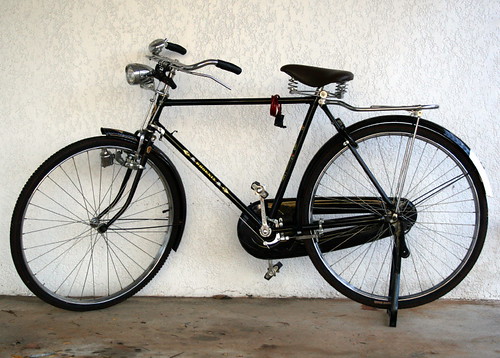 |
| Develop your skills for 15 years on a bike like this+enter local races+get signed by a team+get given a modern carbon fibre bike=win loads of races. Bring on the Glorious Chinese Cycling Revolution! (from Through Balanda Eyes) |
China today is where Russia, Romania and East Germany were in 1990. Of course, professional cycling isn't new in China - it was only three years ago that the nation hosted the Olympic Games. It also hosts no less than four of the 31 races making up the UCI Asia Tour, created by the cycling body in an attempt to sow the seeds of the sport outside of its European natural habitat (the others being the Tour of Hainan, the Tour of Qinghai Lake, Tour of South China Sea and the Tour of Taihu, all of which increase its popularity among the nation's 1.33 billion population, creating new fans. Many of those are kids from poor families, boys and girls who are still riding heavy black bicycles that have more in common with a farmyard gate than the razor blades of carbon fibre that now dominate in the Tours, and they're going to look at cycling and think, "hey - I could do that!" and with the determination of hungry kids who have seen a way out of poverty, they'll practice on their agricultural bikes. Then they'll enter local races organised by people inspired by the UCI, where they'll get noticed by teams who will supply them with modern kit - and then, they'll do what the East Europeans did. There's a new revolution coming in the next decade, and professional cycling will be all the better for it.
 |
| National Stadium, Beijing (© Chumsdock Cheng CC2.0) |
The Stages
Race Map: click here

Stages and Profiles: click here
Stage 1 is a short 11.3km individual time trial from the National Stadium, more popularly known as The Bird's Nest, on the Olympic Green 8.23km from the Zijin Cheng Forbidden City in the city centre. It heads north into the Olympic Park, then back south and around the Stadium to the National Aquatics Centre, also known as theWater Cube - a flat, fast parcours with a number of tricky corners thrown in to keep things interesting.
Stage 2 once again starts at the National Stadium, but this time the riders head west out of the city looping into the beautiful countryside to the north-west of the city, then complete two short circuits, one long circuit and one medium circuit around Mentougou (if you're looking for it on Google Earth, try this spelling rather than the official itinerary's Men Tau Gou - or just search 39°56'23.51"N 116° 5'54.24"E) and three Category 4 ascents to 183m before reaching the finish line in the town after 133.5km.
Stage 3 brings the first of the proper climbs - three Cat 1s and a Cat 2 add up to around 1700m of skyward pedaling - that's comparable to an ascent of the Col d'Aubisque. The first sprint of the day takes place on an uncategorised climb 17km after the first Cat 1, beginning at 800m and reaching the highest point of the stage. The second sprint comes at the bottom of the steep descent that follows the first and is likely to be taken at blindingly fast speed. 162km long, the stage ends in Yongningzhen (Yongning in the roadbook, Yongning Town on the official race map). En route, we get our first look at China's most famous feature. the Great Wall.
 |
| Shunyi's whitewater course is considered exceptionally difficult, even by Olympic standards (© Gerry Boudens CC3.0) |
Stage 5 takes the race back onto the flats with twelve circuits beginning at Tian An Men Square in the heart of Beijing - at 440,000 m² (0.88km x 0.5km), the largest city square anywhere on Earth and ending with a triumphant return to the National Stadium.
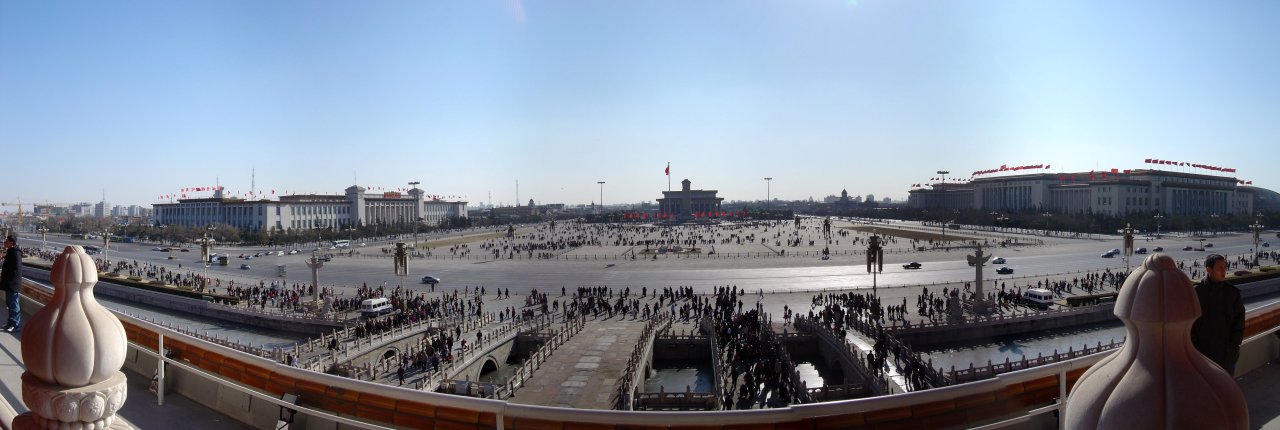 |
| Tian An Men Square |
Monday, 5 September 2011
Tour of Britain 2011

 |
| Confirmed: Mark Cavendish |
 |
| Confirmed: Thor Hushovd |
 |
| Confirmed: Jens Voigt |
11th September Stage 1: Peebles - Dumfries (170.3km)
12th September Stage 2: Kendal - Blackpool (137.7km)
13th September Stage 3: Trentham Estate - Stoke on Trent (140km)
14th September Stage 4: Welshpool - Caerphilly (183.7km)
15th September Stage 5: Exeter-Exmouth
16th September Stage 6: Taunton - Wells
17th September Stage 7: Bury St. Edmunds - Sandringham Royal Estate
18th September Stage 8: Routes A and B Time Trials, London
Once again, we'll be bringing you our traditional detailed stage guides (lauded by one reviewer as the "most in-depth" available) with all the usual facts on the riders, the parcours and the towns, villages and countryside that the race passes through. Look out for each new guide the evening before the stage takes place.
Thursday, 1 September 2011
Vuelta a España - 2011 Stage Guides
Vuelta a España - 2011 Index
Stage Guides

Stage 7: Almadén - Talavera de la Reina (26th August)
Stage 8: Talavera de la Reina - San Lorenzo de El Escorial (27th August)
Stage 9: Villacastin - La Covatilla (28th August)
Stage 10: Salamanca-Salamanca (29th August)
Stage 11: Verin - Mazaneda Ski Station (31st August)
Stage 12: Ponteareas - Pontevedra (1st September)
Stage 13: Sarria - Ponferrada (2nd September)
Stage 14: Astorga - La Farrapona (3rd September)
Stage 15: Aviles - Alto de l'Angliru (4th September)
Stage 16: La Olmeda - Haro (6th September)
Stage 17: Faustino V (Oion/Oyón) - Peña Cabarga (7th September)
Stage 18: Solares - Noja (8th September)
Stage 19: Noja - Bilbao (9th September)
Stage 20: Bilbao - Gasteiz (Vitoria) (10th September)
Stage 21: Jamara Circuit - Madrid (11th September)
Stage 8: Talavera de la Reina - San Lorenzo de El Escorial (27th August)
Stage 9: Villacastin - La Covatilla (28th August)
Stage 10: Salamanca-Salamanca (29th August)
Stage 11: Verin - Mazaneda Ski Station (31st August)
Stage 12: Ponteareas - Pontevedra (1st September)
Stage 13: Sarria - Ponferrada (2nd September)
Stage 14: Astorga - La Farrapona (3rd September)
Stage 15: Aviles - Alto de l'Angliru (4th September)
Stage 16: La Olmeda - Haro (6th September)
Stage 17: Faustino V (Oion/Oyón) - Peña Cabarga (7th September)
Stage 18: Solares - Noja (8th September)
Stage 19: Noja - Bilbao (9th September)
Stage 20: Bilbao - Gasteiz (Vitoria) (10th September)
Stage 21: Jamara Circuit - Madrid (11th September)
"Without doubt the most thorough Tour de France Stage 17 Preview..." (Dolomedia) (We'll try to do the same for the Vuelta, too - JO)
Subscribe to:
Posts (Atom)