Showing posts with label Asia. Show all posts

Monday, 26 September 2011

Tour of Beijing - Stage 1 Route Guide

Stage Map: click here
Stage Profile: click here

The riders couldn't wish for a flatter course than the Stage 1 time trial in the Chinese capital - it starts and ends at 41m and, with the exception of the briefest of blips after around 4km, doesn't really rise any higher along the entire route. With several straight sections and few dangerous bends, it leads north into the Olympic Park where it follows smaller, winding roads for a short while before heading south then back into the city along more straight roads for a final 300m sprint, this is a parcours that will favour sprinters as well as time trial experts and may very well generate new speed records.

The Bird's Nest (© 老黄瓜 CC2.5)
As will also be the case with Stage 2, the route begins at the famous Beijing National Stadium (39°59'28.54"N 116°23'13.94"E): one of the world's most iconic buildings and commonly known as the Bird's Nest for the seemingly random placing of the steel beams from which the outer shell is constructed - however, as is the case with a real bird's nest, there's nothing random about it at all. The completion of the National Stadium
"Bird's Nest" is something that all the
Chinese people are proud of, according to the official race road book - possibly because the government told them to be. After riding north for 591m, riders turn 90 degrees left onto the National Stadium North Road whilst taking care not to hit the grassy verges separating the cycle paths running along both sides of the road  - whereas these will be lined with barriers, it should be noted that Chinese trucks do not need to abide by the same regulations as do those in many other nations and as such, a corner in a busy location such as this is very much subject to diesel spills - one of the hazards most feared by cyclists because the fuel is impossible to see and lethal, especially after rain. On the right, just before the turn, is the 128m Long Long Pagoda - not actually a pagoda at all, but the Olympics international broadcast centre.

Ling Long Pagoda (© Kyle Simourd CC2.0)
The next turn, a 90 degree right, comes 138m later and leads onto Tianchen East Road continuing north for 974m past the China National Convention Centre on the left, housed in the building that originally served as the location of the Olympic press centre and venue for pistol and fencing events. Random fact: the centre's central vacuum cleaning system is the largest in China with 15.8km of piping.

Passing by some of the 2.2 million trees planted around the Olympic site (because the Chinese government like to pretend they're concerned about the environment when there are foreign press about), the riders soon arrive at Kehui South Road (40° 0'19.69"N 116°23'5.35"E) ready for another 90 degree left, this time avoiding the central reservation in addition to the grassy verges (the official road book has not yet been published, so at present we don't know if both carriageways will be open). After crossing Tianchen West Road 204m from the turn, they come to a 90 degree right onto Beichen West Road 110m later. Caution is required again due to a central reservation. Just west of the corner is the Institute of Remote Sensing Applications, occupying the splendidly-named Nanlongwang Hall. The difficulty of the turn depends largely upon which carriageways are in use - if the left, it's a wide and easy section; if right, it becomes much tighter and especially hazardous when wet due to the pedestrian crossing just around the apex.

Having crossed Kehui Road 304m to the north, the riders continue straight ahead on Aolin West Road as it snakes around the western perimeter of the beautiful Olympic Forest Park, a man-made area of forest and lakes almost 2km wide. They'll be on the right carriageway here, as the next turn in impossible from the left. It bends gently left, then passes under a fly-over and past the site of the two Olympic hockey stadia that were taken down after the Games, then bends right and left again before crossing a bridge over the N 5th Ring Road, then following the narrow slip road to the right 128m after the bridge (40° 1'20.74"N 116°22'48.69"E)  down to a very tight right 300m later - a point where significant time could be lost through punctures caused by thorns from the overhanging trees.

A bridge 186m along the road is only very narrower than the road and as such should cause no problems since riders are crossing one at a time. More overhanging trees past the bridge may result in more punctures and there's another very tight right turn 400m after the bridge is left behind, this one made more difficult by a kinked entry (40° 1'27.29"N 116°23'9.87"E). There's an 80 degree right 181m ahead, followed by an equally tight left onto a narrower road 30m later where riders reach the intermediate checkpoint and we get early indication of their performances.

One venue we won't see is the Laoshan Velodrome,  one
of the finest in the world. Built for the Olympics, it's
hosted several cycling events since.  (© Doma-W CC3.0)
Shortly after the checkpoint is what must be one of the most remarkable motorway bridges anywhere in the world. Though some 50m wide - arguably making the passage below it a short tunnel rather than the passage across a bridge - the road on Tianchen Bridge is only around 5.5m wide, the space either side being landscaped and covered in trees and shrubs to form a continuation between the parkland to the north and south. At the road on the other side, riders turn 90 degrees left, ignoring the bridge south over the river and proceed for 805m past a car park and on to Aolin East Road for a right turn to head south.

Having passed under a fly-over, the road bends slightly right and then left before crossing Kehui Road and arriving at the next turn 259m later - a right onto Kehui South Road with caution again required to avoid the central reservation if both lanes are in use. As another busy urban route, diesel spills are a possibility; as may also be the case at the left turn 224m later onto Hujing East Road.

The Water Cube at night (public domain image)
Hujing East curves gently around a bend in the river, crossing five other roads before arriving at the National Stadium South Road 1.93km later and offers some of the best views of the Bird's Nest. On the left is the enormous 5-star Grand Skylight CATIC Hotel, then the riders turn 90 degrees right onto a bridge. The road narrows at the opposite bank to make room for traffic emerging from a central tunnel (39°59'18.16"N 116°23'28.36"E), then opens up again 269m after the corner. It then continues for a further 279m, crossing the wide boulevard past the stadium upon which the route began before reaching the final turn - a 90 degree right onto Tianchen East Road. From this point, there are 300m left to the finish line next to the National Aquatics Centre, better known as Water Cube; a striking building clad in 4000 plastic bubbles.

Saturday, 24 September 2011

Tour of Beijing

The Race

It's not every day that we get to see the inaugural edition of a brand new UCI World Tour, and it's even rarer that such an event takes place in a nation that, until very recently, was so restrictive that the idea of a major international bike race taking place within its borders was all but unthinkable.

That's why the 2011 Tour of Beijing is a little bit special. What's more, with events such as this, the links between the Chinese people and the rest of the world are strengthened - and when that happens, as we saw in the old Eastern Europe, the iron fist with which the Chinese government still rules the populace and crushes dissent begins to rust (and as an example of that socio-political repression, it's quite likely that Cyclopunk will very soon not be making it through the Great Firewall of China which aims to prevent any website critical of the government finding its way into the country).

Of course, professional cycling isn't new in China - it was only three years ago that the nation hosted the Olympic Games. It also hosts no less than four of the 31 races making up the UCI Asia Tour, created by the cycling body in an attempt to sow the seeds of the sport outside of its European natural habitat (the others being the Tour of Hainan, the Tour of Qinghai Lake, Tour of South China Sea and the Tour of Taihu.

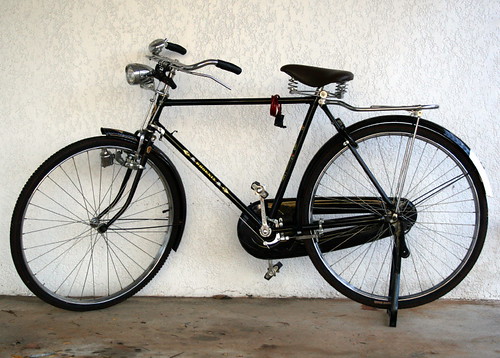
Develop your skills for 15 years on a bike like this+enter
local races+get signed by a team+get given a modern
carbon fibre bike=win loads of races. Bring on the Glorious
Chinese Cycling Revolution! (from Through Balanda Eyes)
Remember the late 80s and early 90s when Eastern Europe and the USSR began to open up, allowing a tidal wave of pop culture, rock music, video games and Big Macs (it can't all be good) to flood across the border while they sent a stream of hard-as-nails cyclists, steely-eyed boys with muscles honed by years of getting up for 4am rides on standard black bicycles that weighed more than they did at the grim Sports Akademies our way in return? Ullrich, Ekimov, Vinokourov, Kasputis and, perhaps the hardest of them all, Voigt? And remember the effect they had on the European cycling scene, blowing races wide apart and raising the level of competition so high that new notches had to be cut?

China today is where Russia, Romania and East Germany were in 1990. Of course, professional cycling isn't new in China - it was only three years ago that the nation hosted the Olympic Games. It also hosts no less than four of the 31 races making up the UCI Asia Tour, created by the cycling body in an attempt to sow the seeds of the sport outside of its European natural habitat (the others being the Tour of Hainan, the Tour of Qinghai Lake, Tour of South China Sea and the Tour of Taihu, all of which increase its popularity among the nation's 1.33 billion population, creating new fans. Many of those are kids from poor families, boys and girls who are still riding heavy black bicycles that have more in common with a farmyard gate than the razor blades of carbon fibre that now dominate in the Tours, and they're going to look at cycling and think, "hey - I could do that!" and with the determination of hungry kids who have seen a way out of poverty, they'll practice on their agricultural bikes. Then they'll enter local races organised by people inspired by the UCI, where they'll get noticed by teams who will supply them with modern kit - and then, they'll do what the East Europeans did. There's a new revolution coming in the next decade, and professional cycling will be all the better for it.

National Stadium, Beijing (© Chumsdock Cheng CC2.0)
So, between the 5th and the 9th of October we get to see top-notch bike racing, help free the Chinese people from tyrannical rule and take another step along the way to the future of cycling. That, by all definitions of the term, is a win-win situation.

The Stages

Race Map: click here
Stages and Profiles: click here

Stage 1 is a short 11.3km individual time trial from the National Stadium, more popularly known as The Bird's Nest, on the Olympic Green 8.23km from the Zijin Cheng Forbidden City in the city centre. It heads north into the Olympic Park, then back south and around the Stadium to the National Aquatics Centre, also known as theWater Cube - a flat, fast parcours with a number of tricky corners thrown in to keep things interesting.

Stage 2 once again starts at the National Stadium, but this time the riders head west out of the city looping into the beautiful countryside to the north-west of the city, then complete two short circuits, one long circuit and one medium circuit around Mentougou (if you're looking for it on Google Earth, try this spelling rather than the official itinerary's Men Tau Gou - or just search 39°56'23.51"N 116° 5'54.24"E) and three Category 4 ascents to 183m before reaching the finish line in the town after 133.5km.

Stage 3 brings the first of the proper climbs - three Cat 1s and a Cat 2 add up to around 1700m of skyward pedaling - that's comparable to an ascent of the Col d'Aubisque. The first sprint of the day takes place on an uncategorised climb 17km after the first Cat 1, beginning at 800m and reaching the highest point of the stage. The second sprint comes at the bottom of the steep descent that follows the first and is likely to be taken at blindingly fast speed. 162km long, the stage ends in Yongningzhen (Yongning in the roadbook, Yongning Town on the official race map). En route, we get our first look at China's most famous feature. the Great Wall.

Shunyi's whitewater course is considered exceptionally
difficult, even by Olympic standards (© Gerry Boudens CC3.0)
Stage 4, the longest in the race, begins at Guichuan Square in Yang Qing, heading east and then looping west again for an initial 20km circuit before arriving back at Yang Qing. Having completed the first sprint, riders travel west, then east and along the southern perimeter mountain range at that end the North China Plain. After turning back towards Beijing, it once again reaches the Great Wall - with a Cat 3 climb up to it - then heads back into the city to finish at the Shunyi Olympic Rowing-Canoeing Centre, an amazing facility with lakes and a custom-built whitewater course created especially for the Games 189.5km after the start.

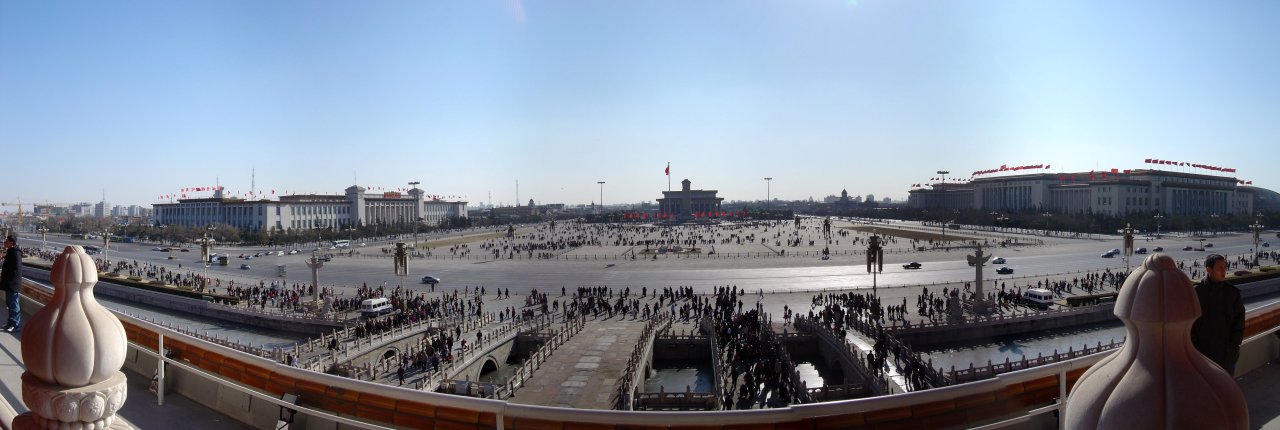
Stage 5 takes the race back onto the flats with twelve circuits beginning at Tian An Men Square in the heart of Beijing - at 440,000 m² (0.88km x 0.5km), the largest city square anywhere on Earth and ending with a triumphant return to the National Stadium.

Tian An Men Square