Showing posts with label tour. Show all posts

Tuesday, 19 August 2014

Daily Cycling Facts 19.08.2014

Iban Mayo at the 2007 Giro d'Italia
Iban Mayo
The French, at one time, elevated cycling to the level of a religion, as did the Italians. The Belgians are still obsessed with it, and the British are becoming so with every year (and every Tour victory) that passes. The Dutch adore the sport too - but no other people have cycling in their blood in quite the same way that the Basques do, and nowhere else is cycling an expression of national identity. There are 2.1 million Basques in their country, Euskadi; according to author Daniel Coyle, 70 of them were riding among the 400 ProTour athletes in 2004, and rider Haimar Zubeldia says that cycling is "an emanation of our people." Iban Mayo, born in Igorre on this day in 1977, was the best of them all during the first five years of the 21st Century.

A few years after leaving school, Mayo became an ambulance driver. One day, the tyres on his ambulance lost their grip and the vehicle smashed headlong into a stone wall, leaving him with two shattered legs that put him in a wheelchair for eight weeks. When he recovered he decided to train as an electrician, because people told him it wouldn't put much strain in his legs and the pay was good. Within a year, he'd surprised doctors by getting on his bike and developing a new style that didn't make his knees hurt quite so much.

Mayo turned professional with Euskaltel-Euskadi in 2000, a team funded partly by commercial sponsorship, partly by public subscription and partly by the Basque government; it is unique in that it functions both as a trade team and as a national team. In his second year with them, he won the GP du Midi-Libre, the Classique des Alpes and a stage at the Critérium du Dauphiné; in his third year he completed the Tour de France and the Vuelta a Espana, coming fifth overall at the latter.

In 2003, Mayo went back to the Tour and won Stage 8 on the Alpe d'Huez, right then and there becoming the biggest threat to Lance Armstrong since Marco Pantani in 1999 (it was also in 2003 that Joseba Beloki, another Basque and one who once claimed that Mayo was a "simple shooting star" who would never complete a Grand Tour, came to the end of his career with a high-speed crash on the Col de la Rochette). He knew, meanwhile, that he wasn't ready to take Armstrong on just yet, so instead he spent the rest of the Tour waging a peculiar reverse-war of attrition against his enemy - which, alongside cycling, is something else that the Basques are very good at doing; because they've been fighting large and powerful foes ever since Roman times, and have outlasted all of them. Without ever letting up, he would allow himself to drift to the back of the peloton and then power up through the ranks, cruising alongside Armstrong for a short while before suddenly thrusting forward - then when the Texan responded and caught him, he'd do it again, and then again and again. Armstrong had no idea what to make of it and spent much of the race looking rather confused, though he won in the end and Mayo was sixth.

Mayo in the unmistakable orange of Eukaltel-Euskadi
The following year, Mayo won the  Dauphiné for a second time, beating both Armstrong and the record on the ascent of Mont Ventoux, and for the first time in half a decade Armstrong' victory did not seem guaranteed before the race even got under way. Unfortunately, Fate had other ideas: Mayo lost a lot of time in a crash early on in the race, then lost even more when the injuries he sustained in the crash prevented him riding to his full ability in the Pyrenees. He then developed glandular fever and didn't start Stage 15.

Almost all riders have one bad year at some point in their career. For Mayo, it was 2005 when he finished the Tour in 60th place and abandoned the Vuelta. He won Stage 6 at Dauphiné in 2006, but the year wasn't to be much of an improvement over the last and he abandoned the Tour before coming 35th at the Vuelta. Nobody - except for Mayo himself - knows when he started doping, but his fans prefer to think that it was at the end of this period and that he frightened Armstrong without needing to cheat (we may, in 2012, be about to find out if Armstrong was himself a cheat, of course); he certainly wouldn't be the first cyclist to resort to the syringe when he found he wasn't living up to earlier promises and dreams. After riding his first Giro d'Italia and winning Stage 19 in 2007 he went to the Tour, which was where he was caught: the UCI revealed on the 30th of July, the day after the final stage, that a sample Mayo provided earlier in the race had tested positive for EPO. He appealed and, on the 22nd of October was cleared by the Spanish Federation when the court heard that the test on his B-sample (tested to confirm or disprove the results of an A-sample if requested by a rider) had been negative; but the UCI insisted that the B-sample had not yet been analysed, refusing to support the Spanish decision. When it was, it was found to be positive; Mayo was banned from competition for two years.

Sun-Geun Gu
Sun-Geun Gu
South Korean Sun-Geun Gu, born on this day in 1984 in Daegu City, won silver medals for the Points and Scratch races at the 2002 World Junior Track Championships and a gold for the Points race at the 2005 Asian Championships. In 2007, after coming second in the time trial and third in the road race at the World B Championships, she qualified for the national team at the 2008 Olympics. During the road race at the Games she became famous around the world for losing control of her bike in the treacherously wet conditions and falling into a shallow concrete drainage channel. After picking herself up and despite obvious pain, she got back on her bike and finished in 59th place.

After winning the silver medal for the road race at the Asian Championships in 2011 (she did so again the following year), Sung-Eun was offered a contract with the Australian Orica-AIS team and thus became South Korea's first professional female cyclist. The move up to world-class road racing has not phased her at all and she has become an integral part of the team - and with results such as second place on Stage 5 at the Energiewacht Tour, statistics seem to show she has a great future ahead.


Ewald Hasler, Alois Lampert and Rolf Graf
Liechtenstein has produced a very small number of professional cyclists. This isn't especially surprising as it's a very small nation, just 160 square kilometres with a population of around 35,000 - and many people there are put off cycling by the mountains, which will always limit the number of people taking up a sport in what is the only nation to lie entirely within the Alps. It is, therefore, curious that two of the most famous, Ewald Hasler and Alois Lampert, were both born in Eschen (which, with a population of a little over 4,000 people, is the nation's fourth-largest city) on this day in 1932. Hasler finished the road race at the 1952 Olympics in 43rd place and turned professional for Gitane-Hutchinson team in 1954 (when he rode with Jean Stablinski, Rik van Looy and Gilbert Bauvin) but switched that same year to the Swiss Cilo team, then retired in 1957 when he rode for König. Lampert became a professional two years later with the German Altenburger team, by which point he had already won Stage 4 at the 1951 Österreich-Rundfahrt and been 30th at the same Olympics Hasler rode, but also rode for the Swiss team Mondia with whom he remained for three years. In 1958 he rode for three teams - Mondia, Allegro and Tigra - then retired at the end of the year.

Rolf Graf was born in Unterentfelden, Switzerland, also on this day in 1932 - and rode with Lampert for Tigra and Allegro on 1958. He began his professional career with Tebag in 1952 when he was 17th in the Olympic road race; then switched to Guerra, Fiorelli and La Française-Dunlop in 1954, the year that he won Gent-Wevelgem. He continued riding for Fiorelli in 1955 but also represented Tebag, where 1950 Tour de France winner and 1951 World Champion Ferdinand Kübler rode as his domestique, then began to ride for Splendid-d'Alessandro as well the next year, 1956, when he took the first of his three National Championships (the others were in 1959 and 1962) and won the Tour de Suisse.

In 1959, Graf went to the Giro d'Italia and won Stage 22, then to the Tour de France where he won Stages 12 and 19; in 1960, he returned to the Tour and won Stage 19. Nine victories in the next two years suggest that his career had at least a few more years to run, but it was cruelly ended by a serious car accident in 1963 from which he never fully recovered. He officially announced his retirement in 1964.

Hasler, Lampert and Graf (and Kübler, for that matter) are all still alive.


Ezio Cecchi finished the Giro d'Italia in second place twice; first in 1938 behind Giovanni Valetti and then in 1948 behind Fiorenzi Magni. The gap between first and second place in 1948, 11 seconds, the the smallest winning margin in the history of the race.

Alphonse Antoine was born on this day in 1915 in the French village of Corny, but later took Belgian nationality and won the Belgian National Championship in 1935. In 1937, he won Stage 12a at the Tour de France.

As a Paris-Roubaix winner, Paul Maye is commemorated
on the Chemin des Géants.
Paul Maye, who was born in Bayonne on this day in 1913, won the French Amateur Championship in 1934 and the French Military Championship a year later. In 1936, having left the Army, he joined the Armor-Dunlop (and spent most of his career riding either for them or for Alcyon-Dunlop) and won Stages 10 and 19c at the Tour de France. In 1938, he won the National Championships, this time at Elite Professional level; he would win it again five years later. Maye won Paris-Tours in 1941, then again in 1942 and 1942 - he thus shares the record with Gustave Danneels (1934, 1936, 1937), Guido Reybrouck (1964, 1966, 1968) and Erik Zabel (1994, 2003, 2005). In 1945, he also won Paris-Roubaix, the race considered by many to be the hardest of them all.

Lucien Vlaemynck, born in Izenberge, Belgium on this day in 1914, became a professional rider with Alcyon-Dunlop in 1935 and stayed with them until his retirement in 1949 - he would, therefore, have known Paul Maye. Vlaemynck specialised in shorter stage races and criteriums; however, he rode the Tour de France once - in 1939, when he came third overall

A Wright Cycle Co. racing machine
Orville Wright, a bicycle builder, was born in the USA on this day in 1871. He's better known - alongside brother Wilbur - as the inventor of the first working heavier-then-air aircraft, and as the brothers never made bikes in any great quantity they probably wouldn't be any better-remembered  than any other small-scale turn-of-the-last-century manufacturers had it not have been for their aircraft. However, we owe them thanks for one innovation: they were the first to come up with the idea of machining the threads of the left-hand side of the bottom bracket and crank in an anti-clockwise direction, thus preventing the crank from loosening in use.

Other cyclists born on this day: Kazimierz Jasiński (Poland, 1946); Ján Valach (Czechoslovakia, now Slovakia, 1973); Hernán Medina (Colombia, 1937); Miklós Somogyi (Hungary, 1962); Andrzej Bławdzin (Poland, 1938); Gerard Veldscholten (Belgium, 1959); Jiří Prchal (Czechoslovakia, now Czech Republic, 1948).

Sunday, 17 August 2014

Daily Cycling Facts 17.08.2014

Filippo Simeoni
Filippo Simeoni
Born in Desio on this day in 1971, Filippo Simeoni was taken on as a trainee by Carrera Jeans-Tassoni in 1994 and showed sufficient promise to receive a professional contract the following year, then spent all but twp of the next fourteen series riding for a sucession of Italian teams (in 2005, he raced for Swiss-based Naturino-Sapore di Mare, the team relocated to Italy in 2006; in 2008 for Ceramica Flaminia-Bossini Docce who, for that one year, were based in Ireland before they too relocated to Italy). During that time, he became known as a super-domestique, a rider who could chase down attacks and still deliver his team leader to the best spot to win a race, but also one who could take a few victories of his own when given opportunity to do so. His best results were his two stage wins at the Vuelta a Espana; one in 2001 and one in 2003, and he also became Italian Road Race Champion in 2008, the year before he retired.

Simeoni's palmares, if we are truthful, is not especially impressive - despite a long career, he achieved just eight victories as a professional and his best Grand Tour result was 55th overall at the 1998 Tour de France. However, he was a character and is fondly remembered for his occasionally rebellious nature: when he won his first Vuelta stage, he stopped shortly before the finish line and walked across holding his bike above his head. Many interpreted this as an ungracious act designed to show rivals that he could still win even if he walked, others said that he was trying to show that the bicycle, rather than the rider, is the most important part of a race. Simeoni himself said that he had intended it to be a tribute to the victims of the September 11 terrorist attacks, which had taken place sixteen days earlier. Nevertheless, the UCI fined him.

Later, he became involved in a long-running battle with Lance Armstrong. Simeoni was caught out by a doping control in 2001 and received a relatively short ban after wisely deciding that the best way forward was to co-operate with the investigation and make a full confession; and with cycling finally waking up in the wake of the Festina Affair to how serious a problem doping had become and following a number of deaths attributed to EPO, Simeoni's testimony would rock cycling - especially when he stated that he had been prescribed EPO and growth hormones by the highly-respected sports doctor Michele Ferrari in 1996 and 1997. Dr. Ferrari's highest-profile client was Armstrong, who publicly called Simeoni a liar in an article published by Le Monde in 2003. Armstrong had become a little too used to those he saw as his enemies backing down the moment he called them out by that time, but Simeoni was made of sterner stuff - he launched a defamation suit, seeking to sue for €100,000 and stating that any money awarded to him would be donated to charitable causes (the case would later be dropped, however). During Stage 18 at the Tour the following year, Simeoni bridged to a six-strong breakaway group. Though neither he nor any other member of the group posed any threat to Armstrong's lead, the American went after him, which in turn forced US Postal's rivals T-Mobile to respond and destroyed any chance the riders in the break had of winning the stage. They begged Armstrong to return to the peloton and let them have their opportunity to shine, an opportunity offered to the best of the non-GC contenders in any Tour, but he would not. Eventually, Simeoni buckled under the pressure and dropped back to the main group where he was met with a barrage of abuse from several riders who had allied themselves with Armstrong, among them Danielle Nardello, Filippo Pozzato and Andrea Peron.

Traditionally, riders do not compete with one another until the sprinters try to be first to the finish line during the final stage of the Tour; instead, they pose for the press and the leader basks in his hard-earned glory. Simeoni's rebelliousness once again came to the fore, because he wanted to show that he was not cowed by Armstrong's bullying tactics, and he attacked the leader time and time again. Each time, US Postal chased him down and brought him back; and each time Simeoni was subjected to more abuse and, shamefully, a barrage of spit from several riders. It was not one of professional cycling's finest moments.

In time, it would become apparent that Armstrong had made a serious mistake - Simeoni was still a prosecution witness in an investigation into Dr. Ferrari at the time of the 2004 Tour, and lawyers involved with the case felt that Armstrong's actions constituted witness intimidation. He was questioned over the incidents early the next year, but no further action was taken; then in December he was indicted and ordered to face charges of defamation dating from the 2003 Le Monde article. That case was also dropped, in April 2006. Armstrong escaped prosecution but, it seemed to many fans and other riders, by the narrowest of margins, and the Cult of Lance began to crumble. Finally, years later, Armstrong was found out: Simeoni's palmares might not be particularly impressive, but his two Vuelta a Espana stages wins and the 2008 National Road Race Championship shine out; Armstrong, meanwhile, was stripped of all results gained since August 1999 and, without them, his palmares is little more extraordinary than Simeoni's.

Thomas Gascoyne
Thomas Gascoyne
Thomas Jepson Gascoyne - various known as Thomas Jeb Gascoyne, Thomas Jefferson Gascoyne or Thomas Mills - was born in Whittington, Derbyshire on this day in 1876 and became a cyclist in 1893. Three years later he made an attempt on the World 25-mile record, the first time he had ever attempted to beat a record greater than 10 miles, and did it in 57'18.4" - 1'43.2" faster than the previous holder's 59'01.6". According to contemporary reports, he was paced by a three-man tandem but overtook it because the combined effort of the riders was too slow for him.

Gascoyne would go on to set numerous other records, including the two miles on a tandem and the flying quarter mile. This led to widespread fame, and when he went to the USA in 1901 his arrival was reported by the New York Times, which seems to have been the first time he was called Thomas Jefferson Gascoyne. The newspaper stated that he had never been beaten in a pursuit race, and on the 20th of July he beat the famous "Major" Marshall Taylor twice in Boston. The following day, having first won a half-mile handicap, he took part in a pursuit without taking a rest break in between and was beaten for the first time.

For reasons unknown, Gascoyne chose to walk away from professional cycling a short while after his return to Europe and emigrated to Australia with a friend (also a cyclist) named Brown. Rather than continue making a living from their sport, they found badly-paid manual jobs and kept them for several years before entering amateur races under false names; Gascoyne became Thomas Mills and Brown became Atkinson. Neither man was race fit; however, Gascoyne's natural talent was sufficient that before too long rumours began to circulate and both men were forced to reveal their true identities - fortunately, the Australian public did not consider their actions dishonest, probably because they'd worked hard for little pay before returning to racing, and Gascoyne in particular became something of a hero.

At the outbreak of the First World War, Gascoyne enlisted in the Australian army and was posted to the trenches of West Flanders. He died there during the Battle of Passchendaele at Ypres on the 4th of October 1917, when he was 41. His body was not recovered and presumably lies where it fell, his memory is preserved at the Memin Gate Memorial to the Missing in Ypres.


Phillip Lavery

Born in Dublin on this day in 1990, Phillip Lavery scored good results ever since he came second in the National Junior Road Race Championship in 2007. 2012, which he spent with the Node4-Giordana team, was the best of his career to date with victories at the GP Stephen Roche, the Shay Elliot Memorial, the Under-23 Nationals and a bronze at the Nationals in the Elite class, and he began 2013 as a guest rider with Team H&R Block from Canada.

From the 1st of August, having impressed with a stage win at the Tour de France Comté Cycliste, the silver medal in the Road Race at the Irish National Championships and a victory a La Chapelle-lès-Luxeuil, he moved to Pro Continental squad Cofidis with a trial contract. Cofidis believed it would be given a Pro licence for 2014, but did not receive one.

Unable to secure a place with a Pro team due to the large number of top-class riders then looking for contracts in the wake of the collapse of several teams, Lavery became disillusioned and decided that he - like the vast majority of cyclists that ever dare to dream of it - was not destined to make it as a professional. He sold his bikes and got a job, turning to running to maintain his fitness. Salvation came from an unexpected source - Azerbaijan, where David McQuaid, himself an Irishman, managed the Synergy Baku team that, in addition to several local riders, boasted a number of Australians and Irishmen Connor McConvey and Matt Brammeier on its roster. The team had started the year with no spare places, but one of the Australians, Will Walker, had been forced into early retirement due to a heart condition; McQuaid heard about Lavery and got in contact, offering him a place with the team.


Álvaro Pino, born in Ponteareas, Spain on this day in 1956, is a rider who is chiefly famous for his success in the Vuelta a Espana - he was 22nd in 1981, tenth in 1982, fourth in 1983, eighth in 1985 and 1988 and fifth in 1989. His best result - and the race for which he is best remembered - was the 1986 Vuelta, which he won against the favourites Laurent Fignon of France, Sean Kelly of Ireland and Robert Millar of Scotland.

Magali le Floc'h, born in France on this day in 1975, won some 28 races during her long career from 1994 to 2008. She was National Road Race Champion in 2002 and 2005 and won the Coupe de France in 2001, 2005 and 2008.


Massimo Strazzer, born in Italy in this day in 1969, managed numerous podium stage finishes at the Giro d'Italia and, in 2001, won the Points competition.

Other cyclists born on this day: Sin Dae-Cheol (South Korea, 1959); Rinus Paul (Netherlands, 1941); Roland Zöffel (Switzerland, 1938); Julio Rubiano (Colombia, 1953); Algis Oleknavicius (West Germany, 1947); Les Ingman (Great Britain, 1927, died 1990); Jean Bourlès (France, 1930); Bojan Ropret (Yugoslavia, 1952); George Cameron (USA, 1881, died 1968); Carl Naibo (France, 1982); Kenneth Røpke (Denmark, 1965); Michael Hepburn (Australia, 1991).

Monday, 14 July 2014

Daily Cycling Facts 14.07.2014

Octave Lapize in 1910
The Tour de France ended on this day in 1963, 1964, 1965 and 1966 - the four earliest end dates in the history of the race. 1963 and 1964 were won by Jacques Anquetil and 1966 by Lucien Aimar, which caused much rejoicing in France as today is also Bastille Day.

Octave Lapize - winner of the 1910 Tour de France and the man who famously screamed "Vous êtes des assassins! Oui, des assassins!" at route officials when he reached the summit of Tourmalet when it was climbed for the first time in the race that year - died on this day in 1917, aged 29. Like so many (their names still known if they won a Tour and long-forgotten if they didn't) his cycling career came to an end in the First World War: his fighter plane was shot down over Flirey in Meurthe-et-Moselle, a village that was completely destroyed during the conflict, and he died in hospital shortly afterwards.

Sheldon Brown
Sheldon Brown, born in Boston, Massachusetts on this day in 1944, was parts manager at the Harris Cyclery bike shop in his home state. Whilst there, his superb memory and eye for detail allowed him to build up a vast  knowledge of bike components which he would use to create an encyclopedic website for his employer. The website grew until it included technical information, workshop advice and tips on modification for (probably) almost every bike and bike component ever manufactured, while Brown himself became a world-recognised expert on the subject and wrote several books. His writing on hub gears, especially Sturmey-Archer models, is considered authoritative.

Sheldon Brown
In the final years of his life, Brown suffered serious nerve deterioration as a result of his illness, going back some time before MS was diagnosed and gradually destroying his balance so that he could no longer ride a conventional bike. He continued cycling on a recumbent tricycle until, eventually, he lost the use of his lower limbs.

Brown, who died of a heart attack on the 4th of February in 2008, was universally liked by all who met him, cyclists and the general public, his cheery personality proving infectious. As he neared the end of his life, he wrote:
"Multiple Sclerosis is a nasty, rare, incurable disease, but there are lots of nasty rare incurable diseases out there. As nasty, rare, incurable diseases go, it's one of the better ones. If you must acquire a nasty, rare, incurable disease, MS is one of the best things going!... I think of it as not so much a "tragedy" as a Really Major Inconvenience... Another great thing about MS is that it's guilt free and blame free! Since nobody knows what causes it, nobody thinks it's because you didn't eat your vegtables, or had sex with the wrong person, or took inappropriate drugs, or lived in a place you shouldn't have, or didn't go to the gym as often as you should have!"

Odile Defraye (Odiel Defraeye)
Odile Defraye
Born in Rumbeke, Belgium on this day in 1888, Odile Defraye was invited at the last moment to join the French bike manufacturer Alcyon's team for the 1912 Tour de France - the team, previously made up entirely of French riders, was initially reluctant to take him on. However, the company's Belgian representative, in charge of sales in the lucrative Belgian market, applied pressure and Defraye was taken on; his job being to help 1911 winner Gustave Garrigou take another victory.

Despite immediately proving to be the stronger rider, Defraye performed his task faithfully and, when Garrigou punctured on nails spread across the road by spectators, the Belgian was the only rider to stop and wait, then try to help him back to the peloton. Garrigou then showed an admirable lack of selfishness: realising that the Belgian had a better chance of catching them without him, he told him to go on alone. Defraye won the stage; while Garrigou did manage to catch up and took second place, the team managers decided that Defraye should become team leader (Garrigou, again proving himself to be free of prima donna tendencies, accepted this). That put him in a very good position indeed - he had the strong Alcyon team riding for him and, since he was the first Belgian with a good chance of winning, all the other Belgian riders too.

Defraye with spare tyres around
his shoulders
A series of punctures and knee problems later in the race nearly put him out of contention and Octave Lapize (who would die on Defraye's birthday five years later, see above) came very close to taking over the lead, but Defraye recovered and launched an attack on the Col de Portet d'Aspet that left Lapize far behind - he abandoned that day, complaining that he couldn't win due to the Belgians all riding for Defraye. Marcel Godivier and Charles Crupelandt, the remaining members of his La Française team, left in solidarity with him the following day.

Once Lapize had gone, Eugène Christophe became Defraye's greatest rival. Christophe was a superbly talented climber but, like most climbers, couldn't sprint; his preferred technique was to mount enormously long solo breaks on the mountain stages (this would have been even more successful when the Tour returned to the accumulated time format the following year, rather than deciding the winner by points, had Christophe not have experienced perhaps the most infuriating and long-running period of bad luck in Tour history) - including, this year, one of 315km, which remains the longest solo break in the history of the race. However, with no mountain stages left and a whole army of helpers willing to chase down an attack, his opportunities had all be used up. Had the race have been decided according to accumulated time, Christophe would in fact have been in the lead; this remained the case until the final time when he eventually gave up, accepted he was beaten and allowed Defraye to become the first ever Belgian winner of the Tour without further challenge.


Mauro Simonetti, who was born in Livorno on this day in 1948, won a bronze medal in the team road race at the 1968 Olympics and Stage 6b at the 1971 Tour de France.

Paul Choque, born in Viroflay on this day in 1910, won a silver medal for the Team Pursuit at the 1932 Olympics. He later twice became French Cyclo Cross Champion (1933 and 1938), won the Critérium International twice (1933 and 1936) and won two stages (16 and 18b) at the 1937 Tour de France, when he was also seventh overall.

On this day in 2012, at the Tour de France, Frank Schleck provided a sample to doping control that tested positive for Xipamide, a diuretic also known as Aquaphor or Aquaphoril. The drug is a diuretic, working by reducing the kidneys' ability to absorb water and thus diluting the urine; this has no performance-enhancing effect but can be used to mask the presence of other substances. As it is not on the UCI's list of banned drugs the rider would not face a suspension, nevertheless his beleaguered RadioShack-Nissan team (caught up in a legal case surrounding retired seven-time Tou winner Lance Armstrong and team manager Johan Bruyneel) withdrew him from the race.

Other cyclists born on this day: Iryna Yanovych (USSR, 1976); Joby Ingram-Dodd (Great Britain, 1980); Gunnar Göransson (Sweden, 1933); Teddy Billington (USA, 1882, died 1966); Mannie Heymans (Namibia, 1971); Tadesse Mekonnen (Ethiopia, 1958); Hipólito Pozo (Ecuador, 1941); Dirk Jan van Hameren (Netherlands, 1965); Jazy Garcia (Guam, 1967); Mark Kingsland (Australia, 1970); Ion Ioniţă (Romania, 1928); Stefan Brykt (Sweden, 1964); Fritz Joost (Switzerland, 1954).

Sunday, 13 July 2014

Daily Cycling Facts 13.07.2014

The Tour de France started on this date in 1908 and 1950 - the latest Tours in history. 1908 was an especially interesting Tour...

Tour de France 1908
Le Grand Depart, 1908
14 stages, 4,488km.
Using an almost identical route to 1907, the 1908 edition had one notable difference to previous years: all cyclists were in the same classification and they all rode identical yellow frames issued to them by the race, though they were still permitted to choose some components for themselves - one popular option was clincher tyres which, while not as efficient as tubular tyres, made repairing punctures considerably easier; since riders were required to carry out all maintenance and repairs themselves this was an important consideration. 36 riders were using them, the majority of which were made by Wolber (who also co-sponsored the Peugeot team) - those riders became eligible for the secondary and unofficial "Prix Wolber pneus démontables" classification, which offered a prize of 3,500 francs to the first rider over the finish line on a bike fitted with them and brought a huge amount of public and media attention for both the product and the manufacturer. Organisers also promised that steps had been taken to prevent bad behaviour and sabotage by  spectators, who in the past had done everything from spread nails over the road to forming mobs and physically beating the riders; this year, the riders were reassured, there was a 90% chance that what was termed "the Apaches" would be apprehended by the police and go to prison.

Marie Marvingt
114 cyclists started the race from 162 who had applied for admittance; 48 being either unable to start or having their applications turned down - among those in the latter group was Marie Marvingt, whose application was declined because she was a woman. Born in 1875 and a qualified surgical nurse, Marvingt had been encouraged to take part in a wide selection of sports by her father and became an enormously successful athlete, winning competitions in equestrian sports, field athletics, tennis, soccer, golf, shooting, water polo, swimming, martial arts, boxing, skiing, bobsleigh, luge, ski jumping, skating, shooting, fencing and mountaineering. Cycling was one of the few sports in which she didn't win any competitions, but she was an avid long distance rider and had ridden from Nancy to Napoli to witness a volcanic eruption. Knowing that only rules prevented her from completing the Tour, she followed the peloton and rode the entire route - sadly, the time she took to do it doesn't seem to have been recorded and so we'll never know how she might have fared against the men. We do know, however, that only 36 riders finished the race, so she can be considered to have beaten 78 of them (for more on Marvingt and her remarkable life, click here).

No cyclist had ever won two Tours (with the exception of Maurice Garin, whose second victory was disqualified due to cheating), but Lucien Petit-Breton believed that he could and he planned to do so; being the first man to centre his entire season on this one race alone (that he would so is indication that, five years after it began, the Tour was already the most important bike race in the world). Using other events solely to train and caring little where he placed in them, he artfully ensured that he reached a peak of physical fitness for the Tour - something that had never before been done and which would not be used again until Miguel Indurain's five wins between 1991 and 1995 and Lance Armstrong's seven wins between 1999 and 2005. What's more, Petit-Breton (whose real surname was Mazan; he had become known as Lucien Breton at the start of his career when he lived in Argentina and began to use it so that his father - who wanted him to get a "proper" job - wouldn't recognise his name in the race results published in newspapers, the Petit being added because there was another rider named Lucien Breton) had the very strong Peugeot team backing him up and, crucially since riders had to carry out their own repairs, he was a skilled mechanic.

Passerieu and fans at the Tour, 1908
The enormously powerful Georges Passerieu won Stage 1 from Paris to Roubaix on the same cobbled roads since made famous by L'Enfer du Nord (in those days, the cobbles were not considered remarkable - that was just how many roads were), beating second-place Petit-Breton by exactly five minutes. Since numerous documents recording the details and history of the early Tours were lost in the Second World War, it's not possible to know for certain if, when Petit-Breton won and Passerieu was second on Stage 2, they were given joint leadership as both had three points or if Passerieu remained leader due to having equaled Petit-Breton's winning time; support for each answer is split reasonably evenly between the various sources. During the stage several riders punctured on nails - Desgrange could make all the promises he liked, but it was never going to be possible to keep tight control on what the public got up to in a race such as the Tour.

Stage 2 ended and Stage 3 began in Metz, which as part of the Lorraine region was then under German control. Desgrange, like many Frenchmen, saw the German annexation of Alsace-Lorraine as an insult to his country it seems strange that he would steer his race through the region; however, one of the reasons he organised the race in the first place was to show off the strength and athleticism of France's young men, he probably welcomed it as an opportunity to demonstrate to Germany that should they ever get ideas about expanding their territory further onto French soil they'd be met by formidable resistance. He was probably pleased, therefore, that Stage 3 was started by none other than the Count von Zeppelin: while no longer a General in the German army (he'd been forced to retire after his command came under heavy criticism in 1890), he retained great power and influence. During the stage Jean Novo, riding for the Labor team, crashed and had to retire. The team's owner then sent a telegram to the manager ordering him to withdraw the team on account of its "mediocre results." Labor is notable in that the riders wore bright yellow jerseys, which stood out in the peloton and made them easy to recognise - this may very well have been where Desgrange got the idea for the maillot jaune which he would later reserve for the leader of the race (we know for certain that the race leader wore a yellow jersey in 1919, but late in his life Philippe Thys said that he'd been given one when he led in 1913 - nobody can prove that he was, but nobody can prove he wasn't either). With Labor gone and Alcyon unable to achieve the performances they would in the coming years, Peugeot dominated the race from that point onwards; beginning with François Faber's Stage 3 victory (while Faber considered himself to be French, he a Luxembourgian passport and was the first Luxembourgian - and only the second foreigner - to win a Tour stage). Petit-Breton finished with him and thus remained in the lead with five points.
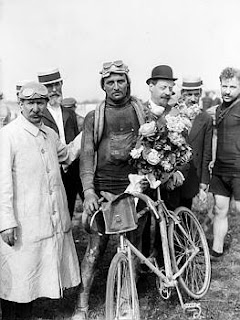
Faber, who later died in No Man's Land when
he tried to rescue an injured comrade
Faber also won Stage 4 after the peloton battled through a blizzard, but as he was 49th on Stage 2 he was out of contention for an overall victory. Petit-Breton came third but remained in the lead with eight points - overall second place Gustave Garrigou had an 18 point disadvantage by this time, so already it seemed that Petit-Breton's decision to concentrate solely on the Tour was paying off. Passerieu won again on Stage 5, beating Faber by 19' after riding solo over the Col de Porte; Petit-Breton was third and now had an advantage of 21 points over new second place Luigi Ganna. Stage 6 climbed Bayard and the infamously steep Rampe de Laffrey; André Pottier - younger brother of 1906 winner René - was first to the top of both, but he was caught and passed on the descent by Jean-Baptiste Dortinacq. Petit-Breton was third again, increasing his advantage to 31 points, then he won Stage 7 and his lead grew to 33. Faber then won Stage 8 and jumped to third overall; although he was fifth behind Petit-Breton on Stage 9, he moved into second place overall with a one point advantage over Garrigou. Nevertheless, he was 39 points behind Petit-Breton who, unless he abandoned or received a penalty, now looked certain to win.

Stage 10 went to Georges Paulmier - Petit-Breton was tenth, by far his worst performance in the race as he finished top four on every other stage. His lead was too great to be threatened, falling to 32, but Faber was only one point ahead of Passerieu and would need to work hard to remain in contention for second place. Petit-Breton won Stage 11, adding two points to his advantage; Faber and Passerieu both had 63 points after the stage but Faber remained officially in second place (which suggests that Passerieu was probably declared sole leader following Stage 2), then secured his position in Stage 12 by opening a gap of five points. It took Passerieu 16h23' to win Stage 13, the longest in the race at 415km; Faber was second and Petit-Breton third, the three of them finishing together - the last rider to complete the stage, Louis di Maria, needed an extra 23h07' to arrive at the finish line.

Lucien Petit-Breton
Petit-Breton started Stage 14 with an advantage of 31 points over Faber and 35 over Passerieu. He had, therefore, no need whatsoever to win that last stage - but he did, consigning Faber once more to second place. Henri Cornet was fifth over the line, much to the delight of the crowd who adored him for his youth and sense of humour - when the race was over organisers announced that there would be a one-lap race of the 666m Pard des Princes velodrome, though the result would not be counted towards the Tour, and Cornet won.

Faber may have been second, but he was declared winner of the Prix Wolber. When the 3,500 francs were added to the prize money he earned for second place in the General Classification, he ended up making more money from the race than Petit-Breton did; however, Petit-Breton later wrote a book, Comment je cours sur route (How I Race on the Road), which is half-memoir and half the earliest example of a cycling training manual.

Top Ten Final General Classification
1  Lucien Petit-Breton (FRA) Peugeot–Wolber 36
2  François Faber (LUX) Peugeot–Wolber 68
3  Georges Passerieu (FRA) Peugeot–Wolber 75
4  Gustave Garrigou (FRA) Peugeot–Wolber 91
5  Luigi Ganna (ITA) Alcyon–Dunlop 120
6  Georges Paulmier (FRA) Peugeot–Wolber 125
7  Georges Fleury (FRA) Peugeot–Wolber 134
8  Henri Cornet (FRA) Peugeot–Wolber 142
9  Marcel Godivier (FRA) Alcyon–Dunlop 153
10  Giovanni Rossignoli (ITA) Bianchi 160
(Note: with Peugeot's domination of the race so complete, the identical bikes experiment - which had previously applied only to the second-class riders rather than to the entire field - was considered unsuccessful and dropped. However, in 1909 bikes still had to be fitted with a stamped lead seal by organisers to make sure riders didn't illegally change bikes during the race.)


Tour de France 1950
22 stages, 4,775km.
Aware that some riders broke the rules by receiving a helpful push from team staff as they collected  fresh bidons, organisers announced that course officials would be keeping a close eye on things and that there would be harsher penalties for any rider spotted breaking rules in this way. There had also been concerns that the bonification system gave climbers an unfair advantage over other riders, thus this was overhauled: being the first to a summit now earned a bonus of 40" rather than a minute and no new mountains were added to the parcours. Prizes increased - a stage winner would now receive 50,000 francs, an increase of 20,000f when compared to 1949, and the overall General Classification winner would receive 100,000. Since stages were now on average much shorter than they had been in the early days of the Tour, cut-off times were reduced dramatically and, for the first time, French TV broadcast live coverage of every stage. In addition to the national and French regional teams, the plan to include an international team gradually developed into one for a North African team consisting of riders from French-controlled Algeria and Morocco.

Gino Bartali
Fausto Coppi had broken his pelvis in a crash at the Giro d'Italia, leaving no clear favourite. Many people believed Gino Bartali stood a good chance although he was a month away from his 36th birthday, others looked to Raphaël Géminiani; while those who considered Louison Bobet to be a "cry baby" (a reputation with which he had been stuck ever since he abandoned the 1947 after finding the Alpine stages too difficult) there were also those who shared manager Maurice Archambaud's opinion that the rider had enormous potential (as would be proved a few years later when he became the first man to win three consecutive Tours), and they believed that he might now have matured sufficiently to win. Finally there was Ferdinand Kübler; a fiery, impetuous and apparently half-crazed Swiss rider with more than enough talent to win a Tour but an equal amount of impulsiveness, which had led him to throw away more than one race in the past with an ill-judged attack or merely on a whim.

Orson Welles was given the honour of starting the first stage, which was won by the Luxembourgian rider Jean Goldschmidt. He then retained the maillot jaune through Stage 2 before Bernard Gauthier finished sixth in a seven-strong break on Stage 3, ending up with 5" overall advantage. Gauthier wasn't considered able to keep it but then did, finishing in sixth place again on Stage 4 to increase it to 2' which remained intact despite his 21st place on Stage 5. Meanwhile, Kübler had finished top ten on the first two stages and ended Stage 5 4'30" down in 9th overall, but he knew he was going to do well in the Stage 6 individual time trial. In fact, he did very well and beat Fiorenzo Magni by 17" and all his rivals by at least 2'55", jumping to third overall with a disadvantage of only 49" - which would have been even greater had be not have decided to stop and change his jersey on the parcours, picking up a 25" penalty for doing so (some sources say that this is incorrect and he was penalised 15" and fined 1,000 francs for wearing a silk jersey rather than a regulation woolen one; while there are obvious advantages to a silk rather than woolen jersey in a time trial, the harshness of time and financial penalty seem so wildly at odds with one another that the first version appears more plausible). Gauthier got away in a successful break again the next day (when Kübler was fined, 100 francs for turning up late at the start line; later in the race he was fined again for getting a push from fans): while he was 11th over the line, the break had been made up of riders far down in the General Classification and he finished with the yellow jersey and an overall advantage of 9'20". Although there was still two weeks of racing to go, a good all-rounder might have been able to defend a lead such a that all the way to the end if he had luck on his side, but Gauthier was not a climber. The favourites didn't even bother trying to take back time over the next few stages, allowing him to keep the jersey and his advantage. Then the race arrived at the Pyrenees and he came 53rd behind Bartali; just like that his huge lead turned into a 9'49" disadvantage and he dropped to 12th overall - he would never wear the maillot jaune again.

Jean Robic
Stages 11 saw one of the great mysterious events in Tour history: Bartali, known as The Pious One on account of his deeply-held Catholic beliefs, escaped with little Jean Robic, who looked like an imp in a painting by Bosch and had the sort of personality that must have tested even Bartali's saintliness, and together they cruised away up the slopes of the Aubisque before being caught by a group of eight including Kléber Piot, who led over Galibier and the Aspin (Piot was primarily a cyclo cross rider and very little is known about him, his performance that day indicates that he had the makings of a superb grimpeur). Huge crowds had gathered to watch the riders tackle the mountains and, as tends to be the way, were not being especially mindful of keeping out of the way: Bartali could not avoid a collision with Robic after a photographer stepped into the road, causing the Frenchman to crash hard. Precisely what happened next remains a mystery: Bartali said that the French spectators accused him of deliberately causing the crash in an attempt to dispose of a rival and that they began punching and kicking him as tried to set off, then one man came at him with a knife; Louison Bobet, who was nearby at the time, said that the spectators were trying to give him a push to get him back on the way and the man with the knife had simply not set it down when he rushed over to help, prior to which he'd been slicing a sausage while having a picnic. Bartali may well have been stunned and confused following the crash and Bobet was an intelligent man who would later win the Tour with his brain as much as his legs, and for that reason many people choose to believe the Frenchman's story. However,it would have been hard for Bobet to see what was going on in a crowd, and why would he have noticed the man slicing a sausage? Also, in recent years it's become known that Bartali both smuggled forged documents around Fascist Italy between groups seeking to help Jewish people escape the country and personally transported numerous Jewish refugees to safety in Switzerland using a specially-designed trailer towed behind his bike. Had he have been discovered, the result would have been summary execution or transportation to a concentration camp - his bravery in therefore in no doubt, for he had faced dangers far greater than a man with a picnic knife and had kept his head. It should also be remembered that like Kübler he'd been fined several times during the race so far, so he might just have been in a bad mood and wanted to make a fuss.

We will never know the truth but, whatever really happened Bartali was sufficiently shaken to announce that he wouldn't be continuing with the race and, as team leader, the majority of the Italians said that they would go with him. Some wanted to stay and help Magni defend the 2'31" advantage with which he finished the stage, but Magni - who, despite holding political beliefs so right-wing he was despised by most other riders, respected the elder statesman of Italian cycling - revealed he was going too, thus becoming the fourth man in history to abandon the Tour while wearing the yellow jersey. Race organisers tried to encourage them to continue by offering them plain grey jerseys so that they'd be less recognisable, but it was to no avail and both the Italian A and B teams abandoned.

Kübler now became overall leader with a 3'20" advantage over Bobet, but he refused to wear the maillot jaune in Stage 12 to acknowledge the fact that it was his by default. The stage was won by a Belgian, Maurice Blomme, and it would be the only Tour stage win of his career. Getting there took so much out of him that he mistook a shadow on the road for the finish line and got off his bike; fortunately a race official was on hand to get him back on his bike and explain he had a few more metres still to go.

Abdel-Kaader Zaaf asleep under the tree
As if to achieve balance with the drama of Stage 11, Stage 13 brought one of the Tour's most amusing events. It was one of those horrendously hot days that sometimes happen around Perpignan and north of the Pyrenees when temperatures rise to more than 40C, the breeze stops blowing off the Mediterranean and the mountains prevent the stale air circulating. The European  riders were unwilling - or unable - to exert themselves and the peloton settled into a slow rhythm, aiming to complete the stage with as little effort as possible. However, Abdel-Kaader Zaaf and Marcel Molinès of the North Africa team were accustomed to the heat of Algeria and found the conditions far less hard-going, so they broke away from the pack early on in the race. Continuing on their way at a high pace, the pair built a lead which reached as much as 20 minutes - sufficient to make Zaaf officially the race leader for a short while. However, by the time they neared the end of the 217km stage, even they were beginning to feel the effects of the weather and stopped to accept drinks offered to them by spectators. Unfortunately for Zaaf, the drink he took was a bottle of wine and, as a Muslim, he'd never consumed alcohol before (Molinès either took a bottle of water or was more used to wine), so it rather went to his head. Before long, he was feeling somewhat the worse for wear and realising he was wobbling dangerously all over the road decided that perhaps he'd better stop for a while in the shade under a tree and see if he started feeling any better (Molines continued and won the stage). Some time later - nobody knows how much later - a group of spectators found him and woke him up. He grabbed his bike, leapt aboard and set off. Unfortunately, in his eagerness to make up for lost time, and possibly still being a little drunk, he failed to realise that he was going back the way he and Molinès had come . When organisers caught up with him, unaware that his confusion was down to alcohol, they assumed his brain had been scrambled by the heat and had him taken to hospital. The next day, he escaped and hurried to the start line where he begged to be allowed to retake the section of the previous stage that he'd missed and continue the race, but being Tour de France officials and every bit as much sticklers for rules as the modern counterparts, the judges wouldn't allow it and upheld his disqualification. (For more information on Zaaf and the good fortune that came his way, click here.)

The weather remained the same for the next few days and nobody could really be bothered to start working on Kübler's 1'06" advantage, considering it small enough to easily be dealt with later in the race. During Stage 15, the peloton as one came to the decision that it was much too hot for cycling, so they stopped, got off and went for a cooling swim in the Mediterranean. Director Jacques Goddet was furious and ordered them to get on with the race immediately or be disqualified - unfortunately for him, reporters found the incident hilarious and he was unfavourably portrayed in the newspapers the next day; he got his revenge by fining all the riders. Stage 16 brought more drama: Kübler won with the Belgian Stan Ockers and Bobet taking second and third right behind him, but the judges declared Bobet to be second - even the French fans were outraged, insisting he was third, and the Belgian team threatened to leave the race if things were not put right. The judges ignored the threat and refused to change the result, and the Belgians eventually backed down and continued.

By the end of Stage 18, during which Bobet tried to win back time on the Izoard, the mountain where he would win the Tour in the future, Kübler's lead had increased to 2'56" and he added another 30" the next day when he finished second, 34" behind Geminiani. It was now beginning to look very much as though he might win, especially with the Stage 20 mountain time trial still to go. He more than lived up to expectations that day, beating Ockers by 5'34" and Bobet by 8'45"; his overall lead going into the final two plain stages was 9'30" on the Belgian and 22'19" on the Frenchman. It wasn't really worth their while trying to claw it back from that point onwards, and so 9'30" was the winning margin for the first Swiss rider to win the Tour de France.

There were many, of course, who said that had Coppi been there or had the Italian teams have stayed in the race, Kübler would not have won. Coppi may indeed have won if he wasn't at home with a broken pelvis; but he was and that's how cycling works, so that point is irrelevant. Bartali, as already described, was past his best and coming to the end of his career - he had been one of the greatest Tour riders ever seen and was still capable of beating far younger men in the mountains, but in this edition the time trials counted for a great deal and he wasn't as fast as he once was. Magni, meanwhile, was a superb rider in the flat time trials, as can be seen by his second place finish in Stage 6 when he was only 17" behind Kübler; but he wasn't much of a climber. However, Kübler could climb and time trial, so it seems that his insistence that he'd have won regardless is probably correct.

On the 24th of July, Kübler will celebrate his 96th birthday. He is the oldest living Tour de France winner, and the longest-lived Tour de France winner of all time.

Top Ten Final General Classification
1  Ferdi Kübler (SUI)  Switzerland 145h 36' 56"
2  Stan Ockers (BEL) Belgium +9' 30"
3  Louison Bobet (FRA) France +22' 19"
4  Raphaël Géminiani (FRA) France +31' 14"
5  Jean Kirchen (LUX) Luxembourg +34' 21"
6  Kléber Piot (FRA) Ile de France–North East +41' 35"
7  Pierre Cogan (FRA) Center–South West +52' 22"
8  Raymond Impanis (BEL) Belgium +53' 34"
9  Georges Meunier (FRA) Center–South West +54' 29"
10  Jean Goldschmit (LUX) Luxembourg +55' 21"


The Death of Tom Simpson

Tom Simpson
30.11.1937 - 13.07.67
It was on this day in 1967 that Tom Simpson - considered at that time and for some years afterwards to have been Britain's best ever hope for a Tour de France overall General Classification winner and still one of only two male British World Champions - died on Mont Ventoux during Stage 13 of the Tour. Tom's death, caused by sheer exhaustion, alcohol, amphetamines and the uniquely challenging conditions found on the mountain has become one of professional cycling's greatest and most-told stories, while the memorial at the spot where he died is a place of pilgrimage for cyclists from around the world.

Simpson did not die in vain: his death was the wake-up call that alerted the world to the prevalence and dangers of doping and forced organisers to begin to consider ways to control it.


La Flèche Wallonne was not held in the wake of the 1940 Nazi invasion and occupation of Belgium, and so the edition held on this day in 1941 - the fifth - was the first time the race had taken place for two years. Running for 205km from Mons to Rocourt, it was notably shorter than in previous years and was won by Sylvain Grysolle, one of the first Classics specialists who after the War would go on to win the Ronde van Vlaanderen and the Omloop Het Volk. Grysolle died on the 19th of January, 1985.


Sylvain Grysolle - image creator unknown, believed public domain. If you own the rights, please contact us to discuss terms/removal.


Cyclists born on this dayTara Whitten (Canada, 1980); Jack Bobridge (Australia, 1989); Dimitri de Fauw (Belgium, 1981, died 2009); Mirco Lorenzetto (Italy, 1981); Richard Groenendaal (Netherlands, 1971); Des Fretwell (Great Britain, 1955); Pascal Hervé (France, 1964); Benno Wiss (Switzerland, 1962); Michael Schiffner (East Germany, 1949); Vinko Polončič (Yugoslavia, 1957); Walter Tardáguila (Uruguay, 1943); Thomas Hochstrasser (Switzerland, 1976).

Friday, 11 July 2014

Daily Cycling Facts 11.07.2014

Tour de France 1998
21 stages + prologue, 3,877.1km.
For the first time, the Tour visited Ireland - the prologue was in Dublin, Stage 1 started and ended in Dublin and Stage 2 ran from Enniscorthy to Cork; then the teams sailed to Roscoff in Brittany for the start of the rest of the race. The number of teams was reduced from 22 to 21 in order to also reduce the number of riders, this having been declared the reason for a large number of crashes in 1997.

British rider Chris Boardman, a time trial specialist, won the prologue and started the race in the maillot jaune for the third time in his career. Erik Zabel took it in Stage 2, then lost it to Bo Hamburger the next day; next it went to the Australian Stuart O'Grady who kept it for three stages until 1997 winner Jan Ullrich got it in Stage 7. Ullrich handed it over to Laurent Desbians the following day but won in back in Stage 9 and, a few days later, looked very much as though he was going to keep it.

Then the race reached the Alps and Marco Pantani blew it apart. 48km from the end of Stage 15, he attacked so hard on Galibier that Ullrich was left reeling, completely and utterly unable to respond to the Italian's power. Pantani even stopped on the way to put on a rain jacket, but still took 8'57" from the man who was no longer his rival and finished the stage as overall leader with an advantage of 3'53" over new second place Bobby Julich (and 5'56" on Ullrich). The following day, Ullrich had to win simply to remain in contention and he did a very impressive job of doing so, leading the peloton over the stage's fifth and final climb; but Pantani stayed with him, and the gap between them remained the same. The German made up time with more superb performances, including his excellent ride in the Stage 20 time trial when he took back 2'35"; but what Pantani had done on Galibier was insurmountable and he won by 3'21" overall.

Pantani was one of the finest grimpeurs in cycling history; had it not have been for the problems he would later face, leading to his tragic death on Valentine's Day in 2004, he might even have topped the achievements of Federico Bahamontes and Charly Gaul. It is, therefore, a great shame that his only Tour victory was overshadowed by the scandals that hit the 1998 race. The first the world knew about a massive investigation into doping was when the Festina team's Belgian soigneur Willy Voet was stopped at the French border in a car packed with enough drugs to open a small but well-stocked pharmacy (he tells his story in his book, Breaking the Chain; a must-read despite suffering a little from Voet being a soigneur rather than a writer). Next came police raids on the teams' hotels, with another huge stash of doping products being seized from the TVM team, then a riders' protest in Stage 17 and the nullification of the stage. It didn't end there and, before long, what became known as the Festina Affair mushroomed into the biggest and most damaging scandal to have ever hit cycling and its effects are still being felt to this day.

Top Ten Final General Classification
1 Marco Pantani (ITA) Mercatone Uno 92h 49' 46"
2 Jan Ullrich (GER) Telekom +3' 21"
3 Bobby Julich (USA) Cofidis +4' 08"
4 Christophe Rinero (FRA) Cofidis +9' 16"
5 Michael Boogerd (NED) Rabobank +11' 26"
6 Jean-Cyril Robin (FRA) US Postal Service +14' 57"
7 Roland Meier (SUI) Cofidis +15' 13"
8 Daniele Nardello (ITA) Mapei +16' 07"
9 Giuseppe Di Grande (ITA) Mapei +17' 35"
10 Axel Merckx (BEL) Polti +17' 39"


Gérard Saint, born on this day in 1935, was a French cyclist who won the overall Combativity award and came ninth in the General Classification at the 1959 Tour de France. e became known as a good all-rounder, despite being unusually large at 1.91m tall for a rider who did as well in the mountains as he did, and was popular among fans because he worked as an unskilled farm labourer before becoming a professional cyclist. He died on the 16th of March 1960 after crashing his Citroen ID into a tree. A stadium in Argentan, the town of his birth, is named in his honour.

Ingrid Haringa, born in Velsen, Netherlands on this day in 1964, began her athletic career as a speed skater. She made her debut in international track cycling at the World Championships of 1991, where she won the Sprint and the Points race; then successfully defended the Points title for the subsequent three years.

Other cyclists born on this day: Davide Malacarne (France, 1987); Artem Ovechkin (USSR, 1986); Jacques Michaud (France, 1951); Gérard Saint (France, 1935); Adolf Heeb (Liechtenstein, 1940); Miloslav Kejval (Czechoslovakia, 1973); Julio Sobrera (Uruguay, 1927); Ingrid Haringa (Netherlands, 1964); Edgardo Pagarigan (Philippines, 1958); Roland Lacombe (France, 1938, died 2011); Cossi Houegban (Benin, 1964); Johan Kankkonen (Finland, 1886, died 1955); Franz Lemnitz (Germany, 1890, died 1942); Ion Cosma (Romania, 1937).

Thursday, 10 July 2014

Daily Cycling Facts 10.07.2014

Tour de France 1939
Tour de France 1939
18 stages (Stages 2,  6, 8, 12, 17 and 18 split into parts A and B, Stages 10 and 16 split into parts A, B and C), 4,224km.

There were three big differences in 1939 compared to earlier races - one with the race, one with the parcours and one with the riders themselves. The difference in the race was that a mountain time trial had been added for the first time: in Stage 16, riders faced a very tough 64km route between Bonneval and Bourg-Saint-Maurice high in the Rhône-Alpes. The parcours differed because for many years it had closely followed the borders - now, with Europe on the brink of war and worrying news from Germany, the race turned north-west at Annecy and headed through France via Dôle, Dijon and Troyes to Paris, remaining well away from the German frontier. Finally, the riders had at long last realised that Henri Pélissier had been right 20 years earlier - it made sense for an athlete to follow a controlled diet designed to enhance their performance. As a result, they began to take vitamin supplements.
"I'm so glad that now that summer is approaching we have an event that makes us forget the dark political events that are taking place. The Tour de France is something of an armistice of the heart." - Henri Troyat
Neither Germany nor Italy sent teams, nor did Spain as it was torn apart by civil war. This posed a problem for organisers, so for the first time four French regional teams were selected. The Belgians were also permitted to send an A and B team. The main French team wasn't considered the best to ever contested the Tour - André Leducq had retired a year earlier; his most obvious replacements were Georges Speicher, Antonin Magne and Roger Lapébie, but none of them were taking part. Therefore, the Belgians were favourite.

Amédée Fournier won the first Tour stage of his career in Stage 1 after crossing the line first among a group of nine (he won the last of his career in Stage 5 too), but with Romain Maes finishing in second place and recording the same time nobody expected the maillot jaune to stay put for long. In fact, it changed hands the very next day during the Stage 2a individual time trial, when Maes won by 1'24" - and as he was a previous Tour winner, fans assumed he'd hang onto it for a few stages. He did not: that same afternoon he finished Stage 2b 9'36" and in 37th place behind an escape group led by Eloi Tassin (who would become the first post-war French road race champion). Jean Fontenay became overall leader, and with René Vietto 2'10" behind him it was only because of the plain parcours that he kept it for two days.

Vietto became leader after escaping with a group of eight during Stage 4; seemingly an unusual move for a climber as he'd have a hard job defending it on the plain stages to come - his overall advantage remained 6" all the way to the Stage 8b time trial. In that stage he beat the majority of his rivals, increasing his advantage to 58". However, the next day Edward Vissers attacked and got away from the peloton. A chase group - including Vietto - went after him, but he crossed the line 4'04" ahead of them; meanwhile Sylvère Maes (who wasn't related to Romain and presumably had no interest in catching Vissers, who was a member of the Belgian B team he captained) had tagged along with the chase group as a good way of getting himself to the finish faster than the majority of the pack. As the line approached he sprinted past and took second place, thus jumping into second place overall with a 2'57" disadvantage to Vietto. This situation remained the same after Stage 10a, but the gap then increased to 3'19" after the Stage 10b individual time trial; this time it remained the same until Stage 12b when Maes came second, recording an equal time to stage winner Maurice Archambaud, while Vietto was sixth and 1'30" down - Maes' disadvantage was slashed to 1'49". Once again, nothing changed for a couple of stages.

Maes on Izoard, 1939
This led to an interesting situation. Vietto was purely a clumber, Maes was thought to be better on the flat - and there were three mountain stages, three plain stages, one mountain time trial and one plain time trial left. In general, it's easier for a climber to win time in the mountains than it is for a rider who prefers flat terrain in the plain stages, however, and so it was widely believed that Vietto would win the Tour on the Alps. Things did not go according to plan: Vissers led over the Allos and Vars, then - as has happened so many times in Tour history - Izoard changed everything. Maes attacked and easily outclassed Vietto, who found himself completely unable to respond and, by the end of the stage, in second place overall with with 1'49" advantage transformed into a 17'12" disadvantage. Then, in the Stage 16b mountain time trial on Iseran, Maes beat him by 9'48" to increase his lead to 27' - and the only way Vietto could have won after that would be if Maes abandoned. He did not, and even added more time over the remainder of the race; at the end of the final stage the Belgian's advantage was 30'38", the largest winning margin for ten years.

The race ended on the 30th of July. 33 days later, on the 1st of September, Nazi Germany invaded Poland; two days after that France and Britain declared war on Germany. There wouldn't be another Tour for eight years.

Top Ten Final General Classification
1 Sylvère Maes (BEL) Belgium 132h 03' 17"
2 René Vietto (FRA) South-East +30' 38"
3 Lucien Vlaemynck (BEL) Belgium B +32' 08"
4 Mathias Clemens (LUX) Luxembourg +36' 09"
5 Edward Vissers (BEL) Belgium +38' 05"
6 Sylvain Marcaillou (FRA) France +45' 16"
7 Albertin Disseaux (BEL) Belgium B +46' 54"
8 Jan Lambrichs (NED) Netherlands +48' 01"
9 Albert Ritserveldt (BEL) Belgium B +48' 27"
10 Cyriel Vanoverberghe (BEL) Belgium B +49' 44"


Hélène Dutrieu
Hélène Dutrieu
Born in Tournai, Belgium on this day in 1877, Hélène Dutrieu became arguably the world's first female cycling superstar. Her father, an officer in the Belgian Army, seems to have been of the unusually enlightened opinion that girls and young women should be permitted to have ambitions other than marriage and children; having been raised in such a healthy and nurturing environment she decided after leaving school at the age of 14 to make her way in the world of work. We don't know when she began riding a bike, but there's a good chance that like many of the male cyclists who turned professional in those days she used a bike to get to work and discovered she was good at riding it - and at the age of sixteen she turned professional with the Simpson Lever team.

In 1895, Dutrieu set a women's hour record and she won the World Speed Track Championships in Ostend in both 1897 and 1898, becoming a household name and earning the nickname La Flèche Humaine. In August 1898 she also won the Grand Prix d'Europe, then a few months later the Course de 12 Jours in London - for which she was awarded the Cross of St André by the king of Belgium. In those days, it was impossible for even a woman as talented as Dutrieu to make a living from racing (even now, more than a century later, the vast majority of "professional" female cyclists are forced to find work between races); so she began appearing at variety shows and public events as a stunt rider, one of her most famous stunts being to ride a vertical loop. She also performed stunts on a motorbike and in cars, later becoming a racing driver.

In 1910, Dutrieu became the first woman to pilot a plane with a passenger; later that year she became the fourth woman in the world (and the first from Belgium) to earn a full pilot's licence, after which she became a stunt aviator with a new nickname - The Girl Hawk - and won numerous competitions and set new records (and caused a minor scandal when she revealed that she didn't wear a corset when flying). In the First World War she drove an ambulance between the trenches and was later installed as director of a military hospital, then after the conflict ended she became a journalist. When she married in 1922 she took French nationality, later becoming vice-president of the women's Aero Club of France and established the Coupe Hélène Dutrieu-Mortier, an award of 200,000 francs for the female Belgian or French pilot to have completed the longest flight in any one year. She died on the 26th of June 1961, aged 83. (For a similar character, see Marie Marvingt - the woman who applied to ride the Tour.)


Víctor Hugo Peña, born in Bogota on this day in 1974, was recruited to the US Postal team in 2001 as a domestique serving Lance Armstrong. He rode the Tour in that capacity that year, again in 2002 and then again in 2003 - when, following the team's successful time trial in Stage 4, he became the first Colombian to have ever worn the maillot jaune. He kept it for three stages, then Richard Virenque took it for a single stage in the Alps before it went to Armstrong for the rest of the race.

Davis Phinney, born in Boulder, Colorado on this day in 1959, became the second American rider in the history of the Tour de France to win a stage in 1986. A devastatingly fast sprinter when at his best, he claims (with some justification) to have won more races than any other American cyclist. In 1999, aged 40, he was diagnosed with Parkinson's Disease; together with wife Connie Carpenter-Phinney (also a professional cyclist and three-time National Road Race Champion) he created the Davis Phinney Foundation, a charitable organisation that seeks to improve the lives of others with the disease. Their son, Taylor, is also a famous professional cyclist.

Wilfried Cretskens, born in Herk-de-Stad, Belgium on this day in 1976, won the Juniors Ronde van Vlaanderen in 1993 and 2007 Tour of Qatar. He has ridden in three Grand Tours (the Vuelta a Espana in 2001, the Tour de France in 2005 and 2006) but failed to finish.

Other cyclists born on this day: Wilfried Peeters (Belgium, 1964); Sarah Walker (New Zealand, 1988); Tsutomu Okabori (Japan, 1957); Roberto Amadio (Italy, 1963); Oliver Martin (USA, 1946); Rıfat Çalışkan (Turkey, 1940); Aubrey Bryce (Guyana, 1949); Oliver McQuaid (Ireland, 1954); Héctor Páez (Colombia, 1982); Eom Yeong-Seop (South Korea, 1964); Dante Benvenuti (Argentina, 1925, died 2002); Sonny Cullen (Ireland, 1934, died 1999); Tilahun Alemayehu (Ethiopia, 1962); Jens Glücklich (West Germany, 1966).