Showing posts with label mountains. Show all posts

Wednesday, 9 July 2014

Daily Cycling Facts 09.07.2014

Tour de France 1905
11 stages, 2,994km.
In 1905, the Tour had seen so much cheating that several riders were banned for life and director Henri Desgrange swore that the race would never be held again. However, by now the race had grown to be far bigger than anyone could have hoped - and was bringing in a lot of money too, so it didn't take too much persuasion to convince him that it should go ahead again in 1905. There would be big changes: the overall winner would now be decided on points rather than according to accumulated time, with the winner of each stage receiving one point, second place two points and third three points and so on plus an extra point for every five minutes between them and the next rider up to a maximum of elevem (the idea was, obviously, to end with as few points as possible, rather like observed trials mountain biking); the intention being that the finishing order became more important rather than winning in as short a finishing time counted, so that riders wouldn't be tempted to cheat by completing parts of a stage by car or train. Another change was that the stages were much shorter (the shortest in 1905 was more than 200km shorter than the shortest in 1904) and would start in the morning rather than the afternoon to ensure they finished during daylight, when officials could better keep an eye on what riders were up to - one method of cheating apparently used widely in 1904 (though with little evidence, it seems) had riders gripping a cork attached by wire to a team car, things such as this could now be far more easily noticed. It worked: none of the top ten in the General Classification nor any stage winner had to be disqualified (that may have been very different had doping controls existed - in those days before reliable tests, riders swallowed, sniffed and injected all sorts of things). Another change permitted riders to be paced by another cyclist, a tandem or a motor vehicle - this had not previously been allowed in the Tour, which was one of the first major cycle races to prevent riders from making use of pacing.

Ballon d'Alsace - the Tour's first mountain (well, sort of...)
In both of the previous editions, the race had been over the Col de la République; Desgrange had preferred to keep this quiet because he felt it would discourage riders from entering. A few route organisers had suggested adding more mountains, perhaps with points for the riders who got to the top fastest, but Desgrange was reluctant. Before the 1905 route was chosen, a L'Auto staff member named Alphonse Steinès took him for a car trip over the Col Bayard and Ballon d'Alsace and, showing him how spectacular a mountain stage could be, finally convinced him - though he made Steinès agree that, should the mountains prove too hard and ruin the race (or, as he had worried before, the riders were robbed by bandits or eaten by bears), the blame would be entirely his and not Desgrange's. Thus, Ballon d'Alsace was included in Stage 2 and the Rampe de Laffrey and Bayard in Stage 4; the first official climbs in the Tour de France.

Aucouturier
Maurice Garin had initially won in 1904 but then been banned for two years; several other top riders were banned for varying periods of time. There was, therefore, no obvious favourite - Henri Cornet was eventually declared winner the previous year, but since he'd originally been fifth and more than three hours slower that Garin he wasn't considered a contender; Louis Trousselier, Hippolyte Aucouturier, Antony Wattelier and René Pottier looked likely to do well, but really nobody knew.

The organisers thought they'd found a way to rein in badly-behaving riders, but the French public were another matter entirely and in the very first stage all the riders (except, rather suspiciously, Jean-Baptiste Dortinacq) had to stop and repair punctures after persons unknown spread 125kg of tacks across the road. However, Trousselier was able to catch Dortinacq up and win the stage - he had to: he was in the Army at the time and had requested permission to enter the race but was only allowed 24 hours leave. He believed, correctly, that if he won the stage his commanding officer would extend his leave - but it was a huge risk to take because he could very easily have ended up facing a court martial (which have since been abolished in France); and he was so determined to escape that prospect that he set a pace so high only fifteen riders finished within the time limit. Fifteen others finished after the limit and the remainder eventually showed up on a train. Desgrange was understandably furious and announced that the race was being abandoned immediately, but the riders managed to talk him round after accepting a 75 point penalty.

Pottier
Aucouturier, Trousselier, Cornet and Pottier got away on the Ballon d'Alsace on Stage 2 after avoiding more nails spread over the road; the heavily-built Aucouturier and Trousselier rapidly finding that they were at a disadvantage when the terrain headed upward. Cornet, still only 20 years old (his 1904 victory makes him the youngest Tour winner ever), found that he wasn't able to keep up with Pottier and was the next to be dropped, thus Pottier became the first man up the first mountain in the Tour de France. On the way down, he discovered the flip-side to the lighter-man-has-the-advantage-when-climbing rule - a heavier rider usually has the advantage when descending because his weight prevents the bike skipping around: Aucouturier caught Pottier and won the stage. Unfortunately, Pottier wouldn't be able to get his revenge when the race reached Bayard, because in Stage 3 he developed tendinitis and abandoned (some sources say he hurt his ankle when he collided with a spectator). Trousselier won again; not far behind him in second place was Lucien Petit-Breton, who would become the first man to win the Tour twice a few years later.

Stage 4, with the Rampe de Laffrey, was where Desgrange must have been convinced once and for all that the riders could cope with the mountains - as one of France's steepest roads (in places, it reaches a gradient of 18%; this has also made it one of the country's most dangerous roads - four accidents to have taken place there are considered the worst motoring accidents in French history  and there used to be a warning sign depicting a skull with flashing lights for eyes until someone decided it was in bad taste), if the riders got up it they could cope with anything else. Julien Maitron, who would win Stage 6 in 1910, was first to the top of both climbs but once again Aucouturier was fastest on the way down; Trousselier was second.

Louis Trousselier
Trousselier won Stage 5 and second on Stage 6, by which time it was impossible for the majority of riders to catch up in the General Classification and most of those that - through a miracle - could had given up and were competing for second. On Stage 7 he had a puncture shortly after the start line, at which point the entire peloton seized its chance and attacked - when, after 200km of chasing, he caught them and then won the stage, they all gave up.

Pottier, despite abandoning, was declared the Tour's very first meilleur grimpeur ("best climber"). Many years later, the meilleur grimpeur would evolve into the King of the Mountains classification. Trousselier earned 6,950 francs for winning the General Classification. The night after doing so he gambled it all away.

Meanwhile, Desgrange's gamble paid dividends - rather than the disaster he'd feared, the riders had got up all the mountains and the spectators had been more impressed than ever, even though quite a few of them probably would have quite liked to have seen a rider being eaten by a bear. Therefore, he was able to report to L'Auto's owners that his race had increased the paper's daily circulation to 100,000 copies. The next year, the Massif Central was added and, a few years later, the Pyrenees and then the Alps.

Top Ten Final General Classification
1 Louis Trousselier (FRA) Peugeot-Wolber 35
2 Hippolyte Aucouturier (FRA) Peugeot-Wolber 61
3 Jean-Baptiste Dortignacq (FRA) Saving 64
4 Emile Georget (FRA) JC Cycles 123
5 Lucien Petit-Breton (FRA) JC Cycles 155
6 Augustin Ringeval (FRA) JC Cycles 202
7 Paul Chauvet (FRA) Griffon 231
8 Philippe Pautrat (FRA) JC Cycles 248
9 Julien Maitron (FRA) Peugeot-Wolber/Griffon 255
10 Julien Gabory (FRA) JC Cycles 304


Federico Bahamontes
Bahamontes, The Eagle of Toledo
When he was 13, Federico Bahamontes and his father Julián became refugees of the Spanish Civil War and went to Madrid in search of food and shelter. Julián found work breaking rocks and earned enough money to start a fresh produce market stall; Federico, like so many boys that became great cyclists, helped support the family by delivering groceries on a heavy utility bike. In 1942 he saw Julián Berrendero win the Vuelta a Espana and became smitten with cycling, which later persuaded him to start racing - and on the 18th of July in 1947, he won the first event he'd ever entered.

Born in Santo-Domingo-Caudilla on this day in 1928, Bahamontes was still an amateur when he won a stage and the King of the Mountains in the 1954 Vuelta a Asturias. That race that brought him to the attention of the Spanish Federation, which wasted no time in recruiting him for the national team that would compete in the 1954 Tour de France - the team coach recognised that there was little he could do to improve on the raw natural talent Bahamontes displayed and sent him off with only one instruction: "Try to win it." He didn't, but he did lead the King of the Mountains from the first stage it was awarded (Stage 11) all the way through to the end of the race. He won the Mountains classification at the Giro d'Italia the next year too, then at the Vuelta a Espana the year after that.

Enough climbing talent to make a thousand mortal grimpeurs:
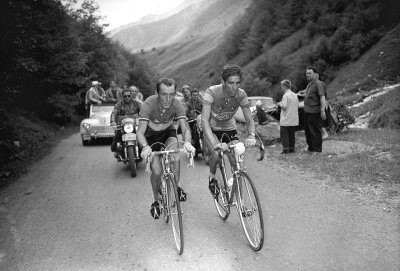
Gaul and Bahamontes
In 1958, he went back to the Tour and was widely considered a favourite. He won the King of the Mountains, but this year he faced one obstacle even he couldn't defeat - Charly Gaul. Bahamontes was arguably a better climber than Gaul on account of his consistency and ability to perform well in all condition but for three weeks that year Gaul found the form of his life and, when the weather at the Tour was as cold and as miserable as he liked it to be, he could climb like no rider seen before nor since, taking the General Classification after making no less a mountain than Ventoux look easy; Bahamontes settled for King of the Mountains again. However, Gaul could only perform well in the sort of weather that had his rivals wishing they'd taken jobs in heated offices; while he could still beat Bahamontes when they escaped together during Stage 17 a year later, the weather was warmer throughout the race and he was simply unable to achieve the consistency he'd have needed to beat the Spaniard and finished out of the top ten overall. Bahamontes took the General Classification and the King of the Mountains that year, twelve years to the day since he won his first race. Some say that he did so only because the rider's agent Daniel Dousset ordered his riders on the French team to let Bahamontes win because he knew that was the only way Henri Anglade, who was handled by rival agent Roger Piel and would be a far greater threat to Dousset's rider Jacques Anquetil in the lucrative post-Tour "round the houses" races than pure climber Bahamontes, could be prevented from winning. Most people who were there to see Bahamontes ride say he would have won anyway.

All in all, Bahamontes won a total of nine King of the Mountains (one at the Giro, two at the Vuelta, six at the Tour - when Lucien van Impe looked like winning his seventh in 1975, he decided to hold back and let the competition go to another rider rather than beat the record set by the man he considered the master). Like Gaul, he had the looks of a grimpeur but didn't ride like one: he was stiff on the bike and rode sitting upright; unlike Gaul, who looked as though he'd been born with the bike attacked to his body, he never seemed quite comfortable and would change his hand positions on the handlebars almost constantly.

In common with most climbers (but not Gaul, who feared nothing but himself) Bahamontes had a great dislike of descending because he was too light to be able to prevent the bike skipping around at high speed. During his amateur career Bahamontes once came off the road and fell into a cactus, and he never liked to take risks after that, often unclipping himself from the toe-straps so he could dab a foot on the ground. According to legend, he was so afraid to descend the Galibier alone having ridden up it solo in the Tour that he stopped, sat down on a wall and had an ice-cream while waiting for the rest of the riders to catch up. Rather than risk disqualification or a fine, the Spanish managers ordered the team mechanic to pretend he was fixing a fault with the bike; but the rider has suggested that this wasn't the case and he was simply afraid to descend alone.

 Bahamontes with Gaul (left) 
At the time of writing, Bahamontes is 85 years old and still very much with us. Mentally, he appears to be still as sharp as he was when he won his Tour; but long gone is the impulsive, sometimes rather infuriating rider who threw his bike over a cliff at the 1956 Tour so that his team mates wouldn't be able to change his mind about abandoning, replaced by a likable, charming and exquisitely mannered gentleman. During the last two decades of Gaul's life, when he had been found living alone in a forest hut with little memory of who had once been and was then returned to the world by the woman who would become his wife, Bahamontes befriended him; he also became a close friend of his childhood hero Berrendero.


Other riders born on this day: Stephen Gallagher (Northern Ireland, 1980); Richard England (Australia, 1981); Dale Stetina (USA, 1956); Eric Thompson (Great Britain, 1927); Armen Arslanian (Lebanon, 1960); Saber Mohamed Hasan (Bahrain, 1967); Jens Juul Eriksen (Denmark, 1926); Obed Ngaite (Central African Republic, 1967).

Tuesday, 9 July 2013

Daily Cycling Facts 09.07.2013

Tour de France 1905
11 stages, 2,994km.
In 1905, the Tour had seen so much cheating that several riders were banned for life and director Henri Desgrange swore that the race would never be held again. However, by now the race had grown to be far bigger than anyone could have hoped - and was bringing in a lot of money too, so it didn't take too much persuasion to convince him that it should go ahead again in 1905. There would be big changes: the overall winner would now be decided on points rather than according to accumulated time, with the winner of each stage receiving one point, second place two points and third three points and so on plus an extra point for every five minutes between them and the next rider up to a maximum of elevem (the idea was, obviously, to end with as few points as possible, rather like observed trials mountain biking); the intention being that the finishing order became more important rather than winning in as short a finishing time counted, so that riders wouldn't be tempted to cheat by completing parts of a stage by car or train. Another change was that the stages were much shorter (the shortest in 1905 was more than 200km shorter than the shortest in 1904) and would start in the morning rather than the afternoon to ensure they finished during daylight, when officials could better keep an eye on what riders were up to - one method of cheating apparently used widely in 1904 (though with little evidence, it seems) had riders gripping a cork attached by wire to a team car, things such as this could now be far more easily noticed. It worked: none of the top ten in the General Classification nor any stage winner had to be disqualified (that may have been very different had doping controls existed - in those days before reliable tests, riders swallowed, sniffed and injected all sorts of things). Another change permitted riders to be paced by another cyclist, a tandem or a motor vehicle - this had not previously been allowed in the Tour, which was one of the first major cycle races to prevent riders from making use of pacing.

Ballon d'Alsace - the Tour's first mountain (well, sort of...)
In both of the previous editions, the race had been over the Col de la République; Desgrange had preferred to keep this quiet because he felt it would discourage riders from entering. A few route organisers had suggested adding more mountains, perhaps with points for the riders who got to the top fastest, but Desgrange was reluctant. Before the 1905 route was chosen, a L'Auto staff member named Alphonse Steinès took him for a car trip over the Col Bayard and Ballon d'Alsace and, showing him how spectacular a mountain stage could be, finally convinced him - though he made Steinès agree that, should the mountains prove too hard and ruin the race (or, as he had worried before, the riders were robbed by bandits or eaten by bears), the blame would be entirely his and not Desgrange's. Thus, Ballon d'Alsace was included in Stage 2 and the Rampe de Laffrey and Bayard in Stage 4; the first official climbs in the Tour de France.

Aucouturier
Maurice Garin had initially won in 1904 but then been banned for two years; several other top riders were banned for varying periods of time. There was, therefore, no obvious favourite - Henri Cornet was eventually declared winner the previous year, but since he'd originally been fifth and more than three hours slower that Garin he wasn't considered a contender; Louis Trousselier, Hippolyte Aucouturier, Antony Wattelier and René Pottier looked likely to do well, but really nobody knew.

The organisers thought they'd found a way to rein in badly-behaving riders, but the French public were another matter entirely and in the very first stage all the riders (except, rather suspiciously, Jean-Baptiste Dortinacq) had to stop and repair punctures after persons unknown spread 125kg  spread across the road. However, Trousselier was able to catch him up and win the stage - he had to: he was in the Army at the time and had requested permission to enter the race but was only allowed 24 hours leave. He believed, correctly, that if he won the stage his commanding officer would extend his leave - but it was a huge risk to take because he could very easily have ended up facing a court martial (which have since been abolished in France); and he was so determined to escape that prospect that he set a pace so high only fifteen riders finished within the time limit. Fifteen others finished after the limit and the remainder eventually showed up on a train. Desgrange was understandably furious and announced that the race was being abandoned immediately, but the riders managed to talk him round after accepting a 75 point penalty.

Pottier
Aucouturier, Trousselier, Cornet and Pottier got away on the Ballon d'Alsace on Stage 2 after avoiding more nails spread over the road; the heavily-built Aucouturier and Trousselier rapidly finding that they were at a disadvantage when the terrain headed upward. Cornet, still only 20 years old (his 1904 victory makes him the youngest Tour winner ever), found that he wasn't able to keep up with Pottier and was the next to be dropped, thus Pottier became the first man up the first mountain in the Tour de France. On the way down, he discovered the flip-side to the lighter-man-has-the-advantage-when-climbing rule - a heavier rider usually has the advantage when descending because his weight prevents the bike skipping around: Aucouturier caught hom and won the stage. Unfortunately, Pottier wouldn't be able to get his revenge when the race reached Bayard, because in Stage 3 he developed tendinitis and abandoned (some sources say he hurt his ankle when he collided with a spectator). Trousselier won again; not far behind him in second place was Lucien Petit-Breton, who would become the first man to win the Tour twice a few years later.

Stage 4, with the Rampe de Laffrey, was where Desgrange must have been convinced once and for all that the riders could cope with the mountains - as one of France's steepest roads (in places, it reaches a gradient of 18%; this has also made it one of the country's most dangerous roads - four accidents to have taken place there are considered the worst motoring accidents in French history  and there used to be a warning sign depicting a skull with flashing lights for eyes until someone decided it was in bad taste), if the riders got up it they could cope with anything else. Julien Maitron, who won Stage 6 in 1910, was first to the top of both climbs but once again Aucouturier was fastest on the way down; Trousselier was second.

Louis Trousselier
Trousselier won Stage 5 and second on Stage 6, by which time it was impossible for the majority of riders to catch up in the General Classification and most of those that - through a miracle - could had given up and were competing for second. On Stage 7 he had a puncture shortly after the start line, at which point the entire peloton seized its chance and attacked - when, after 200km of chasing, he caught them and then won the stage, they all gave up.

Pottier, despite abandoning, was declared the Tour's very first meilleur grimpeur ("best climber"). Many years later, the meilleur grimpeur would evolve into the King of the Mountains classification. Trousselier earned 6,950 francs for winning the General Classification. The night after doing so he gambled it all away. Meanwhile, Desgrange's gamble paid dividends - rather than the disaster he'd feared, the riders had got up all the mountains and the spectators had been more impressed than ever, even though quite a few of them probably would have liked to have seen a rider being eaten by a bear though). Therefore, he was able to report to L'Auto's owners that "his" race (which had actually been thought up by Géo Lefèvre, one of the paper's more junior reporters) had increased the paper's daily circulation to 100,000 copies. The next year, the Massif Central was added and, a few years later, the Pyrenees and then the Alps.

Top Ten Final General Classification
1 Louis Trousselier (FRA) Peugeot-Wolber 35
2 Hippolyte Aucouturier (FRA) Peugeot-Wolber 61
3 Jean-Baptiste Dortignacq (FRA) Saving 64
4 Emile Georget (FRA) JC Cycles 123
5 Lucien Petit-Breton (FRA) JC Cycles 155
6 Augustin Ringeval (FRA) JC Cycles 202
7 Paul Chauvet (FRA) Griffon 231
8 Philippe Pautrat (FRA) JC Cycles 248
9 Julien Maitron (FRA) Peugeot-Wolber/Griffon 255
10 Julien Gabory (FRA) JC Cycles 304


Federico Bahamontes
Bahamontes, The Eagle of Toledo
When he was 13, Federico Bahamontes and his father Julián became refugees of the Spanish Civil War and went to Madrid in search of food and shelter. Julián found work breaking rocks and earned enough money to start a fresh produce market stall; Federico, like so many boys that became great cyclists, helped support the family by delivering groceries on a heavy utility bike. In 1942 he saw Julián Berrendero win the Vuelta a Espana and became smitten with cycling, which later persuaded him to start racing - and on the 18th of July in 1947, he won the first event he'd ever entered.

Born in Santo-Domingo-Caudilla on this day in 1928, Bahamontes was still an amateur when he won a stage and the King of the Mountains in the 1954 Vuelta a Asturias. That race that brought him to the attention of the Spanish Federation, which wasted no time in recruiting him for the national team that would compete in the 1954 Tour de France - the team coach recognised that there was little he could do to improve on the raw natural talent Bahamontes displayed and sent him off with only one instruction: "Try to win it." He didn't, but he did lead the King of the Mountains from the first stage it was awarded (Stage 11) all the way through to the end of the race. He won the Mountains classification at the Giro d'Italia the next year too, then at the Vuelta a Espana the year after that.

Enough climbing talent to make a thousand mortal grimpeurs:
Gaul and Bahamontes
In 1958, he went back to the Tour and was widely considered a favourite. He won the King of the Mountains, but this year he faced one obstacle even he couldn't defeat - Charly Gaul. Bahamontes was arguably a better climber than Gaul on account of his consistency and ability to perform well in all condition but for three weeks that year Gaul found the form of his life and, when the weather at the Tour was as cold and as miserable as he liked it to be, he could climb like no rider seen before nor since, taking the General Classification after making no less a mountain than Ventoux look easy; Bahamontes settled for King of the Mountains again. However, Gaul could only perform well in the sort of weather that had his rivals wishing they'd taken jobs in heated offices; while he could still beat Bahamontes when they escaped together during Stage 17 a year later, the weather was warmer throughout the race and he was simply unable to achieve the consistency he'd have needed to beat the Spaniard and finished out of the top ten overall. Bahamontes took the General Classification and the King of the Mountains that year, twelve years to the day since he won his first race. Some say that he did so only because the rider's agent Daniel Dousset ordered his riders on the French team to let Bahamontes win because he knew that was the only way Henri Anglade, who was handled by rival agent Roger Piel and would be a far greater threat to Dousset's rider Jacques Anquetil in the lucrative post-Tour "round the houses" races than pure climber Bahamontes, could be prevented from winning. Most people who were there to see Bahamontes ride say he would have won anyway.

All in all, Bahamontes won a total of nine King of the Mountains (one at the Giro, two at the Vuelta, six at the Tour - when Lucien van Impe looked like winning his seventh in 1975, he decided to hold back and let the competition go to another rider rather than beat the record set by the man he considered the master). Like Gaul, he had the looks of a grimpeur but didn't ride like one: he was stiff on the bike and rode sitting upright; unlike Gaul, who looked as though he'd been born with the bike attacked to his body, he never seemed quite comfortable and would change his hand positions on the handlebars almost constantly.

In common with most climbers (but not Gaul, who feared nothing but himself) Bahamontes had a great dislike of descending because he was too light to be able to prevent the bike skipping around at high speed. During his amateur career Bahamontes once came off the road and fell into a cactus, and he never liked to take risks after that, often unclipping himself from the toe-straps so he could dab a foot on the ground. According to legend, he was so afraid to descend the Galibier alone having ridden up it solo in the Tour that he stopped, sat down on a wall and had an ice-cream while waiting for the rest of the riders to catch up. Rather than risk disqualification or a fine, the Spanish managers ordered the team mechanic to pretend he was fixing a fault with the bike; but the rider has suggested that this wasn't the case and he was simply afraid to descend alone.

 Bahamontes with Gaul (left) 
At the time of writing, Bahamontes is 85 years old and still very much with us. Mentally, he appears to be still as sharp as he was when he won his Tour; but long gone is the impulsive, sometimes rather infuriating rider who threw his bike over a cliff at the 1956 Tour so that his team mates wouldn't be able to change his mind about abandoning, replaced by a likable, charming and exquisitely mannered gentleman. During the last two decades of Gaul's life, when he had been found living alone in a forest hut with little memory of who had once been and was then returned to the world by the woman who would become his wife, Bahamontes befriended him; he also became a close friend of his childhood hero Berrendero.


Other riders born on this day: Stephen Gallagher (Northern Ireland, 1980); Richard England (Australia, 1981); Dale Stetina (USA, 1956); Eric Thompson (Great Britain, 1927); Armen Arslanian (Lebanon, 1960); Saber Mohamed Hasan (Bahrain, 1967); Jens Juul Eriksen (Denmark, 1926); Obed Ngaite (Central African Republic, 1967).

Monday, 9 July 2012

Daily Cycling Facts 09.07.12

Tour de France 1905
11 stages, 2,994km.
In 1905, the Tour had seen so much cheating that several riders were banned for life and director Henri Desgrange swore that the race would never be held again. However, by now the race had grown to be far bigger than anyone could have hoped - and was bringing in a lot of money too, so it didn't take too much persuasion to convince him that it should go ahead again in 1905. There would be big changes: the overall winner would now be decided on points rather than according to accumulated time, with the winner of each stage receiving one point, second place two points and third three points and so on plus an extra point for every five minutes between them and the next rider up to a maximum of elevem (the idea was, obviously, to end with as few points as possible, rather like observed trials mountain biking); the intention being that the finishing order became more important rather than winning in as short a finishing time counted, so that riders wouldn't be tempted to cheat by completing parts of a stage by car or train. Another change was that the stages were much shorter (the shortest in 1905 was more than 200km shorter than the shortest in 1904) and would start in the morning rather than the afternoon to ensure they finished during daylight, when officials could better keep an eye on what riders were up to - one method of cheating apparently used widely in 1904 (though with little evidence, it seems) had riders gripping a cork attached by wire to a team car, things such as this could now be far more easily noticed. It worked: none of the top ten in the General Classification nor any stage winner had to be disqualified (that may have been very different had doping controls existed - in those days before reliable tests, riders swallowed, sniffed and injected all sorts of things). Another change permitted riders to be paced by another cyclist, a tandem or a motor vehicle - this had not previously been allowed in the Tour, which was one of the first major cycle races to prevent riders from making use of pacing.

Ballon d'Alsace - the Tour's first mountain (well, sort of...)
In both of the previous editions, the race had been over the Col de la République; Desgrange had preferred to keep this quiet because he felt it would discourage riders from entering. A few route organisers had suggested adding more mountains, perhaps with points for the riders who got to the top fastest, but Desgrange was reluctant. Before the 1905 route was chosen, a L'Auto staff member named Alphonse Steinès took him for a car trip over the Col Bayard and Ballon d'Alsace and, showing him how spectacular a mountain stage could be, finally convinced him - though he made Steinès agree that, should the mountains prove too hard and ruin the race (or, as he had worried before, the riders were robbed by bandits or eaten by bears), the blame would be entirely his and not Desgrange's. Thus, Ballon d'Alsace was included in Stage 2 and the Rampe de Laffrey and Bayard in Stage 4; the first official climbs in the Tour de France.

Aucouturier
Maurice Garin had initially won in 1904 but then been banned for two years; several other top riders were banned for varying periods of time. There was, therefore, no obvious favourite - Henri Cornet was eventually declared winner the previous year, but since he'd originally been fifth and more than three hours slower that Garin he wasn't considered a contender; Louis Trousselier, Hippolyte Aucouturier, Antony Wattelier and René Pottier looked likely to do well, but really nobody knew.

The organisers thought they'd found a way to rein in badly-behaving riders, but the French public were another matter entirely and in the very first stage all the riders (except, rather suspiciously, Jean-Baptiste Dortinacq) had to stop and repair punctures after persons unknown spread 125kg  spread across the road. However, Trousselier was able to catch him up and win the stage - he had to: he was in the Army at the time and had requested permission to enter the race but was only allowed 24 hours leave. He believed, correctly, that if he won the stage his commanding officer would extend his leave - but it was a huge risk to take because he could very easily have ended up facing a court martial (which have since been abolished in France); and he was so determined to escape that prospect that he set a pace so high only fifteen riders finished within the time limit. Fifteen others finished after the limit and the remainder eventually showed up on a train. Desgrange was understandably furious and announced that the race was being abandoned immediately, but the riders managed to talk him round after accepting a 75 point penalty.

Pottier
Aucouturier, Trousselier, Cornet and Pottier got away on the Ballon d'Alsace on Stage 2 after avoiding more nails spread over the road; the heavily-built Aucouturier and Trousselier rapidly finding that they were at a disadvantage when the terrain headed upward. Cornet, still only 20 years old (his 1904 victory makes him the youngest Tour winner ever), found that he wasn't able to keep up with Pottier and was the next to be dropped, thus Pottier became the first man up the first mountain in the Tour de France. On the way down, he discovered the flip-side to the lighter-man-has-the-advantage-when-climbing rule - a heavier rider usually has the advantage when descending because his weight prevents the bike skipping around: Aucouturier caught hom and won the stage. Unfortunately, Pottier wouldn't be able to get his revenge when the race reached Bayard, because in Stage 3 he developed tendinitis and abandoned (some sources say he hurt his ankle when he collided with a spectator). Trousselier won again; not far behind him in second place was Lucien Petit-Breton, who would become the first man to win the Tour twice a few years later.

Stage 4, with the Rampe de Laffrey, was where Desgrange must have been convinced once and for all that the riders could cope with the mountains - as one of France's steepest roads (in places, it reaches a gradient of 18%; this has also made it one of the country's most dangerous roads - four accidents to have taken place there are considered the worst motoring accidents in French history  and there used to be a warning sign depicting a skull with flashing lights for eyes until someone decided it was in bad taste), if the riders got up it they could cope with anything else. Julien Maitron, who won Stage 6 in 1910, was first to the top of both climbs but once again Aucouturier was fastest on the way down; Trousselier was second.

Louis Trousselier
Trousselier won Stage 5 and second on Stage 6, by which time it was impossible for the majority of riders to catch up in the General Classification and most of those that - through a miracle - could had given up and were competing for second. On Stage 7 he had a puncture shortly after the start line, at which point the entire peloton seized its chance and attacked - when, after 200km of chasing, he caught them and then won the stage, they all gave up.

Pottier, despite abandoning, was declared the Tour's very first meilleur grimpeur ("best climber"). Many years later, the meilleur grimpeur would evolve into the King of the Mountains classification. Trousselier earned 6,950 francs for winning the General Classification. The night after doing so he gambled it all away. Meanwhile, Desgrange's gamble paid dividends - rather than the disaster he'd feared, the riders had got up all the mountains and the spectators had been more impressed than ever, even though quite a few of them probably would have liked to have seen a rider being eaten by a bear though). Therefore, he was able to report to L'Auto's owners that "his" race (which had actually been thought up by Géo Lefèvre, one of the paper's more junior reporters) had increased the paper's daily circulation to 100,000 copies. The next year, the Massif Central was added and, a few years later, the Pyrenees and then the Alps.

Top Ten Final General Classification
1 Louis Trousselier (FRA) Peugeot-Wolber 35
2 Hippolyte Aucouturier (FRA) Peugeot-Wolber 61
3 Jean-Baptiste Dortignacq (FRA) Saving 64
4 Emile Georget (FRA) JC Cycles 123
5 Lucien Petit-Breton (FRA) JC Cycles 155
6 Augustin Ringeval (FRA) JC Cycles 202
7 Paul Chauvet (FRA) Griffon 231
8 Philippe Pautrat (FRA) JC Cycles 248
9 Julien Maitron (FRA) Peugeot-Wolber/Griffon 255
10 Julien Gabory (FRA) JC Cycles 304


Federico Bahamontes
Bahamontes, The Eagle of Toledo
When he was 13, Federico Bahamontes and his father Julián became refugees of the Spanish Civil War and went to Madrid in search of food and shelter. Julián found work breaking rocks and earned enough money to start a fresh produce market stall; Federico, like so many boys that became great cyclists, helped support the family by delivering groceries on a heavy utility bike. In 1942 he saw Julián Berrendero win the Vuelta a Espana and became smitten with cycling, which later persuaded him to start racing - and on the 18th of July in 1947, he won the first event he'd ever entered.

Born in Santo-Domingo-Caudilla on this day in 1928, Bahamontes was still an amateur when he won a stage and the King of the Mountains in the 1954 Vuelta a Asturias. That race that brought him to the attention of the Spanish Federation, which wasted no time in recruiting him for the national team that would compete in the 1954 Tour de France - the team coach recognised that there was little he could do to improve on the raw natural talent Bahamontes displayed and sent him off with only one instruction: "Try to win it." He didn't, but he did lead the King of the Mountains from the first stage it was awarded (Stage 11) all the way through to the end of the race. He won the Mountains classification at the Giro d'Italia the next year too, then at the Vuelta a Espana the year after that.

Enough climbing talent to make a thousand mortal grimpeurs:
Gaul and Bahamontes
In 1958, he went back to the Tour and was widely considered a favourite. He won the King of the Mountains, but this year he faced one obstacle even he couldn't defeat - Charly Gaul. Bahamontes was arguably a better climber than Gaul on account of his consistency and ability to perform well in all condition but for three weeks that year Gaul found the form of his life and, when the weather at the Tour was as cold and as miserable as he liked it to be, he could climb like no rider seen before nor since, taking the General Classification after making no less a mountain than Ventoux look easy; Bahamontes settled for King of the Mountains again. However, Gaul could only perform well in the sort of weather that had his rivals wishing they'd taken jobs in heated offices; while he could still beat Bahamontes when they escaped together during Stage 17 a year later, the weather was warmer throughout the race and he was simply unable to achieve the consistency he'd have needed to beat the Spaniard and finished out of the top ten overall. Bahamontes took the General Classification and the King of the Mountains that year, twelve years to the day since he won his first race. Some say that he did so only because the rider's agent Daniel Dousset ordered his riders on the French team to let Bahamontes win because he knew that was the only way Henri Anglade, who was handled by rival agent Roger Piel and would be a far greater threat to Dousset's rider Jacques Anquetil in the lucrative post-Tour "round the houses" races than pure climber Bahamontes, could be prevented from winning. Most people who were there to see Bahamontes ride say he would have won anyway.

All in all, Bahamontes won a total of nine King of the Mountains (one at the Giro, two at the Vuelta, six at the Tour - when Lucien van Impe looked like winning his seventh in 1975, he decided to hold back and let the competition go to another rider rather than beat the record set by the man he considered the master). Like Gaul, he had the looks of a grimpeur but didn't ride like one: he was stiff on the bike and rode sitting upright; unlike Gaul, who looked as though he'd been born with the bike attacked to his body, he never seemed quite comfortable and would change his hand positions on the handlebars almost constantly. In common with most climbers (but not Gaul, who feared nothing but himself) Bahamontes had a great dislike of descending because he was too light to be able to prevent the bike skipping around at high speed. During his amateur career he once came off the road and fell into a cactus, and he never liked to take risks after that, often unclipping himself from the toe-straps so he could dab a foot on the ground; in the Tour he was so worried about descending the Galibier alone that he stopped to wait for the peloton to catch up. Rather than risk disqualification or a fine, the Spanish managers ordered the team mechanic to pretend he was fixing a fault with the bike; but Bahamontes never pretended that he'd stopped for any reason other than being scared and passed the time as he waited by having an ice cream.

 Bahamontes with Gaul (left) at the memorial to 
Francois Faber and Nicolas Frantz
At the time of writing, Bahamontes is 84 years old and still very much with us. Mentally, he appears to be still as sharp as he was when he won his Tour; but long gone is the impulsive, sometimes rather infuriating rider who threw his bike over a cliff at the 1956 Tour so that his team mates wouldn't be able to change his mind about abandoning, replaced by a likable, charming and exquisitely mannered gentleman. During the last two decades of Gaul's life, when he had been found living alone in a forest hut with little memory of who had once been and was then returned to the world by the woman who would become his wife, Bahamontes befriended him; he also became a close friend of his childhood hero Berrendero.


Born on this day: Stephen Gallagher (Northern Ireland, 1980); Richard England (Australia, 1981); Dale Stetina (USA, 1956); Eric Thompson (Great Britain, 1927); Armen Arslanian (Lebanon, 1960); Saber Mohamed Hasan (Bahrain, 1967); Jens Juul Eriksen (Denmark, 1926); Obed Ngaite (Central African Republic, 1967).

Sunday, 20 May 2012

Giro d'Italia Stage 15

Lecco
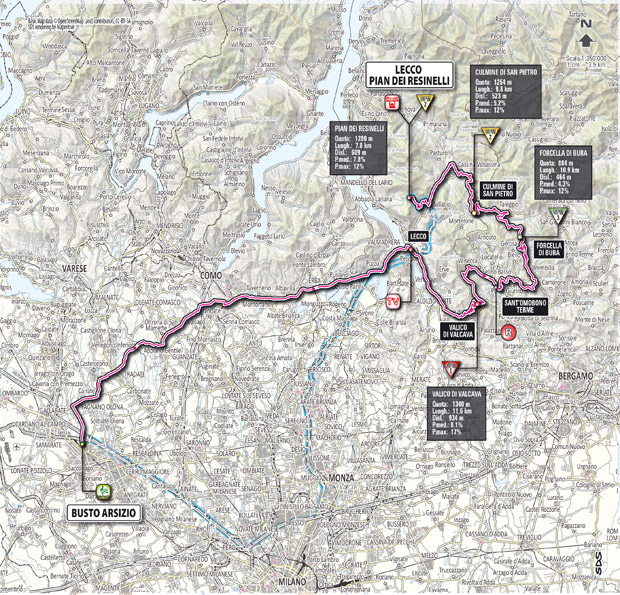
Today is the first day of the third week of the Giro and the race returns for a second day in the high mountains with a 169km parcours that takes in four tough categorised ascents and numerous uncategorised climbs to sap the rider's strength and make the big ones even harder. (Map, profile)

The stage starts in Busto Arsizio, a city that can proudly claim to have been a real thorn in the side of the Fascists during the Second World War as the locals took to the hills and fought savagely for freedom, then in April 1945 set up the first free radio station in Italy since the Fascists took power. The city escaped bombing during the War - it was hit by only one bomb - and as a result many of the Art Nouveau villas built by the wealthy in the early 20th Century survive, as do numerous older buildings. It was the birthplace of cyclist Michele Mara (02.10.1903), a sprinter who won the silver medal at the World Championships of 1928, Milan-San Remo, the Giro di Lombardia and five stages (1, 9, 10, 12, 15) of the Giro d'Italia in 1930, then two more stages (5 and 9) in the Giro d'Italia of 1931; his younger and less talented brother Enrico (07.08.1912), who was 11th in the Giro di Lombardia of 1940; Luigi Casola (11.07.1921), winner of four stages of the Giro d'Italia between 1948 and 1951; Albino Crespi (03.01.1930), winner of Stage 3 in the Giro d'Italia of 1953; Valerio Lualdi (31.08.1951), who raced in ten Giri d'Italia and finished nine, won various other races and rode as a domestique for Francesco Moser; Dario Andriotto (25.10.1972), the 1994 amateur World Time Trial Champion and also a veteran of ten Giri d'Italia (he finished six). Unsurprisingly for a city that ha produced so many world-class cyclists, it once boasted a race - the Coppa Città di Busto Arsizio was first held in 1923, when it was won by Libero Ferrario, and last held in 1967 when Dino Zandegù won.

Valico di Valcava
The first 70.2km were relatively flat with Albese con Cassano the highest point at 398m - none of the climbs in this section looked challenging. Lecco, on the banks of Lake Como at 61.9km, is familiar from the Giro di Lombardia. It would be a beautiful city no matter where it was located, but with the high mountains the riders are about to climb providing the perfect backdrop to the lake and grand buildings, it's a contender for most beautiful in Italy. The first of those mountains was Cat 1 Valico di Valcava, rising to 1,340m, 11.8km in length with an average gradient of 8% and - according to Italian Wikipedia, a maximum of 18% around 4km from the top.

Cat 3 Forcella di Bura began at 113.5km, climbs to 884m with an average 3% gradient over 7.4km, then Cat 2 Culmine di San Pietro began at 144km and is 23.3km in length, long enough to create a low average gradient of 4.4km (max. 12%) despite the 1,254m altitude. Finally, Piani dei Resinelli began at 161.2km and climbs over 7.8km to the finish line located on a plateau at an altitude of 1,280m, giving an average gradient of 6.6%.

The stage's highest profile was the man who wasn't supposed to be here - Frank Schleck (RadioShack-Nissan), who increasingly looks as though he's never going to recapture the form he had in the past this year, abandoned after 28km due to pain from a shoulder injury suffered in Stage 11... or could it be that he's decided to chalk this one up to experience and go home to concentrate on training for the Tour with Andy? We shall see.

Matteo Rabottini
For Matteo Rabottini (Farnese Vini-Selle Italia), meanwhile, the race went better than he could even have hoped: he attacked early on, then rode hard to keep his lead all the way to the finish line. It looked as though his efforts were in vain when ‏Joaquim Rodriguez (Katusha) caught him with 400m to go, this sort of uphill ending being precisely the sort of terrain over which he's all but unbeatable; which is probably why he looked so surprised when the Italian found a new reserve of strength and then hung on in his slipstream before swinging out just metres from the line and taking the most unexpected victory of the 2012 Giro so far with a time of 5h15'30". Alberto Losada was 23" behind them for third place. Rodriguez, who equaled Rabottini's time, took the maglia rosa from Ryder Hesjedal and now has an advantage of 30" in the General Classification. Mark Cavendish, who was 172nd for the stage, remains leader of the Points competition

Top Ten

1 RABOTTINI Matteo FAR 5:15:30 0:00
2 RODRIGUEZ OLIVER Joaquin KAT 5:15:30 0:00
3 LOSADA ALGUACIL Alberto KAT 5:15:53 0:23
4 HENAO MONTOYA Sergio Luis SKY 5:15:55 0:25
5 SCARPONI Michele LAM 5:15:55 0:25
6 BASSO Ivan LIQ 5:15:55 0:25
7 PIRAZZI Stefano COG 5:15:59 0:29
8 KREUZIGER Roman AST 5:15:59 0:29
9 GADRET John ALM 5:15:59 0:29
10 TXURRUKA Amets EUS 5:15:59 0:29 
(Full stage result and GC)


Monday is a rest day - and with three more high mountain stages, one medium, one flat and an individual time trial till to go, the riders will welcome it.

Tuesday, 17 April 2012

Cycling News from around the World 17.04.12

Contador back for Eneco - Galimzyanov accepts EPO repsonsibility - Colour change for Giro KOM


Contador will race Eneco, hopes for Worlds
Contador for Eneco
Alberto Contador, currently serving a back-dated two-year suspension, has confirmed that he plans to make his return at the Eneco Tour which begins this year on the 6th of August - one day after his ban expires. "I can also confirm that I will ride the Vuelta a España," the 29-year-old rider told Spanish radio station Cadena Ser. "I'm very motivated for every race I attend - also, to race your home Grand Tour is special, and I will be even more motivated than if I'd got eighty days of racing in my legs."

There had been much discussion among fans after the ban was announced on the subject of whether any teams would want him once he was free to race, UCI rules stating that a rider's results do not count towards a team's success for a period of two years after a ban. However, Contador says that no fewer than six squads have been after him. "Without a doubt, though, my priority is SaxoBank - they gave me their unconditional support through difficult times, which is something money can't buy," he adds, then goes on to say that he hopes to compete in the World Championships: "I have applied for the National team in both the road race and the time trial. How do I get there? I'm working hard, I've made sacrifices, I allowed myself only a few days off for Easter."

Galmizyanov: Doping "was my personal decision and responsibility"
A press statement released by Katusha says that Denis Galimzyanov  "takes his full personal responsibility" after becoming subject to a provisional suspension after a failed test for EPO. Laura Meseguer, a journalist with Pedalier Pro magazine, used her Twitter account to publish a copy of a letter apparently from Galimzyanov to the team in which the rider declines his right for his B sample to be tested, a virtual admission of guilt, going on to say "Katusha Team has nothing to do with what happened. It was my personal decision and responsibility."

CC BY-SA 3.0 http://creativecommons.org/licenses/by-sa/3.0/deed.en
Denis Galimzyanov
The letter in full reads as follows:
I, the undersigned Denis Galimzyanov, a rider for the Katusha Team, wish to clarify the current matter of my positive doping tests. On the 22nd of March in 2012, whilst in Italy, I received an out-of-competition visit from anti-doping control officials. One month later, a urine sample taken during that visit indicated the presence of EPO.  
I recognise this is indication that I have used a banned substance. 
I fully realise what I have done. 
I deeply regret what happened, and I apologise to the entire team and my team mates along with my fans whom I have disappointed. 
I will accept an appropriate punishment. 
I wish to draw PARTICULAR ATTENTION to the fact that Katusha Team was not involved in what happened. No team member knew or could know about what I was doing. It was my decision and my responsibility alone. 
I decline my right to request analysis of my B sample.
(Thanks for the translation, Tabs Petrowa)

Galmizyanov's ban will raise awkward questions for Katusha, which has already faced attacks over its record on doping despite new manager Hans-Michael Holczer's much-vaunted zero-tolerance policy. Chief doctor, Andrei Mikhailov, received a suspended prison sentence for doping offences in 1998; while another team medic Massimo Besnati was prosecuted for illegal possession of steroids in the wake of the notorious Le Blitz du Giro in 2001 when police raided team hotels. The team was again raided by Italian police in 2011.

Giro King of the Mountains feelin' blue
The King of the Mountains jersey at the Giro d'Italia this year will be blue rather than green, says Tuttobiciweb. The competition has been a part of the Giro since 1933, when it and the General Classification were both won by Alfredo Binda; this will be the first major change to the jersey since 1974. (More from Tuttobiciweb)


Other News
Spanish journalist Sergi López-Egea says that Caja Rural are in line for a Vuelta a Espana wildcard entry this year. Teams will be officially announced on Monday.

Sergi López-Egea @sergi_lopezegea
Segunda noticia ciclista del día. ¡¡¡Enhorabuena a Caja Rural!! Debutará en la Vuelta 2012

Friday, 13 April 2012

Amstel Gold Race 2012

The Parcours (click to enlarge)
We've all enjoyed a spectacular few weeks'-worth of bike racing in Flanders at the Cobbled Classics - now it's time to move on to the Amstel Gold Race, the first of the Ardennes Classics. This one is held in a part of Limburg, the most southerly part of the Netherlands, that were it not for a land corridor that at its narrowest is less than 5km wide would be a Dutch enclave sandwiched between Belgium and Germany. The start line is at the 17th Century Staadhuis in Maastricht (50°51'4.78"N 5°41'28.89"E), right up against the Belgian border on the western side and believed (with some dispute from Nijmegan) to be the oldest city in the country. It's also, of course, the Capital of Europe; birthplace of the European Union and euro currency.

The race consists of three parts, the first being the longest and the last the shortest, and after the flat landscape of Flanders (which, as we know, is not without some serious climbs), the beautiful Ardennes landscape is a refreshing change. It's a region of forested hills that is very different to the rest of the Netherlands - and the people too are very different. They have their own distinct folklore and traditions, their own cuisine and - most notably - their own language, Limburgish, which shares similarities with Dutch and German but is distinct and has numerous dialects of its own. Back in the early days of the 1960s and 1970s, the Gold was known as something of a sprinters' race, but as the course was altered over the years (it had to be - the first time it was run, the organisers simply drew the route on a map and completely forgot to take rivers into account) it became a climbers' race and lately it's turned into an event for the attackers (and for the last two years, Philippe Gaumont's race).

The race passes through Ubachsberg, 2007
Nevertheless, it remains hilly - There are no fewer than 31 climbs during the course of its 256.5km route and the many of them surpass 10% at some point on the way up - it's a toughie alright, and not everyone will make it to the last climb of the day. It's also well-known for large numbers of crashes - the Netherlands is a densely populated nation and Limburg is a very densely populated region where few houses have garages, meaning a lot of parked cars become an added hazard, as does Limburg's apparently inordinate love of excess street furniture.

Steephill have an altitude profile here.
Race Itinerary
Official website
Provisional start list

Kasteel Elsloo
The Parcours
The first climb, Maasberg, is only 10.7km from the startline. It's not too harsh with an average gradient of 4.4% but it reaches 11% at the steepest point - far gentler than some of the killer slopes we saw in Flanders (like the Flanders climbs, there are cobbles here) but enough to discourage the weaker members of any early breaks. Kasteel Elsloo sits at the bottom of the climb; which reveals it to be a house designed to look like a castle rather than the real thing which would have been placed in a more strategically advantageous position at the top. In fact, it began life as a brewery and was later converted into a home, then abandoned following a series of fires before passing into the ownership of a margarine magnate. Adsteeg, with a steeper average of 4.7% but less difficult at the steepest part (8%) than Maasberg, is the next climb at 32.5km and will be familiar as a common feature of the Dutch National Championship road race.

7km further up the road is Lange Raarberg (Climb 3, average 4.3%, maximum 6%). The name translates into English as "long, strange mountain;" but disappointingly it's no stranger than most other hills and derives its name from its proximity to the village Raar (which is itself not very strange and derives its name from Limburgish for "open land," perhaps once the most striking feature in the forested region). At 54.7km, the riders arrive at Bergseweg - one of the easiest climbs with a average gradient of only 3.4% - then at 66.6km it's Sibbergrubbe, also not steep (3.75%) but attractive with the sunken road (the grubbe) set in a time-worn groove in the landscape. While roads such as this are undeniably very pretty to look at, they serve to trap sharp bits of flint and thorns from surrounding fields and hedgerows and, as such, become puncture traps.

Valkenburg
Then, at 72km, it's Cauberg. Beginning at the city gates of Valkenburg and the 6th climb of the race, it's a much harder prospect with an average gradient of 8% and maximum of 12%. The hill has a long history and is the site of Roman catacombes, flint mines that date back even further into the Neolithic period and were still in used by the pre-Roman Celts who named the hill Kadeir (which, through various mutations, led to its present name), 20th Century limestone mines (the Gemeentegrot). It has serious cycling history, too - in addition to the Amstel Gold, the World Championships, Tour de France and the Vuelta a Espana have all passed this way and for the last two years there's been an important cyclo cross race here too. Just beyond Noorbeek (one of the country's most attractive villages) Wolfsberg (Climb 7) is at 93.2km - the average gradient is 5.8%, but it's 12% at the toughest part.

Loorberg, at 98.8km, is Climb 8. The average gradient of 5.1% is steeper than the previous hill but its maximum 9% makes it less daunting. At 108.9km Schweibergerweg (Climb 9) tops out at around 8.6% with an average of  3.7%, then at 115.3km Camerig (Climb 10) with its maximum gradient is 9%, but an average of 7% prevents it from ever being described as easy - in fact COTACOL, a book of hills in the Low Countries compiled by Daniel Gobert and Jean-Pierre Legros, rates it as the hardest climb in the Netherlands.

Drielandenpunt, Climb 11 at 128.3km, marks the point where the Netherlands, Belgium and Germany meet (a tripoint, which is far commoner phenomenon than many people imagine - there are 176 around the world, depending on how political borders are drawn across the globe). According to the official website, the average gradient is 3.8%. The maximum according Aerodata International Surveys  is a very tough 14.1%. The hill is also known as Sneeuwberg, snow mountain, and at 322.5m above sea level is the highest geographical point in the country. Having crossed the border for a brief sortie into Belgium, the riders climb to the village of Gemmenich (Climb 12, ave. 6.4%) and then into the Vijlenerbos forest nature reserve (Climb 13, ave. 5.1% and remaining so to the end, where a nasty little ramp closer to 13% awaits) and on to Epen - the maximum gradient for this section is 9.7% and the average 3.4%, with downhill sections. On the way, the riders begin the second part of the parcours

Monument on Gulperberg
After 144.4km, the race tackles Eperheide (Climb 14, max. 10%, ave. 4.5%) and the arrives 8km later at Gulperberg, Climb 15. One of the steepest hills in the race, when approached from the east - as will be the case - the average gradient is 8.1%, but there's a sudden increase just after halfway where the maximum is 15%. Van Plettenbergweg (Climb 16, ave. 3.7%, max. 8%) is next in line, followed by Eyserweg (Climb 17, ave. 4.4%, max. 9%) less than 2km later and Huls (Climb 18, unknown gradient) with its 128.5m TV and radio antenna 5km after that.

Vrakelberg (Climb 19) lies at 168.1km, another tough hill with an average gradient of 7.7% and maximum of 13%, the road surface here tending to be rather rough and poorly-maintained; then at 176km the riders find themselves back on Sibbergubbe (now Climb 20) as the parcours traces the same route as the first part but heads the other way. Cauberg (now Climb 21) is climbed for the second time at 181.5km, then 3.5km later they reach Geulhemmerweg (Climb 22, ave. 6.2%, max. 11.9%) and then head back into Maastricht. 5.7km later the race reaches Caldier en Keer where riders begin the third part of the parcours.

Bemelerberg
At 198.7km lies Bemelerberg (Climb 23, ave. 4%, max. 6%) where limestone outcrops, mostly created by quarrying, add greatly to the attractiveness of the landscape. Three climbs from earlier come in the next 30km: Wolfsberg (now Climb 24, 215.8km), Loorberg (now Climb 25, 221.4km) and Gulperberg (now Climb 26, 229.7km) before the race heads on to Kruisberg (Climb 27) at 235.2km - not the one that features in the Ronde van Vlaanderen, but an even steeper hill with an average gradient of 8.4% and a maximum of 17%.

Eyserbosweg is Climb 28 at 237.3km - less than 2km from Kruisberg, it's a real test with an average gradient of 7.9% and maximum of 17%, making it a likely place for some riders to abandon. Fromberg (Climb 29, ave. 4.8%, max. 9%) lies 3.7km further on, followed by Keutenberg (Climb 30) 4.5km later - this being where the race gets serious on a slope that averages 6.1% but, at the steepest point, hits a cruel 22% - the same maximum as the legendary Koppenberg. Even with Keutenberg over, the riders aren't finished climbing: after another 10.3km, they reach Cauberg (now Climb 31) for a third and final time, ascending to the finish line in Valkenburg.
Freire's not the strongest nor the
fastest, but you can achieve a lot
if you use your head (and you're
as sneaky as a thieving alleycat)
The Favourites
Philippe Gilbert (BMC) has had a slow start to the season, but he seemed to have finally come back to life at the Brabantse Pijl where he showed signs of finding the excellent form he was on last year. Having won for the last two consecutive years, Gilbert has to be  favourite today - for the top five and possibly the podium, if not for first place. If Gilbert's not got what it takes, his team mate Cadel Evans might have: he's got experience in the Ardennes having won La Flèche Wallonne in 2010 and he's got the form to bully his bike over the climbs and his rivals out of the way. Edvald Boasson Hagen (Sky) has shown time and time again that he can both sprint and climb and he also won the Enenco Tour after it came down this way and climbed some of these very hills last year. Like Gilbert, he may be outclassed for the top step of the podium, but there's a reasonable chance that he'll be somewhere nearby. Thomas Lövkvist (Sky) - the boy has form, he won the Circuit des Ardennes in 2003 and 6th at La Flèche Wallonne in 2009. Now aged 27 and entering what may be his best years, he's continually improved his climbing to become a formidable all-rounder. Samuel Sanchez showed us all at the Tour of the Basque Country that, when he wants to be, he's one of the world's very best climbers - and as part of the Euskaltel-Euskadi team that trains all year round in the High Pyrenees, these green hills hold few fears for him. Don't forget that Sanchez holds another ace in the form of his legendary descending ability, too - a rare talent for a climber. Oscar Freire (Katusha) is a devastatingly fast sprinter and not a bad as many of his ilk when it comes to the climbs, but what really stands him in good stead is his brain - there has been more than one occasion when he's made full use of the chaos at the end of a race (and this one gets really chaotic) to sneak past the big guns when none of them are looking his way and steal victory from under their front wheels.

Wildcards: a Schleck (RadioShack-Nissan), either one of them. Both are physically capable of winning this race; whether or not the actually can depends on whether they can stop pratting around and get themselves into gear (Johny must spend every day wanting to knock their heads together). Johnny Hoogerland (Vacansoleil-DCM) - stranger things have happened, and he was 4th at the Brabantse Pijl last year. (Provisional start list here)

Weather
It's looking as though rain is likely, with a 40% chance of at least some at Maastricht during the day. Chances are it'll be light showers, but some heavier squalls are possible too - when the wind blows from the north over Limburg, the hills force low-lying air currents that have crossed the Netherlands from the North Sea to suddenly increase in altitude and cool so that water vapour condenses to form clouds and precipitation. On the other side of the region at Vaals rain is slightly more likely with a 50% chance of drizzle. It's not going to be warm, either - the actual high of 9C isn't exactly toasty to begin with, but once the wind (up to 28-30kph) is taken into account it'll feel a good 4-5C lower than that. All in all, not a very nice day.

Local Sights
Kasteel Geulle
Maastricht, as might be expected, has a mixture of charming ancient and stunning modern architecture. It's very Belgian in character - which, despite the stereotype, does not mean boring because Belgians + beer + bikes = Saturnalia. Sittard (19.4km), hometown of cyclist Eddy Beugels, has what must be one of the most quintessentially European town squares anywhere on the Continent. Meersen (38.1km) is home to Kasteel Geulle, a fortified manor house surrounded by a wide moat. Raar (40.7km) has two tiny roadside chapels, one dating from the middle of the 19th Century and the other from the early 20th. Valkenburg (46.6, 66.4, 71.1, 175.8, 180.6 and 255.7km) preserves small sections of its medieval city walls and two gatehouses. Mheer (89.8, 212.3km) also has a castle, dating from the 14th Century with various 15th, 16th and 17th Century additions and Hoogcruts (95.1, 217.8km) a ruined 18th Century monastery that resembles an English country house of the same period. Mechelen (107.1, 148.9, 225.9km) has a very beautiful half-timbered house, the Heerenhof, that dates from the 12th Century. Vaals (125.5km) is a town made of important monuments with over 70 sites and buildings considered of architectural merit. Many of the villages along the parcours have half-timbered houses that in many cases are historically important.