Showing posts with label sights. Show all posts

Wednesday, 9 May 2012

Giro d'Italia Stage 5


All of Italy's ancient cities are full of historically important architecture and sites, and all have seen important events. Stage Four visits some that have more than most.

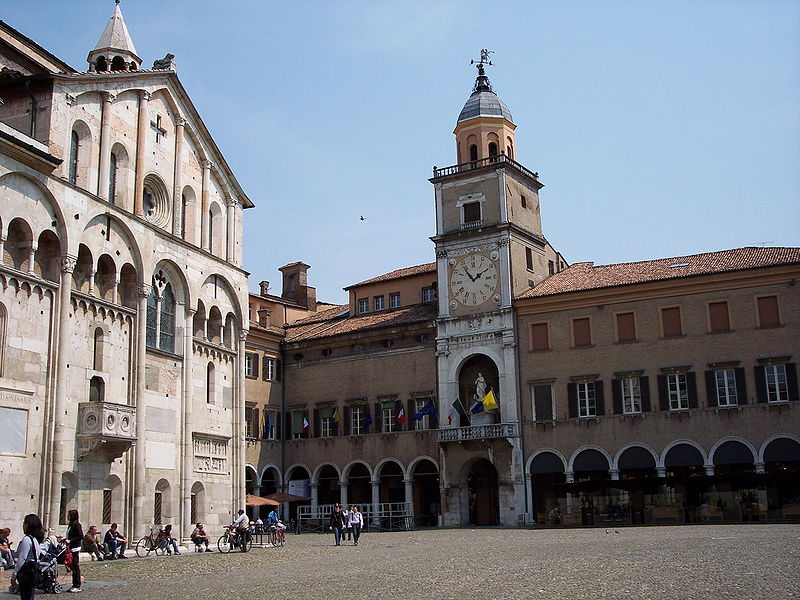
Cathedral and City Hall, Modena
Several places are worth seeing along the way. Modena is perhaps most famous nowadays as the home of Ferrari, Lamborghini, Maserati, Pagani and De Tomaso and for balsamic vinegar, but it has more than its fair share of monuments and historical buildings. Among those not to be missed are the Cathedral, begun in the 11th Century, home to the relics of Saint Geminianus (a 4th Century bishop of Modena, who tradition has it saved the city from the Huns by the rather un-Christian technique of producing a magic fog) and one of the earliest known depictions of scenes from the legend of King Arthur; the Ducal Palace and the City Hall, cobbled together during the 17th and 18th Centuries from various buildings dating from as far back as the middle of the 11th Century and forming one harmonious whole.

Collegio di Spagna, the oldest of the University' constituent
colleges
Bologna - where locals often tell you they've never heard of spaghetti bolognese - has even more, with the San Petronio Basilica (the world's fifteenth largest church), the spindly, precariously leaning Two Towers and the Baroque Cathedral especially worthy of note. It is home to a university, founded in 1088 and considered to be the oldest continually-operating example in the world. Described at the point of its foundation as "universitas magistrorum et scholarium," it gave us the word university. Once, Bologna had even more historical monuments; 44% of what once stood in the city was either completely destroyed or severely damaged during a single day of Alled bombing on the 16th of July, 1944. The city is sometimes known as La Dotta ("the learned one") on account of the University and sometimes as La Grassa ("the fat one") on account of its cuisine and prominent wealth.

Tiberius Bridge, Rimini
Rimini, where the race reaches the Adriatic, has despite being one of Europe's most popular holiday destinations and home to more than a thousand hotels, bars and clubs retained a great deal of historical sites including the Tiberius Bridge, begun in 14CE and finished seven years later (the race doesn't cross it, unfortunately) and the Castel Sismondo which, when built in the 15th Century, was outside the city; the fact that all of its towers face the city centre reveal that Sigismondo Pandolfo Malatesta, the nobleman who commissioned it, was afraid of attacks by his own subjects rather than outside forces (and a brief look at his history reveals that he was not an especially pleasant character: historian Francesco Guicciardini called him the "enemy of every peace and well-living" and Pope Pius II - who was a considerably better man that certain other popes through the ages and, rather peculiarly in the eyes of modern observers such as us, wrote a very successful and bawdy obscene play called Chrysis - accused him of "rape, adultery, and incest." Malatesta is also said to have rid himself of one unwanted wife by having a servant drown her, and the Duke of Urbino claimed that he committed incest with his own son).

Arco di Augusto, Fano
The race ends in Fano, where traces of the defensive walls built by Julius Caesar can still be seen. Th town was presented as a gift to the Frankish Kings of Germany in 754 by the Pope, but was returned to papal control in the 15th Century by Federico III da Montefeltro who had taken it from our friend Malatesta (it was Federico, in fact, who accused Malatesta of incest. Federico is the man in the famous painting by Piero della Francesca, wearing a red hat and showing his peculiar nose: he had his nasal bridge surgically removed, which must have been an unimaginably painful operation in those pre-anaesthesia times, to widen his eyesight following the loss of his right eye in an accident so that he would be better able to spot would-be assassins - because his enlightened beliefs, which included making all citizens equal under the law no matter what their social status, earned him as many enemies as friends). Fano, like Bologna, was once home to numerous towers erected by noble families in an effort to out-do one another, but none of them survive - some were destroyed by time and neglect, others by Napoleon, more during heavy shelling by the Austro-Hungarian Navy in the First World War and then by Allied bombing in the Second;then the last by retreating Nazi troops.

Friday, 13 April 2012

Amstel Gold Race 2012

The Parcours (click to enlarge)
We've all enjoyed a spectacular few weeks'-worth of bike racing in Flanders at the Cobbled Classics - now it's time to move on to the Amstel Gold Race, the first of the Ardennes Classics. This one is held in a part of Limburg, the most southerly part of the Netherlands, that were it not for a land corridor that at its narrowest is less than 5km wide would be a Dutch enclave sandwiched between Belgium and Germany. The start line is at the 17th Century Staadhuis in Maastricht (50°51'4.78"N 5°41'28.89"E), right up against the Belgian border on the western side and believed (with some dispute from Nijmegan) to be the oldest city in the country. It's also, of course, the Capital of Europe; birthplace of the European Union and euro currency.

The race consists of three parts, the first being the longest and the last the shortest, and after the flat landscape of Flanders (which, as we know, is not without some serious climbs), the beautiful Ardennes landscape is a refreshing change. It's a region of forested hills that is very different to the rest of the Netherlands - and the people too are very different. They have their own distinct folklore and traditions, their own cuisine and - most notably - their own language, Limburgish, which shares similarities with Dutch and German but is distinct and has numerous dialects of its own. Back in the early days of the 1960s and 1970s, the Gold was known as something of a sprinters' race, but as the course was altered over the years (it had to be - the first time it was run, the organisers simply drew the route on a map and completely forgot to take rivers into account) it became a climbers' race and lately it's turned into an event for the attackers (and for the last two years, Philippe Gaumont's race).

The race passes through Ubachsberg, 2007
Nevertheless, it remains hilly - There are no fewer than 31 climbs during the course of its 256.5km route and the many of them surpass 10% at some point on the way up - it's a toughie alright, and not everyone will make it to the last climb of the day. It's also well-known for large numbers of crashes - the Netherlands is a densely populated nation and Limburg is a very densely populated region where few houses have garages, meaning a lot of parked cars become an added hazard, as does Limburg's apparently inordinate love of excess street furniture.

Steephill have an altitude profile here.
Race Itinerary
Official website
Provisional start list

Kasteel Elsloo
The Parcours
The first climb, Maasberg, is only 10.7km from the startline. It's not too harsh with an average gradient of 4.4% but it reaches 11% at the steepest point - far gentler than some of the killer slopes we saw in Flanders (like the Flanders climbs, there are cobbles here) but enough to discourage the weaker members of any early breaks. Kasteel Elsloo sits at the bottom of the climb; which reveals it to be a house designed to look like a castle rather than the real thing which would have been placed in a more strategically advantageous position at the top. In fact, it began life as a brewery and was later converted into a home, then abandoned following a series of fires before passing into the ownership of a margarine magnate. Adsteeg, with a steeper average of 4.7% but less difficult at the steepest part (8%) than Maasberg, is the next climb at 32.5km and will be familiar as a common feature of the Dutch National Championship road race.

7km further up the road is Lange Raarberg (Climb 3, average 4.3%, maximum 6%). The name translates into English as "long, strange mountain;" but disappointingly it's no stranger than most other hills and derives its name from its proximity to the village Raar (which is itself not very strange and derives its name from Limburgish for "open land," perhaps once the most striking feature in the forested region). At 54.7km, the riders arrive at Bergseweg - one of the easiest climbs with a average gradient of only 3.4% - then at 66.6km it's Sibbergrubbe, also not steep (3.75%) but attractive with the sunken road (the grubbe) set in a time-worn groove in the landscape. While roads such as this are undeniably very pretty to look at, they serve to trap sharp bits of flint and thorns from surrounding fields and hedgerows and, as such, become puncture traps.

Valkenburg
Then, at 72km, it's Cauberg. Beginning at the city gates of Valkenburg and the 6th climb of the race, it's a much harder prospect with an average gradient of 8% and maximum of 12%. The hill has a long history and is the site of Roman catacombes, flint mines that date back even further into the Neolithic period and were still in used by the pre-Roman Celts who named the hill Kadeir (which, through various mutations, led to its present name), 20th Century limestone mines (the Gemeentegrot). It has serious cycling history, too - in addition to the Amstel Gold, the World Championships, Tour de France and the Vuelta a Espana have all passed this way and for the last two years there's been an important cyclo cross race here too. Just beyond Noorbeek (one of the country's most attractive villages) Wolfsberg (Climb 7) is at 93.2km - the average gradient is 5.8%, but it's 12% at the toughest part.

Loorberg, at 98.8km, is Climb 8. The average gradient of 5.1% is steeper than the previous hill but its maximum 9% makes it less daunting. At 108.9km Schweibergerweg (Climb 9) tops out at around 8.6% with an average of  3.7%, then at 115.3km Camerig (Climb 10) with its maximum gradient is 9%, but an average of 7% prevents it from ever being described as easy - in fact COTACOL, a book of hills in the Low Countries compiled by Daniel Gobert and Jean-Pierre Legros, rates it as the hardest climb in the Netherlands.

Drielandenpunt, Climb 11 at 128.3km, marks the point where the Netherlands, Belgium and Germany meet (a tripoint, which is far commoner phenomenon than many people imagine - there are 176 around the world, depending on how political borders are drawn across the globe). According to the official website, the average gradient is 3.8%. The maximum according Aerodata International Surveys  is a very tough 14.1%. The hill is also known as Sneeuwberg, snow mountain, and at 322.5m above sea level is the highest geographical point in the country. Having crossed the border for a brief sortie into Belgium, the riders climb to the village of Gemmenich (Climb 12, ave. 6.4%) and then into the Vijlenerbos forest nature reserve (Climb 13, ave. 5.1% and remaining so to the end, where a nasty little ramp closer to 13% awaits) and on to Epen - the maximum gradient for this section is 9.7% and the average 3.4%, with downhill sections. On the way, the riders begin the second part of the parcours

Monument on Gulperberg
After 144.4km, the race tackles Eperheide (Climb 14, max. 10%, ave. 4.5%) and the arrives 8km later at Gulperberg, Climb 15. One of the steepest hills in the race, when approached from the east - as will be the case - the average gradient is 8.1%, but there's a sudden increase just after halfway where the maximum is 15%. Van Plettenbergweg (Climb 16, ave. 3.7%, max. 8%) is next in line, followed by Eyserweg (Climb 17, ave. 4.4%, max. 9%) less than 2km later and Huls (Climb 18, unknown gradient) with its 128.5m TV and radio antenna 5km after that.

Vrakelberg (Climb 19) lies at 168.1km, another tough hill with an average gradient of 7.7% and maximum of 13%, the road surface here tending to be rather rough and poorly-maintained; then at 176km the riders find themselves back on Sibbergubbe (now Climb 20) as the parcours traces the same route as the first part but heads the other way. Cauberg (now Climb 21) is climbed for the second time at 181.5km, then 3.5km later they reach Geulhemmerweg (Climb 22, ave. 6.2%, max. 11.9%) and then head back into Maastricht. 5.7km later the race reaches Caldier en Keer where riders begin the third part of the parcours.

Bemelerberg
At 198.7km lies Bemelerberg (Climb 23, ave. 4%, max. 6%) where limestone outcrops, mostly created by quarrying, add greatly to the attractiveness of the landscape. Three climbs from earlier come in the next 30km: Wolfsberg (now Climb 24, 215.8km), Loorberg (now Climb 25, 221.4km) and Gulperberg (now Climb 26, 229.7km) before the race heads on to Kruisberg (Climb 27) at 235.2km - not the one that features in the Ronde van Vlaanderen, but an even steeper hill with an average gradient of 8.4% and a maximum of 17%.

Eyserbosweg is Climb 28 at 237.3km - less than 2km from Kruisberg, it's a real test with an average gradient of 7.9% and maximum of 17%, making it a likely place for some riders to abandon. Fromberg (Climb 29, ave. 4.8%, max. 9%) lies 3.7km further on, followed by Keutenberg (Climb 30) 4.5km later - this being where the race gets serious on a slope that averages 6.1% but, at the steepest point, hits a cruel 22% - the same maximum as the legendary Koppenberg. Even with Keutenberg over, the riders aren't finished climbing: after another 10.3km, they reach Cauberg (now Climb 31) for a third and final time, ascending to the finish line in Valkenburg.
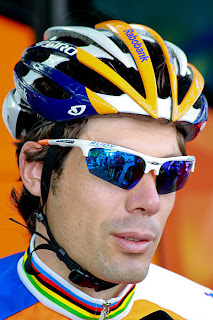
Freire's not the strongest nor the
fastest, but you can achieve a lot
if you use your head (and you're
as sneaky as a thieving alleycat)
The Favourites
Philippe Gilbert (BMC) has had a slow start to the season, but he seemed to have finally come back to life at the Brabantse Pijl where he showed signs of finding the excellent form he was on last year. Having won for the last two consecutive years, Gilbert has to be  favourite today - for the top five and possibly the podium, if not for first place. If Gilbert's not got what it takes, his team mate Cadel Evans might have: he's got experience in the Ardennes having won La Flèche Wallonne in 2010 and he's got the form to bully his bike over the climbs and his rivals out of the way. Edvald Boasson Hagen (Sky) has shown time and time again that he can both sprint and climb and he also won the Enenco Tour after it came down this way and climbed some of these very hills last year. Like Gilbert, he may be outclassed for the top step of the podium, but there's a reasonable chance that he'll be somewhere nearby. Thomas Lövkvist (Sky) - the boy has form, he won the Circuit des Ardennes in 2003 and 6th at La Flèche Wallonne in 2009. Now aged 27 and entering what may be his best years, he's continually improved his climbing to become a formidable all-rounder. Samuel Sanchez showed us all at the Tour of the Basque Country that, when he wants to be, he's one of the world's very best climbers - and as part of the Euskaltel-Euskadi team that trains all year round in the High Pyrenees, these green hills hold few fears for him. Don't forget that Sanchez holds another ace in the form of his legendary descending ability, too - a rare talent for a climber. Oscar Freire (Katusha) is a devastatingly fast sprinter and not a bad as many of his ilk when it comes to the climbs, but what really stands him in good stead is his brain - there has been more than one occasion when he's made full use of the chaos at the end of a race (and this one gets really chaotic) to sneak past the big guns when none of them are looking his way and steal victory from under their front wheels.

Wildcards: a Schleck (RadioShack-Nissan), either one of them. Both are physically capable of winning this race; whether or not the actually can depends on whether they can stop pratting around and get themselves into gear (Johny must spend every day wanting to knock their heads together). Johnny Hoogerland (Vacansoleil-DCM) - stranger things have happened, and he was 4th at the Brabantse Pijl last year. (Provisional start list here)

Weather
It's looking as though rain is likely, with a 40% chance of at least some at Maastricht during the day. Chances are it'll be light showers, but some heavier squalls are possible too - when the wind blows from the north over Limburg, the hills force low-lying air currents that have crossed the Netherlands from the North Sea to suddenly increase in altitude and cool so that water vapour condenses to form clouds and precipitation. On the other side of the region at Vaals rain is slightly more likely with a 50% chance of drizzle. It's not going to be warm, either - the actual high of 9C isn't exactly toasty to begin with, but once the wind (up to 28-30kph) is taken into account it'll feel a good 4-5C lower than that. All in all, not a very nice day.

Local Sights
Kasteel Geulle
Maastricht, as might be expected, has a mixture of charming ancient and stunning modern architecture. It's very Belgian in character - which, despite the stereotype, does not mean boring because Belgians + beer + bikes = Saturnalia. Sittard (19.4km), hometown of cyclist Eddy Beugels, has what must be one of the most quintessentially European town squares anywhere on the Continent. Meersen (38.1km) is home to Kasteel Geulle, a fortified manor house surrounded by a wide moat. Raar (40.7km) has two tiny roadside chapels, one dating from the middle of the 19th Century and the other from the early 20th. Valkenburg (46.6, 66.4, 71.1, 175.8, 180.6 and 255.7km) preserves small sections of its medieval city walls and two gatehouses. Mheer (89.8, 212.3km) also has a castle, dating from the 14th Century with various 15th, 16th and 17th Century additions and Hoogcruts (95.1, 217.8km) a ruined 18th Century monastery that resembles an English country house of the same period. Mechelen (107.1, 148.9, 225.9km) has a very beautiful half-timbered house, the Heerenhof, that dates from the 12th Century. Vaals (125.5km) is a town made of important monuments with over 70 sites and buildings considered of architectural merit. Many of the villages along the parcours have half-timbered houses that in many cases are historically important.

Wednesday, 14 March 2012

Milan-San Remo 2012

Milan-San Remo 2012 (click to enlarge)
Definitive start list
Route details

All the Classics have history, but Milan-San Remo has more history than most. For many fans, it is the most important of the five Monuments, the venerated races that are the most prestigious of the Classics and widely considered secondary only to the Grand Tours. A list of winners is a list of the fastest riders from the last 105 years: Petit-Breton, Christophe, Garrigou, Pélissier, Defraye, Girardengo, Binda, Bartali, Coppi, Bobet, Van Steenbergen, Van Looy, Poblet, Poulidor, Simpson, Merckx, De Vlaeminck, Moser, Kuiper, Kelly, Fignon, Chiappucci, Zabel, Cancellara, Cavendish.

The final climb, Poggio de Sanremo, was introduced into the race in 1960 in an attempt to prevent it from ending in a bunch sprint every year and despite being known as the Sprinters' Classic, there are hills: the Passo del Turchino is a long grind up to 532m, not steep but for the final part, Le Manie tops out at 318m but is much steeper, Cipressa only hits 239m but is also steep - it's the reason many people though Cav couldn't win this one. He took them all by surprise in 2009 when he climbed them with relative ease, then beat Heinrich Haussler across the line to become the first British rider to win this race since Tom Simpson in 1964. Now he says that a second victory is one of his main targets for 2012, and when Cav locks onto a target he's as good as unbeatable.


The race begins at the Piazza Legga Lombarda in Milan (45°28'39.56"N 9°10'51.64"E); an attractive city street with flat cobbles and tramlines by the neoclassical Arena Gianni Brera, previously known as the Arena Civica, which in the 19th Century hosted Bill Cody's famous Wild West Show - as did the Buffalo Velodrome in Paris, once run by Henri Desgrange. It then runs south along the Via Legnano to begin a neutral zone of approximately 7.21km, following the streets through to the famous Castello Sforzesco. This vast citadel, one of the largest in Europe, was once the seat of the powerful Duchy of Milan - itself dating back to pre-Roman times - and now houses several important museums and art collections in addition to the Salla delle Asse, a room with a ceiling decorated by Leonardo da Vinci. Having played an instrumental role in the early days of the Christian faith in Europe, the area surrounding the castle is sometimes known as the Centre of Christianity. After following the road around the castle, the riders turn left into the Via Marco Minghetti and come out at the Piazza Cadorna with its fountains and colourful modern sculptures, then pass into the Via Giosue Carducci. Just visible at a few points are Basilia of Sant'Ambrogio, dating from the 4th Century AD and one of the oldest churches in the city. It is the burial place of several martyrs, killed as a result of Roman persecution of Christians, and of Emperor Louis II. The basilica was much damaged by Allied bombing in 1943, as can still be seen in some parts, though arguably more damage has been done to the complex by the inclusion of the modern and spectacularly ugly museum and office building. That's just the first few kilometres.

Certosa di Pavia
(image credit: Tango7174 CC BY-SA 3.0)
The route takes the  the Largo Paolo d'Ancona, and eventually winds its way to the edge of the city and takes the Via della Chiesa Rossa leading away from the ancient city, then onward past Rozzano (45°23'14.86"N 9° 9'5.04"E) - a small town that has officially been a city since 2003 and which boasts an attractive, apparently semi-derelict fortified manor house. The road becomes known as the SS35 and passes Binasco and Casarile, then bisects Certosa di Pavia with its enormous and world famous monastery complex built in the 14th and 15th Centuries by the Carthusian Order. It has changed hands several times since but is now owned by the State, though a small community of Cistercian monks have lived there since the 1960s. We reach Pavia a short while later, its spires and towers visible from far away across the flat fields (45°11'9.93"N 9° 9'23.61"E).

Once the capital of Lombardy, Pavia is home to a university founded in 1361 and has many important buildings, the most famous of which is the Cathedral - begun in the 15th Century, it's still not finished. For a short time, the city was also home to Albert Einstein. A short while after passing Cava Manara, the riders arrive at a bridge crossing the Po at 38.7km from the start of the race. Gradually, after Bressana  Bottarone, the road begins to climb; almost imperceptibly at first and then more rapidly at Voghera after 59.8km where there is a museum that exhibits the gun that was used to execute Mussolini. Here, the parcours takes the SP93 and continues south-west to Tortona, the largest conurbation the race has seen since Milan and the chosen home of Fausto Coppi who died here in 1960 - the city's stadium is, unsurprisingly, named after the man who for many is Italy's greatest sporting hero but it seems a pity that the race does not pass through Castellania 12km to the south-east, his birthplace. From this point, the altitude rises far more steeply and for the first time becomes a problem for the sprinters, once of whom will most likely win the race - look to see who shows signs of suffering and then keep an eye on them in the steeper climbs to come, as this may be indication that they won't have the strength to compete in the final sprint to the finish line.
Altimetry (click to enlarge)
After 91km, the riders reach Pozzolo Formigaro and then a few kilometres later Novi Ligure (44°45'42.47"N  8°47'9.96"E), birthplace of the legendary Costante Girardengo who was Il Campionissimo long before Coppi was and held the record number of wins in this race (6) for almost five decades until Eddy Merckx won a seventh in 1976. When they reach Bassaluzzo a few kilometres later, the riders have complete the first 100km - and have a little under 200 still to go.

Rossiglione
(image credit: Davide Papalini CC BY-SA 3.0)
The road turns south and becomes the SP155, passing by Capriata d'Orba and Silvano D'Orba. Silvano has a castle that looks the ideal home for a vampire, set on the edge of the forested hills east of the town. 6km away is Ovada, built in between two rivers and jut small enough to feel like an island, after which the race turns into the forested hills and what is perhaps the most beautiful section following the course of the Stura river through Gnocchetto and over a level crossing, then onward through Rossiglione to Campo Ligure. Here, the riders arrive at the first of the two feeding stations and the beginning of the first proper climb, topping out at the Passo del Turchino 532m above sea level (44°29'13.52"N 8°44'6.78"E). In years gone by, this pass frequently decided the winner of Milan-San Remo - in 14 of the first 39 editions, the first man to the top went on to win; but the route has been much-altered over the years and today, only 134km into the race, it's too far from the finish to make much difference and as roads and levels of athleticism have improved it no longer fractures the peloton. The gradient is very low, topping 4% only during the last few metres before the highest point, which is located within the 180m long Passo del Turchino Galleria tunnel (44°29'12.38"N 8°44'6.36"E). The descent, meanwhile, is steep in parts - it drop more than 400m in the next 8km with some sections of 10% encouraging high speed around the hairpins and through the next tunnel (120m) on the way to Mele. (Random fact - in 1910, there was so much snow on the pass that only 4 out of 63 riders made it across.)

Once the Turchino has been passed, the race becomes a very long, very fast sprint for much of the remaining 155.7km with only a few smaller climbs - Le Manie, the three Capi, Cipressa and the Poggio del San Remo to break things up. Expect a large breakaway, and probably several smaller ones too, to try to gain an advantage here and also keep your eyes on the sprinters as their teams nurse them through the kilometres in an attempt to conserve their energy for the last section.

Arenzano
(image credit: Nijnemans CC BY-SA 3.0)
Mele is perhaps not the most attractive town in this part of the world, its best features being the bridge that carries the autostrada high overhead and the views down the green valleys to the Meditarranean which lies only 2km away to the south at Genova Voltri (44°25'50.11"N  8°44'51.85"E), the next town, where the riders will have completed the first half of the race. From here, the parcours runs along the rugged and very beautiful coast of the Italian Riviera. A short way beyond Voltri, it passes through a series of tunnels and then arrives at Arenzano. A short climb takes the race through La Colletta and then to Cogoleto, birthplace of Christopher Columbus and once the site of a Roman bridge - until Allied bombs did to it what the centuries had not.

Fortezza del Priamar
(image credit: Basilico CC BY-SA 3.0)
After another short climb, we reach Castello d'Invrea where the fabulously wealthy come to buy holiday mansions for fabulous sums and the locals leave to find homes they can afford. Next is the  descent into Varazze (44°21'38.00"N 8°34'33.75"E) which was once the home of notable anti-Fascist Lelio Basso, a lawyer who sat on the Russell Tribunal alongside the great Welsh philosopher Betrand Russell himself and Jean-Paul Sartre, investigating allegations the USA had committed war crimes in Vietnam - and found the nation guilty of genocide. Celle Ligure and Albissola Marina come and go as the peloton passes through the 300m Capo Torre tunnel before arriving at Savona, birthplace of two popes,a president, a prime minister and numerous footballers. Standing high on a hill above the town is the Fortezza del Priamar, a vast castle that served as Italy's main military prison until 1903. Vado Ligure (44°16'9.82"N 8°26'9.06"E) is the next recognisable town, Zinola being squeezed in between it and Savona so that it seems nothing but the two linked together. Vado Ligure is an industrial city with a commercial port and a locomotive manufactury, making it in many ways a more interesting place than the pretty tourist traps we've passed so far along the coast.

7km later, the race reaches Spotorno and passes through a 220m tunnel. 3.5km further on is Noli (44°12'20.96"N 8°24'59.01"E) - a tiny town nestling in a wooded valley, but one with an impressive past: between 1193 and 1797, Noli was a self-governing independent nation, the smallest of the Maritime Republics that included Venice and Pisa. The church, San Paragorio, was the cathedral until independence ended with the Napoleonic invasion of 1797. Just outside Noli the race reaches the 200km point, roughly two thirds of the way to the finish, then the  following 4.7km become harder on the sprinters as the parcours briefly leaves the coast and they climb Le Manie. Once again the hill is not high nor steep enough at 318m to decide the race nor prove too much of an obstacle, but coming after so many kilometres it's far from easy.

Porta di Finalborgo frescoed gatehouse,
Finale Ligura
(image credit: Mau CC BY-SA 3.0)
A fast descent leads into Finale Ligure (44°10'14.63"N 8°20'47.94"E), considered by some to be one of Italy's most beautiful towns due to its wooded hillsides, frescoed medieval gatehouses and ancient churches, then the race continues through Borgio Verezzi and Pietra Ligure. Nearby are the Grotte di Borgio Verezzi, caves created when water dissolved soluble bedrock to leave hollows between other rocks. Remains found in the caves show that the region has been inhabited by humans and human ancestors for as long as three quarters of a million years. Loano and Borghetto Santo Spirito are next. The latter does not benefit from unattractive high-rise buildings that sprang up in the 1960s and 70s, but the Castello Borelli which perches on a rocky plinth as though it grew from it is very impressive. Ceriale, 2km away, hosts the second of the two feeding stations - the town's population increased sharply in the Middle Ages due to an influx of people fleeing nearby Capriolo when it was overrun by an invasion of biting ants. In the 16th Century, Ceriale was attacked several times by Arabic pirates which led to the construction of a circular fortification on the beach - it proved to be of little use when Barbary pirates from North Africa attacked in 1637 and looted the town.

Having negotiated streets of varying prettiness and width through Albenga, site of an 11th Century cathedral, the riders cross a bridge and take the SP1 leading to Alassio (44° 0'14.07"N 8°10'5.72"E), which inspired Edward Elgar to write an overture (the town repaid the honour by naming a street after him) and which is usually included on lists of the most beautiful locations in Italy. Laigueglia is next, then it's on to the first of the three Capi, hills low enough to have little if any effect on the outcome of the race. This one is the 67m Capo Mele where there is a lighthouse bulit originally in 1856, then extensively rebuilt in 1947-8 after it was badly damaged by Allied shelling in the Second World War. At the bottom of the descent the riders arrive at Andora and have 50km left to the end of the race. There is a velodrome in the town and the environs are popular among mountain bikers. The 61m summit of Capo Cervo is reached 3km after the town, then we drop into Cervo which marks the beginning of the Cervo/San Bartolomeo al Mare/Diano Marina conurbation where the three towns have grown to become contiguous. Diano San Pietro, up in the hills, will soon join them.

Porto Maurizio, seen from the west
(copyright-free image)
Capo Berta - by far the highest of the Capi at 130m - lies 2.5km on from Diano Marina. Once they're over, we may begin to see the peloton become a little more animated as teams alter their tactics to protect the printers over the last two climbs, also stepping up the pace in an effort to reel back any breaks that are still off the front. Imperia (43°53'18.38"N 8° 2'7.11"E) is reached after the descent and a short climb of 30m; its rather grand and militaristic name is something of a misnomer as the locals chiefly concern themselves with the cultivation of flowers and olives. It is in fact two towns - Oneglia, sited on a low plain, is the more modern half and has a commercial port; while Porto Maurizio stands on the hillside on the western side of the river, where the wealthy have expensive homes along its picturesque winding streets. Once, they were separate entities, then Mussolini decided to join them together and give them that high-falutin' name in 1923. San Lorenzo al Mare is 6.1km away and upon reaching it the riders will be as pleased to know that they have less than 30km to go as they will be unhappy that the town marks the beginning of Cipressa (43°51'4.65"N 7°56'22.10"E), the penultimate climb of the race: it's only 239m high and rises to that altitude in around 11.5km so it's not steep, but coming after 276km it can still make their knees hurt. Sprinters who are obviously suffering here can be ruled off lists of potential winners with some degree of certainty, though it should be remembered that some - most notably Team Sky's Mark Cavendish - have phenomenal recovery times.

Current World Champion Mark
Cavendish, known and respected as
one of the fastest sprinters in the
history of cycling, is widely regarded
as standing a good chance of
repeating the success he had in this
race in 2009 - the year he became the 
first British winner since Tom Simpson
in 1964.
(image credit: Mogens Engelund CC BY-SA 3.0)
With the fast Cipressa descent out of the way the peloton arrives at Santo Stefano al Mar, then Riva Ligure and Prai before crossing a bridge into Arma di Taggia (43°50'17.26"N 7°51'22.22"E) - where they have a little under 15km left to ride. Taggia as a whole is the largest town we've seen for some time with 13,000 inhabitants. The race remains near the coast on the SP1 but the town can be seen stretching north into the hills before the riders tackle the last tunnel (142m) and move on to Bussana, round Capo Verde and begin to climb 160m Poggio di San Remo - the last climb of the race and the place where the teams arrange themselves into formations designed to be able to lead their best hopes over the mountain and into the last section where they can blast off toward the finish. According to the Inner Ring, parts of the road have been resurfaced and are faster than ever. It's possible for a solo attack to result in a win here, as Paolo Bettini proved back in 2003 (nobody else has managed it since, though many have tried), but the race almost invariably ends with a bunch sprint.

The peloton enters San-Remo along the Via Aurelia, continuing when it becomes the Via Guiseppe Mazzini and then the Corso Felice Cavallotti. This leads them to the Rondo Garibaldi where they will turn left onto Via Flume, then right onto the Corso Orazio Raimundo and left 300m later for the Via Nino Bixio. From here, it's all about high speed as the teams lead the sprinters left at the Giardini Vittorio Veneto ready for them to switch on the afterburners and launch themselves at the finish line by the seafront on the Lungomare Italo Calvin (43°48'49.96"N 7°46'28.97"E).

Thor Hushovd - Cav's biggest rival
(image credit: PB85 CC BY-SA 3.0)
Cyclopunk's Top Tip: Cav. Those hills are well within his definition of doable, and once he lights the blue touch paper in a sprint he's as good as unbeatable. He has a rock-hard team to help him including the tried, tested and trusted tough guys Edvald Boasson Hagen, Mathew Hayman, Jeremy Hunt, Christian Knees, Thomas Lofkvist and Ian Stannard; each of whom has seen combat and achieved impressive results in either this race, the other Classics or both. Cav's also got Bernhard Eisel, his lieutenant and lead-out man and with whom he forms 50% of what may be the best-rehearsed double-act in the history of cycling.

It's hard to see any other team working so well together as Sky who, as became apparent at Paris-Nice, have spent all winter honing their technique. BMC are likely to be the biggest threat - the team as a whole may not work so well but Thor Hushovd, Alessandro Ballan and Philippe Gilbert (assuming he's improved his form since the Tirreno-Adriatico) are each capable of winning this race. If they can operate as a unit, Sky will need to work extra hard. GreenEDGE will certainly be wanting to win, not least of all because a Monument in their first season - after a start which some have called "lacklustre" - would silence the critics. Then there's RadioShack-NissanTrek - their team seems less likely to operate as one somehow, but with Cancellara aboard it might not matter: on a good day, Cancellara could win this race solo.

TV: In Britain, the race will be televised live on Eurosport from 13:15. It will also be showing on Eurosport in most other European nations and live streams will be available from all the usual sources.

Thursday, 18 August 2011

Vuelta a España 2011- the first 19 stages previewed

Vuelta a España - 2011 Index
Stage Guides

Stage 3: Petrer - Totana (22nd August)

Stage 7: Almadén - Talavera de la Reina (26th August)


Stage 8: Talavera de la Reina - San Lorenzo de El Escorial (27th August)


Stage 9: Villacastin - La Covatilla (28th August)


Stage 10: Salamanca-Salamanca (29th August)


Stage 11: Verin - Mazaneda Ski Station (31st August)


Stage 12: Ponteareas - Pontevedra (1st September)


Stage 13: Sarria - Ponferrada (2nd September)


Stage 14: Astorga - La Farrapona (3rd September)


Stage 15: Aviles - Alto de l'Angliru (4th September)


Stage 16: La Olmeda - Haro (6th September)


Stage 17: Faustino V (Oion/Oyón) - Peña Cabarga (7th September)

Stage 18: Solares - Noja (8th September)


Stage 19: Noja - Bilbao (9th September)


Stage 20: Bilbao - Gasteiz (Vitoria) (10th September)


Stage 21: Jamara Circuit - Madrid (11th September)


"Without doubt the most thorough Tour de France Stage 17 Preview..." (Dolomedia) (We'll try to do the same for the Vuelta, too - JO)