Showing posts with label Cadel Evans. Show all posts

Sunday, 24 July 2011

Tour de France: Stage 21 Debrief - Yell for Cav 'n' Cadel!

Cavendish
The final stage of a Tour can sometimes be a little boring when we're spoiled by the superb racing and excitement that comes in the run-up to it. It looked a little like this year might turn out that way early on in the race, but it was not to be - while we all knew Andy Schleck wouldn't even dream of being so crass as to try to challenge Cadel Evans' triumph, Mark Cavendish and Jose Joaquin had every reason to fight right up to the end: all it would have taken was Rojas to win the final sprint to the finish and Cav to come fourth and the green jersey wouldn't have been coming to Britain. Then, instead of the clear-cut stage winning solo breakaway that can so easily happen, the race ended with a mass sprint; meaning massively increased chances of snarl-ups that could give a lucky chancer the opportunity to take his glory.

But with Cav defending it that obviously didn't happen, even though a mechanical problem saw him have to take a bike from a domestique and be paced back to the peloton by team mates. He crossed the line just ahead of the rest after 2h27'02", his 20th stage win and the first British rider to ever win the Points Classification in the Tour de France.
Evans

Cadel Evans crossed the line to a hero's welcome, the only type fitting for a Tour de France winner. He's the only Australian to have won a Tour and, at 34, the oldest rider to have done so since World War 2. There are several petitions currently doing the rounds in Australia with the aim of having the 24th of July declared a national public holiday - this is a perfect reason to have one.

Despite the flurry of doping scandals shortly before the Tour - Wim Vansevenant, Sven S., the BMC bus - only one rider provided a positive sample during the race and was expelled immediately. This already being hailed as the cleanest Tour in years; and that means everyone wins.

Stage 21 Results:
1. CAVENDISH Mark 2h 27' 02"  
2. HAGEN Edvald Boasson
3. GREIPEL André
4. FARRAR Tyler
5. CANCELLARA Fabian
6. OSS Daniel
7. BOZIC Borut
8. VAITKUS Tomas
9. CIOLEK Gerald
10. ENGOULVENT Jimmy (all same time)

Benjamin du Tour Arnold Jeannesson
Overall Results 2011:
General Classification:
1. EVANS Cadel 86h 12' 22"  
2. SCHLECK Andy 86h 13' 56" (+ 01' 34")
3. SCHLECK Frank 86h 14' 52" (+ 02' 30")
4. VOECKLER Thomas 86h 15' 42" (+ 03' 20")
5. CONTADOR Alberto 86h 16' 19" (+ 03' 57")
6. SANCHEZ Samuel 86h 17' 17" (+ 04' 55")
7. CUNEGO Damiano 86h 18' 27" (+ 06' 05")
8. BASSO Ivan 86h 19' 45" (+ 07' 23")
9. DANIELSON Tom 86h 20' 37" (+ 08' 15")
10. PERAUD Jean-Christophe 86h 22' 33" (+ 10' 11")

Points:
1. CAVENDISH Mark 334 pts
2. ROJAS Jose Joaquin 272 pts
3. GILBERT Philippe 236 pts
4. EVANS Cadel 208 pts
5. HUSHOVD Thor 195 pts
6. HAGEN Edvald Boasson 192 pts
7. GREIPEL André 160 pts
8. FARRAR Tyler 127 pts
9. SANCHEZ Samue 105 pts
10. CONTADOR Alberto 105 pts

King of the Mountains:
1. SANCHEZ Samuel 108 pts
2. SCHLECK Andy 98 pts
3. VANENDERT Jelle 74 pts
4. EVANS Cadel 58 pts
5. SCHLECK Frank 56 pts
6. CONTADOR Alberto 51 pts
7. ROY Jérémy 45 pts
8. ROLLAND Pierre 44 pts
9. IGLINSKIY Maxim 40 pts
10. HOOGERLAND Johnny 40 pts

Youth:
1. ROLLAND Pierre 86h 23' 05"  
2. TAARAMAE Rein 86h 23' 51" (+ 00' 46")
3. COPPEL Jérôme 86h 30' 58" (+ 07' 53")
4. JEANNESSON Arnold 86h 33' 42" (+ 10' 37") (Benjamin du Tour)
5. RUIJGH Rob 86h 45' 26" (+ 22' 21")
6. URAN Rigoberto 86h 55' 10" (+ 32' 05")
7. THOMAS Geraint 87h 13' 10" (+ 50' 05")
8. GESINK Robert 87h 17' 31" (+ 54' 26")
9. GAUTIER Cyril 87h 40' 05" (+ 1h 17' 00")
10. ZEITS Andrey 87h 44' 10" (+ 1h 21' 05")

Team Classification:
1. TEAM GARMIN - CERVELO 258h 18' 49"  
2. TEAM LEOPARD-TREK 258h 29' 53" (+ 11' 04")
3. AG2R LA MONDIALE 258h 30' 09" (+ 11' 20")
4. TEAM EUROPCAR 259h 00' 42" (+ 41' 53")
5. EUSKALTEL - EUSKADI 259h 10' 49" (+ 52' 00")
6. SKY PROCYCLING 259h 17' 13" (+ 58' 24")
7. KATUSHA TEAM 259h 28' 28" (+ 1h 09' 39")
8. SAXO BANK SUNGARD 259h 35' 01" (+ 1h 16' 12")
9. FDJ 259h 49' 05" (+ 1h 30' 16")
10. COFIDIS LE CREDIT EN LIGNE 260h 06' 18" (+ 1h 47' 29")

Combativity: To be confirmed

Lanterne Rouge Fabio Sabatini. Hurrah!
Lanterne Rouge: 167. SABATINI Fabio 90h 10' 05" (+ 3h 57' 43")

British Riders:
Stage 21
1. CAVENDISH Mark 2h 27' 02"
63. THOMAS Geraint 2h 27' 02" 
146. SWIFT Ben 2h 27' 02" 
158. MILLAR David 2h 27' 37"

Overall General Classification
31. THOMAS Geraint 87h 13' 10" 
76. MILLAR David 88h 27' 18" 
130. CAVENDISH Mark 89h 27' 27" 
137. SWIFT Ben 89h 30' 29" 

Saturday, 23 July 2011

Tour de France: Stage 20 Preview

Incredible and depressing as it may seem, we're already at the penultimate stage on the 2011 Tour. It seems just a few days since the peloton got off to a wobbly start along the Passage de Gois, the crashes that took Bradley Wiggins out of the race and Alexander Vinokourov out of cycling could have been the day before yesterday; but in fact it's been three weeks since Vendée. All that is left is the individual time trial today and the short ride into Paris.

Grenoble at night, photographed from the Bastille.
The city of Grenoble has been a stage town no fewer than 38 times and we can expect a festive atmosphere because, as residents of the unofficial Capital of the Alps,  the 160,000 Grenoblois are well-used to large sporting events: in addition to the regular Tour visits, they hosted the Winter Olympics in 1968 and, annually, the Six Days track cycling festival. It's also a major mountain biking centre and attracts skiiers, snowboarders, paragliders and the practitioners of all other sports that require altitude from all around the world are drawn here partially for the excellent sporting facilities but also for the famous atmosphere - Grenoble has grown wealthy on sports and high-tech industries, and with 51.55% of the residents being aged between 15 and 44 this is a party town.

Surviving section of Roman city wall, Grenoble.
Surrounded on all sides by mountains with some 20 skiing stations, the city occupies a plateau at just over 200m altitude. Mountain sports have led to the creation of many sparkling new towns, but while Grenoble sparkles it's most definitely not new: the earliest mention in text dates to 43BCE when it was known as Cularo. It was already an important place by the 3rd Century CE when the Roman emperor Gratian fortified it, adding a wall and bestowing upon it the right to call itself a city rather than a town. Sections of the walls can still be seen in the older neighbourhoods, most notably along the Rue Lafayette. Gratian gave his own name to the community when it became Gratianopolis which, in time, was modified to Graignovol during the medieval period and, eventually, to its modern form.

Graignovol was chosen by the noble House of Albon, rulers of an assortment of territories throughout the region which as part of the Holy Roman Empire were subject only to very limited French control, as their capital during the 11th Century and the city began to grow larger - and as the Counts made the city richer and more important, it returned the favour. In time they were powerful enough to consolidate their properties and thus create the state of Dauphiné, an independent province with a name familiar to all cyclists due to the eight-stage Critérium du Dauphiné race that takes place annually in early June and serves an important testing ground for the Tour de France in addition to being one of the most important events on the cycling calendar in its own right.

The city benefited from rulers who, by the standards of the time, were remarkably benevolent and who shared their power with some equally generous bishops. Under their command it gained two hospitals and a university, and the Roman bridge was rebuilt. In the late 14th Century Humbert II found himself without an heir and, with no obvious and suitable successor to whom he could hand over the state, he sold the Dauphiné to France. However, it remained to all intents an independent state until the middle of the 15th Century under Louis XI when it was officially and fully incorporated into the kingdom, though the city's inhabitants obtained a charter guaranteeing them certain rights and a fair say in decisions affecting their province.

The Bastille at Grenoble is the most extensive example of 18th Century
fortifications in France.
With a largely Protestant population, Grenoble was attacked frequently during the 16th and 17th Century religious wars and fell to the Catholics in 1590. Rather than controlling and inhabiting their new acquisition, the new rulers - called the Ligue - seemed intent on running it into the ground and so resistance groups led by François de Bonne, duc de Lesdiguières, soon formed and within a year had successfully regained control within a year. De Bonne became lieutenant-general and set about improving the city, increasing its size and building sewers, improved city walls, a bastille and many fountains (because the French do love their fountains). The Bastille still stands on its rocky mount overlooking the town and is now the site of cultural centres, restaurants and various attractions. Around the time of the Revolution the city was briefly renamed Grelibre, but became Grenoble once more under Napoleon. It fell to Austrian troops in 1814 but was rapidly taken back by Napoleon's forces, later withstanding attacks in the wake of Waterloo - which lessened Napoleon's power in France considerably

. By the late 19th Century, industrialisation was in full swing in the city. The great engineer and scientist Aristide Bergès - very much France's Isambard Kingdom Brunel - was instrumental in Grenoble's early adoption of hydroelectric power, which revolutionised the glove-making industry for which the area was famous and massively increased output so that Grenoblois gloves were exported and sold to wealthy people all around the world. Bergès also established papermills, adding another wealth-making string to Grenoble's bow. This expertise made the city an ideal base of production during the First World War when the hydroelectric schemes were expanded to provide power for the war effort and chemical factories grew up among the papermills, the beginnings of the high-tech industries that now generate much of Grenoble's wealth.

That industrial power of course meant that the city was considered highly valuable by the Nazis, who targeted it early on in WW2. Their early invasion attempts were thwarted by General Cartier, leaving the province free of German control right up until the establishment of Vichy France when it became subject to Italian occupation. However, Grenoble never did submit to Fascism and was a problematic hotbed of Résistance activity; seeing many heroic deeds by the underground army - it was this, combined with the Italian's tendency not to be quite so rabidly antisemitic as the Nazis, that saw the Jewish population of Grenoble increase greatly during the war. Late in 1943 the Résistance successfully destroyed a German artillery station which caused a violent crackdown in response with eleven Résistance members murdered - but even this didn't defeat their spirit. A newly-built German arsenal was blown up less than a month later and other attacks took place throughout the province. These brave and decisive actions were recognised soon after the Nazis pulled out when the city was awarded the Compagnon de la Libération by General de Gaulle.

European Synchrotron Radiation Facility
In 1955 the physicist Louis Néel, who would receive a Nobel prize in 1970 for his important work with magnetism which has been instrumental in the development of modern computes, established the CENG nuclear research facility combining research and industry in what has become known as the Grenoble Model. In time, many other laboratories were attracted or set up in Grenoble, including the European Synchrotron Radiation Facility and many others which have helped to make the city a world centre of physical research. Latterly, micro and nanotechnology firms have set up, ensuring that Grenoble's status as the largest research centre in France after Paris is secure for many years to come.

With its connections to the Criterium du Dauphine, Tour and mountain biking Grenoble is a city very much in love with le velo, even by the standards of the French obsession with cyclisme. The stage begins near the city hall, at a large park containing the hall itself and a variety of sporting facilities, then heads south-east on the D5. This being an urban environment, the road features a large number of hazards in the form of street furniture and roundabouts before it reaches Eybens after 2.5km on the outskirts of the city. Eybens has in the past been declared the most sporting city with fewer than 10,000 inhabitants in all of France, so large crowds are likely to be lining the streets today. The road then swings east and across a roundabout shortly before reaching Eyben's velodrome, then south-east through a wooded section, then south again along a much clearer road into Tavernolles and another roundabout. A long, straight section through Le Replat will encourage high speeds, favouring the individual time trial specialists such as Fabian Cancellara but also giving the sprinters a chance to work on their overall times. On the southern edge of the town, the road has kink and an unusual ~ shaped traffic island, making the section quite technical and a possible site of crashes if its wet at any point.

Chateau de Vizille
A few kilometres on is Brié-et-Angonnes with a medieval chapel that the camera operators will - fortunately - be unable to resist. The parcours then turns south-west, along the side of a very steep hill known as Haute-Brié (surely the ideal name for a particularly stinky cheese? It rises 175m in under 0.5km at one point) and takes in a very sharp hairpin bend shortly before Vizille - a hazard that is almost guaranteed to claim at least one victim today. Vizille is famous for its chateau, one of the most photographed in the country and the star of many a postcard, jigsaw and biscuit tin. If you're one of the numerous people who watches the Tour for the chateaux, don't miss this one.

There are a few technical junctions and some street furniture on the way into Vizille; and the road narrows considerably before the tight left-hand turn onto the D524 which leads us to the chateau gardens, home to some extremely territorial geese. It then heads north-east back into the countryside, passing many large houses on the way to Les Cornier which stands at the foot of a steep mountainside that rises to over 2000m. The parcours passes through assorted small hamlets and villages until it reaches a roundabout and junction with the D111, onto which we turn right and head east to a hairpin, then south and up a short but reasonably steep climb to Belmont. Leaving the D111, riders travel north on much narrower, twisting roads into Le Boulond before heading into Saint-Martin-d'Uriage and joining D280. Saint-Martin-d'Uriage's chateau housed a staff training college for the Vichy Government during WW2.

We then pass through the town - more street furniture, corners, roundabouts - to the D524. The first section has several hazards, including a large island containing buildings and a park in the road which could potentially win or lose seconds depending on which way riders go around it. The road then takes a series of sweeping bends around forested hills, untechnical but with possible slippery parts if it rains, into La Combe de Gières and via a fork in the road into Gières with the little Fort du Mûrier. Just past the fork we join the D112, taking us through another forested section and then onto a straight section through town and back into Grenoble, heading back to the park from which we started.

Predictions: This a course that ought to suit Cancellara, but with so much still to play for several riders will be going all out to win this one. Tony Martin, the probable next king of time trials, will also do well - perhaps even beating King Cancellara. The two with most to play for - and potentially lose - are Cadel Evans and Andy Schleck, either of whom could win the Tour today. Cadel is the better time trialist and as such the favourite, but Andy starts the day with a good lead and has hugely improved his time trialing in the last year or two.

Weather: It's really not time-trialing weather today - parts of the course may get some rain, making technical sections more hazardous. The wind will help riders on the way out, but will then become headwinds as they turn back towards Grenoble making the going more difficult and taking valuable seconds off recorded times.

Links: 
Grenoble Tourism
Grenoble Cycling

Friday, 22 July 2011

Tour de France: Stage 19 Preview

A very short stage today at just 109.5km, but with more than enough climbing to keep even the most sadistic of fans entertained: for the second time this year the peloton will be tackling the mighty Galibier with its 16.7km Hors-Categorie grind up to 2556m. Of course, the team medics would be most unimpressed were their charges to attempt tackling that without a few warm-up exercises; so the organisers have thoughtfully thrown in an 11.9km Category 1 ascent of Col du Télégraphe within the first 30km. Oh, and there's a second HC climb of 13.8km reaching 1850m up to the summit of Alpe d'Huez at the end of the stage too, just to get the riders relaxed and ready for their beds.

The Savoyan flag
The stage begins in the heart of the Savoie region, part of the now-defunct nation of Savoy that once straddled the Franco-Swiss-Italian borders and which had the longest-surviving Royal dynasty in Europe; beginning with Humbert I in 1003 and still with us in somewhat reduced circumstances today. Savoy started as a poor and undeveloped area, but its ruling class became skilled at exercising tight control over what was transported through the high mountain passes and extracting money from those involved in such activities. Today, Savoy has a small separatist movement with surveys suggesting between 40 and 55% of the population support devolution from France and Italy and the re-establishment of their nation on its traditional territory. Thus, it's often possible to spot a few Savoyan flags (Savoyan if the official demonym; the more common Savoyard is informal and shouldn't be applied to the flag, though most people probably rightly wouldn't care) waving among the spectators when the Tour visits this region.

La Maison Penchée
Modane lies at the foot of a wide, green valley and is almost contiguous with Saint-André and Villabordin-Rogret to the west and east. Home to around 4000 people who have been Italian at various points in the town's history as well as French and Savoyard; belying the strategic importance of the area and explaining the large number of fortifications dating from medieval times to WW2 dotted around the town and high up into the surrounding mountains. The most famous of these is La Maison Penchée: a concrete bunker designed to house explosives should the Mont-Cenis tunnel need to be blown up if war broke out. Towards the end of WW2, the Nazis blew up the tunnel to hamper future Allied movements. The explosion blew the bunker - which remained intact - more than 30m and it ended up partially buried where it still stands today.

Things are very different in Europe since the EU and nowadays crossing borders between constituent states rarely even requires a passport, so Modane has grown wealthy from the tourists who base themselves here due to the easy access to the Alps of France and Italy - usefully providing employment for those residents who are not cut out for work in the particle physics research laboratories in the area. We leave the town along the D1006 heading west, a non-technical stretch of road sandwiched between the river to the north and railway tracks to the south with a large roundabout on the western perimeter. Another roundabout marks the little hamlet of Freney, home to 85 people, and the large industrial site stuck right next door - if there's one thing the French love, it's an industrial site placed slap in the middle of an area of great natural beauty. A third - insanely complex - roundabout with six exits and a fly-over carries the peloton onwards, the road sharing the river bank with the A43 and passing by a rocky gorge, more industry and a little village named La Praz - the site of the pretty and unmistakably alpine Villa Paul Héroult. Just to the south, Pointe de la Sandoniere reaches almost 2900m.

Saint-Michel-de-Maurienne, artfully cropped so as not to
show the aluminium works which bring prosperity and
ugliness in equal parts to the town.
Soon, we come to a section where the road tackles an artificial lake by way of a wide causeway before continuing crosswise over the dam and up a slipway leading into the long Tunnel d'Orelle, emerging some way on and travelling below the A43 for a while. Soon, it veers north and into Saint-Michel-de-Maurienne. The village is attractive enough, but tourists are a little dissuaded by the enormous aluminium works on the edge of town - even if the owners do provide funds for the doubtless fascinating museum devoted to the history of the metal which is located in the town.  However, we're disappointingly not going to see it today as after 14km the parcours turns south-west via a sharp but uncomplicated corner onto the D902 - a road also known, ominously, as the Rue du Galibier - taking us immediately into Saint-Martin d'Arc; passing through on a sweeping road as it begins to rise before reaching the next village, La Ravoire, where the first climb begins in earnest.

Fort du Telegraphe
The Col du Télégraphe, with an average gradient of 7.1% (maximum 10%) is climbed by means of 14 hairpin switchbacks on a road that visits several tiny and picturesque hamlets along the way before reaching a high ridge south of the Fort du Télégraphe which stands at almost 1600m and commands the valley roads far below. The site was originally occupied by an optical telegraphy station - a method by which a chain of towers are used to pass coded messages from one station to the next by means of symbols formed by articulated arms, similar to semaphore - which gave the Col its name, with the fort built between 1896 and 1890. As such, it lacks the charm of a medieval fortress but is nevertheless an imposing structure. The site has come full circle, for today the fort is topped by a collection of communications masts. The highest point comes 26.5km from the start.

The road follows the ridge for a while, offering views best described as stupendous, then reaches the tiny village called Le Col that has grown up chiefly on the money spent by the cyclists and motorcyclists who come up here and passes Les Granges, which consists largely of chalets for skiers but also has a tiny, picturesque chapel with a single bell. 4.5km onwards and over 100m downwards from the Col is Valloire which has grown to become the largest skiing resort in the Maurienne region, but unlike most ski centres the town has managed to retain much of its traditional alpine appearance and Savoyard character. There are, of course, many modern chalets; but there are much older buildings located about the town too, such as the Notre-Dame-de-l'Assomption which can be described as sumptuously decorated even by the standards of Baroque churches. There is also a ruined Chateau Saint-Pierre, but little remains of it.

As soon as Valloire is left behind, the parcours in on the slopes of the Col du Galibier; climbing today from the opposite direction to Andy Schleck's incredible winning ride yesterday and this side is rated considerably harder. The road travels south for a while, connecting an assortment of villages, before turning left and then right as it crosses a bridge over the rock-strewn stream. It then stays fairly level until a pair of hairpins take it up 20m or so, then begins to climb more rapidly on the approach to a small bridge near a barn where it turns south-east. A series of wide bends takes it between high cliffs which look a little like those along the Casse Deserte yesterday and towards a switchback combined with a bridge where the altitude reaches 2000m.

Col du Galibier
From here, the climbing really begins as a series of hairpins carries the road up to a ridge, which continues onwards and upwards. A final set of seven hairpins brings the Tour to the summit. Plenty of riders - especially the sprinters - will be wishing it was yesterday at this point: they may ridden much further to get here yesterday, but at least once they were here the stage was over. They'll take some comfort from the fact that they're going through the tunnel today, past the Henri Desgrange memorial where a wreath will be placed as it is every time the Tour comes this way, so they don't have to climb as high as yesterday. Those riders not so comfortable with fast descents will be wishing it was all over too because the road back down Galibier is steep and almost 40km long, twisting and turning about several tricky switchbacks as it picks its way precariously downwards to the junction with the D1091 - which we take - just east of an alpine plants botanic garden.

La Grave
The route heads west again, around two steep hairpins and into a long descent through the valley towards Villar-d'Arêne, 63.5km from the start line. More hairpins carry us downwards towards the tunnel which brings us out to La Grave which, with its 12th Century church and stunning location, has been voted as one of the beautiful villages in France and it truly is a stunning place with a perfect cafe that serves the best coffee in France - inhabited whilst I was there by three German goths whom, so far as I could gather, had driven in an ancient Mercedes from Frankfurt simply because of the village's name and were somewhat disappointed at the cheerful prettiness of the place. The excellence of the coffee, however, was sufficient to perk even them up.

The parcours continues downhill to the Lac du Chambon and passes through two tunnels on the northern shore before a sharp left hand corner takes it along the dam at the western side, then around an outcrop and down through the forest into Le Freney-d'Oisans, at which point there is 25.5km to go. The road out clings to the side of a near-vertical cliff, passing through a tunnel and past a look-out which offers stunning views up the valley before climbing up, around and back down a rocky promontory overlooking another artificial lake and Le Clapier, which is reached by means of a bridge over the dam's outflow. Immediately north of the village in the Alpe d-Huez, rising rapidy from the lake to over 2100m.

The 21 hairpins en route to the summit
of Alpe d'Huez.
After Le Clapier, the road becomes almost poker straight and level for a little over 3km and, were it not for the scenery and the fact that it's today's intermediate sprint, would be rather boring. This is a sprint that both Mark Cavendish and Jose Joaquin Rojas could really do with winning - it would go a long way to securing victory for Mark and could earn victory for Jose in the points competition - but chances of either man getting here in time to pick up any points at all are so marginal they may as well be ignored. It soon reaches a roundabout at Le Bourg-d'Oisans where the riders turn right onto the D211, beginning the ascent of Alpe d'Huez.

The Alpe acts as a stage finish this year for the first time since 2008, having been unusually absent on the schedule for the two years up until now, and makes a welcome return. Getting to the top takes in an incredible 21 hairpins, each named after riders who have won a stage there - though since 2001 it's become necessary to start adding the names of recent winners to those who gave their names to the lower bends in years gone by - that year, the lowest hairpin became known as the Coppi-Armstrong. As one of the most famous climbs in the Tour there is guaranteed to be vast crowds of spectators along this section, all hoping to see the rider who, upon winning this stage, may also win the Tour.

Cadel's turn to win today?
Predictions: This afternoon, another hairpin on the climb up Alpe d'Huez will be renamed - but will it be named in honour of Evans or a Schleck? In fact, Frank Schleck already has one named after him, since he won here in 2006 - is it possible that either he or Andy will give the family name to another? In Frank's case, it's actually quite likely - he had a relatively easy ride yesterday, sheltering behind Cadel and Voeckler while Andy was out at the front busying himself with winning the stage, then got into gear and scooted past them to take second place; so he's going to have a lot more left in him today than many other riders. For Andy, it's not so likely - he may be one of the greatest riders in of recent years, but mounting an attack 60km from the finish and then working it all the way up another two HC mountains is going to take a lot out of anyone, even him. But one thing we all learned yesterday is that nobody should ever write him off: the entire cycling press had given up on him for this Tour, and then he scored not just a stage win but one of the best stage wins since the days of Eddy Merckx.

Cadel worked hard yesterday, pulling himself and Thomas Voeckler all the way up Galibier; but he's a strong rider and looking better than ever this year which puts him in a better position than anyone else to defeat the Schlecks. His style is the complete opposite of theirs, brute strength to their almost balletic grace, but they are equally matched in terms of ability. As a wildcard, how about Contador? He's not going to be at all pleased about his ride yesterday, during which he appeared to crack and was unable to respond to his Luxembourger rival. But Contador has up days and down days - if he's having an up day today, there might not be anyone who can catch him.

Weather: Another nice day, by the looks of things - sunny and warm at the start (up to 23 degrees C) and manageable winds over most of the course. At the Col du Telegraphe it'll drop to about 10 degrees, but an east wind of no more than 10kmph will prevent it being too uncomfortable. Galibier is a different matter being so much higher, expect a north wind of 15-20kmph here which, with ambient temperatures of 9 degrees, will make it feel decidedly chilly. On the other side, the valleys will be much warmer with highs up to 26 degrees. Stronger winds up to 30kmph from the north-west may cause problems, acting as cross - and headwinds over some sections. Alpe d'Huez should be fine, plenty of sun and though temperatures are likely to be no more than 10 degrees at the summit. a 15kmph wind from the south-east will prevent it becoming too cold.

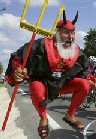
DEVIL WATCH: There's really no need for discussion today - he'll be on one of those hairpins going up Alpe d'Huez. Remember, all you goodly folk - if you see tridents painted on the road, the Devil lurketh somewhere nearby.

Thursday, 21 July 2011

Tour de France: Stage 18 Debrief - fading star turns supernova!

"If you don't risk, you don't win. That's my attitude." (Andy Schleck)
If you missed the stage today beg, borrow, steal or even pay good money for a recording otherwise you  risk missing one of the greatest stages in modern times.

Andy Schleck, the man for whom so many of us had given up hope, attacked on the second climb with 60km to go - and never stopped, dropping all before him and leading up the mighty Col du Galibier; crossing the finish line more than two minutes before the next rider, brother Frank.

If he can do the same tomorrow, the time trial may as well not be raced - he'll not only have won the Tour but achieved possibly the greatest victory since Eddy Merckx.

Meanwhile, it looks like the road to the finish was also the road to the end for Alberto Contador. The champion tried in the early stages but he was simply unable to match Andy's superior skill and strength, leaving it down to Cadel Evans to go on the hunt. Cadel reduced the gap - at one point four minutes - to a little over two, but when it came down to it his enormous brute strength and power couldn't compete with Andy's graceful pedaling style. As the finish line drew near, Frank swung out from the back of the chase group and overtook, coming in 2'07" behind his little brother. Cadel was 8" later and was followed across by Ivan Basso 3" behind him.

Another star of the day was Thomas Voeckler who, thanks partially to Cadel who dragged him up in his slipstream, retains his yellow jersey for an incredible ninth day making him the greatest Frenchman in the Tour for years.

Only 78 riders in - meaning approximately 90 were at risk of disqualification. However, if 20% or more of the riders finish outside the limit, race organisers have the right under UCI rules to extend the permitted time so as to avoid decimating the competition - this decision was, unsurprisingly, taken with each rider finishing outside the time being docked points equivalent to those on offer for winning the race.

This puts Mark Cavendish in a precarious place - having looked like the definite winner of the points competition, he's now only 15 points ahead of Jose Joaquin Rojas. With Rojas a much better climber, it's now very possible that the Manx sprinter won't be the first Briton to wear the green jersey in Paris after all. Everything depends on his performance in tomorrow's intermediate sprint and Saturday's time trial, if that doesn't work in his favour - which, with the sprint coming towards the end of the stage and after the climb up the massive Col du Galibier which almost finished him off for good today and Cavendish's lack of time trial ability, it likely won't - the final result could even depend on the last stage into Paris. This is undoubtedly one of the most exciting final weeks since the Tour began.
"There was no "letting them have time" today. It was flat out behind....SmartOpard was just better. Period." (Jonathon Vaughters, @Vaughters, manager of Garmin-Cervelo, Twitter)
Stage 18 Results:
1. SCHLECK Andy 6h 07' 56"  
2. SCHLECK Frank + 02' 07"
3. EVANS Cadel + 02' 15"
4. BASSO Ivan + 02' 18"
5. VOECKLER Thomas + 02' 21"
6. ROLLAND Pierre + 02' 27"
7. CUNEGO Damiano + 02' 33"
8. TAARAMAE Rein + 03' 22"
9. DANIELSON Tom + 03' 25"
10. HESJEDAL Ryder + 03' 31"

Overall General Classification results following Stage 18:

1. VOECKLER Thomas 79h 34' 06"  
2. SCHLECK Andy + 00' 15"
3. SCHLECK Frank + 01' 08"
4. EVANS Cadel + 01' 12"
5. CUNEGO Damiano + 03' 46"
6. BASSO Ivan + 03' 46"
7. CONTADOR Alberto + 04' 44"
8. SANCHEZ Samuel  + 05' 20"
9. DANIELSON Tom + 07' 08"
10. PERAUD Jean-Christophe + 09' 27"


Points: Mark Cavendish; Climbers: Jelle Vanendert; Youth: Rein Taaramae; Team: Garmin-Cervelo; Combativity: Andy Schleck.

Tuesday, 19 July 2011

Tour de France: Stage 16 Preview

LATEST: A Tour official was found dead in a river near the finish line at Gap early this morning. An investigation has begun.

Following a much-needed rest day - involving such relaxing activities as transporting teams, bikes and the tons of equipment carried about France during the Tour over the 125km from Montpellier to Saint-Paul-Trois-Châteaux, no mean feat in itself - Stage 16 is aimed straight into the heart of the French Alps, considered by many riders and spectators to be the highlight of a Tour and the most likely location for the eventual victor to reveal himself. The parcours is highly representative of the next few days - starting at 99m above sea level, it begins to head skywards right from the start line and then continues to do, climbing all the way until it reaches the 1268m Col de Manse before plunging 524m in 11.5km to the finish at Gap. For those of us who take an interest in the sights and locations along the route of the Tour, this stage is of as much interest for its geology as its history and takes in a number of interesting features.

Saint-Paul-Trois-Châteaux, on the edge of the beautiful department of Drôme, is home to around 8200 people and acts as a stage town for the very first time today. Like the majority of towns in the region, recorded history begins with the Romans who named it Augusta Tricastrinorum, a Latinised version of Tricastin which was the name the Gallic tribes living here before the Romans arrived used. Saint-Paul was added at some point in the 4th Century and, later, Tricastinorum was mistranslated as "three castles," thus giving rise to the modern name. and the town's heraldic emblem featuring three castellated towers and a crown. The town was fortified in ancient times and remnants of the Roman walls can still be seen at some sites around the medieval town centre, which is clear on maps as a roughly circular shaped area inlcuding the catehdral, Notre-Dame de Saint-Paul-Trois-Chateaux which is today considered one of the finest examples of Provençal Romanesque architecture and is of particular interest to archaeologists for the large number of mason's marks still visible on its stonework. To the south is a small mountain rising to around 270m and offering excellent views of the region including towards the south-east-east and - or so I'm informed - cycling's holiest mountain Mont Ventoux.

Chances are that the stage will see an early breakaway, as has every stage thus far this year, but the first few attempts are probably prone to fail when inexperienced riders underestimate gradient leaving the start town and can't keep ahead while the peloton gathers momentum. Sooner or later, the gene pool will have been reduced, leaving only the more experienced super-domestiques attacking the peloton; at which point a breakaway has a chance of success - we'd expect it to build up a small gap and maintain it for a good part of the course today, at least until the halfway point. Their target will once again be the intermediate sprint, but since that doesn't come until three quarters of the way to Gap and it's uphill all the way, whether or not they can get there first is debatable. Since the stage follows a rest day, we think they probably will.

Château de Suze-la-Rousse
Leaving Saint-Paul-Trois-Chateaux, the D59 passes between more forested ridges as it heads south-east for 8km to Suze-la-Rousse. Standing on an outcrop at the north-western corner of the town is the remarkable château which, much modernised in the 16th Century, perfectly combines the aesthetic qualities of a medieval fortress with those of a fine Renaissance stately home. It now houses a university of wine and viticulture. Immediately to the west is the castle's park, known as La Garenne, which contains a 16th Century real tennis court and Neolithic remains, evidence of a local culture predating the castle by thousands of years. The view from here to Mont Ventoux is famous.

The road into Suze-la-Rousse isn't technical as it emerges from a plane-lined avenue and across a bridge, offering one of the best views of the chateau, but the negotiates a roundabout. Shortly after this, riders will cross the road before turning left onto the D94 which is straight and flat. Looking back - which the riders won't - this road provides a good opportunity to comprehend the sheer scale of the chateau just passed; while looking forward it's possible to try to comprehend the even more impressive scale of Ventoux, which looms above the horizon like the malevolent presence that it is - this the riders will do, and be thankful that they don't have to climb it this year. The road sweeps north-east via a simple junction and, 16km from the start, reaches Tulette. The road continues through the middle of the town, straight at first before a couple of right-hand bends that are sharp enough to cause problems if conditions are wet. It then heads east, where it's called the Avenue des Alpes, and past the enormous bottling plant (not far off 400m wide!) which has made Tulette wealthy. Having crossed another roundabout it enters Saint-Maurice-sur-Eygues, an important centre of wine making. Just to the south is the Drôme river - its course is wide as it splits into a number of rivulets flowing through the gorges cut into the rocks. Another large roundabout takes us out of town and onto another plane-lined avenue - still the D94 - north-east past the le Sagittaire leisure park.

34km from the start is a large junction leading south onto a bridge across the river, then onto the D539 which passes the large town of Nyons and follows the line of a ridge of hills past vineyards and woodland. Although the parcours doesn't pass through Nyons, it should be possible to see the 13th Century Tour Randonne, which is topped with an unusual tiered detail with a statue of Mary: the tower is believed to have originally been defensive - it certainly looks like it - but it was purchased in 1862 by a local pastor and converted into a chapel, this being the purpose it still serves. As we approach the eastern end of the town where ridges face on another across the river is the Pont Roman, a graceful single-arch bridge, still in use after a little over six centuries.

The road then becomes the D94 again and continues north-east, crossing the river before skirting Les Clots and following the banks to Aubres and its ruined castle, then makes a large inverted U  and travels east once more to Les Pilles which marks 42.5km travelled. Les Pilles is named after two rocks said to resemble pyramids. The road turns north, following a narrow strip of land between the ridge and the river, then north-east and after 8.5km reaches Sahune, the entry to the Gorges of Saint May, an area of great natural beauty, and the route twists around in all directions for the next 20km to follow their course.

Verclause is located 71km from the start, meaning that there are a further 91.5 to the finish line. A picturesque ruined tower, all that's left of the castle, stands on the rocks high above and a sort time after the peloton passes through the village the road becomes the D994, marking the point where they officially enter the Haute Alpes; the hills to the north becoming noticeably craggier as though to prove the point. As it approaches the village of Rosans (76km), the gradient becomes much steeper and soon reaches over 750m above sea level.


At a flatter section is Moydans, the location of the feeding station and the halfway point. This tiny village is home to just 50 people, so it's entirely possible that the entire population will be waiting on the short main street to see the Tour pass through. Soon, the terrain starts to rise again and by the time the riders pass south of Ribeyret they'll be around 820m up. After another 4.5km, they reach L'Épine in the Buëch Valley where an abbey building atop a small rise north of the village gives the impression of a miniature Glastonbury Tour, passing just to the south of the village. Montclus, at 81km, has the same population as  Moydans but packs them into a smaller physical area sandwiched between higher ground to the north and south. In the centre of the village is a ruined tower dating from the 11th Century and built to provide a look-out point so the locals could prepare for imminent raids by the bandits that in those days infested the area. In 1994, several houses in the village were damaged by a landslide. Just to the east of the village is a small but very beautiful waterfall which plunges down the cliff and through a culvert under to road, the a sort distance further on a sharp left then right-hand corner as the parcours travels over a bridge to the opposite side of the narrow valley.

3km from Montclus is Serres (left), apparently one of just five French towns with names that are palindromes (oh alright, that's not really relevant - but you never know when knowledge of this type might prove useful). Serres can guarantee a good turn-out of spectators because visitors to the Serres Jazz Festival, currently in full swing, will be looking for something to do during a one-day break from the party. If you happen to be in the area, you can see a programme by clicking this link and Klezmer Kaos (whom I've seen a couple of times) have the Cyclopunk Seal of Approval.

The road through Serres is straight and reasonably wide with no hazards other than a roundabout, which shouldn't cause problems, as it joins the D1075 clinging to the cliff alongside the river and heads out of town towards the north, crossing the river opposite a imposing 350m cliff. Soon, the route comes to a large roundabout by an airfield where it rejoins the D994 and heads north-east, passing by yet more gorges. It follows alongside a railway, soon reaching a large station at Veynes where the peloton will have to tackle two roundabouts in quick sucession. Veynes was a small and quiet town until the railway came, but has since become a centre for the development of solar energy. Until the 14th Century, it was home to a Jewish community of whom many worked in local tanneries (Jews in Medieval Europe were banned from working in many industries and had to find jobs in those that other people found distasteful - tanneries not being the most pleasant places in which to work). Sadly, they were exterminated during violent attacks that we would nowadays term pogroms after they were blamed for causing the plague - a common flaspoint for antisemitism at the time.

Today, Veynes is home to the intermediate sprint - organisers have found  quite a challenging stretch of road featuring a first roundabout and right-hand corner towards the end of the first thousand metres, another roundabout immediately after entering the second thousand metres and series of traffic calming devices for good measure, along with an upwards kick of about 24m towards the end. What happens here depends entirely on whether or not a breakaway has formed and if it's still going by this point - if it is, the top points will go to whoever is the fastest: Delaplace, Delage, perhaps Zandio or Uran are likely lead group members and would all be likely winners of the 20 points. If not, expect any of the fast sprinters who isn't too tired from getting here.

La Roche-des-Arnauds
A little way out of town the road turns dead east and enters a long and straight section, passing La Plaine before reaching La Roche-des-Arnauds where, in the middle of the town, it turns sharply right and heads off in another straight line to the south east. The road in and out has central reservations, but is at no point narrow enough to cause problems and, being so straight, will have no effect on riders' times no matter which way they go around them. At Saint-Andre, Berne and La Selle is a twisty section of road which connects the three hamlets in a long loop and from which there are excellent views across the large Gap valley.

5km further on is Gap itself, arrival being marked by a very large roundabout with four exits. The town is home to 45,000 people, making it the largest town in the Southern Alps and an important administrative centre. There are several theories attempting to explain the name with the most likely being that it was orginally named Vapincum by the Celts or pre-Celtic speakers of an Indo-European tongue, subsequently shortened to Vap and then modified by the Franks or Goths. The cathedral - Cathédrale Notre-Dame-et-Saint-Arnoux de Gap - is much younger than it at first looks, having been built between 1866 and 1905; the very successful neo-Gothic design making it appear to have stood since the Middle Ages, as did the genuine medieval cathedral it replaced and which itself stood on the spot of a Roman temple to Apollo. Gap hosts the finish line of the stage, but since only 139km have been covered so far there's obviously more riding to be done - and since the remainder includes the 1268m Col de Manse, quite a bit more.

The road into Gap features several obstacles including roundabouts and sharp bends which only require a little rain and a patch of spilled diesel to become deadly, especially to tired cyclists: the N85  through town, being a major urban route, is likely to be especially hazardous due to the buses which use it and the large number of trees depositing wet leaves on the tarmac during the current windy weather. There are excellent views across the town and valley as the road skirts the northern edge at an altitude of about 820m and a series of potentially hazardous switchbacks shortly before Les Bumats. Soon, the peloton turns off the N85 via a tight right-hander onto the D944 which leads up to and over the Category 2 Col, the summit rather disappointingly being dotted with farms and homes - this is not really one of the Haute-Alpes, but there'll be plenty of those in the coming days.

Just after the summit the parcours switches to the D14 which carries it back south towards La Rochette, a fast descent where the bravest riders - those willing to trust in their tyres whilst gravity drives their speed up and up - will do well, and possibly have the best chances of getting down in one piece, too: modern tyres are very good indeed and most crashes on wet roads are caused by braking rather than the tyres. It was near here in 2003 that Joseba Beloki, a rider with the ONCE team who had started his career with Euskaltel-Euskadi, crashed badly and broke his elbow, hip and wrist, forcing him to abandon the race and subsequently retire. Lance Armstrong had been right behind him at the time and, to avoid the crash, went for a spot of mountain biking across the field next to the road, rejoining the peloton on the other side; which has been featured in just about every "Greatest Tour de France Moments" compilation produced ever since. Beloki later returned to professional racing with BBox for a short time before a row over the drugs used to treat his asthma saw him depart for Saunier Duval-Prodir and then Astana, becoming embroiled in the notorious Puerto doping scandal which left Astana unable to compete in the 2006 Tour and finding himself without a team in 2007 when he retired for a second time.

A short way on from La Rochette is a very sharp right-hand bend onto the D314 which, as today is likely to be wet and the riders are going to be travelling at high speed on the descent will be perhaps one of the most dangerous points on the entire stage; and if that one claims no victims there's an even sharper left-hand bend coming up, followed by a right-hand bend only a little less challenging - in both cases, fields immediately due to the north and a few metres higher may see the rain wash mud onto the road, making the surface even more slippery.

Just outside Gap is Domaine de Charance is
dedicated to the study and conservation of
alpine plants.
Two switchbacks a few kilometres on in a wooded section are likely to be every bit - if not even more - of a hazard and the junction onto the N94 at Pont Sarrazin will come as a great relief to the riders at the end of a hairy descent, but it too is not without its dangers - a large lorry depot just outside Gap is another spot where diesel spills, as invisible as they are lethal to both cyclists and motorcyclist, are very likely and there's a big roundabout just next to a carpark as the road enters the town. The final kilometre runs along the straight Avenue de Marechal Foch, making this another finish ideal for sprinters - assuming can make it to the front of the peloton and have any energy left after the climb.

Predictions: Cadel Evans is obvious contender, a great climber and fast all-rounder who is looking to be a far more dangerous challenger to the Schlecks than Contador in the hills this year - and he's very fast on the flat too, which could see him defeat the Col and then light the afterburners for a blast back down into Gap. Sylvain Chavenel is also very fast, but he seems to have a particular talent for maintaining high speed in heavy rain when others reduce speed to cope with the slippery conditions and become demoralised. Then there's always the possibility that a chancer  will try his luck, like Jelle Vanendert did the other day: don't forget that long, straight final sprint to the finish at Gap's town centre park - any sprinter who can make it in good shape up, over and down Col de Manse will have a huge advantage over the climbers here.

Weather: Easily summed up today - horrible. There's a possibility that the final loop up and over the Col de Manse could even be cancelled as a result. St.-Paul-Trois-Châteaux is already looking pretty grim and it's raining in Saint-Maurice-sur-Eygues at the time of writing. It's apparently not raining at the present in Aubres, but heavy showers are forecast throughout the day. Verclause looks set to be much the same, but wind gusting at up to 27kmph from the east is going to mean a very unpleasant ride as it drives the rain straight into the faces of the riders as they battle their way into it. Moydans and Serres are no better, but conditions could become even worse around Veynes where a north-easterly wind is touching 37kmph at times - more than enough to cause problems and blow riders across the road. The fastest winds predicted today for Gap are a slightly more manageable 22kmph, but heavy rain is forecast throughout the day. It's not going to be a pleasant ride at all.

DEVIL WATCH: The Devil usually shows up un the upward slope of a climb approaching the finish, so Col de Manse is the most obvious place for him today. On the other hand, there are quite a few very pretty locations along the way - Moydans, situated on a small climb, is also a possibility.

Thursday, 14 July 2011

Tour de France: Stage 12 Preview

Ladeeeeeezangennulmun!
It gives me much pleasure to announce that the Tour de France 2011 starts today, rumours of its earlier birth being greatly exaggerated. All that stuff you've been watching for the last week and a half round Vendee, Brittany, Tarn and so on was just an extended prologue and the real competition begins today!
Alright, that's not strictly true - the first eleven stages have been absolute classics with top-notch racing and superb scenery, plus calling the a prologue would belittle the tragedies (Wiggins, Vinokourov, Zabriskie etc.), downplay the heroics (Hoogerland, Flecha) and ignore the high-speed skill (Cavendish, Costa) which, as is the case in every Tour, have been dished out with a shovel.

Meanwhile, it's fair to say that today brings such a change that we are beginning a race within a race, a test to find the world's best grimpeur who shall be crowned the King of the Mountains. In the coming days, the sprinters will be all but forgotten as attention turns to the climbing specialists: Contador, the Schlecks, Evans and the Euskaltel-Euskadi boys, because today brings the first of the high mountains.


After the last two stages, which have primarily been intended to transfer the remaining riders between two points, today is not an easy day at all. In fact, it could accurately be described as bloody difficult. Those first 119km up to the intermediate sprint are almost entirely straight, though there are one or two awkward tight bends chucked in, like the one as the D3 passes through Saint-Clar-de-Rivière 12.5km from the startline - just to keep everyone awake, but let's not forget the parcours rises over 400m.

That's actually quite demoralising, because it makes your knees hurt but it's not enough of a gradient to look like a climb should a rider look back. On a big, bad high-gradient climb, your knees feel like someone's injected molten steel into the articular capsules, but at least you can look back and draw strength from the sense of sheer achievement. Today, just as some riders' knees are beginning to hurt they'll look back and it'll seem they've been riding in the flatlands - and when they look forward, they'll see all 1538m of Hourquette d'Ancizan. Which they have to ride up. And that dissolves will like a marshmallow in nitric acid.

Cugnaux is a vibrant town with some 16,000 inhabitants. The name is derived from that of a tool used to split wood, reflecting the occupation of many locals in the medieval period before the forests that once covered the landscape here were all chopped down and replaced with the arable farmlands now found among the several large urban centres nearby. The town hit French headlines in 2007 when it adopted a new law banning anyone who did not have a burial plot reserved for them from dying within the municipal area and threatening anyone sufficiently inconsiderate as to do so with harsh penalties. It's also the home of three chateaux - Cassagnère, Hautpoul and Maurens.

Gers is characterised by fertile, rolling terrain. Backdrop provided by the Haute-Pyrenees.
22km onward is Rieumes, an attractive town unfortunately connected with the distinctly unattractive "sport" of bull-fighting. Luckily for us, the Tour will be flashing through on the D3 and so we won't have to see any animals being slowly tortured for the entertainment of supposed human beings. As the riders pass through, they enter a forested section and the department of Gers which is home to around 185,300 people but is host to some 890,000 tourists every year - as might be suggested by these statistics, the scenery is not unpleasant. We're not there for long, however, soon moving into Haute-Garonne.

There are a number of villages either side of the parcours as we head towards Ciadoux, 65.5km from the start, but none are of particular note. Nevertheless, this is rural France and there will be chateaux, along with - no doubt - huge bicycles and stuff made out of hay and assorted farm detritus in the fields along the way. Ciaodoux itself is a pleasant enough village, standing on a low hill and offering the riders their first glimpse of the Pyrenees looming in the second half of the stage. It also marks the end of the D3, forcing them to negotiate a sharp right hand corner onto the D635 and then, after a kilometre and a half, a left onto the D17 at Rebirechioulet. The latter looks set to be quite a technical section - although it's an obtuse angle, generally easier than a sharp, acute bend - it's quite a complicated junction due to an irregularly-shaped section right in the middle (43°15'52.08"N 0°42'44.65"E) and may account for a rider or two.

As the riders complete their 73rd kilometre, they come to the village of Blajan with its somewhat dejected-looking church. It's a small one, but attractive in a "faded grandeur" sort of way. It represents the village rather well - Blajan isn't much, but what it is is unpretentious and likable. Nizan-Gesse, 5km on, is similar but trumps its neighbour for location - it sits at the bottom of a shallow valley with woodland along the hills either side and some impressive houses among the trees. What really gives the place an edge, though, is the views to the south: more of the same rolling countryside and patches of trees, finished off perfectly with a backdrop of the Haute-Pyrenees - and we cross into the department of the same name after the next 16km.

Lannemezan, at 101.5km from the start, makes two very impressive claims to fame. One is that it's hosting today's feeding station, the other is that its Town Hall was the very first to appear in the online virtual world Second Life. Once a thriving, wealthy place, Lannemezan fell upon hard times during the last 40 years as the heavy industry upon which it relied declined but since 2007 there have been many positive signs suggesting that the town is on the way back up as it begins to attract high-tech industry.

Le Chateau des Nestes
A few kilometres on is Izaux, famous for its Roman remains which include a well-preserved villa and then Lortet on the banks of what is unmistakably a mountain river. Next is Hèches, located in a passage through the Pyrenees foothills and famous for the nearby cliffs which are a centre for rock-climbing. 5km further is Sarrancolin, a fortified medieval town and very much the gateway into the Pyrenees. It's also the site for the intermediate sprint today, which extends along the valley floor. Arreau, just down the road, is home to many imposing medieval buildings including le Château des Nestes. Ancizan, 4km further on, is a medieval fortified village.

Very soon, we come to Category 1 Hourquette d'Ancizan, the first real mountain of this Tour. The 9.9km journey to the top rises to 1538m with an average gradient of 7.5%, much of it achieved by means of a complicated series of switchbacks. There is a very high possibility that riders may decide to abandon here. The D918 takes the race back down, passing through several little villages with Gripp being perhaps the most attractive, but this section is all about getting as much rest as possible before the Col du Tourmalet, this year's first Hors-Categorie climb and one of the highest and most notorious points ever visited by the Tour.

The highest road in the Pyrenees, Tourmalet is 17.1km long and with an average gradient of 7.3%, one of the most difficult and testing challenges in the Tour de France with which it has long been linked, having been climbed 79 times since its first appearance in 1910. It is, of course, considered a jewel of the race and being the first to the top brings a lot more than points. Expect to see Alberto Contador and Andy Scheck lock horns as they climb - this is where both men will begin their attempt to win the overall General Classification for the top place on the podium in Paris. Don't miss La Mongie on the way up, a beautiful little village at an altitude of 1800m made rich by winter sports.


Once over, the parcours soon reaches Barèges, the highest spa town in the Pyrenees, which grew up after shepherds tending their flocks on the high slopes noticed that sick sheep would recover after bathing in the water bubbling up from the hot springs. Viella is also attractive, as is Luz-Saint-Sauveur - the location of the Chateau-Sainte-Marie which stands ruined and picturesque above the village.

Chateau-Sainte-Marie
Finally, we reach Luz-Ardiden - another Hors-Categorie climb, this time of 1.3km at a gradient of 7.4% to 1715m. It's often said that the Tour takes all a rider has to give and then it takes the rest, too; this was never truer than on this stage. The majority of the riders are going to be agony as they grind their way up the final summit on their way to the finish line at the top, so keep a careful eye on who performs well and who suffers here - those who do well are contenders to win the Tour.
Predictions: Cadel Evans, Alberto Contador or Andy Schleck - our money's firmly on Andy. Wildcard - Frank Schleck, who appears to be in his best form ever. But don't forget, this is home turf for Euskaltel-Euskadi, the Basque hardmen for whom the Pyrenees are regular training rides.

Weather: At long last, things are looking good - but we're in the mountains now, where the weather can change almost in an instant. At altitudes such as Tourmalet, anything can happen. The wind should remain light, but once again the situation may prove different high up as high mountain stages are always susceptible to wind.

DEVIL WATCH: Where could he possibly show up today other than near the summit of Tourmalet?