Showing posts with label Contador. Show all posts

Friday, 6 December 2013

Daily Cycling Facts 06.12.2013

Contador, 29 today
(image credit: VirtKitty CC BY-SA 2.0) 
Alberto Contador
"El Pistolero," Alberto Contador, who won three Tours de France, two Giri d'Italia (but was stripped of one Tour and one Giro following a very controversial and long-running doping investigation), two editions of the Vuelta a Espana, a host of Grand Tour jerseys other than the overall winner jersey, Vuelta a Castilla y León, Volta ao Algarve, Paris-Nice and most of the other races you can think of. He was born in Pinto, Spain in 1982.

Contador, widely considered among the best climbers in the world during a period extending from 2007 to 2011 (as a junior, he was nicknamed Pantani - not a name that cyclists bandy about without really meaning it) and is only the fifth man to have won all three Grand Tours. In common with several other climbing specialists, he is also devastatingly fast in the time trials - a combination that makes him such a hard opponent to beat in a stage race.

Yet, Contador's career almost never happened: in 2004, his second professional year, the Spanish rider had been ill with headaches for several days prior to the Vuelta a Asturias. Then, just 40km into Stage 1, he suffered convulsions and collapsed. Medical investigation revealed cavernous angioma, a disorder in which blood vessels (usually within the brain, but other organs can be affected) become filled with stagnant blood. He required a dangerous operation which left a scar that can sometimes be seen when he takes off his helmet after a sweaty stage, running from one ear right over his head to the other. He resumed training as soon as he was able to do so, and eight months later won Stage 5 at the 2005 Tour Down Under. The following year, he crashed while riding to the team bus after a stage at the Vuelta a Burgos and was rendered unconscious - due to his medical history, he was rushed to hospital and given a CAT scan but no link was found.

Like many other cyclists at his level, Contador's career has been affected by doping allegations. The first came in 2006 when his ONCE-Liberty Seguros team was prevented from starting the Tour de France after several riders - himself included - were implicated in Operación Puerto. He was cleared, and returned in in time for the Vuelta a Burgos at which he crashed as outlined above. He was briefly without a team after that season came to a close until being signed up by Discovery in January 2007; returning the favour with a superb win at Paris-Nice, a textbook example of team tactics in which his domestiques continually worked on their leader's rivals and ground away at them until nobody had the energy to prevent him taking the race. During the same year at the Tour de France, race leader Michael Rasmussen was disqualified after it was shown that he had misled the team during a three-week period prior to the race, making himself unavailable to anti-doping officials. That left Contador in the lead - for once, anti-doping efforts worked in his favour.

In 2008, he was unable to take part in the Tour for a second time, again due to his team: Astana were not permitted to ride due to widespread doping in the past, despite the fact that most of the management and riders had been recruited in the time since the incidents in question. However, the team received an invitation to participate in the Giro d'Italia one week before the race was due to start and, despite a serious lack of training (he was sunbathing on a beach at home in Spain when he was informed) Contador won, the first foreign rider to have done so for twelve years - but earned a place in the hearts of Italian fans when he told them that winning their beloved Grand Tour "was a really big achievement, bigger than if I'd had a second victory in the Tour de France." Later in the year, he also raced in the Vuelta a Espana which that year included an ascent of the legendary Alto de l'Angliru, the steepest mountain in any Grand Tour. All the teams had sent strong climbers to be in with a chance of surviving the stage, which meant that while Contador was first up the mountain - and won the leader's jersey - he didn't win the sort of advantage he would have done over lesser men. However, few other riders in history have been capable of keeping the pace high through the subsequent flat stages and time trial like Contador could. He won, becoming the fifth rider to have won all three Grand Tours during their career (the others are Anquetil, Gimondi, Merckx and Hinault).

(image reuse information)
In 2009, the media learned that Lance Armstrong was to return from retirement solely in order to compete in another Tour and printed stories ranging from the feasible to the lurid claiming that a row had broken out between the riders over who would lead the team. Contador has since explained that he simply wanted an assurance that he would lead, denying that the row was anything like the feud described by some journalists. In the event, manager Johan Bruyneel was clever enough to see through the Armstrong legend and understand that the Texan's best years were in the past, leaving Contador in the top position. His faith paid off: Contador won with an advantage of more than four minutes over second place Andy Schleck (after some superb duels in the mountains) and almost five and half over Armstrong in third place. Unfortunately, a genuine feud broke out after the race when Contador said of Armstrong, "I have never admired him and never will" - an opinion in which he is not alone, numerous riders having expressed their belief that Armstrong affected the Tour and professional cycling negatively despite the armies of new fans he brought. Armstrong replied by saying that "a champion is also measured on how much he respects his teammates and opponents," which even his most ardent supporters will accept is a bit rich coming from a man who has completely ostracised others when he's suspected them of not having his best interests at heart or, in his terminology, being a troll.

2010 brought a strong start to the season, leaving Contador as favourite for the Tour. However, there were those who had taken note of Andy Schleck's increasing strength and wondered if it might be his year instead. Then - Stage 15 and Chaingate, as the incident when Schleck's chain came off on a steep climb and Contador didn't wait for him has become known. It was not, as Contador's detractors - and there are many - claimed a mere example of bad sportsmanship, though. Schleck had himself failed to wait when Contador was caught up in a crash during Stage 3, leading many to wonder if the close friendship between the two riders had fallen by the wayside, like so many riders a victim of the pursuit for Tour de France victory. Schleck fixed his bike and rode hard, but out on his own on the mountain he was unable to catch up. Contador won the stage by 39 seconds - the exact time by which he later won the overall General Classification. The fall-out was ugly - he faced an angry crowd that booed him as he donned the yellow jersey at the end of the stage. Schleck too was  upset, stating his opinion that the Spaniard had acted unsportingly, but Contador issued an apology hours later. The two riders have since patched up their differences and are once again friends.

Contador's apology to Schleck

In Sepetember 2010, after the Tour was over, Contador revealed to the world that a sample he had provided during a rest day between Stages 16 and 17, had subsequently tested positive for the banned bronchodilator Clenbuterol but claimed he had no idea how the drug had got into his system. Later, he said that he thought it might have been from eating contaminated beef - though its use in cattle feed is illegal in the European Union, it is known to be used by farmers as it promotes the growth of lean meat which fetches a higher price than fatty meat. This explanation was considered plausible by doctors and several experts said that as the drug's effects on athletic performance are negligible, they could see no reason that the rider would have deliberately used it. The miniscule amount that was found in the sample also seems to support the theory. However, use of Clenbuterol in Spain is exceedingly rare - tests carried out in 2008 and 2009 on more than 19,000 samples taken from Spanish cattle showed no evidence at all that it was being used while a Europe-wide testing programme involving more than 83,000 samples during the same period recorded just one positive result. There was also the unfortunate discovery of plastic residue in the rider's blood - an indication that he might have received a transfusion of stored blood, either his own or form someone else, as is carried out by cyclists and other athletes to boost their red blood cell levels. However, the test process that discovered the residue is not approved by the World Anti-Doping Authority and as such its findings can not be used as evidence.

As already stated, the amount of Clenbuterol discovered in Contador's positive sample was minute, some 40 times lower than the amount that would result in an automatic ban (not, as earlier reports claimed, 400 times lower) - an amount that at least one doctor has stated was 180 times lower than the rider would have needed to gain any sort of increase in performance whatsoever. Nevertheless, in these post-Festina Affair/Operación Puerto times, professional cycling is in no doubt that it cannot afford any more major scandals if it is to retain any sort of credibility and authorities have had to come down hard on offending riders to save face and leave nobody in doubt that their intention is to stamp out doping once and for all - thus, Contador was handed a provisional suspension pending further investigation; though this had little effect on him as his season had already ended.

Contador's scar from brain surgery can
still be seen
(image credit: GoldenBembel CC BY 2.0)
In January 2011, the Spanish Cycling Federation announced it intended to ban him from racing for a year; but later accepted his explanation and upheld his appeal, clearing him of all charges and freeing him to return to competition in time for the Volta a Algarve. He also took part in the Tour de France, earning himself new fans and the respect of many riders by retaining his dignity at the Tour Presentation when crowd hurled abuse at him and again during the race with a superb mountain attack on the Col du Télégraphe and Galibier in Stage 19; later saying that he had attacked for his own amusement. Yet despite good physical form and some excellent days, Contador rode differently in that Tour. It looked as though part of him was broken, a spark had been suffocated by the sheer weight of the  doping allegations and investigation. It wasn't a pleasant thing to watch. His case was due to be heard by the Court for Arbitration in Sport in June 2011, but was delayed until August after the Tour. It was then delayed again until November, then put back again and he began the 2012 season with the case still hanging over him. Finally, in February that year, a decision was made; to fans worldwide, who had expected a short ban at worst, it came as a shock - although the Court had heard there was no evidence that Contador had intentionally doped, it decided that the drug had probably got into his body via a contaminated food supplement rather than via contaminated beef (the latter being his explanation) and handed him a two-year backdated ban and stripped him of all results since July 2010. The ban would expire in August, leaving him unable to compete in the Tour de France, and his contract with SaxoBank was terminated, sparking off rumours about the future of the team and where he might go in the future; however, it surprised few in July when it was announced he would return to SaxoBank.

From the day that his ban was announced, many believed that he would dominate the Vuelta a Espana from the first stage to the last when he returned. In fact, it turned out to be a far more interesting race than that - for the first seventeen stages, Contador played cat-and-mouse games with Joaquim Rodríguez, who continually came out on top. Some wondered if he was no longer the rider he'd once been, others suspected he was being subtle, leaving it until a time when he could prove to the world that he could win at any time he chose to do so. If that was his plan, the moment came in Stage 17 when he finished 6" ahead of a leading group and took two minutes from Rodriguez, becoming race leader and remaining so until Madrid where he won with an overall advantage of 1'16".

Whatever one thinks of Contador, and there are many who dislike him intensely, it seems very likely that had be not have been prevented from taking part in two Tours and without the stress he had to bear in 2011, there's a very real possibility that he might have won five by now. SaxoBank-Sungard manager Bjarne Riis has continued to support the rider, stating that he believes Contador is capable of winning all three Grand Tours in a single year - something that no other rider has ever achieved and which would be seen by many as a greater accomplishment than the Triple Crown (two Grand Tours and a World Championship). He is now 31, and if he regains the form he once had for 2014 he might still do that.


Charly Gaul
Charly Gaul, 1932-2005
Contador may be among the greatest climbers of his generation, but Charly Gaul, who died on this day in 2004 at the age of 72 (two days before he would have turned 73), was in another class altogether: they called him "The Angel of the Mountains" for a reason - when conditions suited him (which meant heavy rain, icy winds and, ideally, a blizzard), he was quite simply the finest climber cycling has ever seen.

Gaul first showed his talent when he was just 17 years old and riding in the Österreich Rundfahrt by setting a new record on the infamaous Grossglockner, typically in weather so awful the rest of the field wished they were somewhere else. Cycling writer Charlie Woods was there to see it...
The Grossglockner is slightly higher than Mont Ventoux and just as formidable. One can imagine the youngster engaging rather sheepishly with such a monster. He knew that he could climb well on ordinary hills, but this was no man's land. At half-distance, however, despite his manager's exhortations to caution, his class told and he found himself alone in the lead. A few moments of giddy pleasure were soon dispatched by the ever-present need to keep the pedals turning; he was, after all, still in no man's land. This show of force was greeted by another, a thunderstorm and the first squalls of rain probably cooled the fever of his labours and brought with it a lighter, freer atmosphere. He had always been at ease in rainfall [and] beginning to pedal now with an edge of fierce affirmation, he perhaps completely forgot himself for a long series of ramps and bends... To such an extent that not only did he win the stage but broke the existing record for the climb." (Alchin, Richard and Bell, Adrian (eds), Golden Stages of the Tour de France, Mousehold Press, UK, ISBN 1-874739-28-5, p46)
Gaul's climbing technique was, for his time, unique, and in the early days other riders laughed at him because he didn't choose the bigger gears that their machismo demanded they chose. Some, though, knew better; Raphaël Géminiani said that Gaul was "a murderous climber, always the same sustained rhythm, a little machine with a lower gear than the rest, turning his legs at a speed that would break your heart, tick tock, tick tock, tick tock..."

Later, Gaul would become known for breaking away from the peloton to climb the steepest mountains of the Tour de France and Giro d'Italia alone, he was also National Road Champion of Luxembourg six times and National Cyclo Cross Champion twice. He won the Giro twice (1956 and 1959), also winning the King of the Mountains classification on each occasion and the Tour de France in 1958, in addition to the Tour King of the Mountains in 1955 and 1956, and it was he who first invented the fine art of urinating on the move, developing it after another rider attacked during a peloton comfort break, which earned him his other nickname Monsieur Pipi - which he hated, and which was only used behind his back because despite enormous popularity among fans, Gaul could be distinctly unpleasant and even frighteningly aggressive - he once terrified Louison Bobet when he told him: ""I will get my revenge. I will kill you. Remember I was a butcher. I know how to use a knife;" hence another nickname: The Dark Angel). That was not the end of it - though Bobet backed down, realising he had made a very dangerous enemy, Gaul was not a man who forgave easily: two years later during which time the pair had not spoken to one another and Bobet probably thought it was all forgotten, he was surprised when without warning the little Luxembourger confronted him. "You are ready, Monsieur Bobet?" he snarled. "I'll give you a chance. I'll attack on the Luitel climb. I'll even tell you which hairpin. You want to win the Tour more than I do? Easy. I've told you what you need to know." Then, on the climb, Gaul drove the pace so high that Bobet was utterly destroyed. Only Bahamontes could stay with Gaul, but then he cracked too.

Like several other pure climbers, Gaul was a formidable rider in a time trial; unlike the vast majority of lightly-built climbers, including his rival (and friend; one of very few) Bahamontes, Gaul was not afraid of a steep descent. In fact, he seems not to have feared anything very much; except, perhaps, for himself - after retirement, he ran a cafe for a short while and then became a virtual recluse, living with only his dog for company in a forest hut for many years, and the fact that he remembered little of his success raises the possibility that he may have suffered a serious mental illness, perhaps severe depression. This would not have been helped by his excessive drug use; many riders recalled how he frequently foamed at the mouth, and his lack of expression on the mountains when others grimaced in pain is indication that he was quite literally "out of it," mentally disconnected from his suffering legs. Occasionally, if the Tour passed nearby, he would go and watch, knowing that nobody would recognise and bother him now that he was fat and bearded. He was saved when he met his third wife, Josée,  in 1983, and she must have been a truly remarkable woman to have wanted anything to do with such a difficult character. Six years later, he made his first official public appearance since retirement.

Gaul died two days before his 73rd birthday. His total of three General Classification and four King of the Mountain victories at the Grand Tours has been surpassed many times, but in the opinion of many, including those who won more than he did and even Bahamontes whose claim to be the greatest climber is more convincing on he opinion of some than Gaul's, the style in which he won them makes him without equal.

They may have laughed at his low gears and hamster-wheel cadence when he first appeared in the peloton, but they stopped when he beat them all. Nowadays, all the pure climbers use the same technique.


Rachel Atherton
(image credit: Black Country Biker)
Gaul was very good at riding up mountains, a rider who is very good at riding down them is Rachel Atherton who was born on this day in 1987. Atherton began riding BMX when she was eight, then moved on to mountain bikes when she was eleven. Seven years later, she was selected as The Times Sportswoman of the Year after becoming British, European and World Junior Downhill Champion. She then added numerous wins to her palmares before becoming the first British woman to win the World Downhill Championships at Elite level in 2008.

Paul Crake is an Australian professional cyclist who was born in Canberra on this day in 1976. He is also a five-time winner of the Empire State Building Run-up and in 2003 became the first person to make it up the 1,576 steps in less than 10 minutes.

Leandro Faggin, a gold medalist at the 1956 Olympics in Melbourne, died in Padua on this day in 1970, the city in which he was born, aged just 37.

Other cyclists born on this day: Marat Ganayev (USSR, 1964); Stéphane Augé (France, 1974); Raino Koskenkorva (Finland, 1926); Félix Suárez (Spain, 1950); Luisa Seghezzi (Italy, 1965); Hugo Miranda (Chile, 1925); Guglielmo Malatesta (Italy, 1891, died 1920).

Thursday, 6 December 2012

Daily Cycling Facts 06.12.2012

Contador, 29 today
(image credit: VirtKitty CC BY-SA 2.0) 
Alberto Contador
Happy birthday to "El Pistolero," Alberto Contador, who has won three Tours de France, two Giros d'Italia, one Vuelta a Espana, a host of Grand Tour jerseys other than the overall winner jersey, Vuelta a Castilla y León, Volta ao Algarve, Paris-Nice and most of the other races you can think of. He was born in Pinto, Spain in 1982.

Contador, widely considered the best climber in the world today (as a junior, he was nicknamed Pantani - not a name that cyclists bandy about without really meaning it) and is only the fifth man to have won all three Grand Tours. He married his long-term girlfriend Macarena in November 2011 and we wish him all the best in the investigation into his alleged positive test for doping. Many fans don't like Contador, but as far as we're concerned if you love cycling, you should love him too - to see him climb is one of the most beautiful sights in the sport. Unusually for a climbing specialist, he is also devastatingly fast in the time trials - a combination that makes him such a hard opponent to beat in a stage race.

Yet, Contador's career almost never happened: in 2004, his second professional year, the Spanish rider had been ill with headaches for several days prior to the Vuelta a Asturias. Then, just 40km into Stage 1, he suffered convulsions and collapsed. Medical investigation revealed cavernous angioma, a disorder in which blood vessels (usually within the brain, but other organs can be affected) become filled with stagnant blood. He required a dangerous operation which left a scar that can sometimes be seen when he takes off his helmet after a sweaty stage, running from one ear right over his head to the other. He resumed training as soon as he was able to do so, and eight months later won Stage 5 at the 2005 Tour Down Under. The following year, he crashed while riding to the team bus after a stage at the Vuelta a Burgos and was rendered unconscious - due to his medical history, he was rushed to hospital and given a CAT scan but no link was found.

Like many other cyclists at his level, Contador's career has been affected by doping allegations. The first came in 2006 when his ONCE-Liberty Seguros team was prevented from starting the Tour de France after several riders - himself included - were implicated in Operación Puerto. He was cleared, and returned in in time for the Vuelta a Burgos at which he crashed as outlined above. He was briefly without a team after that season came to a close until being signed up by Discovery in January 2007; returning the favour with a superb win at Paris-Nice, a textbook example of team tactics in which his domestiques continually worked on their leader's rivals and ground away at them until nobody had the energy to prevent him taking the race. During the same year at the Tour de France, race leader Michael Rasmussen was disqualified after it was shown that he had misled the team during a three-week period prior to the race, making himself unavailable to anti-doping officials. That left Contador in the lead - for once, anti-doping efforts worked in his favour.

In 2008, he was unable to take part in the Tour for a second time, again due to his team: Astana were not permitted to ride due to widespread doping in the past, despite the fact that most of the management and riders had been recruited in the time since the incidents in question. However, the team received an invitation to participate in the Giro d'Italia one week before the race was due to start and, despite a serious lack of training (he was sunbathing on a beach at home in Spain when he was informed) Contador won, the first foreign rider to have done so for twelve years - but earned a place in the hearts of Italian fans when he told them that winning their beloved Grand Tour "was a really big achievement, bigger than if I'd had a second victory in the Tour de France." Later in the year, he also raced in the Vuelta a Espana which that year included an ascent of the legendary Alto de l'Angliru, the steepest mountain in any Grand Tour. All the teams had sent strong climbers to be in with a chance of surviving the stage, which meant that while Contador was first up the mountain - and won the leader's jersey - he didn't win the sort of advantage he would have done over lesser men. However, few other riders in history have been capable of keeping the pace high through the subsequent flat stages and time trial like Contador could. He won, becoming the fifth rider to have won all three Grand Tours during their career (the others are Anquetil, Gimondi, Merckx and Hinault).

(image reuse information)
In 2009, the media learned that Lance Armstrong was to return from retirement solely in order to compete in another Tour and printed stories ranging from the feasible to the lurid claiming that a row had broken out between the riders over who would lead the team. Contador has since explained that he simply wanted an assurance that he would lead, denying that the row was anything like the feud described by some journalists. In the event, manager Johan Bruyneel was clever enough to see through the Armstrong legend and understand that the Texan's best years were in the past, leaving Contador in the top position. His faith paid off: Contador won with an advantage of more than four minutes over second place Andy Schleck (after some superb duels in the mountains) and almost five and half over Armstrong in third place. Unfortunately, a genuine feud broke out after the race when Contador said of Armstrong, "I have never admired him and never will" - an opinion in which he is not alone, numerous riders having expressed their belief that Armstrong affected the Tour and professional cycling negatively despite the armies of new fans he brought. Armstrong replied by saying that "a champion is also measured on how much he respects his teammates and opponents," which even his most ardent supporters will accept is a bit rich coming from a man who has completely ostracised others when he's suspected them of not having his best interests at heart or, in his terminology, being a troll.

2010 brought a strong start to the season, leaving Contador as favourite for the Tour. However, there were those who had taken note of Andy Schleck's increasing strength and wondered if it might be his year instead. Then - Stage 15 and Chaingate, as the incident when Schleck's chain came off on a steep climb and Contador didn't wait for him has become known. It was not, as Contador's detractors - and there are many - claimed a mere example of bad sportsmanship, though. Schleck had himself failed to wait when Contador was caught up in a crash during Stage 3, leading many to wonder if the close friendship between the two riders had fallen by the wayside, like so many riders a victim of the pursuit for Tour de France victory. Schleck fixed his bike and rode hard, but out on his own on the mountain he was unable to catch up. Contador won the stage by 39 seconds - the exact time by which he later won the overall General Classification. The fall-out was ugly - he faced an angry crowd that booed him as he donned the yellow jersey at the end of the stage. Schleck too was  upset, stating his opinion that the Spaniard had acted unsportingly, but Contador issued an apology hours later. The two riders have since patched up their differences and are once again friends.

Contador's apology to Schleck

In Sepetember 2010, after the Tour was over, Contador revealed to the world that a sample he had provided during a rest day between Stages 16 and 17, had subsequently tested positive for the banned bronchodilator Clenbuterol but claimed he had no idea how the drug had got into his system. Later, he said that he thought it might have been from eating contaminated beef - though its use in cattle feed is illegal in the European Union, it is known to be used by farmers as it promotes the growth of lean meat which fetches a higher price than fatty meat. This explanation was considered plausible by doctors and several experts said that as the drug's effects on athletic performance are negligible, they could see no reason that the rider would have deliberately used it. The miniscule amount that was found in the sample also seems to support the theory. However, use of Clenbuterol in Spain is exceedingly rare - tests carried out in 2008 and 2009 on more than 19,000 samples taken from Spanish cattle showed no evidence at all that it was being used while a Europe-wide testing programme involving more than 83,000 samples during the same period recorded just one positive result. There was also the unfortunate discovery of plastic residue in the rider's blood - an indication that he might have received a transfusion of stored blood, either his own or form someone else, as is carried out by cyclists and other athletes to boost their red blood cell levels. However, the test process that discovered the residue is not approved by the World Anti-Doping Authority and as such its findings can not be used as evidence.

As already stated, the amount of Clenbuterol discovered in Contador's positive sample was minute, some 40 times lower than the amount that would result in an automatic ban (not, as earlier reports claimed, 400 times lower) - an amount that at least one doctor has stated was 180 times lower than the rider would have needed to gain any sort of increase in performance whatsoever. Nevertheless, in these post-Festina Affair/Operación Puerto times, professional cycling is in no doubt that it cannot afford any more major scandals if it is to retain any sort of credibility and authorities have had to come down hard on offending riders to save face and leave nobody in doubt that their intention is to stamp out doping once and for all - thus, Contador was handed a provisional suspension pending further investigation; though this had little effect on him as his season had already ended.

Contador's scar from brain surgery can
still be seen
(image credit: GoldenBembel CC BY 2.0)
In January 2011, the Spanish Cycling Federation announced it intended to ban him from racing for a year; but later accepted his explanation and upheld his appeal, clearing him of all charges and freeing him to return to competition in time for the Volta a Algarve. He also took part in the Tour de France, earning himself new fans and the respect of many riders by retaining his dignity at the Tour Presentation when crowd hurled abuse at him and again during the race with a superb mountain attack on the Col du Télégraphe and Galibier in Stage 19; later saying that he had attacked for his own amusement. Yet despite good physical form and some excellent days, Contador rode differently in that Tour. It looked as though part of him was broken, a spark had been suffocated by the sheer weight of the  doping allegations and investigation. It wasn't a pleasant thing to watch. His case was due to be heard by the Court for Arbitration in Sport in June 2011, but was delayed until August after the Tour. It was then delayed again until November, then put back again and he began the 2012 season with the case still hanging over him. Finally, in February that year, a decision was made; to fans worldwide, who had expected a short ban at worst, it came as a shock - although the Court had heard there was no evidence that Contador had intentionally doped, it decided that the drug had probably got into his body via a contaminated food supplement rather than via contaminated beef (the latter being his explanation) and handed him a two-year backdated ban and stripped him of all results since July 2010. The ban would expire in August, leaving him unable to compete in the Tour de France, and his contract with SaxoBank was terminated, sparking off rumours about the future of the team and where he might go in the future; however, it surprised few in July when it was announced he would return to SaxoBank.

From the day that his ban was announced, many believed that he would dominate the Vuelta a Espana from the first stage to the last when he returned. In fact, it turned out to be a far more interesting race than that - for the first seventeen stages, Contador played cat-and-mouse games with Joaquim Rodríguez, who continually came out on top. Some wondered if he was no longer the rider he'd once been, others suspected he was being subtle, leaving it until a time when he could prove to the world that he could win at any time he chose to do so. If that was his plan, the moment came in Stage 17 when he finished 6" ahead of a leading group and took two minutes from Rodriguez, becoming race leader and remaining so until Madrid where he won with an overall advantage of 1'16".
Whatever one thinks of Contador, it seems very likely that had be not have been prevented from taking part in two Tours and without the stress he had to bear in 2011, there's a very real possibility that he might have won five by now. SaxoBank-Sungard manager Bjarne Riis has continued to support the rider, stating that he believes Contador is capable of winning all three Grand Tours in a single year - something that no other rider has ever achieved and which would be seen by many as a greater accomplishment than the Triple Crown (two Grand Tours and a World Championship). Now aged 29, there's a chance that he might still do that.

Charly Gaul
Charly Gaul, 1932-2005
 "The Angel of the Mountains," Charly Gaul, died on this day in 2004 at the age of 72. Gaul was a rider known for breaking away from the peloton to climb the steepest mountains of the Tour de France and Giro d'Italia alone, he was also National Road Champion of Luxembourg six times and National Cyclo Cross Champion twice. He won the Giro twice (1956 and 1959), also winning the King of the Mountains classification on each occasion and the Tour de France in 1958, in addition to the Tour King of the Mountains in 1955 and 1956. It was Gaul who first invented the fine art of urinating on the move, developing it after another rider attacked during a peloton comfort break, which earned him the nickname Monsieur Pipi - a name he hated.

Despite enormous popularity among fans, Gaul rarely spoke and could be surly (sometimes, even aggressive - he once terrified Louison Bobet when he told him: ""I will get my revenge. I will kill you. Remember I was a butcher. I know how to use a knife.") - after retirement, he became a virtual recluse and lived with only his dog for company in a forest hut for many years (that he remembered little of his success raises the possibility that he may have suffered a serious mental illness, perhaps severe depression), occasionally turning up to watch the Tour but recognised by few when he did so, until he met his third wife in 1983; six years later, he made his first official public appearance since retirement.

Gaul died two days before his 73rd birthday. His record of three General Classification and four King of the Mountain victories at the Grand Tours has been surpassed many times, but in the opinion of many the style in which he won them makes him the greatest climber that cycling has ever known.


Rachel Atherton
(image credit: Black Country Biker)
Gaul was very good at riding up mountains, a rider who is very good at riding down them is Rachel Atherton who was born on this day in 1987. Atherton began riding BMX when she was eight, then moved on to mountain bikes when she was eleven. Seven years later, she was selected as The Times Sportswoman of the Year after becoming British, European and World Junior Downhill Champion. She then added numerous wins to her palmares before becoming the first British woman to win the World Downhill Championships at Elite level in 2008.

Paul Crake is an Australian professional cyclist who was born in Canberra on this day in 1976. He is also a five-time winner of the Empire State Building Run-up and in 2003 became the first person to make it up the 1,576 steps in less than 10 minutes.

Leandro Faggin, a gold medalist at the 1956 Olympics in Melbourne, died in Padua on this day in 1970, the city in which he was born, aged just 37.

Other cyclists born on this day: Marat Ganayev (USSR, 1964); Stéphane Augé (France, 1974); Raino Koskenkorva (Finland, 1926); Félix Suárez (Spain, 1950); Luisa Seghezzi (Italy, 1965); Hugo Miranda (Chile, 1925); Guglielmo Malatesta (Italy, 1891, died

Friday, 11 May 2012

Evening Cycling News 11.05.12

Latest - Velonation: "After weeks of deliberation, @LeviLeipheimer will take start of @AmgenTourofCali. Official announcement later today."


Giro Stage 6 - Tour of Chongming Island Stage 3 - Halfords Tour and Johnson HealthTech GP - Ex-Astana boss: "Alberto rode the 2010 Tour de France clean" - Armstrong interview can be interpreted however you want - Lincoln Festival of Cycling - Box Hill graffiti - Other news - Cyclists angered as bike locks cut in Cambridge - Glos. police seek help in cyclist assault case - The news you might have missed - Tweets

Racing
Miguel  Ángel Rubiano
Giro d'Italia Stage 6
Stage 6 was the 2012 Giro's first medium mountain stage, the three Category 3s and single Cat 2 meaning that while the stage looked likely to end with a sprint, the climbers got their first chance to demonstrate form. The parcours began in Urbino, a remarkable walled city on a hilltop, then moved on to the first climb 26km to the south-east - an uncategorised ascent to 433m, followed by a series of smaller hills. Another uncategorised climb of similar height waited at 78km, then the first Cat 3 began at 89km as the race reached Cingoli. The Cat 2 started at 110km - at 772m, it was much smaller than those still to come but, known as the Passo dello Cappella, it was officially the first col of this year's race and saw a crash for Mark Cavendish, who was fortunately unhurt and continued with the race. After passing through Treia, the rider tackled Cat 3 Montelupone (251m) at 152km, then two more uncategorised hills leading to the final Cat 3, Montegranaro (241m), at 170km. There were two final uncategorised climbs in the 29km after Montegranaro, then with 11km to go the race reaches a slightly downhill section into Porto Sant'Elpidio (where Cipolini won Stage 4 on the 28th of May in 1992, suggesting a sprint finish may be on the cards) and the finish line.

Fifteen riders broke away 29km into the stage and managed to get a lead of 8'35" before the Cappella took its toll, leaving Miguel Ángel Rubiano (Androni Giocattoli-Venezuela) on his own at the front of the race until another seven riders joined him. Despite his hard work, he remained the strongest on Monteluppone and took the King of the Mountain points.

Thor Hushovd was Stage 6's highest-profile victim
Cav was lucky to come out of his crash unharmed, but several others were not as fortunate when the stage turned out to be much harder than it looked on paper. Thor Hushovd (BMC) abandoned the race after 84km, much to the consternation of fans as this sort of parcours usually suits him well. A BMC spokesperson said that she had no details other than that the rider had reported feeling exhausted and that he had been concerned about his current form - after a disappointing Classics season, it looks like the Norwegian is going to need to do a lot of preparation over the coming seven weeks in order to be ready for the Tour de France. Romain Feillu (Vacansoleil-DCM) also abandoned, apparently for similar reasons. Pablo Lastras (Movistar) crashed and looked to have damaged his collarbone after trying to take a corner too fast. Jack Bauer (Garmin-Barracuda) also crashed and seemed in some pain, but fortunately escaped more serious injury; then his team mate Tyler Farrar went down and out later in the stage with an injured hand while Ramūnas Navardauskas was dropped and ended up riding alone.

Rubiano, still at the front, became the first Colombian to win a stage since Luis Felipe Laverde in 2007 when he crossed the line alone to record a time of 5h38'30". He also earned twenty bonification seconds and now leads the King of the Mountains, while Adriano Malori, in second place, picked up a 12" bonus that sees him take the maglia rosa from Navardauskas after escaping and riding solo over the last 30km.

Meanwhile, Cav's luck very nearly ran out as the climbs drained the strength from his legs. He - along with Theo Bos, Graeme Brown and Dennis van Winden (all Rabobank), Taylor Phinney (BMC), Jeremy Hunt (Sky), Sebastien Rosseler (Garmin-Barracuda) - finished the stage 33'12" behind Rubiano, dangerously close to the 33'51" limit that would have seen him disqualified.

Top Ten
  1.  Miguel Angel Chavez Rubiano Androni Giocattoli-Venezuela 5h38'30"
  2.  Adriano Malori Lampre-ISD +1'10"
  3.  Michal Golas Omega Pharma-QuickStep ST
  4.  Alexandr Dyachenko Astana ST
  5.  Cesare Benedetti Team NetApp ST
  6.  Daryl Impey Orica-GreenEDGE +1'51"
  7.  Filippo Pozzato Farnese Vini-Selle Italia ST
  8.  Fabio Sabatini Liquigas-Cannondale ST
  9.  Francisco José Ventoso Alberdi Movistar ST
 10.  Michal Kwiatkowski Omega Pharma-QuickStep ST
(Full stage result and GC)
Holly Blades ‏ @lifeofhollyToday's virtual Pink Jersey Adriano Malori was the Lantern Rouge in the 2010 Tour de France.
Stage 7
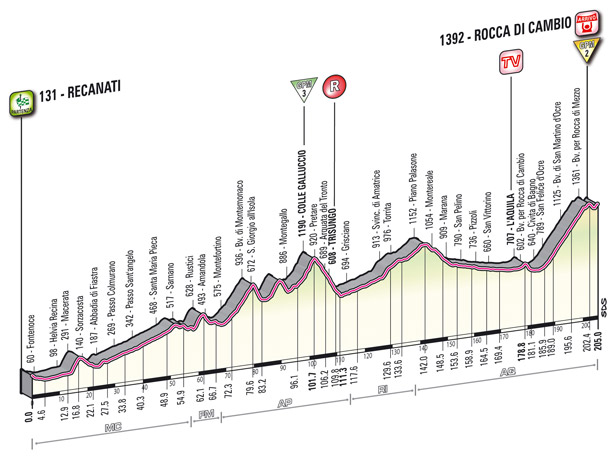
Stage 7 (are we really a week into the Giro already?) extends over 205km between Recanati and Rocca di Cambio (the highest village in the Apennines, where evidence of an earthquake in 2009 can still be seen despite the wealth the Campo Felice ski resort has brought). Like Stage 6, it's rated as a medium mountain stage, but the Cat 3 and Cat 2 along the way are far more like proper mountains than Friday's hills - the Cat 3 rises to 1,190m and the Cat 2 to 1,392m (British fans should remember that this "medium mountain" is 48m higher than Ben Nevis, the highest mountain in the British Isles). Recanati was established as a city in 1150CE, growing up from villages that formed around three castles and became an independent republic 140 years later, but two necropolises dating from Neolithic times are evidence that the region was inhabited long before that. After a short downhill section over the first 5km, most of the first half of the race heads upwards with five hills leading to Cat 2 Col Galluccio beginning at 96.1km. A fast descent leads into a long climb up an uncategorised mountain topping out at 1,152m 142km into the parcours, then it's downhill for the next 46km to a little hill that comes just before the 800m climb to the final few kilometres. The final 3km of this stage is difficult and makes a sprint finish extremely unlikely: the first 1.38km descends around 70m, then the remainder swings steeply upward and climbs 92m in a little over 1.6km and hits a gradient of 10% over one 100m section 0.5km from the finish line. (Profile, final 3km)

The weather for Stage 7 will be very warm at around 25C with light winds of around 7kph. There's is very little chance of rain anywhere along the parcours and even at altitude the temperature will drop no lower than 15C in the late afternoon.

Tour of Chongming Island Stage 3
Melissa Hoskins

Friday's Stage 3 consisted of eleven laps of a 7.2km urban parcours at Shanghai East Beach, a tricky parcours with a number of tight corners including two leading up to the finish line. Melissa Hoskins won two of the three intermediate sprints, then also won the stage to take back the General Classification lead from Monia Baccaille (MCipollini-Giambenini-Gauss) thanks to first-rate team work by Orica-GreenEDGE who dominated the race from start to end, only allowing Baccaille to take the third intermediate sprint in order to prepare for stage victory when it became apparent that Hoskins needed to win it if she was to win the GC. With 10km to go, they took full control of the peloton and got Hoskins precisely where she needed to be to beat Baccaille, Liebet de Vocht (Rabobank), Shelley Olds (AA Drink-Leontien.nl) and others to the line. After bonification, she wins overall by one second and will now go into Sunday's Chongming World Cup round as a favourite.


Stage 3 Top Ten

  1.  Melissa Hoskins Orica-GreenEDGE 1h58'212
  2.  Monia Baccaille MCipollini-Giambenini-Gauss ST
  3.  Liesbet De Vocht Rabobank ST
  4.  Shelley Olds AA Drink-Leontien.nl ST
  5.  Rochelle Gilmore Faren-Honda ST
  6.  Jessie Maclean Orica-GreenEDGE ST
Chongming World Cup
  7.  Jutatip Maneephan ST
  8.  Xin Liu China Chongming-Giant Pro Cycling ST
  9.  Romy Kasper RusVelo ST
  10.  Emilie Moberg Hitec Products-Mistral Home ST

Overall General Classification Top Ten
  1.  Melissa Hoskins Orica-GreenEDGE 6h44'49"
  2.  Monia Baccaille MCipollini-Giambenini-Gauss +1"
  3.  Liesbet De Vocht Rabobank +26"
  4.  Shelley Olds AA Drink-Leontien.nl +27"
  5.  Rochelle Gilmore Faren-Honda +30"
  6.  Jutatip Maneephan +36"
  7.  Emilie Moberg Hitec Products-Mistral Home ST
  8.  Xin Liu China Chongming-Giant Pro Cycling ST
  9.  Romy Kasper RusVelo ST
  10.  Jessie Maclean Orica-GreenEDGE ST
(Full GC results)


Halfords Tour and Johnson HealthTech GP
The third Halfords Tour Series gets underway next week, once again bringing exciting short-course criterium cycling into the heart of several British cities. The format is simple: set out a tight, fast urban parcours and then have the ten teams (CyclePremier-Kovert Racing, Endura Racing, Herbalife-Leisure Lakes, Hope Factory Racing, IG-Sigma Sport, Metaltek-Scott, Node4-Giordana, Raleigh-GAC, Rapha-Condor-Sharp and UK Youth, guest teams to be announced) battle it out and declare the team with the lowest cumulative score for their first three riders over the finish line the winner. That this works is made evident by the fact that not only has the series has been extended from eight races last year to twelve for 2012, television coverage proved popular last year with an average of almost a quarter of a million viewers for each race; which has encouraged ITV4 to provide a one-hour highlights programme for each meet this year.

Halfords Tour Series
1. Tuesday, May 15 - Kirkcaldy (ITV4 May 16 10pm)
2. Thursday, May 17 - Durham (ITV4 May 18 8pm)
3. Tuesday, May 22 - Oxford (ITV4 May 23 8pm)
4. Thursday, May 24 - Redditch (ITV4 May 25 8pm)
5. Friday, May 25 - Aberystwyth (ITV4 May 28 8pm)
6. Tuesday, May 29 - Peterborough (ITV4 May 30 8pm)
7. Thursday, May 31 - Canary Wharf, London (ITV4 June 1 8pm)
8. Tuesday, June 5 - Torquay (ITV4 June 6 8pm)
9. Thursday, June 7 - Colchester (ITV4 June 8 8pm)
10. Tuesday, June 12 - Woking (ITV4 June 13 8pm)
11. Thursday, June 14 - Stoke-on-Trent team time trial (ITV4 June 15 10pm)
12. Thursday, June 14 - Stoke-on-Trent (ITV4 June 15 10pm)


In 2011, the four-round Johnson HealthTech Women's GP Series was run alongside the Halfords Tour, using the same infrastructure and parcours. It too proved enormously successful and has been extended to five rounds this year as a result. Helped enormously by TV coverage (again provided as part of ITV4's Halfords Tour programmes for 2012), the series has done an excellent job of raising the profile of women's racing and the athletes who took part, so much so that Johnson HealthTech managing director Jon Johnston is proudly able to claim that the series encouraged the formation of several new teams. So there we go - proof that if men's and women's races work together, everyone wins. Get to it, Tour of Britain.


A full list of teams competing in the GP has yet to be published, thus far For Viored, Node4-Giordana and Matrix Fitness-Prendas are confirmed.


Johnson HealthTech GP Series
1. Tuesday, May 22 - Oxford
2. Tuesday, May 29 - Peterborough
3. Thursday, June 7 - Colchester
4. Tuesday, June 12 - Woking
5. Thursday, June 14 - Stoke-on-Trent


Ex-Astana boss: "Alberto rode the 2010 Tour de France clean"
Ex-Astana manager Yvon Sanquer, who left the Kazakh-registered team in 2010 at the same time as Alberto Contador left for SaxoBank, is convinced that the Spanish rider did not dope at the Tour de France that year.

"I had paid a lot of attention to the doping issue at Astana," he told Cycling News. "Alberto rode the 2010 Tour de France clean. From where we started in October 2009 until the win in July, a lot of good work was done.

Lance Armstrong: "In my mind, I’m truly done. You can interpret that however you want."
In an interview with Men's Journal, seven-time Tour de France winner Lance Armstrong says that he will not fight any future doping investigations - which has inspired at least one website, Velonation, to ask in a roundabout way if this could be indication that the Texan is tired of lying.

Far be it from this blog to defend Armstrong - who, while I happen to dislike the man, has never been proved to have doped and is therefore in my opinion innocent unless anyone ever produces reliable evidence to suggest otherwise - but, as is almost invariably the case, reading between the lines reveals nothing blank space into which can be inserted any sort of meaning that takes the reader's fancy. When asked, for example,  how he would feel were he to be stripped of his seventh Tour victory, he answers: "I wouldn't be unhappy." Does that mean he knows he doesn't deserve it? Not necessarily - it can also be read as simply meaning that he's tired of fighting (as he says, "I’m done fighting. I’ve moved on") and would be content with a place in history as a six-time Tour winner.

"We all want to be loved, we all want to be respected, we all want to be thought of as fair and ethical and admirable men," he adds. "But very few people are unimpeachable. I’ve resigned myself to the fact that there are always going to be questions."

These sound more like the words of a man who can no longer be bothered with the battle rather than one about to make a confession.

Lincoln Festival of Cycling
818 riders have already signed up to take part in Lincoln's Grand Prix Sportive, with more expected to join on the day - not bad going, considering last year's edition was the first time the event had ever been held.

The sportive is followed on Sunday by the Grand Prix race, now in its 57th year, in which riders complete thirteen laps of a circuit beginning at Yarborough Sports Centre and ending 164km later by the cathedral at the top of the cobbled Michaelgate climb, which rivals the climbs of the Flanders Classics with its maximum gradient of 16.2%. (More sportive details and entry forms)

Box Hill hit by graffiti "artist"
Shock! Horror! Some ne'er-do-well crept up Box Hill last night with a can of white paint and painted a big - er - male reproductive organ on the road! The crudely depicted genitalia appears to be about six metres in length, probably in an attempt to make it unmistakable for the helicopters filming the Olympic road race. Police say they have no idea who the culprit may have been, but confirm that having had a look at the crime scene they've ruled absolutely anyone with any artistic talent out of the investigation.

British cycling fans, well-used to seeing the sort of things that those uncouth Continental types scrawl over the roads at the Grand Tours, are not particulary offended - in fact, most are more surprised that it doesn't seem to have been done using LOCOG-approved graffiti paint (available from official suppliers throughout Britain for only ten times the price of any other sort of paint*).

Of course, it might also be a comment on the recent announcement that anyone wishing to see the race from the best spots on the hill will have to pay. Tickets priced at £10-£15 are, not unexpectedly, available from LOCOG - the money-grabbing cocks.

(Related: "Surrey Police warning over London 2012 cycle race tickets" BBC / "Cycling is free. Someone forgot to tell the Olympic organisers" The Guardian)

*Thanks, @redster73 ;-)

Other News
"Bedford 2-Day round up" (On The Drops)

"Cycling Derby calls for urgent help to save city's planned velodrome" (road.cc)

"Welcome to the Hope Show" (Kathryn Bertine, ESPNW)

"Geox to return to cycling?" (Cycling News)

"John-Lee Augustyn takes indefinite break from pro career" (Velonation)

"Howe and Atkins dispute events after Speed Week crash, USA Cycling to investigate alleged deliberate take down" (Cycling News)

"Cyclists call for 250-metre track" (NationNews, Barbados)

"Cycling: Shepley cyclist Leon Gledhill wins gold in London Schools Games" (Huddersfield Examiner)

Cycling
Bike locks cut at Cambridge station
Cambridge's train station has been crying out for new bike park facilities for years - the sheer number of bikes used daily in the city means that very often all the spaces are filled with riders having to search out lamp-posts on nearby streets, blocking paths and creating friction with pedestrians - so the news that things would be improved with the multi-million pound CB1 redevelopment of the area was very welcome indeed. Therefore, the recent installation of new bike racks - including two-tier models, which vastly increase capacity - was not before time.  However, the installation of the new racks, which was carried out by Cambridgeshire County Council on behalf of rail operator Greater Anglia, has been called into question by several cyclists who returned to where their bikes had been left and discovered that their locks had been cut and their machines placed into storage. Among them was Cambridge's Liberal Democrat MP, keen cyclist Dr. Julian Huppert.

"My bike was left in the section of racks to be removed, although of course I had no idea of this, as there were no signs facing the direction of the bike racks," Dr. Huppert told the Cambridge News. "I came back to see the new racks being put together. I then went to get my bike – and realised that where I’d left it was no longer a bike rack. I did get my bike back, but had to buy a new lock."

"Advance publicity was provided at the station to warn rail passengers of the installation of the new racks and we also consulted with local stakeholders to inform them of the work," a spokesperson for Greater Anglia said - anyone who has ever had to use the city's currently woefully inadequate station (CB1 includes its biggest revamp since 1845) during peak times will be well aware that it becomes so crowded that any sort of publicity could easily be missed. "Any customer who has encountered any problems regarding this matter should contact the station manager at Cambridge, who will be happy to help."

Dr. Huppert: "I am very pleased that the new bike racks are being installed – we desperately need the extra capacity, and I have been working to push this scheme ahead for some time – however, it is a great shame that because not enough signs were put up, people did not realise what would happen, and so needlessly locks had to be cut."

Were you affected and had to buy a new lock? You can contact Greater Anglia via this webpage - make sure you request that they phone you (rather than you phoning National Rail Enquries' rip-off... er... revenue-sharing 0845 customer services number) - and you might just be able to get them to buy you a replacement.

Glos. Police appeal for help in cyclist assault case
Gloucestershire Police are trying to trace a woman who reported on the 28th of January that she had been assaulted by a cyclist who was holding traffic, but didn't leave a name. Seems straightforward so far, doesn't it? The investigation started to get strange when they discovered footage on Youtube, which they believe shows the incident - and reveals that in actual fact, the woman appears to have first assaulted the cyclist, chasing him and trying to push him off his bike and then kicking him after he retaliates.


The incident is thought to have occurred at 12.25pm on the B4425 at Ampney Coln near Bibury. If you recognise the woman or believe you know who may have filmed the incident, Gloucestershire police would like to hear from you - you can contact them by dialing 101 or speak to Crimestoppers on 0800 555 111.

Newswire - what you might have missed
Britain
"Your Pictures - Cycling" (BBC)

"Staff and pupils at Crombie, Elrick and Westhill primary schools are celebrating after receiving a national award in recognition of their commitment to cycling" (Donside Piper)

Worldwide
"Local cyclist’s death prompts call for release of provincial cycling strategy" (The Record, Canada)

"Bike thefts feed a vicious cycle" (The Gazette, Canada)

"Aichi school's 'cyclist's license' keeping kids safe" (Japan Times)

Tweets
Hannah Walker ‏ @spannawalkerVery nearly just got wiped out by some tw*t driver. When I got to her at the lights, her excuse was because I dont pay roadtax! #ButIDoIdiot
Not Pat McQuaid ‏ @UCI_OverlordFINALLY. @markcavendish begins the backwards trek to the pastry wagon. I thought we were going to see MountainCav hang with the peloton.
Josh Owen Morris ‏ @JoshOwenMorrisSrsly, Geox's marketing types need a proper slap. Canning so many people's jobs then waltzing back in with another lover a year later?
Marianne Vos ‏ @marianne_vosHow to end up offroad in a road training, part 3874... Note to self: don't take roads not on the map. Note to self 2: watch out for goats;-)

Wednesday, 9 May 2012

Evening Cycling News 09.05.12

Giro d'Italia Stage 4 - Tour of Chongming Island Stage 1 - 2004 Olympic dope samples may be retested - Tchalykh wins controversial Azerbaijani TT - Best evidence yet for Contador return to SaxoBank - Other racing news (links) - Cycling:  Fahrradi Farfall FFX supercar...er...bike - News you might have missed - RIP 108

Racing
Giro d'Italia Stage 4
Ramūnas Navardauskas, now with
Garmin-Barracuda
On Wednesday, the Giro returned to Italy for a 33.2km team time trial around Verona - another fast, flat course with only a little pimple of a hill shortly after the first time check and several long straights on the outward and return journeys, followed by a flat and a straight 800m section to the finish line.

Verona, a World Heritage Site, has a great deal of history and monuments even by the standards of ancient Italian cities. Not all of the history makes pleasant reading - it has been ruled by blood-thirsty tyrants, suffered an earthquake and numerous plagues and, in the Second World War, was the site of unspeakable horror when large numbers of captured enemy soldiers, anti-fascists, left-wingers and Jews were tortured at what was then a fortress and has since been converted into a church, the Santuario della Madonna di Lourdes.

Garmin-Barracuda, many fans' favourite today, performed sufficiently well to both win the stage and put their 24-year-old Lithuanian Ramūnas Navardauskas into the maglia rosa with an advantage of 10", bringing the four-day reign of BMC's Taylor Phinney - who is no doubt still in pain following the crash caused by Robert Ferrari in Stage 3 - to an end. Navardauskas' team mates Tyler Farrar, Robert Hunter and Ryder Hesjedal take 2nd, 3rd and 4th places behind him.

"The jersey is a very big thing for me," a smiling Navadauskas told the cameras during his post-race interview. "I really love this team. They take care of me."

Top Ten
1 Garmin-Barracuda 37'04"  
2 Katusha +5"  
3 Astana +22"  
4 SaxoBank ST  
5 Omega Pharma-QuickStep +24"  
6 Orica-GreenEDGE +25"  
7 Liquigas-Cannondale +26"  
8 RadioShack-Nissan +28"  
9 Sky +30"  
10 BMC +31"
(Full stage results and GC)

Stage 5 is the last flat parcours for a few days as 6, 7 and 8 all rate as medium mountain stages. Beginning in Modena, it's a strange sort of stage being 209km in length with hardly any corners - the first 172km looks rather like a massively scaled-up sprint with the only sizable deviation from the line being made necessary by the existence of Bologna. There's a little Category 4 hill at 172.1km, rising to 109m, then three gentle and uncategorised climbs in the 16km after it before the final 14km, which are as flat and as straight as the earlier part of the race all the way to the last kilometre when the terrain rises almost imperceptibly. (History along the route)

Stages 1 / 2 / 3 / 4 / 5 / 6 / 7 / 8 / 9 / 10 / 11 / 12 / 13 / 14 / 15 / 16 / 17 / 18 / 19 / 20 / 21

Tour of Chongming Island Stage 1
It's funny, really, that the UCI pour so much money into their efforts to "globalise" cycling (which really means "globalising" the UCI) and refuse to put more into women's cycling, because women's cycling has been blazing a trail in the Far East ever since 2007 and the first Tour of Chongming Island - athree-stage event that has become one of the most important fixtures on the calendar and is followed by the Tour of Chongming Road World Cup.

Melissa Hoskins
Melissa Hoskins (Orica-GreenEDGE) faced stiff competition in the bunch sprint to the finish line with both Rochelle Gilmore (Faren-Honda) and Monia Baccaile (MCipollini-Giambenini-Gauss) chasing her all the way, but proved the fastest of the three on the first of the three pancake-flat stages that are ideally suited to a sprint specialist such as herself - she also won the first intermediate sprint and took second place on the second, picking up useful points for her team.

Despite the near-inevitability of a sprint finish, Hitec Products-Mistral Home and AA Drink-Leontien.nl fired off numerous attacks during the race. None got far as the teams with the best sprinters kept things under control, making sure the race ended how they wanted it to end. In the last couple of kilometres, as they got the sprinters into a position, a crash back in the pack threw Sarah Düster (Rabobank) high into the air and for a second looked horribly like a repeat of the crash at the 2010 Herald Sun Cycling Classic which left her with a broken pelvis. A rider from the Taiwan team also went down, creating a domino effect that saw several others also crash - fortunately, it appears that nobody was badly hurt; but as of yet there has been no confirmation.

Stage 2 (Stage 1 here)
"The girls positioned me out of the wind an they protected me extremely well," Hoskins said after the race. "Two kilometers out, they pushed it to front. Judith [Arndt] took the final left-hand turn and then handed things over to Jessie [MacLean]. Judith had taken us to the bottom of a small bridge, and Jessie took us over the bridge. Jessie gave a final push on the bridge, and then a MCipollini Giambenini attacked. I sat on her wheel for about 250-meters before stepping out of her draft with 150-meters to go. Once I was out front, I was able to hold on for the win." After bonification, Hoskins leads the General Classification with a 7" advantage over Baccaile.

There was some confusion after the race when the UCI accidentally published the General Classification results complete with bonification adjustments instead of the stage results.

Top Ten

  1.  Melissa Hoskins Orica GreenEdge 1h49'01"
  2.  Rochelle Gilmore Faren-Honda ST
  3.  Monia Baccaile MCipollini-Giambenini-Gauss ST
  4.  Liesbet De Vocht Rabobank ST
  5.  Charlotte Becker Specialized-Lululemon ST
  6.  Marta Bastianelli MCipollini-Giambenini-Gauss ST
  7.  Lucy Martin AA Drink-Leontien.nl ST
  8.  Elena Cecchini MCipollini-Giambenini-Gauss ST
  9.  Emilie Moberg Hitec Products-Mistral Home ST
  10.  Evgenia Romanyuta RusVelo ST
(Full stage result and GC)

2004 Olympic doping control samples may be re-tested
The International Olympic Council has announced that it may oblige WADA's request to re-test samples taken at the 2004 Games, utilising new procedures developed in the intervening time, prior to preserved materials being destroyed in August in line with the standing 8 year policy. The number of samples liable to be re-tested has not yet been set, but it is believed likely to between one hundred to several hundred chosen from athletes competing in what IOC medical commissioner Arne Ljungqvist terms "high risk" sports - which we can obviously assume to include cycling.

When samples taken at the 2008 Games were re-tested, five samples were found to contain traces of CERA, an EPO variant undetectable with tests available at the time. Since doping was widespread in cycling and other sports before the Operacion Puerto scandal of 2006, there's a high chance that more cases will come to light if WADA's request is successful.

Tchalykh wins in Azerbaijan
Tchalykh wins Azerbaijan TT
Elena Tchalykh (Dolmans-Boels) won the Azerbeidzjan de Heydar Aliyev Anniversary Time Trial, the first UCI women's event in Azerbaijan and one that has been controversial, not least of all because police and government authorities reportedly regular use rape (and threats of rape) against defendants and defendants' families as a means of coercing confessions from prisoners.

In fact, since the country's human rights record is extremely questionable overall (political prisoners are routinely imprisoned without proof of wrongdoing, prisoners are tortured and beaten, the media is strictly controlled by the authoritarian government, religious minorities suffer persecution despite token equality laws and thousands of citizens have been illegally evicted to make way for urban renewal in capital city Baku - more of this in the news in the coming weeks, since Baku is hosting the Eurovision Song Contest this month), organisations from any democratic nation shouldn't really be promoting anything in Azerbaijan except for popular uprising. Anyway, that's enough of that. Back to cycling...

Top Ten
  1.  Elena Tchalykh Dolmans-Boels 34'37"
  2.  Olena Pavlukhina +34" 15
  3.  Aleksandra Sosenko Vaiana-Tepso +1'00"
  4.  Maria Mishina +1'06"
  5.  Olena Sharpa +1'16"
  6.  Nicole Hanselmann +1'21"
  7.  Oksana Lesnyk +1'26"
  8.  Katarína Hranaiova +1'40"
  9.  Emma Trott Dolmans-Boels +1'48"
  10.  Katarzyna Sosna Vaiana-Tepso +2'10"
(Full result)

Daniel Navarro, now with SaxoBank:
"Alberto needs me"
Best evidence yet for Contador return to SaxoBank
According to Asturian newspaper Elcomercio, Alberto Contador - whose two-year backdated ban is due to end early in August - has confirmed that he plans to ride this year's Vuelta a Espana. What is more interesting is that SaxoBank rider Daniel Navarro told the same paper he won't take part in the Tour de France this year because: "Alberto needs me and I want to have good form for August."

Neither Contador nor SaxoBank have yet confirmed that he will return to the team, but he is widely expected to do so. Could Navarro's comments have been an accidental revelation of something he knows and we don't?


Other News
Ferrari apology a "clear PR exercise," says Cycling News

"Team Type 1-Sanofi secures repeat invite to the Tour de Suisse" (Velonation)

"Jody Cundy aims to inspire at London Paralympics" (British Cycling)

"French federation tests for corticoids at 4 Jours de Dunkerque, One rider did not start final stage as a result, says L’Équipe" (Cycling News)

"Garner happy with place on podium" (This Is Leicestershire)

Jelejah 1Malaysia - Jai Crowford wins Stage 2 as Yusup Abrekov takes GC (Bernama)

Cycling
Fahrradi Farfall FFX is not what it seems
If you opened up the bonnet of the Fahrradi Farfall FFX, what would you expect to find? A V8? A V12? A W16? What you probably wouldn't expect is what's actually in there...

Road legal in Austria, the Fahrradi FFX cost £1.2 million to build - £200,000 more than it would cost to buy the Ferrari FXX that inspired it.

The news you might have missed
Britain
"Wales gets tough over green travel" (The Guardian)

"Give pupils more room on road, says cyclist Beaumont" (The Scotsman)

"'Britain's dumbest cycle lane' isn't actually a cycle lane at all" (road.cc)

"Hotel installs bicycle-powered television" (Telegraph)

Worldwide
"Cyclofemme: A Global Day of Women's Cycling" (Huffington Post)

"Calgary hires its first cycling co-ordinator" (Calgary Herald, Canada)

"In Bibwewadi and Hadapsar, two-wheelers [motorcycles] zoom into cyclists’ space" (The Indian Express)

"New York’s Five Boro Bike Tour: We Hit the Road with 32,000 Happy Cyclists" (Wired)

"ABC 24 presenters are embroiled in controversy after claiming on Monday morning that car “doorings” of cyclists aren’t always solely the driver’s fault – they reckon sometimes the cyclist is at fault too" (Crikey)

Tweets
Giorgia Bronzini ‏ @GiorgiaBronziniTime to relax :) (pic)
Cycleboredom ‏ @CycleboredomLocal pub radio piece on Bike to School Day (loosely): "Drive gently out there today." So, the rest of the time drive like asses? #phrasing

RIP 108

Wouter Weylandt - born 27th of September 1984, Ghent, Belgium; died 9th of May 2011, Mezzanego, Italy.