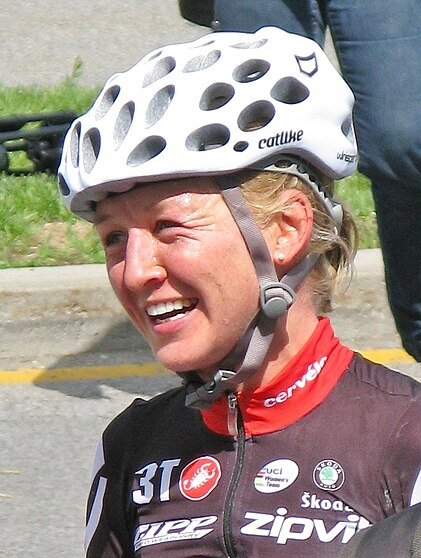
For anybody who cares about women's cycling, it's very easy to feel miserable at the moment - we've just had news that another race has been cancelled, the prizes on offer at the majority of the races are a joke compared to what the men win (and frequently about the same amount the riders could earn for putting in a full week in a fast food restaurant, provided they got a bit of overtime) and the salaries they receive (those who are lucky enough to receive salaries, that is; which is why some of them have to put in a full week in a fast food restaurant and hope for a bit of overtime) are quite frankly an insult in many cases. Be thankful, then, that this week brings us that celebration of all things good in women's cycling, the Festival Luxembourgeois Elsy Jacobs.
Combined, this is a two stage race with a TT prologue. However, in the Elsy Jacobs each stage is a race within its own right to a far greater extent than in any other event and every day has an entirely different feel to the others. The prologue has the feel of a party, not least of all because it takes place in the evening on a 1.7km parcours on Luxembourg city - and as that parcours is both stupendously fast and passes by some of the city's most vibrant bars, it's a full-on party in celebration of speed.
Stage 1 follows the famous parcours of the GP Elsy Jacobs, the one-day race named in honour of the world's first Women's Road Race World Champion and from which this festival grew. It heads north out of Garnich, Jacobs' hometown, then follows a 53.6km loop up to Mersch and back to Garnich again where riders complete five laps of a 9.8km circuit. Those in the know say that it's impossible to predict how this race will end, and more than once the fates have conspired to allow a relative unknown to take the glory.
“The courses are actually pretty aggressive, they provide very good races. I asked the girls to be aggressive at certain points, and they didn’t have to look too hard to find the opportunity to do that. There a million and one little climbs that provide a chance for groups to get away.”- David McPartland, GreenEDGE directeur sportif
Stage 2, named in honour of twelve-time National Champion and twice winner of the Tour de France Nicolas Frantz, uses the same 53.6km loop as Stage 1 but this time sets off from Frantz's hometown Mamer, ending with five 8.9km circuits through the narrow streets.
It's sometimes difficult to follow women's races as many simply don't have the budget to provide the sort of coverage many men's events enjoy - which is, of course, a serious problem for the sport. However, this one rivals the Grand Tours with an expertly-designed website that provides full details of the three courses, results and just about everything else a fan might wish to know.
One day, all women's races will be like this - but the Festival will always be unique, and there really is no other race quite like it.
Like so many cycling races to have begun in the first half of the last century, La Flèche Wallonne was originally organised in an attempt to drive newspaper sales - in this case, the newspaper was Les Sports, and the first race ran between Tournai and Liège. The parcours has been altered greatly over the years, sometimes running in the opposite direction; but for many years it's covered around 200km stretching between Charleroi and Huy where the riders complete three circuits of an extremely challenging circuit featuring the legendary, infamous Muur - also known as le Chemin des Chapelles for the seven chapels that are passed on the way up, the inspiration for many a headline based around riders saying a prayer as they see their chances of victory slipping away on the gradient which is as reaching a maximum of 19% - but take the wrong line around one corner and a short ramp hits 26%.
This year, the route covers 194km, starting once again at Charleroi which lies in the Hainaut province some 45km south of Brussels. The region has been occupied by humans since long before recorded history, traces of primitive metal working providing evidence that the industry which would bring wealth to the city has a long tradition here. However, the city itself dates back only as far as 1666, a time when the Netherlands was ruled by the Spanish Crown - land here was expropriated by Francisco Castel Rodrigo, Governor of the Netherlands, for the construction of a fortress he named in honour of his king Charles-Roy; hence the city's name today. In the 165 years afterwards, it would pass repeatedly from Spanish, French, Dutch and Austrian ownership until Belgium became an independent nation in 1830. That, conveniently, coincided with the beginnings of the Industrial Revolution; the natural resources that had brought people here thousands of years before ensuring that the city became rich and contributed greatly to the wealth of the nation.
The fortress at Huy
Huy's history begins in Roman times when a fortress was built on the River Meuse, but it seems to have remained a village until the Middle Ages when the metallurgy industry took off, rapidly transforming it into the richest town along the Meuse and in 1066 it received city status - the first town north of the Alps in mainland Europe to do so. The rise of the cloth industry ensured even greater prosperity during the 16th and 17th Centuries, as did paper production during the period of Dutch ownership. As such, the castle in the centre of the city remained strategically important and has been improved and extended many times over the years including extensive remodelling between 1818 and 1823.
Favourites Start list
Philippe Gilbert (BMC), last year's winner, has had a rough start to the season but seems to be finding the form he had in 2011; making him most people's top choice in the absence of Cadel Evans. Joaquin Rodriguez (Katusha) will be many people's second choice after taking second place in 2010 and 2011 - there are those who will point to his 24th place at the Amstel Gold Race, but everyone is entitled to an off-day and he rode extremely well in the Tour of the Basque Country. The Schlecks (RadioShack-Nissan) don't seem to quite know what to do with themselves this year and have put on some dismal performances, but both are formidable climbers and, should they remember how to ride their bikes, could well be contenders. You Never Know choices: Thomas Lövkvist (Sky), Oscar Freire (Katusha).
Once of the first Classics to realise that running a women's race alongside the men's event would cost little extra, draw in more fans, double the excitement and generally bring huge benefits all round, the organisers of La Fleche Wallonne first introduced a women's race in 1998 when it it was won by Fabiana Luperini. To date, the men's race has never been won by a British rider but British women have been highly successful with four victories (thus taking joint first place alongside the Netherlands, whose four were all won by Marianne Vos).
The parcours is shorter at 123km and both begins and ends at Huy. The final circuit omits the initial ascent of the Muur but is otherwise identical.
Favourites Start list
As far as a lot of people are concerned, this race is all about Marianne Vos (Rabobank, winner in 2007, 2008, 2008 and 2011) and Emma Pooley (AA Drink-Leontien.nl, winner in 2010), one of the few riders capable of surpassing Vos on a climb and backed by one of the strongest teams ever seen in women's cycling. Other likely names are Vos' team mate Annemiek van Vleuten, Loes Gunnwijk (GreenEDGE), Emma Johansson (Hitec Products-Mistral Home, second place in 2009 and 2011) and, of course, Nicole Cooke (Faren-Honda) - Cooke has shown signs of a return to form after a few bad years recently and as winner in 2003, 2005 and 2006 she cannot be ruled out. You Never Know choices: Lise Nöstvold (Hitec Products-Mistral Home), Judith Arndt (GreenEDGE), the entire Specialized-Lululemon team.
Weather
Things aren't looking too awful for Charleroi, but they're not great either with a 40% chance of light rain. A southerly wind of max. 26km won't make temperatures feel any colder than 11C. Huy looks set to be much the same. Strong winds in the region on Tuesday may have blown twigs and thorns into the roads, increasing the risk of punctures.
Following widespread complaints that last year's race was excessively difficult - and, of course, the terrible and tragic death of Wouter Weylandt, to whom Stage 3 will be dedicated - the 2012 course reveals a considerably more human route; not necessarily easier, but one that will encourage skillful cycling and competition rather than a gritty battle for survival among the hardcore mountain specialists.
Early reports based on leaked maps suggested that this was a parcours ideally suited to new World Champion Mark Cavendish who will be riding with Team Sky for the first time next season. That may be partially true - there are a number of stages upon which barring accident or illness, it's very difficult to imagine anyone other than Cav managing to get themselves across the line first. However, it's categorically not a flat race with many of the Giro' - and cycling's - most hallowed mountains putting in an appearance. Stages 17 and 20 are perhaps the most challenging, with ascents of the Passo Giau and an Alpe di Pampeago finishline in the case of the former and the infamous Passo de Stelvio at the end of the former, an arrangement seemingly intended to keep the final General Classification nicely uncertain right up until the last minute and thus avoid a repeat of 2011 when it became apparent early on in the race that Alberto Contador was going to win.
If there was ever a parcours guaranteed to please spectators - and TV crews, for that matter, which pleases even more spectators - then it's got to be the route around Rudersdal. It's got some difficult corners, some lightning-fast straights and even, though this part of Denmark is pancake flat, so respectable climbing: only 105m per lap, but that soon adds up: the Elite Men will climb 1785m in total, which would take them higher that the highest point of the Col d'Aubisque. It also passes through some very beautiful landscapes, making it not unlike a stage in a tour. However, it has one advantage from a spectator's point of view: instead of the usual several hours of waiting followed by two minutes of excitement before the long haul journey to tomorrow's parcours, fans can see the peloton pass by several times - the Junior Women will complete five circuits, Junior Men nine circuits, Elite Women ten circuits, Under-23 Men twelve circuits and the Elite Men seventeen circuits (plus a 28km section from the Rådhuspladsen in Copenhagen city centre.
The circuit begins on the Kongevejen, a highway running along the western perimetre of the Geels Skov - a forest which has become as famous for its mountain biking trails, some of them running along ancient roads still rutted from the wheels of the logging carts that once ran along them, as it has for the anemones that completely obscure the leaf litter every Spring. In the centre of the forest stands what now appears to be a natural hill, unremarkable but for rising up like a tiny Mont Ventoux from the otherwise flat surroundings. In fact, it's not natural at all; having been specifically built as a ski jump in 1947 and remaining in use until 1980 when the site was returned to nature. Today, Geels Skov is a quiet, peaceful and very beautiful place, but it's seen its share of violence - in 1945, Yngve Marinus Nielsen and his wife Hildur Ruth were brought here by Resistance operatives and executed with a machine gun. Though the couple, both hairdressers, were known to have collaborated with the Nazis, the execution caused much controversy as it took place two days after Denmark was liberated.
The riders set out from the car park halfway along the road at 55°48'16.87"N 12°28'37.41"E, near the entrance to the mountain bike blue trail - in other words, a trail considered to be moderately difficult and thus suited to riders with some experience, and head north-west for 0.7km, descending a fairly steep hill to a right turn onto Øverødvej. Arriving at a roundabout 0.18km later, they take another right onto Vangebovej which, having passed by a car park and some buildings, heads into the forest. There are pedestrian crossings immediately before the first turning, the white sections of which can become slippery when wet, then a raised central section immediately afterwards. There are further crossings both immediately before and immediately after the second turn, as well as a central reservation which would be very easy to hit if the corner was taken too fast or simply by too many riders at the same time. The reservation continues in three parts for 196m with two gaps permitting cars to turn into side-roads - these could be used by riders on the right-hand side of the road to swap to the left in order to take the quickest line through the upcoming bend, a gentle left. The remaining 0.6km is straight and climbs, reasonably steeply in parts.
The next bend is a very gentle right, leading into a short straight of 225m with a very slight descent - possibly a good spot for a breakaway group to attack, gaining a slight lead before hammering on the gas when out of sight around the coming medium left whilst the peloton can't see what's going on. The next straight, 0.53km, leads to a 90 degree left onto Mothsvej - however, as the roads are wide, they're shouldn't be any issues in getting around the corner at speed provided the pack is sufficiently spread out so as not to force anyone into the little traffic island (with signs on metal poles) in the middle of Vangerbovej as they enter the turn.
A much tighter 90 degree left 200m later, meanwhile, could require caution. It's on a narrower section of road with gravelly paths either side - a front wheel slipping on gravel could very quickly lead to the bike hitting a kerbstone and catapulting the rider into the rather scratchy looking hedges shielding the houses from the road. A very similar right-hander lies 65m ahead before the road straightens for 154, leading to the grand cast iron gates of Søllerød Slot, a baroque mansion dating to 1740 and set in parkland with a formal garden. (The house, incidentally, was occupied by Johan Frederik Vilhelm Schlegel; a lawyer who according to the auto-translated page on the house I'm currently reading earned himself an Access to IT qualification in 1787. Clever guy.)
Turning right at the gates leads along Søllerødvej and a section that would be perfectly straight were it not for two very slight deviations, first right and then left. Descending slightly, this could prove to be a very fast part of the race before the tight left corner joining onto Altemosevej (55°48'37.92"N 12°30'33.48"E) which climbs quite considerably for the next 323m; not enough to make the slightest bit of difference to the Voses, Pooleys and Monforts, but unwelcome to the Cavendishes - especially in the final few laps. There are short metal bollards along the edges of the road after the turn, caution being required to avoid them, and as a main route through a suburban area is very much the sort of place where buses sometimes spill diesel. 323m later, the section ends at a medium right bend - there's a crossing with chequered white squares, rather like the stripes of a zebra crossing, immediately upon entering the bend which could be extremely slippery if the road is wet. Note the bike lane to the left of the road, which will be running alongside for some time - for much of its length, it's in much better condition than the road. If only all the world was like Denmark!
The following section is narrow and, in places, overhung by trees which at this time of year especially can result in slippery leaves on the road. However, it runs straight for 0.53km and as such will likely generate high speeds before the next turn, a gentle left leading past a grassy bank on the left - hence potentially slippery road surface after rain - and a tiny, very pretty thatched cottage on the right. There is a narrow, raised speed hump 1.63km from the start of the road and a tight right turn onto Egebaekvej 163m later (the turn coming shortly before an 18th Century mansion with extensive formal gardens that helicopter-borne camera operators will probably be unable to resist), then only very slight deviations for the following 0.59km to a bridge leading over the E47 and E55 motorways. To the left, as the road crosses the bridge, there's a very low kerb separating the road from the cycle lane which riders will need to avoid and to the right, a low kerb made of blocks of stone separating the road from a gravel path. There is forest either side of the road as the riders leave the bridge, thus a potential for slippery leaves. There is no kerb on the right from this point, leading to leaves and twigs collecting along the side of the road - best avoided in case of punctures - except for a short section running along a metal barrier 129m after the bridge; riders will need to avoid hugging the right-hand edge of the road to avoid this.
Having followed a slight bend to the right 0.38km after the bridge, the roadside vegetation on the right includes what looks to be a stumpy, thorny hedge after the route passes a somewhat ramshackle half-timbered thatched cottage on the left. Punctures are extremely likely in this section.
As the athletics and sports centre at Rundforbi Parken comes into view on the right (55°49'36.27"N 12°32'28.22"E), any riders who have been making use of the cycle path will need to be cautious of the bollards around the entrance to the car park on the opposite side just past a pedestrian crossing. There are more on the right, but these are positioned where they won't be immediately in a rider's line - however, catching the right-side pedal on one could be disastrous. The end of the section at Rundforbivej comes 1.23km after the motorway.
The corner is tight with a painted pedestrian crossing and a traffic island with metal signs, caution thus being required here. Another pedestrian crossing lies just around the corner, then the road passes through a short narrow section with bollards either side 0.48km later and then travels by a small lake on the right a short while later. There's another slightly narrowed section at the end of the white fence on the right just past the lake, then a traffic island 380m after the lake. Large industrial plants on both sides of the road as the race enters a wide bend (55°49'9.37"N 12°31'45.27"E) to the left immediately after the traffic island will increase the possibility of diesel spills. Sommer's Automobilmuseum on the left is must-visit for petrolheads visiting the races, as it has a collection of more than 60 vintage and/or rare cars including some unique examples. The road is straight for 135m, then reaches two pedestrian crossings either side of a traffic light-controlled crossroads, widening and becoming a dual carriageway and thus ensuring plenty of room so that the central reservation - split into three parts after the crossroads - doesn't get in the way and cause problems.
After 175m from the last pedestrian crossing, the route arrives at another and a right turn onto Skodborgsvej - this is the point (55°48'54.09"N 12°31'46.99"E) where the Elite Men will join the circuit following the 28km ride from the Rådhuspladsen in Copenhagen city centre on Sunday. Another pedestrian crossing, and a central traffic island, lie just around the apex as the race enters the long, mostly straight penultimate section heading south-west back over the motorway (55°48'53.55"N 12°31'43.03"E) and on towards the Kongevejen. There are another two pedestrian crossings on the other side, this time hit head-on and as such unlikely to be hazardous, then the road narrows down to two lanes again. There's another traffic island 275m after the crossing, with a further hazard caused by the horse chestnut trees on the right of the road around 100m later - the spiky shells of the conkers can cause punctures and become slippery when mashed up by car tyres, plus the conkers themselves can act like ball-bearings under wheels. There are seven more traffic islands in the next 0.6km as the road enters a wide bend to the left.
The route enters a long straight with overhanging trees before being divided by another central reservation leading to a crossroads, once again with pedestrian crossings either side - the road becomes quite narrow for a short stretch until the end of the central reservation, then passes a lay-by 137m later (55°48'27.48"N 12°30'29.71"E). The following section has trees lining the roadsides, meaning slippery leaves and snapped collarbones for anyone who crashes into a trunk. After a short while, a turn for Mothsvej passes by on the right, followed by traffic islands 0.24km later as the road leads to a roundabout.
The first exit leads straight on, with caution being required to avoid the cobbled traffic island immediately after the roundabout. There are more trees lining both sides of the road but the road is straight, smooth and unchallenging until the next traffic island 0.37km ahead, followed by a crossroads and the island's twin on the other side. We then enter a suburban area with a series of raised speed humps coming in close succession, followed by another smooth stretch leading to the right turn at the junction with Kongevejen (55°47'50.05"N 12°28'55.52"E) - it's not an especially difficult transition in the dry, but a selection of pedestrian crossings (immediately before and after the turn), street furniture (road sign in the middle of the road immediately after the turn), sunken, knobbly kerb (around the right-hand edge of the turn) and central reservation (immediately after the turn) could make it potentially very difficult when wet. With both roads being main routes, there's a reasonably high possibility of fuel spillages - rain combined with patch of diesel halfway through the turn could very easily end the race for anyone sufficiently misfortunate as to hit it.
This end of Kongevejen, like the northern part at the start of the race, is a wide highway with plenty of room for a mass sprint to the finish at the end of the final lap of each race. A final climb leads up into Geels Skov, past an obelisk-shaped milestone marking the last 300m of the lap and on to the finish line, back at the same point from which the race started.