Showing posts with label climbs. Show all posts

Sunday, 5 August 2012

Trofeo Internazionale Bastianelli

Large-scale, click for zoom
05.08.12 Official Site (with details of TV coverage)
Italy, UCI 1.2


Start list (subject to change)

One of the greatest non-classic events of Italian cycling and now in its 36th edition, the Trofeo Internazionale Bastianelli takes place on hilly roads north of Atina in Lazio - a beautiful hilltop town which, despite its Roman ruins, cathedral and ducal palace, hasn't yet been discovered by tourists and where the majority of the local population make their living through the production of wine and olive oil.

The race takes place in three parts: Giro 1 (blue) heads at first west, then north into the countryside and west again to Alvito, then turns north-west to loop around Posta Fibreno - which has a lake made famous by a naturally-formed floating island, mentioned by Pliny. The riders then head south-east to Casalvieri and Casalattico, then after 55km arrive back at Atina to begin the next part.

Giro 2 (red) leaves Atina and heads at first west, then north via Settefrati to San Donato Val di Comino, west again to Alvito and south via Casalvieri to Casalattico before turning east back to Atina, covering 62km.

Giro 3 is itself split into three parts, two laps beginning and ending at the start line and a third, slightly shorter lap ending at San Marciano. The total distance is 143km.

Click to enlarge.

A look at the altitude profile reveals that this is not a race for the sprinters, with numerous tough climbs dotting the entire parcours and three big GPMs coming in fast succession between 67 and 85km during Giro 2. The first of these is Gallinaro, its highest point 555m above sea level and situated 71km into the race; the second is Settefrati (79km), the biggest test the riders face today at 825m; the third is San Donato Val di Comino at 85km, 728m high - the profile suggests that the town is approached by a descent; however, while the riders will have been descending from Settefrati, there's a steep climb to reach the centre of the town. Giro 2 ends with a climb of 130m which must then be climbed three more times during Giro 3, draining the last dregs of strength from all the riders and ensuring that only the strongest climbers stand any real chance of being first across the finish line after they climb it for the final time.

Results when available...

Sunday, 20 May 2012

Giro d'Italia Stage 15

Lecco
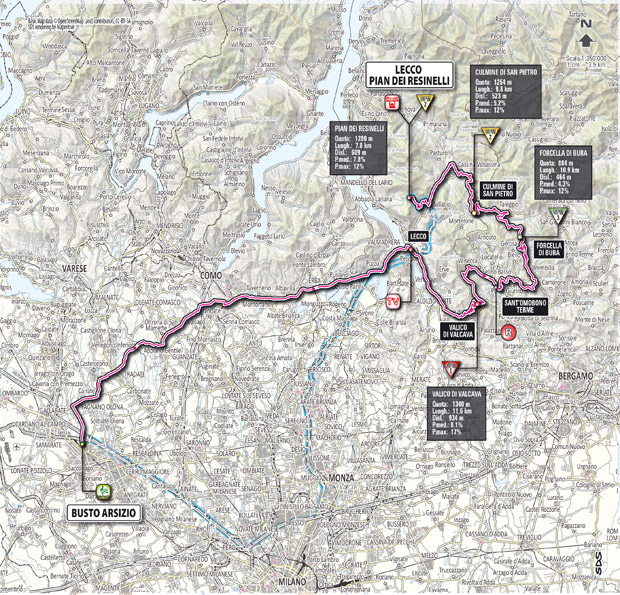
Today is the first day of the third week of the Giro and the race returns for a second day in the high mountains with a 169km parcours that takes in four tough categorised ascents and numerous uncategorised climbs to sap the rider's strength and make the big ones even harder. (Map, profile)

The stage starts in Busto Arsizio, a city that can proudly claim to have been a real thorn in the side of the Fascists during the Second World War as the locals took to the hills and fought savagely for freedom, then in April 1945 set up the first free radio station in Italy since the Fascists took power. The city escaped bombing during the War - it was hit by only one bomb - and as a result many of the Art Nouveau villas built by the wealthy in the early 20th Century survive, as do numerous older buildings. It was the birthplace of cyclist Michele Mara (02.10.1903), a sprinter who won the silver medal at the World Championships of 1928, Milan-San Remo, the Giro di Lombardia and five stages (1, 9, 10, 12, 15) of the Giro d'Italia in 1930, then two more stages (5 and 9) in the Giro d'Italia of 1931; his younger and less talented brother Enrico (07.08.1912), who was 11th in the Giro di Lombardia of 1940; Luigi Casola (11.07.1921), winner of four stages of the Giro d'Italia between 1948 and 1951; Albino Crespi (03.01.1930), winner of Stage 3 in the Giro d'Italia of 1953; Valerio Lualdi (31.08.1951), who raced in ten Giri d'Italia and finished nine, won various other races and rode as a domestique for Francesco Moser; Dario Andriotto (25.10.1972), the 1994 amateur World Time Trial Champion and also a veteran of ten Giri d'Italia (he finished six). Unsurprisingly for a city that ha produced so many world-class cyclists, it once boasted a race - the Coppa Città di Busto Arsizio was first held in 1923, when it was won by Libero Ferrario, and last held in 1967 when Dino Zandegù won.

Valico di Valcava
The first 70.2km were relatively flat with Albese con Cassano the highest point at 398m - none of the climbs in this section looked challenging. Lecco, on the banks of Lake Como at 61.9km, is familiar from the Giro di Lombardia. It would be a beautiful city no matter where it was located, but with the high mountains the riders are about to climb providing the perfect backdrop to the lake and grand buildings, it's a contender for most beautiful in Italy. The first of those mountains was Cat 1 Valico di Valcava, rising to 1,340m, 11.8km in length with an average gradient of 8% and - according to Italian Wikipedia, a maximum of 18% around 4km from the top.

Cat 3 Forcella di Bura began at 113.5km, climbs to 884m with an average 3% gradient over 7.4km, then Cat 2 Culmine di San Pietro began at 144km and is 23.3km in length, long enough to create a low average gradient of 4.4km (max. 12%) despite the 1,254m altitude. Finally, Piani dei Resinelli began at 161.2km and climbs over 7.8km to the finish line located on a plateau at an altitude of 1,280m, giving an average gradient of 6.6%.

The stage's highest profile was the man who wasn't supposed to be here - Frank Schleck (RadioShack-Nissan), who increasingly looks as though he's never going to recapture the form he had in the past this year, abandoned after 28km due to pain from a shoulder injury suffered in Stage 11... or could it be that he's decided to chalk this one up to experience and go home to concentrate on training for the Tour with Andy? We shall see.

Matteo Rabottini
For Matteo Rabottini (Farnese Vini-Selle Italia), meanwhile, the race went better than he could even have hoped: he attacked early on, then rode hard to keep his lead all the way to the finish line. It looked as though his efforts were in vain when ‏Joaquim Rodriguez (Katusha) caught him with 400m to go, this sort of uphill ending being precisely the sort of terrain over which he's all but unbeatable; which is probably why he looked so surprised when the Italian found a new reserve of strength and then hung on in his slipstream before swinging out just metres from the line and taking the most unexpected victory of the 2012 Giro so far with a time of 5h15'30". Alberto Losada was 23" behind them for third place. Rodriguez, who equaled Rabottini's time, took the maglia rosa from Ryder Hesjedal and now has an advantage of 30" in the General Classification. Mark Cavendish, who was 172nd for the stage, remains leader of the Points competition

Top Ten

1 RABOTTINI Matteo FAR 5:15:30 0:00
2 RODRIGUEZ OLIVER Joaquin KAT 5:15:30 0:00
3 LOSADA ALGUACIL Alberto KAT 5:15:53 0:23
4 HENAO MONTOYA Sergio Luis SKY 5:15:55 0:25
5 SCARPONI Michele LAM 5:15:55 0:25
6 BASSO Ivan LIQ 5:15:55 0:25
7 PIRAZZI Stefano COG 5:15:59 0:29
8 KREUZIGER Roman AST 5:15:59 0:29
9 GADRET John ALM 5:15:59 0:29
10 TXURRUKA Amets EUS 5:15:59 0:29 
(Full stage result and GC)


Monday is a rest day - and with three more high mountain stages, one medium, one flat and an individual time trial till to go, the riders will welcome it.

Saturday, 21 April 2012

La Doyenne 2012

Intro - Climbs and Parcours - points of interest and sights - Weather - Favourites - Coverage

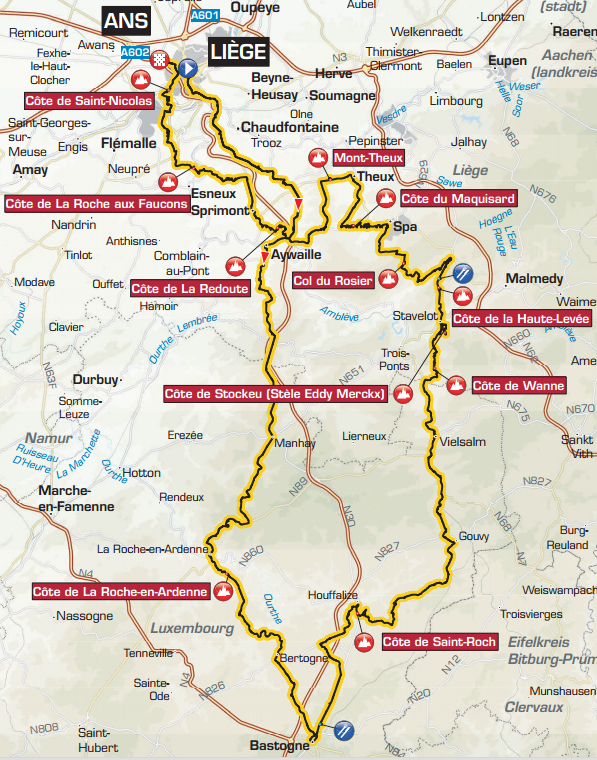
The parcours - click to enlarge
(for a zoombable .pdf, click here)
It's that time of year again. The Flanders Classics, Milan-San Remo and the lunacy that is Paris-Roubaix are all over, as is the first of the Ardennes Classics La Flèche Wallonne; which means it's time for La Doyenne, the oldest of the Monuments, Liège-Bastogne-Liège. First held 120 years ago, La Doyenne was like many races from the latter half of the 19th Century and the first of the 20th originally organised with a view of promoting newspaper sales, in this case L'Expresse - the fact that it was published in French is the reason that the race remained within the French-speaking Walloon region rather than venturing into Flanders, where the cycling-mad natives speak various dialects of Dutch.

Some also call it the toughest Classic, tougher even than Paris-Roubaix. Moreno Argentin, who won four times, said, "Riders who win at Liège are what we call fondisti - men with a superior level of stamina. [The climb of] La Redoute is like the Mur de Huy in that it has to be tackled at pace, from the front of the peloton. The gradient is about 14 or 15 per cent, and it comes after 220 or 230 kilometers, so you don't have to be a genius to work out how tough it is. Liège is a race of trial by elimination, where it's very unlikely that a breakaway can go clear and decide the race before the final 100km. You need to be strong and at the same time clever and calculating - in this sense it's a complete test of a cyclist's ability."

Profile
The Parcours
The race follows its usual format this year with a relatively straight-forward 98km route south to Bastogne that has little in the way of challenging climbs, then a tough 159.5km with ten hard climbs on the way back to Liège. Riders start out from the Place Saint-Lambert in Liège before riding out into the Province of Luxembourg (not to be confused with the Grand Duchy, which it borders), the least-populated part of Belgium; reaching first climb the Côte de La Roche-en-Ardenne after 70km before arriving at the little village Ortho (which has a very interesting medieval church, incidentally). The parcours between La-Roche-en-Ardenne and over the hill to Ortho is around 9km with an average gradient of 5.2% but the steepest part, just before 72km into the race, reaches 17% and it hits 12.5% another half a kilometre up the road.
Climbs with official gradients (gradients in the text refer to absolute maximums, measured on the inside of bends, and are taken from Cycling.be)  

Km 70.0 - Côte de La Roche-en-Ardenne - 2.8 km climb to 6.2 %
Km 116.5 - Côte de Saint-Roch - 1.0 km climb to 11 %
Km 160.0 - Côte de Wanne - 2.7 km climb to 7.3 %
Km 166.5 - Côte de Stockeu (Stèle Eddy Merckx) - 1.0 km climb to 12.2 %
Km 172.0 - Côte de la Haute-Levée - 3.6 km climb to 5.7 %
Km 185.0 - Col du Rosier - 4.4 km climb to 5.9 %
Km 198.0 - Côte du Maquisard - 2.5 km climb to 5 %
Km 208.0 - Mont-Theux - 2.7 km climb to 5.9 %
Km 223.0 - Côte de La Redoute - 2.0 km climb to 8.8 %
Km 238.0 - Côte de La Roche aux Faucons - 1.5 km climb to 9.3 %
Km 252.0 - Côte de Saint-Nicolas - 1.2 km climb to 8.6 %
With the first hill completed, it's only 27km to the turning point at 97km. The feed station is at 98km, then the riders head north on the much hillier return journey. They arrive at the Côte de Saint-Roch after 116.5km, a notoriously harsh climb with an average gradient of 11% and a maximum of 20%, then continue for 43.5km to the Côte de Wanne at 160km, average 7.5% and maximum 13% and into Wanne.

6km after the village is the Côte de Stockeu, sometimes known as the Jewel of Liège-Bastogne-Liège. It's 2.3km in length with an average gradient of 9.9% and a maximum, halfway along, of 21%. Just past the steepest section stands a monument to Eddy Merckx, a likeness of the rider emerging from a rough-hewn lump of granite that also bears a plaque outlining his 525 professional victories - hence the Col's other name, Stèle Eddy Merckx. A cyclist formed from granite no doubt has artistic significance but, as great as he was, even Merckx experienced difficulties on Stockeau; which means there's no shame for those who abandon here.

Côte de la Haute-Levée lies 5.5km ahead, a comparatively easy climb with its average 5.6%; however, the steepest part is still hard-going at 12%. There's a welcome and much flatter 15km section - including the second feed stage at 175km - between it and the Col du Rosier (approached from the south) is by the standards of the Ardennes Classics an easy climb with an average gradient of 3.9% and a maximum 10%. Having passed Spa - hometown of Hercule Poirot and one of Europe's most beautiful cities - the race reaches the Côte du Maquisard at 198km, slightly steeper than the last climb with an average of 5.1% but an equal maximum.

Mont-Theux is 10km further on, average 5.3% and maximum 11%, then at 223km the legendary Côte de La Redoute with its average gradient of 9.7% and maximum 22%. The Côte de La Roche aux Faucons is 15km ahead at 238km - near enough to the finish and steep enough (average 9.9%, maximum 16%) to sometimes prove decisive to the race's outcome - if a strong climber can get a lead here, then keep it over the final climb and through the last 5km, he may take victory. There remain 14km to the Côte de Saint-Nicolas with a steep average of 7.6% and maximum of 13%, followed by the last 5km to Ans - the final 1.5km climbs 79m, which by my reckoning creates an average gradient of 5.5% with the steepest part rising to 13%.

Places of Interest
Montagne de Bueren, Liège
Liège, a city of almost 200,000 inhabitants, once the industrial and now the economic centre of Wallonia, traces its history back to at least 558CE and has much to see, despite having been the destination of 1,500 V1 and V2 missiles after the Allies took the city from Germany at the end of the Second World War (a time during which the people of Liège showed the humanity and bravery, often at great personal risk, by refusing to let the Nazis round up and ship off the city's Jewish population - most of whom would survive the war hidden away in monasteries). The city's most important buildings are St. Paul's Cathedral, dating from the 10th Century but a cathedral only since the early 19th C.; the vast Palace of the Prince Bishops, dating from the 16th C. and the Montagne de Bueren - an outdoor flight of 400 stone steps (maximum gradient 44.2% - who's up for a go at climbing those on their bike, then?). 1.5km away, near Embourg, is a 19th C. fort, one of several surrounding the city, but it's not open to the public and there's little to see.

La Roche-en-Ardenne
Sougné-Remouchamps (called Sougné-Remonchamps on the course guide) at 20km is famous for its caves, which are open to the public who can join tours completed partially by boat along the subterranean River Rubicon. Harzé (27.5km) has a castle which is much younger than it looks, dating from the 16th C but resembling an 11th or 12th C. structure. Manhay (46.5km) has a preserved Panzer tank positioned on a plinth, a memorial to the 1944/5 Battle of the Bulge which saw black American serviceman placed into active combat positions for the first time. La Roche-en-Ardenne (66km) had a 12th C. castle that now lies in ruins, largely as a result of the 19th C. locals who stripped it of masonry to build their homes.

Bastogne (98km), a city of 14,000 people, is also famous for its role in the Battle of the Bulge. It was here that the Nazis, led by crack SS troops, briefly gained the upper hand over the Americans and, for three weeks, surrounded General McAuliffe's troops. The Nazis sent a negotiator to ask him to surrender, but the General replied "Nuts!" and ordered his men to keep fighting. There are several monuments to their eventual victory in the city, including a preserved Sherman tank on a plinth. There's another Panzer tank commemorating the meeting of Generals Patton and Montgomery during the Battle of the Bulge at Houffalize (114.5km), a town considered the centre of Belgian mountain biking - a round of the World Cup was hosted here in 2010.

Tavigny
Tavigny (121km) has a grand chateau with two turrets (your esteemed author, then aged 11, camped in the grounds of the chateau during a family holiday, fell in love with an American woman aged at least 45 and befriended a white goat). Another castle, the Château des Comtes de Salm, once lay a short distance north of Salmchâteau (146.5km) but only the gatehouse and a few ruins exist today - this one too has a goat connection, as legend claims that treasure buried in the grounds is protected by a golden goat. Excavations have indeed turned up numerous gold coins, but it appears the goat prefers to remain a legend. In Stavelot (165.5km) is an unusual Benedictine monastery, founded in 1951, where the monks make a living not by brewing and cheese-making as tends to be the way in Belgium but from the manufacture of latex emulsion paint. The area, including Francorchamps (175.5km), is world famous for the Spa-Francorchamps motor racing circuit which has been in use since 1921 - incredibly fast and, before changes were made, notoriously dangerous, many drivers called it the most beautiful track in the world.

Spa (192km), also known as the Water City, is the place that gave its name to all other places in the world that have water with supposedly health-promoting effects. The water here has been famous since Roman times and wealthy people from across Europe would come here to bathe in it, claiming various medicinal benefits. In the 18th C. the first casino opened up to give them something to do at night as well (aristocrats get up to all sorts of no good if you don't keep them amused, after all) and the rich began building chateaux, rapidly making the city very prosperous indeed. I have swum in the waters at Spa, which a guide said would relieve and possibly even cure my arthritis. It did not.

Franchimont Castle
11.5km from Spa lies Theux, site of Franchimont Castle. Of great military importance since the 11th C., the castle lost strategic value in the 17th C. when improvements in artillery brought it within range of guns on the other hills nearby and it was put into use as a prison until the Napoleonic era when it was sold to a wealthy business man who used it as a quarry, turning it quickly into a ruin. Though unfortunate, this destruction may well have been of aesthetic benefit; and it's a beautiful sight today. Boncelles (241.5km) has another of those 19th C. forts protecting Liège, part of the same network as the one at Embourg. Mostly subterranean, its grey aeration tower gives away its presence and acts as a landmark. Seraing (242km) became a manufacturing centre during the Industrial Revolution, home to factories and mills established by Lancashire-born John Cockerill - the same man who produced the cast iron (not bronze from captured French cannon, as locals will try to tell you) lion atop the Butte du Lion as seen in the Brabantse Pijl two weeks ago. Though not so well-known in Britain, Cockerill is famous throughout Wallonia as the Father of Belgian Industry (and unlike most entrepreneurs of his day, he wasn't a greedy, exploitative fatcat either - by all accounts, he took an active interest in the well-being of those who worked in his factories and by the standards of the times treated them very well). Finally, having passed through the centre of Liège, the riders arrive at the finish line at Ans (257.5km), a contiguous suburb of the city and home to the medieval Château de Waroux which was at the centre of the Guerre des Awans et des Waroux in the 13th C., a private feudal war between enemy noble families that left 30,000 people dead (hence the point above about keeping the aristocracy amused).

Weather
La Doyenne has seen some atrocious weather during its long history, most notably in 1980 when heavy snow fell along the entire parcours and commentators renamed it neige-Bastogne-neige ("snow-Bastogne-snow", which they probably thought extremely witty). It won't snow this year (probably; you never can tell in the Ardennes) but it's not going to be what anyone would call a nice day either. Temperatures at Liège as the riders set out won't be much above 6 or 7C and a 19kph south-westerly will take the edge off that, making it feel more like 1 or 2. There's a very high chance it'll be raining, too. It should be warmer when they get back, around 11C, but it'll still be raining. Bastogne is set to be at least a degree or two colder and rain look equally probable here.

Favourites
Samuel Sanchez
The Brothers Schleck (RadioShack-Nissan) said on Friday that they intended to win, but their form thus far this season suggests they're going to have a hard job making it happen - however, let's not forget that both of them can climb like angels and if they do suddenly start performing well they could both do well. Frank in the top ten? Perhaps. Joaquin Rodriguez (Katusha) also climbs like an angel and he can ride like a demon on the flat sections too - he won't like the weather, being from warmer climes, but rivals will have to work hard to keep him at bay. Unless the unforeseen happens, his team mate Oscar Freire will as always be lurking around at the front of the pack when the finish line draws within site and he's shown time and time again that if an opportunity arises, he'll grab it. Philippe Gilbert (BMC), last year's winner, enters the race as many people's favourite and he's started showing a return to form recently after a slightly lacklustre start to the season, so this may prove to be his day. Finally, my choice: Samuel Sanchez (Euskaltel-Euskadi) - the Tour of the Basque Country is, oddly, not as far removed from this race in terms of similarity as it is geographically: the hills are bigger, but along the way there are a lot of tough little ramps. This was especially the case on the final stage which on paper looked flat, but in reality turned out to be a series of nasty surfaces and cruel little climbs. Upon it, Sammy was in his element and performed far beyond expectations, slaughtering the opposition and gaining a decisive victory. He's also one of the very few climbers able to descend every bit as quickly, which while this is a race that does not tend to give rise to successful breakaways might still give him the advantage he needs to at least remain well-placed for the final uphill sprint. (Start list here)

Coverage
British Eurosport are covering the race live between 14:00 and 16:00BST. Online feeds of varying legality will be up from around 13:00BST (14:00 local time/CEST) and as ever, Sports-Livez is a good place to look for them. The official race ticker will be available at the official race website; Eurosport, Sporza and Cycling News all have their own in English. Twitterers seem to have decided on #LBL as the hashtag of choice.


Tuesday, 17 April 2012

La Flèche Wallonne 2012

History - Charleroi and Huy - the parcours - men's starters and favourites - Flèche Wallonne Féminine - women's starters and favourites - weather - coverage

The parcours - click to enlarge
(for a full-size zoomable .pdf, click here)
Like so many cycling races to have begun in the first half of the last century, La Flèche Wallonne was originally organised in an attempt to drive newspaper sales - in this case, the newspaper was Les Sports, and the first race ran between Tournai and Liège. The parcours has been altered greatly over the years, sometimes running in the opposite direction; but for many years it's covered around 200km stretching between Charleroi and Huy where the riders complete three circuits of an extremely challenging circuit featuring the legendary, infamous Muur - also known as le Chemin des Chapelles for the seven chapels that are passed on the way up, the inspiration for many a headline based around riders saying a prayer as they see their chances of victory slipping away on the gradient which is as reaching a maximum of 19% - but take the wrong line around one corner and a short ramp hits 26%.

This year, the route covers 194km, starting once again at Charleroi which lies in the Hainaut province some 45km south of Brussels. The region has been occupied by humans since long before recorded history, traces of primitive metal working providing evidence that the industry which would bring wealth to the city has a long tradition here. However, the city itself dates back only as far as 1666, a time when the Netherlands was ruled by the Spanish Crown - land here was expropriated by Francisco Castel Rodrigo, Governor of the Netherlands, for the construction of a fortress he named in honour of his king Charles-Roy; hence the city's name today. In the 165 years afterwards, it would pass repeatedly from Spanish, French, Dutch and Austrian ownership until Belgium became an independent nation in 1830. That, conveniently, coincided with the beginnings of the Industrial Revolution; the natural resources that had brought people here thousands of years before ensuring that the city became rich and contributed greatly to the wealth of the nation.

The fortress at Huy
Huy's history begins in Roman times when a fortress was built on the River Meuse, but it seems to have remained a village until the Middle Ages when the metallurgy industry took off, rapidly transforming it into the richest town along the Meuse and in 1066 it received city status - the first town north of the Alps in mainland Europe to do so. The rise of the cloth industry ensured even greater prosperity during the 16th and 17th Centuries, as did paper production during the period of Dutch ownership. As such, the castle in the centre of the city remained strategically important and has been improved and extended many times over the years including extensive remodelling between 1818 and 1823.

Profile - click to enlarge
The Climbs
1. Muur de Huy, Huy, 70.5km, max. 19%
2. Côte de Peu d'Eau, Andenne, 110km, max. 15%
3. Côte de Haut-Bois, Haltinne, 115.5km, max. 17.5%
4. Côte de Groynne, Andenne, 141km, max. 20%
5. Côte de Bohisseau, Andenne, 147km, max. 18.5%
6. Côte de Bousalle, Andenne, 150km, max. 13.1%
7. Muur, 163km
8. Côte d'Amay, 179.5km, max. 20%
9. Côte de Villers-le-Bouillet, 185.5km, max. 17.5%
10. Muur, 194km

Favourites
Start list
Philippe Gilbert (BMC), last year's winner, has had a rough start to the season but seems to be finding the form he had in 2011; making him most people's top choice in the absence of Cadel Evans. Joaquin Rodriguez (Katusha) will be many people's second choice after taking second place in 2010 and 2011 - there are those who will point to his 24th place at the Amstel Gold Race, but everyone is entitled to an off-day and he rode extremely well in the Tour of the Basque Country. The Schlecks (RadioShack-Nissan) don't seem to quite know what to do with themselves this year and have put on some dismal performances, but both are formidable climbers and, should they remember how to ride their bikes, could well be contenders. You Never Know choices: Thomas Lövkvist (Sky), Oscar Freire (Katusha).

La Flèche Wallonne Féminine
The parcours - click to enlarge
(for a full-size zoomable .pdf, click here)
Once of the first Classics to realise that running a women's race alongside the men's event would cost little extra, draw in more fans, double the excitement and generally bring huge benefits all round, the organisers of La Fleche Wallonne first introduced a women's race in 1998 when it it was won by Fabiana Luperini. To date, the men's race has never been won by a British rider but British women have been highly successful with  four victories (thus taking joint first place alongside the Netherlands, whose four were all won by Marianne Vos).

The parcours is shorter at 123km and both begins and ends at Huy. The final circuit omits the initial ascent of the Muur but is otherwise identical.

Favourites
Start list
As far as a lot of people are concerned, this race is all about Marianne Vos (Rabobank, winner in 2007, 2008, 2008 and 2011) and Emma Pooley (AA Drink-Leontien.nl, winner in 2010), one of the few riders capable of surpassing Vos on a climb and backed by one of the strongest teams ever seen in women's cycling. Other likely names are Vos' team mate Annemiek van Vleuten, Loes Gunnwijk (GreenEDGE), Emma Johansson (Hitec Products-Mistral Home, second place in 2009 and 2011) and, of course, Nicole Cooke (Faren-Honda) - Cooke has shown signs of a return to form after a few bad years recently and as winner in 2003, 2005 and 2006 she cannot be ruled out. You Never Know choices: Lise Nöstvold (Hitec Products-Mistral Home), Judith Arndt (GreenEDGE), the entire Specialized-Lululemon team.

Weather
Things aren't looking too awful for Charleroi, but they're not great either with a 40% chance of light rain. A southerly wind of max. 26km won't make temperatures feel any colder than 11C. Huy looks set to be much the same. Strong winds in the region on Tuesday may have blown twigs and thorns into the roads, increasing the risk of punctures.

Coverage
British Eurosport have two hours of live coverage from 13:30BST and highlights on Eurosport 2 at 19:30BST, repeated at 22.20BST on Eurosport.
Live streams online from various sources (including here) starting at 13:15BST (14:15 local time/CEST).
The women's race, unfortunately and as usual, is unlikely to be televised but videos should be available soon after the race.

Friday, 13 April 2012

Amstel Gold Race 2012

The Parcours (click to enlarge)
We've all enjoyed a spectacular few weeks'-worth of bike racing in Flanders at the Cobbled Classics - now it's time to move on to the Amstel Gold Race, the first of the Ardennes Classics. This one is held in a part of Limburg, the most southerly part of the Netherlands, that were it not for a land corridor that at its narrowest is less than 5km wide would be a Dutch enclave sandwiched between Belgium and Germany. The start line is at the 17th Century Staadhuis in Maastricht (50°51'4.78"N 5°41'28.89"E), right up against the Belgian border on the western side and believed (with some dispute from Nijmegan) to be the oldest city in the country. It's also, of course, the Capital of Europe; birthplace of the European Union and euro currency.

The race consists of three parts, the first being the longest and the last the shortest, and after the flat landscape of Flanders (which, as we know, is not without some serious climbs), the beautiful Ardennes landscape is a refreshing change. It's a region of forested hills that is very different to the rest of the Netherlands - and the people too are very different. They have their own distinct folklore and traditions, their own cuisine and - most notably - their own language, Limburgish, which shares similarities with Dutch and German but is distinct and has numerous dialects of its own. Back in the early days of the 1960s and 1970s, the Gold was known as something of a sprinters' race, but as the course was altered over the years (it had to be - the first time it was run, the organisers simply drew the route on a map and completely forgot to take rivers into account) it became a climbers' race and lately it's turned into an event for the attackers (and for the last two years, Philippe Gaumont's race).

The race passes through Ubachsberg, 2007
Nevertheless, it remains hilly - There are no fewer than 31 climbs during the course of its 256.5km route and the many of them surpass 10% at some point on the way up - it's a toughie alright, and not everyone will make it to the last climb of the day. It's also well-known for large numbers of crashes - the Netherlands is a densely populated nation and Limburg is a very densely populated region where few houses have garages, meaning a lot of parked cars become an added hazard, as does Limburg's apparently inordinate love of excess street furniture.

Steephill have an altitude profile here.
Race Itinerary
Official website
Provisional start list

Kasteel Elsloo
The Parcours
The first climb, Maasberg, is only 10.7km from the startline. It's not too harsh with an average gradient of 4.4% but it reaches 11% at the steepest point - far gentler than some of the killer slopes we saw in Flanders (like the Flanders climbs, there are cobbles here) but enough to discourage the weaker members of any early breaks. Kasteel Elsloo sits at the bottom of the climb; which reveals it to be a house designed to look like a castle rather than the real thing which would have been placed in a more strategically advantageous position at the top. In fact, it began life as a brewery and was later converted into a home, then abandoned following a series of fires before passing into the ownership of a margarine magnate. Adsteeg, with a steeper average of 4.7% but less difficult at the steepest part (8%) than Maasberg, is the next climb at 32.5km and will be familiar as a common feature of the Dutch National Championship road race.

7km further up the road is Lange Raarberg (Climb 3, average 4.3%, maximum 6%). The name translates into English as "long, strange mountain;" but disappointingly it's no stranger than most other hills and derives its name from its proximity to the village Raar (which is itself not very strange and derives its name from Limburgish for "open land," perhaps once the most striking feature in the forested region). At 54.7km, the riders arrive at Bergseweg - one of the easiest climbs with a average gradient of only 3.4% - then at 66.6km it's Sibbergrubbe, also not steep (3.75%) but attractive with the sunken road (the grubbe) set in a time-worn groove in the landscape. While roads such as this are undeniably very pretty to look at, they serve to trap sharp bits of flint and thorns from surrounding fields and hedgerows and, as such, become puncture traps.

Valkenburg
Then, at 72km, it's Cauberg. Beginning at the city gates of Valkenburg and the 6th climb of the race, it's a much harder prospect with an average gradient of 8% and maximum of 12%. The hill has a long history and is the site of Roman catacombes, flint mines that date back even further into the Neolithic period and were still in used by the pre-Roman Celts who named the hill Kadeir (which, through various mutations, led to its present name), 20th Century limestone mines (the Gemeentegrot). It has serious cycling history, too - in addition to the Amstel Gold, the World Championships, Tour de France and the Vuelta a Espana have all passed this way and for the last two years there's been an important cyclo cross race here too. Just beyond Noorbeek (one of the country's most attractive villages) Wolfsberg (Climb 7) is at 93.2km - the average gradient is 5.8%, but it's 12% at the toughest part.

Loorberg, at 98.8km, is Climb 8. The average gradient of 5.1% is steeper than the previous hill but its maximum 9% makes it less daunting. At 108.9km Schweibergerweg (Climb 9) tops out at around 8.6% with an average of  3.7%, then at 115.3km Camerig (Climb 10) with its maximum gradient is 9%, but an average of 7% prevents it from ever being described as easy - in fact COTACOL, a book of hills in the Low Countries compiled by Daniel Gobert and Jean-Pierre Legros, rates it as the hardest climb in the Netherlands.

Drielandenpunt, Climb 11 at 128.3km, marks the point where the Netherlands, Belgium and Germany meet (a tripoint, which is far commoner phenomenon than many people imagine - there are 176 around the world, depending on how political borders are drawn across the globe). According to the official website, the average gradient is 3.8%. The maximum according Aerodata International Surveys  is a very tough 14.1%. The hill is also known as Sneeuwberg, snow mountain, and at 322.5m above sea level is the highest geographical point in the country. Having crossed the border for a brief sortie into Belgium, the riders climb to the village of Gemmenich (Climb 12, ave. 6.4%) and then into the Vijlenerbos forest nature reserve (Climb 13, ave. 5.1% and remaining so to the end, where a nasty little ramp closer to 13% awaits) and on to Epen - the maximum gradient for this section is 9.7% and the average 3.4%, with downhill sections. On the way, the riders begin the second part of the parcours

Monument on Gulperberg
After 144.4km, the race tackles Eperheide (Climb 14, max. 10%, ave. 4.5%) and the arrives 8km later at Gulperberg, Climb 15. One of the steepest hills in the race, when approached from the east - as will be the case - the average gradient is 8.1%, but there's a sudden increase just after halfway where the maximum is 15%. Van Plettenbergweg (Climb 16, ave. 3.7%, max. 8%) is next in line, followed by Eyserweg (Climb 17, ave. 4.4%, max. 9%) less than 2km later and Huls (Climb 18, unknown gradient) with its 128.5m TV and radio antenna 5km after that.

Vrakelberg (Climb 19) lies at 168.1km, another tough hill with an average gradient of 7.7% and maximum of 13%, the road surface here tending to be rather rough and poorly-maintained; then at 176km the riders find themselves back on Sibbergubbe (now Climb 20) as the parcours traces the same route as the first part but heads the other way. Cauberg (now Climb 21) is climbed for the second time at 181.5km, then 3.5km later they reach Geulhemmerweg (Climb 22, ave. 6.2%, max. 11.9%) and then head back into Maastricht. 5.7km later the race reaches Caldier en Keer where riders begin the third part of the parcours.

Bemelerberg
At 198.7km lies Bemelerberg (Climb 23, ave. 4%, max. 6%) where limestone outcrops, mostly created by quarrying, add greatly to the attractiveness of the landscape. Three climbs from earlier come in the next 30km: Wolfsberg (now Climb 24, 215.8km), Loorberg (now Climb 25, 221.4km) and Gulperberg (now Climb 26, 229.7km) before the race heads on to Kruisberg (Climb 27) at 235.2km - not the one that features in the Ronde van Vlaanderen, but an even steeper hill with an average gradient of 8.4% and a maximum of 17%.

Eyserbosweg is Climb 28 at 237.3km - less than 2km from Kruisberg, it's a real test with an average gradient of 7.9% and maximum of 17%, making it a likely place for some riders to abandon. Fromberg (Climb 29, ave. 4.8%, max. 9%) lies 3.7km further on, followed by Keutenberg (Climb 30) 4.5km later - this being where the race gets serious on a slope that averages 6.1% but, at the steepest point, hits a cruel 22% - the same maximum as the legendary Koppenberg. Even with Keutenberg over, the riders aren't finished climbing: after another 10.3km, they reach Cauberg (now Climb 31) for a third and final time, ascending to the finish line in Valkenburg.
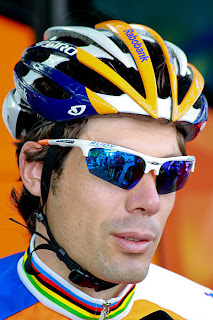
Freire's not the strongest nor the
fastest, but you can achieve a lot
if you use your head (and you're
as sneaky as a thieving alleycat)
The Favourites
Philippe Gilbert (BMC) has had a slow start to the season, but he seemed to have finally come back to life at the Brabantse Pijl where he showed signs of finding the excellent form he was on last year. Having won for the last two consecutive years, Gilbert has to be  favourite today - for the top five and possibly the podium, if not for first place. If Gilbert's not got what it takes, his team mate Cadel Evans might have: he's got experience in the Ardennes having won La Flèche Wallonne in 2010 and he's got the form to bully his bike over the climbs and his rivals out of the way. Edvald Boasson Hagen (Sky) has shown time and time again that he can both sprint and climb and he also won the Enenco Tour after it came down this way and climbed some of these very hills last year. Like Gilbert, he may be outclassed for the top step of the podium, but there's a reasonable chance that he'll be somewhere nearby. Thomas Lövkvist (Sky) - the boy has form, he won the Circuit des Ardennes in 2003 and 6th at La Flèche Wallonne in 2009. Now aged 27 and entering what may be his best years, he's continually improved his climbing to become a formidable all-rounder. Samuel Sanchez showed us all at the Tour of the Basque Country that, when he wants to be, he's one of the world's very best climbers - and as part of the Euskaltel-Euskadi team that trains all year round in the High Pyrenees, these green hills hold few fears for him. Don't forget that Sanchez holds another ace in the form of his legendary descending ability, too - a rare talent for a climber. Oscar Freire (Katusha) is a devastatingly fast sprinter and not a bad as many of his ilk when it comes to the climbs, but what really stands him in good stead is his brain - there has been more than one occasion when he's made full use of the chaos at the end of a race (and this one gets really chaotic) to sneak past the big guns when none of them are looking his way and steal victory from under their front wheels.

Wildcards: a Schleck (RadioShack-Nissan), either one of them. Both are physically capable of winning this race; whether or not the actually can depends on whether they can stop pratting around and get themselves into gear (Johny must spend every day wanting to knock their heads together). Johnny Hoogerland (Vacansoleil-DCM) - stranger things have happened, and he was 4th at the Brabantse Pijl last year. (Provisional start list here)

Weather
It's looking as though rain is likely, with a 40% chance of at least some at Maastricht during the day. Chances are it'll be light showers, but some heavier squalls are possible too - when the wind blows from the north over Limburg, the hills force low-lying air currents that have crossed the Netherlands from the North Sea to suddenly increase in altitude and cool so that water vapour condenses to form clouds and precipitation. On the other side of the region at Vaals rain is slightly more likely with a 50% chance of drizzle. It's not going to be warm, either - the actual high of 9C isn't exactly toasty to begin with, but once the wind (up to 28-30kph) is taken into account it'll feel a good 4-5C lower than that. All in all, not a very nice day.

Local Sights
Kasteel Geulle
Maastricht, as might be expected, has a mixture of charming ancient and stunning modern architecture. It's very Belgian in character - which, despite the stereotype, does not mean boring because Belgians + beer + bikes = Saturnalia. Sittard (19.4km), hometown of cyclist Eddy Beugels, has what must be one of the most quintessentially European town squares anywhere on the Continent. Meersen (38.1km) is home to Kasteel Geulle, a fortified manor house surrounded by a wide moat. Raar (40.7km) has two tiny roadside chapels, one dating from the middle of the 19th Century and the other from the early 20th. Valkenburg (46.6, 66.4, 71.1, 175.8, 180.6 and 255.7km) preserves small sections of its medieval city walls and two gatehouses. Mheer (89.8, 212.3km) also has a castle, dating from the 14th Century with various 15th, 16th and 17th Century additions and Hoogcruts (95.1, 217.8km) a ruined 18th Century monastery that resembles an English country house of the same period. Mechelen (107.1, 148.9, 225.9km) has a very beautiful half-timbered house, the Heerenhof, that dates from the 12th Century. Vaals (125.5km) is a town made of important monuments with over 70 sites and buildings considered of architectural merit. Many of the villages along the parcours have half-timbered houses that in many cases are historically important.

Tuesday, 10 April 2012

Brabantse Pijl

The parcours - click to enlarge
(image credit: Flanders Classics)
The last of the Flanders Classics, the 52nd edition of Brabantse Pijl takes place over 196km - starting off at Leuven before passing through Overijse, then heading west to Halle before doubling back to Overijse for a nasty little circuit made up of five  ascents of four tough hills. It's a tough race, even by the standards of the hilly Classics, with an incredible 28 climbs in total to be tackled along the way.

The Parcours
The riders set off from Sint-Pieterskerk in Leuven's Grote Markt (50°52'45.17"N 4°42'2.90"E) and head south out of the city (passing 0.76km to the west of the woodland where the Fidea CX Leuven races were held on News Year's Eve last year)  and arriving at Holstheide,the first climb after 17km (the route planner doesn't give details of gradient, but using the not-always-accurate Google Earth it looks to be 12% maximum, 5.5% average), then reach Overijse for the first time after 20.5km. The next proper hill is Rue de Hal, 48.6km away, but the parcours in between is most definitely not flat as a look at the altitude profile will reveal - there are five short-but-respectably-steep climbs in between. Arriving at Overijse again after 28.4km, the race sets out on the long 60km journey to Halle.

Climb 2 Rue de Hal is 65.6km into the parcours and again looks to be 12% max., approx. 5% average. Climb 3 Alsemberg is 22.8km further up the road (10% max., 4.2% av,); then Climb 4 Bruineput, the hardest in this section is 5.6km away ( 13.9% max., 8.3% av.). With that out of the way, there are 2.5km to Climb 5 Krabosstraat which gets to 9.5% as it climbs into forest. Climb 6 Rue de Nivelles (8.3% max., 4.4% av.) awaits 5.9km on, then there are 26.3 "flat" kilometres.

Profile - click to enlarge
(image credit: Flanders Classics)
Climb 7 Route d'Ohain lies just outside Lasne (50°41'9.32"N 4°28'58.64"E) and marks 77km to the end of the race and appears to be one of the most difficult, reaching as much as 15% maximum with an average on 9% (again according to Google Earth). Climb 8 Rue François Dubois (11.6% max., 4.9% av.), the last before we enter that very hilly Overijse circuit, is 7.3km away.

4.5km later, riders turn right off Fr. Verbeekstraat to begin their first lap of the circuit and are met almost immediately by the distinctly unpleasant Climb 9 Hagaard (A on the map) which has an average gradient of 14.6%; by far the hardest climb so far. Climb 10 (B) Hertsraat, 3.8km away, is a far more sedate affair with an average of 4.6%, though 9% at the steepest point will certainly create problems - and the psychological effect of such a straight climb can be great: it's much easier to carry on when you can't see what lies around the next corner than when there's a stiff hill rearing up right in front of your eyes. Climb 11 (C) Ijskelderlaan lies 3.1km ahead (11% max., 7.2% average), another off-puttingly straight one this time through a residential area. Climb 12 (D) Schavei (12.1% max., 6.1% av.) is the final climb on the circuit, it too is straight.

Then, having completed the 12.8km circuit, the riders set out on the first of four more laps before reaching the finish line on Brusselsesteenweg (50°46'40.05"N 4°31'23.62"E).

The Race-Losing Curse, aka Cyclopunk's Top Tip
His form hasn't been spectacular this year so far, so it seems likely that Andy Schleck is going to want to pull his finger out and show he still knows how to ride a bike in this race. The hills are steep and there's a hell of a lot of them, but we all saw what he did on the Col du Galibier at the Tour last year - if he's 50% as good as he was that day, he can win this race.

Weather
Rain is expected in Leuven all day, heaviest in the morning - and with temperatures at around 7-8C as the riders set out, there'll be some grumpy faces at the start line and possibly one or two who don't bother showing up (they'll say it because they don't want to risk catching a cold in the run-up to Sunday's Amstel Gold Race because no cyclist admits to being anything less than 100% megahard at all times). Overijse may be dry by the time they first get there, though showers are possible, and might even get some sunshine later in the day - it'll be just this side of cold at 12C. Halle looks set to be much the same as Overijse.

First live footage up at around 14:00BST (15:00 local time/CEST). Available from all the usual sources online, including here.
Route details here (.pdf)
Start list (.pdf)

Interesting Stuff
Sint-Pieterskerk
Leuven's Sint-Pieterskerk is an interesting building. Originally designed to include a 170m tower, which would have been the tallest structure in the world at the time (16th Century), ground instability forced a change in plans and it never reached more than a third that height. Two structural failures within 65 years of completion reduced its height even further and it now stands just clear of the main church roof. The church was badly damaged during both World Wars; fortunately its art treasures were saved and, after it was hit by a bomb in 1944, a previously unknown 11th Century crypt was discovered. Among the oldest artifacts is a carved wooden head, all that remains of a crucifix destroyed by a fire that caused the roof to cave in in 1914.

Until the 1970s when the brand was bought by Artois, Overijse was home to the Lootvoet brewery - producers of the cyclist's favourite Belgian beer Leffe. If you know of any better excuse to have a bottle (or three) while watching the race, don't bother emailing because no excuse for Leffe is required.

La Hulpe lies just over the border in the Walloon region, hence the French placenames in that section of the race. Inhabited for at least 10,000 years, the town's name is thought to be derived from a Celtic word meaning "silver river" - today, the river and the ponds it's formed are known as L'Argentine, itself derived from the Latin word for silver argentum. Keep an eye out for Château Solvay.

Lasne is Belgium's wealthiest area yet, perversely and as tends to be the way of things, its inhabitants pay the lowest local taxes - its name is also said to come from a Celtic word, this time meaning "slow river." Plancenoit, nearby, was the location of several incidents during the Battle of Waterloo - it was here that Gebhard Leberecht von Blücher's army engaged that of Napoleon at La Papelotte, a fortified farm; after which Blücher met the Duke of Wellington at another farm and formed an alliance. An inn near Plancenoit, La Belle Alliance, was used by Napoleon as his headquarters during the battle and holes in the church wall are said to have been made by musket fire.

Butte du Lion
The Butte du Lion can be seen from several points along the route. The 43m hill is almost perfectly conical in shape, belying the fact that it's artificial - construction was ordered by William I of the Netherlands to mark the spot where his son William II (better known as the Prince of Orange) was knocked off his horse when he was hit in the shoulder by a Napoleonic musket ball. The 4.5m tall lion on top weighs 28 tonnes and locals and tour guides will tell you it's made of bronze from melted-down French cannon, even though they probably know full well that it's made of iron cast in Liège by the English blacksmith and entrepreneur William Cockerill who, rather amusingly, had been awarded the Ordre national de la Légion d'honneur by Napoleon in 1807 as a mark of recognition for his services to manufacturing and industry. Wellington hated the lion and the butte - "They have spoiled my battlefield!" he said when he first saw it.

At Braine-le-Château, look out for the château that gave the town its name - you may recognise it from countless jigsaws.

Tuesday, 3 April 2012

News Digest 03.04.12

Tour of the Basque Country - Top blood-doping expert quits in "muzzling" row - Contador will not appeal CAS decision, attacks anti-doping movement - Fabs back at the end of May - Vos will race in Energiwacht Tour

Stage 2 (click to enlarge)
(image credit: Diario Vasco)
Vuelta Ciclista al Pais Vasco Stage 2
“I didn’t come into today’s stage expecting to win. We were riding for Allan. When I found myself with the gap, I decided to take it. The boys worked so well early in the race and held it all together in the sprint. It’s a massive victory -definitely the biggest moment in my career.” (Daryl Impey)
Today brought us Stage 2 of the Vuelta Ciclista al Pais Vasco, better known in Britain as the Tour of the Basque Country - and it was a tough, hilly 165.7 km ride from Güeñes to Vitoria-Gasteiz. Stage 1's selection of mountains (five Cat 3s, one Cat 2 and 1) looked harder than today's 5 Cat 3s and single Cat 2; but today's were higher with the race reaching 810m at the Alto de Zaldiaran, which was climbed twice. (Steephill map here)

It was a very different sort of parcours, however, and not least because of the cold and rain that persisted through most of the day. Whereas the last of the climbs were over and done with plenty of flat terrain running up to the finish line yesterday, the peloton reached Zaldiaran's summit for the second time with only 9.3km to go today; then faced a long descent before the last very short flat section. That made it difficult for teams to arrange themselves into lead-out formations in an effort to get their sprinters into position. As expected, the earlier part of the stage was dominated by a break - Jérôme Pineau (Omega Pharma-Quickstep), Thibaut Pinot (FDJ-Big Mat) and Mads Christensen (SaxoBank) were off up the road after just 7km. A couple more riders joined them 25km later and the merry band worked well together to build a lead of seven minutes before that last Zaldiaran climb proved too much and they fell back into the peloton like spent fireworks.

Daryl Impey
(image credit: darylimpey.com)
Wesley Sulzberger (GreenEdge), Alexsandr Dyachenko (Astana)  Dominique Nerz (Liquigas-Cannondale) and Edvard Vorganov (Katusha) were the next to go, taking their chances on the climb and reaching the summit first. It wasn't long until the peloton followed them onto the last descent and, shortly afterwards, caught all of them except for Nerz who managed to stay out for a little longer until Astana brought him to heel - unfortunately, in doing so they used up too much of their own energy and rapidly began to show signs suggesting they were out of contention for this one. As the 1km to go point approached GreenEDGE took over the reins in a movement that is rapidy becoming as familiar as it is effective, keeping the pack in check as their man Daryl Impey leaped away to line, closely followed by team mate Allen Davis for second place by no more than two bike lengths. Sky's Davide Appollonio led the pack and took third; the next 94 riders crossing in quick sucession and all taking the same time as Impey.

  1.  Daryl Impey GreenEdge 04:10:07
  2.  Allan Davis GreenEdge ST
  3.  Davide Appollonio Sky ST
  4.  Jose Joaquin Rojas Gil Movistar ST
  5.  Michael Matthews Rabobank ST
  6.  Daniele Ratto Liquigas-Cannondale ST
  7.  Francesco Gavazzi Astana ST
  8.  Fabian Wegmann Garmin-Barracuda ST
  9.  Gianni Meersman Lotto-Belisol   ST
  10.  Daniele Pietropolli Lampre-ISD ST 


The full results are here. Best British rider was Sky's Luke Rowe in 115th. Cyclopunk's two top tips for today? Ah, well... Sammy Sanchez (Euskaltel-Euskadi) was 15th, Jens Voigt (RadioShack-Nissan) was 155th.

The Basque EITB TV station is covering the race and will provide a legal, free online stream each day from 14:15 BST.

Tour of the Basque Country: 1 (video) / 2 (video) / 3 (video) / 4 (video) / 5 (video) / 6

Doctor quits anti-doping body in "muzzling" row
Dr. Michael Ashenden, who is considered to be one of the world's top experts on blood doping, has declined to take up his new position with the Athlete Passport Management Unit, a new body that will take over much of the responsibility for anti-dope tests from the UCI and International Association of Athletics Federations, saying that new contracts issued to panel members - which include tight confidentiality clauses - are an attempt by the APMU to "manage the message."

"It seems to me that too much emphasis is being placed on controlling what the media are told. There should be nothing to hide, so why stop the experts from talking?" Dr. Ashenden told the BBC. "We constantly struggle to overcome their omerta, their refusal to tell us what is happening in their sport. We want them to blow the whistle on their colleagues. And yet here Lausanne is imposing its own omerta."

Dr. Ashenden acted as expert witness in the trials of Alberto Contador and Lance Armstrong, and has been a vocal critic of biological passports after discovering the system can be cheated by microdosing. The new clause demands that panel members must seek permission from the APMU whilst representing them and for a period of seven years after stepping down, effectively giving the Unit the power to silence members as and when they choose - which would allow them to prevent a member from voicing his or her concerns. "I believe it's important media have the opportunity to ask hard questions. Unless they're well informed about how the passport operates, they won't know which questions to ask," he says. (More from the BBC) (NYVelocity have a must-read interview with Dr. Ashenden here)


Contador will not appeal
Alberto Contador has confirmed he will not appeal the CAS decision to uphold the two-year ban he received following a long-running doping case. The announcement comes as a surprise since an appeal was widely expected, especially in the wake of a Belgian Court of Appeal judgement that ruled the UCI had acted unfairly in banning Iljo Keisse under broadly similar circumstances and ordered cycling's governing body to pay the Belgian rider €100,000.

Contador had stated previously that he might appeal in the Swiss courts. However, talking to the Spanish El Mundo newspaper, he said that his legal team see little point. "I have lost confidence in the sports courts. I have not doped and I am punished," he added, also complaining that the anti-doping movement has become "a business... a source of revenue for laboratories, TAS, lawyers, researchers, doctors, cheats."

Other News
Fabian Cancellara, who suffered a quadruple fracture of the collarbone at the Ronde van Vlaanderen (Fabs is not a man who does things by halves), plans a return to competition by the end of May. Fans have been treated to some absolutely top quality Fabianese since the crash, which has been blamed on discarded bidons...
Fabian cancellara ‏ @f_cancellara
The rumours are were i have touch it the ground on the feedzone in the #rondevanflanderen they must make new asphalt,there is a big hohle

 (More on Fabian and his upcoming press conference at Cycling News)


Rabobank's Marianne Vos is reported to have recovered from the 'flu that kept her away from the Ronde van Vlaanderen, leaving her free to race in the Energiwacht Tour which begins on Wednesday. Rabobank annonunced the good news on Twitter...

Rabosport Wielrennen ‏ @rabowielrennen
Marianne Vos is hersteld van griep. Start woensdag in Energiewacht Tour. Selectie: Vos, Slappendel, Van Vleuten, Düster, Kitchen, Antoshina. (Trans: Marianne Vos has recovered from flu. Starting Wednesday Energiewacht Tour. Selection: Vos, Slappendel, Van Vleuten, Duster, Kitchen, Antoshina.)