Showing posts with label Liège-Bastogne-Liège. Show all posts

Sunday, 28 September 2014

Daily Cycling Facts 28.09.2014

Léon Devos
Today is the anniversary of the 1919 edition of Liège-Bastogne-Liège, the ninth ever held and the latest calendar date in the 120-year history of the race - as the first in the wake of the First World War, many of the riders who had been on the start lines before racing in Europe was halted by the conflict were no longer around. The parcours was 237km in length and winner Léon Devos also spelled De Vos, took 9h20'30" to complete it after battling through snow to get there.

Trixi Worrack
Born in Cottbus, East Germany on this day in 1981, Trixi Worrack became Junior World Individual Time Trial Champion in 1998, then came third in the same event and second in the Junior World Road Race Championship a year later.

In 2000, she signed her first professional contract with Red Bull Frankfurt and finished Stage 4 of the Women's Challenge in third place. She remained with the team the following year and won Stage 7 at the Women's Challenge, was third at La Flèche Wallonne and fourth in the National Elite ITT Championship. From 2003 to 2009 she rode for Equipe Nürnberger Versicherung; in 2003 she became National Road Race Champion and was second in the Holland Ladies' Tour, then in 2004 she won the Tour de l'Aude, the Krasna Lipa and the Giro della Toscana. In 2005 she won the Primavera Rosa (the women's version of Milan-San Remo); in 2006 he was second at the Holland Ladies' Tour for a third time, also coming second in the World Road Race Championship; in 2007 she was second at the Tour de l'Aude; in 2008 she became National Points Race Champion and in 2009 she won Stage 8 at the Giro Donne and the National ITT Championship.

Worrack at the Thüringen-Rundfahrt, 2012
Worrack joined German team Noris Cycling for 2010 and dominated the Czech Tour, winning all five stages and the General Classification; then in 2011 she raced for AA Drink-Leontien.nl and came fourth at the Trophée d'Or Féminin and won Stage 5 at the Giro della Toscana. She moved on to Specialized-Lululemon for 2012 and has been an instrumental rider in a spectacular first year for the team, starting off the season with a Stage 2 victory and second place overall at the Tour of Qatar, then came third at the Omloop Het Nieuwsblad and won Stage 3 at the Gracia Orlova and Stages 3 and 4 and second place overall at the Thüringen-Rundfahrt. She also rode with Lululemon's victorious squad at the World Team Time Trial Championship and took eighth place at the World ITT Championship. At the London Olympics, she was ninth in the ITT.

In 2013, Worrack became National Cyclo Cross Champion. On the road, still with Lululemon, she came second on Stage 2 and fifth overall at the Tour of Qatar and second at the Classica Cita di Padova during the Spring races, then came second in the time trial and first in the road race at the National Championships and was sixth overall at the Boels Rental Ladies Tour. Lululemon quite literally dominated the team trials in almost every race they entered throughout 2013, frequently beating even their nearest rivals Orica-AIS and Rabobank-Liv/Giant by large margins; Worrack was an integral part of the squad, riding with them in their successful time trials at the Open de Suede Vargarda, the Lotto-Belisol Belgium Tour, the Boels Rental Ladies Tour and again at the World Team Time Trial Championships, where they beat Rabobank into second place by 1'11.09".


Anthony Ravard, born in Nantes, France on this day in 1983, won three stages at the Tour de Normandie in 2008, his first professional year. In 2011 he won Etoile de Bessèges and finished the World Road Race Championships in 13th place and in 2012 he was fourth at the GP Fina - Fayt-le-Franc.

Broadcaster and journalist Jon Snow is familiar to Britons as the presenter of ITN's flagship 10 o'clock News. He is less well-known as a cyclist, except to members of the Cyclists' Touring Club - having become president of the organisation in 2007. Snow was educated at the University of Liverpool but was rusticated (expelled) due to his part in an anti-apartheid protest. He once found himself seated next to a sleeping Idi Amin aboard a Ugandan presidential jet and seriously considered taking the revolver from Amin's belt and killing him with it; stopping only because of the risk to other passengers.

Frances Willard
Frances Willard, born in Churchville, New York on this day in 1839, was a suffragist, social activist and temperance campaigner who, in addition to her work towards getting women the right to vote, was involved in the fight for free school meals, benefits for the poor, workers' rights to join trade unions, municipal organisations devoted to public health and sanitation, state-funded education for the children of poor families and limitations on the hours employees could be made to work, as well as backing new laws against child abuse and rape. Like Susan B. Anthony, she was also a keen advocate of the bicycle which she saw as means of enabling women to travel when and where they wished. In 1895, she wrote A Wheel Within a Wheel: How I Learned to Ride the Bicycle, in which she describes her own cycling journeys and the stories of other women she met while completing them. Although it suffers a little from a typically Victorian tendency to ramble, the book is often funny, always interesting and still well worth a read today; best of all, it's out of copyright and can be read online and downloaded free.

Other cyclists born on this day: Jesús Hernández (Spain, 1981); Guus Bierings (Netherlands, 1956); Paweł Kaczorowski (Poland, 1949); Eddie Fiola (USA, 1964); Robert Thompson (Great Britain, 1882); Waldemar Bernatzky (Uruguay, 1920); Maurice Renaud (France, 1900, died 1968); Francesco Del Grosso (Italy, 1899, died 1938); Carlos Coloma (Spain, 1981); Piet Peters (Netherlands, 1921); Paul Réneau (Belize, 1960); Walter Martin (USA, 1881); Jean Brun (Switzerland, 1926, died 1993); Martin Willock (Canada, 1954); Gilbert de Rieck (Belgium, 1936).

Sunday, 6 July 2014

Daily Cycling Facts 06.07.2014

Maurice Moritz
The eighth edition of Liège-Bastogne-Liège, the oldest of the Monuments that make up the five most prestigious Classic races, was held on this day in 1913. The winner was Maurice Moritz who crossed the line just ahead of the twelve other men in the final sprint and recorded a time of 7h23' - virtually nothing else is known about him. This was the only time the race was ever held in July and it was the last edition until 1919, racing in Europe being brought to a temporary halt by the First World War.


The Tour de France has started on this date three times - 1932, 1991 and 2002.

1932
21 stages, 4,479km.
The number of stages and overall distance was reduced. Henri Desgrange was still concerned that the sprinters suffered more in the mountains than the climbers did on the plain stages, so the bonification system was overhauled once again - whereas the previous year the winner had received a bonus of three minutes, now he would receive four minutes plus an extra three if he finished more than three minutes ahead of second place, while second place earned two minutes and third one minute. This had been done largely because Degrange felt that Charles Pélissier deserved a chance at winning a Tour.  Pélissier was a sprinter who had won fourteen stages over the course of the last three years, including an incredible eight in 1930 (a record that would not be equaled until Merckx managed to do it in 1970, and which has never been bettered - though Merckx did it again in 1974) and Desgrange seems to have liked him tremendously (not so Charles' brother, 1923 Tour winner Henri, with whom Desgrange had a long feud and hated; though he would admit that he was a great rider) - the era of specialist riders such as modern-day sprinter Mark Cavendish who knows he'll never win a Tour had not yet arrived.

Jean Aerts
In the end, though, Pélissier stayed away that year, as did Antonin Magne; but with a team that included André Leducq, Marcel Bidot, Maurice Archambaud and Georges Speicher the French remained favourites. Their biggest rivals were the Belgians, whose Jean Aerts won the first stage; the team suffered however from internal rivalry between the French-speaking Walloons and the Flemish - when the Walloons failed to support Aerts in Stage 2 the maillot jaune passed to Kurt Stöpel (thanks to bonification), who thus became the first German rider to have ever led the Tour. The next day, Stöpel was 57th but didn't lose a great deal of time as 52 of those riders finished together, finding himself 1'45" behind stage winner Leducq, who now held the yellow jersey and, with help from his team and by making good use of his excellent descending skills to regain time lost on the climbs to come, kept it throughout the remainder of the race. Leducq finished 1'09" after Stage 4 winner Georges Ronsse, but his advantage over Stöpel remained intact and then grew by 10" on Stage 5 despite Leducq finishing 3'53" after the winner. During that stage, Spanish Vicente Trueba - who would become the very first King of the Mountains the following year - was first over the Aubisque. Like many climbers he disliked descending, lacking the weight required to prevent the bike skipping all over the road at high speed, so French touriste-routier Benoît Fauré was able to catch him on the way to the Tourmalet and got to the top first - but was denied a stage win by the Italian Antonio Pesento who caught him on the way down and then beat him in a sprint to the finish.

In the mountains, 1932
Leducq got into difficulties during Stage 6 when the race climbed Les Ares, Portet d'Aspet, Port and Puymorens, but once again he was able to use his descending skills and managed to come second with the same time as winner Frans Bonduel, thus adding another minute to his lead over Stöpel. Bonduel and Leducq were first and second on Stage 7 too, so Leducq got another minute, then increased it to 6'05"despite finishing in the same time group as the German on Stage 8 and it remained the same after Stage 9. On Stage 10, Francesco Camusso got away (and became virtual leader for a while) on the Braus and Castillon climbs and won the stage. Stöpel went after him but tired, eventually finishing in fourth place with a time 2'38" greater, but Leducq was 16th and 5'30" down - his overall lead dropped to 3'13", but on Stage 11 it increased to 7'13". He could have won now by riding safely, remaining with the peloton and making sure he had his team around him ready to chase down any breaks that might have a chance of putting a dent in his lead, but he'd developed a taste for the ecstatic French fans that greeted him with every win so he chose to go for a more glorious win and kept contesting stages - he won Stage 13, once again through his descending skills which he used this time to catch Camusso who had escaped in a snowstorm on Galibier, after which he led by 13'03"; then came third on Stage 14 to increase it by another minute. He won Stage 15 too, adding another four, and he would have won even more when he was first over the line on Sage 18 had judges not have noticed that he'd received illegal help in the form of a push from Albert Barthélemy (who was not, as many people imagine, related to Honore Barthélémy - note the very small variation in their surnames). As punishment he was relegated to 21st, taking a place among a group of riders that received the same stage time as new winner Rafaele di Paco but missed out of bonuses. Stöpel was third and won back a minute, but with three stages to go it made no difference; especially when Leducq won Stages 20 and 21 as well, taking his eventual overall advantage to 24'03".

1932 wasn't the only time Leducq got a helpful push from a
team mate - he's seen here in 1933 receiving assistance from
Georges Speicher
Organisers could not miss the fact that all 24 of those minutes came from the total of 31 awarded to Leducq; since Stöpel had been awarded seven, without the bonus system the gap between the two riders would have been just 3", which would have been the smallest winning margin before or since. This, they felt, would have been fairer; perhaps more importantly it might have made for a more exciting race - the following year, it was changed again and the winner alone received a bonus, reduced to two minutes.

Top Ten Final General Classification
1  André Leducq (FRA) France 154h 11' 49"
2  Kurt Stöpel (GER) Germany/Austria +24' 03"
3  Francesco Camusso (ITA) Italy +26' 21"
4  Antonio Pesenti (ITA) Italy +37' 08"
5  Georges Ronsse (BEL) Belgium +41' 04"
6  Frans Bonduel (BEL) Belgium +45' 13"
7  Oskar Thierbach (GER) Germany/Austria +58' 44"
8  Jef Demuysere (BEL) Belgium +1h 03' 24"
9  Luigi Barral (ITA) Touriste-routier +1h 06' 57"
10  Georges Speicher (FRA) France +1h 08' 37"


1991
22 stages (Stages 1 and 2 held on the same day) + prologue, 3,914.4km.
Thierry Marie
Thierry Marie wore the maillot jaune in Stage 1 after winning the prologue, but nobody was surprised when Greg Lemond got into a breakaway on Stage 1 and grabbed sufficient time bonuses to take it away. Having won in 1986 and then, after making an incredible come-back following a near-fatal shotgun accident, in 1989 and 1991 as well, Lemond was favourite among the public and riders; all that remained to be seen was whether he'd now keep the jersey for as much of the race as possible or let it go in a few days and then take it back later on in the race. In fact, he had it for only 42 minutes - that very afternoon, the Ariostea team beat his Z team in the team time trial and the jersey went to Rolf Sørensen. Sørensen  lost it again in Stage 5 when he crashed hard enough to destroy his bike. A domestique was on hand to supply him with a new one but, very obviously in a great deal of pain, he finished in 90th place. X-rays revealed that he'd smashed his collarbone. Marie got another two days in yellow after breaking away after 25km in Stage 6 and then staying away for the rest of the day. At 234km, it's the second longest solo break in the history of the Tour.

Stage 8, the first of two individual time trials, was expected to the where the General Classifications contenders would begin their assualts on overall victory and this proved to be the case: all of them (with the exception of Claudio Chiappucci who, if he was going to win, would do so in the mountains) fought hard for good times. Miguel Indurain used his enormous physical strength to win, but Lemond came in just 8" slower and became race leader with an advantage of 1'13". That remained the same the next day, then dropped 4" after Stage 10, the stage in which the PDM's team Tour came to a premature end: Nico Verhoeven and Uwe Raab were both unable to start due to a fever, then three of their team mates abandoned later that day. On Stage 11, the remaining four PDM riders also left the race; which immediately led to allegations of doping. However, no proof was ever found; we must, therefore, accept the official line that their illness was caused by an injection of a contaminated but legal food supplement.

Urs Zimmerman
Stage 12 started with a protest as riders refused to move for forty minutes after the race was officially started, showing solidarity for Urs Zimmermann who had been rather pettily disqualified for travelling between Stage 11 and Stage 12 by car rather than aeroplane because flying frightened him. Eventually officials relented - Zimmermann was allowed back into the race and his Motorola team manager was barred instead for failing to get permission from race organisers. The riders were also not happy about a new rule requiring them to wear helmets: there had been a strike at Paris-Nice earlier in the year, now two thirds of the peloton handed their helmets over to race officials at the start of the stage and refused to take them back until the end - which doesn't sound a particularly effective protest unless one remembers that this meant the organisers now had to look after 150 helmets and transport them from the start town to the finish. Over the last few days it had become apparent that all was not well with Lemond - and the other riders spotted it, just as any predator notices weakness: when a break consisting of Luc Leblanc, Pascal Richard and Charly Mottet looked to have a good chance of staying away in Stage 12, he found that nobody was willing to help him catch them - three stages earlier he was still le patron, but now he was an also-ran and his word no longer carried weight. Mottet took the maillot jaune, Leblanc the stage. Meanwhile, a Spanish rider named Miguel Indurain who had come tenth the year before clawed back 8". It got worse the next day: Lemond somehow got to the top of Tourmalet only a few seconds behind the race leaders, but Indurain was already long gone and even managed to catch Chiappucci on the final climb up Val Louron. As the better climber, the climb took less of a toll on Chiappucci and he was able to get back ahead and win the stage by 1", but Indurain was now in yellow - with an advantage of 3'.

Indurain on his way home, with trophy
Lemond won back a few seconds later in the race. It wasn't enough to make any meaningful difference in the General Classification, but it turned the race into a defeat rather than a crushing one. Indurain had as good as won now and could have taken things relatively easy, but instead he kept on increasing his overall time by first managing to stay within 1" of Gianni Bugno when he launched a blistering attack on the hallowed Alpe d'Huez, then won the Stage 21 time trial by 27". Never in Tour history has there been such a sharply-defined transfer between two eras.

Top Ten Final General Classificiation
1  Miguel Indurain (ESP) Banesto 101h 01' 20"
2  Gianni Bugno (ITA) Gatorade-Chateau d'Ax +3' 36"
3  Claudio Chiappucci (ITA) Carrera +5' 56"
4  Charly Mottet (FRA) RMO +7' 37"
5  Luc Leblanc (FRA) Castorama +10' 10"
6  Laurent Fignon (FRA) Castorama +11' 27"
7  Greg LeMond (USA) Z +13' 13"
8  Andrew Hampsten (USA) Motorola +13' 40"
9  Pedro Delgado (ESP) Banesto +20' 10"
10  Gerard Rué (FRA) Helvetia +20' 13"


2002
20 stages + prologue, 3,277.5km.
The Saeco team's wildcard invite was revoked shortly before the race began when news emerged that Gilberto Simoni, who had won the Giro d'Italia in 2001, had tested positive for cocaine on two occasions; Jean Delatour being invited in their place.

Ventoux, 2002
Lance Armstrong won the prologue, then settled back into the prologue for the first week with absolutely no concern when the maillot jaune went to Rubens Bertogliati after Stage 1, then Erik Zabel and then Igor González. Everyone expected him to take the lead in the Stage 9 time trial, despite the time he'd lost when he got stuck behind a crash earlier in the race. In fact he came second, making up only 8"; which, had it have been any other rider, would not have drawn comment - but it wasn't any other rider; it was Lance. Did this mean - could this mean - that after three victories his reign was coming to an end? Armstrong couldn't explain it, he chose instead to wait for the Pyrenees in Stages 11 and 12.

He won both, taking back the yellow jersey on the first day and soaring past Laurent Jalabert and Richard Virenque on the final climbs as they fought one another in their own private battle for King of the Mountains. The peloton had seriously understimated him - Lance wasn't finished, he was just getting started.

Richard Virenque
Stage 14 climbed Mont Ventoux, an opportunity for Virenque - his best years were gone, but a decisive victory on the most hallowed mountain in cycling would secure him his position among the greatest climbers of all time. He won the stage by 1'58", which was a good result but not the sort of glorious mountain triumph enjoyed by the likes of Gaul and Bahamontes. He'd won the King of the Mountains five times by this point and he'd win it two more times; but he wasn't in the same league as the Angel and the Eagle. What's more, Ventoux had tested him and he had been found lacking - he didn't look well when he arrived at the finish line. Armstrong rode wisely - he knew that Ventoux can end a rider's Tour, career and even life, so he got himself up without demanding too much from his body and finishing 2'20" later in third place. It was more than sufficient and he added almost two minutes to his lead over second place Joseba Beloki in the General Classification, then when the race left the mountains behind and went to the last time trial he won and his advantage went up to 7'17" - the time by which he won overall a day later.

Armstrong would, in 2012, be stripped of this victory and his six other Tour wins following a USADA investigation into doping at the US Postal team. Levi Leipheimer gave evidence against him and, in doing so, admitted that he too had doped.

Top Ten Overall General Classification
1 Lance Armstrong (USA) US Postal Service 82h 05' 12" (disqualified)
2 Joseba Beloki (ESP) ONCE +7' 17"
3 Raimondas Rumsas (LIT) Lampre +8' 17"
4 Santiago Botero (COL) Kelme +13' 10"
5 Igor González (ESP) ONCE +13' 54"
6 José Azevedo (POR) ONCE +15' 44"
7 Francisco Mancebo (ESP) iBanesto.com +16' 05"
8 Levi Leipheimer (USA) Rabobank +17' 11" (disqualified)
9 Roberto Heras (ESP) US Postal Service +17' 12"
10 Carlos Sastre (ESP) Team CSC +19' 05"


Cyclists born on this day:Tiffany Cromwell (Australia, 1988); Tea Vikstedt-Nyman (Finland, 1959 Jeremy Yates (New Zealand, 1982); Henry Anglade (France, 1933); Jeremy Yates (New Zealand, 1982); Fortunato Baliani (Italy, 1974); René Le Grèves (France, 1910); Phạm Văn Sau (South Vietnam, 1939); Marcin Karczyński (Poland, 1978); Tiemen Groen (Netherlands, 1946); Son Hui-Jeong (South Korea, 1987); Adam Laurent (USA, 1971); Fitzroy Hoyte (Trinidad and Tobago, 1940, died 2008); Joseph Geurts (Belgium, 1939); Luis Laverde (Colombia, 1979); Al Sellinger (USA, 1914, died 1986).

Thursday, 29 May 2014

Daily Cycling Facts 29.05.2014

Houa was born in Liege on the 8th of November 1867
and died on the 31st of January 1918 at Bressoux 
On this day in 1892, 33 amateur cyclists met in the Belgian city of Liege and embarked on a race organised by the local cycling union and the Pesant Club Liègois. The event was financed by L'Expresse, a newspaper then published in French-speaking Belgium and Northern France, and by their request the race stayed within Wallonia. The winner, Léon Houa, took 10h48'36" to complete the 250km parcours and the last of the seventeen riders to finish crossed the finish line five hours and eighteen minutes later. Few would ever have believed that in 2012 the race would still be going; often called La Doyenne, it is Liège-Bastogne-Liège, the oldest, most venerable and, for many, the most prestigious of the five Monument one-day races.

Louis Mottiat, 06.07.1889 - 05.06.1972
Liège-Bastogne-Liège has fallen on this date on two other occasions, 1921 and 1930, but as it's now held from mid to late April so as to fit in with the other Classics (the so-called Northern Classics all take place within weeks of one another), it will never again be held on this date. 1921 was the 11th edition as the race was not held for a period of fourteen years from 1894 and stopped again during the First World War. The parcours covered 209km and was won for the first of two consecutive years by Louis Mottiat, who would win four stages at the Tour de France that same year. The 20th edition, taking place in 1930, was won for the first time by a German, Hermann Buse -  German fans would have to wait almost half a century until 1979 for another victory.

Hubert Opperman
Born in Victoria, Australia on this day in 1904, Hubert Opperman was the son of British-German immigrants who made a living from any sort of work that came their way. His father was variously employed as a butcher, a lumberjack, a coach driver and a miner and, whilst still a child, Hubert earned extra money driving a horse-drawn plough - and by delivering telegrams on a bicycle, which he turned out to be rather good at riding fast.

Hubert Opperman
Aged 17, he entered his first race. Coming third didn't win him the prize he'd been hoping for - a Malvern Star racing bike - but it did bring him to the attention of Malvern Star proprietor Bruce Small, who sought the rider out after the race and offered him a sponsorship. Less than three years later he repaid the company with victory in the National Road Race Champion of 1924, and then again in 1926, 1927 and 1929.

In 1927, three newspapers - Australia's Melbourne Herald and Sporting Globe, alongside New Zealand's Sun - joined forces and started a fund to send an Australasian team to the Tour de France. Australian riders had first appeared at the Tour in 1914 but had not made much of an impact; now - in the brave new world between the First World War and the Great Depression, the nation saw sport as a means to increase its profile on the international stage. By 1928, enough money had been raised and Opperman, accompanied by Harry Watson of New Zealand and Australians Ernie Bainbridge and Percy Osborne, was on his way to France. Journalist René de Latour noted what he called "a marked contrast" between the attitudes of Opperman and the other men: whilst to them it was " a trip in which to collect a few souvenirs to take home, to the eager Oppy it was a wonderful chance to reach the top in international competition." Nevertheless, the Europeans failed to recognise that a serious, if yet not fully-formed, talent had arrived in their midst. "Whom did he beat over there, anyway?" they asked one another. "Let's see him on the road, then we'll know. We've yet to see any classy Australian road rider."

Opperman had been to Europe before, in 1928 when he took part in the Bol d'Or 24-hour classic racing behind tandem pacers (and had won on a borrowed utility bike after persons unknown sabotaged his chain), and he realised that the team would now be competing against rivals performing on a far higher level that those they had faced at home; so he applied for a place for the team on a Vélo Club Levallois training camp run by rider-turned-coach Paul Ruinart. They were accepted and, after a few weeks, were entered into their first European race - the now defunct Paris-Rennes. 32 riders took part, among them some of the finest of the day including Nicolas Frantz (who, the previous year, had won the Tour de France) and Gaston Rebry (who had won Paris-Nantes and would later add an impressive selection of Tour stages), meeting at a cafe in Paris at midnight before riding away into a night full of rain and hailstorms when the race started at 2am. Frantz won, Eugène Archambault was second and Rebry third - but Opperman proved he had the ability to make a name in European racing when he finished in eighth place. At Paris-Brussels shortly afterwards, he cam third behind Georges Ronsse and Frantz.
Opperman rode from Perth to Sydney, a distance of 4,110km, in 1937. The time he took to
complete the journey - 13 days, 10 hours and 11 minutes - held as a record for 30 years
The Tour was to start one month later; however, despite Opperman's success, the team entered with a serious deficit in numbers - while other teams consisted of ten men, the Australasian's plan to recruit six European riders had come to nothing and they still had only four. To make things worse, the aging Bainbridge was far slower than he had once been and tended to be the first man in the autobus, generally after no more than 70km or so. Time and time again, they were defeated by stronger squads. Help came from an unexpected source. Perhaps Ludo Feuillet, manager of the mighty Alcyon team, saw potential in Opperman and wanted to make friends so that he'd be able to poach him for his own team in the future or perhaps he just felt sorry for the Australian who was putting in so much effort only to be soundly defeated day after day - no matter; he took him under his wing and ave him advice on tactics, equipment and so on, and was largely responsible for him finishing in 18th place overall.

Oppy, as he was becoming known, never did win a Tour de France, though he improved his result to 12th place in 1931. Meanwhile, he did well in other French events such as Paris-Brest-Paris that same year, which he won against Frantz and Maurice Dewaele (who had won Oppy's first Tour) and, in time, was adopted as a national hero. Still with Malvern Star, which acted as sales agent for the British manufacturer BSA, he came to Britain during the time when road racing was still banned by the National Cycling Union. Setting new records - provided the rider wore dark, normal clothing rather than anything that might give away the fact that he or she was up to anything that might be deemed competitive upon the King's highway - meanwhile, was not; and he set a new record for Land's End to John o'Groats, then the 1000 Miles, then London-York and the 12 Hours.

Back in Australia five years later, he broke no fewer than 100 records during a single 24-hour race before signing up to the Royal Australian Air Force. He would end the War as a flight lieutenant, one step down from squadron leader, but as was the case with so many riders of the day the conflict took away many years during which he might still have been winning races. He returned to competition in 1945, but now in his forties he was simply unable to perform as he once had and retired in 1947.

After his racing career was over, Opperman realised that he could still serve his nation by putting his fame to good use and getting elected into government. Though an ardent Socialist, the Labor Party's doctrines were too close to Communism for his tastes and so instead he joined the Liberal Party, where he would eventually become a parliamentary whip. Among his many accomplishments, perhaps the most honourable were his efforts to relax Australia's notoriously strict (and, to our modern eyes, shockingly racist) laws barring entry to immigrants of mixed ethnicity and he received well-deserved recognition for his humane views, becoming an Officer of the Order of the British Empire in 1953 and, fifteen years later, a Knight Bachelor; yet was never so pleased as he was when half a million French fans voted for him as L'Auto's Sportsman of the Year. He continued to ride his bike every day until the age of 90, when his wife Mavys persuaded him to stop for fear that he might not survive an accident, and died on his stationary bike on the 18th of April in 1996.

Greg Ball
Paracyclist Gregory Ball, born in Ipswitch, Queensland on this day in 1974, broke the 1km Time Trial World Record during his first year competing for Australia, then took a gold medal for the Team Sprint at the 2000 Paralympic Games. Two years later he won the 1km TT at the World Championships, then went on to even greater Paralympics success with gold for the 1km TT and the Team Sprint.

In 2011, Ball set a new 1km TT World Record - and failed a voluntary anti-doping test afterwards. He still claims that the drug that was discovered in his sample - anabolic steroid stanozolol, the same drug that saw Ben Johnson stripped of his gold medal at the 1988 Olympics - got there through "an honest mistake," most likely the pills given to him by a friend and which he says he assumed were vitamins that he believed would help him to cope with depression.

There are those who say that he must be innocent, because why else would he have voluntarily submitted himself to a test? We need to bear in mind, of course, that had he have refused the test when it was suggested, his achievement would immediately have been called into doubt. Finally, what athlete, in 2011, would willingly swallow any pill without knowing first of all what it was and secondly that he or she could trust the person giving it to them? The Australian Sports Anti-Doping Authority apparently thought along the same lines and, on the 26th of October 2011, upheld Cycling Australia's decision to ban him from competition for two years. He will also have to repay Aus$27,500 granted to him by the Australian Sports Commission and will not attend the 2012 Paralympics - at the age of 37, his racing days are almost certainly over; a sad end to the career of a man who seemed to be an inspirational athlete.


Kathryn Curi, born in Goshen, Connecticut on this day in 1974, became National Road Race Champion in 2005 and, three years later, won the Geelong World Cup.

Other cyclists born on this day: Stefan Ciekański (Poland, 1958); Horacio Gallardo (Bolivia, 1981); Valentina Yevpak (USSR, 1960); Franco Ongarato (Italy, 1949); Norbert Dürpisch (East Germany, 1952); Eom In-Yeong (South Korea, 1971); Milan Křen (Czechoslovakia, 1965); Lu Suyan (China, 1965); José Mercado (Mexico, 1938); Eric Magnin (France, 1967); Magdaleno Cano (Mexico, 1933, died 2009); Choy Mow Thim (Malaysia, 1947); Łukasz Kwiatkowski (Poland, 1982)

Wednesday, 28 May 2014

Daily Cycling Facts 28.05.2014

The second edition of Liège-Bastogne-Liège, the oldest of the five Monument races, took place on this day in 1893 - the only time it has fallen on this date and, since it's now held between mid to late April, it never will again. Run for a second and final year as an amateur event, it was won for the second of three consecutive years by Léon Houa; it took him 10h42" to complete the 250km parcours - almost seven minutes faster than the previous year. 30' behind him was Michel Borisowski, who is sometimes incorrectly said to have been Russian but was in fact Belgian. There are only two known photographs of Houa - one can be seen on the right; the other will appear tomorrow, the anniversary of the first edition of the race.

Michael Boogerd
Michael Boogerd, who was born in The Hague on this day in 1972 and was later - somewhat unsurprisingly - nicknamed The Boogeyman, became a professional cyclist with the WordPerfect team in 1994 and remained with them for his entire career as the squad found new sponsors and changed its name, first to Novell and then to Rabobank.

Boogerd's speciality was the Ardennes Classics, the hilly courses suiting his wiry physique very well, yet he was frequently outclassed by riders such as Michele Bartoli, Johan Museeuw and Erik Dekker, which saw him earn a reputation as an "eternal second." Shortly after his retirement in 2007 he dismissed the claim, and with some justification: after all, he had won an Amstel Gold Race in 1999 and two editions of the Brabantse Pijl (2001, 2003). Not all Classics specialists can carry their talent over into the stage races, but Boogerd enjoyed some success here too - including a stage win at his very first Tour de France (Stage 6, 1996), fifth overall at the Tour two years later, another stage victory at the 2002 Tour (Stage 16) and numerous other good results. His greatest achievement, meanwhile, were his three National Championships: he won the title in 1997, 1998 and 2006.

An enormously popular rider among the Dutch public, not least of all on account of his dazzling white smile and boy band looks, Boogerd was 50% of the inspiration for the book Michael & Erik - which covers the his and Erik Dekker's careers.

Diana Žiliūtė
Diana Žiliūtė
Diana Žiliūtė, born in Rietavas on this day in 1976, is a Lithuanian cyclist who first appeared on the international scene in 1994 when she won the Junior World Road Race Championship. Three years later she won the European Under-23 Time Trial Championship and then in 1998 the Elite World Road Race Cup and Championship.

Thus began the career of Lithuania's most successful cyclist of all time - she would go on to build up one of the most impressive palmares of any cyclist during the late 1990s and first decade of the 21st Century with a series of victories at the Giro Donne (Stage 3, 2000; Stage 13, 2001; Prologue and Stage 6, 2004), the Tour de France Féminin (GC, 1999; Prologue, Stages 1, 5, 6 and 7, 2006; Stages 1, 2b and 3, 2008; Prologue, 2009), the Women's Challenge (Stage 3, 1998; Stages 3 and 6, 2000), the Holland Ladies' Tour (Stages 1, 2 and 7, 2003) and the Vuelta Ciclista a Navarra (GC and Stages 1, 2, 3 and 4, 2000). In addition, she won a second World Cup in 2000, the Trofeo Alfredo Binda in 2003, the GP Liberazione and the Giro di San Marino in 2006, the Tour de Prince Edward Island in 2007 and the Giro della Toscana in 2009.


Tom Southam, born in Penzance on this day in 1981, was the rider who, along with Charlie Wegelius, caused controversy at the 2005 World Championships when they chose to ride in support of the leader of the Liquigas-Bianchi trade team rather than Team GB leader Roger Hammond. Like Wegelius he paid a high price for doing so, becoming persona non grata in the eyes of many fans for some years after the incident.

Rohan Dennis, an Australian cyclist born on this day in 1990, has won several gold medals at the National Track Championships and the World Track Cup. In 2010 he began to make his mark on the road, too, winning the Under-23 National Time Trial title after coming first overall at the Geelong Tour. In 2012, he won the U-23 National TT and road race, then came fifth overall at the Tour Down Under - and look to be on the verge of beginning a great career.

Cees van Espen, a Dutch rider born in Arnhem on this day in 1938, was one of that vast majority of cyclists who middle along, winning a provincial race here and there but never quite finding what it takes to make it into the upper echelons. Among his modest victories were Culemborg in 1961, the Ronde van Twente in 1962, Ossendrecht two years later - and Stage 5a at the 1965 Tour de France.

Other cyclists born on this day: Mickaël Bourgain (France, 1980); Luke Madill (Australia, 1980); Wim van Huffel (Belgium, 1979); Vagn Bangsborg (Denmark, 1936); Arve Haugen (Norway, 1943); Bjørnar Vestøl (Norway, 1974); Scott Richardson (South Africa, 1971); Chris Koberstein (Canada, 1968).

Friday, 16 May 2014

Daily Cycling Facts 16.05.2014

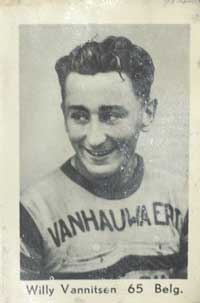
The 25th edition of La Flèche Wallonne took place on this day in 1961, running from Liège to Charleroi for a second consecutive year. However, the parcours had been altered and as such was 15km shorter at 193km - the shortest in the 76-year history of the event. The winner was Willy Vannitsen who won more than 110 races during his 13 professional years, including Stage 1 at the 1958 Giro d'Italia and Stages 10 and 15 at the 1962 Tour de France, yet is virtually forgotten outside his native Belgium.

Liège-Bastogne-Liège, the oldest and - according to some - greatest Classic of them all took place on this day in 1909. Eugène Charlier was the first over the line, but when officials discovered he hadn't finished the race on the same bike he started with his victory was disallowed - rather than being disqualified, as some sources claim, his time was recorded as being the same as that of Victor Fastre (and the next seven men, this being the first time that the race had ended with a bunch sprint) and he was relegated to second place. In third place was Paul Deman, winner four years later of the Ronde van Vlaanderen and then Paris-Roubaix in 1920 and Paris-Tours in 1923.

Alfredo Binda
The Giro d'Italia began on this day seven times - 1925, 1936, 1959, 1969, 1974, 1985 and 1998. The 1925 edition started and ended in Milan, with twelve stages covering a total of 3,520km. It is remembered - by those few people fortunate to have seen it and still be with us - as one of the most exciting ever due to an epic battle between Costante Girardengo, who fought long and hard through the mountains and won five stages, and Alfredo Binda who matched every attack he made to take the race lead from him and keep it for the final eight stages to win by 4'58".

1936 covered 3,745km in 19 stages, though Stages 15 and 17 were split - 15a was a short road stage, 15b an individual time trial, 17a and 17b were short road stages. Gino Bartali, who had won the Mountains classification the previous year, returned and performed even better to win the Mountains and his first General Classification, leading the race through the final twelve stages and winning two of them. Olimpio Bizzi won Stage 6 at the age of 18 years and 299 days, making him the youngest Giro stage winner ever.

Charly Gaul
1959 was made up if 22 stages and 3,657km - another epic year in which Luxembourg's Charly Gaul once again proved himself unbeatable in the mountains (or, as many will point out, proved himself capable of consuming larger quantities of la bomba), driving hard over the snowy peaks and continuing to push himself when others had exhausted themselves. Gaul was almost as good in a time trial as he was in the climbs, but he wasn't quite as good as Jacques Anquetil who took a 1'30" lead after Stage 2, then proceeded to slowly grind down his opponent's advantage until the race leadership passed to him in Stage 15. Going into Stage 20, the Frenchman still had the lead and many believed the race was as good as his. Then, in Stage 21, Gaul crushed him. Pushing so hard over three challenging mountain that nobody could get near him, he won by 9'48" and took back the leadership. Rolf Graf won the final stage, but Ancquetil may as well have not bothered - bettering what Gaul had done was far beyond even his capabilities.

1969 covered 3,851.3km in 22 stages and would be one of the most controversial editions ever due to a sample provided during Stage 16 by Eddy Merckx, found to be positive for N-ethyl-3-phenyl-norbornan-2-amine, a stimulant prescribed under the name Reactivan and still used, though rarely, in medicine today. For reasons that remain unknown, news of the sample and the rider's expulsion from the race was supplied to the press before he and his team management were notified and when he revealed that he had been offered money to throw the race by an un-named Italian rider the day before, suspicions that something nefarious was going on began to pick up speed. Prince Albert of Belgium sent his own aeroplane to bring him home and the government got involved, demanding an investigation from the Italian Foreign Minister. The Italian Federation continued to insist it had acted correctly and, while Merckx was subsequently given the go ahead to ride in that year's Tour de France, which he won, the official reason for his Giro expulsion has never been retracted. Many believe that the Belgian rider would have won but, with him out of the way, Felice Gimondi dominated the remainder of the race and took the overall General Classification. 43 years later, Merckx still says that the stage was such an easy one that he had no reason to resort to cheating, as does appear to be the case when we take his abilities into account, and to this day he insists he is innocent. So does the official who was in charge of the positive sample.

From left to right: Hinault, Maertens, Merckx and de Vlaeminck
(unknown copyright)
In 1974, Merckx won for the fifth time after 22 stages and 4,001km. While he led from Stage 14 to the end, it was noticeable at several points during the race, especially when Jose-Manuel Fuente and Gianbattista Baronchelli got into a duel in Stage 20 and raised the pace so high that Merckx nearly exhausted himself in his attempts to keep the leadership (in fact, Baronchelli was "leader on the road" for a while during the stage), that his reign was beginning to crumble. He would win the Tour as well that year, becoming for the fourth time one of the few riders to have won two Grand Tours in a season.

1985 came during the reign of the man commonly considered the second greatest cyclist after Merckx, Bernard Hinault who won for a third time. Taking third place after the 22 stages and 3,998km was Greg Lemond, who would slay the Badger the following year when he became the first American to win the Tour de France. When Hinault won the Tour later in the year, he won two Grand Tours in a season for the third time. Strangely, when the Giro next started on this date in 1998, winner Marco Pantani took the first step in adding his name to the list too because he also won the Tour that year. 1998 covered 3,868km in 22 stages.

Simon Gerrans
Simon Gerrans, born in Melbourne on this day in 1980, took up cycling after injuring his knee during childhood; the sport having been recommended to him by his neighbour, who was a reasonably successful rider himself - Phil Anderson, the first non-European to wear the maillot jaune at the Tour de France. It soon turned out that he wasn't bad at it either and he was awarded a scholarship at the Australian Institute of Sport, where he began to develop into a world-class road racer.

Simon Gerrans
(image credit: GreenEDGE)
Gerrans' first major success was the Under-23 title at the National Championships of 2002, where he also took 5th in the Elite race. The big European teams were not slow in taking note and in 2003 he was invited to join Carvalhelhos-Boavista as a trainee after spending a short while with the Norwegian team Ringerike, then a year later AG2R Prévoyance with whom he turned professional in 2005 and entered the Tour de France for the first time, surprising many by coming third in Stage 17 and leaving no doubt that he was a new talent - one that could very easily have been ended in February the next year with a crash at the GP d'Ouverture la Marseillaise which left him with pins in his collarbone and shoulder as well as several stitches to repair flesh wounds to his head. He recovered quickly and rode his second Tour that year, improving his General Classification result from 126th to 79th, then dropped to 94th in 2007.

In 2008, having moved on to Crédit Agricole, he won Stage 15 after sprinting to the finish without challenge from the other surviving two riders of a four-man break that had escaped early in the stage and managed to stay out in front. The next year he joined the legendary Cervelo Test Team, but managers mystified fans by failing to pick him for the Tour squad. However, he did go to the Giro d'Italia, where he won Stage 14 (Cervelo's first Grand Tour stage win), and the Vuelta a Espana where he won Stage 10; thus becoming the first Australian rider to have won a stage at all three Grand Tours. 2010 saw him depart for the new British team Sky, with whom he went back to the Tour. Another crash ended his chances in Stage 8 and left him with a broken arm. He stayed with Sky through 2011 and began to show promise as a Classics rider, taking third at the Amstel Gold, second at the Waalse Pijl and 12th at Liège-Bastogne-Liège, then third for Stage 2 at the Tour.

In 2011, it was announced that a new team, GreenEDGE, was being put together and stood a very good chance of being the first Australian team to receive a ProTour licence from the UCI. Gerrans was invited join and did so - which, in 2012, looked to have been a very wise decision. With them, he became National Champion for the first time, won a second Tour Down Under and then added the highlight of his career so far - victory at the legendary Milan-San Remo Monument when he beat Fabian Cancellara. The following year, Gerrans won stages at the Tour Down Under, Volta a Catalunya and Tour of the Basque Country before going to the Tour de France, where he achieved another career highlight by winning Stage 3 and then the Stage 4 team time trial. In 2014, he became National Road Race Champion and won Stage 1 and the overall General Classification and Points competition at the Tour Down Under, then enjoyed more Classic s success with a victory at Liège-Bastogne-Liège.

Matthias Kessler
The German rider Matthias Kessler, born in Nuremburg on this day in 1979, was little known outside his own nation until 2000 when he turned professional with Deutsche Telekom. In 2001 he finished in the top 5 for two stages at the Giro d'Italia but remained little known - until he was widely proclaimed an outside favourite for the Classics in 2003 on the strength of 6th place at Liège-Bastogne-Liège in 2002 and soon caught the public's attention for his habit of unzipping his jersey and deliberately ripping his undershirt to keep cool. He finished the Amstel Gold Race in 5th place in 2003, then La Flèche Wallonne in 3rd a year later.

Unfortunately, what could have been a great career was marred by bad luck and doping. In the 2004 Tour de France he was left in agony after a bad crash and, while he finished the stage, didn't start the next day. In 2007, he provided a sample that was shown to contain unusually high levels of testosterone; leading to his dismissal from Astana a short while later. Things began to fall apart from that point on and he experienced difficulty in finding a new contract once his two-year ban came to an end. In 2010, while on a training ride in Algaida, Mallorca, he accidentally collided with a cat. The resulting crash left him with serious head injuries., ending his career.

Other cyclists born on this day: Roger de Beukelaer (Belgium, 1951); Roberts Plūme (Latvia, 1897, died 1956); Im Sang-Jo (South Korea, 1930); Pål Henning Hansen (Norway, 1953); Juan Reyes (Cuba, 1944); Wilhelm Rabe (Germany, 1876); Antonio Hernández (Mexico, 1951); Lennie Kristensen (Denmark, 1968); Gustavo Guglielmone (Argentina, 1971).

Saturday, 28 September 2013

Daily Cycling Facts 28.09.2013

Léon Devos
Today is the anniversary of the 1919 edition of Liège-Bastogne-Liège, the ninth ever held and the latest calendar date in the 120-year history of the race - as the first in the wake of the First World War, many of the riders who had been on the start lines before racing in Europe was halted by the conflict were no longer around. The parcours was 237km in length and winner Léon Devos also spelled De Vos, took 9h20'30" to complete it after battling through snow to get there.

Trixi Worrack
Born in Cottbus, East Germany on this day in 1981, Trixi Worrack became Junior World Individual Time Trial Champion in 1998, then came third in the same event and second in the Junior World Road Race Championship a year later.

In 2000, she signed her first professional contract with Red Bull Frankfurt and finished Stage 4 of the Women's Challenge in third place. She remained with the team the following year and won Stage 7 at the Women's Challenge, was third at La Flèche Wallonne and fourth in the National Elite ITT Championship. From 2003 to 2009 she rode for Equipe Nürnberger Versicherung; in 2003 she became National Road Race Champion and was second in the Holland Ladies' Tour, then in 2004 she won the Tour de l'Aude, the Krasna Lipa and the Giro della Toscana. In 2005 she won the Primavera Rosa (the women's version of Milan-San Remo); in 2006 he was second at the Holland Ladies' Tour for a third time, also coming second in the World Road Race Championship; in 2007 she was second at the Tour de l'Aude; in 2008 she became National Points Race Champion and in 2009 she won Stage 8 at the Giro Donne and the National ITT Championship.

Worrack at the Thüringen-Rundfahrt, 2012
Worrack joined German team Noris Cycling for 2010 and dominated the Czech Tour, winning all five stages and the General Classification; then in 2011 she raced for AA Drink-Leontien.nl and came fourth at the Trophée d'Or Féminin and won Stage 5 at the Giro della Toscana. She moved on to Specialized-Lululemon for 2012 and has been an instrumental rider in a spectacular first year for the team, starting off the season with a Stage 2 victory and second place overall at the Tour of Qatar, then came third at the Omloop Het Nieuwsblad and won Stage 3 at the Gracia Orlova and Stages 3 and 4 and second place overall at the Thüringen-Rundfahrt. She also rode with Lululemon's victorious squad at the World Team Time Trial Championship and took eighth place at the World ITT Championship. At the London Olympics, she was ninth in the ITT.

In 2013, Worrack became National Cyclo Cross Champion. On the road, still with Lululemon, she came second on Stage 2 and fifth overall at the Tour of Qatar and second at the Classica Cita di Padova during the Spring races, then came second in the time trial and first in the road race at the National Championships and was sixth overall at the Boels Rental Ladies Tour. Lululemon quite literally dominated the team trials in almost every race they entered throughout 2013, frequently beating even their nearest rivals Orica-AIS and Rabobank-Liv/Giant by large margins; Worrack was an integral part of the squad, riding with them in their successful time trials at the Open de Suede Vargarda, the Lotto-Belisol Belgium Tour, the Boels Rental Ladies Tour and again at the World Team Time Trial Championships, where they beat Rabobank into second place by 1'11.09".


Anthony Ravard, born in Nantes, France on this day in 1983, won three stages at the Tour de Normandie in 2008, his first professional year. In 2011 he won Etoile de Bessèges and finished the World Road Race Championships in 13th place and in 2012 he was fourth at the GP Fina - Fayt-le-Franc.

Broadcaster and journalist Jon Snow is familiar to Britons as the presenter of ITN's flagship 10 o'clock News. He is less well-known as a cyclist, except to members of the Cyclists' Touring Club - having become president of the organisation in 2007. Snow was educated at the University of Liverpool but was rusticated (expelled) due to his part in an anti-apartheid protest. He once found himself seated next to a sleeping Idi Amin aboard a Ugandan presidential jet and seriously considered taking the revolver from Amin's belt and killing him with it; stopping only because of the risk to other passengers.

Frances Willard
Frances Willard, born in Churchville, New York on this day in 1839, was a suffragist, social activist and temperance campaigner who, in addition to her work towards getting women the right to vote, was involved in the fight for free school meals, benefits for the poor, workers' rights to join trade unions, municipal organisations devoted to public health and sanitation, state-funded education for the children of poor families and limitations on the hours employees could be made to work, as well as backing new laws against child abuse and rape. Like Susan B. Anthony, she was also a keen advocate of the bicycle which she saw as means of enabling women to travel when and where they wished. In 1895, she wrote A Wheel Within a Wheel: How I Learned to Ride the Bicycle, in which she describes her own cycling journeys and the stories of other women she met while completing them. Although it suffers a little from a typically Victorian tendency to ramble, the book is often funny, always interesting and still well worth a read today; best of all, it's out of copyright and can be read online and downloaded free.

Other cyclists born on this day: Jesús Hernández (Spain, 1981); Guus Bierings (Netherlands, 1956); Paweł Kaczorowski (Poland, 1949); Eddie Fiola (USA, 1964); Robert Thompson (Great Britain, 1882); Waldemar Bernatzky (Uruguay, 1920); Maurice Renaud (France, 1900, died 1968); Francesco Del Grosso (Italy, 1899, died 1938); Carlos Coloma (Spain, 1981); Piet Peters (Netherlands, 1921); Paul Réneau (Belize, 1960); Walter Martin (USA, 1881); Jean Brun (Switzerland, 1926, died 1993); Martin Willock (Canada, 1954); Gilbert de Rieck (Belgium, 1936).

Sunday, 15 September 2013

Daily Cycling Facts 15.09.2013

On this day in 1912, the seventh Liège-Bastogne-Liège was held - one of two editions (the other being the ninth) to be held in September, rather than in Spring or Summer as had been the case previously and ever since. The parcours was 257km in length and winner Omer Verschoore (right) took 8h35' to complete it, beating Jacques Coomans in a sprint to the finish line. Little is known about Verschoore, other than that he was born on the 2nd of December 1888 in Moorslede, Belgium and died on the 6th of June 1931 in Paris.

Fausto Coppi
Ask cycling fans who the best rider in the history of cycling was and you can expect a range of different answers. Many, regardless of their nationality, will say Eddy Merckx; most French fans will say Bernard Hinault. Lots of people will say Briek Schotte, even though he won far fewer races than Merckx or Hinault. Some Americans would say Lemond, but most will still say Armstrong - though a few of them mean Kristin rather than Lance. Fans who love the mountain stages will say Gaul or Bahamontes, while those who love the sprints will say Cipollini or Cavendish. Lots of Brits will say Simpson while those who are in the know will say Burton. I would say Marianne Vos, because she's won more races at the age of 26 than Merckx had, and she hasn't finished her career yet (Merckx, incidentally, admits to being highly impressed too). If you ask the tifosi, Italy's notoriously and wonderfully biased, obsessive cycling fans, they'll all say Coppi.

Coppi
Angelo Fausto Coppi was born in Castellania on this day in 1919, the fourth of five children. Like many of the giants in cycling history he was sickly in his youth and showed absolutely no interest in school. His health improved when he found a rusty, brakeless bike in the cellar at the family home, learned to ride it and fell in love; his school attendance did not - aged 13, he was caught playing truant and a teacher made him write "I ought to be at school, not riding my bicycle!" repeatedly on the blackboard as punishment. Not long afterwards he left school and went to work as a butcher. Gaul, incidentally took a similar route, working as a butcher and slaughterman; another similarity was that both men excelled at climbing and time trials. However, Coppi held a third ace: he was also a devastatingly fast sprinter, an unusual combination that didn't go unnoticed by his one childhood ally - a merchant seaman uncle with a lifelong love of cycling, who gave Fausto the money to buy his first racing bike.

Wisely, Coppi used the 600 lire to get a frame custom-built for him, planning to use his wages from his delivery boy job to buy components ("Oh how my legs used to ache at night through climbing all those stairs during the day! But I'm glad I did, because it surely made my legs so strong," he later said). Unfortunately, the frame builder ripped him off - after taking Fausto's money and telling him his frame would be ready in a week, he took much longer than agreed while working on frames for established riders, then gave him an off-the-peg frame instead. Fausto didn't yet have the confidence to demand he got what he'd paid for.

But Coppi was so good that it didn't matter if his frame didn't fit him - he won races anyway. His first race was one in 1934 for boys who were not members of cycling clubs; he didn't come first but he did win 20 lire and a sandwich. In 1938 he got his racing licence and won the next race he entered - this time, the prize was an alarm clock. At that time, Coppi still worked in the butcher's shop, which was where he met Giuseppe Cavanna, an ex-boxer who had lost his sight after one too many punches damaged his brain and then became a masseur, learning the finer details of cycling and of the reputation Coppi was already building from his clients. When they met, he encouraged the rider to become an Independent so that he'd be able to compete with professionals as well as with amateurs and suggested he enter the Tour of Tuscany in 1939. Coppi did so, following Cavanna's advice to "follow Bartali!" until a buckled wheel put him out of the race. However, less than a month later he won a race at Varzi with a lead of seven minutes on the second-placed rider - as one of the constituent races of the season-long National Amateur Championship, he had gone up against riders with far more experience and resoundingly beaten them all. He won six more races that year and signed to Legnano - Bartali's team.

In 1940, aged only 20, Coppi won the Elite National Road Race Championship and the Giro d'Italia - almost three-quarters of a century later, he remains the youngest ever winner of the Giro. The Giro didn't take place from 1941 to 1945 due to the Second World War, but he won the National Pursuit Championship in 1941, then the National Pursuit and Road Race Championship and set a new Hour Record in 1941, before Italian racing came to an end until after the war. During those years, he fought in the 38th Infantry alongside a man named Arduino Chiapucci - father of Claudio, who won the King of the Mountains twice at the Giro and the Tour de France in the 1990s - before they were captured by the British on the 13th of April 1943 and became prisoners of war. Like all POWs, he was required to work while incarcerated; British amateur cyclist Len Levesley was no doubt very surprised the day he realised that the man cutting his hair was a Giro d'Italia winner. Neither man spoke the other's language, but Levesley gave him a bar of chocolate.

Coppi with Bartali
Cycling started up again in 1946 and Coppi won Milan-San Remo. He was determined to win another Giro too and took three stage victories, but he couldn't hold off Bartali who fought hard for his third and final overall victory (Bartali beat him in the King of the Mountains too; while Coppi had been sent off to fight, Bartali, who was five years older, had spent much of the war smuggling Jewish refugees over the Alps into Switzerland using a special trailer with a secret compartment - he was, therefore, as good at climbing as he'd ever been), then later in the year he won the Giro di Lombardia. In 1947 he was all but unbeatable, winning the National Road Race Championship, the National and World Pursuit Championship, another Giro di Lombardia and three stages plus the General Classification at the Giro d'Italia (Bartali beat him again in the King of the Mountains). In the 1948 Giro he won the General Classification and the King of the Mountains, as well as the National Pursuit and Road Race Championships, Milan-San Remo and the Giro di Lombardia; but his greatest moment came the following year when he won the Giro and the Tour de France, something no other rider had ever done. He also won the King of the Mountains at both races, the National Road Race Championship, the World Pursuit Championship and another Giro di Lombardia.

In 1950, Coppi won Paris-Roubaix, the hardest of the ultra-hard Northern Classics (some say the hardest race of all) that fans and riders alike traditionally said Italian riders could not win. He also won the Waalse Pijl, one of the difficult Flemish Classics. In 1951 he won stages at the Giro and the Tour but missed part of the season due to a broken collarbone suffered at Milan-Turin; he was also hit hard by the tragic death of his beloved younger brother Serse, also a professional cyclist, following a crash in a race at the Giro del Piemonte. In 1952 he missed some opportunities again due to a broken shoulderblade, but repeated his 1949 achievement of winning the Giro and the Tour; though this time he was second in the Giro's King of the Mountains.

Coppi leading Richard Filippi at the Trofeo Baracchi, 1953
Coppi won his final Giro - the fifth, a record that has not yet been matched - in 1953; he also won his only World Road Race Championship that year. In the two years that followed, he scored excellent results: he won the King of the Mountains at the 1954 Giro but was fourth in the General Classification, then in 1955 he was second overall and won the National Road Race Championship. It was obvious, though, that the years in which he dominated European cycling had ended - in the subsequent four years, he won only six times; more than the majority of cyclists could even dream of winning, but very poor indeed for the Champion of Champions.

Coppi declined as fast as he had once ridden. He had always been unusually forthright about his drug use, a subject most riders preferred not to discuss despite the fact that many of the drugs that would now result in suspension were not then banned - he was once asked if cyclists used la bomba, amphetamines. "Yes," replied, "- and those who say they don't are not worth talking to." The interviewer asked if he had used la bomba himself: "Yes, when it was necessary." When was it necessary? "Almost all the time!" (Bartali, who believed that everybody should live life as honestly as possible, was very much opposed to any sort of cheating, including doping. He took to mounting secretive raids on Coppi's hotel rooms and took away the empty phials and pill boxes he found there so that his own doctor could tell him what they were. In time, he became such an expert on the drug's effects that he was able to accurately judge how Coppi planned to ride the following day). If la bomba hastened his decline, it wouldn't have come as a surprise: he was well aware of what the drug could do, once telling René de Latour: "What is the good of having world champions if those boys are worn out before turning professional? Maybe the officials are proud to come back with a rainbow jersey. But if this done at the expense of the boys' futures, then I say it's wrong. Do you think it normal that our best amateurs become nothing but gregari [domestiques]?" He went on to name four riders who had shown great promise as amateurs but failed to live up to expectations as professionals, in his opinion because of drugs, and practically invited them to sue to him for defamation. That way, he said, "the facts will be brought to light and this may mean a change in our methods."

Coppi and Occhini
By the end of his career, his reputation was in tatters - nowadays, when Italians have become used to Silvio Berlusconi, most of them are virtually unshockable when it comes to the behaviour of public figures; but in the 1940s and 1950s Italy was a deeply devout Catholic nation and the population was horrified to discover that their great hero had been having a secret affair. The Woman In White was Giulia Occhini, the strikingly beautiful wife of army captain Enrico Locatelli. Locatelli was a cycling fan; his wife - who was not - accompanied him to see Coppi race in 1948. Afterwards their car was caught next to Coppi's in a traffic jam, which was where the affair began. That same evening, she sought the rider out at his hotel to ask for an autographed photo. They were not exposed until 1954, when a press photographer snapped her waiting for him at the end of a race, and the scandal broke. Coppi left his wife, Bruna Ciampolini, and moved in with Occhini; but their landlord threw them out. Ciampolini refused to agree to a divorce (which was still illegal in some parts of Italy at the time), the Pope became involved and asked Coppi to return to her, then influenced the president of the National Federation to send a letter claiming that his conduct caused St. Peter "very great pain." When Coppi raced, spectators spat at him as he passed.

Coppi memorial on the Pordoi Pass on the Dolomites
In 1959, the year that Coppi rode the Vuelta a Espana and, according to Pierre Chany, was the first rider to be dropped on every stage (he was, Chany said, "a magnificent and grotesque washout"), he was invited with Henry Anglade, Jacques Anquetil (who beat Coppi's Hour Record in 1956), Raphaël Géminiani, Roger Hassenforder and Louison Bobet to compete in a race in Burkina Faso, then to a hunting expedition with the nation's president Maurice Yaméogo afterwards. Géminiani shared a room with Coppi and later remembered that they had been troubled by mosquitoes; both of them contracted plasmodium falciparum, a form of malaria that causes the vast majority of all deaths attributed to the disease each year. Géminiani recovered, Coppi did not - he died on the 2nd of January in 1960, when he was 40 years old.

In 2002, a rumour emerged suggesting that Coppi's death had in fact been caused by a cocaine overdose. Details were sketchy, but newspaper Corriere dello Sport claimed to have got the story from a mysterious figure known as Giovanni, who had in turn got it from someone named Angelo Bonazzi. Meanwhile, another story attributed to a monk named Brother Adrien said that Coppi hadn't been killed by malaria or cocaine, but by a poisonous potion apparently widely used in Burkina Faso. Coppi's doctor rubbished both claims, but a legal investigation was launched and, for a while, it looked as though his body would be exhumed for analysis; after a year the investigation was shut down and the case dismissed after no evidence to support either claim, or an exhumation, could be found.

Monika Valvik-Valen
Born Grethe Monika Eikild Valen (she later married Olympic discus thrower Svein Inge Valvik) in Porsgrunn on this day in 1970, became National Junior Road Race Champion on Norway in 1987 and won all five stages at the Swedish Tygrikeskupen, the Elite National Championships for road racing and time trial, Stage 2 at the Tour de France Féminin and fifth place in the Olympics road race in 1992.

In 1993, she won three stages at the Tygrikeskupen, enough to win the General Classification again, then successfully defended both her National titles; in 1994 she retained the National Road Race title but lost the time trial - no real upset, as she replaced it with a gold medal at the World Road Race Championship. In 1997, having signed up to Serotta and riding for the first time as a professional, she became National Champion in road racing, time trial and criterium. She was Road Race Champion again the following year, then Criterium Champion again in 2000 and Stage 7 at the Women's Challenge in 2002. Valvik-Valen's older sister Anita Valen-de Vries (married to Gerrit de Vries, who rode seven Tours de France) was also a professional cyclist and was herself National Champion in road race, time trial and criterium in 2003.

Lorenzo Bernucci
Born in Sarzana, Italy on this day in 1979, Lorenzo Bernucci turned professional with Landbouwkrediet-Colnago in 2002 and stayed with them for three years, gaining some good results - including third place finishes in the Under-23 World Championships and Paris-Roubaix and, in 2002, the Giro d'Italia. He went to Fasso Bortolo in 2005 and won Stage 6 at the Tour de France, then signed to T-Mobile in 2006.

In September 2007, Bernucci tested positive for anorexiant drug Sibutramine, used to control weight. The drug, which has since been banned throughout the European Union and in several nations around the world after it was connected to heart failure, renal failure and strokes, had been on the UCI's list of banned drugs the previous year; Bernucci claimed that he had been taking it for four years and was not aware that it was now banned - since he had failed to inform T-Mobile's doctors of this, he was deemed to have acted negligently by the team and fired.

Bernucci returned to cycling with the San Marino-based Cinelli OPD in June the following year, then went to LPR Brakes for 2009 and Lampre-Farnese Vini for 2010, picking up good - if not superb - results along the way. However, it appears that anti-doping agencies and the Carabinieri were not convinced his earlier run-in with the law had taught him a lesson and kept him under suspicion: in 2010 his wife, Valentina Borgioli, was stopped at Pisa airport after suspicions that she might be carrying doping products to the Belgian Classics, then in April the couple's home was raided. Police found a perfluorocarbon product used to increase the number of red cells in the blood (similar to EPO) and human albumin, the latter having a number of properties of interest to cheating athletes including being the ideal sunstance with which dilute the blood in order to get around haematocrit counts. The Italian Olympic Committee sought a six-year ban; the Tribunale Nazionale Antidoping granted them five years - as Bernucci was 31 at the time, his career is likely to be finished. Several members of his family were shown to be involved with the supply of doping products and were also banned from involvement in sport: his father, mother and wife for four years each and his brother initially for four, later reduced to three.


Pierino Baffi
Pierino Baffi, born in Vailate on this day in 1930, was a very good cyclist but not a great Grand Tour-winning one. He could win stages, however - Stages 6 and 9 at the Vuelta a Espana in 1955, Stage 10 at the Giro d'Italia in 1956, Stages 8 and 19 at the Tour de France in 1957, Stage 6 at the Giro in 1960 and Stage 2 at the Giro in 1963. Nevertheless, he earned a far bigger place in cycling history: in 1958, he won Stage 12 at the Giro, Stages 10, 16 and 24 at the Tour and Stages 3 and 14 at the Vuelta, thus becoming the second rider ever to win stages at all three Grand Tours in a single year. The first had been Miguel Poblet, two years earlier; the feat has since been repeated only by Alessandro Petacchi in 2003. Baffi's son Adriano also became a cyclist and won the Points comptition at the 1993 Giro, then became a directeur sportif for LeopardTrek after retiring from racing.

Sebastian Lang, born in Sonneberg, East Germany on this day in 1979, became National Time Trial Champion of Germany in 2006. In 2008, he led the King of the Mountains between Stages 12 and 14 at the Tour de France.

René Haselbacher, born in Vienna on this day in 1977, was National Road Race Champion of Austria in 2002.

Giancarlo Bellini, born in Crosa, Italy on this day in 1945, won the Baby Giro in 1970 and turned professional with Molteni the following year. In 1972 he finished Stage 5 at the Giro d'Italia in second place, but he would not win a Grand Tour stage until 1978 when he won Stage 12 at the Giro. However, in 1976 he won the King of the Mountains at the Tour de France.

Other cyclists born on this day: Brent Emery (USA, 1954); Yeung Alexandra (Hong Kong, 1972); Anthony Peden (New Zealand, 1970); Viktor Romanov (USSR, 1937); Tapani Vuorenhela (Finland, 1947); Roby Hentges (Luxembourg, 1940); Daniel Goens (Belgium, 1948); Pak Jong-Hyeon (South Korea, 1938); Tanja Žakelj (Slovenia, 1988); Gustavo Artacho (Argentina, 1967); Porfirio Remigio (Mexico, 1939); John Stenner (USA, 1964, died 1994); Mees Gerritsen (Netherlands, 1939); Kaspars Ozers (Latvia, 1968).