Showing posts with label Cadel. Show all posts

Friday, 14 February 2014

Daily Cycling Facts 14.02.2014

Cadel Evans
Born in this day in 1977 in Katherine, a town and important Aboriginal community in the Northern Territory of Australia, Cadel Evans spent much of his childhood living in Armidale, New South Wales where he developed a love for skateboarding and which, he says, helped to shape him as an endurance athlete due to its altitude of almost 1000m. Towards the end of his teenage years, he began mountain biking and immediately showed potential, winning silver medals at the 1997 World Championships.

Cadel Evans
(image credit: Ludovic Péron CC BY-SA 3.0)
He had also displayed notable ability on the road, including winning a bronze medal in 1995 Junior Time Trial World Championship - the beginning of a process that would lead him to manager Tony Rominger and the now-notorious Michele Ferrari and which, by 2000, saw him switch allegiances and become a full-time road racer. He turned professional with Saeco in 2001 (having been a professional with the Volvo-Cannondale MTB squad) and won his first major victor, the Tour of Austria, that same year. As might be expected of a rider as promising as him, switched teams regularly as he rose up through the ranks, riding for Mapei the next year. At Mapei, he came under the guidance of the legendary trainer Aldo Sassi; the man who helped him transform from a world-class mountain biker to a world-class road cyclist. He entered his first Grand Tour, the Giro d'Italia, with them and finished 14th overall - not bad at all in a race that most debutantes don't finish. Earlier in 2001, he'd won the King of the Mountains at the Tour Down Under, as he would again the next year.

2004 brought another Tour of Austria win, then in 2005 he entered his first Tour de France and came a remarkable 8th overall. That was improved to 4th in 2006, along with a third Tour Down Under mountains award and the Tour de Romandie, then honed down to 2nd in 2007. This was the point at which it became apparent that, somewhere in the near future, there was a Tour win with his name on it. It wan't to be 2008 or 2009, though the Points Classification at the Critérium du Dauphiné was a effective way to prove he could sprint as well as climb, and it couldn't be 2010 when Alberto Contador and Andy Schleck decided between themselves who was going to win when they were away together up in the mountains (the decision being made, in Contador's favour, with a little help from a slipped chain in Stage 15).

Then 2011 came round. Contador, whilst able to show that he's still the world's best climber, had been left reeling by an ongoing doping investigation and Bradley Wiggins, a favourite due to his earlier win at the Critérium du Dauphiné (in which Evans came 2nd) was forced out after a crash left him with a broken collar bone. That left Schleck - a rider far, far better at climbing, but nervous on a difficult descent as we saw on the slippery route into Gap from the Col de Manse when the Australian took a full minute from his rival. Schleck clawed back time with an incredible solo break on the Galibier a few days later, a ride hailed as one of the finest stage wins in years, and one perhaps intended to win him the race. But, with a superhuman effort, Evans managed to keep the advantage lower that Schleck would have liked. A win the next day on Alpe d'Huez might have sealed things in Schleck's favour, but it wasn't to be - the mountain, for some reason, seems to be one of the few that doesn't suit him. By the Stage 20 time trial, Schleck's advantage was down to 57" and while he's made heroic efforts to improve in the discipline, he'd have needed a miracle to keep it from Evans.

At the Tour of Germany, 2005
(image credit: Juergen Wohlfahrt CC BY-SA 2.5)
The rest, of course, is history. Evans rode even better than expected, finishing the stage a mere 7" behind winner Tony Martin and gave himself a 1'34" lead. Schleck would need to be content with another 2nd place overall, his disadvantage too great for the race to be won in the final stage into Paris even had he have been the sort of rider sufficiently disrespectful of tradition to attempt to take back the race. Evans had become the first Australian to win the Tour, finally completing a course of events set in motion by Don Kirkham and Ivor Munro right back in 1914. Aged 34, he was also one of the five oldest ever winners and, since Lance Armstrong was found to have cheated and was subsequently stripped of his seven victories, is one of only two non-Europeans to have won the Tour.

In 2012, Evans began the Tour among the favourites - partly because of his 2011 victory, but also because an unusually flat parcours made the eventual outcome heavily reliant on the time trials. However, his poor  performances in two of the mountain stages left him unable to challenge and Bradley Wiggins, who had taken the yellow jersey in Stage 7, remained leader for the rest of the race, and he finished in seventh place overall. This would not be the season's only disappointment - after getting off to a promising start when he won a stage and the General Classification at the Critérium International and the Points competition at the Critérium du Dauphiné (in addition to third in the General Classification), he suffered a noticeable loss of form after the Tour and managed only 80th place in the Road Race at the Olympics, then cited "inadequate recovery and fatigue" as the reasons behind his decision not to compete in the Individual Time Trial. Shortly after the Games, he announced that he would be sitting out for the remainder of the season in order to concentrate on recovering his fitness for 2013.

In 2013, Evans showed a return to form with third place overall at the Giro d'Italia and the Tour of Oman. Early results in 2014 - second overall at the Tour Down Under with one stage win (Stage 3), and second at the National Road Race Championships - indicate good chances for a successful season which, now that he is 37, must surely be one of his last at the top of the sport.

Evans is known for his philanthropic philosophy, donating Aus$50,000 to charities, including the Amy Gillett Foundation set up in memory of the cyclist who was killed in a road accident in 2005. He is also a vocal supporter of the Free Tibet movement, saying "I don't want to see a repeat of what happened to [Australian] Aboriginal culture happen to another culture."


Gianni Bugno
Gianni Bugno, born on this day in 1964 in Brugg, Switzerland,  displayed all the signs of a cyclist who was destined to become one of the great Grand Tour riders - he began winning important races immediately his professional career began, including Stage 18 at the 1988 Tour de France and another at the Giro d'Italia a year later. Then he won the World Cup, two Tour stages, Milan-San Remo and both the overall General Classification and the Points competition at the Giro in 1990. He was World Champion in 1991 and 1992, coming 2nd and 3rd in the Tour those same years.

Unfortunately, he had one serious problem - his career coincided with that of Miguel Indurain and the wins, despite Indurain's claim that Bugno was his biggest threat - that would otherwise have been his were always just out of his reach. For the last five years of his career, he seems to have stopped trying and contented himself with stage wins (two at the Giro, two at the Vuelta a Espana) and overall victory at other races such as the Tour of Flanders, the Tour Méditerranéen and a National Championship.

Today, he is still involved in cycling. However, unlike the majority of retired cyclists who want to remain a part of the scene, he apparently still has a taste for adrenaline and now pilots the helicopter that follows the Giro to film footage for the RAI television station.


Maurice de Waele
The Belgian Tour de France winner Maurice de Waele died on this day in 1952, aged 55 years. He had come 2nd behind Nicolas Frantz in 1927 and 3rd behind Frantz and André Leducq the year before his win, and for a while it looked as though it wasn't goint to happen in 1929 either. He had been the race leader from the start to Stage 7 when two punctures caused him to lose enough time for Frantz, Leducq and Victor Fontan to move ahead of him (and, by the end of the stage, record equal elapsed times; thus leading to the only situation in the history of the Tour when three riders all wore the yellow jersey on the same day).

However, he refused to give up and rode so hard that when Fontan was forced out with a broken bike (and had attempted to continue on a replacement with the broken one strapped to his back because the rules of the day demanded a rider finish with - but not, apparently on - the bike with which he started) he had 75 seconds on Frantz and more on Leducq. Then, he suffered more punctures and lost the lead again, leaving Frantz leader on the road (ie, overall leader for a period during a stage) - but Frantz was unlucky and had punctures too, so de Waele regained the lead and won the stage. Riders were required to repair punctures themselves; having been permitted to accept help the previous year.

By Stage 10, de Waele was not feeling well and got gradually worse until he collapsed in Stage 15. His team, Alcyon, approached the organisers and requested that the next stage be started an hour later, which was granted. Then - with flagrant disregard for the rules that stated each rider, no matter what team he rode for, had to ride for himself alone - they came together and through combined effort somehow kept him upright and moving forward at a speed sufficient for him to finish the stage in 11th place, losing 13 minutes but remaining in the overall lead. Gradually, he improved over the following stages and miraculously retained the leadership all the way to the end of the final stage.

Henri Desgrange, who had instigated the "every man for himself" rule, was predictably furious; later telling journalists "My race has been won by a corpse!" As a result, he abolished trade teams and introduced national teams the following year - a rule that remained in place until 1961 when trade teams were reintroduced (though national teams would make an "experimental" reappearance in 1967 and 1968 as organisers attempted to prevent strikes, as had happened in 1966 when riders showed their displeasure at newly-introduced anti-doping tests).


Marco Pantani
Today is, as all cycling fans know, also the anniversary of the death of Marco Pantani, who was found in a Rimini hotel room after suffering heart failure and a cerebral œdema caused by cocaine poisoning.
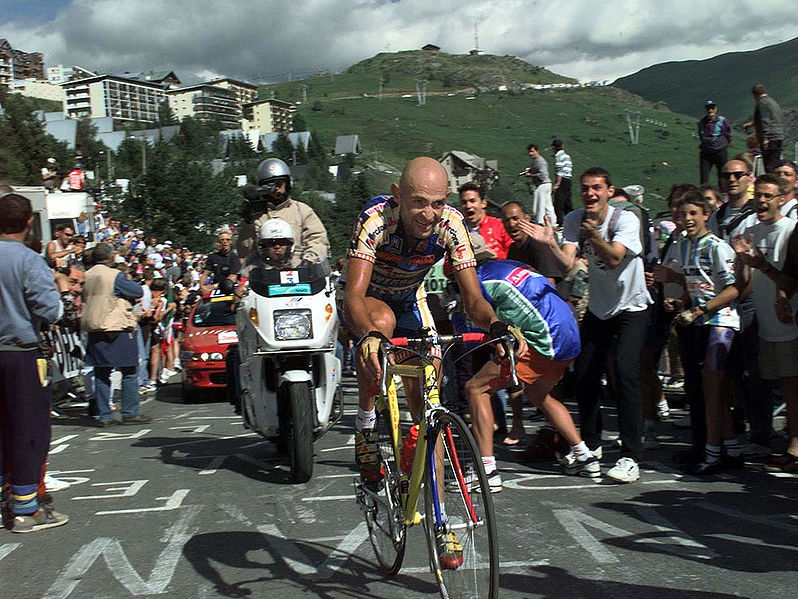
Pantani, 1970-2004, on the Alpe d'Huez
(image credit: Hein Ciere CC BY 3.0
Pantani, who was 32 when he died, was a bad boy - he failed several anti-doping tests during his career, but conveniently for him in the days before a reliable test for EPO had been developed, leaving doctors reliant on the rather shaky stop-gap haematocrit reading method (one reading of 60.1% is highly suspicious for even the most rabid of his many fans, meanwhile). However, there is plenty of evidence to suggest that even without EPO he'd have been one of the greatest climbers in the sport's history which, combined with his colourful character and appearance and a near-miraculous recovery after he collided head-on with a car in the Milano-Torino, ensured enormous popularity with the fans and with other riders.

A personality such as his meant there were arguments too, of course: the most famous being the one that flared up during the 2000 Tour de France when Lance Armstrong apparently eased off the pace to make him a gift of winning on Mont Ventoux. Ventoux has been known as the mountain that can kill since Tom Simpson met his death there in 1967, and it very nearly finished off Eddy Merckx in 1970 too - it's serious business and, as Armstrong would later be informed in no uncertain terms (according to his book Every Second Counts), "nobody makes a gift of Ventoux." Pantani felt patronised - he had ridden as strongly as Armstrong as they approached the top and would have preferred to have won it on his own merit (as he did the following day). The situation was not helped at all when Armstrong insulted the Italian by calling him Elefantino, a nickname referring to his rather prominent ears that he was known to detest.

The Galibier monument
(image credit: Italian Cycling Journal)
From 2001 onwards, Pantani seemed demoralised by the ongoing accusations that he was doping and began to show signs of depression. Comeback attempts were made at various points in the next two years, but the fire had gone. In 2003, he booked himself into a private clinic to receive treatment for alcoholism, substance addiction and nervous disorders.

Most addicts weaken and "blow out" at least once during the road to recovery, then go back to the hard task they've set for themselves - some recover, some never do. Racing cyclists are not people who do anything by halves. Pantani was no exception, and his blow out was a major one: he barricaded himself into his room and seems to have experienced some sort of drug-induced insanity before eventually succumbing to acute cocaine poisoning.

Pantani was deeply flawed, but his status as a hero is in no doubt - almost a decade after his pitiful death, he remains one of the most popular riders in the history of cycling and his name is frequently still seen among those of today's stars painted on the roads at the three Grand Tours. There is an annual race, the Memorial Marco Pantani, named after him and each year one mountain stage of the Giro d'Italia is dedicated to him. In June 2011, a monument to him was unveiled on the Col du Galibier. Another stands on the Colle della Fauniera, a pass in Piemonte that has become known as the Colle Pantani.


Albert Dejonghe who would win Paris-Roubaix in 1922, then Stage 4 at the Tour de France the following year before finishing in 5th place at the 1925 Tour and 6th in 1926, was born in Middelkerke on this day in 1894.

Giuseppe Guerini was an Italian cyclist born in Gazzaniga on this day in 1970. While he has an impressive palmares stretching right back to his days as an amateur in 1988, he will be remembered as the cyclist knocked off his bike when a German photographer jumped in front of him to get a shot not far from the Alpe d'Huez finish line of Stage 10 at the 1999 Tour de France and apparently forgot that objects seen through the viewfinder are closer than they appear, failing to get out of the way so the rider collided with them. Though he fell heavily, Guerini was unhurt and got back on his bike - and won the stage.

Other cyclists born on this day: Ray Jones (Great Britain, 1918); Michael Færk Christensen (Denmark, 1986); Anders Lund (Denmark, 1985); Dirk Baert (Belgium, 1949); Mario Escobar (Colombia, 1940); Mark Whitehead (USA, 1961, died 2011); Willy Debosscher (Belgium, 1943); Frédéric Lancien (France, 1971); Matthias Lange (Germany, 1963); Linas Balčiūnas (Lithuania, 1978); Nicolas Owona (Cameroon, 1952); Tim Veldt (Netherlands, 1984); Oleksandr Symonenko (Ukraine, 1974); José Pacheco (Portugal, 1942); Juan Martínez (Spain, 1962); Sergio Godoy (Guatemala, 1973); Friedrich Neuser (Germany, 1932); Radovan Fořt (Czechoslovakia, 1965); Thorleif Andresen (Norway, 1945).

Thursday, 14 February 2013

Daily Cycling Facts 14.02.2013

Cadel Evans
Born in this day in 1977 in Katherine, a town and important Aboriginal community in the Northern Territory of Australia, Cadel Evans spent much of his childhood living in Armidale, New South Wales where he developed a love for skateboarding and which, he says, helped to shape him as an endurance athlete due to its altitude of almost 1000m. Towards the end of his teenage years, he began mountain biking and immediately showed potential, winning silver medals at the 1997 World Championships.

Cadel Evans
(image credit: Ludovic Péron CC BY-SA 3.0)
He had also displayed notable ability on the road, including winning a bronze medal in 1995 Junior Time Trial World Championship - the beginning of a process that would lead him to manager Tony Rominger and the now-notorious Michele Ferrari and which, by 2000, saw him switch allegiances and become a full-time road racer. He turned professional with Saeco in 2001 (having been a professional with the Volvo-Cannondale MTB squad) and won his first major victor, the Tour of Austria, that same year. As might be expected of a rider as promising as him, switched teams regularly as he rose up through the ranks, riding for Mapei the next year. At Mapei, he came under the guidance of the legendary trainer Aldo Sassi; the man who helped him transform from a world-class mountain biker to a world-class road cyclist. He entered his first Grand Tour, the Giro d'Italia, with them and finished 14th overall - not bad at all in a race that most debutantes don't finish. Earlier in 2001, he'd won the King of the Mountains at the Tour Down Under, as he would again the next year.

2004 brought another Tour of Austria win, then in 2005 he entered his first Tour de France and came a remarkable 8th overall. That was improved to 4th in 2006, along with a third Tour Down Under mountains award and the Tour de Romandie, then honed down to 2nd in 2007. This was the point at which it became apparent that, somewhere in the near future, there was a Tour win with his name on it. It wan't to be 2008 or 2009, though the Points Classification at the Critérium du Dauphiné was a effective way to prove he could sprint as well as climb, and it couldn't be 2010 when Alberto Contador and Andy Schleck decided between themselves who was going to win when they were away together up in the mountains (the decision being made, in Contador's favour, with a little help from a slipped chain in Stage 15).

Then 2011 came round. Contador, whilst able to show that he's still the world's best climber, had been left reeling by an ongoing doping investigation and Bradley Wiggins, a favourite due to his earlier win at the Critérium du Dauphiné (in which Evans came 2nd) was forced out after a crash left him with a broken collar bone. That left Schleck - a rider far, far better at climbing, but nervous on a difficult descent as we saw on the slippery route into Gap from the Col de Manse when the Australian took a full minute from his rival. Schleck clawed back time with an incredible solo break on the Galibier a few days later, a ride hailed as one of the finest stage wins in years, and one perhaps intended to win him the race. But, with a superhuman effort, Evans managed to keep the advantage lower that Schleck would have liked. A win the next day on Alpe d'Huez might have sealed things in Schleck's favour, but it wasn't to be - the mountain, for some reason, seems to be one of the few that doesn't suit him. By the Stage 20 time trial, Schleck's advantage was down to 57" and while he's made heroic efforts to improve in the discipline, he'd have needed a miracle to keep it from Evans.

At the Tour of Germany, 2005
(image credit: Juergen Wohlfahrt CC BY-SA 2.5)
The rest, of course, is history. Evans rode even better than expected, finishing the stage a mere 7" behind winner Tony Martin and gave himself a 1'34" lead. Schleck would need to be content with another 2nd place overall, his disadvantage too great for the race to be won in the final stage into Paris even had he have been the sort of rider sufficiently disrespectful of tradition to attempt to take back the race. Evans had become the first Australian to win the Tour, finally completing a course of events set in motion by Don Kirkham and Ivor Munro right back in 1914. Aged 34, he was also one of the five oldest ever winners

In 2012, Evans began the Tour among the favourites - partly because of his 2011 victory, but also because an unusually flat parcours made the eventual outcome heavily reliant on the time trials. However, his poor  performances in two of the mountain stages left him unable to challenge and Bradley Wiggins, who had taken the yellow jersey in Stage 7, remained leader for the rest of the race, and he finished in seventh place overall. This would not be the season's only disappointment - after getting off to a promising start when he won a stage and the General Classification at the Critérium International and the Points competition at the Critérium du Dauphiné (in addition to third in the General Classification), he suffered a noticeable loss of form after the Tour and managed only 80th place in the Road Race at the Olympics, then cited "inadequate recovery and fatigue" as the reasons behind his decision not to compete in the Individual Time Trial. Shortly after the Games, he announced that he would be sitting out for the remainder of the season in order to concentrate on recovering his fitness for 2013.

Evans is known for his philanthropic philosophy, donating Aus$50,000 to charities, including the Amy Gillett Foundation set up in memory of the cyclist who was killed in a road accident in 2005. He is also a vocal supporter of the Free Tibet movement, saying "I don't want to see a repeat of what happened to [Australian] Aboriginal culture happen to another culture."

Gianni Bugno
Gianni Bugno, born on this day in 1964 in Brugg, Switzerland,  displayed all the signs of a cyclist who was destined to become one of the great Grand Tour riders - he began winning important races immediately his professional career began, including Stage 18 at the 1988 Tour de France and another at the Giro d'Italia a year later. Then he won the World Cup, two Tour stages, Milan-San Remo and both the overall General Classification and the Points competition at the Giro in 1990. He was World Champion in 1991 and 1992, coming 2nd and 3rd in the Tour those same years.

Unfortunately, he had one serious problem - his career coincided with that of Miguel Indurain and the wins, despite Indurain's claim that Bugno was his biggest threat - that would otherwise have been his were always just out of his reach. For the last five years of his career, he seems to have stopped trying and contented himself with stage wins (two at the Giro, two at the Vuelta a Espana) and overall victory at other races such as the Tour of Flanders, the Tour Méditerranéen and a National Championship.

Today, he is still involved in cycling. However, unlike the majority of retired cyclists who want to remain a part of the scene, he apparently still has a taste for adrenaline and now pilots the helicopter that follows the Giro to film footage for the RAI television station.

Maurice de Waele
The Belgian Tour de France winner Maurice de Waele died on this day in 1952, aged 55 years. He had come 2nd behind Nicolas Frantz in 1927 and 3rd behind Frantz and André Leducq the year before his win, and for a while it looked as though it wasn't goint to happen in 1929 either. He had been the race leader from the start to Stage 7 when two punctures caused him to lose enough time for Frantz, Leducq and Victor Fontan to move ahead of him (and, by the end of the stage, record equal elapsed times; thus leading to the only situation in the history of the Tour when three riders all wore the yellow jersey on the same day).

However, he refused to give up and rode so hard that when Fontan was forced out with a broken bike (and had attempted to continue on a replacement with the broken one strapped to his back because the rules of the day demanded a rider finish with - but not, apparently on - the bike with which he started) he had 75 seconds on Frantz and more on Leducq. Then, he suffered more punctures and lost the lead again, leaving Frantz leader on the road (ie, overall leader for a period during a stage) - but Frantz was unlucky and had punctures too, so de Waele regained the lead and won the stage. Riders were required to repair punctures themselves; having been permitted to accept help the previous year.

By Stage 10, de Waele was not feeling well and got gradually worse until he collapsed in Stage 15. His team, Alcyon, approached the organisers and requested that the next stage be started an hour later, which was granted. Then - with flagrant disregard for the rules that stated each rider, no matter what team he rode for, had to ride for himself alone - they came together and through combined effort somehow kept him upright and moving forward at a speed sufficient for him to finish the stage in 11th place, losing 13 minutes but remaining in the overall lead. Gradually, he improved over the following stages and miraculously retained the leadership all the way to the end of the final stage.

Henri Desgrange, who had instigated the "every man for himself" rule, was predictably furious; later telling journalists "My race has been won by a corpse!" As a result, he abolished trade teams and introduced national teams the following year - a rule that remained in place until 1961 when trade teams were reintroduced (though national teams would make an "experimental" reappearance in 1967 and 1968 as organisers attempted to prevent strikes, as had happened in 1966 when riders showed their displeasure at newly-introduced anti-doping tests).

Marco Pantani
Today is, as all cycling fans know, also the anniversary of the death of Marco Pantani, who was found in a Rimini hotel room after suffering heart failure and a cerebral œdema caused by cocaine poisoning.

Pantani, 1970-2004, on the Alpe d'Huez
(image credit: Hein Ciere CC BY 3.0
Pantani, who was 32 when he died, was a bad boy - he failed several anti-doping tests during his career, but conveniently for him in the days before a reliable test for EPO had been developed, leaving doctors reliant on the rather shaky stop-gap haematocrit reading method (one reading of 60.1% is highly suspicious for even the most rabid of his many fans, meanwhile). However, there is plenty of evidence to suggest that even without EPO he'd have been one of the greatest climbers in the sport's history which, combined with his colourful character and appearance and a near-miraculous recovery after he collided head-on with a car in the Milano-Torino, ensured enormous popularity with the fans and with other riders.

A personality such as his meant there were arguments too, of course: the most famous being the one that flared up during the 2000 Tour de France when Lance Armstrong apparently eased off the pace to make him a gift of winning on Mont Ventoux. Ventoux has been known as the mountain that can kill since Tom Simpson met his death there in 1967, and it very nearly finished off Eddy Merckx in 1970 too - it's serious business and, as Armstrong would later be informed in no uncertain terms (according to his book Every Second Counts), "nobody makes a gift of Ventoux." Pantani felt patronised - he had ridden as strongly as Armstrong as they approached the top and would have preferred to have won it on his own merit (as he did the following day). The situation was not helped at all when Armstrong insulted the Italian by calling him Elefantino, a nickname referring to his rather prominent ears that he was known to detest.

The Galibier monument
(image credit: Italian Cycling Journal)
From 2001 onwards, Pantani seemed demoralised by the ongoing accusations that he was doping and began to show signs of depression. Comeback attempts were made at various points in the next two years, but the fire had gone. In 2003, he booked himself into a private clinic to receive treatment for alcoholism, substance addiction and nervous disorders.

Most addicts weaken and "blow out" at least once during the road to recovery, then go back to the hard task they've set for themselves - some recover, some never do. Racing cyclists are not people who do anything by halves. Pantani was no exception, and his blow out was a major one: he barricaded himself into his room and seems to have experienced some sort of drug-induced insanity before eventually succumbing to acute cocaine poisoning.

Pantani was deeply flawed, but his status as a hero is in no doubt - almost a decade after his pitiful death, he remains one of the most popular riders in the history of cycling and his name is frequently still seen among those of today's stars painted on the roads at the three Grand Tours. There is an annual race, the Memorial Marco Pantani, named after him and each year one mountain stage of the Giro d'Italia is dedicated to him. In June 2011, a monument to him was unveiled on the Col du Galibier. Another stands on the Colle della Fauniera, a pass in Piemonte that has become known as the Colle Pantani.


Albert Dejonghe who would win Paris-Roubaix in 1922, then Stage 4 at the Tour de France the following year before finishing in 5th place at the 1925 Tour and 6th in 1926, was born in Middelkerke on this day in 1894.

Giuseppe Guerini was an Italian cyclist born in Gazzaniga on this day in 1970. While he has an impressive palmares stretching right back to his days as an amateur in 1988, he will be remembered as the cyclist knocked off his bike when a German photographer jumped in front of him to get a shot not far from the Alpe d'Huez finish line of Stage 10 at the 1999 Tour de France and apparently forgot that objects seen through the viewfinder are closer than they appear, failing to get out of the way so the rider collided with them. Though he fell heavily, Guerini was unhurt and got back on his bike - and won the stage.

Other cyclists born on this day: Ray Jones (Great Britain, 1918); Michael Færk Christensen (Denmark, 1986); Anders Lund (Denmark, 1985); Dirk Baert (Belgium, 1949); Mario Escobar (Colombia, 1940); Mark Whitehead (USA, 1961, died 2011); Willy Debosscher (Belgium, 1943); Frédéric Lancien (France, 1971); Matthias Lange (Germany, 1963); Linas Balčiūnas (Lithuania, 1978); Nicolas Owona (Cameroon, 1952); Tim Veldt (Netherlands, 1984); Oleksandr Symonenko (Ukraine, 1974); José Pacheco (Portugal, 1942); Juan Martínez (Spain, 1962); Sergio Godoy (Guatemala, 1973); Friedrich Neuser (Germany, 1932); Radovan Fořt (Czechoslovakia, 1965); Thorleif Andresen (Norway, 1945).

Tuesday, 14 February 2012

Daily Cycling Facts 14.02.12

Cadel Evans
Born in this day in 1977 in Katherine, a town and important Aboriginal community in the Northern Territory of Australia, Cadel Evans spent much of his childhood living in Armidale, New South Wales where he developed a love for skateboarding and which, he says, helped to shape him as an endurance athlete due to its altitude of almost 1000m. Towards the end of his teenage years, he began mountain biking and immediately showed potential, winning silver medals at the 1997 World Championships.

Cadel Evans
(image credit: Ludovic Péron CC BY-SA 3.0)
He had also displayed notable ability on the road, including winning a bronze medal in 1995 Junior Time Trial World Championship - the beginning of a process that would lead him to manager Tony Rominger and the now-notorious Michele Ferrari and which, by 2000, saw him switch allegiances and become a full-time road racer. He turned professional with Saeco in 2001 (having been a professional with the Volvo-Cannondale MTB squad) and won his first major victor, the Tour of Austria, that same year. As might be expected of a rider as promising as him, switched teams regularly as he rose up through the ranks, riding for Mapei the next year. At Mapei, he came under the guidance of the legendary trainer Aldo Sassi; the man who helped him transform from a world-class mountain biker to a world-class road cyclist. He entered his first Grand Tour, the Giro d'Italia, with them and finished 14th overall - not bad at all in a race that most debutantes don't finish. Earlier in 2001, he'd won the King of the Mountains at the Tour Down Under, as he would again the next year.

2004 brought another Tour of Austria win, then in 2005 he entered his first Tour de France and came a remarkable 8th overall. That was improved to 4th in 2006, along with a third Tour Down Under mountains award and the Tour de Romandie, then honed down to 2nd in 2007. This was the point at which it became apparent that, somewhere in the near future, there was a Tour win with his name on it. It wan't to be 2008 or 2009, though the Points Classification at the Critérium du Dauphiné was a effective way to prove he could sprint as well as climb, and it couldn't be 2010 when Alberto Contador and Andy Schleck decided between themselves who was going to win when they were away together up in the mountains (the decision being made, in Contador's favour, with a little help from a slipped chain in Stage 15).

Then 2011 came round. Contador, whilst able to show that he's still the world's best climber, had been left reeling by an ongoing doping investigation and Bradley Wiggins, a favourite due to his earlier win at the Critérium du Dauphiné (in which Evans came 2nd) was forced out after a crash left him with a broken collar bone. That left Schleck - a rider far, far better at climbing, but nervous on a difficult descent as we saw on the slippery route into Gap from the Col de Manse when the Australian took a full minute from his rival. Schleck clawed back time with an incredible solo break on the Galibier a few days later, a ride hailed as one of the finest stage wins in years, and one perhaps intended to win him the race. But, with a superhuman effort, Evans managed to keep the advantage lower that Schleck would have liked. A win the next day on Alpe d'Huez might have sealed things in Schleck's favour, but it wasn't to be - the mountain, for some reason, seems to be one of the few that doesn't suit him. By the Stage 20 time trial, Schleck's advantage was down to 57" and while he's made heroic efforts to improve in the discipline, he'd have needed a miracle to keep it from Evans.

At the Tour of Germany, 2005
(image credit: Juergen Wohlfahrt CC BY-SA 2.5)
The rest, of course, is history. Evans rode even better than expected, finishing the stage a mere 7" behind winner Tony Martin and gave himself a 1'34" lead. Schleck would need to be content with another 2nd place overall, his disadvantage too great for the race to be won in the final stage into Paris even had he have been the sort of rider sufficiently disrespectful of tradition to attempt to take back the race. Evans had become the first Australian to win the Tour, finally completing a course of events set in motion by Don Kirkham and Ivor Munro right back in 1914.

Evans is known for his philanthropic philosophy, donating Aus$50,000 to charities, including the Amy Gillett Foundation set up in memory of the cyclist who was killed in a road accident in 2005. He is also a vocal supporter of the Free Tibet movement, saying "I don't want to see a repeat of what happened to [Australian] Aboriginal culture happen to another culture."

Gianni Bugno
Gianni Bugno, born on this day in1964 in Brugg, Switzerland,  displayed all the signs of a cyclist who was destined to become one of the great Grand Tour riders - he began winning important races immediately his professional career began, including Stage 18 at the 1988 Tour de France and another at the Giro d'Italia a year later. Then he won the World Cup, two Tour stages, Milan-San Remo and both the overall General Classification and the Points competition at the Giro in 1990. He was World Champion in 1991 and 1992, coming 2nd and 3rd in the Tour those same years.

Unfortunately, he had one serious problem - his career coincided with that of Miguel Indurain and the wins, despite Indurain's claim that Bugno was his biggest threat - that would otherwise have been his were always just out of his reach. For the last five years of his career, he seems to have stopped trying and contented himself with stage wins (two at the Giro, two at the Vuelta a Espana) and overall victory at other races such as the Tour of Flanders, the Tour Méditerranéen and a National Championship.

Today, he is still involved in cycling. However, unlike the majority of retired cyclists who want to remain a part of the scene, he apparently still has a taste for adrenaline and now pilots the helicopter that follows the Giro and provides footage for the RAI television station.

Maurice de Waele
The Belgian Tour de France winner Maurice de Waele died on this day in 1952, aged 55 years. He had come 2nd behind Nicolas Frantz in 1927 and 3rd behind Frantz and André Leducq the year before his win, and for a while it looked as though it wasn't goint to happen in 1929 either. He had been the race leader from the start to Stage 7 when two punctures caused him to lose enough time for Frantz, Leducq and Victor Fontan to move ahead of him (and, by the end of the stage, record equal elapsed times; thus leading to the only situation in the history of the Tour when three riders all wore the yellow jersey on the same day).

However, he refused to give up and rode so hard that when Fontan was forced out with a broken bike (and had attempted to continue on a replacement with the broken one strapped to his back because the rules of the day demanded a rider finish with - but not, apparently on - the bike with which he started) he had 75 seconds on Frantz and more on Leducq. Then, he suffered more punctures and lost the lead again, leaving Frantz leader on the road (ie, overall leader for a period during a stage) - but Frantz was unlucky and had punctures too, so de Waele regained the lead and won the stage. Riders were required to repair punctures themselves; having been permitted to accept help the previous year.

By Stage 10, de Waele was not feeling well and got gradually worse until he collapsed in Stage 15. His team, Alcyon, approached the organisers and requested that the next stage be started an hour later, which was granted. Then - with flagrant disregard for the rules that stated each rider, no matter what team he rode for, had to ride for himself alone - they came together and through combined effort somehow kept him upright and moving forward at a speed sufficient for him to finish the stage in 11th place, losing 13 minutes. Gradually, he improved over the following stages and miraculously retained the leadership all the way to the end of the final stage.

Henri Desgrange, who had instigated the "every man for himself" rule, was predictably furious; later telling journalists that his race had "been won by a corpse." As a result, he abolished trade teams and introduced national teams the following year - a rule that remained in place until 1961 when trade teams were reintroduced (though national teams would make an "experimental" reappearance in 1967 and 1968 as organisers attempted to prevent strikes, a had happened in 1966 when riders showed their displeasure at newly-introduced anti-doping tests).

Marco Pantani
Today is, as all cycling fans know, also the anniversary of the death of Marco Pantani, who was found in a Rimini hotel room after suffering heart failure and a cerebral œdema caused by cocaine poisoning.

Pantani, 1970-2004, on the Alpe d'Huez
(image credit: Hein Ciere CC BY 3.0
Pantani, who was 32 when he died, was a bad boy - he failed several anti-doping tests during his career, but conveniently for him in the days before a reliable test for EPO had been developed, leaving doctors reliant on the rather shaky stop-gap haematocrit reading method (one reading of 60.1% is highly suspicious for even the most rabid of his many fans, meanwhile). However, there is plenty of evidence to suggest that even without EPO he'd have been one of the greatest climbers in the sport's history which, combined with his colourful character and appearance and a near-miraculous recovery after he collided head-on with a car in the Milano-Torino, ensured enormous popularity with the fans and with other riders.

A personality such as his meant there were arguments too, of course: the most famous being the one that flared up during the 2000 Tour de France when Lance Armstrong apparently eased off the pace to make him a gift of winning on Mont Ventoux. Ventoux has been known as the mountain that can kill since Tom Simpson met his death there in 1967, and it very nearly finished off Eddy Merckx in 1970 too - it's serious business and, as Armstrong would later be informed in no uncertain terms (according to his book Every Second Counts), "nobody makes a gift of Ventoux." Pantani felt patronised - he had ridden as strongly as Armstrong as they approached the top and would have preferred to have won it on his own merit (as he did the following day). The situation was not helped at all when Armstrong insulted the Italian by calling him Elefantino, a nickname referring to his rather prominent ears that he was known to detest.

The Galibier monument
(image credit: Italian Cycling Journal)
From 2001 onwards, Pantani seemed demoralised by the ongoing accusations that he was doping and began to show signs of depression. Comeback attempts were made at various points in the next two years, but the fire had gone. In 2003, he booked himself into a private clinic to receive treatment for alcoholism, substance addiction and nervous disorders.

Most addicts weaken and "blow out" at least once during the road to recovery, then go back to the hard task they've set for themselves. Some recover, some never do. Sadly, Pantani was not a man who did things by halves, and his blow out was a major one. There is an annual race, the Memorial Marco Pantani, named after him and each year one mountain stage of the Giro d'Italia is dedicated to him. In June 2011, a monument to him was unveiled on the Col du Galibier. Another stands on the Colle della Fauniera, a pass in Piemonte that has become known as the Colle Pantani.


Albert Dejonghe who would win Paris-Roubaix in 1922, then Stage 4 at the Tour de France the following year before finishing in 5th place at the 1925 Tour and 6th in 1926, was born in Middelkerke on this day in 1894.

Giuseppe Guerini was an Italian cyclist born in Gazzaniga on this day in 1970. While he has an impressive palmares stretching right back to his days as an amateur in 1988, he will be remembered as the cyclist knocked off his bike when a German photographer jumped in front of him to get a shot not far from the Alpe d'Huez finish line of Stage 10 at the 1999 Tour de France and apparently forgot that objects seen through the viewfinder are closer than they appear, failing to get out of the way so the rider collided with them. Though he fell heavily, Guerini was unhurt and got back on his bike - and won the stage.

Other births: Ray Jones (Great Britain, 1918); Michael Færk Christensen (Denmark, 1986); Anders Lund (Denmark, 1985); Dirk Baert (Belgium, 1949); Mario Escobar (Colombia, 1940); Mark Whitehead (USA, 1961, died 2011); Willy Debosscher (Belgium, 1943); Frédéric Lancien (France, 1971); Matthias Lange (Germany, 1963); Linas Balčiūnas (Lithuania, 1978); Nicolas Owona (Cameroon, 1952); Tim Veldt (Netherlands, 1984); Oleksandr Symonenko (Ukraine, 1974); José Pacheco (Portugal, 1942); Juan Martínez (Spain, 1962); Sergio Godoy (Guatemala, 1973); Friedrich Neuser (Germany, 1932); Radovan Fořt (Czechoslovakia, 1965); Thorleif Andresen (Norway, 1945).

Sunday, 16 October 2011

Cadel donates Maillot Jaune to cyclist's chapel

The high mountain passes of Italy are dotted with numerous chapels dedicated to Catholic saints. Some are small, rustic and almost forgotten; others are grand affairs visited and financially supported by many.

Moser's 1984 record-beating bike (public domain image)
None are as famous among cyclists as that 754m up on the Colle del Ghisallo where legend has it a travelling count was attacked by bandits in medieval times. Whilst fleeing, he passed a tiny shrine where he saw an apparition of the Virgin Mary and being a good Catholic, he ran to it knowing that he would find protection. Sure enough, the bandits couldn't find him and he was saved - to show his gratitude, he vowed to build a church on the spot (45°55'25.01"N 9°16'2.78"E).

In time, Madonna del Ghisallo became the patron saint of all travellers passing through the area. Later, she became the patron of a specific type of traveller, cyclists, when the pass became a regular feature of the Giro d'Italia and especially the Giro di Lombardia; and she was officially declared such by papal decree in 1948 when a votive flame was carried all the way from Rome, for the final stretch by Italian heroes Coppi and Bertali.

Cadel in yellow, 2011
(© HTO3 CC BY-ND 2.0)
Famous cyclists - at first Italians, but soon others too - began to donate mementos of their successes to the little church. Among a collection that grew so large that much of it is now housed in a purpose-built museum next door are Grand Tour-winning bikes owned by Coppi, Bartali and Eddy Merckx and the bike upon which Francisco Moser smashed the Hour Record (distance ridden in one hour) in 1984, its curving silver lines and strange lenticular wheels still looking futuristic nearly three decades later. The most poignant is the smashed, twisted remains of the bike upon which local lad Fabio Casartelli met a premature and terrible end on the Col de Portet-Aspet during Stage 15 of the 1995 Tour de France.

While this year's Tour winner Cadel Evans is neither a religious man nor prey to the sometimes peculiar superstitions that many riders insist they must observe in order to avoid injury, death or - worst of all - bad form; he, like all cyclists, is keen to observe the traditions and customs of the sport, honouring the memory of those who came before him and those who have fallen. So, in the area as part of il Lombardia on Saturday the 15th of October, he took the opportunity to make a pilgrimage and added one of the yellow jerseys he won in this year's Tour to his rainbow jersey from 2009. During a service conducted by local priest Father Farina, the jersey was blessed and then left before a holy mural of the saint, ready to be placed within a protective frame and added to the vast collection of cycling relics within the building.

Saturday, 23 July 2011

Tour de France: Stage 20 Debrief - Aussie Rules!

Could the 24th of July soon be known
as Cadel Evans Day?
It's fair to say that most of us expected Cadel Evans to beat Andy Schleck today simply because he's so much the better rider in individual time trials, but since Andy's got so much better recently we expected a close result.

How wrong we were. Cadel thrashed the competition, recording an excellent time while Andy was rather lack-lustre. The Luxembourger ends the stage 1'34" behind the Australian who will now be wearing the yellow jersey as he rides into Paris tomorrow and, barring the unthinkable and punctures, will be this year's overall General Classification winner. He certainly earned it today, as anyone who saw him crying with joy as his BMC comrades hugged him will attest.

Australians have been a part of the Tour since 1914, when Don Kirkham and Ivan Munro entered and came 17th and 20th, and Australian Phil Anderson was the first non-European to wear the yellow jersey during Stage 8 in 1981; but Cadel will be their first overall General Classification winner. Aussie fans have organised petitions demanding that, if he does win, the Government declares the day a national pubic holiday in future. Any nation that takes a Tour de France win that seriously surely deserves one!

In the end, he took just 55'40" to get round the 42.5km course, a mere seven seconds behind the fastest time set all day and enough for 2nd place, after putting down the power all the way. When it comes to technique, the graceful Andy is always the better rider but this was all about strength; and Cadel's a much harder man than skinny Luxembourger, who ended up 17th - however, the younger of the Schleck brothers says on Twitter he's now going to eat twenty cheeseburgers, so who knows what'll happen next time?

It was no surprise that Fabian Cancellara set the first impressive time, setting the bar at an impressive 57'16", despite the wet roads earlier on in Grenoble. Not so long ago, once the Swiss champion set a time you could pretty much assume bettering it to be a physical impossibility but his best days have now gone and the roads dried up, so it didn't come as a shock when first Richie Porte lopped off 12" and then Thomas de Gendt took another couple of seconds off Porte's time. However, one thing that did come out of the blue was the stunning 56'39" time recorded by Alberto Contador; enough to place him in third place despite a wobbly start when his foot came free of the pedal. Poor Philippe Gilbert went one further - whilst standing up on the pedals, his chain came off and that, as all male cyclists are aware, leads inevitably to cajoneitis.

Tony Martin, who came first on this exact parcours when it was used in the Critérium du Dauphiné earlier this year, also left nobody speechless with his time of 55'33" which would have been stunning for anyone except him - with Martin being as good as he is, times so far in advance of the rest are only to be expected.

Best Brit, Scotsman David Millar.
The best British rider was David Millar in 32nd place with +3'41" - a much slower time than was expected, but it's since been revealed he's suffering from bronchitis. Next was Welshman Geraint Thomas in 46th with +4'24", then Ben Swift in 130th with +7'14" and Mark Cavendish in 156th with +8'35". The best rider from Team Sky was Norwegian Edvald Boasson Hagen, 12th place with +2'10". People's Champion Thomas Voeckler took a good 13th place with +2'14", putting him in 14th place overall.
"I am proud of my of my team and my fans - thanks for all the support - and even more proud to stand with my soulmate@schleckfrank on the podium." (@andy_schleck, Twitter)
"Congrats to Cadel to you deserve that! Happy for you and your team BMC! It's been a great battle, looking forward to next year already!!!" (@andy_schleck, Twitter)
"Congrats to Cadel Evans - the best won."@andy_schleck and me are proud to be on the podium. thx to @leopardtrek." (@schleckfrank, Twitter)
Not far now, lads!
Stage 20 Results:

1. MARTIN Tony 55' 33"  
2. EVANS Cadel + 00' 07"
3. CONTADOR Alberto + 01' 06"
4. DE GENDT Thomas + 01' 29"
5. PORTE Richie + 01' 30"
6. PERAUD Jean-Christophe + 01' 33"
7. SANCHEZ Samuel + 01' 37"
8. CANCELLARA Fabian + 01' 42"
9. VELITS Peter + 02' 03"
10. TAARAMAE Rein + 02' 03"


Overall General Classification results following Stage 10:

1. EVANS Cadel 83h 45' 20"  
2. SCHLECK Andy + 01' 34"
3. SCHLECK Frank + 02' 30"
4. VOECKLER Thomas + 03' 20"
5. CONTADOR Alberto + 03' 57"
6. SANCHEZ Samuel + 04' 55"
7. CUNEGO Damiano + 06' 05"
8. BASSO Ivan + 07' 23"
9. DANIELSON Tom + 08' 15"
10. PERAUD Jean-Christophe + 10' 11"


Points: Mark Cavendish; Climbing: Sammy Sanchez; Youth: Pierre Rolland; Team: Garmin-Cervelo; Combativity: Not yet available.


British riders in the Overall General Classification following Stage 20:

31. THOMAS Geraint + 1h 00' 48"
76. MILLAR David + 2h 14' 21"
130. CAVENDISH Mark + 3h 15' 05"
137. SWIFT Ben + 3h 18' 07"

Friday, 22 July 2011

Tour de France: Stage 19 Debrief - not the Queen stage, but it ruled

"A squalid, manic and sometimes lethal shambles, and that's just the way they like it. It's the Glastonbury Festival for cycling fans." (Tim Moore, author of French Revolutions)
It couldn't be Bradley and it wouldn't be Andy, so that left us cheering for our third hope today - any Frenchman. We're not French but, well, it's their game, isn't it? Pierre Rolland's incredible victory today was a lot more than just a stage win - not that there's any such thing as "just" a stage win, especially when the stage contains the Cols du Telegraphe and Galibier and the Alpe d'Huez - it was a chance for the country that elevated cycling from a sport to a religion to have a much-deserved taste of glory.
Vive la France! Vive le Tour! Vive le velo!
The People's Hero Thomas Voeckler rode well, driving himself onward despite obviously being in a great deal of pain and even managed to outgrow a little temper tantrum that saw him take a bidon from the Europcar team car and then smash it to the ground. He's done a superb job in this Tour and has been a more-than-worthy rider to wear the yellow jersey for nine days, but he knew as well as the rest of us that he owes a lot of thanks to Lady Luck and can't be at all surprised that he now has to give it up to Andy Schleck.
"I have never been so close to winning the Tour in my life. It’s a dream I have had since I was a little boy. I’m incredibly happy." (Andy Schleck)
Andy rode well, marking Contador and Cadel all the way; although he couldn't take the stage, his excellent time combined with yesterday's win was sufficient to give him a 53" lead in the overall General Classification. However, nothing is set in stone and no clear winner has emerged yet, so whether or not he can keep the yellow jersey depends on the individual time trial tomorrow - not Andy's forte, though he's improved massively in the last two years. The trouble is, Cadel Evans isn't bad in TTs at all - in fact, he's far and away the best among the new top ten GC riders.
"As a sprinter it's not a nice sight to see Alberto Contador attack at the bottom of the first of 3 massive climbs!" (@mattgoss1986, Twitter)
Professional cycling needs riders like
Alberto Contador.
Contador earned the Combativity award, having attacked from the 15th kilometre. Let's just hope it's not also a retirement present, because he really livened up the race: he told reporters after the stage that he mounted the final attacks on the slopes of Alpe d'Huez "for amusement" - professional cycling would be poorer place without his presence! The three-time Tour champion is now 3'55" behind in the overall General Classification, almost certainly too large a gap to be in with a chance of winning the Tour, but he'll have won himself a few new fans with his efficient and dissuasive response when an aggressive spectator dressed as a doctor complete with surgical mask - presumably trying to make some half-formed point about doping - gave chase whilst screaming in his face: without even missing a pedal stroke, Bertie delivered a short sharp punch in the face. Good man.
"What an amazing experience that climb truly is legendary." (Ben Swift @swiftybswift, Twitter)
Mark Cavendish was lucky once again to avoid disqualification when he missed the stage elimination time Fortunately for him, he crossed the line with a pack of riders numerous enough to invoke the 20% rule which states that if more than 20% of the starters are outside of the maximum allotted time, the judges can extend it so as to avoid cutting down the number of riders on the following stage to a point where competition would be reduced. He was also fortunate in that closest rival Jose Joaquin Rojas was in the same group as him, so they both lost 20 points - had Rojas have made the cut, he'd now be wearing the green jersey. Meanwhile, Tejay van Garderen questions the wisdom of having such short cut-off times, making the very good point that they encourage some riders to descend at dangerous speeds in excess of their ability: "Having such a short time cut makes riders take more risks on the descents. RIP Wouter."


Stage 19 Results:

1. ROLLAND Pierre 3h 13' 25"  
2. SANCHEZ Samuel + 00' 14"
3. CONTADOR Alberto + 00' 23"
4. VELITS Peter + 00' 57"
5. EVANS Cadel + 00' 57"
6. DE GENDT Thomas + 00' 57"
7. CUNEGO Damiano + 00' 57"
8. SCHLECK Frank + 00' 57"
9. SCHLECK Andy + 00' 57"
10. HESJEDAL Ryder + 01' 15"


Overall Results following Stage 19:

1. SCHLECK Andy 82h 48' 43"  
2. SCHLECK Frank + 00' 53"
3. EVANS Cadel + 00' 57"
4. VOECKLER Thomas + 02' 10"
5. CUNEGO Damiano + 03' 31"
6. CONTADOR Alberto + 03' 55"
7. SANCHEZ Samuel + 04' 22"
8. BASSO Ivan + 04' 40"
9. DANIELSON Tom + 07' 11"
10. ROLLAND Pierre + 08' 57"


Points: Mark Cavendish (280); Mountains: Sammy Sanchez (108); Youth: Pierre Rolland; Team: Garmin-Cervelo; Combativity: Alberto Contador.