Showing posts with label 1997. Show all posts

Saturday, 5 July 2014

Daily Cycling Facts 05.07.2014

The Tour de France began on this day in 1909, 1938, 1956, 1997, 2003 and 2008.

1909
The Tour, 1909
14 stages, 4,498km.
In 1908, Desgrange decided that all riders should race on identical bikes supplied by the Tour in an attempt to make the race a contest of skill and athleticism, rather than one that might be won by superior equipment. This had not been judged a success and was dropped in 1909 - firstly due to the expense of providing the bikes and secondly because trade teams became official: in the past, while riders did ride with teams, teams were not recognised by the race. Now the teams were official, though riders were still considered to be individuals and were expected to race as such rather than in support of a team leader. This meant the companies that ran them would put more money into the Tour - and in return, they obviously wanted to show off their bikes to the public. However, each rider was still required to complete the race using one bike only, which could only be replaced if a course official declared it irreparably damaged; at the start line each bike was given a stamped lead seal and officials checked them carefully at the start lines, finish lines and checkpoints (where, for the first time, toilets were installed - Desgrange was embarrassed that riders urinated in front of spectators, despite the fact that spectators appear to have always found this a source of great amusement and will still gather around locations thought likely to become "nature break" stops to this day). The winner was selected according to points, as had been the case since 1905; after Stage 8, by which time 79 riders had abandoned (mostly due to the awful weather), the points amassed by those riders were redistributed among the riders still in the race according to the position in which they'd have finished each stage had the race only included them at the start. This was repeated after the eleventh stage.
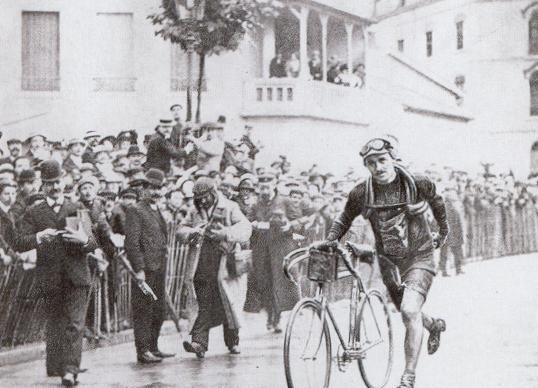
Faber runs with his broken bike to win Stage 4
A record 150 riders started the race; only 38 of them rode for the teams, the remainder being unsponsored correurs isolés ("isolated riders") who paid their own way. The Tour had been developing into an international event ever since the first edition, but with so many riders there were more foreigners than ever before: the French were still in the majority but there were many Belgians (5), Swiss (5)  and Italians (19) and two riders from elsewhere. Cyrille van Hauwaert won Stage 1 and became the first Belgian stage winner and the first foreigner to lead the race in Tour history, then François Faber (having become the first Luxembourger to win a stage the previous year and only the second foreigner, Faber was tipped to win by Lucien Petit-Breton) won the next when be beat Octave Lapize by 33'. Faber, at 1.88m and 88kg, was enormous by the standards of the day, hence his nickname The Giant of Colombes; he used the strength he'd built up in his work as a docker to ride solo for 200km the next day through deep snow and won again, this time beating Gustave Garrigou by 33'. On Stage 4 his chain broke with a kilometres to go, so he ran the rest of the way with his bike beside him and won that one by 10'. During Stage 5 he was first blown right of the road by a powerful crosswind and then kicked off his bike by a horse, in both cases he was able to continue and ended up beating Garrigou into second place again, this time by 5'.

Faber now had a thirteen point advantage over Garrigou and became the Tour's first superstar: in the past, French fans supported French riders, Belgian fans supported Belgian riders and so on, but Faber transcended that - 20,000 people, French, Belgian, Luxembourger and others, turned out to see him finish Stage 6 and when he won that one too they were ecstatic and his five consecutive stage wins remains a record more than a century later. Tour organisers became worried, however, that if Faber continued to dominate the race so completely, the other riders would give up all hope of winning and race despondently for second and third; so they asked him if he'd take things easy for a while: he'd either tired himself out, realised that the race was already as good as his or agreed, because Stage 7 was won by Ernest Paul - who just happened to be his half-brother. Jean Alavoine won Stage 9 (Faber had a rest and came tenth, his worst performance in the race), then Constant Ménager took the only Tour stage win of his career. Louis Trousselier, Garrigou and Paul Duboc won the following three, but they were all still too far behind Faber overall for a single stage win to make any difference. Finally, Alavoine won Stage 14 in notable circumstances - his bike became sufficiently damaged to be unridable 10km to go and, realising that locating an official and going through the formalities of being permitted a new one was going to lose significant time, he shouldered it like a cyclo cross rider and ran to the finish line where he won the stage by 6'30".

François Faber
Faber had moved to Alcyon from Peugeot at the end of 1908 and was now instrumental in the team's domination of the race, but his team mates had also ridden remarkably well: three places in the top ten went to isolés, including Ernest Paul in sixth, while Le Globe's Ménager was seventh. All the other places were taken by Alcyon. Being tall and well-built with his big moustache, Faber looked older than he was - few realise therefore that, at 22 years and seven months old, he's the third youngest man to have won a Tour a well as the first foreigner. He was only 28 when he climbed out of a trench and went into no man's land to rescue an injured comrade on the 9th of May in 1915, and was shot in the back and killed as he carried the man back. That very morning he'd received a message from his wife, informing him that she had given birth to a healthy baby girl.

Top Ten Final General Classification
1 François Faber (LUX) Alcyon 37
2 Gustave Garrigou (FRA) Alcyon 57
3 Jean Alavoine (FRA) Alcyon 66
4 Paul Duboc (FRA) Alcyon 70
5 Cyrille van Hauwaert (BEL) Alcyon 92
6 Ernest Paul (FRA) 95
7 Constant Ménager (FRA) Le Globe 102
8 Louis Trousselier (FRA) Alcyon 114
9 Eugène Christophe (FRA) 139
10 Aldo Bettini (ITA) 142


1938
The Tour, 1938
21 stages (Stages 6 and 17 split into parts A and B; Stages 4, 10 and 20 split into parts A, B and C), 4,694km.
Unsponsored individual riders were barred from entry for the first time - as professionalism among the sponsored riders and teams increased, they had largely ceased to be competitive some time earlier. The time bonus system was extensively overhauled in an attempt to prevent any rider who won two or three stages with a large lead from gaining an unfair advantage over one who rode consistently; now winning a stage earned 1' or a maximum of 1'15" if his lead over the second place rider was judged sufficient. Since climbers were thought to suffer less on plain stages than sprinters did in the mountains, the winner of a mountain stage was limited to one minute. Team time trials had fallen out of favour and were abandoned, not reappearing in the race until 1954, and the Col d'Iseran - a mountain that has played host to so many of the most glorious moments in the history of the Tour, was included for the first time. The Belgian and French teams (there were in fact three French teams - the national team, the Bleuets made up of riders who for various reasons couldn't be included in the national team and the Cadets, a team of young riders) were considered to be the strongest. The Italians were thought less so, but they had Gino Bartali who, having come very close to victory in 1937, was a favourite for overall victory.

The first seven stages were unremarkable, save for the unwelcome sight of Willi Oberbeck winning Stage 1 in a jersey emblazoned with the swastika of Nazi Germany. Then on Stage 8, when the race reached the Pyrenees, Bartali attacked and nobody could follow him (Georges Speicher tried to do so by hanging onto a car, but was seen by officials and disqualified) - he was the first man over the Aubisque, Tourmalet and Aspin, but then disaster struck when his rear wheel crumpled. The Belgians Félicien Vervaecke and Ward Vissers passed him and went on to take first and second place, Bartali managed to take third place 55" behind them. After the stage, Vervaecke led the General Classification with Bartali second at +2'18", but with time bonuses the next day the gap was reduced to 57".

Gino Bartali
On Stage 14, Bartali attacked again - and for a second time nobody could stop him being the first over Allos, Vars and Izoard. This time his bike didn't let him down and he finished the stage with a overall advantage of 17'45" over the Luxembourgian Matt Clemens and 21'30" over Vervaecke. he lost some time in the Stage 20b time trial, but from that point onwards his victory was never in any doubt; his final advantage was 18'27". André Leducq (winner in 1930 and 1932) and Antonin Magne (winner in 1931 and 1934) mounted a successful two-man escape in the final stage and crossed the line together, being declared joint stage winner. For Leducq, it was a record 25th stage win, since bettered by only Eddy Merckx (34) and Bernard Hinault(28) (and, since Mark Cavendish has 21 and shows no signs of slowing down at the time of writing, probably him too before long). Neither man would ever ride the Tour again.

Top Ten Final General Classification
1 Gino Bartali (ITA) Italy 148h 29' 12"
2 Félicien Vervaecke (BEL) Belgium +18' 27"
3 Victor Cosson (FRA) France +29' 26"
4 Ward Vissers (BEL) Belgium +35' 08"
5 Matt Clemens (LUX) Luxembourg +42' 08"
6 Mario Vicini (ITA) Italy +44' 59"
7 Jules Lowie (BEL) Belgium +48' 56"
8 Antonin Magne (FRA) France +49' 00"
9 Marcel Kint (BEL) Belgium +59' 49"
10 Dante Gianello (FRA) Bleuets +1h 06' 47


1956
22 stages (Stage 4 split into parts A and B), 4,498km.
The French government ordered the Tour to take secondary roads as much as possible so as to avoid major road closures, but the Tour and caravan was now so large that it frequently became stuck on the narrow routes and caused far more disruption than it would have done had the organisers have been permitted to take it on roads of their own choosing. A rule change allowed punctures to be remedied by changing the wheel, previously the rider had to stop and repair it. For the second time in Tour history, no previous winner started the race - this had last happened in 1927 (1903 isn't counted on account of being the first Tour). Based on form, Charly Gaul therefore became favourite.
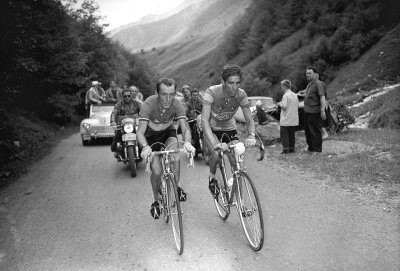
Enough climbing talent to make a thousand mortal grimpeurs:
Gaul and Bahamontes
Gaul, who was almost as good against the clock as he was in the mountains, won the Stage 4a but remained 15'04" behind overall; however, he was expected to make up time in the mountains provided the weather was on his side - he hated hot conditions, but when it was cool nobody in the world could follow him. Unforunately, the Pyrenees tended to be too hot for him and he lost time; when the race arrived at the Alps it was looking as though he was going to run out of time - even Stage 17, the second day in the Alps when he was the first man over Sestrieres, didn't win back enough time to make much of a difference. Stage 18 was a different matter entirely: Federico Bahamontes (the only climber to ever rival Gaul) was fastest up Mont Cenis and his less-famous countryman René Marigil fastest on Croix de Fer, then Gaul launched one of the blistering attacks that in the future would win him a Tour. Having simply ridden away from the peloton, he won the stage with 3'22" on Stan Ockers and 7'29" on Gastone Nencini and Bahamontes - who was so angry at his inability to respond that he picked up his bike and threw it into a gulley (his team mates managed to get it back out and persuaded him to continue). It had been a superb stage win, but it was still too late for Gaul to take the General Classification. The King of the Mountains, meanwhile, was his.

Every once in a while, the Tour turns up a completely unexpected winner. Roger Walkowiak, who had only been given opportunity to ride at the very last moment after Gilbert Bauvin was transferred from Nord-Est-Centre to the national team, found himself in the maillot jaune after Stage 7 when he got away in an escape group (for the second time in the race) that won the stage by 18'46", but at such an early point he neither expected nor intended to keep it - team manager Sauveur Ducazeaux told him he'd be far better off losing it and seeing what happened later, because defending it would likely prove too much effort. He lost time over the coming stages, giving up the jersey in Stage 10 and few people thought he'd get it back again. However, in Stage 15 the entire Belgian became ill - an incident they blamed on food poisoning from bad fish served in a hotel the night before but which is commonly supposed (and very possibly was) caused by an unknown drug administered to them; a serious setback for the French team's strongest rivals. In Stage 17 he got away in another successful break, though this time the maillot jaune went to Wouter Wagtmans; but when Walkowiak managed to keep up with Bahamontes as Gaul was winning Stage 18 it passed back to him. Bahamontes was now probably the only rider capable of challenging him, but with only one mountain stage left his chance never came - an almost unknown rider, dismissed as an also-ran before the race even got under way, had won. He was the second rider to win a Tour without a stage win on the way to victory, the last man to do so being Firmin Lambot in 1922, and the only Tour winner to have won a single Tour stage at any point during his career.

Roger Walkowiak
Neither the press nor public were impressed; they'd wanted the young Jacques Anquetil (who had decided not to take part anyway) to win - Jacques Goddet said that the applause as he crossed the last finish line sounded more like a lamentation than a celebration. It wasn't long before the first accusations that he was an undeserving winner, a victor through luck rather than skill and effort (the term "à la Walko," to succeed in that way, became popular for a while), began to appear and he was badly hurt by them.  He rode again the next year but his spirit was broken and he rapidly dropped the bottom of the General Classification, despite a stage win at that year's Vuelta a Espana proving that he was fully capable of winning a stage in his own right; gradually, depressed, he faded away. In retirement he opened a bar in his hometown, but even local cycling fans told him he shouldn't have won and before long he gave that up too, preferring the anonymity of a job at a car factory, where he had worked before becoming a professional cyclist.

Goddet had a totally different opinion. Walowiak, he said, was his all-time favourite winner and the very archetype of what an all-rounder should be and had won the maillot jaune with his legs before keeping it with his head. Later, Bernard Hinault would also defend him - "There are people who say that Walkowiak should not have won the Tour. They should have been on that Tour! He took the jersey, he lost it and he regained it. He was not a thief. The Tour is not a gift," he insisted. Walkowiak is 85 at the time of writing. In time, the cycling world finally came to understand that Goddet and Hinault were correct and, after so many years of shameful treatment that left him preferring to pretend his great achievement had never happened he's now happy to talk about it.

Top Ten Final General Classification
1 Roger Walkowiak (FRA) North East-Center 124h 01'16"
2 Gilbert Bauvin (FRA) France +1'25"
3 Jan Adriaensens (BEL) Belgium +3'44"
4 Federico Bahamontes (ESP) Spain +10'14"
5 Nino Defilippis (ITA) Italy +10'25"
6 Wout Wagtmans (NED) Netherlands +10'59"
7 Nello Lauredi (FRA) South East France +14'01"
8 Stan Ockers (BEL) Belgium +16'52"
9 René Privat (FRA) France +22'59"
10 Antonio Barbosa (POR) Luxembourg/Mixed +26'03"


1997
Ullrich and Udo Bolts, 1997
21 stages + prologue, 3,943.8km.
Jan Ullrich's final advantage of 9'09" becomes the biggest gap between first and second place since Laurent Fignon beat Bernard Hinault by 10'32" in 1984. Ullrich also wins the Youth category, becoming the first rider to have won it and the General Classification in a single edition.

Top Ten Final General Classification
1 Jan Ullrich (GER) Telekom 100h 30' 35"
2 Richard Virenque (FRA) Festina +9' 09"
3 Marco Pantani (ITA) Mercatone Uno +14' 03"
4 Abraham Olano (ESP) Banesto +15' 55"
5 Fernando Escartín (ESP) Kelme +20' 32"
6 Francesco Casagrande (ITA) Saeco +22' 47"
7 Bjarne Riis (DEN) Telekom +26' 34"
8 José Maria Jimenez (ESP) Banesto +31' 17"
9 Laurent Dufaux (SUI) Festina +31' 55"
10 Roberto Conti (ITA) Mercatone Uno +32' 26"


2003
Armstrong in the maillot jaune after Stage 8, 2003
20 stages + prologue, 3,427.5km.
Unusually for a modern Tour, the 2003 edition started and ended in Paris - to mark the race's first century, celebrations also inspiring the organisers to keep the race entirely in France, as had been the case with early editions. The race was expected to be - and was - one of the most hotly-contested in many years and numerous favourites attempted to prevent Lance Armstrong from matching the five-victory record shared by Jacques Anquetil, Eddy Merckx, Bernard Hinault and Miguel Indurain; yet statistics show - and he confesses - that his preformance in this edition was the worst of his seven wins. The Tour was awarded the Prince of Asturias Award, a prize given to events and organisations that "contribute to encouraging and promoting scientific, cultural and humanistic values that form part of mankind's universal heritage."

In 2003, there was an incident that is likely to remain unique - as fans watched the tail end of the peloton go by on Galibier, they were asked to move a little further along the road. Then, without warning, a man on a mountain bike hurtled down towards the road from higher up the slope, launched into the air from a small rocky ledge and jumped clear across the riders, landing (and crashing) on the rock-strewn terrain on the other side. His name was Dave Watson, a professional freerider with the Kona Clump team; after being given a check-over by paramedics, police decided that his assistants (from a French mountain bike magazine) hadn't endangered any member of the public other than Dave himself, he was allowed to go on his way.

Lance Armstrong, who won this edition and six others, would be stripped of all his Tour victories in 2012 following an investigation into doping.


Top Ten Final General Classification
1 Lance Armstrong (USA) US Postal Service 83h 41' 12" (disqualified)
2 Jan Ullrich (GER) Bianchi +1' 01"
3 Alexandre Vinokourov (KAZ) Telekom +4' 14"
4 Tyler Hamilton (USA) Team CSC +6' 17"
5 Haimar Zubeldia (ESP) Euskaltel +6' 51"
6 Iban Mayo (ESP) Euskaltel +7' 06"
7 Ivan Basso (ITA) Fassa Bortolo +10' 12"
8 Christophe Moreau (FRA) Crédit Agricole +12' 28"
9 Carlos Sastre (ESP) Team CSC +18' 49"
10 Francisco Mancebo (ESP) iBanesto.com +19' 15"


2008
Sastre in yellow, 2008
21 stages, 3,559km.
The bonification system - which awarded time bonuses to the winners of intermediate sprints and stages - was abandoned. A feud between the ASO and the UCI finally boiled over when the ASO announced that it wasn't inviting Astana to the race due to the team's involvement in Operacion Puerto, despite a UCI rule stating that all ProTour teams were to be invited to the Grand Tours; the ASO got its way. The race remained almost entirely in France, dipping briefly into Italy at the end of Stage 15 and the start of Stage 16. Mark Cavendish won his first four Tour stages but didn't place in the top ten on points, Bernard Kohl won the King of the Mountains and was third overall but was later shown to have doped with CERA, an EPO variant, and was disqualified. To date, second place Carlos Sastre - who also won overall - has not been upgraded in the Mountains, nor has Denis Menchov in the General Classification.

Top Ten Final General Classification
1 Carlos Sastre (ESP) Team CSC 87h 52' 52"
2 Cadel Evans (AUS) Silence-Lotto +0' 58"
3  ---
4 Denis Menchov (RUS) Rabobank +2' 10"
5 Christian Vande Velde (USA) Garmin +3' 05"
6 Fränk Schleck (LUX) Team CSC +4' 28"
7 Samuel Sánchez (ESP) Euskaltel +6' 25"
8 Kim Kirchen (LUX) Team Columbia +6' 55"
9 Alejandro Valverde (ESP) Caisse d'Epargne +7' 12"
10 Tadej Valjavec (SLO) Ag2r +9' 05"

Eduardo Chozas
Born in Madrid on this day in 1960, Eduardo Chozas, a professional rider from 1980 to 1993, has been largely fogotten today despite winning two stages at the Giro d'Italia (Stage 5, 1983; Stage 2, 1990) and four stages at the Tour de France (Stage 15, 1985; Stage 11, 1986; Stage 22, 1987, Stage 13, 1990 - when he also took his best General Classification result, sixth, and won the overall Combativity Award).

His other claim to fame is that he entered more Grand Tours than any other man in the history of cycling - six editions of the Tour de France, seven editions of the Giro d'Italia and fourteen editions of the Vuelta a Espana. He finished 26 of them, also a record, abandoning only the 1984 Vuelta.

Cyclists born on this day: Philippe Gilbert (Belgium, 1982); Günter Kaslowski (Germany, 1934, died 2001); Ali Çetiner (Turkey, 1925); Raimondas Vilčinskas (Lithuania, 1977); Jan Kudra (Poland, 1937); Hernán López (Argentina, 1973); Amadu Yusufu (Malawi, 1958); Pramote Sangskulrote (Thailand, 1952); Glenn Magnusson (Sweden, 1969); Jo Jae-Hyeon (South Korea, 1938); Alex Zülle (Switzerland, 1968); Gustav Hentschel (USA, 1896, died 1980); Frank Elliott (Canada, 1911, died 1964); Alexander Kristoff (Norway, 1987); Ernest Bens (Belgium, 1949); Ralf Elshof (Netherlands, 1962); ...and Paul Smith, the fashion designed who wanted to be a professional cyclist (Great Britain, 1946).

Sunday, 29 June 2014

Daily Cycling Facts 29.06.2014

The Tour de France began on his day in 1913, 1919, 1967, 1978, 1984, 1996 and 2013. In 1913 there were 15 stages, covering a total of 5,338km. In 1903, the overall winner was decided by accumulated time, then in 1904 by points amassed during the race - in 1913 it returned to accumulated time and has remained so ever since; the main reason for the switch being that it was felt Belgian riders had been unfairly benefiting from the points system.

On the start line were no fewer than six previous winners, a record, who had won all by three of the Tours ever held: they were Louis Trousselier (1905), Lucien Petit-Breton (1907, 1908), François Faber (1909), Octave Lapize (1910), Gustave Garrigou (1911) and Odile Defraye (1912). For the very first time, an African rider took part - he was Ali Neffati, a Tunisian who had been "discovered" by Tour director Henri Desgrange and became a personal friend of his, being given a job as a driver for Desgrange's L'Auto newspaper when his cycling career came to an end. It's pleasing to be able to say that, while they were curious about the exotic rider, the French public exhibited no more prejudice towards him than they had towards "Major" Marshall Taylor, an American rider who enjoyed enormous popularity in France at the turn of the century - a time when, back home, he was barred from some velodrome races when a small number of venues refused him entry for no reason other than that he was black. It was also the first time that the race ran anticlockwise, heading out of Paris to Le Havre and then following the coastline south to the Pyrenees before moving across the south of the country to the Alps before heading north and back to Paris; previous editions had gone in the opposite direction.

Marcel Buysse
Givanni Michelotto, Jules Masselis, Henri Pélissier, Marcel Buysse and "The Death-Rider Of Lichtervelde" Henri van Lerberghe won the first five stages which, other than the spectators who threw nails into the road during the first stage (and ruined the chances of winning for 29 riders), an interesting four-way leadership split between Masselis, Buysse, Odile Defraye and Alfons Lauwers after Stage 2 and Lapize's decision to leave the race during Stage 3 in protest at his low salary, passed without incident with the overall leadership eventually going to Defraye, who went into Stage 6 with an advantage of 4'55" over second-place Eugène Christophe. The edition is most famous for what happened next.

Christophe dropped Defraye with relative ease during Stage 6, which started at 03:00 and took in seven major cols. He left his rival far behind on the Aubisque and wasn't too concerned when Thys caught him on Tourmalet and was first to the summit because officials had told him that he now led overall by 18'. Nevertheless, he thought that he might as well use the descent to try to extend his lead further, so in his own words he "plunged full-speed towards the valley." Then, with around 10km to go to the bottom, he found he was unable to steer. Looking down, he saw that his forks had snapped just below the crown race, and anyone who knows Tourmalet and the speeds that can be reached on the way down it will find it as amazing as he undoubtedly did that he was then able to bring himself to a safe halt.

Christophe descending
The rules stated that, unless a race official declared a bike irreparably damaged, the rider was required to repair it himself or face a stiff penalty, perhaps even disqualification. Christophe makes no mention of being refused permission, but we can assume permission was refused and he had no choice but carry his bike down the mountain in search of somewhere to mend it - he considered taking a shortcut down the goat tracks that snake all over the mountain, but he was crying with the sheer frustration of it all and couldn't see clearly enough to risk it. After two hours he reached Ste-Marie-de-Campan and met a girl who took him to Monsieur Lecomte, the village blacksmith. Lecomte said that he would repair the fork, but an official (the presence of an official at this point is why we can assume permission to replace the bike earlier was refused - he'd been joined by some nosy staff from other teams, keen to make sure Christophe didn't get any special treatment) told Christophe that this would result in a penalty. Lecomte then told him he was free to make use of the forge - fortunately, before becoming a professional cyclist, Christophe had been a locksmith; and in those days all locksmiths produced locks from raw materials rather than simply sold locks made elsewhere in factories, so he was no stranger to the tools he had at his disposal and with Lecomte's guidance he was able to complete the repair in three hours. Then the race official penalised him ten minutes, because Lecomte's seven-year-old son Corni had worked the bellows.

Lecomte have him a loaf of bread to replenish his energy levels then, having torn it up and stuffed it into his jersey pockets for easy consumption on the road, Christophe set off over the Cols du Aspin and Peyresourde towards the finish line, arriving there in 29th place and 3h50'14" after stage winner Thys - yet, incredibly, not last; fifteen riders arrived after him. There was some good news: the official that gave him the 10' penalty was considered to have been excessively harsh considering the rider's ordeal and the punishment was reduced to 3', unfortunately this still knocked him out of the overall top three once the other riders' bonuses had been added up. Moments after he'd arrived, representatives from Peugeot (who sponsored his team and supplied their equipment) surrounded him and took his bike away, then began informing everyone that he'd hit a car: they didn't want the press and public to know that one of their bikes had broken so catastrophically during normal use. The next morning his bike was returned, with a new fork, and the one Christophe fixed wasn't seen again until thirty years later when a dying man bequeathed it to him in his will.

1913 winner Philippe Thys
Marcel Buysse won Stage 7, then Garrigou and Lambot won the next two - on Stage 9, Buysse's chances of winning overall ended when his handlebars snapped and he lost just short of three-and-a-half hours, including a 25' minute penalty for getting some help mending them. He decided instead that he'd go for stage wins: Lambot won Stage 9 and Faber Stage 10, then Buysse won four of the remaining five (Stage 13 also went to Faber). After Stage 9, Thys led by 1h07'30" and looked set to win. Garrigou - who, like Thys, rode for Peugeot - was either content to take second or had been ordered by the team not to challenge; but Petit-Breton rode for Automoto and had every intention of limiting his losses, perhaps even stealing victory, by taking every chance that presented itself and making best use of the Sturmey-Archer hub that allowed him to change gear "on the fly" while Thys had to stop, remove his rear wheel, flip it over to the different cog on the other side and then fasten it up again. Both men crashed hard in Stage 14: Thys lost consciousness but recovered, then got help fixing his bike and received a 10' penalty that allowed him to remain 8'37" ahead overall; Petit-Breton was more seriously hurt and his race came to an end. The next day, Thys shadowed Garrigou all the way, responding the very same moment whenever he tried to attack, and his advantage remained inviolate. He won again the next year, then in 1920 became the first man to win three Tours.


1919 consisted of 15 stages and covered a total distance of 5,560km, which makes it the second-longest Tour ever held. As it was the first edition since the end of the First World War and France's roads had been severely damaged by bombs, shelling and tanks, the winner's average speed of 24.056km is the slowest ever recorded. Three winners from before the war were not on the startline: Lucien Petit-Breton had been killed when he was hit by a car while serving as an Army message carrier, Octave Lapize, who became a fighter pilot, was shot down over Flirey and died a few days later, François Faber was shot in the back while trying to rescue a fallen comrade from no man's land between the trenches, the very same day that news arrived informing him that his wife had just given birth to their daughter.

Odile Defraye
With an enormous percentage of an entire generation of young men lost, the average age of the starters was far higher than in previous years. Odile Defraye had won the Tour in 1912 and Philippe Thys won in 1913 and 1914 - as nobody really knew what to expect the two Belgians were favourites before the race. However, when Thys showed up it was obvious that he hadn't been riding his bike much during the war and apparently spent most of his time eating - "You have become un petit bourgeois who has lot his love for his bike and wasted a huge talent," Desgrange told him. The bike firms that had sponsored teams before the war were also in poor shape and couldn't provide the backing they once had; realising that the race would be the best way to advertise their products and they would all benefit as a result, they worked together as an organisation named La Sportive that managed to provide at least some sort of support to a little over half the riders. La Sportive remained in operation until 1923 as France tried to put itself back together. L'Auto, which owned and ran the Tour, realised that riders would be discouraged from entering if they couldn't afford to buy food - for the first time in the history of the race, the organisation supplied them.

Jean Rossius won Stage 1 but was then given a 30' penalty when judges declared that he'd contravened the rules by helping Thys, who was in a crash and decided he may as well give up;  Henri Pélissier, who crossed the line 1'15" after Rossius, became the race's first leader. On Stage 2 he won it fair and square after he and brother Francis outperformed their rivals, finishing with a 3'47" lead on Honoré Barthélemy and Jean Alavoine and an overall advantage of 19'52" over Eugène Christophe, while Rossius was 4'40" (the last rider to finish, Leon Leclerc, arrived 9h07'47" later).

Henri Pélissier wanted to abandon the race during Stage 3 and rode slowly. Tour director Henri Desgrange, who would later become his enemy following a row, realised that he was one of France's best hopes for victory and persuaded him to continue; but by this time he was 45' behind the leaders. He managed to catch up, though it took three hours of hard work to do so, then finished second behind his brother in a sprint to the finish - his overall lead now increased to 23'10. Meanwhile, Léon Scieur had had four punctures and ended up with an overall disadvantage of more than two hours - unless he experienced a miracle, he was out of contention.

Francis Pelissier, 1919
After the stage, Pélissier told journalists that whereas all the other riders were carthorses, he was a thoroughbred - this obviously won him no friends in the peloton, but Henri was rather a disagreeable man anyway and had never really had any friends other than Petit-Breton (who had "discovered" him) and his brothers (who seem to have been completely over-awed by him). It's worth noting that he was also correct - he was one of the very first riders to realise that a small amounts of healthy food consumed regularly was a better diet for a cyclist than loading up on vast piles of steak, eggs, sugar and alcohol (the list of what Maurice Garin, who won the first Tour, ate during a race in Paris in 1893 makes for amusing reading and is a good indication of the sort of things cyclists ate before more of them started to find that old Henri had been right after all). He was also one of the first to develop a training regime that had some basis in science, rather than old wives' tales, and it paid off - when he returned to the Tour in 1923 to prove a point to Desgrange, he was unstoppable. On Stage 4 he'd regret it, though: he had a puncture and, rather than riding slowly while he fixed it (as the unwritten laws of gentlemanly competition and more tangible rules of the Tour in those days stated they and he must), the entire peloton attacked and left him far behind - only faithful Francis waited. Before too long, a few riders began dropping off the back of the peloton and the Pélissiers recruited them to assist in a chase, but since they represented different teams Desgrange ordered them to stop working together. Henri did remarkably well to finish in tenth place, 34'52" behind stage winner Alavoine, but he'd lost a significant amount of time to Christophe and now trailed in second place overall with a disadvantage of 11'42". Francis was even less fortunate - he finished 17th, 3h25'27" behind Alavoine. That evening, the two of them decided to retire from the race.

Christophe, the first man to wear the
maillot jaune (probabaly)
Stage 5 was the longest in the history of the Tour at 482km. Alavoine won again, though it took him 18h54'07" to do so. Incredibly, it finished in a bunch sprint with seven other riders sharing the winning time. Christophe finished 13" after them, extending his advantage to 15'51" over Émile Masson. Barthélemy won the next stage, Alavoine won two and then Barthélemy won another two, but nobody could get close to Christophe and his lead was 23'19" at the start of Stage 11. That morning, Desgrange came to him shortly before the stage started and announced that he had come up with an idea that would make it easier for fans to spot the race leader, thus drawing more attention to him and to the race - and then produced a bright yellow jersey to replace the green armband that had previously marked out the race leader. Christophe hated it on sight, but agreed to wear it; though he had to be persuaded to put it on again for Stage 12 because some spectators had called him a canary (which ranks quite low on any list of "most hurtful insults ever hurled at the peloton").

Many years later, Philippe Thys told Champions et Vedettes magazine that he'd been offered (and had refused) a yellow jersey in 1913. His honesty and good character are in no doubt; but there is no documentary evidence to support his claim whatsoever and, since he was 67 when he said it, it's generally assumed that his mind was playing tricks on him. However, in 1920, the jersey was not awarded until Stage 9, when it was given to Thys. This leads to three obvious possibilities: the first is that the jersey didn't exist until 1919 and Thys was actually remembering an incident from 1920; the second is that Desgrange thought it up on a whim in 1919 and had no intention of it ever becoming a permanent part of the race until he suddenly remembered it a year later; the third is that it wasn't intended to be a permanent feature and Desgrange thought it up in 1919 (or perhaps remembered it. and the effect it either did have or he perceived it to have had in 1913, then reintroduced it) in an attempt to increase competition - by this point in 1919, only eleven riders remained in the race and, while he once claimed that in the ideal Tour only one rider would finish, he was well aware that fewer riders meant less interest. In 1920, most of the favourites abandoned early and the riders that remained rode slowly due to oppressive heat. Could it be that Desgrange, desperate to liven things up, brought back what has become one of the most recognised and prestigious trophies in sport simply as a last resort? There's another mystery - why is the yellow jersey yellow? The reason usually given is that the paper upon which L'Auto was printed was yellow, but some people have wondered if in reality it's because yellow has never been a very fashionable colour for clothing and it was the only one in which Desrange could get the jersey made at very short notice due to the post-war shortage of materials and at a price he liked.

Firmin Lambot
Barthélemy won Stage 11, his third consecutive victory, then a little-known Italian named Luigi Lucottin won two. Christophe's lead remained intact, and at the start of Stage 14 he had an overall advantage of 28'05" over second place Firmin Lambot. Over the course of the Tour's history since that year, the legend of the Curse of the Yellow Jersey has appeared. It has some basis in reality - the race leader can expect to have to deal with more attacks than any other rider, especially if he's one of the also-rans allowed to win it in the early stages when as many as a hundred other also-rans will be after their own time in the spotlight or if he's a General Classification contender in the final stages, when rivals will be trying to steal it and the Tour. Cyclists are a superstitious bunch, as anyone who has seen the assortment of charms they dangle from their handlebars or the utter horror on their faces if somebody spills salt during a meal at the team's hotel will tell you; thus it wasn't long before some people appeared to genuinely believe in the Curse and blamed it for the bad luck its wearer supposedly experiences because of it. Christophe was its first victim - during Stage 14, on the rough cobbled roads around Valenciennes, his forks snapped. This happened to him in 1913 (see above) and would happen again in 1922, and since the rules of the day stated that every rider had to carry out his own repairs he had no alternative but to carry his bike for an hour to the nearest forge, where he made sure that nobody did anything that could possibly be considered to have assisted him in any way. He finished tenth, last-but-one, 2h28'58" after Lambot (who took 21h04'27" to get to the finish line) and dropped to third place overall, 2h00'53" behind Lambot and 7'56" behind Alavoine.

On Stage 15, Christophe had so many punctures that it looks rather like somebody might have been paying spectators to throw tacks in the road, which was most certainly not unknown in those days but tended to be carried out less blatantly than before the war. He lost more time, but remained in third place 2h26'31" behind the winner. Alavoine stayed second with +1h42'54", Lambot won with 231h07'15" and many riders realised that amassing stage wins was not necessarily the way to win the Tour.


During the 1920s, Henri Desgrange had become increasingly convinced that the teams' manuacturers, almost invariably bike manuacturers, were using nefarious means to ensure their riders won and sales went up as a result. He was right, they were; he was also right when he said there was nothing he could do to stop them other than ban trade teams altogether and replace them national teams who, in theory at least (in some cases, national teams have been so tied up with one sponsor that they're virtually a trade team - and vice versa, as is the the case with Euskaltel-Euskadi to this day). In 1929, when Alcyon worked together to get Maurice de Waele over the line in first place even though according to Desgrange he resembled a corpse, he'd had enough and from 1930 only national teams came. That situation came to an end in 1962 and the trade teams returned; then - officially to control protests against doping controls but arguably in an effort to end complaints that the race caused too many road closures (Geoffrey Nicholson, Le Tour, ISBN 0-340-54268-3) they were introduced in 1967 and 1968, after which they vanished forever.

There were 22 stages that year and they covered a total of 4,708km. For the first time there was also a prologue, and the race had been designed to be the hardest Tour ever. It cannot, therefore, have been an uneventful race all the way until it reached Mont Ventoux in Stage 13 on the 13th of July - but because of what happened that day, everything else had been forgotten.

Tom Simpson was the finest male rider Britain had ever produced and, thanks largely due to him, the Tour was increasingly popular on that side of the English Channel where there was a real sense that he might even become the first British winner. He was also intelligent and funny, making him popular with the other riders; those that might not have liked him (and not one surviving rider from his era will admit to that) learned to respect him, because he had the legs to go with it.

It was hellishly hot that morning before the stage began and forecasters warned it would get worse, reaching as much as 45C. That worried official race doctor Pierre Dumas - when he went for a walk at 06:30, he met some friends. "If the riders take something today, we'll have a death on our hands," he told them. They may have shared his concerns, but Dumas - who had come to cycling almost by chance, with no previous background in the sport - was well known for taking doping far more seriously than anybody else. Many people accepted it a simply a part of the sport, one that was better not discussed, so they may also have not.

It seems odd that, only 45 years ago, medical science believed that drinking the amount of water now recommended during athletic activity was actually harmful; but that was the case and, as a result, race organisers permitted riders no more than four standard bidons (about two litres) of water per stage. The riders, meanwhile, knew that they got thirsty and mounted cafe raids in which they would descend en masse upon rural bars and shops and guzzle down any fluids they could find, not caring about the large bills that showed up on their managers' desks months later. Early on in the stage, Tom had been drinking from a bottle of brandy.

He'd been up Ventoux before and was well aware that, as Raphaël Géminiani had tried to warn Ferdinand Kübler more than a decade earlier, it's "not like any col." Kübler thought he could prove himself stronger than the old volcano, so Ventoux ended his Tour career. Tom had once written the following, describing an earlier experience:
"It is like another world up there among the bare rocks and the glaring sun. The white rocks reflect the heat and the dust rises, clinging to your arms, legs and face. I rode well up there doing about five miles to the gallon in perspiration. It was almost overwhelming hot up there and I think it was the only time that I have got off my bike and my pants have nearly fallen down. They were soaked and heavy with sweat which was running off me in streams and I had to wring out my socks because the sweat was running into my shoes."
He knew, then, that Ventoux demanded respect. At Chalet Reynard, near the point where riders emerge from the weird and airless forests of the lower slopes and come out into the blast furnace of a road that leads to the top, the heat and alcohol was already giving his problems and several riders passed him. Team manager Alec Taylor wondered briefly if this might be a psychological trick designed to make his rivals think he couldn't cope, but when he drew close to Tom he could see that it wasn't. A little further up he was even worse, unable to concentrate and wondering about all over the road in a place without barriers to prevent a plunge over the side. At this point, Taylor and team mechanic Harry Hall still didn't doubt Tom would make it up the mountain and were far more concerned about what he might do to try to make up the time he was losing once he was over the summit - he'd long ago earned a reputation for being a lunatic descender, apparently relishing the thrill of high-speed corners that would have had most other riders reducing their speed by half. Then he crashed.

Hall was the first one to reach him. "That's it for you, Tom," he said, preparing himself for the emotional outpouring that was sure to come when the rider sat out the remainder of the stage in the team car, following his comrades. But Tom wanted to go on. Both men wished later that they'd stopped him.

For a man suffering as Tom was, he made it a very long way - it's 5.35km along the road and not far from 400m upward to the place where he fell for the second time. This time he wasn't going on, though he didn't know it because he was already unconscious, his hands locked in a deathgrip to the bars and his legs still trying to pedal. Hall was first to him again and said later that he knew it was too late. With the help of another mechanic, Ken Ryall, they prised his hands loose and laid him down at the side of the road. One of the Tour's police outriders summoned Dr. Dumas, who was there in moments. He, his deputy and a nurse took turns administering heart massage, mouth-to-mouth resuscitation and oxygen until the helicopter arrived and took him to hospital, where he was declared dead. His last words, spoken as Hall reached him, were not "Put me back on my bike!" - that was made up by a journalist who wasn't there. Hall and Taylor say they were "Go on! Go on!"

The cause of death was given as a heart attack but Dumas, knowing that there was more to it than that and realising that Tom had bequeathed him a chance to prevent more stupid deaths, refused to sign the death certificate until an approved poisons expert had carried out an autopsy. Five days later, it confirmed that he had been taking the amphetamines that were also found in the pockets of his jersey; the drugs having prevented him from being able to know when his body was unable to take any more.

1978
Hinault (left) with Joop Zoetemelk
22 stages, 2 split + prologue, 3,908km. Hinault's first victory, on his very first appearance in the race.

Top Ten Final General Classification
1 Bernard Hinault (FRA) Renault 107h 18' 00"
2 Joop Zoetemelk (NED) Miko +3' 56"
3 Joaquim Agostinho (POR) Flandria-Velda +6' 54"
4 Joseph Bruyere (BEL) C&A +9' 04"
5 Christian Seznec (FRA) Miko +12' 50"
6 Paul Wellens (BEL) Raleigh +14' 38"
7 Francisco Galdos (ESP) KAS +17' 08"
8 Henk Lubberding (NED) Raleigh +17' 26"
9 Lucien Van Impe (BEL) C&A +21' 01"
10 Mariano Martínez (FRA) Jobo +22' 58"

1984
Laurent Fignon
23 stages + prologue, 4,020.9km.
The Battle of Hinault and Fignon, eventually won by Fignon (his second consecutive victory). For the first time the Tour was joined by a women's race, the Tour de France Féminin: Marianne Martin won, followed by Heleen Hage and Deborah Schumway

Top Ten Final General Classification
1 Laurent Fignon (FRA) Renault-Elf 112h 03' 40"
2 Bernard Hinault (FRA) La Vie Claire-Terraillon +10' 32"
3 Greg LeMond (USA) Renault-Elf +11' 46"
4 Robert Millar (GBR) Peugeot +14' 42"
5 Sean Kelly (IRE) Skil-Reydel-Sem +16' 35"
6 Ángel Arroyo (ESP) Reynolds-Papel Aluminio +19' 22"
7 Pascal Simon (FRA) Peugeot +21' 17"
8 Pedro Muñoz (ESP) Teka +26' 17"
9 Claude Criquielion (BEL) Splendor-Mondial-Moquettes +29' 12"
10 Phil Anderson (AUS) Panasonic-Raleigh +29' 16"

1996
21 stages + prologue, 3,895.4km.
Bjarne Riis wins, bringing the Indurain Era to an end. Later, he would admit to doing so with the help of EPO. The period permitted by the legal statute of limitation has since expired, meaning that Riis cannot be stripped of the title; however, he is generally regarded as having not won and is not listed as having done so in the Tour's official records.

Top Ten Final General Classification
1 Bjarne Riis (DEN) Telekom 95h 57' 16"
2 Jan Ullrich (GER) Telekom +1' 41"
3 Richard Virenque (FRA) Festina +4' 37"
4 Laurent Dufaux (SUI) Festina +5' 53"
5 Peter Luttenberger (AUT) Carrera +7' 07"
6 Luc Leblanc (FRA) Polti +10' 03"
7 Piotr Ugrumov (LAT) Roslotto-ZG Mobili +10' 04"
8 Fernando Escartin (ESP) Kelme +10' 26"
9 Abraham Olano (ESP) Mapei +11' 00"
10 Toni Rominger (SUI) Mapei +11' 53"


Livio Isotti, born in Pesaro, Italy on this day in 1927, won the Giro della Romagna in 1950 and Stage 7 at the 1953 Tour de France, where he was 42nd overall.

In 2013, the 100th edition of the Tour began in Corsica - the first time that the race had ever visited the island, which was the only French metropolitan district it had not previously visited. With 2012 winner Bradley Wiggins staying away, there was no clear favourite; however, Cadel Evans, Chris Froome, Andy Schleck and Alberto Contador were all heavily backed by fans. Stage 1 followed the trend set over the previous decade or so by being a full, mass-start stage rather than an individual time trial prologue and was marked by several crashes and a remarkable incident in which Australian outfit Orica-AIS' enormous team bus, the largest at the race in 2012, became wedged under the banner over the finish line - with the peloton fast approaching. It was initially decided to end the race at the 3km to go point but, when the bus was finally moved, the stage ran its full course, though not without another crash that left stage win favourite Mark Cavendish limping to the line. The crash having taken place in the last 3km, all riders were awarded the same time; however, Marcel Kittel was first over the line for the victory.

Cyclists born today: George Hincapie (USA, 1973); Bob Haro (USA, 1958); Sante Gaiardoni (Italy, 1939); Frank Brilando (USA, 1925); Pedro Caino (Argentina, 1956); Pedro Lopes (Portugal, 1975); Ľuboš Kondis (Slovakia, 1976); Pascal Poisson (France, 1958); Cesare Zanzottera (Italy, 1886, died 1961); Yaichi Numata (Japan, 1951); Rusli Hamsjin (Indonesia, 1938); Matías Médici (Argentina, 1975); Niels Baunsøe (Denmark, 1939); Lars Olsen (Denmark, 1965); Ernesto Grobet (Mexico, 1909, died 1969); Evrard Godefroid (Belgium, 1932); Manuel Aravena (Chile, 1954); Ernest Moodie (Cayman Islands, 1959); Philippe Grivel (Switzerland, 1964); Moises López (Mexico, 1940) - and, possibly, Louis Trousellier, who was born on the 29th of either January or June in 1881.

Friday, 5 July 2013

Daily Cycling Facts 05.07.2013

The Tour de France began on this day in 1909, 1938, 1956, 1997, 2003 and 2008.

1909
The Tour, 1909
14 stages, 4,498km.
In 1908, Desgrange decided that all riders should race on identical bikes supplied by the Tour in an attempt to make the race a contest of skill and athleticism, rather than one that might be won by superior equipment. This had not been judged a success and was dropped in 1909 - firstly due to the expense of providing the bikes and secondly because trade teams became official: in the past, while riders did ride with teams, teams were not recognised by the race. Now the teams were official, though riders were still considered to be individuals and were expected to race as such rather than in support of a team leader. This meant the companies that ran them would put more money into the Tour - and in return, they obviously wanted to show off their bikes to the public. However, each rider was still required to complete the race using one bike only, which could only be replaced if a course official declared it irreparably damaged; at the start line each bike was given a stamped lead seal and officials checked them carefully at the start lines, finish lines and checkpoints (where, for the first time, toilets were installed - Desgrange was embarrassed that riders urinated in front of spectators, despite the fact that spectators appear to have always found this a source of great amusement and will still gather around locations thought likely to become "nature break" stops to this day). The winner was selected according to points, as had been the case since 1905; after Stage 8, by which time 79 riders had abandoned (mostly due to the awful weather), the points amassed by those riders were redistributed among the riders still in the race according to the position in which they'd have finished each stage had the race only included them at the start. This was repeated after the eleventh stage.

Faber runs with his broken bike to win Stage 4
A record 150 riders started the race; only 38 of them rode for the teams, the remainder being unsponsored correurs isolés ("isolated riders") who paid their own way. The Tour had been developing into an international event ever since the first edition, but with so many riders there were more foreigners than ever before: the French were still in the majority but there were many Belgians (5), Swiss (5)  and Italians (19) and two riders from elsewhere. Cyrille van Hauwaert won Stage 1 and became the first Belgian stage winner and the first foreigner to lead the race in Tour history, then François Faber (having become the first Luxembourger to win a stage the previous year and only the second foreigner, Faber was tipped to win by Lucien Petit-Breton) won the next when be beat Octave Lapize by 33'. Faber, at 1.88m and 88kg, was enormous by the standards of the day, hence his nickname The Giant of Colombes; he used the strength he'd built up in his work as a docker to ride solo for 200km the next day through deep snow and won again, this time beating Gustave Garrigou by 33'. On Stage 4 his chain broke with a kilometres to go, so he ran the rest of the way with his bike beside him and won that one by 10'. During Stage 5 he was first blown right of the road by a powerful crosswind and then kicked off his bike by a horse, in both cases he was able to continue and ended up beating Garrigou into second place again, this time by 5'.

Faber now had a thirteen point advantage over Garrigou and became the Tour's first superstar: in the past, French fans supported French riders, Belgian fans supported Belgian riders and so on, but Faber transcended that - 20,000 people, French, Belgian, Luxembourger and others, turned out to see him finish Stage 6 and when he won that one too they were ecstatic and his five consecutive stage wins remains a record more than a century later. Tour organisers became worried, however, that if Faber continued to dominate the race so completely, the other riders would give up all hope of winning and race despondently for second and third; so they asked him if he'd take things easy for a while: he'd either tired himself out, realised that the race was already as good as his or agreed, because Stage 7 was won by Ernest Paul - who just happened to be his half-brother. Jean Alavoine won Stage 9 (Faber had a rest and came tenth, his worst performance in the race), then Constant Ménager took the only Tour stage win of his career. Louis Trousselier, Garrigou and Paul Duboc won the following three, but they were all still too far behind Faber overall for a single stage win to make any difference. Finally, Alavoine won Stage 14 in notable circumstances - his bike became sufficiently damaged to be unridable 10km to go and, realising that locating an official and going through the formalities of being permitted a new one was going to lose significant time, he shouldered it like a cyclo cross rider and ran to the finish line where he won the stage by 6'30".

François Faber
Faber had moved to Alcyon from Peugeot at the end of 1908 and was now instrumental in the team's domination of the race, but his team mates had also ridden remarkably well: three places in the top ten went to isolés, including Ernest Paul in sixth, while Le Globe's Ménager was seventh. All the other places were taken by Alcyon. Being tall and well-built with his big moustache, Faber looked older than he was - few realise therefore that, at 22 years and seven months old, he's the third youngest man to have won a Tour a well as the first foreigner. He was only 28 when he climbed out of a trench and went into no man's land to rescue an injured comrade on the 9th of May in 1915, and was shot in the back and killed as he carried the man back. That very morning he'd received a message from his wife, informing him that she had given birth to a healthy baby girl.

Top Ten Final General Classification
1 François Faber (LUX) Alcyon 37
2 Gustave Garrigou (FRA) Alcyon 57
3 Jean Alavoine (FRA) Alcyon 66
4 Paul Duboc (FRA) Alcyon 70
5 Cyrille van Hauwaert (BEL) Alcyon 92
6 Ernest Paul (FRA) 95
7 Constant Ménager (FRA) Le Globe 102
8 Louis Trousselier (FRA) Alcyon 114
9 Eugène Christophe (FRA) 139
10 Aldo Bettini (ITA) 142


1938
The Tour, 1938
21 stages (Stages 6 and 17 split into parts A and B; Stages 4, 10 and 20 split into parts A, B and C), 4,694km.
Unsponsored individual riders were barred from entry for the first time - as professionalism among the sponsored riders and teams increased, they had largely ceased to be competitive some time earlier. The time bonus system was extensively overhauled in an attempt to prevent any rider who won two or three stages with a large lead from gaining an unfair advantage over one who rode consistently; now winning a stage earned 1' or a maximum of 1'15" if his lead over the second place rider was judged sufficient. Since climbers were thought to suffer less on plain stages than sprinters did in the mountains, the winner of a mountain stage was limited to one minute. Team time trials had fallen out of favour and were abandoned, not reappearing in the race until 1954, and the Col d'Iseran - a mountain that has played host to so many of the most glorious moments in the history of the Tour, was included for the first time. The Belgian and French teams (there were in fact three French teams - the national team, the Bleuets made up of riders who for various reasons couldn't be included in the national team and the Cadets, a team of young riders) were considered to be the strongest. The Italians were thought less so, but they had Gino Bartali who, having come very close to victory in 1937, was a favourite for overall victory.

The first seven stages were unremarkable, save for the unwelcome sight of Willi Oberbeck winning Stage 1 in a jersey emblazoned with the swastika of Nazi Germany. Then on Stage 8, when the race reached the Pyrenees, Bartali attacked and nobody could follow him (Georges Speicher tried to do so by hanging onto a car, but was seen by officials and disqualified) - he was the first man over the Aubisque, Tourmalet and Aspin, but then disaster struck when his rear wheel crumpled. The Belgians Félicien Vervaecke and Ward Vissers passed him and went on to take first and second place, Bartali managed to take third place 55" behind them. After the stage, Vervaecke led the General Classification with Bartali second at +2'18", but with time bonuses the next day the gap was reduced to 57".

Gino Bartali
On Stage 14, Bartali attacked again - and for a second time nobody could stop him being the first over Allos, Vars and Izoard. This time his bike didn't let him down and he finished the stage with a overall advantage of 17'45" over the Luxembourgian Matt Clemens and 21'30" over Vervaecke. he lost some time in the Stage 20b time trial, but from that point onwards his victory was never in any doubt; his final advantage was 18'27". André Leducq (winner in 1930 and 1932) and Antonin Magne (winner in 1931 and 1934) mounted a successful two-man escape in the final stage and crossed the line together, being declared joint stage winner. For Leducq, it was a record 25th stage win, since bettered by only Eddy Merckx (34) and Bernard Hinault(28) (and, since Mark Cavendish has 21 and shows no signs of slowing down at the time of writing, probably him too before long). Neither man would ever ride the Tour again.

Top Ten Final General Classification
1 Gino Bartali (ITA) Italy 148h 29' 12"
2 Félicien Vervaecke (BEL) Belgium +18' 27"
3 Victor Cosson (FRA) France +29' 26"
4 Ward Vissers (BEL) Belgium +35' 08"
5 Matt Clemens (LUX) Luxembourg +42' 08"
6 Mario Vicini (ITA) Italy +44' 59"
7 Jules Lowie (BEL) Belgium +48' 56"
8 Antonin Magne (FRA) France +49' 00"
9 Marcel Kint (BEL) Belgium +59' 49"
10 Dante Gianello (FRA) Bleuets +1h 06' 47


1956
22 stages (Stage 4 split into parts A and B), 4,498km.
The French government ordered the Tour to take secondary roads as much as possible so as to avoid major road closures, but the Tour and caravan was now so large that it frequently became stuck on the narrow routes and caused far more disruption than it would have done had the organisers have been permitted to take it on roads of their own choosing. A rule change allowed punctures to be remedied by changing the wheel, previously the rider had to stop and repair it. For the second time in Tour history, no previous winner started the race - this had last happened in 1927 (1903 isn't counted on account of being the first Tour). Based on form, Charly Gaul therefore became favourite.

Enough climbing talent to make a thousand mortal grimpeurs:
Gaul and Bahamontes
Gaul, who was almost as good against the clock as he was in the mountains, won the Stage 4a but remained 15'04" behind overall; however, he was expected to make up time in the mountains provided the weather was on his side - he hated hot conditions, but when it was cool nobody in the world could follow him. Unforunately, the Pyrenees tended to be too hot for him and he lost time; when the race arrived at the Alps it was looking as though he was going to run out of time - even Stage 17, the second day in the Alps when he was the first man over Sestrieres, didn't win back enough time to make much of a difference. Stage 18 was a different matter entirely: Federico Bahamontes (the only climber to ever rival Gaul) was fastest up Mont Cenis and his less-famous countryman René Marigil fastest on Croix de Fer, then Gaul launched one of the blistering attacks that in the future would win him a Tour. Having simply ridden away from the peloton, he won the stage with 3'22" on Stan Ockers and 7'29" on Gastone Nencini and Bahamontes - who was so angry at his inability to respond that he picked up his bike and threw it into a gulley (his team mates managed to get it back out and persuaded him to continue). It had been a superb stage win, but it was still too late for Gaul to take the General Classification. The King of the Mountains, meanwhile, was his.

Every once in a while, the Tour turns up a completely unexpected winner. Roger Walkowiak, who had only been given opportunity to ride at the very last moment after Gilbert Bauvin was transferred from Nord-Est-Centre to the national team, found himself in the maillot jaune after Stage 7 when he got away in an escape group (for the second time in the race) that won the stage by 18'46", but at such an early point he neither expected nor intended to keep it - team manager Sauveur Ducazeaux told him he'd be far better off losing it and seeing what happened later, because defending it would likely prove too much effort. He lost time over the coming stages, giving up the jersey in Stage 10 and few people thought he'd get it back again. However, in Stage 15 the entire Belgian became ill - an incident they blamed on food poisoning from bad fish served in a hotel the night before but which is commonly supposed (and very possibly was) caused by an unknown drug administered to them; a serious setback for the French team's strongest rivals. In Stage 17 he got away in another successful break, though this time the maillot jaune went to Wouter Wagtmans; but when Walkowiak managed to keep up with Bahamontes as Gaul was winning Stage 18 it passed back to him. Bahamontes was now probably the only rider capable of challenging him, but with only one mountain stage left his chance never came - an almost unknown rider, dismissed as an also-ran before the race even got under way, had won. He was the second rider to win a Tour without a stage win on the way to victory, the last man to do so being Firmin Lambot in 1922, and the only Tour winner to have won a single Tour stage at any point during his career.

Roger Walkowiak
Neither the press nor public were impressed; they'd wanted the young Jacques Anquetil (who had decided not to take part anyway) to win - Jacques Goddet said that the applause as he crossed the last finish line sounded more like a lamentation than a celebration. It wasn't long before the first accusations that he was an undeserving winner, a victor through luck rather than skill and effort (the term "à la Walko," to succeed in that way, became popular for a while), began to appear and he was badly hurt by them.  He rode again the next year but his spirit was broken and he rapidly dropped the bottom of the General Classification, despite a stage win at that year's Vuelta a Espana proving that he was fully capable of winning a stage in his own right; gradually, depressed, he faded away. In retirement he opened a bar in his hometown, but even local cycling fans told him he shouldn't have won and before long he gave that up too, preferring the anonymity of a job at a car factory, where he had worked before becoming a professional cyclist.

Goddet had a totally different opinion. Walowiak, he said, was his all-time favourite winner and the very archetype of what an all-rounder should be and had won the maillot jaune with his legs before keeping it with his head. Later, Bernard Hinault would also defend him - "There are people who say that Walkowiak should not have won the Tour. They should have been on that Tour! He took the jersey, he lost it and he regained it. He was not a thief. The Tour is not a gift," he insisted. Walkowiak is 85 at the time of writing. In time, the cycling world finally came to understand that Goddet and Hinault were correct and, after so many years of shameful treatment that left him preferring to pretend his great achievement had never happened he's now happy to talk about it.

Top Ten Final General Classification
1 Roger Walkowiak (FRA) North East-Center 124h 01'16"
2 Gilbert Bauvin (FRA) France +1'25"
3 Jan Adriaensens (BEL) Belgium +3'44"
4 Federico Bahamontes (ESP) Spain +10'14"
5 Nino Defilippis (ITA) Italy +10'25"
6 Wout Wagtmans (NED) Netherlands +10'59"
7 Nello Lauredi (FRA) South East France +14'01"
8 Stan Ockers (BEL) Belgium +16'52"
9 René Privat (FRA) France +22'59"
10 Antonio Barbosa (POR) Luxembourg/Mixed +26'03"


1997
Ullrich and Udo Bolts, 1997
21 stages + prologue, 3,943.8km.
Jan Ullrich's final advantage of 9'09" becomes the biggest gap between first and second place since Laurent Fignon beat Bernard Hinault by 10'32" in 1984. Ullrich also wins the Youth category, becoming the first rider to have won it and the General Classification in a single edition.

Top Ten Final General Classification
1 Jan Ullrich (GER) Telekom 100h 30' 35"
2 Richard Virenque (FRA) Festina +9' 09"
3 Marco Pantani (ITA) Mercatone Uno +14' 03"
4 Abraham Olano (ESP) Banesto +15' 55"
5 Fernando Escartín (ESP) Kelme +20' 32"
6 Francesco Casagrande (ITA) Saeco +22' 47"
7 Bjarne Riis (DEN) Telekom +26' 34"
8 José Maria Jimenez (ESP) Banesto +31' 17"
9 Laurent Dufaux (SUI) Festina +31' 55"
10 Roberto Conti (ITA) Mercatone Uno +32' 26"


2003
Armstrong in the maillot jaune after Stage 8, 2003
20 stages + prologue, 3,427.5km.
Unusually for a modern Tour, the 2003 edition started and ended in Paris - to mark the race's first century, celebrations also inspiring the organisers to keep the race entirely in France, as had been the case with early editions. The race was expected to be - and was - one of the most hotly-contested in many years and numerous favourites attempted to prevent Lance Armstrong from matching the five-victory record shared by Jacques Anquetil, Eddy Merckx, Bernard Hinault and Miguel Indurain; yet statistics show - and he confesses - that his preformance in this edition was the worst of his seven wins. The Tour was awarded the Prince of Asturias Award, a prize given to events and organisations that "contribute to encouraging and promoting scientific, cultural and humanistic values that form part of mankind's universal heritage."

In 2003, there was an incident that is likely to remain unique - as fans watched the tail end of the peloton go by on Galibier, they were asked to move a little further along the road. Then, without warning, a man on a mountain bike hurtled down towards the road from higher up the slope, launched into the air from a small rocky ledge and jumped clear across the riders, landing (and crashing) on the rock-strewn terrain on the other side. His name was Dave Watson, a professional freerider with the Kona Clump team; after being given a check-over by paramedics, police decided that his assistants (from a French mountain bike magazine) hadn't endangered any member of the public other than Dave himself, he was allowed to go on his way.

Lance Armstrong, who won this edition and six others, would be stripped of all his Tour victories in 2012 following an investigation into doping.


Top Ten Final General Classification
1 Lance Armstrong (USA) US Postal Service 83h 41' 12" (disqualified)
2 Jan Ullrich (GER) Bianchi +1' 01"
3 Alexandre Vinokourov (KAZ) Telekom +4' 14"
4 Tyler Hamilton (USA) Team CSC +6' 17"
5 Haimar Zubeldia (ESP) Euskaltel +6' 51"
6 Iban Mayo (ESP) Euskaltel +7' 06"
7 Ivan Basso (ITA) Fassa Bortolo +10' 12"
8 Christophe Moreau (FRA) Crédit Agricole +12' 28"
9 Carlos Sastre (ESP) Team CSC +18' 49"
10 Francisco Mancebo (ESP) iBanesto.com +19' 15"


2008
Sastre in yellow, 2008
21 stages, 3,559km.
The bonification system - which awarded time bonuses to the winners of intermediate sprints and stages - was abandoned. A feud between the ASO and the UCI finally boiled over when the ASO announced that it wasn't inviting Astana to the race due to the team's involvement in Operacion Puerto, despite a UCI rule stating that all ProTour teams were to be invited to the Grand Tours; the ASO got its way. The race remained almost entirely in France, dipping briefly into Italy at the end of Stage 15 and the start of Stage 16. Mark Cavendish won his first four Tour stages but didn't place in the top ten on points, Bernard Kohl won the King of the Mountains and was third overall but was later shown to have doped with CERA, an EPO variant, and was disqualified. To date, second place Carlos Sastre - who also won overall - has not been upgraded in the Mountains, nor has Denis Menchov in the General Classification.

Top Ten Final General Classification
1 Carlos Sastre (ESP) Team CSC 87h 52' 52"
2 Cadel Evans (AUS) Silence-Lotto +0' 58"
3  ---
4 Denis Menchov (RUS) Rabobank +2' 10"
5 Christian Vande Velde (USA) Garmin +3' 05"
6 Fränk Schleck (LUX) Team CSC +4' 28"
7 Samuel Sánchez (ESP) Euskaltel +6' 25"
8 Kim Kirchen (LUX) Team Columbia +6' 55"
9 Alejandro Valverde (ESP) Caisse d'Epargne +7' 12"
10 Tadej Valjavec (SLO) Ag2r +9' 05"

Eduardo Chozas
Born in Madrid on this day in 1960, Eduardo Chozas, a professional rider from 1980 to 1993, has been largely fogotten today despite winning two stages at the Giro d'Italia (Stage 5, 1983; Stage 2, 1990) and four stages at the Tour de France (Stage 15, 1985; Stage 11, 1986; Stage 22, 1987, Stage 13, 1990 - when he also took his best General Classification result, sixth, and won the overall Combativity Award).

His other claim to fame is that he entered more Grand Tours than any other man in the history of cycling - six editions of the Tour de France, seven editions of the Giro d'Italia and fourteen editions of the Vuelta a Espana. He finished 26 of them, also a record, abandoning only the 1984 Vuelta.

Cyclists born on this day: Philippe Gilbert (Belgium, 1982); Günter Kaslowski (Germany, 1934, died 2001); Ali Çetiner (Turkey, 1925); Raimondas Vilčinskas (Lithuania, 1977); Jan Kudra (Poland, 1937); Hernán López (Argentina, 1973); Amadu Yusufu (Malawi, 1958); Pramote Sangskulrote (Thailand, 1952); Glenn Magnusson (Sweden, 1969); Jo Jae-Hyeon (South Korea, 1938); Alex Zülle (Switzerland, 1968); Gustav Hentschel (USA, 1896, died 1980); Frank Elliott (Canada, 1911, died 1964); Alexander Kristoff (Norway, 1987); Ernest Bens (Belgium, 1949); Ralf Elshof (Netherlands, 1962); ...and Paul Smith, the fashion designed who wanted to be a professional cyclist (Great Britain, 1946).