Showing posts with label 1938. Show all posts

Saturday, 5 July 2014

Daily Cycling Facts 05.07.2014

The Tour de France began on this day in 1909, 1938, 1956, 1997, 2003 and 2008.

1909
The Tour, 1909
14 stages, 4,498km.
In 1908, Desgrange decided that all riders should race on identical bikes supplied by the Tour in an attempt to make the race a contest of skill and athleticism, rather than one that might be won by superior equipment. This had not been judged a success and was dropped in 1909 - firstly due to the expense of providing the bikes and secondly because trade teams became official: in the past, while riders did ride with teams, teams were not recognised by the race. Now the teams were official, though riders were still considered to be individuals and were expected to race as such rather than in support of a team leader. This meant the companies that ran them would put more money into the Tour - and in return, they obviously wanted to show off their bikes to the public. However, each rider was still required to complete the race using one bike only, which could only be replaced if a course official declared it irreparably damaged; at the start line each bike was given a stamped lead seal and officials checked them carefully at the start lines, finish lines and checkpoints (where, for the first time, toilets were installed - Desgrange was embarrassed that riders urinated in front of spectators, despite the fact that spectators appear to have always found this a source of great amusement and will still gather around locations thought likely to become "nature break" stops to this day). The winner was selected according to points, as had been the case since 1905; after Stage 8, by which time 79 riders had abandoned (mostly due to the awful weather), the points amassed by those riders were redistributed among the riders still in the race according to the position in which they'd have finished each stage had the race only included them at the start. This was repeated after the eleventh stage.

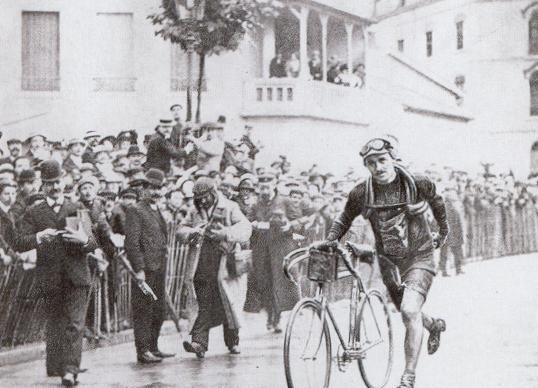
Faber runs with his broken bike to win Stage 4
A record 150 riders started the race; only 38 of them rode for the teams, the remainder being unsponsored correurs isolés ("isolated riders") who paid their own way. The Tour had been developing into an international event ever since the first edition, but with so many riders there were more foreigners than ever before: the French were still in the majority but there were many Belgians (5), Swiss (5)  and Italians (19) and two riders from elsewhere. Cyrille van Hauwaert won Stage 1 and became the first Belgian stage winner and the first foreigner to lead the race in Tour history, then François Faber (having become the first Luxembourger to win a stage the previous year and only the second foreigner, Faber was tipped to win by Lucien Petit-Breton) won the next when be beat Octave Lapize by 33'. Faber, at 1.88m and 88kg, was enormous by the standards of the day, hence his nickname The Giant of Colombes; he used the strength he'd built up in his work as a docker to ride solo for 200km the next day through deep snow and won again, this time beating Gustave Garrigou by 33'. On Stage 4 his chain broke with a kilometres to go, so he ran the rest of the way with his bike beside him and won that one by 10'. During Stage 5 he was first blown right of the road by a powerful crosswind and then kicked off his bike by a horse, in both cases he was able to continue and ended up beating Garrigou into second place again, this time by 5'.

Faber now had a thirteen point advantage over Garrigou and became the Tour's first superstar: in the past, French fans supported French riders, Belgian fans supported Belgian riders and so on, but Faber transcended that - 20,000 people, French, Belgian, Luxembourger and others, turned out to see him finish Stage 6 and when he won that one too they were ecstatic and his five consecutive stage wins remains a record more than a century later. Tour organisers became worried, however, that if Faber continued to dominate the race so completely, the other riders would give up all hope of winning and race despondently for second and third; so they asked him if he'd take things easy for a while: he'd either tired himself out, realised that the race was already as good as his or agreed, because Stage 7 was won by Ernest Paul - who just happened to be his half-brother. Jean Alavoine won Stage 9 (Faber had a rest and came tenth, his worst performance in the race), then Constant Ménager took the only Tour stage win of his career. Louis Trousselier, Garrigou and Paul Duboc won the following three, but they were all still too far behind Faber overall for a single stage win to make any difference. Finally, Alavoine won Stage 14 in notable circumstances - his bike became sufficiently damaged to be unridable 10km to go and, realising that locating an official and going through the formalities of being permitted a new one was going to lose significant time, he shouldered it like a cyclo cross rider and ran to the finish line where he won the stage by 6'30".

François Faber
Faber had moved to Alcyon from Peugeot at the end of 1908 and was now instrumental in the team's domination of the race, but his team mates had also ridden remarkably well: three places in the top ten went to isolés, including Ernest Paul in sixth, while Le Globe's Ménager was seventh. All the other places were taken by Alcyon. Being tall and well-built with his big moustache, Faber looked older than he was - few realise therefore that, at 22 years and seven months old, he's the third youngest man to have won a Tour a well as the first foreigner. He was only 28 when he climbed out of a trench and went into no man's land to rescue an injured comrade on the 9th of May in 1915, and was shot in the back and killed as he carried the man back. That very morning he'd received a message from his wife, informing him that she had given birth to a healthy baby girl.

Top Ten Final General Classification
1 François Faber (LUX) Alcyon 37
2 Gustave Garrigou (FRA) Alcyon 57
3 Jean Alavoine (FRA) Alcyon 66
4 Paul Duboc (FRA) Alcyon 70
5 Cyrille van Hauwaert (BEL) Alcyon 92
6 Ernest Paul (FRA) – 95
7 Constant Ménager (FRA) Le Globe 102
8 Louis Trousselier (FRA) Alcyon 114
9 Eugène Christophe (FRA) – 139
10 Aldo Bettini (ITA) – 142


1938
The Tour, 1938
21 stages (Stages 6 and 17 split into parts A and B; Stages 4, 10 and 20 split into parts A, B and C), 4,694km.
Unsponsored individual riders were barred from entry for the first time - as professionalism among the sponsored riders and teams increased, they had largely ceased to be competitive some time earlier. The time bonus system was extensively overhauled in an attempt to prevent any rider who won two or three stages with a large lead from gaining an unfair advantage over one who rode consistently; now winning a stage earned 1' or a maximum of 1'15" if his lead over the second place rider was judged sufficient. Since climbers were thought to suffer less on plain stages than sprinters did in the mountains, the winner of a mountain stage was limited to one minute. Team time trials had fallen out of favour and were abandoned, not reappearing in the race until 1954, and the Col d'Iseran - a mountain that has played host to so many of the most glorious moments in the history of the Tour, was included for the first time. The Belgian and French teams (there were in fact three French teams - the national team, the Bleuets made up of riders who for various reasons couldn't be included in the national team and the Cadets, a team of young riders) were considered to be the strongest. The Italians were thought less so, but they had Gino Bartali who, having come very close to victory in 1937, was a favourite for overall victory.

The first seven stages were unremarkable, save for the unwelcome sight of Willi Oberbeck winning Stage 1 in a jersey emblazoned with the swastika of Nazi Germany. Then on Stage 8, when the race reached the Pyrenees, Bartali attacked and nobody could follow him (Georges Speicher tried to do so by hanging onto a car, but was seen by officials and disqualified) - he was the first man over the Aubisque, Tourmalet and Aspin, but then disaster struck when his rear wheel crumpled. The Belgians Félicien Vervaecke and Ward Vissers passed him and went on to take first and second place, Bartali managed to take third place 55" behind them. After the stage, Vervaecke led the General Classification with Bartali second at +2'18", but with time bonuses the next day the gap was reduced to 57".

Gino Bartali
On Stage 14, Bartali attacked again - and for a second time nobody could stop him being the first over Allos, Vars and Izoard. This time his bike didn't let him down and he finished the stage with a overall advantage of 17'45" over the Luxembourgian Matt Clemens and 21'30" over Vervaecke. he lost some time in the Stage 20b time trial, but from that point onwards his victory was never in any doubt; his final advantage was 18'27". André Leducq (winner in 1930 and 1932) and Antonin Magne (winner in 1931 and 1934) mounted a successful two-man escape in the final stage and crossed the line together, being declared joint stage winner. For Leducq, it was a record 25th stage win, since bettered by only Eddy Merckx (34) and Bernard Hinault(28) (and, since Mark Cavendish has 21 and shows no signs of slowing down at the time of writing, probably him too before long). Neither man would ever ride the Tour again.

Top Ten Final General Classification
1 Gino Bartali (ITA) Italy 148h 29' 12"
2 Félicien Vervaecke (BEL) Belgium +18' 27"
3 Victor Cosson (FRA) France +29' 26"
4 Ward Vissers (BEL) Belgium +35' 08"
5 Matt Clemens (LUX) Luxembourg +42' 08"
6 Mario Vicini (ITA) Italy +44' 59"
7 Jules Lowie (BEL) Belgium +48' 56"
8 Antonin Magne (FRA) France +49' 00"
9 Marcel Kint (BEL) Belgium +59' 49"
10 Dante Gianello (FRA) Bleuets +1h 06' 47


1956
22 stages (Stage 4 split into parts A and B), 4,498km.
The French government ordered the Tour to take secondary roads as much as possible so as to avoid major road closures, but the Tour and caravan was now so large that it frequently became stuck on the narrow routes and caused far more disruption than it would have done had the organisers have been permitted to take it on roads of their own choosing. A rule change allowed punctures to be remedied by changing the wheel, previously the rider had to stop and repair it. For the second time in Tour history, no previous winner started the race - this had last happened in 1927 (1903 isn't counted on account of being the first Tour). Based on form, Charly Gaul therefore became favourite.

Enough climbing talent to make a thousand mortal grimpeurs:
Gaul and Bahamontes
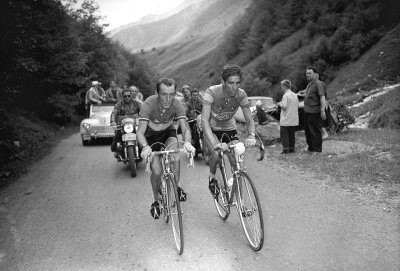
Gaul, who was almost as good against the clock as he was in the mountains, won the Stage 4a but remained 15'04" behind overall; however, he was expected to make up time in the mountains provided the weather was on his side - he hated hot conditions, but when it was cool nobody in the world could follow him. Unforunately, the Pyrenees tended to be too hot for him and he lost time; when the race arrived at the Alps it was looking as though he was going to run out of time - even Stage 17, the second day in the Alps when he was the first man over Sestrieres, didn't win back enough time to make much of a difference. Stage 18 was a different matter entirely: Federico Bahamontes (the only climber to ever rival Gaul) was fastest up Mont Cenis and his less-famous countryman René Marigil fastest on Croix de Fer, then Gaul launched one of the blistering attacks that in the future would win him a Tour. Having simply ridden away from the peloton, he won the stage with 3'22" on Stan Ockers and 7'29" on Gastone Nencini and Bahamontes - who was so angry at his inability to respond that he picked up his bike and threw it into a gulley (his team mates managed to get it back out and persuaded him to continue). It had been a superb stage win, but it was still too late for Gaul to take the General Classification. The King of the Mountains, meanwhile, was his.

Every once in a while, the Tour turns up a completely unexpected winner. Roger Walkowiak, who had only been given opportunity to ride at the very last moment after Gilbert Bauvin was transferred from Nord-Est-Centre to the national team, found himself in the maillot jaune after Stage 7 when he got away in an escape group (for the second time in the race) that won the stage by 18'46", but at such an early point he neither expected nor intended to keep it - team manager Sauveur Ducazeaux told him he'd be far better off losing it and seeing what happened later, because defending it would likely prove too much effort. He lost time over the coming stages, giving up the jersey in Stage 10 and few people thought he'd get it back again. However, in Stage 15 the entire Belgian became ill - an incident they blamed on food poisoning from bad fish served in a hotel the night before but which is commonly supposed (and very possibly was) caused by an unknown drug administered to them; a serious setback for the French team's strongest rivals. In Stage 17 he got away in another successful break, though this time the maillot jaune went to Wouter Wagtmans; but when Walkowiak managed to keep up with Bahamontes as Gaul was winning Stage 18 it passed back to him. Bahamontes was now probably the only rider capable of challenging him, but with only one mountain stage left his chance never came - an almost unknown rider, dismissed as an also-ran before the race even got under way, had won. He was the second rider to win a Tour without a stage win on the way to victory, the last man to do so being Firmin Lambot in 1922, and the only Tour winner to have won a single Tour stage at any point during his career.

Roger Walkowiak
Neither the press nor public were impressed; they'd wanted the young Jacques Anquetil (who had decided not to take part anyway) to win - Jacques Goddet said that the applause as he crossed the last finish line sounded more like a lamentation than a celebration. It wasn't long before the first accusations that he was an undeserving winner, a victor through luck rather than skill and effort (the term "à la Walko," to succeed in that way, became popular for a while), began to appear and he was badly hurt by them.  He rode again the next year but his spirit was broken and he rapidly dropped the bottom of the General Classification, despite a stage win at that year's Vuelta a Espana proving that he was fully capable of winning a stage in his own right; gradually, depressed, he faded away. In retirement he opened a bar in his hometown, but even local cycling fans told him he shouldn't have won and before long he gave that up too, preferring the anonymity of a job at a car factory, where he had worked before becoming a professional cyclist.

Goddet had a totally different opinion. Walowiak, he said, was his all-time favourite winner and the very archetype of what an all-rounder should be and had won the maillot jaune with his legs before keeping it with his head. Later, Bernard Hinault would also defend him - "There are people who say that Walkowiak should not have won the Tour. They should have been on that Tour! He took the jersey, he lost it and he regained it. He was not a thief. The Tour is not a gift," he insisted. Walkowiak is 85 at the time of writing. In time, the cycling world finally came to understand that Goddet and Hinault were correct and, after so many years of shameful treatment that left him preferring to pretend his great achievement had never happened he's now happy to talk about it.

Top Ten Final General Classification
1 Roger Walkowiak (FRA) North East-Center 124h 01'16"
2 Gilbert Bauvin (FRA) France +1'25"
3 Jan Adriaensens (BEL) Belgium +3'44"
4 Federico Bahamontes (ESP) Spain +10'14"
5 Nino Defilippis (ITA) Italy +10'25"
6 Wout Wagtmans (NED) Netherlands +10'59"
7 Nello Lauredi (FRA) South East France +14'01"
8 Stan Ockers (BEL) Belgium +16'52"
9 René Privat (FRA) France +22'59"
10 Antonio Barbosa (POR) Luxembourg/Mixed +26'03"


1997
Ullrich and Udo Bolts, 1997
21 stages + prologue, 3,943.8km.
Jan Ullrich's final advantage of 9'09" becomes the biggest gap between first and second place since Laurent Fignon beat Bernard Hinault by 10'32" in 1984. Ullrich also wins the Youth category, becoming the first rider to have won it and the General Classification in a single edition.

Top Ten Final General Classification
1 Jan Ullrich (GER) Telekom 100h 30' 35"
2 Richard Virenque (FRA) Festina +9' 09"
3 Marco Pantani (ITA) Mercatone Uno +14' 03"
4 Abraham Olano (ESP) Banesto +15' 55"
5 Fernando Escartín (ESP) Kelme +20' 32"
6 Francesco Casagrande (ITA) Saeco +22' 47"
7 Bjarne Riis (DEN) Telekom +26' 34"
8 José Maria Jimenez (ESP) Banesto +31' 17"
9 Laurent Dufaux (SUI) Festina +31' 55"
10 Roberto Conti (ITA) Mercatone Uno +32' 26"


2003
Armstrong in the maillot jaune after Stage 8, 2003
20 stages + prologue, 3,427.5km.
Unusually for a modern Tour, the 2003 edition started and ended in Paris - to mark the race's first century, celebrations also inspiring the organisers to keep the race entirely in France, as had been the case with early editions. The race was expected to be - and was - one of the most hotly-contested in many years and numerous favourites attempted to prevent Lance Armstrong from matching the five-victory record shared by Jacques Anquetil, Eddy Merckx, Bernard Hinault and Miguel Indurain; yet statistics show - and he confesses - that his preformance in this edition was the worst of his seven wins. The Tour was awarded the Prince of Asturias Award, a prize given to events and organisations that "contribute to encouraging and promoting scientific, cultural and humanistic values that form part of mankind's universal heritage."

In 2003, there was an incident that is likely to remain unique - as fans watched the tail end of the peloton go by on Galibier, they were asked to move a little further along the road. Then, without warning, a man on a mountain bike hurtled down towards the road from higher up the slope, launched into the air from a small rocky ledge and jumped clear across the riders, landing (and crashing) on the rock-strewn terrain on the other side. His name was Dave Watson, a professional freerider with the Kona Clump team; after being given a check-over by paramedics, police decided that his assistants (from a French mountain bike magazine) hadn't endangered any member of the public other than Dave himself, he was allowed to go on his way.

Lance Armstrong, who won this edition and six others, would be stripped of all his Tour victories in 2012 following an investigation into doping.


Top Ten Final General Classification
1 Lance Armstrong (USA) US Postal Service 83h 41' 12" (disqualified)
2 Jan Ullrich (GER) Bianchi +1' 01"
3 Alexandre Vinokourov (KAZ) Telekom +4' 14"
4 Tyler Hamilton (USA) Team CSC +6' 17"
5 Haimar Zubeldia (ESP) Euskaltel +6' 51"
6 Iban Mayo (ESP) Euskaltel +7' 06"
7 Ivan Basso (ITA) Fassa Bortolo +10' 12"
8 Christophe Moreau (FRA) Crédit Agricole +12' 28"
9 Carlos Sastre (ESP) Team CSC +18' 49"
10 Francisco Mancebo (ESP) iBanesto.com +19' 15"


2008
Sastre in yellow, 2008
21 stages, 3,559km.
The bonification system - which awarded time bonuses to the winners of intermediate sprints and stages - was abandoned. A feud between the ASO and the UCI finally boiled over when the ASO announced that it wasn't inviting Astana to the race due to the team's involvement in Operacion Puerto, despite a UCI rule stating that all ProTour teams were to be invited to the Grand Tours; the ASO got its way. The race remained almost entirely in France, dipping briefly into Italy at the end of Stage 15 and the start of Stage 16. Mark Cavendish won his first four Tour stages but didn't place in the top ten on points, Bernard Kohl won the King of the Mountains and was third overall but was later shown to have doped with CERA, an EPO variant, and was disqualified. To date, second place Carlos Sastre - who also won overall - has not been upgraded in the Mountains, nor has Denis Menchov in the General Classification.

Top Ten Final General Classification
1 Carlos Sastre (ESP) Team CSC 87h 52' 52"
2 Cadel Evans (AUS) Silence-Lotto +0' 58"
3  ---
4 Denis Menchov (RUS) Rabobank +2' 10"
5 Christian Vande Velde (USA) Garmin +3' 05"
6 Fränk Schleck (LUX) Team CSC +4' 28"
7 Samuel Sánchez (ESP) Euskaltel +6' 25"
8 Kim Kirchen (LUX) Team Columbia +6' 55"
9 Alejandro Valverde (ESP) Caisse d'Epargne +7' 12"
10 Tadej Valjavec (SLO) Ag2r +9' 05"

Eduardo Chozas
Born in Madrid on this day in 1960, Eduardo Chozas, a professional rider from 1980 to 1993, has been largely fogotten today despite winning two stages at the Giro d'Italia (Stage 5, 1983; Stage 2, 1990) and four stages at the Tour de France (Stage 15, 1985; Stage 11, 1986; Stage 22, 1987, Stage 13, 1990 - when he also took his best General Classification result, sixth, and won the overall Combativity Award).

His other claim to fame is that he entered more Grand Tours than any other man in the history of cycling - six editions of the Tour de France, seven editions of the Giro d'Italia and fourteen editions of the Vuelta a Espana. He finished 26 of them, also a record, abandoning only the 1984 Vuelta.

Cyclists born on this day: Philippe Gilbert (Belgium, 1982); Günter Kaslowski (Germany, 1934, died 2001); Ali Çetiner (Turkey, 1925); Raimondas Vilčinskas (Lithuania, 1977); Jan Kudra (Poland, 1937); Hernán López (Argentina, 1973); Amadu Yusufu (Malawi, 1958); Pramote Sangskulrote (Thailand, 1952); Glenn Magnusson (Sweden, 1969); Jo Jae-Hyeon (South Korea, 1938); Alex Zülle (Switzerland, 1968); Gustav Hentschel (USA, 1896, died 1980); Frank Elliott (Canada, 1911, died 1964); Alexander Kristoff (Norway, 1987); Ernest Bens (Belgium, 1949); Ralf Elshof (Netherlands, 1962); ...and Paul Smith, the fashion designed who wanted to be a professional cyclist (Great Britain, 1946).

Monday, 30 June 2014

Daily Cycling Facts 30.06.2014

The Vuelta a Espana began on this day in 1942. Its 19 stages covered 3,683km and the winner of both the General Classification and the King of the Mountains was Julián Berrendero. He also won the previous year, when the race returned after the Spanish Civil War; after this edition the race wasn't held again until 1945 due to Spain's economic problems and the Second World War.


Crupelandt signs in at a race checkpoint
The Tour de France has started on this day more than on any other: 1912, 1929, 1931, 1937, 1948, 1949, 1973, 1977 and 1990 - and it starts again today in 2012. In 1912, the fifteen stages covered a total of 5,289km. One rider, a man named Stéphanois Panel but commonly known by the name Joannie, came with a bike fitted with a derailleur gear system - this was the first time such a device had been seen at the Tour. He called the system Chemineau  and had invented it, and the handlebar-mounted fully-indexed lever that controlled it, himself. It seems to have worked well, but race organisers felt it made the climbs too easy and when he abandoned they persuaded the other riders that it was unreliable, then banned derailleurs for the next quarter of a century. The race started from the enormously popular Lunar Park on the Avenue de la Grande Armée, a far more prestigious location than any Grand Départ so far and evidence that the Tour was becoming something far greater to the French than just a bicycle race.

Gustave Garrigou, the previous year's winner, was the favourite. His Alcyon team had signed up Odile Defraye to support him, but Garrigou sensed that he might prove to be a rival and persuaded the other team members to object to his inclusion for the Tour. Alcyon refused to back down and Defraye remained in the selection. Charles Crupelandt (who became a hero during the First World War, but was then accused of a crime he probably didn't commit and was banned from racing for life - probably because his rivals pressed the National Federation to do so; by the time he died in 1955 he'd had both legs amputated and had lost his sight) won an uneventful first stage in which Defraye was 14th at +30'54 and Garrigou 21st at +41'53".

On the Aubisque, 1912
During Stage 2, Garrigou and Defraye got away together. Defraye won, Garrigou recorded the same time - however, due to the points system then used to determine the General Classification leader, Defraye moved into second place overall behind Vicenzo Borgarello who had picked up enough points along the way to become the first Italian rider to ever lead the Tour de France. In Stage 3, they both got into a fourteen-strong break before Defraye attacked at the foot of the Ballon d'Alsace (the Tour's first mountain in 1905) and was first to the top; then the fantastically fast (if frequently unfortunate) descender Eugène Christophe dropped him on the way down and took the stage. Defraye was now leading overall

Defraye appears at this point to have had no intention of standing in Garrigou's way - either that or he was a gentleman, because when Garrigou punctured on tacks thrown into the road (probably by French fans trying to hold up Belgian riders) he stopped and waited. Garrigou, however, had been impressed by Defraye's performance so far and was now touched that he'd waited. He too was a gentleman, and he told him to go on without him rather than ruin his own chances. This meant that, for the first time, a Belgian rider stood a very good chance of winning overall - most of the other Belgians then completely forgot about their teams and rode for him. Race director Henri Desgrange, who was fiercely opposed to riders helping one another, was of course incensed.

Christophe won Stage 4. He was a useless sprinter, but he climbed well and descended even better; therefore his best way to win a stage race decided on points was to escape the peloton and hope for the best with heroically long solo breaks - this is what he did on Stage 5, winning after the longest solo break in Tour history (315km) and earning enough points to share the leadership afterwards. On Stage 6, Defraye had recovered from his knee problems in Stage 5 and attacked in the mountains. Octave Lapize was the only man able to go with him and managed to win the stage when Defraye punctured, which enabled him to replace Christophe in sharing the lead. Defraye then attacked again on the Portet d'Aspet in Stage 7 - Lapize tried, but this time he couldn't respond. Borgarello won Stage 8, but was now too far behind for it to make much difference.

During Stage 9 Lapize abandoned in protest at the Belgian riders working for Defraye and his La Française team mates Crupelandt and Marcel Godivier left the race that evening for the same reason; Christophe thus moved into second place in the General Classification. There were six stages to go and he was 20 points behind - with all the Belgians now working for his rival, Christophe could only possibly win if Defraye left the race. He didn't, and kept doing well, eventually becoming the first Belgian to win the Tour with an advantage of 59 points. However, had the winner have been selected according to accumulated time, the General Classification would have looked very different. Desgrange recognised this, and the following year the race was decided that way.

Top Ten Final General Classification
1  Odile Defraye (BEL) Alcyon 49p
2  Eugène Christophe (FRA) Armor 108p
3  Gustave Garrigou (FRA) Alcyon 140p
4  Marcel Buysse (BEL) Peugeot 147p
5  Jean Alavoine (FRA) Armor 148p
6  Philippe Thys (BEL) Peugeot 148p
7  Hector Tiberghien (BEL) Griffon 149p
8  Henri Devroye (BEL) Le Globe 163p
9  Félicien Salmon (BEL) Peugeot 166p
10  Alfons Spiessens (BEL) J.B. Louvet 167p
(Note that in the event of two riders tying on points, accumulated time would be taken into account - hence Alavoine and Thys do not share 5th place)


In 1928, organisers had worried that the plain stages were not as interesting to fans as mountain stages (which is true, in the case of many fans) so they experiemented with running them as long individual time trials instead. Unfortunately, even the most boring of flat stages appeal to everyone who appreciates cycling on some level, if only for the sheer spectacle of the peloton going by, while time trials appeal only to those with an interest in the more technical aspects of cycling competition; as a result, a dangerously high percentage of the population simply lost interest. In 1929, they did away with the individual time trials altogether, but the race had returned to something more like standard format - there were 22 stages of which three were team time trials, covering a total of 5,286km, though they reserved the right to reintroduce individual time trials should any stage be ridden at an average speed less than 30kph (in 1930, organisers decided to do away with time trials altogether; they didn't reappear until 1934).

Another outcome of the 1928 race was a desire to prevent any one team dominating the race, as had Alcyon when they took all three steps on the final podium. Organisers had not yet decided that national teams were the way forward (that came in 1930 and lasted into the 1960s) but officially, trade teams were not in the race and, as a result, riders were simply the 1st Class, which meant they were professional, or 2nd Class, which meant they were semi-professional (perhaps having a bike supplied free by a shop, but otherwise responsible for their own costs, or independent (which really meant "rich enough to pay their own way or happy to beg for scraps and sleep in hedges along the parcours"). Organisers had let it be known that anything looking suspiciously like collusion between riders who spent the rest of the year racing for any one particular team would result in prohibitive action, though they didn't specify what that action might be - last time they'd tried something along the same lines, in 1924 when they allowed the 2nd Class to set off with a two-hour head start one day and then when that didn't get the results they wanted tried to reverse the situation the next day, the riders had soon had quite enough of being messed around and threatened a strike, forcing Desgrange to back down. Their reluctance to give further details, therefore, tends to suggest that until somebody came up with the national teams idea they were completely at a loss as to what they could do about it. In view of that, one last petty rule change seems simply spiteful - in 1928 riders had been allowed to accept help when repairing punctures; in 1929 they had to do it themselves. It was also the first time that the race was covered by radio broadcasts.

Aimé Dossche won the first stage and held the yellow jersey until Stage 4 while André Leducq, Omer Taverne and Louis de Lannoy won Stages 2, 3 and 4. Maurice Dewaele became leader after Stage 4 and stayed in yellow until the end of Stage 7. Gustaaf van Slembrouck and Paul Le Drogo won Stages 5 and 6, then Nicolas Frantz won Stage 7. Dewaele punctured on that stage and lost significant time; Frantz, Leducq and Victor Fontan all shared the best overall accumulated time and so Stage 8 began with the unusual sight of three men each wearing a maillot jaune.

Lucien Buysse, who had won the Tour in 1926 but was now racing as a touriste-routier, attacked early in Stage 9 and was the first man to the top of the Aubisque, but Dewaele and Fontan caught him on the way down. Dewaele punctured again and lost more time; Fontan lost the stage to a Spanish rider named Salvador Cardona but slipped into the lead overall - and thus, at the age of 37 years and 21 days,  became the second oldest man in Tour history to wear the maillot jaune (after Eugène Christophe, who was 37 years and 165 days the last time he wore it in 1922). However, just 7km into Stage 10, Fontan crashed: some eyewitnesses said he rode into a dog, other that he rode into a gutter, which raises the likely scenario that he rode into a gutter while trying to avoid a dog. His fork snapped, leaving him subject to the old rule that a replacement bike was only permitted if a race official had deemed the machine irreparable. Unfortunately, at this early stage, all the officials were stationed much further ahead and the director's car had already gone past. If he was going to remain in the race, his only option was to find another bike and take the old one with him to prove it couldn't be fixed so, after knocking on almost every door in the nearest village until he eventually found someone with a bike they'd lend him, he strapped his broken machine to his back and set off. He rode alone like that for 145km before the weight and the pain of the broken bike digging into his spine and ribs became too much, then he sat down by a fountain at Saint-Gaudens, overlooking the Garonne valley, and burst into tears. 171km away, Jef Demuysere won the stage and Dewaele became overall leader.

Victor Fontan
Some time later, Fontan was found at the fountain by the journalists Alex Virot (who would be killed in a motorcycle accident at the Tour in 1957) and Jean Antoine, who were producing reports for Radio Cité. They recorded his sobbing and, less than two hours later, it was broadcast. All of France felt for him and angry that, when he'd been doing so well, he could be robbed of victory through no fault of his own: Les Echos des Sports journalist Louis Delblat summed up popular feeling best with the following words:
"How can a man lose the Tour de France because of an accident to his bike? I can't understand it. The rule should be changed so that a rider with no chance of winning can give his bike to his leader, or there should be a a car with several spare bicycles. You lose the Tour de France when you find someone better than you are. You don't lose it through a stupid accident to your machine."
The next year, Desgrange had changed the rules. More than a quarter of a century after the first Tour, riders no longer had to seek official permission to replace a broken bike.

Leducq, Marcel Bidot, Benoît Fauré, Gaston Rebry and Julien Vervaecke won the next five stages. Dewaele was still leading overall and ended Stage 14 with an advantage of 18'20". Then, with just an hour to go until the start of Stage 15, he fainted. Alcyon requested that the start be delayed for one hour, which was granted, but he was obviously not a well man as the team propped him up on the start line before quite literally holding him upright all the way to the end of the stage (organisers did nothing at the time, which strengthens the argument that they had no idea how to respond to Desgrange's hated teamwork) and somehow getting him there only 13'25" after Vervaecke and losing only 2'49" from his overall lead. The next day, he'd recovered and kept his lead at 15'31" while Charles Pélissier (younger brother of Henri and Francis, who had competed in the Tours around the First World War) won the stage.

Giuseppe Pancera
Leducq won Stages 17 and 18 and Dewaele upped his lead to 18'20" again, kept it the same as Bernard van Rysselberghe won Stage 19, then added 10' by winning Stage 20. Leducq and Nicolas Frantz took the final two, but it was too late now. Demuysere had stayed in second place overall ever since Stage 16, but judges found on favour of an accusation that he'd accepted a drink outside of a feeding zone, where doing so was forbidden (until surprisingly late, conventional wisdom stated that it was best to avoid drinking as far as possible during strenuous athletic activity; so riders were limited to four bidons - about two litres - per race. Nowadays, of course, domestiques can be seen flitting to and from the team cars to collect fresh bidons for their masters at almost any point along the parcours). As a result, he was penalised 25' and fell into third place behind Guiseppe Pancera, who trailed 44'23" behind Dewaele.

Desgrange, who had seen Dewaele at the start of Stage 15, was seething (reading the history of the Tour, it's very easy to imagine that Desgrange spent most of his life moving from one level of fury to another. His management style was heavy-handed and he had a tendency towards pomposity and arrogance, but he appreciated jokers and, after divorcing his first wife, spent the rest of his life with a bohemian artist named Jeanne Deley, who filled their Paris home with all manner of other artists, characters and general eccentrics. His lighter side also came out during an ongoing row with the Mercier bike company, which is recounted as an aside at the end of this article). "My race has been won by a corpse!" he proclaimed, and immediately set about finding ways to prevent such a thing every happening again. The next year, as described above, trade teams were banned from the Tour.

Top Ten Final General Classification
1  Maurice Dewaele (BEL) Alcyon 186h 39' 15"
2  Giuseppe Pancera (ITA) La Rafale 44' 23"
3  Joseph Demuysere (BEL) Lucifer 57' 10"
4  Salvador Cardona (ESP) Fontan–Wolber 57' 46"
5  Nicolas Frantz (LUX) Alcyon 58' 00"
6  Louis Delannoy (BEL) La Française +1h 06' 09"
7  Antonin Magne (FRA) Alleluia–Wolber +1h 08' 00"
8  Julien Vervaecke (BEL) Alcyon +2h 01' 37"
9  Pierre Magne (FRA) Alleluia–Wolber +2h 03' 00"
10  Gaston Rebry (BEL) Alcyon +2h 17' 49"


1931
24 stages, 5,901km.
Max Bulla won Stage 2 and took the maillot jaune - the only time it was ever worn by an touriste-routier in the history of the Tour. He benefited from the fact that riders in his class were permitted to set off ten minutes before the 1st Class professional riders, as was the case in Stages 3, 4, 6, 7 and 12.

Top Ten Final General Classification
1  Antonin Magne (FRA) France 177h 10' 03"
2  Jef Demuysere (BEL) Belgium +12' 56"
3  Antonio Pesenti (ITA) Italy +22' 51"
4  Gaston Rebry (BEL) Belgium +46' 40"
5  Maurice De Waele (BEL) Belgium +49' 46"
6  Julien Vervaecke (BEL) Belgium +1h 10' 11"
7  Louis Peglion (FRA) France +1h 18' 33"
8  Erich Metze (GER) Germany +1h 20' 59"
9  Albert Büchi (SUI) Australia/Switzerland +1h 29' 29"
10  André Leducq (FRA) France +1h 30' 08"
"As the bicycle banged and jolted over the uneven ground, one yearned for company, for another human whose conversation would share the anxious misery of those uncertain hours. Yes, there it was, a vague outline of a hunched figure swinging and swaying in an effort to find a smooth track. 
French is the Esperanto of the cycling fraternity, so I ventured some words in that tongue. C'est dur ("it is hard"), but only a grunt came back. For a mile we plugged on in silence, then again in French I tried: "This Tour - it is very difficult - all are weary." Once more, only a snarling noise returned. "This boorish oaf," I thought, "I'll make the blighter answer."
"It is very dark, and you are too tired to talk," I inferred, sarcastically. The tone touched a verbal gusher as a totally unexpected voice bawled, "Shut up, you Froggie gasbag - I can't understand a flaming word you've been jabbering," and then I realised that I had been unwittingly riding with Bainbridge." - Sir Hubert Opperman on the 1931 Tour

In 1937, there were 20 stages. Three of them - 5, 14, 17 - were split into parts A, B and C, Stages 11, 12, 13, 18 and 19 were split into Stages A and B; and they covered a total of 4,415km.

Since the Tour began, Henri Desgrange had allowed only wooden wheel rims for fear that the heat generated on the descents would melt the glue holding tubular tyres to metal rims - which were first permitted in this edition. For the very first time, a British team took part: Bill Burl and Charles Holland were the first British riders to enter the race and they were joined by a Canadian, Pierre Gachon, who was the only non-European (Gachon abandoned in Stage 1, Burl went in Stage 2 after being knocked off by a photographer and breaking his collarbone, Holland eventually went in 14c but had ridden well). The Italian team returned, Mussolini having banned Italian cyclists from entering in 1936. Among them was Gino Bartali, making his Tour debut: he fell into a river during Stage 8 and was very nearly swept away by the current - thankfully, Francesco Camusso was nearby and managed to grab hold of him and haul him out. He continued, but lost significant time in the next stages and abandoned in Stage 12.

 Roger Lapébie 
Roger Lapébie, who was one of the few riders on a bike equipped with a derailleur (which had just been permitted in the race for the first time since 1912 - see above) was elected leader by the remaining six riders from the French team at the start of Stage 9 but, at the start of Stage 15 was the victim of sabotage when his handlebars were partially sawn through. He managed to bodge a repair, but his bike hadn't been fitted with a bidon cage and he came very close to giving up in that stage until a team mate persuaded him to continue - after Sylvère Maes punctured, Lapébie was able to take second place and won a 45" time bonus, but then lost it when officials found he'd been pushed by spectators and penalised him 90". The Belgians thought that be should have been punished more severely, but the French team threatened to leave en masse if this happened and no further action was taken.

In Stage 16, Maes punctured again and was helped back into the lead by Adolf Braeckeveldt and Gustaaf Deloor - both were Belgian, but they were touriste-routiers rather than part of the Belgian team and so their assistance should not have fallen foul of the law that riders could not be helped by members of their own team. Nevertheless, Maes was penalised 15". Earlier in the stage, the gate at a railway crossing had been lowered right after Lapébie had gone through and just as Maes was about to follow him. The Belgian team believed this had been done deliberately and, adding a complaint that the French fans threw stones at them, they left the race.

From that point onwards, Lapébie was without challenge and had little difficulty in winning. This edition was marred by an unwelcome, ugly sight - the swastika-emblazoned jerseys of the team from Nazi Germany.

Top Ten Final General Classification
1  Roger Lapébie (FRA)  France 138h 58' 31"
2  Mario Vicini (ITA) Individual[1] +7' 17"
3  Leo Amberg (SUI) Switzerland +26' 13"
4  Francesco Camusso (ITA) Italy +26' 53"
5  Sylvain Marcaillou (FRA) France +35' 36"
6  Edouard Vissers (BEL) Individual +38' 13"
7  Paul Chocque (FRA) France +1h 05' 19"
8  Pierre Gallien (FRA) Individual +1h 06' 33"
9  Erich Bautz (GER) Germany +1h 06' 41"
10  Jean Frechaut (FRA) Individual +1h 24' 34"

Bartali in the mountains, 1948
The 1948 Tour was second edition since the Second World War, and it consisted of 21 stages covering a total of 4,922km. When the 1947 Tour took place, the conflict had come to an end but the peace treaty between France and Italy had not yet been signed. This meant that, legally, the two nations were still at war, so the Italian team had to be made up of Italians resident in France. In 1948 the situation had been resolved and Bartali was back.

For the very first time, a stage was broadcast live on television and millions of people across the nation tuned in to watch the riders cross the last finish line at the Parc des Princes velodrome. The TV cameras attracted new sponsors, most notably the Les Laines woolens company which became the new sponsor of the maillot jaune, and introduced financial rewards for those who got to wear it. In 1947, newspapers had complained that too many riders rode deliberately slowly in an attempt to become lanterne rouge - while this guaranteed them more media attention and race invites than finishing anywhere else outside the top ten (even anywhere other than first place, if they had good business sense), it was felt that it made the race boring. The public wanted a return to the days of old when heroic riders risked life and limb to be faster than their rivals, thus a new rule stated that the last rider over the line in Stages 3 to 18 would be eliminated from the race.

The Tour organisers had invited the Swiss to send a team, largely because they wanted the crowd-pleasing Tour de Suisse winner Ferdi Kübler in the race, but Kübler refused because he could make more money winning several small races than entering one big one that he probably wouldn't win. However, the Swiss Aeschlimann brothers Roger and Georges, who came from Lausanne and thus guaranteed a good crowd turn-out when the race visited the city at the end of Stage 15, did want to come. They were immediately accepted and placed into a team with eight foreign-born French residents which became known as The Internationals.

The Italian team had argued before the race over whether Bartali or Fausto Coppi, who had already won two Giri d'Italia, should be team leader. The Tour organisers wanted both men in the race and even permitted a second Italian team so they could both lead, but eventually Coppi decided to sulk and refused to take part at all. Bartali was no longer a young man and whilst the war had taken its toll on everyone, he didn't look to be in good shape (nobody knew it yet, but it had taken a greater psychological toll on him than on many others - he'd spent much of it risking torture and execution at the hands of the Fascists by personally smuggling Jewish Italians to safety in neutral Switzerland). He won the first stage, but then began to struggle and Louison Bobet had little trouble in gaining the overall lead and keeping it - though he collapsed after Stage 11, he recovered in time to win the next day.

After finishing Stage 12 with an overall disadavantage of 20', Bartali told his team mates that he was going to abandon; but they persuaded him to sleep on it and see how he felt the following day. He did so, but during the night was woken by a phonecall from Alcide De Gasperi - the prime minister of Italy. De Gasperi told him that Palmiro Togliatti, chairman of the Communist Party, had been assassinated. Could Bartali try his very best to win the next day, he asked, in the hope that such good news might prevent the populace rising up and thrusting the country into civil war?

Bartali assured him that not only would he win the stage, he would win the race - and he kept both promises. Stage 13 was won with a 6'13" lead after he took on and beat no less a rider than Briek Schotte (whom many of the toughest riders of Flanders say was the only true Flandrien), reducing the gap between himself and Bobet to 1'06". Then he won Stages 14 and 15 too, which gave him an overall lead of 1'47" - and, more importantly, united Italy in their support for him. He finished 32" behind stage winner Edward van Dijck in Stage 16, but because his rivals lost significant time his overall lead grew to 32'20" and from that point onwards. Ten years after his first Tour victory, he had won another - the longest period between two wins by any one individual in the history of the race.


Top Ten Final General Classification
1  Gino Bartali (ITA)  Italy 147h 10' 36"
2  Brik Schotte (BEL) Belgium +26' 16"
3  Guy Lapébie (FRA) Centre-South East +28' 48"
4  Louison Bobet (FRA) France +32' 59"
5  Jeng Kirchen (LUX) NeLux +37' 53"
6  Lucien Teisseire (FRA) France +40' 17"
7  Roger Lambrecht (BEL) Internationals +49' 56"
8  Fermo Camellini (ITA) Internationals +51' 36"
9  Louis Thiétard (FRA) Paris +55' 23"
10  Raymond Impanis (BEL) Belgium +1h 00' 03"

1949
Fausto Coppi
21 stages, 4,808km.
Once again, the Italian team was split by a row over whether Bartali or Coppi should win. Since Bartali had won the previous year and was considered more experienced, he was chosen - but, after considering leaving the race due to lack of support, this time Coppi won.

Top Ten Final General Classification
1  Fausto Coppi (ITA)  Italy 149h 40' 49"
2  Gino Bartali (ITA) Italy +10' 55"
3  Jacques Marinelli (FRA) Ile de France +25' 13"
4  Jean Robic (FRA) West-North +34' 28"
5  Marcel Dupont (BEL) Belgian Aiglons +38' 59"
6  Fiorenzo Magni (ITA) Italian Cadets +42' 10"
7  Stan Ockers (BEL) Belgium +44' 35"
8  Jean Goldschmit (LUX) Luxembourg +47' 24"
9  Apo Lazaridès (FRA) France +52' 28"
10  Pierre Cogan (FRA) West-North +1h 08' 55


Cyrille Guimard
In 1973 there were 20 stages, Stages 1, 2, 7, 12, 16 and 20 being split into parts A and B. The total distance covered was 4,140.4km. Before the route was announced, there were widespread grumblings that the organisers had plotted out a much flatter parcours than usual in an attempt to favour Cyrille Guimard - once, it had been an open secret that French riders received preferential treatment, but when the race details were revealed and it turned out that in actual fact three more mountains had been added it was seen that those days had come to and end. This is less indication that the organisers had made a conscious decision to be more fair and more a sign that the Tour had now grown so big that it transcended Frenchness; it was now a world event.

For once, there were no major changes to the rules; the biggest difference from 1972 being the absence of Eddy Merckx - he had switched from Faema to the Molteni team with a contract to ride the Vuelta a Espana (26th April-13th May) and the Giro (18th May-9th June), and even he didn't much fancy the idea of three Grand Tours totaling more than 11,000km in the space of just under three months. No French riders took part in the 1973 Giro, which was thought to be a slight and so no Italian teams came to the Tour.

Luis Ocaña, seen in 1971
Raymond Poulidor was a favorite, chosen by the heart more than the head - he was no longer a young man, but after so many years in the shadow of first Anquetil and then Merckx his legions of fans hoped that be might somehow take the Tour victory he'd wanted for so long. Bernard Thévenet and José-Manuel Fuente were reckoned to be in with a good chance too; but the man deemed by far most likely to win was the Spaniard Luis Ocaña, who had come very close to preventing Merckx from taking his third victory in 1971. He and Herman van Springel crashed in Stage 1a after a dog ran across the road in front of them, but neither man was hurt (they both managed to avoid the dog, too). Ocaña joined Guimard in a two-man break in Stage 3 and succeeded in putting two minutes between himself and Zoetemelk, but probably felt far more pleased with his new 6' lead over José-Manuel Fuente because the two men hated each other. Their enmity was not helped at all during Stage 8, when they attacked at the same time and ended up riding together over Izoard: Fuente stopped doing his share of the work near the top, then sprinted past to take the best points. Now that they were trying to outdo one another, their pace kept rising higher and higher - eventually Fuente punctured and, some would say quite rightfully considering what had happened on Izoard, Ocaña attacked; crossing the finish line alone with a lead of 58". The next riders after Fuente arrived nearly seven minutes later, but the peloton was more than twenty minutes down the road.

At the end of Stage 9, British rider Barry Hoban failed an anti-doping control, was fined 100 Swiss Francs and was eliminated from the race. Hoban had been a close friend of Tom Simpson, who died six years and one day earlier on Mont Ventoux when the amphetamines he took prevented him from knowing that his body could take no more, and two years after that he married Simpson's widow. That he of all people was still willing to dope shows that for the majority of riders doing so really was a necessity simply in order to be able to keep up at that time.

Poulidor lost control during Stage 13 and plunged into a ravine on Portet d'Aspet. With help - including race director Jacques Goddet - he was able to climb back up to the road, but had injured his head and had to be helicoptered to hospital. Fans prayed for his recovery, but nobody really thought his chances of winning had ended that day - Ocaña had led since Stage 7a, and his victory hadn't really been in any doubt for some time. When it came, he was able to say he'd earned it; but it can't have tasted as sweet as one against Merckx.

Top Ten Final General Classification
1  Luis Ocaña (ESP) Bic 122h 25' 34"
2  Bernard Thévenet (FRA) Peugeot +15' 51"
3  José-Manuel Fuente (ESP) Kas +17' 15"
4  Joop Zoetemelk (NED) Gitane +26' 22"
5  Lucien Van Impe (BEL) Sonolor +30' 20"
6  Herman Van Springel (BEL) Rokado +32' 01"
7  Michel Périn (FRA) Gan +33' 02"
8  Joaquim Agostinho (POR) Bic +35' 51"
9  Vicente Lopez-Carril (ESP) Kas +36' 18"
10  Régis Ovion (FRA) Peugeot +36' 59"

1977
(Bernard Thevenet)
Bernard Thevenet
22 stages (Stages 5, 7, 13, 15 and 22 split into parts A and B) + prologue. 4,096km
The Giro d'Italia and Vuelta a Espana paid teams to take part but the Tour, being the grandest of the Grand Tours, expected teams to pay for the honour. In 1977, several teams chose t stay away, either in protest or because they were unable to afford the fee - for that reason, the unusually low figure of 100 riders started. Lucien van Impe, winner in 1976, was hoping for a second victory and remained a favourite right up until the route was announced. However, after several years in which the mountain stages had dominated the race the organisers had decided to put more emphasis on the time trials; Bernard Thévenet, who had ended the reign of Merckx in 1975, took over. Joop Zoetemelk, Hennie Kuiper and Raymond Delisle were expected to give him problems. Merckx was there, but was far past his best and many people wondered what had become of his promise to quit while he was ahead. Dietrich Thurau, riding the Tour for the first time, won the prologue and dreamed of wearing the maillot jaune for Stage 13 when the race visited Germany; unfortunately the Pyrenees came early in 1977, starting in Stage 2 and threatening to ruin his chances. However, after teaming up with Merckx he managed to remain in contention and then won back time during the time trials - he got his wish. The riders got bored during the nine stages between the Pyrenees and the Alps, which began in Stage 14, and as result the race became boring. Jacques Goddet published a report, really an angry open letter to them, in L'Equipe in which he attacked them for their apathy. Surprisingly, they didn't threaten to strike. Agostinho won Stage 18 but then failed an anti-doping test, so the win was disallowed. Antonio Menendez from KAS was thus declared winner, but then he failed a test too. Merckx had been third, but he hadn't been tested and by now it was too late - so the stage still has no official winner. Thévenet had no problems in the last stages and took his victory unchallenged - it had been an interesting Tour, but for all the wrong reasons.

Top Ten Final General Classification
1  Bernard Thevenet (FRA) Peugeot 115h 38' 30"
2  Hennie Kuiper (NED) Raleigh +0' 48"
3  Lucien Van Impe (BEL) Lejeune +3' 32"
4  Francisco Galdos (ESP) KAS +7' 45"
5  Dietrich Thurau (GER) Raleigh +12' 24"
6  Eddy Merckx (BEL) Fiat +12' 38"
7  Michel Laurent (FRA) Peugeot +17' 42"
8  Joop Zoetemelk (NED) Miko +19' 22"
9  Raymond Delisle (FRA) Miko +21' 32"
10  Alain Meslet (FRA) Gitane +27' 31"

1990
21 stages + prologue, 3,404km
The Combination and Intermediate Sprint Classifications vanished from the race, neither has since been reintroduced. Greg Lemond took his third victory, a remarkable recovery after he was nearly killed when a dropped shotgun fired 40 pellets into his back.

Top Ten Final General Classification
1  Greg LeMond (USA) Z 90h 43' 20"
2  Claudio Chiappucci (ITA) Carrera Jeans-Vagabond +2' 16"
3  Erik Breukink (NED) PDM +2' 29"
4  Pedro Delgado (ESP) Banesto +5' 01"
5  Marino Lejarreta (ESP) ONCE +5' 05"
6  Eduardo Chozas (ESP) ONCE +9' 14"
7  Gianni Bugno (ITA) Chateau d'Ax +9' 39"
8  Raúl Alcalá (MEX) PDM +11' 14"
9  Claude Criquielion (BEL) Lotto-Superclub +12' 04"
10  Miguel Indurain (ESP) Banesto +12' 47"

Cyclists born on this day: Jackson Stewart (USA, 1980); Geoffrey Lequatre (France, 1981); Wayne McCarney (Australia, 1966); Léon Gingembre (France, 1875, died 1928); Valentino Gasparella (Italy, 1935); Rocco Travella (Switzerland, 1967); Luděk Štyks (Czechoslovakia, 1961); Karl Koch (Germany, 1910, died 1944); Anthony Stirrat (Great Britain, 1970); Joona Laukka (Finland, 1972); Gaynan Saydkhuzhin (USSR, 1937); Corine Dorland (Netherlands, 1973); Kjell Rodian (Denmark, 1942); Ignacio Gili (Argentina, 1971); Kashi Leuchs (New Zealand, 1978); Diego Garavito (Colombia, 1972); Lucjan Józefowicz (Poland, 1935); Sylvain Chavanel (France, 1979).

Henri Desgrange versus the Mercier bicycle company
In 1934, André Leducq broke his contract with the Alcyon team and went to ride for Mercier (money was involved, as was team owner Émile Mercier's offer to rename the team A. Leducq-Mercier-Hutchinson). Alcyon boss Edmond Gentil was not at all happy so, knowing that Desgrange personally chose the riders for the French national team, he asked him not to select Leducq. Desgrange agreed.

Mercier heard what had happened and began to complain, writing numerous letters to the paper and eventually getting his lawyers involved. Desgrange, as usual, expected any decision he made to be final and go without questioning, so he ordered the staff at his L'Auto newspaper (which ran the Tour) to never mention Mercier again, either in the offices or in print. Mercier was now even more angry, but still Desgrange ignored him. However, since Mercier sponsored a successful team and was an important manufacturer, it became increasingly difficult not to mention them - so Desgrange found a compromise: from that point onwards, the team could be mentioned in the paper but only if incorrectly spelled. Mercier was now absolutely apoplectic with rage and fired off a stiffly-worded complaint each and every time it happened.

The first time, Desgrange printed an apology. ""Monsieur Gercier has let us known that his name is Monsieur Mervier," it read. Another complaint soon followed. This time, the apology read: "Monsieur Mervier asks us to say that, in reality, he is called Monsieur Cermier." The next complaint was even more angry. Desgrange's response? "Monsieur Cermier insists that in fact he is known as Monsieur Merdier."

Desgrange is also frequently said to have stolen all the credit for the Tour from his employee Geo Lefévre, the man who supposedly thought it up completely off-the-cuff at a L'Auto crisis meeting in 1902. To find out why this accusation may be unjust, click here.

Friday, 5 July 2013

Daily Cycling Facts 05.07.2013

The Tour de France began on this day in 1909, 1938, 1956, 1997, 2003 and 2008.

1909
The Tour, 1909
14 stages, 4,498km.
In 1908, Desgrange decided that all riders should race on identical bikes supplied by the Tour in an attempt to make the race a contest of skill and athleticism, rather than one that might be won by superior equipment. This had not been judged a success and was dropped in 1909 - firstly due to the expense of providing the bikes and secondly because trade teams became official: in the past, while riders did ride with teams, teams were not recognised by the race. Now the teams were official, though riders were still considered to be individuals and were expected to race as such rather than in support of a team leader. This meant the companies that ran them would put more money into the Tour - and in return, they obviously wanted to show off their bikes to the public. However, each rider was still required to complete the race using one bike only, which could only be replaced if a course official declared it irreparably damaged; at the start line each bike was given a stamped lead seal and officials checked them carefully at the start lines, finish lines and checkpoints (where, for the first time, toilets were installed - Desgrange was embarrassed that riders urinated in front of spectators, despite the fact that spectators appear to have always found this a source of great amusement and will still gather around locations thought likely to become "nature break" stops to this day). The winner was selected according to points, as had been the case since 1905; after Stage 8, by which time 79 riders had abandoned (mostly due to the awful weather), the points amassed by those riders were redistributed among the riders still in the race according to the position in which they'd have finished each stage had the race only included them at the start. This was repeated after the eleventh stage.

Faber runs with his broken bike to win Stage 4
A record 150 riders started the race; only 38 of them rode for the teams, the remainder being unsponsored correurs isolés ("isolated riders") who paid their own way. The Tour had been developing into an international event ever since the first edition, but with so many riders there were more foreigners than ever before: the French were still in the majority but there were many Belgians (5), Swiss (5)  and Italians (19) and two riders from elsewhere. Cyrille van Hauwaert won Stage 1 and became the first Belgian stage winner and the first foreigner to lead the race in Tour history, then François Faber (having become the first Luxembourger to win a stage the previous year and only the second foreigner, Faber was tipped to win by Lucien Petit-Breton) won the next when be beat Octave Lapize by 33'. Faber, at 1.88m and 88kg, was enormous by the standards of the day, hence his nickname The Giant of Colombes; he used the strength he'd built up in his work as a docker to ride solo for 200km the next day through deep snow and won again, this time beating Gustave Garrigou by 33'. On Stage 4 his chain broke with a kilometres to go, so he ran the rest of the way with his bike beside him and won that one by 10'. During Stage 5 he was first blown right of the road by a powerful crosswind and then kicked off his bike by a horse, in both cases he was able to continue and ended up beating Garrigou into second place again, this time by 5'.

Faber now had a thirteen point advantage over Garrigou and became the Tour's first superstar: in the past, French fans supported French riders, Belgian fans supported Belgian riders and so on, but Faber transcended that - 20,000 people, French, Belgian, Luxembourger and others, turned out to see him finish Stage 6 and when he won that one too they were ecstatic and his five consecutive stage wins remains a record more than a century later. Tour organisers became worried, however, that if Faber continued to dominate the race so completely, the other riders would give up all hope of winning and race despondently for second and third; so they asked him if he'd take things easy for a while: he'd either tired himself out, realised that the race was already as good as his or agreed, because Stage 7 was won by Ernest Paul - who just happened to be his half-brother. Jean Alavoine won Stage 9 (Faber had a rest and came tenth, his worst performance in the race), then Constant Ménager took the only Tour stage win of his career. Louis Trousselier, Garrigou and Paul Duboc won the following three, but they were all still too far behind Faber overall for a single stage win to make any difference. Finally, Alavoine won Stage 14 in notable circumstances - his bike became sufficiently damaged to be unridable 10km to go and, realising that locating an official and going through the formalities of being permitted a new one was going to lose significant time, he shouldered it like a cyclo cross rider and ran to the finish line where he won the stage by 6'30".

François Faber
Faber had moved to Alcyon from Peugeot at the end of 1908 and was now instrumental in the team's domination of the race, but his team mates had also ridden remarkably well: three places in the top ten went to isolés, including Ernest Paul in sixth, while Le Globe's Ménager was seventh. All the other places were taken by Alcyon. Being tall and well-built with his big moustache, Faber looked older than he was - few realise therefore that, at 22 years and seven months old, he's the third youngest man to have won a Tour a well as the first foreigner. He was only 28 when he climbed out of a trench and went into no man's land to rescue an injured comrade on the 9th of May in 1915, and was shot in the back and killed as he carried the man back. That very morning he'd received a message from his wife, informing him that she had given birth to a healthy baby girl.

Top Ten Final General Classification
1 François Faber (LUX) Alcyon 37
2 Gustave Garrigou (FRA) Alcyon 57
3 Jean Alavoine (FRA) Alcyon 66
4 Paul Duboc (FRA) Alcyon 70
5 Cyrille van Hauwaert (BEL) Alcyon 92
6 Ernest Paul (FRA) – 95
7 Constant Ménager (FRA) Le Globe 102
8 Louis Trousselier (FRA) Alcyon 114
9 Eugène Christophe (FRA) – 139
10 Aldo Bettini (ITA) – 142


1938
The Tour, 1938
21 stages (Stages 6 and 17 split into parts A and B; Stages 4, 10 and 20 split into parts A, B and C), 4,694km.
Unsponsored individual riders were barred from entry for the first time - as professionalism among the sponsored riders and teams increased, they had largely ceased to be competitive some time earlier. The time bonus system was extensively overhauled in an attempt to prevent any rider who won two or three stages with a large lead from gaining an unfair advantage over one who rode consistently; now winning a stage earned 1' or a maximum of 1'15" if his lead over the second place rider was judged sufficient. Since climbers were thought to suffer less on plain stages than sprinters did in the mountains, the winner of a mountain stage was limited to one minute. Team time trials had fallen out of favour and were abandoned, not reappearing in the race until 1954, and the Col d'Iseran - a mountain that has played host to so many of the most glorious moments in the history of the Tour, was included for the first time. The Belgian and French teams (there were in fact three French teams - the national team, the Bleuets made up of riders who for various reasons couldn't be included in the national team and the Cadets, a team of young riders) were considered to be the strongest. The Italians were thought less so, but they had Gino Bartali who, having come very close to victory in 1937, was a favourite for overall victory.

The first seven stages were unremarkable, save for the unwelcome sight of Willi Oberbeck winning Stage 1 in a jersey emblazoned with the swastika of Nazi Germany. Then on Stage 8, when the race reached the Pyrenees, Bartali attacked and nobody could follow him (Georges Speicher tried to do so by hanging onto a car, but was seen by officials and disqualified) - he was the first man over the Aubisque, Tourmalet and Aspin, but then disaster struck when his rear wheel crumpled. The Belgians Félicien Vervaecke and Ward Vissers passed him and went on to take first and second place, Bartali managed to take third place 55" behind them. After the stage, Vervaecke led the General Classification with Bartali second at +2'18", but with time bonuses the next day the gap was reduced to 57".

Gino Bartali
On Stage 14, Bartali attacked again - and for a second time nobody could stop him being the first over Allos, Vars and Izoard. This time his bike didn't let him down and he finished the stage with a overall advantage of 17'45" over the Luxembourgian Matt Clemens and 21'30" over Vervaecke. he lost some time in the Stage 20b time trial, but from that point onwards his victory was never in any doubt; his final advantage was 18'27". André Leducq (winner in 1930 and 1932) and Antonin Magne (winner in 1931 and 1934) mounted a successful two-man escape in the final stage and crossed the line together, being declared joint stage winner. For Leducq, it was a record 25th stage win, since bettered by only Eddy Merckx (34) and Bernard Hinault(28) (and, since Mark Cavendish has 21 and shows no signs of slowing down at the time of writing, probably him too before long). Neither man would ever ride the Tour again.

Top Ten Final General Classification
1 Gino Bartali (ITA) Italy 148h 29' 12"
2 Félicien Vervaecke (BEL) Belgium +18' 27"
3 Victor Cosson (FRA) France +29' 26"
4 Ward Vissers (BEL) Belgium +35' 08"
5 Matt Clemens (LUX) Luxembourg +42' 08"
6 Mario Vicini (ITA) Italy +44' 59"
7 Jules Lowie (BEL) Belgium +48' 56"
8 Antonin Magne (FRA) France +49' 00"
9 Marcel Kint (BEL) Belgium +59' 49"
10 Dante Gianello (FRA) Bleuets +1h 06' 47


1956
22 stages (Stage 4 split into parts A and B), 4,498km.
The French government ordered the Tour to take secondary roads as much as possible so as to avoid major road closures, but the Tour and caravan was now so large that it frequently became stuck on the narrow routes and caused far more disruption than it would have done had the organisers have been permitted to take it on roads of their own choosing. A rule change allowed punctures to be remedied by changing the wheel, previously the rider had to stop and repair it. For the second time in Tour history, no previous winner started the race - this had last happened in 1927 (1903 isn't counted on account of being the first Tour). Based on form, Charly Gaul therefore became favourite.

Enough climbing talent to make a thousand mortal grimpeurs:
Gaul and Bahamontes
Gaul, who was almost as good against the clock as he was in the mountains, won the Stage 4a but remained 15'04" behind overall; however, he was expected to make up time in the mountains provided the weather was on his side - he hated hot conditions, but when it was cool nobody in the world could follow him. Unforunately, the Pyrenees tended to be too hot for him and he lost time; when the race arrived at the Alps it was looking as though he was going to run out of time - even Stage 17, the second day in the Alps when he was the first man over Sestrieres, didn't win back enough time to make much of a difference. Stage 18 was a different matter entirely: Federico Bahamontes (the only climber to ever rival Gaul) was fastest up Mont Cenis and his less-famous countryman René Marigil fastest on Croix de Fer, then Gaul launched one of the blistering attacks that in the future would win him a Tour. Having simply ridden away from the peloton, he won the stage with 3'22" on Stan Ockers and 7'29" on Gastone Nencini and Bahamontes - who was so angry at his inability to respond that he picked up his bike and threw it into a gulley (his team mates managed to get it back out and persuaded him to continue). It had been a superb stage win, but it was still too late for Gaul to take the General Classification. The King of the Mountains, meanwhile, was his.

Every once in a while, the Tour turns up a completely unexpected winner. Roger Walkowiak, who had only been given opportunity to ride at the very last moment after Gilbert Bauvin was transferred from Nord-Est-Centre to the national team, found himself in the maillot jaune after Stage 7 when he got away in an escape group (for the second time in the race) that won the stage by 18'46", but at such an early point he neither expected nor intended to keep it - team manager Sauveur Ducazeaux told him he'd be far better off losing it and seeing what happened later, because defending it would likely prove too much effort. He lost time over the coming stages, giving up the jersey in Stage 10 and few people thought he'd get it back again. However, in Stage 15 the entire Belgian became ill - an incident they blamed on food poisoning from bad fish served in a hotel the night before but which is commonly supposed (and very possibly was) caused by an unknown drug administered to them; a serious setback for the French team's strongest rivals. In Stage 17 he got away in another successful break, though this time the maillot jaune went to Wouter Wagtmans; but when Walkowiak managed to keep up with Bahamontes as Gaul was winning Stage 18 it passed back to him. Bahamontes was now probably the only rider capable of challenging him, but with only one mountain stage left his chance never came - an almost unknown rider, dismissed as an also-ran before the race even got under way, had won. He was the second rider to win a Tour without a stage win on the way to victory, the last man to do so being Firmin Lambot in 1922, and the only Tour winner to have won a single Tour stage at any point during his career.

Roger Walkowiak
Neither the press nor public were impressed; they'd wanted the young Jacques Anquetil (who had decided not to take part anyway) to win - Jacques Goddet said that the applause as he crossed the last finish line sounded more like a lamentation than a celebration. It wasn't long before the first accusations that he was an undeserving winner, a victor through luck rather than skill and effort (the term "à la Walko," to succeed in that way, became popular for a while), began to appear and he was badly hurt by them.  He rode again the next year but his spirit was broken and he rapidly dropped the bottom of the General Classification, despite a stage win at that year's Vuelta a Espana proving that he was fully capable of winning a stage in his own right; gradually, depressed, he faded away. In retirement he opened a bar in his hometown, but even local cycling fans told him he shouldn't have won and before long he gave that up too, preferring the anonymity of a job at a car factory, where he had worked before becoming a professional cyclist.

Goddet had a totally different opinion. Walowiak, he said, was his all-time favourite winner and the very archetype of what an all-rounder should be and had won the maillot jaune with his legs before keeping it with his head. Later, Bernard Hinault would also defend him - "There are people who say that Walkowiak should not have won the Tour. They should have been on that Tour! He took the jersey, he lost it and he regained it. He was not a thief. The Tour is not a gift," he insisted. Walkowiak is 85 at the time of writing. In time, the cycling world finally came to understand that Goddet and Hinault were correct and, after so many years of shameful treatment that left him preferring to pretend his great achievement had never happened he's now happy to talk about it.

Top Ten Final General Classification
1 Roger Walkowiak (FRA) North East-Center 124h 01'16"
2 Gilbert Bauvin (FRA) France +1'25"
3 Jan Adriaensens (BEL) Belgium +3'44"
4 Federico Bahamontes (ESP) Spain +10'14"
5 Nino Defilippis (ITA) Italy +10'25"
6 Wout Wagtmans (NED) Netherlands +10'59"
7 Nello Lauredi (FRA) South East France +14'01"
8 Stan Ockers (BEL) Belgium +16'52"
9 René Privat (FRA) France +22'59"
10 Antonio Barbosa (POR) Luxembourg/Mixed +26'03"


1997
Ullrich and Udo Bolts, 1997
21 stages + prologue, 3,943.8km.
Jan Ullrich's final advantage of 9'09" becomes the biggest gap between first and second place since Laurent Fignon beat Bernard Hinault by 10'32" in 1984. Ullrich also wins the Youth category, becoming the first rider to have won it and the General Classification in a single edition.

Top Ten Final General Classification
1 Jan Ullrich (GER) Telekom 100h 30' 35"
2 Richard Virenque (FRA) Festina +9' 09"
3 Marco Pantani (ITA) Mercatone Uno +14' 03"
4 Abraham Olano (ESP) Banesto +15' 55"
5 Fernando Escartín (ESP) Kelme +20' 32"
6 Francesco Casagrande (ITA) Saeco +22' 47"
7 Bjarne Riis (DEN) Telekom +26' 34"
8 José Maria Jimenez (ESP) Banesto +31' 17"
9 Laurent Dufaux (SUI) Festina +31' 55"
10 Roberto Conti (ITA) Mercatone Uno +32' 26"


2003
Armstrong in the maillot jaune after Stage 8, 2003
20 stages + prologue, 3,427.5km.
Unusually for a modern Tour, the 2003 edition started and ended in Paris - to mark the race's first century, celebrations also inspiring the organisers to keep the race entirely in France, as had been the case with early editions. The race was expected to be - and was - one of the most hotly-contested in many years and numerous favourites attempted to prevent Lance Armstrong from matching the five-victory record shared by Jacques Anquetil, Eddy Merckx, Bernard Hinault and Miguel Indurain; yet statistics show - and he confesses - that his preformance in this edition was the worst of his seven wins. The Tour was awarded the Prince of Asturias Award, a prize given to events and organisations that "contribute to encouraging and promoting scientific, cultural and humanistic values that form part of mankind's universal heritage."

In 2003, there was an incident that is likely to remain unique - as fans watched the tail end of the peloton go by on Galibier, they were asked to move a little further along the road. Then, without warning, a man on a mountain bike hurtled down towards the road from higher up the slope, launched into the air from a small rocky ledge and jumped clear across the riders, landing (and crashing) on the rock-strewn terrain on the other side. His name was Dave Watson, a professional freerider with the Kona Clump team; after being given a check-over by paramedics, police decided that his assistants (from a French mountain bike magazine) hadn't endangered any member of the public other than Dave himself, he was allowed to go on his way.

Lance Armstrong, who won this edition and six others, would be stripped of all his Tour victories in 2012 following an investigation into doping.


Top Ten Final General Classification
1 Lance Armstrong (USA) US Postal Service 83h 41' 12" (disqualified)
2 Jan Ullrich (GER) Bianchi +1' 01"
3 Alexandre Vinokourov (KAZ) Telekom +4' 14"
4 Tyler Hamilton (USA) Team CSC +6' 17"
5 Haimar Zubeldia (ESP) Euskaltel +6' 51"
6 Iban Mayo (ESP) Euskaltel +7' 06"
7 Ivan Basso (ITA) Fassa Bortolo +10' 12"
8 Christophe Moreau (FRA) Crédit Agricole +12' 28"
9 Carlos Sastre (ESP) Team CSC +18' 49"
10 Francisco Mancebo (ESP) iBanesto.com +19' 15"


2008
Sastre in yellow, 2008
21 stages, 3,559km.
The bonification system - which awarded time bonuses to the winners of intermediate sprints and stages - was abandoned. A feud between the ASO and the UCI finally boiled over when the ASO announced that it wasn't inviting Astana to the race due to the team's involvement in Operacion Puerto, despite a UCI rule stating that all ProTour teams were to be invited to the Grand Tours; the ASO got its way. The race remained almost entirely in France, dipping briefly into Italy at the end of Stage 15 and the start of Stage 16. Mark Cavendish won his first four Tour stages but didn't place in the top ten on points, Bernard Kohl won the King of the Mountains and was third overall but was later shown to have doped with CERA, an EPO variant, and was disqualified. To date, second place Carlos Sastre - who also won overall - has not been upgraded in the Mountains, nor has Denis Menchov in the General Classification.

Top Ten Final General Classification
1 Carlos Sastre (ESP) Team CSC 87h 52' 52"
2 Cadel Evans (AUS) Silence-Lotto +0' 58"
3  ---
4 Denis Menchov (RUS) Rabobank +2' 10"
5 Christian Vande Velde (USA) Garmin +3' 05"
6 Fränk Schleck (LUX) Team CSC +4' 28"
7 Samuel Sánchez (ESP) Euskaltel +6' 25"
8 Kim Kirchen (LUX) Team Columbia +6' 55"
9 Alejandro Valverde (ESP) Caisse d'Epargne +7' 12"
10 Tadej Valjavec (SLO) Ag2r +9' 05"

Eduardo Chozas
Born in Madrid on this day in 1960, Eduardo Chozas, a professional rider from 1980 to 1993, has been largely fogotten today despite winning two stages at the Giro d'Italia (Stage 5, 1983; Stage 2, 1990) and four stages at the Tour de France (Stage 15, 1985; Stage 11, 1986; Stage 22, 1987, Stage 13, 1990 - when he also took his best General Classification result, sixth, and won the overall Combativity Award).

His other claim to fame is that he entered more Grand Tours than any other man in the history of cycling - six editions of the Tour de France, seven editions of the Giro d'Italia and fourteen editions of the Vuelta a Espana. He finished 26 of them, also a record, abandoning only the 1984 Vuelta.

Cyclists born on this day: Philippe Gilbert (Belgium, 1982); Günter Kaslowski (Germany, 1934, died 2001); Ali Çetiner (Turkey, 1925); Raimondas Vilčinskas (Lithuania, 1977); Jan Kudra (Poland, 1937); Hernán López (Argentina, 1973); Amadu Yusufu (Malawi, 1958); Pramote Sangskulrote (Thailand, 1952); Glenn Magnusson (Sweden, 1969); Jo Jae-Hyeon (South Korea, 1938); Alex Zülle (Switzerland, 1968); Gustav Hentschel (USA, 1896, died 1980); Frank Elliott (Canada, 1911, died 1964); Alexander Kristoff (Norway, 1987); Ernest Bens (Belgium, 1949); Ralf Elshof (Netherlands, 1962); ...and Paul Smith, the fashion designed who wanted to be a professional cyclist (Great Britain, 1946).