Showing posts with label Spain. Show all posts

Saturday, 7 April 2012

Vuelta Ciclista al Pais Vasco Stage 6 report and results

Sammy Sanchez

If you don't feel astounded right now, look at this...

Stage 6
1 Samuel Sanchez Gonzalez (Spa) Euskaltel-Euskadi 28'48
2 Bauke Mollema (Ned) Rabobank +6
3 Tony Martin (Ger) Omega Pharma-Quickstep +7 (Full stage results when available)

That's right - climber Samuel Sanchez beat World Time Trial Champion Tony Martin in the closing time trial stage of the Tour of the Basque Country. And that means...

Overall General Classification
1 Samuel Sanchez Gonzalez (Spa) Euskaltel-Euskadi 20h58'15"
2 Joaquim Rodriguez Oliver (Spa) Katusha +12"
3 Bauke Mollema (Ned) Rabobank +42" (Full GC results when available)

...which is, quite frankly, an incredible result. The two small climbs turned out to be surfaced with rather poor condition tarmac were far harder than the stage profile suggested, with heavy rain not helping on the tricky descents. Joaquin Rodriguez (Katusha) went into the stage with a 9" advantage after getting the better of the Euskaltel captain in Stage 5 and rode what may prove to be the best time trial of his life; however, while Sanchez has developed into an enormously talented all-rounder, Rodriguez remains very much a climber and his efforts simply couldn't deliver what he needed

Euskaltel-Euskadi has suffered very public financial problems in the last year. While acting as the Basque national team, the economic recession has hit Spain and Portugal hard, with the autonomous Basque Country also experiencing problems - and with the Basques obsessed by the sport, the loss of this team would be a greater tragedy than is normally the case when any other team vanishes. With luck, this result will prove sufficient to bring a new backer onboard.

There'll be a lot of patxaran drunk in Euskal Herria tonight - and Sammy deserves every toast.

Interesting Stuff: Sky race report Katusha report

Tour of the Basque Country: 1 (video) / 2 (video) / 3 (video) / 4 (video) / 5 (video) / 6

Tuesday, 3 April 2012

News Digest 03.04.12

Tour of the Basque Country - Top blood-doping expert quits in "muzzling" row - Contador will not appeal CAS decision, attacks anti-doping movement - Fabs back at the end of May - Vos will race in Energiwacht Tour

Stage 2 (click to enlarge)
(image credit: Diario Vasco)
Vuelta Ciclista al Pais Vasco Stage 2
“I didn’t come into today’s stage expecting to win. We were riding for Allan. When I found myself with the gap, I decided to take it. The boys worked so well early in the race and held it all together in the sprint. It’s a massive victory -definitely the biggest moment in my career.” (Daryl Impey)
Today brought us Stage 2 of the Vuelta Ciclista al Pais Vasco, better known in Britain as the Tour of the Basque Country - and it was a tough, hilly 165.7 km ride from Güeñes to Vitoria-Gasteiz. Stage 1's selection of mountains (five Cat 3s, one Cat 2 and 1) looked harder than today's 5 Cat 3s and single Cat 2; but today's were higher with the race reaching 810m at the Alto de Zaldiaran, which was climbed twice. (Steephill map here)

It was a very different sort of parcours, however, and not least because of the cold and rain that persisted through most of the day. Whereas the last of the climbs were over and done with plenty of flat terrain running up to the finish line yesterday, the peloton reached Zaldiaran's summit for the second time with only 9.3km to go today; then faced a long descent before the last very short flat section. That made it difficult for teams to arrange themselves into lead-out formations in an effort to get their sprinters into position. As expected, the earlier part of the stage was dominated by a break - Jérôme Pineau (Omega Pharma-Quickstep), Thibaut Pinot (FDJ-Big Mat) and Mads Christensen (SaxoBank) were off up the road after just 7km. A couple more riders joined them 25km later and the merry band worked well together to build a lead of seven minutes before that last Zaldiaran climb proved too much and they fell back into the peloton like spent fireworks.

Daryl Impey
(image credit: darylimpey.com)
Wesley Sulzberger (GreenEdge), Alexsandr Dyachenko (Astana)  Dominique Nerz (Liquigas-Cannondale) and Edvard Vorganov (Katusha) were the next to go, taking their chances on the climb and reaching the summit first. It wasn't long until the peloton followed them onto the last descent and, shortly afterwards, caught all of them except for Nerz who managed to stay out for a little longer until Astana brought him to heel - unfortunately, in doing so they used up too much of their own energy and rapidly began to show signs suggesting they were out of contention for this one. As the 1km to go point approached GreenEDGE took over the reins in a movement that is rapidy becoming as familiar as it is effective, keeping the pack in check as their man Daryl Impey leaped away to line, closely followed by team mate Allen Davis for second place by no more than two bike lengths. Sky's Davide Appollonio led the pack and took third; the next 94 riders crossing in quick sucession and all taking the same time as Impey.

  1.  Daryl Impey GreenEdge 04:10:07
  2.  Allan Davis GreenEdge ST
  3.  Davide Appollonio Sky ST
  4.  Jose Joaquin Rojas Gil Movistar ST
  5.  Michael Matthews Rabobank ST
  6.  Daniele Ratto Liquigas-Cannondale ST
  7.  Francesco Gavazzi Astana ST
  8.  Fabian Wegmann Garmin-Barracuda ST
  9.  Gianni Meersman Lotto-Belisol   ST
  10.  Daniele Pietropolli Lampre-ISD ST 


The full results are here. Best British rider was Sky's Luke Rowe in 115th. Cyclopunk's two top tips for today? Ah, well... Sammy Sanchez (Euskaltel-Euskadi) was 15th, Jens Voigt (RadioShack-Nissan) was 155th.

The Basque EITB TV station is covering the race and will provide a legal, free online stream each day from 14:15 BST.

Tour of the Basque Country: 1 (video) / 2 (video) / 3 (video) / 4 (video) / 5 (video) / 6

Doctor quits anti-doping body in "muzzling" row
Dr. Michael Ashenden, who is considered to be one of the world's top experts on blood doping, has declined to take up his new position with the Athlete Passport Management Unit, a new body that will take over much of the responsibility for anti-dope tests from the UCI and International Association of Athletics Federations, saying that new contracts issued to panel members - which include tight confidentiality clauses - are an attempt by the APMU to "manage the message."

"It seems to me that too much emphasis is being placed on controlling what the media are told. There should be nothing to hide, so why stop the experts from talking?" Dr. Ashenden told the BBC. "We constantly struggle to overcome their omerta, their refusal to tell us what is happening in their sport. We want them to blow the whistle on their colleagues. And yet here Lausanne is imposing its own omerta."

Dr. Ashenden acted as expert witness in the trials of Alberto Contador and Lance Armstrong, and has been a vocal critic of biological passports after discovering the system can be cheated by microdosing. The new clause demands that panel members must seek permission from the APMU whilst representing them and for a period of seven years after stepping down, effectively giving the Unit the power to silence members as and when they choose - which would allow them to prevent a member from voicing his or her concerns. "I believe it's important media have the opportunity to ask hard questions. Unless they're well informed about how the passport operates, they won't know which questions to ask," he says. (More from the BBC) (NYVelocity have a must-read interview with Dr. Ashenden here)


Contador will not appeal
Alberto Contador has confirmed he will not appeal the CAS decision to uphold the two-year ban he received following a long-running doping case. The announcement comes as a surprise since an appeal was widely expected, especially in the wake of a Belgian Court of Appeal judgement that ruled the UCI had acted unfairly in banning Iljo Keisse under broadly similar circumstances and ordered cycling's governing body to pay the Belgian rider €100,000.

Contador had stated previously that he might appeal in the Swiss courts. However, talking to the Spanish El Mundo newspaper, he said that his legal team see little point. "I have lost confidence in the sports courts. I have not doped and I am punished," he added, also complaining that the anti-doping movement has become "a business... a source of revenue for laboratories, TAS, lawyers, researchers, doctors, cheats."

Other News
Fabian Cancellara, who suffered a quadruple fracture of the collarbone at the Ronde van Vlaanderen (Fabs is not a man who does things by halves), plans a return to competition by the end of May. Fans have been treated to some absolutely top quality Fabianese since the crash, which has been blamed on discarded bidons...
Fabian cancellara ‏ @f_cancellara
The rumours are were i have touch it the ground on the feedzone in the #rondevanflanderen they must make new asphalt,there is a big hohle

 (More on Fabian and his upcoming press conference at Cycling News)


Rabobank's Marianne Vos is reported to have recovered from the 'flu that kept her away from the Ronde van Vlaanderen, leaving her free to race in the Energiwacht Tour which begins on Wednesday. Rabobank annonunced the good news on Twitter...

Rabosport Wielrennen ‏ @rabowielrennen
Marianne Vos is hersteld van griep. Start woensdag in Energiewacht Tour. Selectie: Vos, Slappendel, Van Vleuten, Düster, Kitchen, Antoshina. (Trans: Marianne Vos has recovered from flu. Starting Wednesday Energiewacht Tour. Selection: Vos, Slappendel, Van Vleuten, Duster, Kitchen, Antoshina.)


Friday, 23 March 2012

Cyclopunk's News Digest 23-24.03.12

 Today's News: Julian Simon wins Volta a Catalunya Stage 5 (video!) - Boonen wins E3 (video!) - Kevin van Impe announces retirement - Tiernan-Locke out of Coppi e Bartali, Ulissi takes Stage - Provisional Critérium International start list released

Click to enlarge

Volta a Catalunya Stage 5

The Volta a Catalunya never really leaves the mountains, but no stage this year can replace what would have been a spectacular Stage 3 - spectacular, that is, had it not have been cut short by heavy snow. Stage 5 came closest, meanwhile; with 207.1km, a 930m Category 2 and a 650m Cat 1 it could be considered a substitute Queen.

The start line was in Ascó on the Ebre river, a village made famous by two things - the excellent local fishing and a nuclear power station; the latter being the site of a radiation leak in November 2007 (which wasn't reported to the Spanish Nuclear Safety Council until April the following year), then after a very short downhill section in the first few kilometres, the terrain swung upward and then upward some more, reaching the 552m summit of La Granadella after 40km. Another short descent followed, then the riders headed into the sky again for that Cat 2, Villanova da Prade. A much longer descent encouraged high speeds down to Montblanc, at 390m considerably shorter than its namesake and in fact the lowest point for the next 50km or so, then they were heading upwards once more on the uncategorised 725m Sant Coloma de Queralt before more downhilling into a 45km section between Igualada and Monistrol de Montserrat with just a few small (but reasonably steep) climbs.

Cat 1 Alt de Montserrat was next and the point where the final outcome began to take shape. Cyclopunk's choices today were Michael Albasini (GreenEDGE), Denis Menchov (Katusha) and Rigoberto Uran (Sky). It was the 25-year-old Colombian from Sky who came closest to expectations, looking very much as though he was going to take a second consecutive win until Julien Simon (Saur-Sojasun) got the better of him in the final sprint and took the glory.


GreenEDGE continued as they did yesterday, rallying together around Albasini who, due to the decision not to count Stage 3's results towards the General Classification, unexpectedly remains race leader. With two stages left to race, it makes sense - with just one Cat 2 and six Cat 3s remaining, the Swiss rider's luck looks increasingly as though it might last. (Full results when available)


E3 Prijs

Click to enlarge
If mountains aren't your thing (there are, apparently, a few cyclists out there who don't like 'em), then some down 'n' dirty cobbled Flanders action is probably what you're after - in which case, the legendary E3 Prijs Vlaanderen - Harelbeke on Friday was almost certainly right up wour cobbled street.

The UCI 1.HC-rated race that started in 1958 is for many fans a Monument in all but name, the latter half of its 203km studded with plenty of the near-vertical grinds that characterise Flanders races. The 2012 edition appears little changed from 2011; which is a good thing, because it means the riders faced some of the  some of the most dreaded hills in the region: De Muur with a maximum gradient of 19.8%; La Houppe, which at its steepest is "only" 10% but extends for 3.44km; Berg Stene, max. 17%; Boigneberg, max. 15%; Eikenberg, max. 11% but cobbled for 1.2km; Taaienberg, max. 18% and cobbled for 1.25km; Paterberg, the toughest of them all at max. 20% with cobbles for almost 0.4km; then Knokteberg and Tiegemberg, max. 13.3% and 9% in the final 25km. There are various cobbled sections thrown in for good measure too, such as Holleweg and the (in)famous Paddestraat. (Course guide)

Tom Boonen scores a record 5th E3 win
(image credit: DarkSideX CC BY-SA 2.0)
Cyclopunk was predicting a win for RadioShack-Nissan's Cancellara and the Swiss rider would certainly have liked one after coming so close at Milan-San Remo the day before his birthday last week, but it was not to be. His day got off to a bad start with a crash soon after the race began - fortunately he was unhurt and lost little time; but in the next few kilometres he was seen on at least two occasions to dab a foot on the road in order to stay upright, evidence perhaps that he might have been a little off-colour. In the Flanders Classics, the parcours has as much of a say in deciding the winner as riders' strength and skill and does - when the 31-year-old got a puncture not much further up the road it began to look as though today wasn't going to be his day. A second crash and two more punctures confirmed it and he had to settle for 22nd place.

Bad luck also befell Garmin-Barracuda's David Millar - a rider who has known more than his fair share of bad luck over the years. The 35-year-old crashed and broke the same collarbone he broke in the 2009 Paris-Nice. Second breaks often being more complicated, he may now need to undergo invasive surgery to repair it. Carlos Barredo (Rabobank) was also hurt. The 30-year-old collided with Cancellara who was changing a wheel on Oude Kwaaremont. As tends to be the way in a collision with Spartacus, who is 1.86m of solid bone and muscle, Barredo came off second best - he landed heavily on his arm and was confirmed to have broken it by his team some time after the race.

Things went much better for Tom Boonen of Omega Pharma-QuickStep, a team that is enjoying a phenomenal start to the season. Having spent the race concentrating on getting through with a good time, he waited as team mate Sylvain Chavanel recruited Astana's Dmitriy Muravyev into a two-man escape as the race entered the final 7km - a clever move which sent Sky and Vacansoleil into a flurried, successful attack to catch them and bring them back to the pack. One or two others had a go but got nowhere as the top teams began to ready themselves in the last 3km, then Sky stepped up the tempo going into the sprint. Boonen seemed to have left it too late but then outsprinted sneaky Oscar Freire who had been patiently lurking among the pack with an impressive display power, throwing himself over the line to a record fifth victory. Freire took a deserved second, followed by Sky's Bernhard Eisel in third. (Full results when available)


Kevin van Impe retires from racing

Kevin van Impe - nephew of Lucien, winner of the 1976 Tour de France - has announced his retirement after what his Vacansoleil-DCM team called "years of bad luck" when revealing the news via Twitter.

"Kevin approached us this winter to ask if he'd be able to help the team leaders in their Spring Classics campaign," says manager Daan Luijkx. "It's unfortunate that he won't be doing that, but his happiness is more importnat. I think he is wise to take this decision and I wish him all the best with his family."

"I feel relieved to have made the decision," the 31-year-old says. "I'm very pleased with the support the team have given me in recent months and happy that they respect my choice." 

Van Impe was at the centre of a controversy in 2008 when anti-doping officials demanded he provided a sample after approaching him at a crematorium where he was making funeral arrangements for his son, then threatened to sanction him if he refused. Shocked at the insensitivity, riders mounted protests at Paris-Nice and Tirreno-Adriatico that year and no charges were brought.


Other News

Britain's best hope at the Settimana Coppi e Bartali, 27-year-old Jonathan Tiernan-Locke, has been forced to abandon the race after contracting a stomach complaint. Currently leading the UCI Europe Tour, the Endura Racing rider will not concentrate on making a full recovery as soon as possible to preserve his advantage. Diego Ulissi (Lampre-ISD) won a second consecutive stage victory in Friday's Stage 5 after beating Danilo di Luca (Acqua&Sapone) over the line, while NetApp's Bartosz Huzarski took a sufficiently good time in third place to go to tomorrow's final stage time trial as race leader, 10" ahead of di Luca. Neither man is especially well-known for their TTs, so at this moment the outcome is impossible to predict.

Critérium International organisers have released a provisional start list. The famous event is due to take place over three stages and 275km this weekend.

Tweets


Koen de Kort ‏ @koendekort
Having no skin left on your entire right side of the body looks like this (all bandaged up) 

Saturday, 21 January 2012

Vuelta a Andalucia Prologue Preview


The Vuelta a Andalucia kicks off on the 19th of February, providing us with a chance to get an early look at riders' form and - for fans in cycling's North European homelands - a reminder of what the sun looks like. It's an event with a long pedigree, having first been run in 1925 (though that was the last one until 1955), and has been won by some of the greatest names in the sport over the years, including Rudi Altig, Freddy Mertens, Gerrie Knetemann, Oscar Freire and Joost Posthuma.

Castillo de Sancti Petri, San Fernando
(image credit: Peejayem CC BY-SA 2.5)
The prologue is an almost perfectly flat 6km time trial to be held along the Avenida San Juan Bosco in San Fernando, a town known locally as La Isla - and it was in fact an island at one time though it's since been connected to the mainland and as such has become a peninsula, the natural defensive advantages of this geography being a major factor in the city's resistance to Napoleon's forces in 1810, when San Fernano and the Province of Cadiz surrounding it were the only part of Spain that didn't become subject to French control. There is archaeological evidence of human inhabitation stretching right back to into palaeolithic times in the region, but San Fernando didn't become a city until the Phoenicians developed it into an important centre of the fish salting industry. They also built a temple to their god Melkart here, which was later re-dedicated to Hercules when the Romans took control of the region. The Romans established many potteries and built the first bridge between the island and the mainland, which allowed the city to become rich - however, it was during the reign of Ferdinand and Isabella that it really became prosperous, its port being one of the main arrival points for ships laden with goods and gold from the newly-discovered Americas. While San Fernando resisted Napoleon, it fell to the French in 1823, two years after his death. This point marks the beginning of the city's downfall - once the French had left, five years later, it became lawless until the 1868 Revolution when it was taken over by Juan Bautista Topete when he formed a rebel government standing in opposition to that of Queen Isabel II. As a result, the city came under frequent bombardment from the Royalist Navy and sustained much damage. The 20th Century was not kind to San Fernando - the hardships that all Spain endured under the Fascist government of Franco was compounded here by the loss of the ship-building industry and the decline of salt-manufacturing. Neither was ever replaced and, to make matters worse, the population began to grow rapidly during the latter half of the century and now stands at around 97,000 - this had led to widespread unemployment and poverty. While the city enjoys some income from tourism, it remains one of the poorest in Spain and as such will be thankful for the influx of people and euros attracted by the race.

The riders start just across the road from the police station (36°27'53.20"N 6°11'32.44"W) and travel south-west along the wide dual-carriageway road, past the Instituto de Educacion Secundaria Sancti-Petri on the left with a peculiar igloo-shaped portico and a conical steeple - this marks the location of the finish line. There are many empty lots along the street, behind which buildings in varying states of repair can be seen. but the clean and modern structures by the roadside show that limited prosperity is returning to the city. The road surface is good here, but a shallow gulley and low kerb on the right - separating the road from parking places - may be best avoided as it appears to collect dust which, very often, means there'll also be broken glass, stones and other puncture-causing debris. This feature extends along almost the entire parcours, in and out. Unless the road is resurfaced for the event, riders will also need to look out for potholes around a drain cover as they pass by the Calle San Nicolas as it leads off to the right 190m from the start (marked 1 on the map) - there's a narrow smooth strip to the left of the drain, whereas the route to the right is wider but will require deft handling to avoid hitting the kerb directly ahead which protrudes some was into the road before the roadside parking spaces begin again.

The parcours (click for enlargement)
(mapping: OpenStreetMap CC BY-SA 2.0)
65m ahead, the landscape opens up on the left of the road and we get our first glimpse of the remains of the salt-producing areas. Other than a few ramshackle bits of wood here and there, nature has taken over to such an extent that from ground level the area looks like a salt marsh. From above, the regimented and geometric layout can clearly be seen. Small craft are able to navigate the tidal channels and boat-owning locals may well use it as a good place from which to see the riders pass. 390m from the start, the parcours arrives at the Ronda del Estero roundabout (2). The palm trees in the centre are encircled by a ring of gravel which, if any has managed to get into the road, could cause problems in the same way that the gravel that collects on the outer edge of mountain hairpins does, but if the road has been swept the section around the ronda is not technical and unlikely to cause problems - however, construction sites along the road may mean diesel spills on the road surface as riders turn when arriving at and leaving the feature.

It's a pancake-flat parcours - expect to see the time trial specialists getting up to
full speed.
Having left the roundabout behind, the riders pass onto the Avenida de la Ronda del Estero; a road that is perfectly straight and, but for a few drain covers, free of hazards for half a kilometre. Due to the short length of the stage, riders will be likely to get up to high speeds on both the outward and inward journeys along this section. It ends at a roundabout almost identical to the previous one and presents the same dangers, then enters a 406m section that curves gradually to the right and is again hazard-free apart from a few drain covers. The next roundabout (3) also has gravel and is made slightly more technical than the last as the right-hand passage around it is tighter. The following 461m section is much like the previous but curves gradually to the left, the road surface remaining good throughout, then it arrives at another roundabout with more gravel (4). The passage around this one is tighter than the last, but not so tight as to make crashes likely. Meanwhile, the Avenida de la Constitucion de 1978 to the right is one of the main roads leading into the city and the road surface shows evidence of sand dropped from construction site traffic - this and diesel spills could form a potential hazard if not removed.

Iglesia de San Pedro y San Pedro
(image credit: Peejayem CC BY-SA 2.5)
The following section, just under 1km in length, is the final one before riders reach the turning point and head back to the finish line. It bends slightly left 110m after the roundabout (5), then runs perfectly straight until the very end. The surface is very good for the initial 190m after the roundabout until the road reaches the Calle del Pinto Torres Aley on the right (5a) - some rather poor quality repairs here had left a rough section and an ideal place for bits of glass and so on to collect, but this may have been put right since. There were a few rough spots by the construction sites a little further on, but if these have been completed the road is likely to have been resurfaced - in which case, it'll be a fast section. The road ends at the turning point marked by a small roundabout (6) on the Calle Cayo Junio Draco - passage around it is tight and the road here was in bad shape in the past due to heavy vehicles from the construction sites directly ahead, but again this may have been repaired.

The return journey uses the opposite side of the road which, for the first 800m, is straight and good quality; thus allowing riders to get a fast start. It then reaches same rough section as before by the Calle del Pinto Torres Aley (5a), but the hazard is increased here because vehicles leaving the marshy area to the right leave large amounts of sand (and, in wet weather, mud) on the road, making it slippery. Caution is required as far as the first roundabout (5). Getting around the roundabout is straightforward - the bends are reasonably tight, but the road is wide and offers plenty of room for a bike. The race is now on the 461m section  between roundabouts, the surface on this side being equally as good as the opposite but the passage about the next roundabout is also tight (4). The following 406m section is very good and ends in a less technical roundabout (3), as is the next half kilometre; though the open area to the right (3a), which appears to be used as a car and lorry park, tends to result in sand on the road - and as ever with trucks, possible diesel spills. If the wind is blowing from the east, riders may also need to look out for carrier bags and other litter blown across from this area.

Salt marshes to the east of the parcours
(image credit: Peejayem CC BY-SA 2.5)
The next roundabout is the Ronda del Estero (2) - there is another large, open area to the right here (2a) which makes this passage around it potentially more hazardous than earlier because gravel from the roundabout is joined by sand: photographs of the section show a lot of it on the tarmac. Once around it, the riders pass back onto the Avenida San Juan Bosco for the final section; as straight and smooth as the opposite side and hence an ideal spot for spectators who wish to see just how fast professional time trial specialists can ride - they'll be travelling at full speed along this final part of the course. The finish line is by the  igloo-shaped portico at the Instituto de Educacion Secundaria Sancti-Petri (36°27'51.00"N 6°11'33.90"W).

More stages: Pro 1 2 3 4 (not yet available)
Provisional start list

Thursday, 12 January 2012

Dutch start for 2015 Vuelta?

Dutch race organiser Jos Vaessen and the organisers of the Vuelta a Espana will discuss the prospect of the 2015 event starting in the Netherlands, says Wielerland.nl.

If it goes ahead, the first weekend would be spent in Groningen, Friesland and Drenthe, the heartlands of Dutch cycling where the sport enjoys enormous popularity.

Rodriguez backs Contador for the Vuelta

Joaquim Rodriguez
(image credit: Haggisnl
CC BY 3.0)
Katusha's Spanish climber Joaquim Rodriguez - a man who knows a thing or two about mountains - says that if  cleared by the Court for Arbitration in Sport, Alberto Contador will be the man to watch in this year's extremely hilly Vuelta a Espana.

With no fewer than nine stages ending with challenging climbs and six featuring steep sections en route, sprinters are down to jut six stages in which they'll have any real chance of success this year. It's a strength-sapping, difficult parcours where a rider such a Contador, who can keep going long after others have run out of energy, can do well. However, Rodriguez believes that he too ha the chance to perform well.

"If he's there, Alberto Contador will be the favorite by far. There are beautiful and difficult uphill finishes, which suit me. The individual time trial - a nightmare for me - is limited," he says, referring to the much-reduced 40km ITT that in addition to the lack of sprinters' stages makes the race very much one for the grimpeurs alone.

Sammy Sanchez of Euskaltel-Euskadi also sounds optimistic, telling L'Equip that while there are many summit finishes, "these are short... not endless."

Movistar's Juan José Cobo, who won the event last year when he rode on a wildcard entry with Geox-TMC after an amazing ride in which he made the dreaded Alto de l'Angliru with its gradients approaching 24% look easy, says that the three stages in Sanchez's homeland the Asturias Mountains will be key to winning the race. "This is super demanding Vuelta. Maybe even too much for me," he adds, "This course is perhaps too pointed for me."

Wednesday, 11 January 2012

Vuelta heads for the hills

Los Ancares is just one of the aspects of the 2012 Vuelta
that make it very much a race for the climbers
(image credit: FCPB CC BY-SA 3.0)
The 2012 Tour de France bowed out of the mountains arms race that has seen the three Grand Tours adding longer, steeper and ever more challenging climbs as the battled to lay claim to the toughest Queen Stage over the last few years, finally deciding that enough is enough and organising an event that a non-grimpeur might have a chance of winning rather than searching out some topography to outdo the Mortirolo, Zoncolan and Angliru; but the Vuelta a Espana has apparently reminded itself that a far a many fans are concerned, the mountains maketh the tour and gone in the other direction entirely, introducing more and tougher climbs for this year.

Last year's race, which ventured into the Basque Country for the first time in a generation, proved that there are some beautiful mountain roads in the north of Spain and this year the race has a very northern flavour - there are no stages south of Madrid, seemingly a strange choice since the sport ha a large fan base in the lower latitudes of the country. Coll de la Gallina, Los Ancares, Bola del Mundo, Valdezcaray, Lagos de Covadonga, Cuitu Negro, the Coll de la Gallina and Arrate will all test the peloton to the limit - last year, Mark Cavendish abandoned the race; explaining that he's a sprinter and the race had no sprints left. This year, the sprinters have their chances reduced to Stages 10, 12, 13, 17, 19, and 21, with 2 and 18 not out of reach for those who suffer less than others on the climbs. That's six sprint stages of which 13, 19 and 21 will by no means be easy wins - so who knows how many will even bother showing up?

It's not going to be a race for the time trial specialists either, with organisers reducing the individual TT to a mere 40km, so expect teams to send their finest climbers to compete on some stunning and very hard stages.

Stages 1-21 altimetry (click to enlarge):


Saturday, 10 September 2011

Vuelta a España - Stage 21 Guide

Jarama Circuit, final start line of the 2011 Vuelta
Stage Map: click here
Stage Profile: click here
More Previews: click here

After yesterday's 185km journey from Bilbao to Vitoria, today is the short (95.6km), flat and partially ceremonial final run into Madrid and the winner's podium, thus ending the 66th Vuelta a España - the last of the 2011 Grand Tours. What a classic it's been: the organisers pulled out all the stops this year in an effort to ensure their race would no longer be considered the boring cousin to the Tour and Giro, making it one of the most challenging events we've seen in many years. We've seen many of a very beautiful country's most beautiful places and we've seen some of the most testing landscapes. We've seen riders abandoning due to the sheer difficulty of the parcours, we've seen relative unknowns ride through the pack and score incredible victories. Chapeau to Unipublic - viva la Vuelta!

Madrid's Royal Palace and Catedral de la Almudena (CC3.0)
The stage begins at the hallowed Jarama Circuit which, before modern Formula 1 rules deemed it to narrow for future races, hosted nine Spanish Grands Prix and no less than fifteen rounds of the World Motorcycle Championships. Designed by the legendary John Hugenholtz, the circuit was built in 1967 and in its current layout is 3.85km in length - the peloton will complete one lap to begin the neutral zone, exiting via the tunnel onto the road network and arriving at the start of the race proper after 5.2km. Heading south-west along the wide road, the riders turn right onto the Av. de Europa with numerous speed humps and reach San Sebastián de los Reyes after 9.6km. Reaching a roundabout, they turn 90 degrees right and left to access the Calle de Real, passing along it for 1.23km until a right turn onto the Av. de Espana leads into Alcobendas. Passing by  the Plaza Mayor and city hall, the race crosses two more roundabouts and arrives at the football ground in the Parque de Navarra, turning left just past it onto the Paseo de la Chopera and continuing for 0.88km until the Carretera de Madrid- Irún and turning right again.

Gran Via
The race is now on the Autovia del Norte, one of the primary routes into Madrid. After 6.2km - having now covered 20.3km from the start - they arrive at Salida 10B, an exit off the road, and take a complex route through the interchange onto the Av. Manuel Azaña and travelling west onto the M-30. This route leads to another interchange where the peloton will turn left to join the Paseo de la Castellana, travelling through 0.5km illuminated tunnel and reaching the Plaza de San Juan de Cruz 2.6km later. Continuing south leads to the Plaza de Doctor Marañón and onward to the Glorieta Emilio Castelar and, 1.6km further, the Paseo Recoletos.

La Plaza de Cibeles hosts the finish of the Vuelta (CC2.0)
0.4km later, the riders arrive at the Plaza de Cibeles and turn right at the roundabout for the Calle de Alcalá, then a slight tight after 0.43km onto the Calle Gran Via. Once at the Plaza de Callao, the peloton turns through 180 degrees and travels back along the Gran Via to the Calle de Alcalá and Plaza de Cibeles where they turn a sharp right onto the Paseo del Prado. Following the road for 1.4km leads to the Glorieta del Emperador Carlos V. Then, having turned 180 degrees left around it, they head back to the Plaza de Cibeles. This 5.7km circuit is repeated a further ten times, with the third and eighth circuits of the eleven forming the two intermediate sprints and the end of the 2011 Vuelta a España coming after 95.6km, when the surviving riders will have covered a total of 3330.1km since the race began more than three weeks ago in Benidorm.

We don't really need to include much of a history of Madrid here and it'd be practically impossible to do without running into many thousands of words: the city is a world capital, home to 3.25 million people and has been inhabited since prehistoric times. Instead, here are a few facts (and if you subsequently win your local pub quiz, you owe us a pint):

Despite Spain's recent financial crisis, Madrid remains an
important centre of banking, technology and trade (CC3.0)
Madrid's Royal Palace, official residence of the king but wholly owned and used by the nation for state functions, is the largest royal palace in Europe. It covers 135,000 square metres and contains 2800 rooms, hosuign works of art by - among many others - Goya, Velázquez and Caravaggio.

The city has put in a bid to host the 2020 Olympic Games.

The Museo del Prado on the Paseo del Prado has a collection of art considered by some experts to be the finest ever assembled. As a result, it's one of the most visited museums in the world. It houses 7,600 paintings, 1,000 sculptures, 4,800 prints, 8,200 drawings and a vast collection of historical documents. The Museo Nacional Centro de Arte Reina Sofía, a short walk from the Prado, contains one of the world's most famous and dramatic works of art - Picasso's Guernica.

Madrid is around 300km from the coast. However, it still has a beach - the man-made Urban Beach on the banks of the Manzanares River.

The oldest church in the city is San Nicolas de los Servitas. The 13th Century bell tower is believed to have originally been the minaret of a Moorish mosque.

CaixaForum, Madrid's most unusual building (and our favourite) (CC2.0)
Madrid is located 650m above sea level, making it the highest capital city in Europe

Perhaps the most unusual structure in Madrid, the bizarre and fascinating CaixaForum art gallery can be found near the Paseo del Prado. The ground floor is glass-walled, open and modern. The first and second floors are a far older industrial building, the internal walls removed to form an airy open space. The third and fourth floors are made from rusted steel plates, contrasting with a wall of living plants standing next to the gallery.

It's been the capital of Spain since the 17th Century.

The city's flag and coat of arms features a bear standing on its hind legs to reach berries on a tree. It's believed that Madrid was called Ursaria, "land of bears," in ancient times due to the large numbers of bears that then lived in the area.

Whilst regular readers will be well aware of our views on bullfighting, Madrid's Museo Taurino is worth a visit to see the costume worn by the famous matador Manolete as he attempted to kill his fifth bull in a single day. However, that time the bull got the upper hand and gored him to death. Hurrah!

Tourists tend to assume Madrid is hot and sunny all year round. It's one of the sunniest places in Europe with approximately 250 clear days per annum, but due to its altitude it can become very cold in winter and snow isn't unknown. The record low was -10C.

Plaza Mayor
Madrid's underground metro system is the second largest in Western Europe - only the London Underground is larger. It's the sixth largest in the world after London (largest), New York, Moscow, Seoul and Shanghai. However, since the city is the 50th most populous in the world, the system is unusually clean and pleasant, even at rush hour.

In 2010, Madrid's population was 3,273,049. They're joined by around six million tourists each year.


Now, how in the world are Unipublic going to top this in 2012...?

Predictions: With no change in the GC leaders' placings at the end of Stage 20, Cobo and Froome remain separated by 13 seconds. Traditionally, race leads are not contested in the final stage of a Grand Tour - but that most definitely doesn't mean they can't be. Anything could happen today, all depending on the sort of race it turns out to be - will it be gentlemanly good sportsmanship or will we see pedal-to-the-metal, teeth-and-nails alleycat warfare?

Weather: Hot. Starting at a horrible 27C, it'll get even hotter as the stage progresses to reach 29 or 30C at the end. Winds will be very light to non-existent - headwinds for the first half and crosswinds for the remainder, but not strong enough to make any difference. Once again, no rain is expected anywhere along the parcours and it should remain sunny throughout.

Friday, 9 September 2011

Vuelta a España - Stage 20 Preview

Stage Map: click here
Stage Profile: click here
More Previews: click here

Well, this is it folks. We've been to Cordoba, Burgos and Aviles. We've seen the arid semi-desert in the south and centre of the country and we've seen the lush, green fields of the north-west. We've even been up Alto de l'Angliru, perhaps the most challenging feature of any Grand Tour. Now we're on Stage 20, the last of the "proper" stages before the more-or-less ceremonial short trip into Madrid and the winners' podium.

But this is the Vuelta, and while we've seen all the challenges listed above and many, many more, there was no way Stage 20 was going to be easy. It's 185km long - far from the longest, but a serious test after nearly three weeks' of racing and 3050km, but the organisers have decided that's not enough of an ordeal so they've included some fair old mountains along the way too. The first, a Cat 2, is no Galibier but will certainly leave the riders on no doubt that their suffering is not yet over; the second is a Cat 1 with 555m of climbing in 7km; the third's a Cat 3 positioned perfectly to sap all but the very last grams of strength before the final Cat 1, a 505m wall. Lovely!

Bilbao is stunning by night (and thus presumably not at
all popular with nearby astronomers). There's much more
information on the city in the Stage 19 Preview.
The stage begins where Stage 18 left off, in the fine Basque city of Bilbao. Setting out from Botikazar Erribera (or Botica Vieja, as the Spanish language road book prefers it) no the northern bank of the river, the riders travel east for 0.22km before turning right at the roundabout and along the Puente Euskalduna, the bridge they crossed twice in the opposite direction yesterday. They then arrive at the Sagrado Corazón, taking the opposite exit onto the On Diego Lopez Haroko Kale Nagusia (Gran Vía Don Diego López) before a left turn at the Plaza Don Federico Moyua to enter the Alameda Recalde. Having crossed the Puente de Salve, the race follows the first slip road on the right down onto the Maurice Ravel Etorbidea and progresses eastwards towards the tunnel separating it from the Zumalakarregi Etorbidea, following the route round a wide left-hand bend and onto the N-634. The neutral zone comes to an end 9km from Botikazar Erribea, roughly halfway between Kukullaga and Agirre-Aperribai.

The peloton continue through Galdakao, the wide and smooth road offering up no hazards en route. The town - home to almost 30,000 people and the birthplace of cyclists Ramon Gonzalez Arrieta, winner of the 1995 Classique de Alpes (which ran for fourteen years until 2004, living on since 2007 as a juniors' competition), and Igor Antón,  who is racing today with local team Euskaltel-Euskadi - is unsurprisingly rather overlooked due to its more famous neighbour. However, it predates Bilbao; having been first mentioned as a town in a document connected to its official application to become part of the city during the 14th Century. The application was successful, permitting it to enjoy the same privileges and thus grow rapidly up until 1630 when it once again became a separate community. The Industrial Revolution, for all the pollution and suffering it cause, was good to Galdakao - quarries, mines, forges, a dynamite factory and, in 1882, the railway saw the city grow rich.

Idolo de Mikeldi and Cruz de Kurutziaga, Durango
Having passed underneath the A-8 motorway, the race travels by various communities including Elexalde and Gumuzio before reaching countryside followed all too rapidly by industrualised areas. The road swings back and forth across the motorway before a slip road leaves on the left, curving around to the right and swooping under both the N-634 and A-8 into Amorebieta-Etxano. Turning left at the upcoming junction carries the peloton along the San Miguel Kalea or BI-3334. Straight ahead at the roundabout on the edge of the town leads towards a large B-shaped intersection, with the BI-3334 merging back into the N-634 before it travels east past more industry and comes to Arriandi - a town given over almost entirely to industry - with 21.4km ridden from the start of the race. Durango comes next; the town made famous by the discovery of the prehistoric Ídolo de Mikeldi, a four-legged animal roughly the size and shape of a boar. Its purpose remains a mystery, but the most likely explanation would be an object of worship among the ancient pre-Roman tribes who lived here thousands of years ago (it can be seen in the Museum of Archaeology, Ethnography and History in Bilbau). The Cruz de Kurutziaga, a heavily-carved Gothic cross and the only one of its kind on Europe, attracts more visitors to the town that any other feature - the one outdoors is in fact a replica (an identical replica stands in the same museum as the Ídolo de Mikeldi), the original having been moved inside the Ermita Cercana de la Veracruz nearby following a vandal attack in 1981. Though the majority of the figures represented upon it are recognisably characters from the Bible, the presence of various suspiciously pagan-looking symbols has led to much speculation as to who carved it and why.

Palacio de Berriz
The first climb - uncategorised, hence no points - begins just outside Durango before the race continues along the N-634 past Trana-Matiena and on to Berriz, 30.2km from the start. Zaldibar lies 2km ahead. The peloton turn left, passing under the A-8 once more and entering the small community on the Bilbao Etorbidea. Just a few kilometres away to the north-east is Mallabia, the home of the Orbea bicycle firm - producers of some of the most desirable bikes in the world, including those ridden by the Euskaltel-Euskadi team. The route joins the San Andres Etorbidea in the middle of the town, leading out to a wide 90 degree right shirtly before a wide, unchallenging hairpin located 1.55km after the motorway underpass. The summit, at 310m, comes at the second of the two sweeping left-handers soon after the hairpin; then the race reaches an industrial unit with a truck depot making it a potential spot for hazardous diesel spills on the road. 310m is reached several more times before the easy descent into Ermua. Ermua, though inhabited since at least the bronze age, grew up as it became a dormitory town for the local industry, with many of the inhabitants employed in the metal working factories. However, unlike many towns of its type, which apparently exist solely as a place in which to store a workforce overnight, it's a place with a unique character of its own and several fine buildings. Among them are the 16th Century Palacio Lobiano, considered one of the best examples of Renaissance architecture in the region, and the 18th Century Baroque Palacio de Valdespina. The town has also produced two professional cyclists - Pedro Horrillo, wingman to Oscar Freire until a horrific accident in Stage 8 of the 2009 in which he plunged over a 60m cliff and was left with multiple fractures and a punctured lung, ending his career; and Igor Astarloa, who paid tribute to the town when announcing his decision to retire after doping allegations in 2010.

Continuing along the N-634, the route reaches Gipuzkoa and then Eibar. According to the Vuelta itinerary, the race progresses along the Calle Iruri and Calle Juan Guisasola - however, there is no road called Iruri in the town - we think they mean the Calle de Isasi (or Isasi Kalea as we prefer to call it, since we favour the Basque names). Secondly, the Calle Juan Guisasola comes after, not before, the right-hand turn and is also known as the GI-2639 - they are not separate roads as the race details suggest. This leads to some confusion as to the precise location of the stage's first intermediate sprint - it's either on the N-634/Isasi Kalea before the turn, or on the GI-2639 afterwards. The first climb, Cat 2 Alto de Karabieta with 425m of climbing in 6.8km, begins immediately after the sprint.

"Torre" de Urrapain
Having passed to the left of Eibar's bullring and football stadium (football being another sport beloved by the Basques, bullfighting being an atrocity sadly endemic throughout Spain), the route crosses the A-8 on a fly-over. There are a few bends on the way up - though no hairpins - but due to the lower speeds during climbs they shouldn't cause problems. The summit, 560m above sea level, comes shortly after the peloton emerge from forest by some buildings. The descent is similarly easy, though a long, thin traffic island just as the race enters Elgeta could prove hazardous to the unwary. Elgeta has an immediately noticeable different character to the towns north of the climb the race has just completed, being predominantly rural in nature - the name is derived from the Basque term elke, meaning "cultivated field." The town looks modern, partially as a result of heavy bombing right up until 1937 during the Civil War. It retains a handful of older structures, however, including the Iglesia Sra. de la Asunción, dating from the 14th Century but much re-modelled in the 16th; the Torre de Urrupain, not actually a torre at all and more fittingly also known as the Casa Abidrío, with an impressive Baroque facade; and the ruined 13th Century Ermita de Uriarte.

Ubera. The year? 1970. (From kzgunea)
The road book itinerary takes a little departure from reality again in Elgeta, instructing us to turn left onto the GI-2631 - unfortunately, the GI-2631 is quite a long way away to the east and doesn't go to the next village Ubera. The GI-2632, meanwhile, not only goes there, it also runs through Elgeta; making it seem by far the more likely to be correct. After turning a tight - and potentially slippery - left onto this road, the peloton encounter right-hander, wide but steep hairpin 0.73km later. The final descent into Ubera is fast but not technical with the exception of a final right-hand hairpin on the entry into Ubera. Preceded by a sweeping 90 degree left, it will be approached at high speed and riders who haven't studied the route could very easily find themselves taking the section too fast and crashing into the trees on the left side of the road. Add to this the rural nature of the surroundings and there's an added hazard posed by the possibility of mud on the the road.

If you blink, you'll miss Ubera - it's a tiny village with few buildings, plus the race passes straight through. Following a few unchallenging bends right after the village, the road becomes straight for a 1.1km descending section likely to encourage high speed, followed by a tricky medium right/tight 90 degree left/medium 90 degree right combination before passing under the AP-1 and GI-627 into Bergara where the peloton turn right at the first roundabout onto the Calle de Amillaga. There are a number of speed humps from this point until we leave the village behind. At the end of the road they turn a tight left onto another section of the Calle de Amillaga, passing right across a roundabout and ahead onto the Calle de Leiziriako San Lorentzo. This becomes the Calle Mugerza and, after a short narrow section where the road is constricted by a building on the right, onto the Calle Zubieta which follows the banks of the river for a short distance before disappearing behind houses and becoming the Calle Mahasterreka. The Cat 1 ascent of Alto de Elosua with 555m of climbing in 7.3km begins with 57km ridden since the start of the race.

Torre Moyua, Bergara
Though Bergara - called Vergara in Spanish - has a fine selection of interesting features (especially the megalithic monuments including dolmens and long barrows in the surrounding hill) it experiences very little tourism, both as a result of and resulting in the town's reliance of heavy industry and metal working. It's very much a town where people live and work rather than holiday, but a tourist in the area could spend a day or two without getting bored. Highlights include the Casa Arrese, dating from the 16th Century and a superb example of a Renaissance urban palace; the Torre Gabiria, constructed during the 15th Century with various features added during the 16th, prior to to a fire in 1719 and subsequent rebuilding; the Torre Moyua, more palace than defensive tower, though it incorporates various decorative elements based on defensive architecture; and the Hórreo de Agarre, a large granary held together entirely by dove-tailing with no nails used in its construction.

A footbridge crosses the road on the eastern perimeter of the town, then two sweeping left-hand bends lead into a right-handed, tight and steep hairpin before the road leads right and right again into trees and a short descent. An easy 90 degree left leads past houses, followed by an untechnical section up to the second hairpin - a left, not too tight and less steep than the previous; then a similar one turning right 0.56km ahead. A long straight section leads up to the fourth, left, wide and not steep; the the road passes among trees and emerges near the fifth, right, wide and medium steepness, bringing the road up to 600m. The final section takes place along the following straight section, the summit reached at a crossroads on the edge of forest. There's a wide 90 degree left bend just as the road leaves the trees behind.

Elosua (CC3.0)
The initial part of the descent to Elosua shouldn't be particularly demanding unless the weather's wet, though there are some potential trouble spots further down. The most evident are the series  very sharp bends starting 0.33km after the junction with the GI-3742 as the road follows the contours of the mountain; a section which, with fast entry speeds, descending altitude and trees, have all the ingredients necessary for a few crashes. Having left the forest and entered open countryside, the route negotiates a medium 90 degree left leading past a building, then enters a very tight 90 degree right. Two smoother rights lead into a straighter section, followed by a sweeping left-hand bend and another very tight 90 degree right back among trees. Once exited, a final straight leads to a junction with the GI-631 where the race turns right. Though this road features many bends, it's slightly uphill and will thus reduce speeds becoming less dangerous as a result. It's crossed several times by footbridges, each of which are likely to be packed with spectators - none of them stupid enough to try dropping anything onto the riders as they pass below, we hope. Police may prevent them from tying banners, flags and suchlike to the bridge to prevent this risk. Presently, the peloton come to a tiny village strung out along the road in a narrow, forested valley - Aizpurutxo, 79.3km from the start of the race. It's a poor, ramshackle, rather dirty and utterly charming little place.

The road away from Aizpurutxo has many bends, but each is wide and as the road climbs slightly speeds will remain low enough to avoid crashes. However, one potentially dangerous point comes after 3.1km, in a place where the mountainside right of the road has been stripped bear of trees, allowing the topsoil to wash away. This has left bare rock, leading to a very high likelihood of gravel on the road which can easily cause loss of traction - and unpleasant crashes as a result, since crashes on gravel often result in gravel having to be picked out of the skin. Just after this section is a series of tight bends: 90 degree left/90 degree right/90 degree very tight right/90 degree left/90 degree left/very tight 130 degree right. Houses and other buildings begin to appear along the roadsides and then - having added another 7.4km to the total ridden - the race arrives at Zumarraga and a series of tunnels. All are illuminated, the first being 0.13km, the second 0.1km and the third 0.17km, resurfacing just south of a roundabout and almost immediately merging into the GI-632.

Zumarraga
Until the late 15th Century, Zumarraga was a scattered collection of tiny hamlets and isolated farmsteads, a place apparently hardly even noticed with the first documentary evidence of its existence as a community only a hundred years previously. Gradually, an urban centre began to form and in the 16th Century the parish authorities applied for the right to relocate the parish church from its original site in the mountains to this new town. From this point, it developed rapidly; growing much larger during the 19th Century and becoming the fine and pleasant town that it is today during the early part of the 20th Century. By 1977, the population was almost 13,000; though this has fallen to around 10,000 today.

The peloton leave the southbound GI-632, curving back up to the roundabout they passed beneath and turning left for the westbound section, a road that will take the race all the way back to Bergara. An uncategorised mountain - hence no points, even for a rider who climbs it like a squirrel on EPO climbs a tree - begins as soon as the race leaves the town, the summit coming after 4.9km among farm buildings just after a series of wide, sweeping bends. A very tight pair of right/left hairpins form a S-shaped section 0.55km after the bus stops near the summit: they're steep, tight, surrounded by trees and lead straight into a tight left and medium right. Add all this together and mix in the high entry speed after half a kilometre of descent and we have the perfect recipe for some hairy near-misses if not a few actual crashes.

Another tight, steep right-hand hairpin follows after 0.34km with a medium left-hand bend in another 0.44km and a very tight right-hander - almost a hairpin - 0.2km after that before the road straightens out for the final stretch before Antzuola, with a slightly tricky section involving a central reservation and a strange roundabout. The descending road immediately after the village may also be hazardous, especially after rain when leaves from the thick forest either side of the road could lead to very slippery conditions. The same applies to two corners at the end of the section, one wide left and the next a tighter right. Having emerged from the forest, the road splits into two with the race taking the left path to travel through the 0.34km illuminated Zubiaurre  tunnel passing underneath an entire suburb on the south side of Bergara. The feeding station is nearby.

Postcard dated 1923 from Bizkaia
Once out of the tunnel, the peloton arrive after 1.55km at a pair of roundabouts. Turning right at the first and left at the seconds takes them onto the GI-637 heading south and, a short way along the road, passing underneath the AP-1 motorway and crossing the river twice in within a kilometre. The route follows the road out of the next roundabout and heads to the left. At the large and complicated interchange just beyond the upcoming bends, the race turns right to travel along the GI-632. Category 3 Alto de Kanpazar with 273m of climbing in 5.4km begins at the 106.6km point.

Having climbed to 385m, the route passes by a house and enters a medium right-hand bend as the road becomes the BI-632. The 460m summit comes 1.1km after the bend by a recreation ground just over the border in Bizkaia Province. There a number of technical sections on the descent: the first is a tricky medium left situated 0.58km after the building at the recreation ground, a bend that wouldn't be at all difficult were it not for the preceding descent and surrounding trees; a tight right 0.85km later; a very tight (90 degrees +) 0.33km after that; a sweeping right 0.91km further on and a medium hairpin 0.32 after that to finish - it's an unusual one in that the entry and exit are roughly level, but the apex of the bend dips several metres lower.

Arriving at a junction shortly before Elorrio, the route turns right onto the Av. del Arrasate which becomes the Elizaburu Kalea following the junction with the BI-2632. At the end of the road, the road book itinerary instructs us to turn left onto the Calle San Pio, by which we think they probably mean the Calle de San Pio X or San Pio X Kalea. This leads onto what the Vuelta calls the Calle San Justo, in this case apparently meaning the Calle de San Fausto or San Fausto Kalea, location of the stage's second intermediate sprint. This route leads, as the road book says it should, to the BI-636 heading into Atxondo.

Portal de Don Tello
Despite Elorrio's reliance on heavy industry and the large number of industrial plants in the vicinity, the town is famous for its splendid architectural heritage and has a range of grand palaces and religious buildings. Among them are the Palacio de Estéibar-Arauna, the Palacio de Arabio and the Portal de Don Tello. The latter - the last remnant of the town's medieval wall - is still equipped with a cannon. Also not to be missed are the Iglesia de la Purísima Concepción, considered one of the finest Renaissance churches in the Basque Country but in fact of 15th Century Gothic origin, and the  Necrópolis de Argiñeta - one of the oldest Christian burial sites in the region. It's also the birthplace of José Antonio Ardanza, CEO of Euskaltel - the sponsors of everybody's favourite orange-clad Basque cycling team,.

Torre de Muntsaratz
Atxondo (if you're using a Spanish map, look for Axpe Achondo) is located 122.5km from the start of the race. The race just clips the northern edge of the town before heading on towards Abadiño 2km further up the road. The town's most famous building is the ancient Torre de Muntsaratz, dating from the 9th Century as a defensive feature before restoration and conversion in the 15th Century to a country stately home by and for the aristocratic Muntsaratz family. There are more than sufficient other mansions to keep a visitor going for two or three days' stay in the town.

The race passes through Abadiño along the Alfredo Baeschilla Etorbidea, heading into the industrial Astola neighbourhood and around a roundabout into Durango. A quarter of a kilometre further up the road are two more roundabouts where the race turn left onto the Montorreta Kalea. The second left turning then leads along the Larrasoloeta Kalea, with numerous speed humps before it becomes the Santikurutz Kalea, then the Barrio de Santa Cruz which ends with a roundabout. Here, will pass right around and take the second left leading to the BI-623 and another left turn towards Izurtza. The road passes to the left of a large quarry - hence likelihood of hazardous diesel spillages on the road - and onward into Mañaria.

Manaria
Mañaria may only have a population of some 500 people, but it's produced no fewer than three professional cyclists - namely, Julián Gorospe, winner of two Vuelta a Espana stages and one in the Tour de France prior to retirement in 1994; his younger brother Rubén who became assistant director of Euskaltel-Euskadi following his own retirement in the same year; and Unai Uribarri, a domestique with Euskaltel-Euskadi. This is, without any shadow a doubt, a town in love with the sport - expect the entire population to be out to cheer the Vuelta on, with an especially warm welcome for the riders wearing orange.

The race passes straight over a roundabout just beyond the town, reaching the first hairpins 0.37km later - two, a left and a right, in very close succession. Neither are particularly steep, but both are very tight. Coincidentally, have a look to the right of the road if you get the opportunity just as the riders enter the hairpins - our maps say there's nothing there, while Google Earth has blacked it out in the way they sometimes do when a government has asked them to keep something quiet. Whatever could it be? Should you be physically following the Vuelta, we suggest you don't go for a quick stroll over the fields to have a closer look because getting arrested by the Spanish secret services probably really sucks. The next hairpin is 0.35km ahead, a tight left, not steep and the next 100m further on, tight right, not steep. A tight 100 degree left lies in wait 0.47km up the road, followed immediately by a sweeping right; then there are two more hairpins starting after a quarter of a kilometre. The first - left, medium, quite steep - comes 77m before the second - right, tight, quite steep; leading into a long straight through forest and climbing to 570m, finished off with a sweeping right past a large building with a stunning backdrop formed by high peaks. A tight left comes up 0.12km later, followed by a medium right hairpin, fairly steep, 0.15km ahead and a medium right bend soon afterwards, at which point the road reaches 600m and passes another building. A medium left can be seen up ahead, leading into a large U-shaped bend - the entry is easy, the exit much tighter. The summit comes at a crossroads 138.6km from the start line.
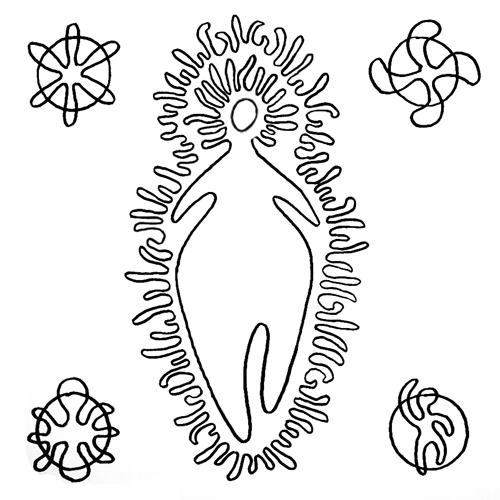
Mari, depicted in her "Woman of Fire"
guise (with squiggly bits) (CC2.5)
Nearby, and easily seen from the crossroads, is the Santuario de San Antonio. One of the largest and most revered shrines in the region, it occupies a site believed to have been the home of Mari, the greatest deity in the pre-Christian Basque religion. There is a tradition involving suspiciously pagan, pseudo-Freudian imagery that a young woman can increase her chances of finding a male partner by sticking pins in a cloth kept in the church - a white-headed pin will bring her a blonde man, a black-headed pin a dark-haired man.

The descent is neither challenging nor steep, consisting of long straights broken up by wide, sweeping bends all the way to the Urunagako Urtegia lakes where, after 153.6km, the race joins the N-240. We continue southwards past Legutiano and over a bridge crossing one arm of the lakes, then arrive 2.4km later at a junction on the left with the A-3006. This leads us to a junction with the A-267 2km away, where the race turns left under the AP-1 motorway. After another 2km, it reaches Landa, entered by way of a right turn onto a much narrower road, then right again a few metres later for the A-3002. 4.2km later, it reaches Ullibarri-Gamboa - a village that feels as though it's on the coast, standing on the banks of a vast lake named after the community - before the route follows the banks of the lake all the way to the wide dam that created it, continuing south into the countryside. A wide right/left U-shaped bend 0.2km after the dam leads to a crossroads, then onward to a medium 90 degree right 0.46km before entering Arroiabe.

Iglesia de Arroiabe (CC3.0)
Arroiabe's population has doubled since 2000, turning it into the present day sprawling metropolis home to 62 people. The village's pretty church stands on the southern edge, maintaining an air of serene separation from the earthly activities of those who live nearby - it's an impressive sight. 1.5km later the race arrives at Mendibil before skirting past Arazua-Ubarrundia and traveling underneath the E-5 motorway to Gasteiz (Vitoria on Spanish language maps). At the next roundabout, the race turns left and continues to the Zurbanoko Atea with several speed humps, turning left and then right for the Hezeguneen Ibilbidea. Left again at the next roundabout leads up to the Bulevar de Salburua and under the railway, the left again at the next roundabout (a long, elongated version) carries the race along the Calle Venta de la Estrella and, having negotiated another roundabout, the Itturitxu Kalea before it becomes the Zumabide Kalea running up to yet another roundabout and the Maite Zúñiga Kalea. Left at the following roundabout exits along the Martin Fixz Kalea, which becomes the Tanis Agirrebengoa Kalea before a tight right turn onto the Gaztelako Atea.

Gasteiz (CC3.0)
A final left leads along the Gasteizko Hiriburua and the final section, a straight and flat 700m sprint with the finish line at 185km.

Gasteiz, home to almost a quarter of a million people, is Euskadi's second largest city. Tradition states that it was founded by Visigoth king Liuvigild in the 6th Century as an attempt to emulate the grand Roman cities left behind with the fall of the Empire. Should this be true, his choice of location proved wise - the community was ideally placed to act as a hub of trade and communication between the Spanish central plateau and the north-western European nations, ensuring rapid growth in size, importance and wealth. As a port, it benefited early on from a multicultural society, with people from all around the Mediterranean, Europe and the wider world adding their skills and knowledge to the culture. The Jewish Quarter was one of the most important in Spain, a centre of learning and philosophy, prior to the Expulsion in the 15th Century. Long after they had been pushed out or forced on pain of death to convert to Christianity, Gasteiz did not forget its Jews - the old Jewish cemetery is preserved as a park, with a monument commemorating their contributions to the city. Gasteizit earned city status in 1431. It was the site of the decisive Battle of Vitoria in 1813 when the combined Spanish, Portuguese and British armies defeated the French, effectively bringing French control of the nation to an end.

As has been the case in Bilbao, the Basques demonstrate their seemingly effortless ability to combine centuries-old and cutting-edge contemporary architecture in a harmonious whole in Gasteiz - there's nowhere else in the world where venerable palaces and churches sit side-by-side with shining towers of glass and steel quite so successfully as they do in Euskadi. Among the churches are the Catedral de Santa María (the Old Cathedral), itself an expression of that Basque skill as it combines elements from the 13th Century to the present, and the Catedral de María Inmaculada (the New Cathedral), which looks medieval but is in fact a product of the Gothic Revival during the early part of the 20th Century and is unique for its Art Nouveau interior decorations. Among ancient architecture, highlights include the remnants of the medieval defensive wall, once 900m in length and completely encompassing the city as it stood when the wall was constructed; the early 13th Century Torre de Doña Otxanda, a superb example of medieval defensive architecture now put to excellent use as a museum of and centre of research in natural sciences which counts the oldest specimen of a butterfly ever discovered among its exhibits; the Museum of Fine Arts, housed in one of the best examples of a Renaissance palace; and, nearby, the 13th Century Torre de Mendoza - no decorative stately home, this one, designed solely with strength and ability to withstand attack in mind, could perhaps best be described as looking "purposeful." It currently houses a museum of heraldry.

Bibat - the seamless combination of ancient and modern into a harmonious whole.
Could there be anywhere else that symbolises the Basque Country quite so well?
For those who appreciate the modern, the ARTIUM is as good a place the start as any. This stunning white structure, built in 2001/2002, houses the Basque Centre-Museum of Contemporary Art and includes works by many of the greatest names in 20th and 21st Century art including Picasso, Miró, Jake and Dinos Chapman, Muñoz and Dali. Also not to be missed is the remarkable Museum of Archaeology, somehow looking as though it was always meant to stand next to the Museo Fournier de Naipes (the playing card museum) despite being separated by several centuries and an ocean of architectural difference: the former is housed in a strikingly contemporary building, the latter in a fortified medieval mansion. The amorphous whole, known as Bibat, is highly symbolic of both Gasteiz and Euskadi; an embodiment of that Basque tendency to remember what was good in the past while always striving for a better future.

Predictions: Yesterday proved an amazing day for the Basques - not only did the Vuelta return to their nation for the first time in more than three decades, the Basque rider Igor Anton achieved a superb stage victory; everything they and the legions of Euskaltel-Euskadi fans around the world hoped for. Now, can they do the same today? Or will Bradley Wiggins, now that a GC triumph appears to be out of his grasp, cut his losses and try to at least win a stage? Whatever happens, there's a good chance we'll see Chris Froome make one last effort to grab back those 13 seconds and catch Cobo.

Weather: A little cooler than Stage 19, starting out at around 25C before shifting up and down the scale between this figure and a low of 20C as the altitude changes during the first 140km. Following that, it's be warmer - rising from 27 to 28C - in the final 45km. Light crosswinds are expected up to 112km, then a light tailiwind for the remainder. No rain is expected anywhere on the parcours, but clouds in the latter half mean there's an outside chance of a few drops.

More Stage Previews: click here.