Wednesday, 25 July 2012

Daily Cycling Facts 25.07.12

Ruslan Pidgornyy, born in Ukraine on this day in 1977, began his professional career with De Nardi-Pasta Montegrappa in 2002 and won the Giro del Friuli Venezia Giulia in 2003. He became National Road Race Champion in 2008. In 2004, Pidgornyy and team mate Yuriy Ivanov were sacked by the LPR-Piacenzi Management SRL team after they were accused of assaulting and robbing a woman working as a prostitute near Emilia in Italy. According to news reports at the time, the pair attempted to drag the woman into a car but were unsuccessful, then stole €150 from her - both men admitted their guilt. Two other members of the team, Dimitri Konyshev and Andrey Karpachev, were also arrested but were not sacked as they had apparently taken no active part in the attack. Pidgornyy was offered a contract with the Irish Tenax team the following year and remained with them for four years, later joining ISD-Neri for two seasons and ending his career with Vacansoleil-DCM in 2011.

Stage 4, Tour de France 1904
François Beaugendre, born in France on this day in 1880, rode in the 1903 Tour de France - the first ever held - and came ninth overall, 10h52'14" behind winner Maurice Garin. He entered again the following year and finished Stages 3 and 4 in third place, but then failed to start Stage 5; after numerous riders were disqualified some months after the race had ended, he became official winner of Stage 4 and leader of the race with an advantage of 25'15" over eventual General Classification winner Henri Cornet. Beaugendre rode the Tour again in 1907 and 1908, coming first fifth and then thirteenth, and retired in 1911. His brothers Joseph and Omer were also cyclists - Joseph rode the Tour in 1909, Omer - who won Paris-Tours in 1908 - in 1910.

Wilfried Trott, born in West Germany on this day in 1948, won the Rund um Köln a record three times (1972, 1976 and 1979).

Other cyclists born on this day: Matt Illingworth (Great Britain, 1968); Nacer Bouhanni (France, 1990); Alfred Letourneur (France, 1907); Jean Eudes Demaret (France, 1984); François Beaugendre (France, 1880); Guillaume Levarlet (France, 1985); Wladimir Belli (Italy, 1970); Gerardo Moncada (Colombia, 1962); Peter Riis Andersen (Denmark, 1980); Kosaku Takahashi (Japan, 1944); Robert Farrell (Trinidad and Tobago, 1949); Declan Lonergan (Ireland, 1969); Maurice Gillen (Luxembourg, 1895, died 1974); Per Digerud (Norway, 1933, died 1988); Masaki Inoue (Japan, 1979); Alfred Gaida (West Germany, 1951); Kouflu Alazar (Ethiopia, 1931).

Tuesday, 24 July 2012

Who Had The Blingest Team Bus?

So the 2012 Tour de France is over, and the sideburns won it - cue OBE, a few weeks in which white vans will give way to cyclists and a general feeling of well-being among British cyclists and fans.


That means it's now time to announce the results of another competition, one that runs alongside the General Classification, King of the Mountains, Points, Youth, Teams and Combativity. It's unofficial, but the sums of money involved are stupendous. It is, of course, the legendary Who Had The Blingest Team Bus? competition.

RadioShack-NissanTrek
RadioShack-NissanTrek's Mercedes (extra blingpoints for the Merc badge) is a fine-looking beast  - and driver Vinny, seen here earning extra pocket money by washing it, is not without his charms either. Hang on a minute, though... Yes! Thought as much! It's the just old LeopardTrek bus given a quick going-over with a can of Dulux "Hot Paprika!" That's not very conspicuous consumption, is it? Minus 20% for that!

However, RSNT have a secret. To save in fuel costs, the bus's engine was removed and the rear wheels were connected to Jens Voigt's stationary bike. This means that it now holds the record for Fastest Bus in the World. Serious bling is, therefore, won back. Also, extra points for replacing the alarm system with a lion.

Cost: N/A if Brian Nygaard paid for it.

RSNT Blingrating: 83%

AG2R-La Mondiale
AG2R-La Mondiale's bus really split opinion among the panel of judges: 30% were reminded of chocolate and liked it, 30% were reminded of poo and didn't, the rest were more interested in how skinny Maxime Bouet's thighs are or had sneaked out for a smoke. Therefore your beloved writer decided to throw democracy to the wind and decide it alone - and it's a thumbs-up, because when it's all shiny and glossy, that shade of brown does indeed look appealing.

It's still a rubbish colour for their shorts though.

Cost: A large enough chunk of the team's budget for there not to be enough left over to buy nicer shorts.

AG2R Blingrating: 70%

Lampre-ISD
Lampre-ISD's pink and blue kit doesn't appeal to everyone, though it's far more popular than the old ; but when the colourscheme is reduced to a few tasteful stripes on their Euromar bus it looks rather stylish. However, since both Lampre and ISD manufacture steel and presumably have access to welding equipment, they could have modified it and come up with a much better vehicle. Fans will, therefore, be very disappointed if Lampre show up next year in anything less impressive that this...
Cost: Probably a fair bit

Lampre blingrating: 10% - it's far too restrained and tasteful to be bling.

Garmin-Sharp
Now that they're co-sponsored by Sharp, Slipstream Sports have more electronic gadgets than the Starship Enterprise and Stephen Fry combined - at a loss as to what they should do with them all, they decided to grab considerable blingpoints by sticking a great big flat-screen TV on the outside of their bus, thus enabling fans to keep up with the action without the effort of actually turning around and facing the direction of the race. Guys, that is class.

Cost: More money than you will ever have in your life

Garmin-Sharp blingrating: 100%

Argos-Shimano

Argos-Shimano are so proud of their bus that they've uploaded a YouTube video showing it off - and they should be proud, too, because it's got a sick paintjob (as the kids would say) and enough gizmos to out-do any one of the modified hot-hatchbacks that hang around the carpark of your local McDonald's every Saturday night. It's also got a multi-screen entertainment system more than capable of pumping out phat beatz, earning the team their unique place as the only non-ProTour squad to make it through to the finals of this exclusive competition. The team has since announced that for the 2013 Tour, the bus will be fitted with a computerised Tyler Farrar detector that will automatically lock the doors and windows if he comes within 10 metres.

Cost: If the bus was filled with 1 Euro coins, it probably wouldn't be enough to buy another one.

Argos-Shimano blingrating: 72% (points deducted for that urinal - why would you want your team bus to look like a public lavvy?)

Orica-GreenEDGE
Other teams thought new kids on the block Orica-GreenEDGE had brought their own private jet when they rocked up to Liège in this barge - which, a highly impressed Ned Boulting reported, was a whole metre longer than Sky's bus! Precisely how long it is was never made clear; Ned tried to estimate it but couldn't due to the rear end of vehicle being over the horizon but, according to rumours doing the rounds at the race, GreenEDGE practiced for some of the shorter stages by riding from one end to the other on the inside as it was being driven to the day's stage town (they didn't practice for the longer stages in the same way, though - that'd just be silly).

According to the International Ned Boulting Fan Club, what really impressed Ned was not the length nor even the revolutionary crash-proof front (achieved by making it an exact copy of a Nokia 3210 cellphone) - it was the on-board fully-fitted washing machine. That, ladies and gents, is bling incarnate.

Cost: Australia's entire GDP between 2006-2011

GreenEDGE blingrating: 100%.

Sky


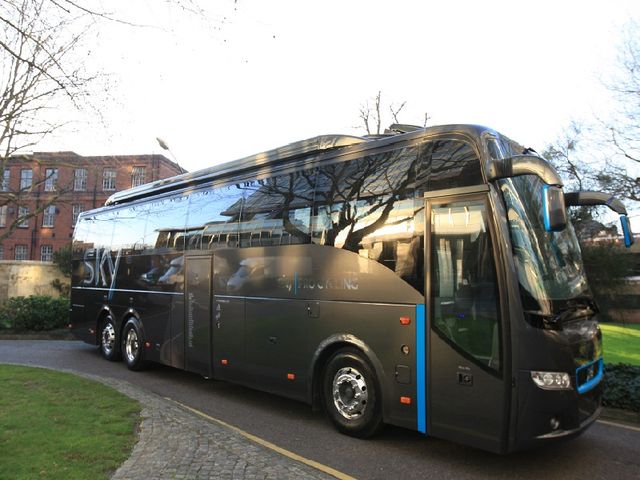
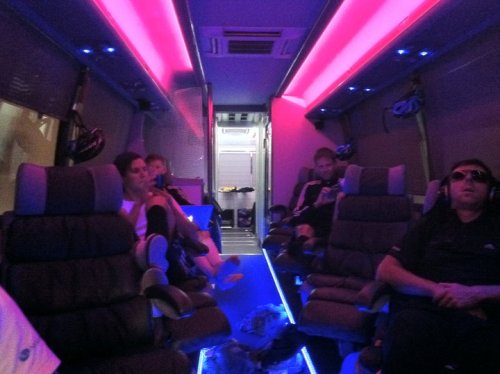
This is Sky ProCycling's Volvo 9700 Tri-Axle and, no matter where you live, it is better than your house. Stood on end, it would overtake The Shard as Europe's tallest building and it comes fully equipped for intergalactic travel - when in orbit around Earth, it eclipses the sun. It has nine leather seats, sleeping facilities, two showers, two toilets (with super-luxury quilted bog roll), an office that can be converted into a massage suite and - a real essential for nine young men on a road trip - mood lighting. The 10 million watt sound system has reportedly now been reprogrammed to make it unable to play Lesley Garrett CDs.

Cost: probably enough to finance a thousand women's teams for ten years/end world hunger (probably both, with enough change for a bag of chips on the way home), but not nearly as much as sponsor Rupert Murdoch saves through tax avoidance each year.

Sky Blingrating: 95% - judges originally gave it 100%, but deducted 5% when it was pointed out that it doesn't have 24-carat gold wheels.

And the winner is...
Garmin-Sharp and Orica-GreenEDGE both receive 100% blingratings for their mobile überhotels, with GreenEDGE just edging ahead due to theirs being longer than a Jackie Durand solo breakaway. However, while it's not the biggest, Sky's bus with its massage suite is a hard to beat. That they have not one, but two of the monsters means that Sky ProCycling are hereby declared winners of the 2012 Tour de France Who Had The Blingest Bus? competition. Let our rejoicing be without boundaries, and so on.

Team GB prepare for the Games


The Cycle Show review

I had great hopes right from the moment this show was announced: after all, ITV4 (the broadcaster) and Century TV (the producers) seem intent on working together to ensure that the channel becomes "the home of cycling on British TV" - Eurosport having lost their claims to that title in the eyes of many cyclists when they decided to drop their coverage of an important stage at the Giro d'Italia this year in favour of motorsport.

Century TV operations director Sharon Fuller says that the show has been in the pipeline for two years, and it shows. Initial impressions were promising: it appears well-polished and the graphics, film quality and sound are excellent - this is a show in a much higher class to some of the cycling programmes that serve as little more than filler on certain cable/satellite stations. Main presenter Graham Little makes a good job of it too; his background in journalism combined with love of cycling (he began his professional career with Irish newspaper The Impartial Reporter and was team leader of the victorious squad at the 2009 Race Around Ireland) means that he is ideally suited to the show.

Co-presenter Rob Hayles hosted a segment filmed on Box Hill, the biggest climb on the Olympic road race course and a route familiar to many British cyclists. This also proved successful - while not imparting a great deal of information about the hill, hill climbing technique or the many races that have taken place there, there should always be space in any cycling show for the glorious sight of a peloton gaining altitude. The non-stop, low-volume background music throughout the segment was vaguely irritating, but that may be down to personal preference rather than anything else: for me, the most fitting soundtrack to cycling is screaming 900bpm splittercore techno; if you prefer relatively sedate generic rock (and most people do) you probably didn't even notice it. Meanwhile, we saw very little of Anna Glowinski, who only really appeared in the taster section for next week's show - I suspect that since each episode is only half and hour long (22 minutes with adverts), Glowinski and Hayles will have their time in the spotlight on alternative weeks.

The Cycle Show promises a heady brew of road cycling, MTB, BMX, commuting, leisure cycling, race coverage, bike and kit reviews, maintenance, safety, trivia and - most importantly, for many - "balanced coverage of women's cycling," the latter being especially welcome since women's cycling receives precious little coverage elsewhere. In episode one we were limited to the Box Hill segment and a short piece on cycling in cities (which was all good, practical advice; some viewers will doubtless take issue with guest and Team UK Youth owner Nigel Mansell's insistence that we should all wear helmets, but the issue is so contentious and emotive that it's not really worth discussing until somebody comes up with solid data either in favour or against); however, this being the first episode of a new series, much of the show was given over to introductory material - we'll see how things pan out in the coming weeks and whether it really is going to become the first show to give women's cycling the attention it so deserves, perhaps even put it on an equal footing with men's cycling.

Highlights
Graeme Obree, as ever, was interesting, impressive, likable, animated and articulate. The man truly is a national treasure and a genius in the best "pottering about in the garden shed" tradition; his willingness to show off his new record-attempt bike "Beastie" in these times when the big bike companies' R&D departments keep new machines under tighter wraps than Lockheed Martin's latest Skunk Works  stealth project was as refreshing. The bike, and the man himself, are fascinating.

The third guest was the very venerable Gary Fisher, one of the men credited as inventor of the mountain bike (and certainly one of the most important figures in its development from clunker to modern hi-tech thoroughbred. Fisher got to say little, giving the impression that he'd been included at the last moment simply due to being in London at the time, but his obvious admiration for Obree and the Scotsman's achievements was a highlight of the show - as was his very remarkable facial hair. The Rollapaluza roller sprint - in which Obree and Fisher went head-to-head on a pair of stationary bikes hooked up to a giant analogue meter - was a lot of fun and should prove a popular feature in future shows, and Century TV have dropped heavy hints that next week's guest Eddy Merkcx will be having a go.

Conclusion
All British cyclists should watch this show - first impressions are extremely promising and it has massive potential to become a uniting force in our sport. Fuller says that "If viewers get behind this series there will be more chance of being able to make a second series, and perhaps a series with one hour per show." They've already been given a massive boost by Bradley Wiggins' Tour success, with predicted viewing figures doubling from 250,000 to half a million overnight and a one-hour format would allow far broader coverage of cycling in general, this would dramatically increase the show's appeal. The only real criticism was the ITV4 continuity announcer talking over the "this show is sponsored by Chain Reaction Cycles" bit at the end of the closing credits - Chain Reaction have stumped up no less than 90% of the production costs and without their backing the show would never have happened, they deserve, therefore, to get their money's worth.

Episode 1 of The Cycle Show is also available on iPlayer and will be repeated at 16:45 on Saturday the 28th of July and at 10:50 on Sunday the 29th (both ITV4). Episode 2 airs at 20:00, Monday the  30th of July.


Early viewing figures have been greater than expected and, as a result, from the 13th of August each episode will be one hour long!


For a specialised listing of all the cycling on British TV over this week, click here.

Daily Cycling Facts 24.07.12

Ferdinand Kübler
Ferdinand Kübler
Born in Marthalen, Switzerland in 1919, Ferdinand Kübler - commonly called Ferdi, though he prefers Ferdy - is 93 years old today: making the oldest surviving Tour de France winner in the world today and the longest lived Tour winner in history. In his best years, Ferdy was like no rider seen before: an uncontrollable, impulsive, unstoppable rider every bit as likely to throw his chances away in a suicidal attack as to impress with his enormous talent. His career was ended by no less an opponent than Mont Ventoux, and he won more than 400 victories during his career. Had he not have been limited to Swiss races in the early days by the Nazi occupation of Europe, he might easily have come closer to Eddy Merckx's record 525.

Kübler's professional career began with the Cilo team in 1940 and he became National Pursuit Champion on the track that year; he kept the title and won a stage at the Tour de Suisse the following year when he rode for the P. Egli Rad team. In 1942 he won the National Hill Climb Championship and the General Classification at the Tour de Suisse, then in 1943 he won the Pursuit Championship for a third time. In 1944 and 1945, he won A Travers Lausanne for the fourth and then fifth time and, in the latter year, also became National Cyclo Cross Champion; with the war over he was free to compete in foreign events but had a quiet year. He entered the Tour de France with the Tebag team in 1947 and won Stages 1 and 5, wearing the maillot jaune for one day and abandoning in Stage 7; having won the National Road Race Championship, the Tour de Romandie and the Tour de Suisse in 1948 he returned to the Tour in 1949 (having won the National Road Race Championship again) and won Stage 5, this time he abandoned in Stage 18. Later that year he won the silver medal at the World Road Race Championships.

There are those who say that had Fauto Coppi not have broken his pelvis at the Giro d'Italia and had Gino Bartali's Italian team have stayed in the race instead of going with him when he abandoned after allegedly being threatened by a man with a knife, Kübler would not have won the 1950 Tour de France. Coppi may indeed have won if he was able to race; but he wasn't and that's how cycling works, so that point is irrelevant. Bartali was aging and coming to the end of his career - he had been one of the greatest Tour riders ever seen and was still capable of beating far younger men in the mountains, but in this edition the time trials counted for a great deal and he wasn't as fast as he once was. Magni, meanwhile, was a superb rider in the flat time trials, as can be seen by his second place finish in Stage 6 when he was only 17" behind Kübler; but he wasn't much of a climber. Kübler could climb and time trial, so it seems that his insistence that he'd have won regardless is probably correct. Either way, it was a fair-and-square victory and we'll never know what might have been. It should also be remembered that he had phenomenal form that year, winning thirteen other races, fourth place overall at the Giro and three Tour stages.

Kübler on the Tour, 1950
Kübler met his match on the 18th of July in 1955, the day his impulsiveness led him to make a serious mistake - underestimating Ventoux. The old volcano wasn't in the mood to go easy on anyone that day - as Jean Malléjac discovered, not even realised he'd collapsed when the doctors got to him, lying flat on the stony ground with one leg still trying to turn the pedals; and he didn't regain consciousness for a quarter of an hour (he was one of six men to collapse that day). Kübler had believed himself able to tame the mountain. Raphaël Géminiani tried to warn him: "Watch out, Ferdy - the Ventoux is not like any other col." Kübler, with his curious habit of referring to himself in the third person, replied: "Ferdy is not like any other rider." Then he tried to sprint to the summit, and hadn't got very far before he was reduced to begging for a push from spectators to get over. On the way down, ashen-faced and in a cold sweat, he found a bar and started drinking heavily - other customers persuaded him to continue and got him back on his bike, but he set off in the wrong direction and finished in 42nd place. "He is too old, Ferdy; he is to sick - Ferdy has killed himelf on the Ventoux," he told a press conference that night, then abandoned and never returned to the Tour. He won three races the following year, then retired in 1957.

After his racing years came to an end, Ferdy bought a flower shop and became manager of the Italian Gazzola team, home to Charly Gaul; another rider who sometimes foamed at the mouth when climbing, but one to whom even Ventoux paid respect. He was also a friend of Tom Simpson, who bore a passing resemblance to him - Simpson, of course, died on Ventoux in 1968. Kübler is still involved in Tour de Suisse public relations work to this day.

Daniel Morelon 
Daniel Morelon, born in Bourg-en-Bresse on this day in 1944, began cycling after going to see some races with his father and two older brothers. Having originally dreamed of a career as a road racer, he developed an interest in track cycling after watching Sante Gaiardoni winning the gold medals for the 1,000m Time Trial and Sprint at the 1960 Olympics; decided that his future lay in the velodrome, he entered his first race two years later and crashed (due to forgetting that he was on a fixed-gear bike, he said) yet still finished second behind Pierre Trentin, who would become his great rival.

On 1963, Morelon was summoned to complete his National Service with the French Army and joined the Insep National Sports Institute, which brought him into contact with coaches and training levels operating at the top levels of cycling. Within a year, he was specialising in the Sprint and was able to beat then World Champion Patrick Sercu - and two years later, he was World Champion himself: as he would be again in 1967, 1969, 1970, 1971, 1973 and 1975. Despite their rivarly, Morelon and Trentin often rode together in tandem events and became World Champions in 1966.

Morelon retired in 1977 and became National Coach; however, in 1980 he returned to competition and won silver for the Keirin and bronze for the Sprint at the European Championships. In 1990 he became chief of a training facility in Hyeres, where he coached Laurent Gané and developed a new rivalry with his Parisian counterpart Gérard Quintyn, the coach responsible for Florian Rousseau. Both men retired following the 2004 Olympics; while Morelon was taken on by the Italian team prior to the 2008 Games he decided instead to work for the Chinese, coaching Guo Shuang.


Josef Fuchs, born in Einseideln, Switzerland on this day in 1948, won Liège-Bastogne-Liège in 1981.

Daisuke Imanaka, who was born in Hiroshima on this day in 1963, became the second Japanese rider to ride the Giro d'Italia (1995) and the Tour de France (1996).

Cyclists born on this day: Gerard Bosch van Drakestein (Netherlands, 1887, died 1972); Deb Murrell (Great Britain, 1966); Radiša Čubrić (Yugoslavia, later Serbia, 1962); Alberto Ongarato (Italy, 1975); Levi Heimans (Netherlands, 1985); Bob Downs (Great Britain, 1955); Aitor Pérez (Euskadi, 1977); Gabriele Missaglia (Italy, 1970); Adriano Durante (1940); Bjørn Stiler (Denmark, 1911); Bent Pedersen (Denmark, 1945); Heinz Richter (East Germany, 1947); Vratislav Šustr (Czechoslovakia, 1959); Arturo Gériz (Spain, 1964); Dania Pérez (Cuba, 1973); Tanasije Kuvalja (Yugoslavia, 1946); Kleanthis Barngas (Greece, 1978); Robert Pfarr (USA, 1920, died 2006).

Monday, 23 July 2012

Daily Cycling Facts 23.07.12

Judith Arndt
Born in Königs Wusterhausen, Germany on this day in 1976, Judith Arndt has become one of the greatest all-rounders in cycling with numerous excellent results in road racing, time trials and on the track.

Arndt turned professional with the Red Bull team in 1999, at a time when she already had five National titles and one World Championship to her name. As a result she did not experience a year or two in which her results dipped while she adjusted to the increased competition as most riders do when they move up to the top level of the sport - having been competing at Elite level since 1995, there was no nasty surprise waiting for her and in that first year she won Stage 1 and second place in the overall General Classification at the Holland Ladies' Tour, the Tour de Bretagne and numerous other events. She was a popular favourite for the 2000 Olympics but picked up a virus shortly before the Games; however, the National Pursuit and Points race prevented the year from becoming a total wash-out, as did silver medals for the same two events at the World Championships.

2001 was the year in which Arndt transformed herself from a track rider who could also ride well on the road into a world-beating road racer, winning another Tour de Bretagne and the Gracia Orlova in addition to second place at the Tour de l'Aude, the Thüringen-Rundfahrt and the Women's Challenge. She also won the National Individual Time Trial Championship for a third time and came third in the Road Race at the Nationals. One year later she won the National Road Race, the Women's Challenge, the Tour de l'Aude, the Tour de Snowy and the Redlands Classic. Since then, she has added more three more victories at the Gracia Orlova (2005, 2006, 2007), another Tour de l'Aude (2003), two editions of the Emakumeen Bira (2009, 2012), the National Individual Time Trial title another six times (2003, 2004, 2005, 2010, 2011, 2012), the Tour of Qatar (2012), two editions of the Ronde van Vlaanderen (2008, 2012), numerous other races and a vast number of other podium places.

Sometimes outspoken, Arndt has clashed with the German cycling federation in the past. The most notable example of this came in 2004 when she raised her finger at the judges as she crossed the line (the gesture means "fuck off") to show what she thought of the Federation's decision not to select her long-term partner Petra Rossner in the Olympic team (Rossner won the World Cup in 2002 and had become National Road Race Champion two months before the Games; it does, therefore, seem strange that she wasn't selected). The Federation, as tends to be the way with national cycling federations, didn't take kindly to being criticised by a rider and forced Arndt to apologise; nevertheless, she earned an army of new fans.

Roger Hassenforder
Since the earliest days of the sport, cycling has been populated by eccentrics and characters - one of the most amusing of them all was Roger Hassenforder, who was born in Sausheim, France on this day in 1930 and became known as le boute-en-train ("the merry-maker") to the French and de Clown van de Elzas ("the Clown of Alsace") the the Dutch and Flemish. One of his most popular stunts was giving interviews during races, including the Tour de France.

Most cyclists rarely win anything, some win many races and a few will enjoy success at the Tour. Hassenforder was an unusual case in that almost all of his successes came in the Tour and he won very few smaller events - he won a total of eight Tour stages, including four in 1956 alone, and wore the maillot jaune for four days in 1953. Yet, he never won a Tour and in fact finished just one of the sixth he entered: 1956 when, despite those four stage wins, he was 50th overall.

When Hassenforder retired, he opened a cafe at Kaysersberg, one of the most beautiful and historic towns in the Alsace. It rapidly became a favourite haunt of local cyclists and those who visited from around the world, growing into a restaurant and hotel - it can still be found at 129 Rue General de Gaulle and, while no longer owned by the Hassenforder family, the new owners have been wise enough to keep it as the rider intended and maintain its cycling links.


The Basque cyclist David Etxebarria, born in Abadiño on this day in 1973, won the Tour de l'Avenir in 1996 and Stages 9 and 12 at the Tour de France in 1999.

Jean Fontenay, who was born in Hirel on this day in 1911, came second overall at Paris-Nice in 1936 and wore the maillot jaune for two stages in the 1939 Tour de France.

Jörg Jaksche, born in Fürth, Germany on this day in 1976, won Paris-Nice and the Tour Méditerranéen in 2004, then came 16th overall at the Tour de France the following year. In 2006 he was one of the nine riders blocked from taking part in the Tour as part of the Operación Puerto investigation; in 2007 he admitted that he was "Bella," one of the code names used in documents seized from Dr. Eufemiano Fuentes, and that he had received blood transfusions administered by the doctor.

Cyclists born on this day: Daniela Gassmann (Switzerland, 1964); Oleksandr Kvachuk (USSR/Ukraine, 1983); Rik Verbrugghe (Belgium, 1974); José Pittaro (Argentina, 1946); Hans-Peter Jakst (West Germany, 1954); Ali Ben Ali (Tunisia, 1933); Olaf Meyland-Smith (Denmark, 1882, died 1924); Benny Deschrooder (Belgium, 1980); Zoltán Halász (Hungary, 1960); Roberto Lezaun (Spain, 1967).

Sunday, 22 July 2012

Daily Cycling Facts 22.07.12


On this day in 2012, Bradley Wiggins became the first British winner in the history of the Tour de France.


Giovanni Battaglin
Born in Marostica on this day in 1951, Giovanni Battaglin became one of the shining lights of Italian cycling at a time when it seemed the Belgians were going to take the sport over completely.

Battaglin first came to note in 1972 when he won the Baby Giro, the amateur version of the Giro d'Italia, which brought immediate offers to turn professional. He chose Jolljceramica and would remain with them for five seasons - and in his first year, aged only 21, amazed the cycling world by finishing third overall in the General Classification (behind Eddy Merckx and Felice Gimondi) and King of the Mountains (behind José Manuel Fuente and Merckx) at the Giro d'Italia. These were truly remarkable results: a serious new talent had arrived and some wondered if Battaglin might even prove a greater rider than Merckx, who was then at the height of his powers.

In 1974 he finished sixth, proving that he could repeat his good performance; in 1975 he won a stage for the first time (Stage 13, an individual time trial) but didn't finish the race, later that year he rode his first Tour de France and finished two stages in the top ten but once again couldn't finish the race. In 1976 he won Stage 2 at the Tour but failed to finish for the second time and in 1978 he won Stages 6, 7 and 8 at the Tour de Suisse.

1979 would be Battaglin's real breakthrough year with General Classification victory at the Tour of the Basque Country and the King of the Mountains at the Tour de France, where he was sixth overall despite receiving a penalty when he failed an anti-doping test. He won Stage 18 and came third overall at the Giro a year later, but his career thus far was merely a run-up to 1981 - the year that he won the Vuelta a Espana courtesy of a superb ride by his Inoxpran team in the Stage 10 mountain team time trial, then began the Giro three days after the Vuelta ended. He took the lead in Stage 19 and kept it for the remainder of the race, becoming the second man (after Merckx in 1973) to win the Vuelta and Giro in a single season.

He rode the Tour again in 1982 and 1984, but had nothing like his earlier success: his best placing was 46th for Stage 3 in 1982. He did, meanwhile, manage third place for Stage 9 at the Giro in 1984, but it was obvious that for Battaglin the best years came early and he retired later that year. The bike company he started in 1982 is still in operation, its products are among the most desirable bikes in the world.


Rasa Leleivytė
Three-time Lithuanian National Champion Rasa Leleivytė, born in Vilnius on this day in 1988, became World Junior Champion in 2006 and won the GP Città di Cornaredo in 2011. On the 18th of July 2012, the UCI revealed that an out-of-competition sample she provided on the 12th of June had tested positive for EPO; she was provisionally suspended pending investigation.

Pascale Jules, born in La Garenne-Colombes on this day in 1961, won Stage 8 at the 1984 Tour de France. He was a close friend of Laurent Fignon and rode with him on the Renault-Elf team, the pair of them hoping to become the successors to Bernard Hinault, but moved to Seat-Orbea following a row with team manager Cyrille Guimard.

Jean-Claude Leclercq, born in Abbeville on this day in 1962, was French National Road Race Champion in 1985.

Jean-Claude Lebaube, born in Renneville on this day in 1937, wore the yellow jersey of the Tour de France for one day after Stage 11 in 1966. He was fourth in the overall General Classification at the 1963 Tour and fifth in 1965.

Cyclists born on this day: Ryan Anderson (Canada, 1987); Sam Bewley (New Zealand, 1987); Dries Devenyns (Belgium, 1983); Janek Tombak (USSR/Estonia, 1976); Pascal Jules (France, 1961); Patrick McDonough (USA, 1961); Francisco Pérez Sanchez (Spain, 1978); Godtfred Olsen (Denmark, 1883, died 1954); Pakanit Boriharnvanakhet (Thailand, 1949); Akio Kuwazawa (Japan, 1959); José Prieto(Cuba, 1949); Hjalmar Väre (Finland, 1892, died 1952); Max Triebsch (Germany, 1885); Daniel Amardeilh (France, 1959); Frits Schür (Netherlands, 1950); Bojan Udovic (Yugoslavia, 1957); Rufin Molomadan (Central African Republic, 1967); Jukka Heinikainen (Finland, 1972); Koloman Sovic (Yugoslavia, 1899, died 1971); Sjaak Pieters (Netherlands, 1957); Mario Vanegas (Colombia, 1939).