Showing posts with label Kübler. Show all posts

Thursday, 24 July 2014

Daily Cycling Facts 24.07.2014

Ferdinand Kübler
Ferdinand Kübler
Born in Marthalen, Switzerland in 1919, Ferdinand Kübler - commonly called Ferdi, though he prefers Ferdy - is the oldest surviving Tour de France winner in the world and the longest lived Tour winner in history. In his best years, Ferdy was like no rider seen before: an uncontrollable, impulsive, unstoppable rider every bit as likely to throw his chances away in a suicidal attack as to impress with his enormous talent. Ending his career took no less an opponent than Mont Ventoux, and he won more than 400 victories. Had he not have been limited to Swiss races in the early days of his career by the Nazi occupation of Europe, he might easily have come closer to Eddy Merckx's record of 525.

Kübler's professional career began with the Cilo team in 1940 and he became National Pursuit Champion on the track that year; he kept the title and won a stage at the Tour de Suisse the following year when he rode for the P. Egli Rad team. In 1942 he won the National Hill Climb Championship and the General Classification at the Tour de Suisse, then in 1943 he won the Pursuit Championship for a third time. In 1944 and 1945, he won A Travers Lausanne for the fourth and then fifth time and, in the latter year, also became National Cyclo Cross Champion; with the war over he was free to compete in foreign events but had a quiet year. He entered the Tour de France with the Tebag team in 1947 and won Stages 1 and 5, wearing the maillot jaune for one day and abandoning in Stage 7; having won the National Road Race Championship, the Tour de Romandie and the Tour de Suisse in 1948 he returned to the Tour in 1949 (having won the National Road Race Championship again) and won Stage 5, this time he abandoned in Stage 18. Later that year he won the silver medal at the World Road Race Championships.

There are those who say that had Fauto Coppi not have broken his pelvis at the Giro d'Italia and had Gino Bartali's Italian team have stayed in the race instead of going with him when he abandoned after allegedly being threatened by a man with a knife, Kübler would not have won the 1950 Tour de France. Coppi may indeed have won if he was able to race; but he wasn't and that's how cycling works, so that point is irrelevant. Bartali was aging and coming to the end of his career - he had been one of the greatest Tour riders ever seen and was still capable of beating far younger men in the mountains, but in this edition the time trials counted for a great deal and he wasn't as fast as he once was. Magni, meanwhile, was a superb rider in the flat time trials, as can be seen by his second place finish in Stage 6 when he was only 17" behind Kübler; but he wasn't much of a climber. Kübler could climb and time trial, so it seems that his insistence that he'd have won regardless is probably correct. Either way, it was a fair-and-square victory and we'll never know what might have been. It should also be remembered that he had phenomenal form that year, winning thirteen other races, fourth place overall at the Giro and three Tour stages.

Kübler on the Tour, 1950
Kübler met his match on the 18th of July in 1955, the day his impulsiveness led him to make a serious mistake - underestimating Ventoux. The Giant of Provence wasn't in the mood to go easy on anyone that day, as Jean Malléjac discovered, not even realising what was happening to him when he collapsed on the seared asphalt - when the doctors got to Malléjac they found him lying flat on the stony ground with one leg still trying to turn the pedals and he didn't regain consciousness for a quarter of an hour (he wasn't the only one - no fewer than six men collapsed and needed medical assistance that day).

Kübler had believed himself able to tame the mountain. Raphaël Géminiani tried to warn him: "Watch out, Ferdy - the Ventoux is not like any other col." Kübler, with his curious habit of referring to himself in the third person, replied: "Ferdy is not like any other rider." Then he tried to sprint to the summit, and hadn't got very far before he was reduced to begging for a push from spectators to get over. On the way down, ashen-faced and in a cold sweat, he found a bar and started drinking heavily - other customers persuaded him to continue and got him back on his bike, but he set off in the wrong direction and finished in 42nd place. "He is too old, Ferdy; he is to sick - Ferdy has killed himelf on the Ventoux," he told a press conference that night, then abandoned and never returned to the Tour. He won three races the following year, then retired in 1957.

After his racing years came to an end, Ferdy bought a flower shop and became manager of the Italian Gazzola team, home to Charly Gaul; another rider who sometimes foamed at the mouth when climbing, but a climber to whom even Ventoux paid respect. He was also a friend of Tom Simpson, who bore a passing resemblance to him - Simpson, of course, died on Ventoux in 1968. Kübler is still involved in Tour de Suisse public relations work to this day.

Daniel Morelon 
Daniel Morelon, born in Bourg-en-Bresse on this day in 1944, began cycling after going to see some races with his father and two older brothers. Having originally dreamed of a career as a road racer, he developed an interest in track cycling after watching Sante Gaiardoni winning the gold medals for the 1,000m Time Trial and Sprint at the 1960 Olympics; decided that his future lay in the velodrome, he entered his first race two years later and crashed (due to forgetting that he was on a fixed-gear bike, he said) yet still finished second behind Pierre Trentin, who would become his great rival.

In 1963, Morelon was summoned to complete his National Service with the French Army and joined the Insep National Sports Institute, which brought him into contact with coaches and training levels operating at the top levels of cycling. Within a year, he was specialising in the Sprint and was able to beat then World Champion Patrick Sercu - and two years later, he was World Champion himself: as he would be again in 1967, 1969, 1970, 1971, 1973 and 1975. Despite their rivarly, Morelon and Trentin often rode together in tandem events and became World Champions in 1966.

Morelon retired in 1977 and became National Coach; however, in 1980 he returned to competition and won silver for the Keirin and bronze for the Sprint at the European Championships. In 1990 he became chief of a training facility in Hyeres, where he coached Laurent Gané and developed a new rivalry with his Parisian counterpart Gérard Quintyn, the coach responsible for Florian Rousseau. Both men retired following the 2004 Olympics; while Morelon was taken on by the Italian team prior to the 2008 Games he decided instead to work for the Chinese, coaching Guo Shuang.


Josef Fuchs, born in Einseideln, Switzerland on this day in 1948, won Liège-Bastogne-Liège in 1981.

Daisuke Imanaka, who was born in Hiroshima on this day in 1963, became the second Japanese rider to ride the Giro d'Italia (1995) and the Tour de France (1996).

Cyclists born on this day: Gerard Bosch van Drakestein (Netherlands, 1887, died 1972); Deb Murrell (Great Britain, 1966); Radiša Čubrić (Yugoslavia, later Serbia, 1962); Alberto Ongarato (Italy, 1975); Levi Heimans (Netherlands, 1985); Bob Downs (Great Britain, 1955); Aitor Pérez (Euskadi, 1977); Gabriele Missaglia (Italy, 1970); Adriano Durante (1940); Bjørn Stiler (Denmark, 1911); Bent Pedersen (Denmark, 1945); Heinz Richter (East Germany, 1947); Vratislav Šustr (Czechoslovakia, 1959); Arturo Gériz (Spain, 1964); Dania Pérez (Cuba, 1973); Tanasije Kuvalja (Yugoslavia, 1946); Kleanthis Barngas (Greece, 1978); Robert Pfarr (USA, 1920, died 2006).

Tuesday, 8 July 2014

Daily Cycling Facts 08.07.2014

The Tour de France has started on the date twice, in 1907 and 1954.

1907
Stage 3, 1907
14 stages, 4,488km.
In any Tour, the winner of the last edition is usually considered the favourite; in 1907 René Pottier could not be due to tragic circumstances - some time around Christmas and the New Year, he'd discovered that while he was away winning the 1906 Tour his wife had been having an affair and, on the 25th of January, he hanged himself. Louis Trousselier, Emile Georget and François Faber were considered most likely to replace him and, for the first time, favourites achieved something like modern celebrity status with newspapers and magazines publishing biographies, back stories and gossip. For the second time, the race ventured outside France - in 1906 it had gone into German-controlled Alsace-Lorraine, it did so again when it visited Metz but under notably different conditions: with relations between Europe's great powers deteriorating fast, the French flag was strictly banned once the race passed the border and the official cars were not permitted to go with the riders. Curiously, one of the biggest problems was caused on the way back into France - French customs held the riders up for so long that the race had to be halted and restarted once they'd finished. During Stage 4 from Belfort to Lyon, the race passed through Romandy - the first time it had ever been to Switzerland. It was also the first time that the Alps were specifically included for the challenge they presented, rather than simply because they happened to be between stage towns, Henri Desgrange having been persuaded by the popularity of the Vosges and Massif Central stages in the previous two years that his fears the riders would be attacked by bandits or eaten by bears was worth the risk. Because of this added hardship, the coureurs de vitesse (riders sponsored by trade teams, but expected to ride for themselves alone) were permitted to receive help from mechanics following the race in cars and could even continue on a replacement bike if their machine was declared beyond repair by a course official. Coureurs sur machines poinçonnées (later known as touriste-routiers and then independents before being barred from entry) received either limited sponsorship, perhaps being supplied with a bike, or none at all and were expected to carry out all repairs themselves and to complete the race with only one bike.

Georget's crash, 1907
Trousselier won the first stage by 3'30; Georget beat him by a tiny margin and moved into third overall on Stage 2 in Metz but judges decided for unclear reasons that they should be awarded joint first place. Trousselier nevertheless remained in first place overall with a four point advantage (Cadolle, in second place, was three points down). When Georget won Stage 3 he moved into first, leading Trousselier by a point. Cadolle was now third with a three point disadvantage and thus remained in second place after Stage 4, despite beating Georget by a second. On Stage 5 Georget and Faber led the race together over the 500m Les Eschelles, but when they arrived at 1,326, Col du Porte Faber, who was much bigger and heavier, found himself outclassed; Georget left him behind and won the stage by 7', increasing his lead to seven points. He then came second behind Georges Passerieu on Stage 6, but Passerieu was too far down in the General Classification for a stage victory to make any meaningful difference - Cadolle was fifth, crossing the line 27' later and Georget's advantage rose to ten points. On the next stage, Cadolle crashed and fell onto his bike, ending up with a piece of flesh ripped from his knee by the handlebars. With his biggest rival gone, Georget won that stage and the next - by the end of Stage 8, his advantage was 16 points.

During Stage 9, Georget arrived at a checkpoint where riders had to stop and sign their names to prove they'd followed the route and not taken shortcuts (or, as was quite common in the early Tours, a train), and just as he arrived his frame snapped. What happened next is slightly mysterious: despite the race officials around the checkpoint meaning that any sort of rule-breaking would be spotted and punished, he decided that rather than losing time by waiting while his damaged bike was declared irreparable he'd just take one from his Peugeot-Wolver team mate Pierre Gonzague-Privat, who was so far behind overall that waiting for a decision and a replacement made little difference - was he completely ignorant of the rule, did he think that it would be overlooked (and anyone who knew anything about Tour officials and their legendary officiousness would surely be well aware that it would most definitely not) or was he told by an unknown person, perhaps an official bribed by another rider or team manager, that he could take his team mate's bike? More than a century later, we will probably never know. He was fined 500 francs, but ended with a 19.5 point advantage over Lucien Petit-Breton who moved into second place by winning the stage.

At Ville d'Avray, 1907
After Stage 9, Trousselier declared his belief that Georget's punishment was too light and left the race in protest, taking the entire Alcyon team with him. Organisers apparently felt the same because they then decided to relegate him from first place to last for that stage which, once his points for coming third on Stage 10 had been taken in account, gave him a 25.5 point overall disadvantage to new leader Petit-Breton who led stage winner and new General Classification second place Gustave Garrigou by 15 points. With four stages left, Georget's chances of winning were completely lost, and when Petit-Breton won Stage 11 and increased his lead to 17 points it began to look very much as though he was the most likely winner - he could only lose now if he abandoned.

Lucien Petit-Breton
Garrigou won Stage 12 but Petit-Breton was second, so his lead only dropped to 16 points. Georget had given up hope of overall victory but still crossed the finish line first in Stage 13, Petit-Breton was second again and so his advantage rose once more to 17 points; then he was third on the final stage and finished the race 19 points ahead. He was the first coureur sur machines poinçonnée to win a Tour, and the next year he became the first man to win a second Tour.

The majority of coureurs sur machines poinçonnée were poor and would sleep anywhere they could during the race, often spending the night in a barn or, sometimes, in a hedge; they would also eat whatever they could find along the way - in those days, when many of them would have been used to living as peasants, they'd have been adept at catching rabbits and birds and foraging for edible plants but they also sometimes lived on what the sponsored riders discarded (as happened in 1914, when a hungry poinçonnée eagerly pounced upon and devoured a half-eaten sandwich thrown away by a sponsored rider - who was promptly penalised by officials for providing assistance to a rider that wasn't part of his own team). Some, meanwhile, were wealthy men who entered the Tour for the adventure - and the most famous of them all was Henri Pépin. Pépin had no intention of winning the Tour and treated it all as a jolly jaunt around the countryside, taking with him a pair of men named Henri Gauban and Jean Dargassies (actually Dargaties, but Tour organisers misheard him and it stuck) whom he had hired to support him and act as manservants (and who, as a result, are the first riders to have ridden a Tour purely to support another rider rather than to attempt a win for themselves - the first domestiques, no less). Each night, at his expense, they slept in the finest hotel the stage town had to offer and every day they would select a restaurant along the route and dine in style. They were, therefore, far from the first riders over the line every day; in fact, they finished Stage 2 twelve hours and twenty minutes after winner Emile Georget, the more serious riders having set off at 5.30am while Pépin was engaged in what journalist Pierre Chany delicately termed "conversation with a lady" - they were not, however, last; four men finished after them. By all accounts, Desgrange was not impressed, but as the race was decided on points rather than times (hence no time limits) there was nothing he could do.
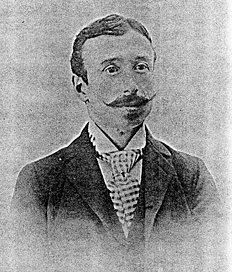
Henri  Pépin
The crowd didn't declare Pépin nothing but a useless, spoiled playboy as he was already well known to them and had proved himself an able cyclist many years earlier - he had been featured on the cover of Le Cycle magazine, when he was a member of Veloce Club de Marmande, and in 1897 he was vice-consul of the French cycling federation. Their good nature towards him, however, was deserved, even though he seems to have been rather keen to pass himself off as an aristocrat when he was not one: one day, he and his two comrades came across a rider named Jean-Marie Teychenne who had hit la fringale, then fallen into a ditch and was too hungry to pull himself out and continue. The man explained that he was finished and could be left until the broom wagon came for him.

"Nonsense!" Pépin told him, instructing Gauban and Dargassies to pull the man out of the ditch. "We are but three but we live well and we shall finish this race. We may not win, but we shall see France!" The three were now four, with Pépin happily paying for Teychenne to get a taste of the  highlife with them.

In Stage 5, Pépin decided he'd had enough of the game and paid his assistants a sum equal to the prize awarded to the race winner, then caught a train home. Dargassies - who, it appears, knew Pépin from the 1905 Tour which they had both ridden - went with him while Gauban elected to continue and did rather well for a while, narrowing the enormous gap between himself and the race leader to just 36 minutes, but was then beset by misfortune and abandoned during Stage 11. He had entered every Tour since it began, but this was his last. Dargassies also never entered again, but Pépin returned at the age of 49 and raced again in 1914, the year that he died of what was then termed "athleticism" - probably a coronary caused by an undetected heart defect.

Top Ten Final General Classification
1 Lucien Petit-Breton (FRA) Peugeot-Wolber 47 Poinçonnées
2 Gustave Garrigou (FRA) Peugeot-Wolber 66 Vitesse
3 Emile Georget (FRA) Peugeot-Wolber 74 Vitesse
4 Georges Passerieu (FRA) Peugeot-Wolber 85 Vitesse
5 François Beaugendre (FRA) Peugeot-Wolber 123 Poinçonnées
6 Eberardo Pavesi (ITA) Otav 150 Poinçonnées
7 François Faber (LUX) Labor-Dunlop 156 Poinçonnées
8 Augustin Ringeval (FRA) Labor-Dunlop 184 Vitesse
9 Aloïs Catteau (BEL) 196 Poinçonnées
10 Ferdinand Payan (FRA) 227 Poinçonnées


1954
23 stages (Stages 4 and 21 split into parts A and B), 4,656km.
Wagtmans, 1954
Two new features made their first appearance this year: split stages and team time trials - a few stages in the past had started with teams being sent off separately, but this was the first time that the time they recorded counted towards the General Classification. It was also the first time that the Tour started outside France, the Grand Départ being hosted by Amsterdam and the Stage 1 finish line by Brasschaat, also in the Netherlands - the Dutch national team were therefore determined to do well, and got their wish when Wout Wagtmans won on the first day and then remained in the yellow jersey until Stage 4a, the team time trial - which Switzerland won but saw the French team take back enough time to get Louison Bobet into the overall lead.

Bobet had won Stage 2, but the Swiss riders Ferdy Kübler and Hugo Koblet were right behind him: Koblet, who had won in 1951, was only a minute down in the General Classification at the end of the stage and Gilbert Bauvin just 30". However, it was early days yet and Bobet was a wise rider; he had, therefore, no intention of taking the lead just yet as defending it would require energy best saved for later on - and was probably quite surprised that the maillot jaune remained his when he finished outside the top ten for Stages 4b (during which the strange little climber Jean Robic collided with a photographer and abandoned the race) and 5, then ninth on Stages 6 and 7. In fact, it took until Stage 8 before Wagtmans managed to get into a breakaway and made up enough time to win it back.

Bahamontes on Tourmalet, 1954
Bauvin won Stage 10, the last plain parcours before the Pyrenees, and jumped from ninth to second overall. The next day, Wagtmans crashed - he finished the stage, but had noticeably lost all enthusiasm from that point and it was only by luck that he retained a 9" lead by the end. It didn't last long the next day, because Bauvin, Jean Malléjac and Federico Bahamontes were on him like a pride of lions with a wounded zebra, breaking away and heading off up the infamous Tourmalet/Aspin/Peyresourde Circle of Death like rocketships: by the end of Stage 12 Wagtmans  was 19'20" behind new leader Bauvin. That stage didn't go well for Koblet, either - he'd been a phenomenally talented rider at his best, but he was destined to be one of those riders that gets only a year or two at the top: he crashed, lost 27' and abandoned the following day. Ten years later, when he was 39, he was killed in a car crash that may have been suicide.

Ferdinand Kübler
Despite the loss of their leader, the Swiss team remained highly competitive and set a high pace in Stage 13 with the fiery Kübler driving the peloton at breakneck speed. Bauvin soon discovered that he'd used up far too much energy keeping up with Bahamontes (one of the greatest climbers of all time) the day before and found himself unable to keep up, losing significant time. Bobet could, and when the stage came to an end he'd moved back into first place overall with a 4'33" advantage. Over the coming days it became apparent that Kübler, who had won in 1950, meant to do so again and Bobet faced frequent, savage attacks when the Swiss team went to work on him, not even bothering to chase down the breakaway of also-rans that won the stage. With the average speed pushed high for the second consecutive day, Bauvin lost another 20' and was no longer a contender; meanwhile, Bobet responded to each and every attack - his advantage over Fritz Schär, who had been third after stage 15, remained 10'18" after Stage 16. Kübler and Schär both won back time during Stage 17, but then Bobet repeated his stunning 1953 ride over Izoard, dropping the entire peloton and upping his overall advantage to 12'49" - enough to have won the Tour, especially now that the Swiss were tiring after all that Kübler had asked of them (Kübler was a wonderfully impulsive rider who would throw everything away on a whim; riders like him have long since vanished). He didn't need to win the Stage 21b individual time trial, but when he did he beat Kübler by 2'30"; when the race came to an end two stages later his overall lead was 15'49".

Bobet on Izoard
Bahamontes won the King of the Mountains, the first of six (and he won overall in 1959 too); Kübler won the Points competition. Bobet was the fifth rider to have won two consecutive Tours and, later in the year, became the second man to have won both a Tour and the World Championships in a single season (the first was Georges Speicher in 1933). In a year's time, he would be the first to win three Tours consecutively.

Top Ten Final General Classification
1 Louison Bobet (FRA) France 140h 06' 05"
2 Ferdi Kübler (SUI) Switzerland +15' 49"
3 Fritz Schär (SUI) Switzerland +21' 46"
4 Jean Dotto (FRA) South East +28' 21"
5 Jean Malléjac (FRA) West +31' 38"
6 Stan Ockers (BEL) Belgium +36' 02"
7 Louis Bergaud (FRA) South West +37' 55"
8 Vincent Vitetta (FRA) South East +41' 14"
9 Jean Brankart (BEL) Belgium +42' 08"
10 Gilbert Bauvin (FRA) Center-North East +42' 21"


Cyclists born on this day: Jesse Sergent (New Zealand, 1988); Smaisuk Krisansuwan (Thailand, 1943); Christel Ferrier Bruneau (France, 1979); Mark Bristow (Great Britain, 1962); Jenny McCauley (Ireland, 1974); Otto Luedeke (USA, 1916, died 2005); James Jackson (Canada, 1908); Roberto Pagnin (Italy, 1962); Werner Karlsson (Sweden, 1887, died 1946); Paolo Tiralongo (Italy, 1977); Ivonne Kraft (West Germany, 1970); Bärbel Jungmeier (Austria, 1975); Bernard van de Kerckhove (Belgium, 1941); Stefano Colage (Italy, 1962); Jean-René Bernaudeau (France, 1956); Sven Johansson (Sweden, 1914, died 1982); Bill Messer (Great Britain, 1915); Serge Proulx (Canada, 1953).

Wednesday, 24 July 2013

Daily Cycling Facts 24.07.2013

Ferdinand Kübler
Ferdinand Kübler
Born in Marthalen, Switzerland in 1919, Ferdinand Kübler - commonly called Ferdi, though he prefers Ferdy - is 94 years old today: making him the oldest surviving Tour de France winner in the world and the longest lived Tour winner in history. In his best years, Ferdy was like no rider seen before: an uncontrollable, impulsive, unstoppable rider every bit as likely to throw his chances away in a suicidal attack as to impress with his enormous talent. Ending his career took no less an opponent than Mont Ventoux, and he won more than 400 victories. Had he not have been limited to Swiss races in the early days of his career by the Nazi occupation of Europe, he might easily have come closer to Eddy Merckx's record of 525.

Kübler's professional career began with the Cilo team in 1940 and he became National Pursuit Champion on the track that year; he kept the title and won a stage at the Tour de Suisse the following year when he rode for the P. Egli Rad team. In 1942 he won the National Hill Climb Championship and the General Classification at the Tour de Suisse, then in 1943 he won the Pursuit Championship for a third time. In 1944 and 1945, he won A Travers Lausanne for the fourth and then fifth time and, in the latter year, also became National Cyclo Cross Champion; with the war over he was free to compete in foreign events but had a quiet year. He entered the Tour de France with the Tebag team in 1947 and won Stages 1 and 5, wearing the maillot jaune for one day and abandoning in Stage 7; having won the National Road Race Championship, the Tour de Romandie and the Tour de Suisse in 1948 he returned to the Tour in 1949 (having won the National Road Race Championship again) and won Stage 5, this time he abandoned in Stage 18. Later that year he won the silver medal at the World Road Race Championships.

There are those who say that had Fauto Coppi not have broken his pelvis at the Giro d'Italia and had Gino Bartali's Italian team have stayed in the race instead of going with him when he abandoned after allegedly being threatened by a man with a knife, Kübler would not have won the 1950 Tour de France. Coppi may indeed have won if he was able to race; but he wasn't and that's how cycling works, so that point is irrelevant. Bartali was aging and coming to the end of his career - he had been one of the greatest Tour riders ever seen and was still capable of beating far younger men in the mountains, but in this edition the time trials counted for a great deal and he wasn't as fast as he once was. Magni, meanwhile, was a superb rider in the flat time trials, as can be seen by his second place finish in Stage 6 when he was only 17" behind Kübler; but he wasn't much of a climber. Kübler could climb and time trial, so it seems that his insistence that he'd have won regardless is probably correct. Either way, it was a fair-and-square victory and we'll never know what might have been. It should also be remembered that he had phenomenal form that year, winning thirteen other races, fourth place overall at the Giro and three Tour stages.

Kübler on the Tour, 1950
Kübler met his match on the 18th of July in 1955, the day his impulsiveness led him to make a serious mistake - underestimating Ventoux. The Giant of Provence wasn't in the mood to go easy on anyone that day, as Jean Malléjac discovered, not even realising what was happening to him when he collapsed on the seared asphalt - when the doctors got to Malléjac they found him lying flat on the stony ground with one leg still trying to turn the pedals and he didn't regain consciousness for a quarter of an hour (he wasn't the only one - no fewer than six men collapsed and needed medical assistance that day).

Kübler had believed himself able to tame the mountain. Raphaël Géminiani tried to warn him: "Watch out, Ferdy - the Ventoux is not like any other col." Kübler, with his curious habit of referring to himself in the third person, replied: "Ferdy is not like any other rider." Then he tried to sprint to the summit, and hadn't got very far before he was reduced to begging for a push from spectators to get over. On the way down, ashen-faced and in a cold sweat, he found a bar and started drinking heavily - other customers persuaded him to continue and got him back on his bike, but he set off in the wrong direction and finished in 42nd place. "He is too old, Ferdy; he is to sick - Ferdy has killed himelf on the Ventoux," he told a press conference that night, then abandoned and never returned to the Tour. He won three races the following year, then retired in 1957.

After his racing years came to an end, Ferdy bought a flower shop and became manager of the Italian Gazzola team, home to Charly Gaul; another rider who sometimes foamed at the mouth when climbing, but a climber to whom even Ventoux paid respect. He was also a friend of Tom Simpson, who bore a passing resemblance to him - Simpson, of course, died on Ventoux in 1968. Kübler is still involved in Tour de Suisse public relations work to this day.

Daniel Morelon 
Daniel Morelon, born in Bourg-en-Bresse on this day in 1944, began cycling after going to see some races with his father and two older brothers. Having originally dreamed of a career as a road racer, he developed an interest in track cycling after watching Sante Gaiardoni winning the gold medals for the 1,000m Time Trial and Sprint at the 1960 Olympics; decided that his future lay in the velodrome, he entered his first race two years later and crashed (due to forgetting that he was on a fixed-gear bike, he said) yet still finished second behind Pierre Trentin, who would become his great rival.

In 1963, Morelon was summoned to complete his National Service with the French Army and joined the Insep National Sports Institute, which brought him into contact with coaches and training levels operating at the top levels of cycling. Within a year, he was specialising in the Sprint and was able to beat then World Champion Patrick Sercu - and two years later, he was World Champion himself: as he would be again in 1967, 1969, 1970, 1971, 1973 and 1975. Despite their rivarly, Morelon and Trentin often rode together in tandem events and became World Champions in 1966.

Morelon retired in 1977 and became National Coach; however, in 1980 he returned to competition and won silver for the Keirin and bronze for the Sprint at the European Championships. In 1990 he became chief of a training facility in Hyeres, where he coached Laurent Gané and developed a new rivalry with his Parisian counterpart Gérard Quintyn, the coach responsible for Florian Rousseau. Both men retired following the 2004 Olympics; while Morelon was taken on by the Italian team prior to the 2008 Games he decided instead to work for the Chinese, coaching Guo Shuang.


Josef Fuchs, born in Einseideln, Switzerland on this day in 1948, won Liège-Bastogne-Liège in 1981.

Daisuke Imanaka, who was born in Hiroshima on this day in 1963, became the second Japanese rider to ride the Giro d'Italia (1995) and the Tour de France (1996).

Cyclists born on this day: Gerard Bosch van Drakestein (Netherlands, 1887, died 1972); Deb Murrell (Great Britain, 1966); Radiša Čubrić (Yugoslavia, later Serbia, 1962); Alberto Ongarato (Italy, 1975); Levi Heimans (Netherlands, 1985); Bob Downs (Great Britain, 1955); Aitor Pérez (Euskadi, 1977); Gabriele Missaglia (Italy, 1970); Adriano Durante (1940); Bjørn Stiler (Denmark, 1911); Bent Pedersen (Denmark, 1945); Heinz Richter (East Germany, 1947); Vratislav Šustr (Czechoslovakia, 1959); Arturo Gériz (Spain, 1964); Dania Pérez (Cuba, 1973); Tanasije Kuvalja (Yugoslavia, 1946); Kleanthis Barngas (Greece, 1978); Robert Pfarr (USA, 1920, died 2006).

Monday, 8 July 2013

Daily Cycling Facts 08.07.2013

The Tour de France has started on the date twice, in 1907 and 1954.

1907
Stage 3, 1907
14 stages, 4,488km.
In any Tour, the winner of the last edition is usually considered the favourite; in 1907 René Pottier could not be due to tragic circumstances - some time around Christmas and the New Year, he'd discovered that while he was away winning the 1906 Tour his wife had been having an affair and, on the 7th of July, he hanged himself. Louis Trousselier, Emile Georget and François Faber were considered most likely to replace him and, for the first time, favourites achieved something like modern celebrity status with newspapers and magazines publishing biographies, back stories and gossip. For the second time, the race ventured outside France - in 1906 it had gone into German-controlled Alsace-Lorraine, it did so again when it visited Metz but under notably different conditions: with relations between Europe's great powers deteriorating fast, the French flag was strictly banned once the race passed the border and the official cars were not permitted to go with the riders. Curiously, one of the biggest problems was caused on the way back into France - French customs held the riders up for so long that the race had to be halted and restarted once they'd finished. During Stage 4 from Belfort to Lyon, the race passed through Romandy - the first time it had ever been to Switzerland. It was also the first time that the Alps were specifically included for the challenge they presented, rather than simply because they happened to be between stage towns, Henri Desgrange having been persuaded by the popularity of the Vosges and Massif Central stages in the previous two years that his fears the riders would be attacked by bandits or eaten by bears was worth the risk. Because of this added hardship, the coureurs de vitesse (riders sponsored by trade teams, but expected to ride for themselves alone) were permitted to receive help from mechanics following the race in cars and could even continue on a replacement bike if their machine was declared beyond repair by a course official. Coureurs sur machines poinçonnées (later known as touriste-routiers and then independents before being barred from entry) received either limited sponsorship, perhaps being supplied with a bike, or none at all and were expected to carry out all repairs themselves and to complete the race with only one bike.

Georget's crash, 1907
Trousselier won the first stage by 3'30; Georget beat him by a tiny margin and moved into third overall on Stage 2 in Metz but judges decided for unclear reasons that they should be awarded joint first place. Trousselier nevertheless remained in first place overall with a four point advantage (Cadolle, in second place, was three points down). When Georget won Stage 3 he moved into first, leading Trousselier by a point. Cadolle was now third with a three point disadvantage and thus remained in second place after Stage 4, despite beating Georget by a second. On Stage 5 Georget and Faber led the race together over the 500m Les Eschelles, but when they arrived at 1,326, Col du Porte Faber, who was much bigger and heavier, found himself outclassed; Georget left him behind and won the stage by 7', increasing his lead to seven points. He then came second behind Georges Passerieu on Stage 6, but Passerieu was too far down in the General Classification for a stage victory to make any meaningful difference - Cadolle was fifth, crossing the line 27' later and Georget's advantage rose to ten points. On the next stage, Cadolle crashed and fell onto his bike, ending up with a piece of flesh ripped from his knee by the handlebars. With his biggest rival gone, Georget won that stage and the next - by the end of Stage 8, his advantage was 16 points.

During Stage 9, Georget arrived at a checkpoint where riders had to stop and sign their names to prove they'd followed the route and not taken shortcuts (or, as was quite common in the early Tours, a train), and just as he arrived his frame snapped. What happened next is slightly mysterious: despite the race officials around the checkpoint meaning that any sort of rule-breaking would be spotted and punished, he decided that rather than losing time by waiting while his damaged bike was declared irreparable he'd just take one from his Peugeot-Wolver team mate Pierre Gonzague-Privat, who was so far behind overall that waiting for a decision and a replacement made little difference - was he completely ignorant of the rule, did he think that it would be overlooked (and anyone who knew anything about Tour officials and their legendary officiousness would surely be well aware that it would most definitely not) or was he told by an unknown person, perhaps an official bribed by another rider or team manager, that he could take his team mate's bike? More than a century later, we will probably never know. He was fined 500 francs, but ended with a 19.5 point advantage over Lucien Petit-Breton who moved into second place by winning the stage.

At Ville d'Avray, 1907
After Stage 9, Trousselier declared his belief that Georget's punishment was too light and left the race in protest, taking the entire Alcyon team with him. Organisers apparently felt the same because they then decided to relegate him from first place to last for that stage which, once his points for coming third on Stage 10 had been taken in account, gave him a 25.5 point overall disadvantage to new leader Petit-Breton who led stage winner and new General Classification second place Gustave Garrigou by 15 points. With four stages left, Georget's chances of winning were completely lost, and when Petit-Breton won Stage 11 and increased his lead to 17 points it began to look very much as though he was the most likely winner - he could only lose now if he abandoned.

Lucien Petit-Breton
Garrigou won Stage 12 but Petit-Breton was second, so his lead only dropped to 16 points. Georget had given up hope of overall victory but still crossed the finish line first in Stage 13, Petit-Breton was second again and so his advantage rose once more to 17 points; then he was third on the final stage and finished the race 19 points ahead. He was the first coureur sur machines poinçonnée to win a Tour, and the next year he became the first man to win a second Tour.

The majority of coureurs sur machines poinçonnée were poor and would sleep anywhere they could during the race, often spending the night in a barn or, sometimes, in a hedge; they would also eat whatever they could find along the way - in those days, when many of them would have been used to living as peasants, they'd have been adept at catching rabbits and birds and foraging for edible plants but they also sometimes lived on what the sponsored riders discarded (as happened in 1914, when a hungry poinçonnée eagerly pounced upon and devoured a half-eaten sandwich thrown away by a sponsored rider - who was promptly penalised by officials for providing assistance to a rider that wasn't part of his own team). Some, meanwhile, were wealthy men who entered the Tour for the adventure - and the most famous of them all was Henri Pépin. Pépin had no intention of winning the Tour and treated it all as a jolly jaunt around the countryside, taking with him a pair of men named Henri Gauban and Jean Dargassies (actually Dargaties, but Tour organisers misheard him and it stuck) whom he had hired to support him and act as manservants (and who, as a result, are the first riders to have ridden a Tour purely to support another rider rather than to attempt a win for themselves - the first domestiques, no less). Each night, at his expense, they slept in the finest hotel the stage town had to offer and every day they would select a restaurant along the route and dine in style. They were, therefore, far from the first riders over the line every day; in fact, they finished Stage 2 twelve hours and twenty minutes after winner Emile Georget, the more serious riders having set off at 5.30am while Pépin was engaged in what journalist Pierre Chany delicately termed "conversation with a lady" - they were not, however, last; four men finished after them. By all accounts, Desgrange was not impressed, but as the race was decided on points rather than times (hence no time limits) there was nothing he could do.

Henri  Pépin
The crowd didn't declare Pépin nothing but a useless, spoiled playboy as he was already well known to them and had proved himself an able cyclist many years earlier - he had been featured on the cover of Le Cycle magazine, when he was a member of Veloce Club de Marmande, and in 1897 he was vice-consul of the French cycling federation. Their good nature towards him, however, was deserved, even though he seems to have been rather keen to pass himself off as an aristocrat when he was not one: one day, he and his two comrades came across a rider named Jean-Marie Teychenne who had hit la fringale, then fallen into a ditch and was too hungry to pull himself out and continue. The man explained that he was finished and could be left until the broom wagon came for him.

"Nonsense!" Pépin told him, instructing Gauban and Dargassies to pull the man out of the ditch. "We are but three but we live well and we shall finish this race. We may not win, but we shall see France!" The three were now four, with Pépin happily paying for Teychenne to get a taste of the  highlife with them.

In Stage 5, Pépin decided he'd had enough of the game and paid his assistants a sum equal to the prize awarded to the race winner, then caught a train home. Dargassies - who, it appears, knew Pépin from the 1905 Tour which they had both ridden - went with him while Gauban elected to continue and did rather well for a while, narrowing the enormous gap between himself and the race leader to just 36 minutes, but was then beset by misfortune and abandoned during Stage 11. He had entered every Tour since it began, but this was his last. Dargassies also never entered again, but Pépin returned at the age of 49 and raced again in 1914, the year that he died of what was then termed "athleticism" - probably a coronary caused by an undetected heart defect.

Top Ten Final General Classification
1 Lucien Petit-Breton (FRA) Peugeot-Wolber 47 Poinçonnées
2 Gustave Garrigou (FRA) Peugeot-Wolber 66 Vitesse
3 Emile Georget (FRA) Peugeot-Wolber 74 Vitesse
4 Georges Passerieu (FRA) Peugeot-Wolber 85 Vitesse
5 François Beaugendre (FRA) Peugeot-Wolber 123 Poinçonnées
6 Eberardo Pavesi (ITA) Otav 150 Poinçonnées
7 François Faber (LUX) Labor-Dunlop 156 Poinçonnées
8 Augustin Ringeval (FRA) Labor-Dunlop 184 Vitesse
9 Aloïs Catteau (BEL) 196 Poinçonnées
10 Ferdinand Payan (FRA) 227 Poinçonnées


1954
23 stages (Stages 4 and 21 split into parts A and B), 4,656km.
Wagtmans, 1954
Two new features made their first appearance this year: split stages and team time trials - a few stages in the past had started with teams being sent off separately, but this was the first time that the time they recorded counted towards the General Classification. It was also the first time that the Tour started outside France, the Grand Départ being hosted by Amsterdam and the Stage 1 finish line by Brasschaat, also in the Netherlands - the Dutch national team were therefore determined to do well, and got their wish when Wout Wagtmans won on the first day and then remained in the yellow jersey until Stage 4a, the team time trial - which Switzerland won but saw the French team take back enough time to get Louison Bobet into the overall lead.

Bobet had won Stage 2, but the Swiss riders Ferdy Kübler and Hugo Koblet were right behind him: Koblet, who had won in 1951, was only a minute down in the General Classification at the end of the stage and Gilbert Bauvin just 30". However, it was early days yet and Bobet was a wise rider; he had, therefore, no intention of taking the lead just yet as defending it would require energy best saved for later on - and was probably quite surprised that the maillot jaune remained his when he finished outside the top ten for Stages 4b (during which the strange little climber Jean Robic collided with a photographer and abandoned the race) and 5, then ninth on Stages 6 and 7. In fact, it took until Stage 8 before Wagtmans managed to get into a breakaway and made up enough time to win it back.

Bahamontes on Tourmalet, 1954
Bauvin won Stage 10, the last plain parcours before the Pyrenees, and jumped from ninth to second overall. The next day, Wagtmans crashed - he finished the stage, but had noticeably lost all enthusiasm from that point and it was only by luck that he retained a 9" lead by the end. It didn't last long the next day, because Bauvin, Jean Malléjac and Federico Bahamontes were on him like a pride of lions with a wounded zebra, breaking away and heading off up the infamous Tourmalet/Aspin/Peyresourde Circle of Death like rocketships: by the end of Stage 12 Wagtmans  was 19'20" behind new leader Bauvin. That stage didn't go well for Koblet, either - he'd been a phenomenally talented rider at his best, but he was destined to be one of those riders that gets only a year or two at the top: he crashed, lost 27' and abandoned the following day. Ten years later, when he was 39, he was killed in a car crash that may have been suicide.

Ferdinand Kübler
Despite the loss of their leader, the Swiss team remained highly competitive and set a high pace in Stage 13 with the fiery Kübler driving the peloton at breakneck speed. Bauvin soon discovered that he'd used up far too much energy keeping up with Bahamontes (one of the greatest climbers of all time) the day before and found himself unable to keep up, losing significant time. Bobet could, and when the stage came to an end he'd moved back into first place overall with a 4'33" advantage. Over the coming days it became apparent that Kübler, who had won in 1950, meant to do so again and Bobet faced frequent, savage attacks when the Swiss team went to work on him, not even bothering to chase down the breakaway of also-rans that won the stage. With the average speed pushed high for the second consecutive day, Bauvin lost another 20' and was no longer a contender; meanwhile, Bobet responded to each and every attack - his advantage over Fritz Schär, who had been third after stage 15, remained 10'18" after Stage 16. Kübler and Schär both won back time during Stage 17, but then Bobet repeated his stunning 1953 ride over Izoard, dropping the entire peloton and upping his overall advantage to 12'49" - enough to have won the Tour, especially now that the Swiss were tiring after all that Kübler had asked of them (Kübler was a wonderfully impulsive rider who would throw everything away on a whim; riders like him have long since vanished). He didn't need to win the Stage 21b individual time trial, but when he did he beat Kübler by 2'30"; when the race came to an end two stages later his overall lead was 15'49".

Bobet on Izoard
Bahamontes won the King of the Mountains, the first of six (and he won overall in 1959 too); Kübler won the Points competition. Bobet was the fifth rider to have won two consecutive Tours and, later in the year, became the second man to have won both a Tour and the World Championships in a single season (the first was Georges Speicher in 1933). In a year's time, he would be the first to win three Tours consecutively.

Top Ten Final General Classification
1 Louison Bobet (FRA) France 140h 06' 05"
2 Ferdi Kübler (SUI) Switzerland +15' 49"
3 Fritz Schär (SUI) Switzerland +21' 46"
4 Jean Dotto (FRA) South East +28' 21"
5 Jean Malléjac (FRA) West +31' 38"
6 Stan Ockers (BEL) Belgium +36' 02"
7 Louis Bergaud (FRA) South West +37' 55"
8 Vincent Vitetta (FRA) South East +41' 14"
9 Jean Brankart (BEL) Belgium +42' 08"
10 Gilbert Bauvin (FRA) Center-North East +42' 21"


Cyclists born on this day: Jesse Sergent (New Zealand, 1988); Smaisuk Krisansuwan (Thailand, 1943); Christel Ferrier Bruneau (France, 1979); Mark Bristow (Great Britain, 1962); Jenny McCauley (Ireland, 1974); Otto Luedeke (USA, 1916, died 2005); James Jackson (Canada, 1908); Roberto Pagnin (Italy, 1962); Werner Karlsson (Sweden, 1887, died 1946); Paolo Tiralongo (Italy, 1977); Ivonne Kraft (West Germany, 1970); Bärbel Jungmeier (Austria, 1975); Bernard van de Kerckhove (Belgium, 1941); Stefano Colage (Italy, 1962); Jean-René Bernaudeau (France, 1956); Sven Johansson (Sweden, 1914, died 1982); Bill Messer (Great Britain, 1915); Serge Proulx (Canada, 1953).

Tuesday, 24 July 2012

Daily Cycling Facts 24.07.12

Ferdinand Kübler
Ferdinand Kübler
Born in Marthalen, Switzerland in 1919, Ferdinand Kübler - commonly called Ferdi, though he prefers Ferdy - is 93 years old today: making the oldest surviving Tour de France winner in the world today and the longest lived Tour winner in history. In his best years, Ferdy was like no rider seen before: an uncontrollable, impulsive, unstoppable rider every bit as likely to throw his chances away in a suicidal attack as to impress with his enormous talent. His career was ended by no less an opponent than Mont Ventoux, and he won more than 400 victories during his career. Had he not have been limited to Swiss races in the early days by the Nazi occupation of Europe, he might easily have come closer to Eddy Merckx's record 525.

Kübler's professional career began with the Cilo team in 1940 and he became National Pursuit Champion on the track that year; he kept the title and won a stage at the Tour de Suisse the following year when he rode for the P. Egli Rad team. In 1942 he won the National Hill Climb Championship and the General Classification at the Tour de Suisse, then in 1943 he won the Pursuit Championship for a third time. In 1944 and 1945, he won A Travers Lausanne for the fourth and then fifth time and, in the latter year, also became National Cyclo Cross Champion; with the war over he was free to compete in foreign events but had a quiet year. He entered the Tour de France with the Tebag team in 1947 and won Stages 1 and 5, wearing the maillot jaune for one day and abandoning in Stage 7; having won the National Road Race Championship, the Tour de Romandie and the Tour de Suisse in 1948 he returned to the Tour in 1949 (having won the National Road Race Championship again) and won Stage 5, this time he abandoned in Stage 18. Later that year he won the silver medal at the World Road Race Championships.

There are those who say that had Fauto Coppi not have broken his pelvis at the Giro d'Italia and had Gino Bartali's Italian team have stayed in the race instead of going with him when he abandoned after allegedly being threatened by a man with a knife, Kübler would not have won the 1950 Tour de France. Coppi may indeed have won if he was able to race; but he wasn't and that's how cycling works, so that point is irrelevant. Bartali was aging and coming to the end of his career - he had been one of the greatest Tour riders ever seen and was still capable of beating far younger men in the mountains, but in this edition the time trials counted for a great deal and he wasn't as fast as he once was. Magni, meanwhile, was a superb rider in the flat time trials, as can be seen by his second place finish in Stage 6 when he was only 17" behind Kübler; but he wasn't much of a climber. Kübler could climb and time trial, so it seems that his insistence that he'd have won regardless is probably correct. Either way, it was a fair-and-square victory and we'll never know what might have been. It should also be remembered that he had phenomenal form that year, winning thirteen other races, fourth place overall at the Giro and three Tour stages.

Kübler on the Tour, 1950
Kübler met his match on the 18th of July in 1955, the day his impulsiveness led him to make a serious mistake - underestimating Ventoux. The old volcano wasn't in the mood to go easy on anyone that day - as Jean Malléjac discovered, not even realised he'd collapsed when the doctors got to him, lying flat on the stony ground with one leg still trying to turn the pedals; and he didn't regain consciousness for a quarter of an hour (he was one of six men to collapse that day). Kübler had believed himself able to tame the mountain. Raphaël Géminiani tried to warn him: "Watch out, Ferdy - the Ventoux is not like any other col." Kübler, with his curious habit of referring to himself in the third person, replied: "Ferdy is not like any other rider." Then he tried to sprint to the summit, and hadn't got very far before he was reduced to begging for a push from spectators to get over. On the way down, ashen-faced and in a cold sweat, he found a bar and started drinking heavily - other customers persuaded him to continue and got him back on his bike, but he set off in the wrong direction and finished in 42nd place. "He is too old, Ferdy; he is to sick - Ferdy has killed himelf on the Ventoux," he told a press conference that night, then abandoned and never returned to the Tour. He won three races the following year, then retired in 1957.

After his racing years came to an end, Ferdy bought a flower shop and became manager of the Italian Gazzola team, home to Charly Gaul; another rider who sometimes foamed at the mouth when climbing, but one to whom even Ventoux paid respect. He was also a friend of Tom Simpson, who bore a passing resemblance to him - Simpson, of course, died on Ventoux in 1968. Kübler is still involved in Tour de Suisse public relations work to this day.

Daniel Morelon 
Daniel Morelon, born in Bourg-en-Bresse on this day in 1944, began cycling after going to see some races with his father and two older brothers. Having originally dreamed of a career as a road racer, he developed an interest in track cycling after watching Sante Gaiardoni winning the gold medals for the 1,000m Time Trial and Sprint at the 1960 Olympics; decided that his future lay in the velodrome, he entered his first race two years later and crashed (due to forgetting that he was on a fixed-gear bike, he said) yet still finished second behind Pierre Trentin, who would become his great rival.

On 1963, Morelon was summoned to complete his National Service with the French Army and joined the Insep National Sports Institute, which brought him into contact with coaches and training levels operating at the top levels of cycling. Within a year, he was specialising in the Sprint and was able to beat then World Champion Patrick Sercu - and two years later, he was World Champion himself: as he would be again in 1967, 1969, 1970, 1971, 1973 and 1975. Despite their rivarly, Morelon and Trentin often rode together in tandem events and became World Champions in 1966.

Morelon retired in 1977 and became National Coach; however, in 1980 he returned to competition and won silver for the Keirin and bronze for the Sprint at the European Championships. In 1990 he became chief of a training facility in Hyeres, where he coached Laurent Gané and developed a new rivalry with his Parisian counterpart Gérard Quintyn, the coach responsible for Florian Rousseau. Both men retired following the 2004 Olympics; while Morelon was taken on by the Italian team prior to the 2008 Games he decided instead to work for the Chinese, coaching Guo Shuang.


Josef Fuchs, born in Einseideln, Switzerland on this day in 1948, won Liège-Bastogne-Liège in 1981.

Daisuke Imanaka, who was born in Hiroshima on this day in 1963, became the second Japanese rider to ride the Giro d'Italia (1995) and the Tour de France (1996).

Cyclists born on this day: Gerard Bosch van Drakestein (Netherlands, 1887, died 1972); Deb Murrell (Great Britain, 1966); Radiša Čubrić (Yugoslavia, later Serbia, 1962); Alberto Ongarato (Italy, 1975); Levi Heimans (Netherlands, 1985); Bob Downs (Great Britain, 1955); Aitor Pérez (Euskadi, 1977); Gabriele Missaglia (Italy, 1970); Adriano Durante (1940); Bjørn Stiler (Denmark, 1911); Bent Pedersen (Denmark, 1945); Heinz Richter (East Germany, 1947); Vratislav Šustr (Czechoslovakia, 1959); Arturo Gériz (Spain, 1964); Dania Pérez (Cuba, 1973); Tanasije Kuvalja (Yugoslavia, 1946); Kleanthis Barngas (Greece, 1978); Robert Pfarr (USA, 1920, died 2006).

Sunday, 8 July 2012

Daily Cycling Facts 08.07.12

The Tour de France has started on the date twice, in 1907 and 1954.

1907
Stage 3, 1907
14 stages, 4,488km.
In any Tour, the winner of the last edition is usually considered the favourite; in 1907 René Pottier could not be due to tragic circumstances - some time around Christmas and the New Year, he'd discovered that while he was away winning the 1906 Tour his wife had been having an affair and, on the 7th of July, he hanged himself. Louis Trousselier, Emile Georget and François Faber were considered most likely to replace him and, for the first time, favourites achieved something like modern celebrity status with newspapers and magazines publishing biographies, back stories and gossip. For the second time, the race ventured outside France - in 1906 it had gone into German-controlled Alsace-Lorraine, it did so again when it visited Metz but under notably different conditions: with relations between Europe's great powers deteriorating fast, the French flag was strictly banned once the race passed the border and the official cars were not permitted to go with the riders. Curiously, one of the biggest problems was caused on the way back into France - French customs held the riders up for so long that the race had to be halted and restarted once they'd finished. During Stage 4 from Belfort to Lyon, the race passed through Romandy - the first time it had ever been to Switzerland. It was also the first time that the Alps were specifically included for the challenge they presented, rather than simply because they happened to be between stage towns, Henri Desgrange having been persuaded by the popularity of the Vosges and Massif Central stages in the previous two years that his fears the riders would be attacked by bandits or eaten by bears was worth the risk. Because of this added hardship, the coureurs de vitesse (riders sponsored by trade teams, but expected to ride for themselves alone) were permitted to receive help from mechanics following the race in cars and could even continue on a replacement bike if their machine was declared beyond repair by a course official. Coureurs sur machines poinçonnées (later known as touriste-routiers and then independents before being barred from entry) received either limited sponsorship, perhaps being supplied with a bike, or none at all and were expected to carry out all repairs themselves and to complete the race with only one bike.

Georget's crash, 1907
Trousselier won the first stage by 3'30; Georget beat him by a tiny margin and moved into third overall on Stage 2 in Metz but judges decided for unclear reasons that they should be awarded joint first place. Trousselier nevertheless remained in first place overall with a four point advantage (Cadolle, in second place, was three points down). When Georget won Stage 3 he moved into first, leading Trousselier by a point. Cadolle was now third with a three point disadvantage and thus remained in second place after Stage 4, despite beating Georget by a second. On Stage 5 Georget and Faber led the race together over the 500m Les Eschelles, but when they arrived at 1,326, Col du Porte Faber, who was much bigger and heavier, found himself outclassed; Georget left him behind and won the stage by 7', increasing his lead to seven points. He then came second behind Georges Passerieu on Stage 6, but Passerieu was too far down in the General Classification for a stage victory to make any meaningful difference - Cadolle was fifth, crossing the line 27' later and Georget's advantage rose to ten points. On the next stage, Cadolle crashed and fell onto his bike, ending up with a piece of flesh ripped from his knee by the handlebars. With his biggest rival gone, Georget won that stage and the next - by the end of Stage 8, his advantage was 16 points.

During Stage 9, Georget arrived at a checkpoint where riders had to stop and sign their names to prove they'd followed the route and not taken shortcuts (or, as was quite common in the early Tours, a train), and just as he arrived his frame snapped. What happened next is slightly mysterious: despite the race officials around the checkpoint meaning that any sort of rule-breaking would be spotted and punished, he decided that rather than losing time by waiting while his damaged bike was declared irreparable he'd just take one from his Peugeot-Wolver team mate Pierre Gonzague-Privat, who was so far behind overall that waiting for a decision and a replacement made little difference - was he completely ignorant of the rule, did he think that it would be overlooked (and anyone who knew anything about Tour officials and their legendary officiousness would surely be well aware that it would most definitely not) or was he told by an unknown person, perhaps an official bribed by another rider or team manager, that he could take his team mate's bike? More than a century later, we will probably never know. He was fined 500 francs, but ended with a 19.5 point advantage over Lucien Petit-Breton who moved into second place by winning the stage.

At Ville d'Avray, 1907
After Stage 9, Trousselier declared his belief that Georget's punishment was too light and left the race in protest, taking the entire Alcyon team with him. Organisers apparently felt the same because they then decided to relegate him from first place to last for that stage which, once his points for coming third on Stage 10 had been taken in account, gave him a 25.5 point overall disadvantage to new leader Petit-Breton who led stage winner and new General Classification second place Gustave Garrigou by 15 points. With four stages left, Georget's chances of winning were completely lost, and when Petit-Breton won Stage 11 and increased his lead to 17 points it began to look very much as though he was the most likely winner - he could only lose now if he abandoned.

Lucien Petit-Breton
Garrigou won Stage 12 but Petit-Breton was second, so his lead only dropped to 16 points. Georget had given up hope of overall victory but still crossed the finish line first in Stage 13, Petit-Breton was second again and so his advantage rose once more to 17 points; then he was third on the final stage and finished the race 19 points ahead. He was the first coureur sur machines poinçonnée to win a Tour, and the next year he became the first man to win a second Tour.

The majority of coureurs sur machines poinçonnée were poor and would sleep anywhere they could during the race, often spending the night in a barn or, sometimes, in a hedge; they would also eat whatever they could find along the way - in those days, when many of them would have been used to living as peasants, they'd have been adept at catching rabbits and birds and foraging for edible plants but they also sometimes lived on what the sponsored riders discarded (as happened in 1914, when a hungry poinçonnée eagerly pounced upon and devoured a half-eaten sandwich thrown away by a sponsored rider - who was promptly penalised by officials for providing assistance to a rider that wasn't part of his own team). Some, meanwhile, were wealthy men who entered the Tour for the adventure - and the most famous of them all was Henri Pépin. Pépin had no intention of winning the Tour and treated it all as a jolly jaunt around the countryside, taking with him a pair of men named Henri Gauban and Jean Dargassies (actually Dargaties, but Tour organisers misheard him and it stuck) whom he had hired to support him and act as manservants (and who, as a result, are the first riders to have ridden a Tour purely to support another rider rather than to attempt a win for themselves - the first domestiques, no less). Each night, at his expense, they slept in the finest hotel the stage town had to offer and every day they would select a restaurant along the route and dine in style. They were, therefore, far from the first riders over the line every day; in fact, they finished Stage 2 twelve hours and twenty minutes after winner Emile Georget, the more serious riders having set off at 5.30am while Pépin was engaged in what journalist Pierre Chany delicately termed "conversation with a lady" - they were not, however, last; four men finished after them. By all accounts, Desgrange was not impressed, but as the race was decided on points rather than times (hence no time limits) there was nothing he could do.

Henri  Pépin
The crowd didn't declare Pépin nothing but a useless, spoiled playboy as he was already well known to them and had proved himself an able cyclist many years earlier - he had been featured on the cover of Le Cycle magazine, when he was a member of Veloce Club de Marmande, and in 1897 he was vice-consul of the French cycling federation. Their good nature towards him, however, was deserved, even though he seems to have been rather keen to pass himself off as an aristocrat when he was not one: one day, he and his two comrades came across a rider named Jean-Marie Teychenne who had hit la fringale, then fallen into a ditch and was too hungry to pull himself out and continue. The man explained that he was finished and could be left until the broom wagon came for him.

"Nonsense!" Pépin told him, instructing Gauban and Dargassies to pull the man out of the ditch. "We are but three but we live well and we shall finish this race. We may not win, but we shall see France!" The three were now four, with Pépin happily paying for Teychenne to get a taste of the  highlife with them.

In Stage 5, Pépin decided he'd had enough of the game and paid his assistants a sum equal to the prize awarded to the race winner, then caught a train home. Dargassies - who, it appears, knew Pépin from the 1905 Tour which they had both ridden - went with him while Gauban elected to continue and did rather well for a while, narrowing the enormous gap between himself and the race leader to just 36 minutes, but was then beset by misfortune and abandoned during Stage 11. He had entered every Tour since it began, but this was his last. Dargassies also never entered again, but Pépin returned at the age of 49 and raced again in 1914, the year that he died of what was then termed "athleticism" - probably a coronary caused by an undetected heart defect.

Top Ten Final General Classification
1 Lucien Petit-Breton (FRA) Peugeot-Wolber 47 Poinçonnées
2 Gustave Garrigou (FRA) Peugeot-Wolber 66 Vitesse
3 Emile Georget (FRA) Peugeot-Wolber 74 Vitesse
4 Georges Passerieu (FRA) Peugeot-Wolber 85 Vitesse
5 François Beaugendre (FRA) Peugeot-Wolber 123 Poinçonnées
6 Eberardo Pavesi (ITA) Otav 150 Poinçonnées
7 François Faber (LUX) Labor-Dunlop 156 Poinçonnées
8 Augustin Ringeval (FRA) Labor-Dunlop 184 Vitesse
9 Aloïs Catteau (BEL) 196 Poinçonnées
10 Ferdinand Payan (FRA) 227 Poinçonnées


1954
23 stages (Stages 4 and 21 split into parts A and B), 4,656km.
Wagtmans, 1954
Two new features made their first appearance this year: split stages and team time trials - a few stages in the past had started with teams being sent off separately, but this was the first time that the time they recorded counted towards the General Classification. It was also the first time that the Tour started outside France, the Grand Départ being hosted by Amsterdam and the Stage 1 finish line by Brasschaat, also in the Netherlands - the Dutch national team were therefore determined to do well, and got their wish when Wout Wagtmans won on the first day and then remained in the yellow jersey until Stage 4a, the team time trial - which Switzerland won but saw the French team take back enough time to get Louison Bobet into the overall lead.

Bobet had won Stage 2, but the Swiss riders Ferdy Kübler and Hugo Koblet were right behind him: Koblet, who had won in 1951, was only a minute down in the General Classification at the end of the stage and Gilbert Bauvin just 30". However, it was early days yet and Bobet was a wise rider; he had, therefore, no intention of taking the lead just yet as defending it would require energy best saved for later on - and was probably quite surprised that the maillot jaune remained his when he finished outside the top ten for Stages 4b (during which the strange little climber Jean Robic collided with a photographer and abandoned the race) and 5, then ninth on Stages 6 and 7. In fact, it took until Stage 8 before Wagtmans managed to get into a breakaway and made up enough time to win it back.

Bahamontes on Tourmalet, 1954
Bauvin won Stage 10, the last plain parcours before the Pyrenees, and jumped from ninth to second overall. The next day, Wagtmans crashed - he finished the stage, but had noticeably lost all enthusiasm from that point and it was only by luck that he retained a 9" lead by the end. It didn't last long the next day, because Bauvin, Jean Malléjac and Federico Bahamontes were on him like a pride of lions with a wounded zebra, breaking away and heading off up the infamous Tourmalet/Aspin/Peyresourde Circle of Death like rocketships: by the end of Stage 12 Wagtmans  was 19'20" behind new leader Bauvin. That stage didn't go well for Koblet, either - he'd been a phenomenally talented rider at his best, but he was destined to be one of those riders that gets only a year or two at the top: he crashed, lost 27' and abandoned the following day. Ten years later, when he was 39, he was killed in a car crash that may have been suicide.

Ferdinand Kübler
Despite the loss of their leader, the Swiss team remained highly competitive and set a high pace in Stage 13 with the fiery Kübler driving the peloton at breakneck speed. Bauvin soon discovered that he'd used up far too much energy keeping up with Bahamontes (one of the greatest climbers of all time) the day before and found himself unable to keep up, losing significant time. Bobet could, and when the stage came to an end he'd moved back into first place overall with a 4'33" advantage. Over the coming days it became apparent that Kübler, who had won in 1950, meant to do so again and Bobet faced frequent, savage attacks when the Swiss team went to work on him, not even bothering to chase down the breakaway of also-rans that won the stage. With the average speed pushed high for the second consecutive day, Bauvin lost another 20' and was no longer a contender; meanwhile, Bobet responded to each and every attack - his advantage over Fritz Schär, who had been third after stage 15, remained 10'18" after Stage 16. Kübler and Schär both won back time during Stage 17, but then Bobet repeated his stunning 1953 ride over Izoard, dropping the entire peloton and upping his overall advantage to 12'49" - enough to have won the Tour, especially now that the Swiss were tiring after all that Kübler had asked of them (Kübler was a wonderfully impulsive rider who would throw everything away on a whim; riders like him have long since vanished). He didn't need to win the Stage 21b individual time trial, but when he did he beat Kübler by 2'30"; when the race came to an end two stages later his overall lead was 15'49".

Bobet on Izoard
Bahamontes won the King of the Mountains, the first of six (and he won overall in 1959 too); Kübler won the Points competition. Bobet was the fifth rider to have won two consecutive Tours and, later in the year, became the second man to have won both a Tour and the World Championships in a single season (the first was Georges Speicher in 1933). In a year's time, he would be the first to win three Tours consecutively.

Top Ten Final General Classification
1 Louison Bobet (FRA) France 140h 06' 05"
2 Ferdi Kübler (SUI) Switzerland +15' 49"
3 Fritz Schär (SUI) Switzerland +21' 46"
4 Jean Dotto (FRA) South East +28' 21"
5 Jean Malléjac (FRA) West +31' 38"
6 Stan Ockers (BEL) Belgium +36' 02"
7 Louis Bergaud (FRA) South West +37' 55"
8 Vincent Vitetta (FRA) South East +41' 14"
9 Jean Brankart (BEL) Belgium +42' 08"
10 Gilbert Bauvin (FRA) Center-North East +42' 21"


Cyclists born on this day: Jesse Sergent (New Zealand, 1988); Smaisuk Krisansuwan (Thailand, 1943); Christel Ferrier Bruneau (France, 1979); Mark Bristow (Great Britain, 1962); Jenny McCauley (Ireland, 1974); Otto Luedeke (USA, 1916, died 2005); James Jackson (Canada, 1908); Roberto Pagnin (Italy, 1962); Werner Karlsson (Sweden, 1887, died 1946); Paolo Tiralongo (Italy, 1977); Ivonne Kraft (West Germany, 1970); Bärbel Jungmeier (Austria, 1975); Bernard van de Kerckhove (Belgium, 1941); Stefano Colage (Italy, 1962); Jean-René Bernaudeau (France, 1956); Sven Johansson (Sweden, 1914, died 1982); Bill Messer (Great Britain, 1915); Serge Proulx (Canada, 1953).