Showing posts with label longest. Show all posts

Monday, 26 August 2013

Daily Cycling Facts 26.08.2013

Léon Houa
The dates of the Classics, the great one-day races of Europe that after the three Grand Tours are the most prestigious races on the cycling calendar, have changed many times over the years before settling into their current order and months. Even the five Monuments, the most venerated of the Classics, are not immune; and the oldest of them all Liège-Bastogne-Liège has fallen in Spring, Summer and even Autumn. One such example was the third edition, held on this day in 1894, when it was open to professional riders for the first time. The parcours, a loop starting and finishing at Spa, was shortened from 250km to 223km - a fact reflected in the time taken by Léon Houa to win for a third consecutive year: 8h52'05", almost two hours faster than 1895. In fourth place, 43' behind Houa, was Maurice Garin who would go on to win the first Tour de France nine years later.

Carlo Galetti
As is commonly the case with riders from the early days of road cycling, we know surprisingly little about Carlo Galetti, who was born in Corsico, Italy on this day in 1882 - even though he won the Giro d'Italia in 1910, 1911 and 1912. He seems to have begun riding as an amateur as early as 1901 but has no recorded victories until a race called the Campionato Brianzola in 1905, where he beat Luigi Ganna (who would win the first Giro in 1909) into second place. The following year he joined the Italian-based, British-sponsored Rudge Whitworth team and, as was not uncommon in those days, also rode for the Italian Otav team. He remained a member of both for two years and won a number of prestigious events including Roma-Napoli-Roma, the Corza Nationale, the Giro di Sicilia and second place in the Giro di Lombardia.

Carlo Galetti
In 1908, Galetti switched to the famous French team Alcyon-Dunlop where he rode alongside some of the biggest names in pre-First World War cycling including Hippolyte Aucouturier, Eugène Christophe, Paul Duboc, Louis Trousselier and his old rival Ganna; also riding for Atala where he was again a team mate of Ganna. He won a second Giro di Sicilia that year, then moved back to Rudge Whitworth, now co-sponsored by Pirelli, and Legnano-Pirelli in 1909. He stood on the podium after five stages at the Giro that year, but Ganna - who had remained with Atala - beat him by two points. The following year he went back to Atala and rode once again with Ganna who would win three stages at the Giro, but finished in third place with a 23 point disadvantage; Galetti won two stages but was able to beat second place Eberado Pavesi (also an Atala team mate) by 18 points despite riding into a haystack and getting left behind during the final stage.

Galetti and Pavesi moved to Bianchi in 1911 while Ganna again stayed put at Atala. He won the first stage of the Giro, then lost the leadership to Giovanni Rossinoli who would keep it until Stage 6 when Galetti briefly won it back and held it for three stages until Lucien Petit-Breton became the first Frenchman to lead the race. In Stage 10, which Galetti won, he took it back from Petit-Breton and retained it until the end of the race. In 1912 he represented three teams, Dei, Senior-Polack and Atala, returning to the Giro with the latter - Pavesi had gone with him again, so they and Ganna became team mates once again (with Giovanni Micheletto, they became known as the Four Musketeers). Neither Ganna nor Pavesi won a stage at the Giro that year, possibly due to a lack of impetus as the General Classification had been abolished in favour of the Teams category. Micheletto took Stages 1 and 8, Galetti won Stage 5 (Stage 4, held two days earlier, was cancelled because the riders refused to ride through a river that had burst its banks and flooded the road; they were taken by train to Rome, where the stage was due to end in a velodrome and where angry fans demanded their ticket money back. Stage 9 was hastily organised and added to the race as a result);  Atala won the race by ten points due to their efforts.

Galetti, presumably towards the end of the Giro
Galetti never rode the Giro again, but his career wasn't over yet: 1913 passed without victory, then he came second at Milan-San Remo in 1914, jut before the War brought European cycling to a temporary halt. He survived the conflict and returned to the sport in 1918, winning Milan-San Remo and taking third place at the Giro di Lombardia. In 1919 he signed a new contract with Legnano-Pirelli and won the National Stayers Championship before taking second place at the Giro della Provincia Milano in 1920 and at Milano-Modena a year later. He seems to have retired as a professional rider at the end of 1921 but then came back in 1930 and 1931, by which time he was nearly 50 years old.

In 1920, Galetti began manufacturing bikes under his own name. The company was bought out in 1952, but 40 years after his Giro victories and three years after his death the Galetti name remained sufficiently familiar for new owners Alessi to retain it; they also went through the catalogues and put machines designed by Galetti himself back into production. Now known as New Galetti, it's still in operation today and produces a range of bikes including a highly desirable hardtail MTB, city and kids models and a stunningly attractive fixie.

Chris Boardman
Born in Hoylake, Great Britain on this day in 1968, Chris Boardman started racing when he was 13. By the time he was 16, he'd been selected for the National Cycling Team ("I was going to the World Championships and getting an absolute kicking," he says) and won the Road Time Trials Council's George Herbert Stancer 10-mile Championship and beaten the British Junior's 25-mile record. Two years later, he won the Junior 25-mile Championship.

Chris Boardman
Boardman was purely a time-trial specialist, excelling in that one discipline but lacking the ability to compete at the top level of cycling in other types of race. Nevertheless, he was so good in time trial that he was in high demand among the professional teams that competed in the Grand Tours and signed to Roger Legeay's Gan in 1993. The following year, he went to the Tour de France and set a record that still stands for the fastest prologue, recording an average speed of 55.152kph. As only he and Robert Millar had been the only cyclists to enjoy a high profile among the non-cycling public since Tom Simpson, he was widely predicted to be a future Tour winner despite his insistence that he could not win due to his poor performances in the mountains. The following year saw him crash and abandon in the Prologue, then in 1996 with the Prologue raced in heavy rain he was unable to perform as well a expected and was beaten by Alex Zülle. He then won the Prologue in 1997 and 1998, but in both years later crashed and abandoned.

Cycling had been extensively modernised by Boardman's era - the soigneurs of old, some of them with methods that were apparently based more on withcraft than science, had long gone. New materials, lightweight and strong, were replacing parts that had been drilled to replace weight and carbon fibre allowed manufacturers to introduce new machines that looked like they came from a hundred years in the future when compared to those of a decade before. Boardman embraced every advance, being one of the first to rely heavily on heart-rate monitors, performance meters and any scientific discovery that might offer a marginal gain; even going to far as to install an altitude tent (similar to an oxygen tent, but with a low-oxygen atmosphere to mimic the air at high altitiude) at his home - he said it had little effect other than to increase his concentration. For this reason, he earned the nickname The Professor among his fellow cyclists. The best-known expression of this eagerness to accept new developments was his use of the revolutionary new Lotus 108 bike at the 1992 Olympics, which he rode to gold and a new World Record time of 4'24.496" and, one year later, to a new "best human effort" (ie, using a non-standard bike radically different to that used by Eddy Merckx in 1972) Hour Record of 52.270km when he beat the previous record set by Graeme Obree one week earlier.

The Lotus 108
Boardman was diagnosed with osteoporosis in 1998. As treatment required hormone replacement therapy to increase his testosterone levels - which is banned under anti-doping rules - he chose to forego treatment for two years with an aim of ending his career on a highpoint at the 2000 Olympics. However, the disease progressed more rapidly than he had hoped; after winning thirteen races during 1998 and 1999, he was unable to compete in the Games. Instead, he set a new official UCI Hour Record (using a standard bike) at 49.441km on the 27th of October in 2000, then retired. He later became technical adviser to the British national road and track teams and is today best known as a commentator and for his bike range, Boardman Elite.


Knud Enemark Jensen
Born in Aarhus, Denmark's second-largest city, on the 30th of November in 1936, Knud Enemark Jensen represented his nation at the 1960 Olympics in Rome. The team time trial at the Games took place on the 26th of August in conditions so hot that team mate Jorgen B. Jorgensen was forced to abandon with sunstroke during the first lap; if they lost another man, the entire team would automatically be disqualified. Jensen complained that he too felt ill and became so dizzy that remaining team mates Vagn Bangsborg and Niels Baunsof had to hold him upright, spraying cold water on him to try to keep him cool. He would not let the team down, so he did not give up.

After a while, Jensen looked a little steadier and Bangsborg let go. The moment he did so, Jensen crashed, hitting his head hard. He was then taken to a medical tent set up near the finish line where doctors diagnosed a probable fractured skull, but for some reason he was not taken to hospital. The tent, standing in direct sun all day, was already hot when the rider was taken in and it became hotter as the day went on. He died there that afternoon, having remained unconscious since the crash. Sometime later, the Danish team coach confessed to having given the riders a vasodilator, nicotinyl alcohol, and eye-witnessed claimed to have seen him swallow eight phenylisopropylamine tablets, fifteen amphetamines and a large amount of coffee before the race; yet his corpse was declared free of drugs when it was autopsied and the cause of death given as heatstroke. However, years later one of the three doctors that had carried out the process claimed that they had found amphetamines and "traces of several things" in Jensen's system.

Jensen's death, at least partially because it was captured by television cameras, was not in vain. The public were so shocked that athletes held up as the physical ideal we should strive to emulate were putting their health at risk in order to be able to win their events and, 64 years since Arthur Linton became the first athlete to have died as a result of doping (probably - his death was put down to typhoid, but most modern researchers believe it was due to drugs administered to him by notorious soigneur Choppy Warburton), the International Olympic Committee and UCI began to realise that they needed to act to control doping.


Gianni Da Ros
Gianni Da Ros
Gianni Da Ros, who was born in Pordenone on this day in 1986, showed a great deal of promise as junior when he won silver medals for the Team Pursuit and Individual Sprint at the Italian Nationals in 2004, then more in the Under-23 class three years later with gold medals for the same two events and a silver for the Scratch at the Open Balkan Championship. He then won the Tre Giorni Citta di Pordenone with Davide Cimoli in July 2008, which earned him a trainee contract with Liquigas starting from the 1st of August and a full professional contract for the following year.

He would never win as a professional, however. On the 11th of March 2009, while training with the team, he was arrested as part of a police investigation into a doping supply network. He and two other riders, Davide Lucato and Albinio Corrazin were subsequently found guilty and all three received bans - Lucato for eight years, Corrazin for two years and Da Ros for twenty years, the longest ban ever handed to a cyclist. On appeal, the court decided that while he was guilty of both using and supplying drugs and should, therefore, remained banned, twenty years was excessive as he had not been shown to have administered drugs to another person. It was reduced to four years and will expire in March 2013, but Da Ros has not yet given any indication that he plans to return to professional cycling.

Krekels in 2006
Jan Krekels
Born in Sittard on this day in 1947, Jan Krekels hoped to be selected for the Dutch team at the 1968 Olympics after winning a number of important races early in the season, but was informed that he hadn't made the grade - so, despite being tall and well-built, he rode himself to point of exhaustion at the mountainous Österreich-Rundfahrt in an attempt to change the selection panel's minds. He won, it worked and with his help the team won the Team Time Trial in Mexico City; a remarkable feat since their training had been limited to Limburg, where the highest point is 322.7m above sea level  - around 2,100m lower than Mexico City's mean altitude.

Following the Games, Krekels was offered a professional contract with Bic, where he could have ridden alongside Jacques Anquetil. However, he was a homely sort of character and worried that he'd be lonely because of his inability to speak French, so he elected to stay at home and continue riding for a succession of small Dutch and Belgian teams. In 1971 he won a stage at the Tour de Suisse, then finished in the top ten on five stages and won one (Stage 19) at the Tour de France,  which all suggests that he might have gone a long way had he have taken up Bic's offer. As things were, his career slowly but surely faded away. Krekels doesn't care, though - he set up a central heating business, made a good living from it and still lives in Liburg, not far from where he was born. He says he's happy and he looks it when he appears in public.


Henk Nijdam, born in Eelderwolde, Netherlands on this day in 1935, won the National Pursuit Championship in 1960, 1966 and 1967; the World Amateur Pursuit Championship in 1961; the World Elite Pursuit Championship in 1962; Stage 6 at the 1964 Tour de France; Stage 20 at the Tour and Stages 8, 10b and 16 at the Vuelta a Espana in 1966 and Stage 12 at the Vuelta in 1967. He was the father of Jelle Nijdam, who was born on the 16th of August 1963.

Arnaud Démare, born in France on this day in 1991, won the Under-23 World Road Race Championship in 2011. In 2012, he won the Vattenfall Cyclassics, Le Samyn and Cholet-Pays de Loire, stages at the Tour of Qatar and the Route du Sud and was fourth at Kuurne-Brussels-Kuurne.

Bob Mionske, born in Evanston, Illinois on this day in 1962, represented the USA at the Olympics in 1988 and 1992, coming fourth in the road race in 1988. In 1990, he became National Road Race Championship. Following his retirement from competition in 1993, Mionske trained in law and became qualified to practice as an attorney, then in 1999 opened his own firm - the first in the world to specialise in representing cyclists and cases involving what became known (after he coined the phrase) as "bicycle law," and in 2007 he wrote a book on he subject titled Bicycling & The Law, the first volume devoted to bicycle law since The Road Rights and Liabilities of Wheelmen of 1895.

Robert de Middeleir, born in Oordegem, Belgium on this day in 1938, won the Omloop Het Volk and was second at Kuurne-Brussels-Kuurne and the Brabantse Pijl in 1962.

Jan Nevens, born in Ninove, Belgium on this day in 1958, won Stage 6 at the 1986 Tour de Romandie

Émile Baffert, who was born in Grenoble on this day in 1924, won Stage 22 at the 1950 Tour de France.

Bart de Clercq, who was born in Zottegem, Belgium on this day in 1986, won Stage 7 at the 2011 Giro d'Italia.

Other cyclists born on this day: Jimmy Watkins (USA, 1982); Aurélien Clerc (Switzerland, 1979): Jørn Lund (Denmark, 1944); Frans van Looy (Belgium, 1950); Carsten Wolf (East Germany, 1964); Danilo Wyss (Switzerland, 1985); Ceferino Estrada (Mexico, 1945, died 2003); Regina Marunde (West Germany, 1968); Lindford Gillitt (Belize, 1964); Al Stiller (USA, 1923, died 2004); Aleksandr Shefer (Kazakhstan, 1971); Stein Bråthen (Norway, 1954); Yury Dmitriyev (USSR, 1946); Erich Arndt (Germany, 1911); Han Shuxiang (China, 1965); Lucien Faucheux (France, 1899, died 1980); Yordan Penchev (Bulgaria, 1956); Ventura Díaz (Spain, 1937).

Wednesday, 12 June 2013

Daily Cycling Facts 12.06.2013

The famous Liège-Bastogne-Liège Classic, the oldest of the Monuments that make up the five most important cycle races after the Grand Tours, fell on this day in 1911 - the sixth edition, as the race skipped 1894-1908 and 1910. The winner was Joseph Vandaele (right), also spelled Van Daele, who would have been the second Frenchman to win the race as he was born in Wattrelos but had taken Belgian nationality prior to 1911.

The Vuelta a Espana began on this day in 1941. At 4,442km it was the longest edition ever (the exact distance is unclear, and some sources say 4,409km - either makes it the longest; though it fell far short of the longest ever Grand Tour, the 1926 Tour de France which was an incredible 5,745km). It also had the lowest ever number of starters, 32, partially as a result of the distance but primarily because this was the first edition since the Spanish Civil War and the country was still piecing itself back together. Julián Berrendero won overall (and again the next year) with a time of 168h45'26", while Delio Rodríguez (+29'17") won twelve stages but was fourth overall. His total of 39 stage wins in the five editions he entered remains the record today.


Félicia Ballanger
Félicia Ballanger
Born in La Roche-sur-Yon, Félicia Ballanger was born on this day in 1971 and named after her mother's favourite cyclist Felice Gimondi (her brother, Frédéric, was named after Federico Bahamontes). It seems likely, then, that her mother may have hoped to raise two successful cyclists of her own; and thanks to Félicia she got her wish.

Whilst still a child, Félicia joined the Vendée la Roche Cycliste and was immediately recognised as a serious track talent; the specialised training she received enabling her to win the Junior World Sprint Champion title in 1988. A year later she won the Sprint silver medal racing in the Elite category at the National Championships, then did so again in 1990; coming second on both occasions to Isabelle Gautheron who, seven years her senior, was by far the more experienced rider. She won the title in 1991 and 1992, then came second again in 1993 and might have won gold at the World Chmpionships had she not have been left with a broken collarbone and  a shard of broken wood embedded in her thigh following a crash. The next year, she won back the National Sprint title; then in 1994 she won it again and added the National 500m Championship and two gold medals for the same events at the Worlds. She won all four events again in 1996, then won another gold in the Sprint at the Olympics.

Ballanger retained her two National and two World titles all the way to 2000, then relinquished the World titles (she won the National ones for another year) so she could concentrate on the Olympics again - and this time, she won gold for the 500m and the Sprint. One of the most successful track cyclists of all time, she finally ended her reign when she retired in 2001 and took up the post of vice-president of the Fédération Française de Cyclisme. Today, she lives on the island of Nouméa in the French South Pacific territory of New Caledonia. She is married, had two children and works for the Ministry of Youth and Sport where she is responsible for anti-doping programs.

Bauer in the maillot jaune
Steve Bauer
Steve Bauer, who was born St. Catherines, Ontario on this day in 1959, joined the National Team in 1977 and originally specialised in team pursuit events. It wasn't long before he turned out to also be a very talented road racer, winning the National Championship in 1981, 1982 and 1983 and, after winning the United Texas Tour and coming third in the World Road Race Championships in 1984, he began to specialise in the discipline.

In 1985, he joined Bernard Hinault's La Vie Claire team and was entered for his first Tour de France. He took an impressive sixth place in the Prologue, then eighth in Stage 8, seventh in Stage 21 and fifth in Stage 22, which earned his third place in the overall Youth category and tenth in the General Classification - a very good finish indeed for a Tour debutante. This was the first of eleven Tours; his best overall result would be in 1988 when he was fourth in the General Classification behind Pedro Delgado, Steven Rooks and Fabio Parra. That edition also brought his only solo win ( La Vie Claire won the Stage 3 team time trial in 1985) - Stage 1, and after it he led the race for five days and was only the second Canadian to have ever worn the maillot jaune.

Bauer aboard the frankly plug-ugly "Stealth Bike" he rode to
second place at Paris-Roubaix in 1990
Bauer is remembered as one of the unluckiest riders in the history of professional cycling and his palmares would almost certainly shine far brighter had he not have been condemned so many times to runner-up places by punctures, mechanicals and crashes. In 1988, he was at the centre of a controversy involving Claude Criquielion. The two riders had collided during the final sprint at the World Championships; Bauer was able to remain upright but disqualified, while Maurizio Fondriest took advantage of the situation and won. Criquielion, who had been hoping to win back his 1984 title, refused to believe that it had been just another example of the sort of accident that happens in a sprint - indeed, it's far from certain from video footage if it was in fact an accident - and attempted to sue to sue the Canadian for assault, asking for an amount equal to £1.5 million. The case dragged on for three years before a court eventually found in favour of Bauer. In 1990, the finishing order at Paris-Roubaix was so close that judges examined photographs for more than ten minutes before deciding that Bauer had lost to Eddy Planckaert by 1cm, the closest finish in the history of the race.

In 1994, Bauer was awarded the Meritorious Service Medal in recognition of his work in paving the way for future Canadian cyclists to compete at the top level of the sport, and there's a very good case to be made in support of Ryder Hesjedal dedicating the Tour de France victory that he'll probably win sooner or later to him. Having retired after the 1996 Olympics, Bauer formed Team R.A.C.E Pro, which would become Spidertech-C10. He remains the owner and a directeur sportif.


Andrea Guardini
Italian cyclist Andrea Guardini, who born in Tregnago on this day in 1989, holds the record for most stages won at the Tour de Langkawi with twelve from three editions, 2011 (five), 2012 (six) and 2013 (1). In 2011 he also won Stage 5 at the Tour of Qatar, Stages 1 and 7 at the Tour of Turkey and Stage 5 at the Volta a Portugal. Many consider him destined for great things, perhaps even a Grand Tour victory, pointing to his Stage 18 victory at the Giro d'Italia in 2012 and fourth place at Scheldeprijs is 2013 as evidence.


Philippe Bouvatier, who was born in Rouen on this day in 1964, became French Junior Road Race Champion in 1982 and joined Renault-Elf in 1984, then took thrid place at the Tour de l'Avenir. In 1986, by which time he was with Zor-B.H. Sport, he rode in the Tour de France - like the majority of Tour debutantes, he didn't finish; but 31st place on Stage 6 over 200km from Villers-sur-Mer to Cherbourg was respectable enough. In 1987 he did better, finishing the race and coming twelfth on Stage 24, a 38km individual time trial. He finished again in 1988 and improved his overall placing to 32nd; then rode his final Tour in 1990 for RMO, abandoning the race after Stage 6 when he came 190th, one place above Lanterne Rouge Thierry Claveyrolat. After three more years riding criteriums and smaller stage races, he retired in 1995 after failing to win anything that year.

Davide Viganò was born in Carate Brianza, Italy on this day in 1984. He has enjoyed some notable successes in the Grand Tours, including tenth place for Stage 21 at the 2006 Vuelta a Espana, fourth for Stage 12 and fifth for Stage 21 at the 2007 Vuelta, eighth for Stage 4 and third for Stage 21 at the 2008 Vuelta, eighth for Stage 2 and 9 and sixth for Stage 11 at the Giro d'Italia and fourth for Stage 6 at thee Vuelta in 2009.

Colby Pearce, born in Boulder, Colorado on this day in 1972, won the US Madison Championship in 2000 and held it until 2003 when he came second. In the intervening time, he also rode for the gold-winning Pursuit team. In 2003 he was National Scratch Champion, the once again rode with the victorious Team Pursuit squad in 2004 and a year later won back the Madison title. He retired from competition in 2005 to take up a position as coach to the National Track Team, but resigned and returned to racing in 2007. He won the Madison title for the last time in 2007 and 2008 (with another Team Pursuit gold in both years).

Charles King, an English cyclist born on this day in 1911, won a bronze medal in front of Hitler when he and the British team finished the Team Pursuit in third place at the 1936 Olympics in Berlin. He died on the 19th of July, 2001.

On this day in 1979, amateur cyclist Bryan Allen both powered and piloted the Gossamer Albatross - a human-powered aeroplane - over the English Channel. Designed and built by Dr. Paul B. MacCready, the Albatross consisted of a mylar skin stretched over a carbon fibre and polystyrene skeleton, unladen it weight 32kg. Inside was a modified bike frame, by pedaling the pilot drove a two-bladed propellor. MacCready died on the 28th of August 2007; Allen is now a software engineer at the Pasadena Jet Propulsion Laboratory.

Other cyclists born on this day: Rafael Nuritdinov (USSR, 1977); Csaba Steig (Hungary, 1971); Bob Boucher (Canada, 1943); Ken Muhindi (Kenya, 1978); Buddy Ford (Bermuda, 1957); Jacek Bodyk (Poland, 1966); Bruno Monti (Italy, 1930, died 2011); Alla Vasilenko (USSR, 1972); Dawid Krupa (Poland, 1980); Emilio Falla (Ecuador, 1986).

Sunday, 26 August 2012

Daily Cycling Facts 26.08.12

Léon Houa
The dates of the Classics, the great one-day races of Europe that after the three Grand Tours are the most prestigious races on the cycling calendar, have changed many times over the years before settling into their current order and months. Even the five Monuments, the most venerated of the Classics, are not immune; and the oldest of them all Liège-Bastogne-Liège has fallen in Spring, Summer and even Autumn. One such example was the third edition, held on this day in 1894, when it was open to professional riders for the first time. The parcours, a loop starting and finishing at Spa, was shortened from 250km to 223km - a fact reflected in the time taken by Léon Houa to win for a third consecutive year: 8h52'05", almost two hours faster than 1895. In fourth place, 43' behind Houa, was Maurice Garin who would go on to win the first Tour de France nine years later.

Carlo Galetti
As is commonly the case with riders from the early days of road cycling, we know surprisingly little about Carlo Galetti, who was born in Corsico, Italy on this day in 1882 - even though he won the Giro d'Italia in 1910, 1911 and 1912. He seems to have begun riding as an amateur as early as 1901 but has no recorded victories until a race called the Campionato Brianzola in 1905, where he beat Luigi Ganna (who would win the first Giro in 1909) into second place. The following year he joined the Italian-based, British-sponsored Rudge Whitworth team and, as was not uncommon in those days, also rode for the Italian Otav team. He remained a member of both for two years and won a number of prestigious events including Roma-Napoli-Roma, the Corza Nationale, the Giro di Sicilia and second place in the Giro di Lombardia.

Carlo Galetti
In 1908, Galetti switched to the famous French team Alcyon-Dunlop where he rode alongside some of the biggest names in pre-First World War cycling including Hippolyte Aucouturier, Eugène Christophe, Paul Duboc, Louis Trousselier and his old rival Ganna; also riding for Atala where he was again a team mate of Ganna. He won a second Giro di Sicilia that year, then moved back to Rudge Whitworth, now co-sponsored by Pirelli, and Legnano-Pirelli in 1909. He stood on the podium after five stages at the Giro that year, but Ganna - who had remained with Atala - beat him by two points. The following year he went back to Atala and rode once again with Ganna who would win three stages at the Giro, but finished in third place with a 23 point disadvantage; Galetti won two stages but was able to beat second place Eberado Pavesi (also an Atala team mate) by 18 points despite riding into a haystack and getting left behind during the final stage.

Galetti and Pavesi moved to Bianchi in 1911 while Ganna again stayed put at Atala. He won the first stage of the Giro, then lost the leadership to Giovanni Rossinoli who would keep it until Stage 6 when Galetti briefly won it back and held it for three stages until Lucien Petit-Breton became the first Frenchman to lead the race. In Stage 10, which Galetti won, he took it back from Petit-Breton and retained it until the end of the race. In 1912 he represented three teams, Dei, Senior-Polack and Atala, returning to the Giro with the latter - Pavesi had gone with him again, so they and Ganna became team mates once again (with Giovanni Micheletto, they became known as the Four Musketeers). Neither Ganna nor Pavesi won a stage at the Giro that year, possibly due to a lack of impetus as the General Classification had been abolished in favour of the Teams category. Micheletto took Stages 1 and 8, Galetti won Stage 5 (Stage 4, held two days earlier, was cancelled because the riders refused to ride through a river that had burst its banks and flooded the road; they were taken by train to Rome, where the stage was due to end in a velodrome and where angry fans demanded their ticket money back. Stage 9 was hastily organised and added to the race as a result);  Atala won the race by ten points due to their efforts.

Galetti, presumably towards the end of the Giro
Galetti never rode the Giro again, but his career wasn't over yet: 1913 passed without victory, then he came second at Milan-San Remo in 1914, jut before the War brought European cycling to a temporary halt. He survived the conflict and returned to the sport in 1918, winning Milan-San Remo and taking third place at the Giro di Lombardia. In 1919 he signed a new contract with Legnano-Pirelli and won the National Stayers Championship before taking second place at the Giro della Provincia Milano in 1920 and at Milano-Modena a year later. He seems to have retired as a professional rider at the end of 1921 but then came back in 1930 and 1931, by which time he was nearly 50 years old.

In 1920, Galetti began manufacturing bikes under his own name. The company was bought out in 1952, but 40 years after his Giro victories and three years after his death the Galetti name remained sufficiently familiar for new owners Alessi to retain it; they also went through the catalogues and put machines designed by Galetti himself back into production. Now known as New Galetti, it's still in operation today and produces a range of bikes including a highly desirable hardtail MTB, city and kids models and a stunningly attractive fixie.

Chris Boardman
Born in Hoylake, Great Britain on this day in 1968, Chris Boardman started racing when he was 13. By the time he was 16, he'd been selected for the National Cycling Team ("I was going to the World Championships and getting an absolute kicking," he says) and won the Road Time Trials Council's George Herbert Stancer 10-mile Championship and beaten the British Junior's 25-mile record. Two years later, he won the Junior 25-mile Championship.

Chris Boardman
Boardman was purely a time-trial specialist, excelling in that one discipline but lacking the ability to compete at the top level of cycling in other types of race. Nevertheless, he was so good in time trial that he was in high demand among the professional teams that competed in the Grand Tours and signed to Roger Legeay's Gan in 1993. The following year, he went to the Tour de France and set a record that still stands for the fastest prologue, recording an average speed of 55.152kph. As only he and Robert Millar had been the only cyclists to enjoy a high profile among the non-cycling public since Tom Simpson, he was widely predicted to be a future Tour winner despite his insistence that he could not win due to his poor performances in the mountains. The following year saw him crash and abandon in the Prologue, then in 1996 with the Prologue raced in heavy rain he was unable to perform as well a expected and was beaten by Alex Zülle. He then won the Prologue in 1997 and 1998, but in both years later crashed and abandoned.

Cycling had been extensively modernised by Boardman's era - the soigneurs of old, some of them with methods that were apparently based more on withcraft than science, had long gone. New materials, lightweight and strong, were replacing parts that had been drilled to replace weight and carbon fibre allowed manufacturers to introduce new machines that looked like they came from a hundred years in the future when compared to those of a decade before. Boardman embraced every advance, being one of the first to rely heavily on heart-rate monitors, performance meters and any scientific discovery that might offer a marginal gain; even going to far as to install an altitude tent (similar to an oxygen tent, but with a low-oxygen atmosphere to mimic the air at high altitiude) at his home - he said it had little effect other than to increase his concentration. For this reason, he earned the nickname The Professor among his fellow cyclists. The best-known expression of this eagerness to accept new developments was his use of the revolutionary new Lotus 108 bike at the 1992 Olympics, which he rode to gold and a new World Record time of 4'24.496" and, one year later, to a new "best human effort" (ie, using a non-standard bike radically different to that used by Eddy Merckx in 1972) Hour Record of 52.270km when he beat the previous record set by Graeme Obree one week earlier.

The Lotus 108
Boardman was diagnosed with osteoporosis in 1998. As treatment required hormone replacement therapy to increase his testosterone levels - which is banned under anti-doping rules - he chose to forego treatment for two years with an aim of ending his career on a highpoint at the 2000 Olympics. However, the disease progressed more rapidly than he had hoped; after winning thirteen races during 1998 and 1999, he was unable to compete in the Games. Instead, he set a new official UCI Hour Record (using a standard bike) at 49.441km on the 27th of October in 2000, then retired. He later became technical adviser to the British national road and track teams and is today best known as a commentator and for his bike range, Boardman Elite.


Knud Enemark Jensen
Born in Aarhus, Denmark's second-largest city, on the 30th of November in 1936, Knud Enemark Jensen represented his nation at the 1960 Olympics in Rome. The team time trial at the Games took place on the 26th of August in conditions so hot that team mate Jorgen B. Jorgensen was forced to abandon with sunstroke during the first lap; if they lost another man, the entire team would automatically be disqualified. Jensen complained that he too felt ill and became so dizzy that remaining team mates Vagn Bangsborg and Niels Baunsof had to hold him upright, spraying cold water on him to try to keep him cool. He would not let the team down, so he did not give up.

After a while, Jensen looked a little steadier and Bangsborg let go. The moment he did so, Jensen crashed, hitting his head hard. He was then taken to a medical tent set up near the finish line where doctors diagnosed a probable fractured skull, but for some reason he was not taken to hospital. The tent, standing in direct sun all day, was already hot when the rider was taken in and it became hotter as the day went on. He died there that afternoon, having remained unconscious since the crash. Sometime later, the Danish team coach confessed to having given the riders a vasodilator, nicotinyl alcohol, and eye-witnessed claimed to have seen him swallow eight phenylisopropylamine tablets, fifteen amphetamines and a large amount of coffee before the race; yet his corpse was declared free of drugs when it was autopsied and the cause of death given as heatstroke. However, years later one of the three doctors that had carried out the process claimed that they had found amphetamines and "traces of several things" in Jensen's system.

Jensen's death, at least partially because it was captured by television cameras, was not in vain. The public were so shocked that athletes held up as the physical ideal we should strive to emulate were putting their health at risk in order to be able to win their events and, 64 years since Arthur Linton became the first athlete to have died as a result of doping (probably - his death was put down to typhoid, but most modern researchers believe it was due to drugs administered to him by notorious soigneur Choppy Warburton), the International Olympic Committee and UCI began to realise that they needed to act to control doping.


Gianni Da Ros
Gianni Da Ros
Gianni Da Ros, who was born in Pordenone on this day in 1986, showed a great deal of promise as junior when he won silver medals for the Team Pursuit and Individual Sprint at the Italian Nationals in 2004, then more in the Under-23 class three years later with gold medals for the same two events and a silver for the Scratch at the Open Balkan Championship. He then won the Tre Giorni Citta di Pordenone with Davide Cimoli in July 2008, which earned him a trainee contract with Liquigas starting from the 1st of August and a full professional contract for the following year.

He would never win as a professional, however. On the 11th of March 2009, while training with the team, he was arrested as part of a police investigation into a doping supply network. He and two other riders, Davide Lucato and Albinio Corrazin were subsequently found guilty and all three received bans - Lucato for eight years, Corrazin for two years and Da Ros for twenty years, the longest ban ever handed to a cyclist. On appeal, the court decided that while he was guilty of both using and supplying drugs and should, therefore, remained banned, twenty years was excessive as he had not been shown to have administered drugs to another person. It was reduced to four years and will expire in March 2013, but Da Ros has not yet given any indication that he plans to return to professional cycling.

Krekels in 2006
Jan Krekels
Born in Sittard on this day in 1947, Jan Krekels hoped to be selected for the Dutch team at the 1968 Olympics after winning a number of important races early in the season, but was informed that he hadn't made the grade - so, despite being tall and well-built, he rode himself to point of exhaustion at the mountainous Österreich-Rundfahrt in an attempt to change the selection panel's minds. He won, it worked and with his help the team won the Team Time Trial in Mexico City; a remarkable feat since their training had been limited to Limburg, where the highest point is 322.7m above sea level  - around 2,100m lower than Mexico City's mean altitude.

Following the Games, Krekels was offered a professional contract with Bic, where he could have ridden alongside Jacques Anquetil. However, he was a homely sort of character and worried that he'd be lonely because of his inability to speak French, so he elected to stay at home and continue riding for a succession of small Dutch and Belgian teams. In 1971 he won a stage at the Tour de Suisse, then finished in the top ten on five stages and won one (Stage 19) at the Tour de France,  which all suggests that he might have gone a long way had he have taken up Bic's offer. As things were, his career slowly but surely faded away. Krekels doesn't care, though - he set up a central heating business, made a good living from it and still lives in Liburg, not far from where he was born. He says he's happy and he looks it when he appears in public.


Henk Nijdam, born in Eelderwolde, Netherlands on this day in 1935, won the National Pursuit Championship in 1960, 1966 and 1967; the World Amateur Pursuit Championship in 1961; the World Elite Pursuit Championship in 1962; Stage 6 at the 1964 Tour de France; Stage 20 at the Tour and Stages 8, 10b and 16 at the Vuelta a Espana in 1966 and Stage 12 at the Vuelta in 1967. He was the father of Jelle Nijdam, who was born on the 16th of August 1963.

Arnaud Démare, born in France on this day in 1991, won the Under-23 World Road Race Championship in 2011. In 2012, he won the Vattenfall Cyclassics, Le Samyn and Cholet-Pays de Loire, stages at the Tour of Qatar and the Route du Sud and was fourth at Kuurne-Brussels-Kuurne.

Bob Mionske, born in Evanston, Illinois on this day in 1962, represented the USA at the Olympics in 1988 and 1992, coming fourth in the road race in 1988. In 1990, he became National Road Race Championship. Following his retirement from competition in 1993, Mionske trained in law and became qualified to practice as an attorney, then in 1999 opened his own firm - the first in the world to specialise in representing cyclists and cases involving what became known (after he coined the phrase) as "bicycle law," and in 2007 he wrote a book on he subject titled Bicycling & The Law, the first volume devoted to bicycle law since The Road Rights and Liabilities of Wheelmen of 1895.

Robert de Middeleir, born in Oordegem, Belgium on this day in 1938, won the Omloop Het Volk and was second at Kuurne-Brussels-Kuurne and the Brabantse Pijl in 1962.

Jan Nevens, born in Ninove, Belgium on this day in 1958, won Stage 6 at the 1986 Tour de Romandie

Émile Baffert, who was born in Grenoble on this day in 1924, won Stage 22 at the 1950 Tour de France.

Bart de Clercq, who was born in Zottegem, Belgium on this day in 1986, won Stage 7 at the 2011 Giro d'Italia.

Other cyclists born on this day: Jimmy Watkins (USA, 1982); Aurélien Clerc (Switzerland, 1979): Jørn Lund (Denmark, 1944); Frans van Looy (Belgium, 1950); Carsten Wolf (East Germany, 1964); Danilo Wyss (Switzerland, 1985); Ceferino Estrada (Mexico, 1945, died 2003); Regina Marunde (West Germany, 1968); Lindford Gillitt (Belize, 1964); Al Stiller (USA, 1923, died 2004); Aleksandr Shefer (Kazakhstan, 1971); Stein Bråthen (Norway, 1954); Yury Dmitriyev (USSR, 1946); Erich Arndt (Germany, 1911); Han Shuxiang (China, 1965); Lucien Faucheux (France, 1899, died 1980); Yordan Penchev (Bulgaria, 1956); Ventura Díaz (Spain, 1937).

Tuesday, 24 July 2012

Who Had The Blingest Team Bus?

So the 2012 Tour de France is over, and the sideburns won it - cue OBE, a few weeks in which white vans will give way to cyclists and a general feeling of well-being among British cyclists and fans.


That means it's now time to announce the results of another competition, one that runs alongside the General Classification, King of the Mountains, Points, Youth, Teams and Combativity. It's unofficial, but the sums of money involved are stupendous. It is, of course, the legendary Who Had The Blingest Team Bus? competition.

RadioShack-NissanTrek
RadioShack-NissanTrek's Mercedes (extra blingpoints for the Merc badge) is a fine-looking beast  - and driver Vinny, seen here earning extra pocket money by washing it, is not without his charms either. Hang on a minute, though... Yes! Thought as much! It's the just old LeopardTrek bus given a quick going-over with a can of Dulux "Hot Paprika!" That's not very conspicuous consumption, is it? Minus 20% for that!

However, RSNT have a secret. To save in fuel costs, the bus's engine was removed and the rear wheels were connected to Jens Voigt's stationary bike. This means that it now holds the record for Fastest Bus in the World. Serious bling is, therefore, won back. Also, extra points for replacing the alarm system with a lion.

Cost: N/A if Brian Nygaard paid for it.

RSNT Blingrating: 83%

AG2R-La Mondiale
AG2R-La Mondiale's bus really split opinion among the panel of judges: 30% were reminded of chocolate and liked it, 30% were reminded of poo and didn't, the rest were more interested in how skinny Maxime Bouet's thighs are or had sneaked out for a smoke. Therefore your beloved writer decided to throw democracy to the wind and decide it alone - and it's a thumbs-up, because when it's all shiny and glossy, that shade of brown does indeed look appealing.

It's still a rubbish colour for their shorts though.

Cost: A large enough chunk of the team's budget for there not to be enough left over to buy nicer shorts.

AG2R Blingrating: 70%

Lampre-ISD
Lampre-ISD's pink and blue kit doesn't appeal to everyone, though it's far more popular than the old ; but when the colourscheme is reduced to a few tasteful stripes on their Euromar bus it looks rather stylish. However, since both Lampre and ISD manufacture steel and presumably have access to welding equipment, they could have modified it and come up with a much better vehicle. Fans will, therefore, be very disappointed if Lampre show up next year in anything less impressive that this...
Cost: Probably a fair bit

Lampre blingrating: 10% - it's far too restrained and tasteful to be bling.

Garmin-Sharp
Now that they're co-sponsored by Sharp, Slipstream Sports have more electronic gadgets than the Starship Enterprise and Stephen Fry combined - at a loss as to what they should do with them all, they decided to grab considerable blingpoints by sticking a great big flat-screen TV on the outside of their bus, thus enabling fans to keep up with the action without the effort of actually turning around and facing the direction of the race. Guys, that is class.

Cost: More money than you will ever have in your life

Garmin-Sharp blingrating: 100%

Argos-Shimano

Argos-Shimano are so proud of their bus that they've uploaded a YouTube video showing it off - and they should be proud, too, because it's got a sick paintjob (as the kids would say) and enough gizmos to out-do any one of the modified hot-hatchbacks that hang around the carpark of your local McDonald's every Saturday night. It's also got a multi-screen entertainment system more than capable of pumping out phat beatz, earning the team their unique place as the only non-ProTour squad to make it through to the finals of this exclusive competition. The team has since announced that for the 2013 Tour, the bus will be fitted with a computerised Tyler Farrar detector that will automatically lock the doors and windows if he comes within 10 metres.

Cost: If the bus was filled with 1 Euro coins, it probably wouldn't be enough to buy another one.

Argos-Shimano blingrating: 72% (points deducted for that urinal - why would you want your team bus to look like a public lavvy?)

Orica-GreenEDGE
Other teams thought new kids on the block Orica-GreenEDGE had brought their own private jet when they rocked up to Liège in this barge - which, a highly impressed Ned Boulting reported, was a whole metre longer than Sky's bus! Precisely how long it is was never made clear; Ned tried to estimate it but couldn't due to the rear end of vehicle being over the horizon but, according to rumours doing the rounds at the race, GreenEDGE practiced for some of the shorter stages by riding from one end to the other on the inside as it was being driven to the day's stage town (they didn't practice for the longer stages in the same way, though - that'd just be silly).

According to the International Ned Boulting Fan Club, what really impressed Ned was not the length nor even the revolutionary crash-proof front (achieved by making it an exact copy of a Nokia 3210 cellphone) - it was the on-board fully-fitted washing machine. That, ladies and gents, is bling incarnate.

Cost: Australia's entire GDP between 2006-2011

GreenEDGE blingrating: 100%.

Sky


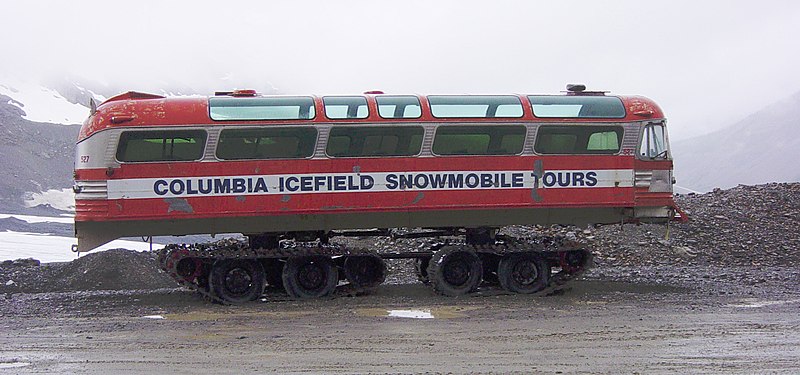
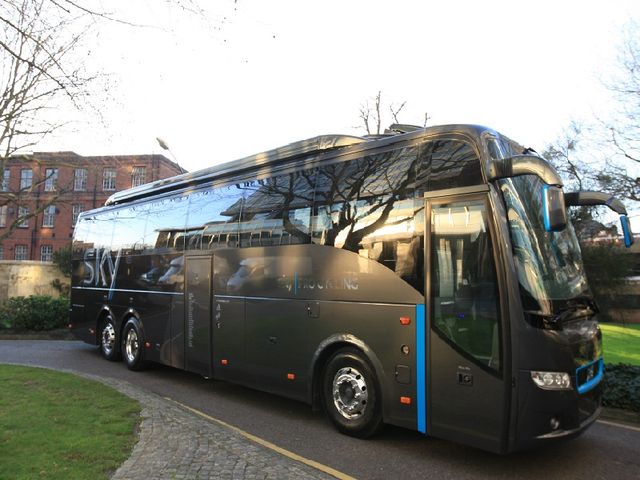
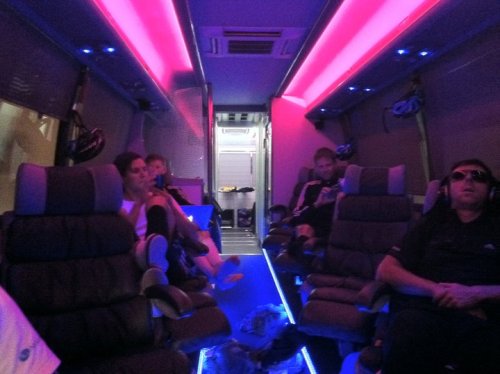
This is Sky ProCycling's Volvo 9700 Tri-Axle and, no matter where you live, it is better than your house. Stood on end, it would overtake The Shard as Europe's tallest building and it comes fully equipped for intergalactic travel - when in orbit around Earth, it eclipses the sun. It has nine leather seats, sleeping facilities, two showers, two toilets (with super-luxury quilted bog roll), an office that can be converted into a massage suite and - a real essential for nine young men on a road trip - mood lighting. The 10 million watt sound system has reportedly now been reprogrammed to make it unable to play Lesley Garrett CDs.

Cost: probably enough to finance a thousand women's teams for ten years/end world hunger (probably both, with enough change for a bag of chips on the way home), but not nearly as much as sponsor Rupert Murdoch saves through tax avoidance each year.

Sky Blingrating: 95% - judges originally gave it 100%, but deducted 5% when it was pointed out that it doesn't have 24-carat gold wheels.

And the winner is...
Garmin-Sharp and Orica-GreenEDGE both receive 100% blingratings for their mobile überhotels, with GreenEDGE just edging ahead due to theirs being longer than a Jackie Durand solo breakaway. However, while it's not the biggest, Sky's bus with its massage suite is a hard to beat. That they have not one, but two of the monsters means that Sky ProCycling are hereby declared winners of the 2012 Tour de France Who Had The Blingest Bus? competition. Let our rejoicing be without boundaries, and so on.

Wednesday, 20 June 2012

Daily Cycling Facts 20.06.12

Stage 10, 1926 - Bottecchia, who will not finish the stage,
struggles through difficult conditions on Izoard
On this day in 1926, 126 riders set off from Evian on the first stage of the 20th Tour de France. For the second time in its history, the race didn't start in Paris, and it had been reduced to 17 stages from 18 in 1925 - however, it was most definitely not easier. For a start, riders would face the Alps twice, on the way out and the way back in and again, and Henri Desgrange (who believed that the ideal Tour would be one in which only one rider finished) hadn't cut a stage for their benefit - he did it to increase the average stage length. What's more, the parcours followed the nations borders more closely than ever before or since; making this the longest Tour in history at 5,745km (for comparison, the 2012 edition is 3,497km).

Automoto's Ottavio Bottecchia was most fans' favourite as he'd won in 1924 and 1925, but many others fancied Alcyon's Adelin Benoit who had surprised everyone with a stage win and five days in the maillot jaune in 1925. A classic battle was expected, but as tends to be the way in the Tour de France it turned out far better than anyone had hoped. Right from the first stage unexpected things happened, beginning with a perfect solo break by Jules Buysse (brother of Marcel, who won six stages in 1913, and Lucien, who had finished in second place overall in 1925) that saw him win the stage with an advantage of thirteen minutes. Stage 2 ended with a bunch sprint won by little-known Belgian rider Aimé Dossche, who had picked up his first professional contract with Automoto at the the start of the year but seems to have switched to Christophe (which, like Automoto, was co-sponsored by Hutchinson at that time) before the Tour; so the GC remained virtually unchanged. Then in Stage 3 Gustaaf van Slembrouck managed to grab a lead that kept him in the maillot jaune for six days.

During Stage 3, Lucien Buysse received news that his infant daughter had died but, after thinking things over, decided to honour his family's request that he continue and try to win a stage that could be dedicated to the memory. Stage 4 was perhaps too soon and went to Félix Sellier instead; Stage 5 to Adelin Benoit. Another little-known Belgian named Joseph van Daam won Stage 6 after judges declared that Sellier had broken race regulations (van Daam would win two more later on, so he was much more famous when the race ended), then Nicolas Frantz won Stage 7; since Frantz had finished fourth in 1925 and showed enormous promise, instantly made him a favourite too (he's have to wait another year for the first of his two overall victories, however). Van Daam won Stage 8, this time on his own merit, then Frantz took Stage 9. The race had truly begun now, with a new challenger making things difficult for Bottecchia and Benoit.

One of the Tour's more inexplicably iconic images: a cow watches Jules Buysse
Desgrange, ever since he'd been convinced that it was possible to ride the high mountains and that the riders wouldn't be eaten by bears (something that, perhaps unfortunately in the eyes of some fans, has yet to happen in the Tour) and that in fact the public enjoyed the race more when it was an heroic spectacle, was always on the look-out for ways to make his race more difficult. Stage 10, however, went far beyond anything from previous years - and, say the ever-dwindling number of people who were there to see it, since. In terms of distance, it wasn't the longest stage that year - ten stages were longer, the longest 433km - but its 326km took the riders over some of the toughest roads in France, and they set out at midnight to be in with a chance of finishing by the following afternoon. Matters were not improved by a storm on the Col d'Aspin, but the Buysse brothers were made of stern stuff: while the rest of the peloton survived, they attacked hard and Lucien won after riding for seventeen hours. He had taken the maillot jaune, but better still he could dedicate the hardest stage in the history of the Tour to the memory of his daughter.

By 18:00, only ten men had arrived at the finish line and Desgrange was becoming concerned, perhaps worried that bears did have a taste for cyclists after all. He sent race organisers out in cars to search of the missing men and before long some had been located, in various states of exhaustion, strung out along the route. A full 24 hours after the stage had begun, 47 of the 76 starters had crossed the line, at which point it was decided that all riders would be permitted an extra 40% of the winning time (6 hours and 48 minutes) in which to finish as the standard cut-off time in which all riders must finish in order to escape disqualification would leave a field so depleted it would reduce competition and make for a boring race. The remaining 22 were disqualified. Incredibly, despite the harsh stage, only one rider abandoned: Bottecchia. The stage had been so difficult that judges had turned a blind eye when some of the riders had arrived at the end of the stage by bus and when a member of the public confessed that he had carried some riders to the finish line in his car but insisted they'd been in such a poor state he had done so through altruism rather than being offered money, officials declined to disqualify the riders - and paid the man for helping them.

Buysse leads over the Tourmalet, Stage 11
When Buysse won Stage 11 two days later, he gained a lead of more than an hour over his nearest rival. From now on, he was able to stay tucked safely away in the peloton, conserving his energy and simply making sure that he finished (which didn't prevent him winning the meilleur grimpeur, a prize for the best climber from the days before the King of the Mountains competition). Frantz won two more stages once the race returned to the flatlands, but he didn't have a hope of getting anywhere near the leader now and had to be content with second place. As they crossed the finish line in Paris behind stage winner Dossche, the gap between them was 1h22'25" (Buysse's overall time was 238h44'25" - around two-and-three-quarter times as long as Cadel Evan's 2011 winning time); a far greater memorial to his daughter than a stage win.

For the first time, not one single stage had been won by a Frenchman (this wouldn't happen again until 1999). Desgrange, who wanted the race to be a spectacle of every-man-for-himself heroism; he was, therefore, not at all pleased with the tactics employed by the teams in an effort to survive the superhuman distances involved in the 1926 Tour. As a result, all but three of the flat stages in 1927 were run as team time trials. Buysse said that he would win again in 1927, but Automoto experienced financial difficulties and, as his best years were gone by the time they could afford to send a team back to the Tour, 1926 was his only victory. Bottecchia decided to retire following his problems on Stage 10. One year later he was dead, possibly due to murder at the hands of Italian Fascists.


Fabian Wegmann
Fabian Wegmann
Fabian Wegmann, born in Münster on this day in 1980, turned professional with Gerolsteiner in 2002 and remained with them until the end of 2008 (older brother Christian, once a professional rider himself, joined the team's management in 2006). In 2009 he followed general manager Christian Henn to Milram, staying there for two seasons until he received an invite to join the new Leopard Trek in 2011. However, as Leopard Trek was based around climbers Andy and Frank Schleck and RadioShack had climbers of its own, Wegmann was judged surplus to requirements when the teams merged at the end of the year and was not one of the riders who made the jump; later being picked up by Garmin-Barracuda

A climber of considerable repute, Wegmann does better in races that favour the grimpeurs. He won the King of the Mountains at the 2004 Giro d'Italia, the 2005 GP San Francisco with its two 18% climbs and the GP Miguel Indurain in 2006 and 2008. He won the National Championships in 2007 and 2008.


Considering their geographic position between cycling-mad Italy and Eastern Europe - who, while not quite as passionate as the tifosi, do enjoy a bike race - the Greeks are strangely under-represented in the annals of cycling history. One name that does show up is that of Zafeiris Volikakis, who was born in Volos on this day in 1990. While he has been successful primarily in track competitions at home, he also won a silver medal in the Team Sprint at the 2006 European Junior Championships and a bronze at the Worlds the same year, also placing 17th in the Keirin at the 2010 Worlds (his team were 13th in the Sprint) and third for the Keirin at the Moscou track meet in 2011 (his older brother Christos was first).

Belgian cyclo cross rider Dieter Vanthourenhout was born in Brugge on this day in 1985 and won the National Debutants Championship in 2001, then the Juniors a year later. In 2006, he was third at the Under-23 Nationals and has added podium finishes in several races since.

Other births: Rita Razmaitė (Lithuania, 1967); William Morton (Canada, 1880); Hailu Fana (Ethiopia, 1967); Eduardo Cuevas (Chile, 1951); Eduardo Trillini (Argentina, 1958); Ilias Kelesidis (Greece, 1953, died 2007); Adrian Timmis (Great Britain, 1964 ); Noël de la Cruz (Cuba, 1968); Zsigmond Sarkadi Nagy (Hungary, 1955); Antón Villatoro (Guatemala, 1970); Émile Demangel (France, 1882, died 1968); Mohd Rizal Tisin (Malaysia, 1984); Michael McCarthy (USA, 1968); Ahrensborg Claussen (Denmark, 1895, died 1967).

Tuesday, 12 June 2012

Daily Cycling Facts 12.06.12

The famous Liège-Bastogne-Liège Classic, the oldest of the Monuments that make up the five most important cycle races after the Grand Tours, fell on this day in 1911 - the sixth edition, as the race skipped 1894-1908 and 1910. The winner was Joseph Vandaele (right), also spelled Van Daele, who would have been the second Frenchman to win the race as he was born in Wattrelos but had taken Belgian nationality prior to 1911.

The Vuelta a Espana began on this day in 1941. At 4,442km it was the longest edition ever (the exact distance is unclear, and some sources say 4,409km - either makes it the longest; though it fell far short of the longest ever Grand Tour, the 1926 Tour de France which was an incredible 5,745km). It also had the lowest ever number of starters, 32, partially as a result of the distance but primarily because this was the first edition since the Spanish Civil War and the country was still piecing itself back together. Julián Berrendero won overall (and again the next year) with a time of 168h45'26", while Delio Rodríguez (+29'17") won twelve stages but was fourth overall. His total of 39 stage wins in the five editions he entered remains the record today.


Félicia Ballanger
Félicia Ballanger
Born in La Roche-sur-Yon, Félicia Ballanger was born on this day in 1971 and named after her mother's favourite cyclist Felice Gimondi (her brother, Frédéric, was named after Federico Bahamontes). It seems likely, then, that her mother may have hoped to raise two successful cyclists of her own; and thanks to Félicia she got her wish.

Whilst still a child, Félicia joined the Vendée la Roche Cycliste and was immediately recognised as a serious track talent; the specialised training she received enabling her to win the Junior World Sprint Champion title in 1988. A year later she won the Sprint silver medal racing in the Elite category at the National Championships, then did so again in 1990; coming second on both occasions to Isabelle Gautheron who, seven years her senior, was by far the more experienced rider. She won the title in 1991 and 1992, then came second again in 1993 and might have won gold at the World Chmpionships had she not have been left with a broken collarbone and  a shard of broken wood embedded in her thigh following a crash. The next year, she won back the National Sprint title; then in 1994 she won it again and added the National 500m Championship and two gold medals for the same events at the Worlds. She won all four events again in 1996, then won another gold in the Sprint at the Olympics.

Ballanger retained her two National and two World titles all the way to 2000, then relinquished the World titles (she won the National ones for another year) so she could concentrate on the Olympics again - and this time, she won gold for the 500m and the Sprint. One of the most successful track cyclists of all time, she finally ended her reign when she retired in 2001 and took up the post of vice-president of the Fédération Française de Cyclisme. Today, she lives on the island of Nouméa in the French South Pacific territory of New Caledonia. She is married, had two children and works for the Ministry of Youth and Sport where she is responsible for anti-doping programs.

Bauer in the maillot jaune
Steve Bauer
Steve Bauer, who was born St. Catherines, Ontario on this day in 1959, joined the National Team in 1977 and originally specialised in team pursuit events. It wasn't long before he turned out to also be a very talented road racer, winning the National Championship in 1981, 1982 and 1983 and, after winning the United Texas Tour and coming third in the World Road Race Championships in 1984, he began to specialise in the discipline.

In 1985, he joined Bernard Hinault's La Vie Claire team and was entered for his first Tour de France. He took an impressive sixth place in the Prologue, then eighth in Stage 8, seventh in Stage 21 and fifth in Stage 22, which earned his third place in the overall Youth category and tenth in the General Classification - a very good finish indeed for a Tour debutante. This was the first of eleven Tours; his best overall result would be in 1988 when he was fourth in the General Classification behind Pedro Delgado, Steven Rooks and Fabio Parra. That edition also brought his only solo win ( La Vie Claire won the Stage 3 team time trial in 1985) - Stage 1, and after it he led the race for five days and was only the second Canadian to have ever worn the maillot jaune.

Bauer aboard the frankly plug-ugly "Stealth Bike" he rode to
second place at Paris-Roubaix in 1990
Bauer is remembered as one of the unluckiest riders in the history of professional cycling and his palmares would almost certainly shine far brighter had he not have been condemned so many times to runner-up places by punctures, mechanicals and crashes. In 1988, he was at the centre of a controversy involving Claude Criquielion. The two riders had collided during the final sprint at the World Championships; Bauer was able to remain upright but disqualified, while Maurizio Fondriest took advantage of the situation and won. Criquielion, who had been hoping to win back his 1984 title, refused to believe that it had been just another example of the sort of accident that happens in a sprint - indeed, it's far from certain from video footage if it was in fact an accident - and attempted to sue to sue the Canadian for assault, asking for an amount equal to £1.5 million. The case dragged on for three years before a court eventually found in favour of Bauer. In 1990, the finishing order at Paris-Roubaix was so close that judges examined photographs for more than ten minutes before deciding that Bauer had lost to Eddy Planckaert by 1cm, the closest finish in the history of the race.

In 1994, Bauer was awarded the Meritorious Service Medal in recognition of his work in paving the way for future Canadian cyclists to compete at the top level of the sport, and there's a very good case to be made in support of Ryder Hesjedal dedicating the Tour de France victory that he'll probably win sooner or later to him. Having retired after the 1996 Olympics, Bauer formed Team R.A.C.E Pro, which would become Spidertech-C10. He remains the owner and a directeur sportif.


Andrea Guardini

Italian cyclist Andrea Guardini, who born in Tregnago on this day in 1989, holds the record for most stages won at the Tour de Langkawi with eleven - all of them from just two editions, 2011 (five) and 2012 (six). In 2011 he also won Stage 5 at the Tour of Qatar, Stages 1 and 7 at the Tour of Turkey and Stage 5 at the Volta a Portugal; in 2012 he won Stage 5 at the Giro d'Italia. Many consider him destined for great things, perhaps even a Grand Tour victory.


Philippe Bouvatier, who was born in Rouen on this day in 1964, became French Junior Road Race Champion in 1982 and joined Renault-Elf in 1984, then took thrid place at the Tour de l'Avenir. In 1986, by which time he was with Zor-B.H. Sport, he rode in the Tour de France - like the majority of Tour debutantes, he didn't finish; but 31st place on Stage 6 over 200km from Villers-sur-Mer to Cherbourg was respectable enough. In 1987 he did better, finishing the race and coming twelfth on Stage 24, a 38km individual time trial. He finished again in 1988 and improved his overall placing to 32nd; then rode his final Tour in 1990 for RMO, abandoning the race after Stage 6 when he came 190th, one place above Lanterne Rouge Thierry Claveyrolat. After three more years riding criteriums and smaller stage races, he retired in 1995 after failing to win anything that year.

Davide Viganò was born in Carate Brianza, Italy on this day in 1984. He has enjoyed some notable successes in the Grand Tours, including tenth place for Stage 21 at the 2006 Vuelta a Espana, fourth for Stage 12 and fifth for Stage 21 at the 2007 Vuelta, eighth for Stage 4 and third for Stage 21 at the 2008 Vuelta, eighth for Stage 2 and 9 and sixth for Stage 11 at the Giro d'Italia and fourth for Stage 6 at thee Vuelta in 2009.

Colby Pearce, born in Boulder, Colorado on this day in 1972, won the US Madison Championship in 2000 and held it until 2003 when he came second. In the intervening time, he also rode for the gold-winning Pursuit team. In 2003 he was National Scratch Champion, the once again rode with the victorious Team Pursuit squad in 2004 and a year later won back the Madison title. He retired from competition in 2005 to take up a position as coach to the National Track Team, but resigned and returned to racing in 2007. He won the Madison title for the last time in 2007 and 2008 (with another Team Pursuit gold in both years).

Charles King, an English cyclist born on this day in 1911, won a bronze medal in front of Hitler when he and the British team finished the Team Pursuit in third place at the 1936 Olympics in Berlin. He died on the 19th of July, 2001.

On this day in 1979, amateur cyclist Bryan Allen both powered and piloted the Gossamer Albatross - a human-powered aeroplane - over the English Channel. Designed and built by Dr. Paul B. MacCready, the Albatross consisted of a mylar skin stretched over a carbon fibre and polystyrene skeleton, unladen it weight 32kg. Inside was a modified bike frame, by pedaling the pilot drove a two-bladed propellor. MacCready died on the 28th of August 2007; Allen is now a software engineer at the Pasadena Jet Propulsion Laboratory.

Other births: Rafael Nuritdinov (USSR, 1977); Csaba Steig (Hungary, 1971); Bob Boucher (Canada, 1943); Ken Muhindi (Kenya, 1978); Buddy Ford (Bermuda, 1957); Jacek Bodyk (Poland, 1966); Bruno Monti (Italy, 1930, died 2011); Alla Vasilenko (USSR, 1972); Dawid Krupa (Poland, 1980); Emilio Falla (Ecuador, 1986).