Showing posts with label cyclisme. Show all posts

Wednesday, 2 April 2014

Daily Cycling Facts 02.04.2014

The 1899 Paris-Roubaix - yet to earn its modern alternative name, The Hell of the North - was held on this day. As many road races were then motorpaced, velodrome riders with experience in derny events could sometimes gain an advantage over those with more road experience; as proved to be the case that year when the race was won by Albert Champion (much more about him and his remarkable life in two days' time, the anniversary of his birth).

Alfons Schepers
The Ronde van Vlaanderen fell on this date in 1933, 1939, 1944, 1950, 1956, 1967, 1989, 1995, 2000 and 2006. 1933, won by Alfons Schepers, was the first edition of the race in which the Belgian police played a role - previously, spectator figures had been sufficiently low for the event to carry on without them (organiser Karel Van Wijnendaele said he'd been able to count the spectators along the way and at the finish the first few times the race was held). Gradually, it had become more popular; but for the time being police presence and roles were limited with just a few gendarmerie keeping an eye on things - four years later, half a million people showed up and organisers had to ask police to provide assistance on a scale more like that of modern races.

Karel Kaers in London, 1938 (the bike is a
British-built Rudge-Whitworth)
Karel Kaers - who had won the World Race Championship five years earlier, the youngest man to have ever done so - won in 1939; a victory made remarkable because he said hadn't meant to win it. He'd set out that morning intending to have a training ride in preparation for Paris-Roubaix so he drove as far as Kwaremont where he parked, got his bike out and cycled the 40km to Ghent where he intended to ride part of the course before stopping when the race went by his car. Since he wasn't going to go any further and had no reason to pace himself, when the peloton reached Kwaremont he decided he'd sprint away from them and reach the top in time to see them go by - and discovered his car had vanished. At this point, we have to ask ourselves why he didn't grab the nearest gendarme and report the vehicle as stolen; but there's no reason that the truth should be allowed to get in the way of a good story - and this story says he decided to continue riding instead and, eventually, won; discovering at the finish line that his manager had seen he had the potential to win and had driven the car away so he'd keep riding.

Rik van Steenbergen, youngest man to
win the Ronde van Vlaanderen
1944 was the last time the race was held during the Second World War with Belgium being liberated from Nazi control during September that year - it had been the only Classic to continue running for the duration. Rik van Steenbergen scored the first of his two victories. He later explained that he had been fortunate to be given the opportunity to ride: "When I turned pro, I couldn't ride it straight away," he said. "There were three categories of rider: road-riders A, road-riders B, and track riders. I was registered with the federation as a track rider. At first they wouldn't let me ride the national championship. But Jean van Buggenhout, the manager, got me reclassified on the Wednesday before the race. I won it and became an 'A' rider. Then I could start the year in the Tour of Flanders." 19 years old at the time, he remains the youngest rider to have ever won the event - and with most riders' professional careers beginning in their early 20s and their best years coming in their late 20s and early 30s, it's a record unlikely to ever be broken.

1950 brought the second of Fiorenzo Magni's record three consecutive victories after he spent all day leading the pack with few riders willing to challenge him. Finally, he made his move on the Muur van Geraardsbergen which was a part of the race for the first time that year, forming a breakaway with André Mahé and Wim van Est. In time, they tired and fell back, leaving the Italian to cross the line with a 2'15" advantage over 2nd place Briek Schotte. The Muur, which climbs from 33m to 110m with a maximum gradient of 20%, proved too much for many riders: of 220 starters, only 21 finished.

Jean Forestier
Jean Forestier won in 1956 and went on to win the Points competition at the Tour de France a year later. Dino Zandegù beat a young Eddy Merckx in 1967 - things may have gone very differently had Merckx, who was already showing unmistakable signs of what he was to become, not been thwarted by the repeated efforts of Zandegù's team mate Felice Gimondi to keep him in check. 1989 winner Edwig Van Hooydonck had won in the Under-23 category in 1986 and would win again as an Elite in 1991 - four years later, when he was 31 and EPO use was becoming prevalent, he retired in protest at doping; saying that he could not continue to be competitive as he was not willing to cheat. 1995 saw the second of three wins for Johan Museuuw who, having also won three editions of Paris-Roubaix, five other Monuments and a total of eleven Classics and semi-Classics is the most successful Classics rider of the last two decades.

Van Steenbergen had become the youngest man to win the Ronde in 1944, and in 2000 Andrei Tchmil - aged 37 - became the oldest, and the first Russian. That year, a new tradition called the Dorp van de Ronde was introduced to celebrate a chosen village or town along the parcours - the first town thus honoured was Ingelmunster. Tom Boonen, who was mentored by Museuuw and rivals him for the title of best Classics rider over the same time period, won in 2006 when the Dorp van de Ronde was Ichtegem, home to pub that contains a museum dedicated to 1920 winner Jules Vanhevel.


2006 also brought a second consecutive win for Mirjam Melchers-Van Poppel in the Ronde van Vlaanderen voor Vrouwen.


On this day in 1949, Carlo Galetti died in Milan. The Italian cyclist - who won the Giro d'Italia in 1910, 1911 and 1912 - was born on the 26th of August 1882 and also won Milan-San Remo in 1909.

Franz Nietlispach
(image credit: Regula Merkt CC BY-SA 3.0)
Franz Nietlispach, a Paralympian handcyclist, was born in Muri, Switzerland on this day in 1958. Also competing in athletics and - early in his career - table tennis, he took part in every Summer Paralympics between 1976 and 2008.

Other cyclists born on this day: Marco Corti (Italy, 1986); Steve Houanard (France, 1986); Luis Alfredo López (Colombia, 1966); Lennart Fagerlund (Sweden, 1952); Willi Moore (Great Britain, 1947); Tan Thol (Cambodia, 1941); Jaroslav Jeřábek (Czechoslovakia, 1971); Christian Brunner (Switzerland, 1953); Sayed Esmail Hosseini (Iran, 1942); Emilio Vidal (Venezuela, 1929); Arne Petersen (Denmark, 1913, died 1990); Tim Mountford (USA, 1946); Serhiy Cherniavskiy (Ukraine, 1976); Thomas Boutellier (Switzerland, 1967).

Tuesday, 2 April 2013

Daily Cycling Facts 02.04.2013

The 1899 Paris-Roubaix - yet to earn its modern alternative name, The Hell of the North - was held on this day. As many road races were then motorpaced, velodrome riders with experience in derny events could sometimes gain an advantage over those with more road experience; as proved to be the case that year when the race was won by Albert Champion (much more about him and his remarkable life in two days' time, the anniversary of his birth).

Alfons Schepers
The Ronde van Vlaanderen fell on this date in 1933, 1939, 1944, 1950, 1956, 1967, 1989, 1995, 2000 and 2006. 1933, won by Alfons Schepers, was the first edition of the race in which the Belgian police played a role - previously, spectator figures had been sufficiently low for the event to carry on without them (organiser Karel Van Wijnendaele said he'd been able to count the spectators along the way and at the finish the first few times the race was held). Gradually, it had become more popular; but for the time being police presence and roles were limited with just a few gendarmerie keeping an eye on things - four years later, half a million people showed up and organisers had to ask police to provide assistance on a scale more like that of modern races.

Karel Kaers in London, 1938 (the bike is a
British-built Rudge-Whitworth)
Karel Kaers - who had won the World Race Championship five years earlier, the youngest man to have ever done so - won in 1939; a victory made remarkable because he said hadn't meant to win it. He'd set out that morning intending to have a training ride in preparation for Paris-Roubaix so he drove as far as Kwaremont where he parked, got his bike out and cycled the 40km to Ghent where he intended to ride part of the course before stopping when the race went by his car. Since he wasn't going to go any further and had no reason to pace himself, when the peloton reached Kwaremont he decided he'd sprint away from them and reach the top in time to see them go by - and discovered his car had vanished. At this point, we have to ask ourselves why he didn't grab the nearest gendarme and report the vehicle as stolen; but there's no reason that the truth should be allowed to get in the way of a good story - and this story says he decided to continue riding instead and, eventually, won; discovering at the finish line that his manager had seen he had the potential to win and had driven the car away so he'd keep riding.

Rik van Steenbergen, youngest man to
win the Ronde van Vlaanderen
1944 was the last time the race was held during the Second World War with Belgium being liberated from Nazi control during September that year - it had been the only Classic to continue running for the duration. Rik van Steenbergen scored the first of his two victories. He later explained that he had been fortunate to be given the opportunity to ride: "When I turned pro, I couldn't ride it straight away," he said. "There were three categories of rider: road-riders A, road-riders B, and track riders. I was registered with the federation as a track rider. At first they wouldn't let me ride the national championship. But Jean van Buggenhout, the manager, got me reclassified on the Wednesday before the race. I won it and became an 'A' rider. Then I could start the year in the Tour of Flanders." 19 years old at the time, he remains the youngest rider to have ever won the event - and with most riders' professional careers beginning in their early 20s and their best years coming in their late 20s and early 30s, it's a record unlikely to ever be broken.

1950 brought the second of Fiorenzo Magni's record three consecutive victories after he spent all day leading the pack with few riders willing to challenge him. Finally, he made his move on the Muur van Geraardsbergen which was a part of the race for the first time that year, forming a breakaway with André Mahé and Wim van Est. In time, they tired and fell back, leaving the Italian to cross the line with a 2'15" advantage over 2nd place Briek Schotte. The Muur, which climbs from 33m to 110m with a maximum gradient of 20%, proved too much for many riders: of 220 starters, only 21 finished.

Jean Forestier
Jean Forestier won in 1956 and went on to win the Points competition at the Tour de France a year later. Dino Zandegù beat a young Eddy Merckx in 1967 - things may have gone very differently had Merckx, who was already showing unmistakable signs of what he was to become, not been thwarted by the repeated efforts of Zandegù's team mate Felice Gimondi to keep him in check. 1989 winner Edwig Van Hooydonck had won in the Under-23 category in 1986 and would win again as an Elite in 1991 - four years later, when he was 31 and EPO use was becoming prevalent, he retired in protest at doping; saying that he could not continue to be competitive as he was not willing to cheat. 1995 saw the second of three wins for Johan Museuuw who, having also won three editions of Paris-Roubaix, five other Monuments and a total of eleven Classics and semi-Classics is the most successful Classics rider of the last two decades.

Van Steenbergen had become the youngest man to win the Ronde in 1944, and in 2000 Andrei Tchmil - aged 37 - became the oldest, and the first Russian. That year, a new tradition called the Dorp van de Ronde was introduced to celebrate a chosen village or town along the parcours - the first town thus honoured was Ingelmunster. Tom Boonen, who was mentored by Museuuw and rivals him for the title of best Classics rider over the same time period, won in 2006 when the Dorp van de Ronde was Ichtegem, home to pub that contains a museum dedicated to 1920 winner Jules Vanhevel.


2006 also brought a second consecutive win for Mirjam Melchers-Van Poppel in the Ronde van Vlaanderen voor Vrouwen.


On this day in 1949, Carlo Galetti died in Milan. The Italian cyclist - who won the Giro d'Italia in 1910, 1911 and 1912 - was born on the 26th of August 1882 and also won Milan-San Remo in 1909.

Franz Nietlispach
(image credit: Regula Merkt CC BY-SA 3.0)
Franz Nietlispach, a Paralympian handcyclist, was born in Muri, Switzerland on this day in 1958. Also competing in athletics and - early in his career - table tennis, he took part in every Summer Paralympics between 1976 and 2008.

Other cyclists born on this day: Marco Corti (Italy, 1986); Steve Houanard (France, 1986); Luis Alfredo López (Colombia, 1966); Lennart Fagerlund (Sweden, 1952); Willi Moore (Great Britain, 1947); Tan Thol (Cambodia, 1941); Jaroslav Jeřábek (Czechoslovakia, 1971); Christian Brunner (Switzerland, 1953); Sayed Esmail Hosseini (Iran, 1942); Emilio Vidal (Venezuela, 1929); Arne Petersen (Denmark, 1913, died 1990); Tim Mountford (USA, 1946); Serhiy Cherniavskiy (Ukraine, 1976); Thomas Boutellier (Switzerland, 1967).

Monday, 2 April 2012

Daily Cycling Facts 02.04.12

The 1899 Paris-Roubaix - yet to earn its modern alternative name, The Hell of the North - was held on this day. As many road races were then motorpaced, velodrome riders with experience in derny events could sometimes gain an advantage over those with more road experience; as proved to be the case that year when the race was won by Albert Champion (much more about him and his remarkable life in two days' time, the anniversary of his birth).

Alfons Schepers
The Ronde van Vlaanderen fell on this date in 1933, 1939, 1944, 1950, 1956, 1967, 1989, 1995, 2000 and 2006. 1933, won by Alfons Schepers, was the first edition of the race in which the Belgian police played a role - previously, spectator figures had been sufficiently low for the event to carry on without them (organiser Karel Van Wijnendaele said he'd been able to count the spectators along the way and at the finish the first few times the race was held). Gradually, it had become more popular; but for the time being police presence and roles were limited with just a few gendarmerie keeping an eye on things - four years later, half a million people showed up and organisers had to ask police to provide assistance on a scale more like that of modern races.

Karel Kaers in London, 1938 (the bike is a
British-built Rudge-Whitworth)
Karel Kaers - who had won the World Race Championship five years earlier, the youngest man to have ever done so - won in 1939; a victory made remarkable because he said hadn't meant to win it. He'd set out that morning intending to have a training ride in preparation for Paris-Roubaix so he drove as far as Kwaremont where he parked, got his bike out and cycled the 40km to Ghent where he intended to ride part of the course before stopping when the race went by his car. Since he wasn't going to go any further and had no reason to pace himself, when the peloton reached Kwaremont he decided he'd sprint away from them and reach the top in time to see them go by - and discovered his car had vanished. At this point, we have to ask ourselves why he didn't grab the nearest gendarme and report the vehicle as stolen; but there's no reason that the truth should be allowed to get in the way of a good story - and this story says he decided to continue riding instead and, eventually, won; discovering at the finish line that his manager had seen he had the potential to win and had driven the car away so he'd keep riding.

Rik van Steenbergen, youngest man to
win the Ronde van Vlaanderen
1944 was the last time the race was held during the Second World War with Belgium being liberated from Nazi control during September that year - it had been the only Classic to continue running for the duration. Rik van Steenbergen scored the first of his two victories. He later explained that he had been fortunate to be given the opportunity to ride: "When I turned pro, I couldn't ride it straight away," he said. "There were three categories of rider: road-riders A, road-riders B, and track riders. I was registered with the federation as a track rider. At first they wouldn't let me ride the national championship. But Jean van Buggenhout, the manager, got me reclassified on the Wednesday before the race. I won it and became an 'A' rider. Then I could start the year in the Tour of Flanders." 19 years old at the time, he remains the youngest rider to have ever won the event - and with most riders' professional careers beginning in their early 20s and their best years coming in their late 20s and early 30s, it's a record unlikely to ever be broken.

1950 brought the second of Fiorenzo Magni's record three consecutive victories after he spent all day leading the pack with few riders willing to challenge him. Finally, he made his move on the Muur van Geraardsbergen which was a part of the race for the first time that year, forming a breakaway with André Mahé and Wim van Est. In time, they tired and fell back, leaving the Italian to cross the line with a 2'15" advantage over 2nd place Briek Schotte. The Muur, which climbs from 33m to 110m with a maximum gradient of 20%, proved too much for many riders: of 220 starters, only 21 finished.

Jean Forestier
Jean Forestier won in 1956 and went on to win the Points competition at the Tour de France a year later. Dino Zandegù beat a young Eddy Merckx in 1967 - things may have gone very differently had Merckx, who was already showing unmistakable signs of what he was to become, not been thwarted by the repeated efforts of Zandegù's team mate Felice Gimondi to keep him in check. 1989 winner Edwig Van Hooydonck had won in the Under-23 category in 1986 and would win again as an Elite in 1991 - four years later, when he was 31 and EPO use was becoming prevalent, he retired in protest at doping; saying that he could not continue to be competitive as he was not willing to cheat. 1995 saw the second of three wins for Johan Museuuw who, having also won three editions of Paris-Roubaix, five other Monuments and a total of eleven Classics and semi-Classics is the most successful Classics rider of the last two decades.

Van Steenbergen had become the youngest man to win the Ronde in 1944, and in 2000 Andrei Tchmil - aged 37 - became the oldest, and the first Russian. That year, a new tradition called the Dorp van de Ronde was introduced to celebrate a chosen village or town along the parcours - the first town thus honoured was Ingelmunster. Tom Boonen, who was mentored by Museuuw and rivals him for the title of best Classics rider over the same time period, won in 2006 when the Dorp van de Ronde was Ichtegem, home to pub that contains a museum dedicated to 1920 winner Jules Vanhevel.


2006 also brought a second consecutive win for Mirjam Melchers-Van Poppel in the Ronde van Vlaanderen voor Vrouwen.


On this day in 1949, Carlo Galetti died in Milan. The Italian cyclist - who won the Giro d'Italia in 1910, 1911 and 1912 - was born on the 26th of August 1882 and also won Milan-San Remo in 1909.

Franz Nietlispach
(image credit: Regula Merkt CC BY-SA 3.0)
Franz Nietlispach, a Paralympian handcyclist, was born in Muri, Switzerland on this day in 1958. Also competing in athletics and - early in his career - table tennis, he took part in every Summer Paralympics between 1976 and 2008.

Other births: Marco Corti (Italy, 1986); Steve Houanard (France, 1986); Luis Alfredo López (Colombia, 1966); Lennart Fagerlund (Sweden, 1952); Willi Moore (Great Britain, 1947); Tan Thol (Cambodia, 1941); Jaroslav Jeřábek (Czechoslovakia, 1971); Christian Brunner (Switzerland, 1953); Sayed Esmail Hosseini (Iran, 1942); Emilio Vidal (Venezuela, 1929); Arne Petersen (Denmark, 1913, died 1990); Tim Mountford (USA, 1946); Serhiy Cherniavskiy (Ukraine, 1976); Thomas Boutellier (Switzerland, 1967).

Monday, 19 March 2012

Cyclopunk's News Digest 19-20.03.12

Today's News: Volta Ciclista a Catalunya starts today - Dope doctor arrested in Spain - Route change for 2013 MSR - Rein Taaramäe and Thor Hushovd out with illnesses - Minor injuries for Quintero after MSR crash - Three Brit teams at the Tour of Normandy - This week's races


Volta Ciclista a Catalunya
The week-long Volta Ciclista a Catalunya - Spain's second most prestigious cycling event after the Vuelta a Espana Grand Tour and the third oldest stage race in the world, first run in 1911 - kicks off today with a 138.9km stage starting and ending at Calella on Catalonia's Costa del Maresme. The start list looks like this, and Cyclopunk reckons Astana's Egor Silin will do well today - but so might one of the younger Euskaltel-Euskadi riders.

It's an exciting race for fans from around the world, not just from Spain, because this is the first of the European races in which the riders face the first "proper" mountains - Category 2 Alt di Villedrau's summit just before the 60km point reaches 903m and Category 1 Alt del Collformic hits 1,140m a little over 20km later.

Stage 2 is 161km in length with a highest point - Alt del Angels - only 480m above sea level, but the slopes are far steeper than those in Stage 1 and for that reason the mountain receives the same category as Collformic. Stage 3 (La Vall d'en Bas (Sant Esteve d'en Bas) to Port-Ainé) is the Queen Stage and a real challenge by anyone's standards - 210.9km long, it features two Hors-Categorie mountains in the looming shapes of the Port del Canto with its 1,730m summit located 165km along the parcours and a summit finish on Port Aine, 1,947m up. As though those weren't enough, riders need to get over two Cat 1 climbs on the way: Alt di Coubet hits 1,031m and Collada de Toses 1,800m. Total climbing on this stage is 6,597m. Stage 4, Tremp - Ascó, returns us to something more like humanly possible, the 199km topping out at 675m. Stage 5 covers 207.1km from Ascó to Manresa with a Cat 1 and Cat 2 on the way. Stage 6 runs between Sant Fruitós de Bages and Badalona Centre Comercial Màgic, 169.4km with three Cat 3s, then Stage 7 takes the race from Badalona Centre Comercial Màgic into Barcelona, 119.8km away and over three Cat 3s and a Cat 2. Further details on each stage, results and news will be published here each day.
Stage 1 altimetry (click for enlargement)
Bradley Wiggins leads Team Sky who will no doubt be eager to repeat their Paris-Nice success, especially in the wake of a crushing defeat for Mark Cavendish and team mates at Milan-San Remo. He's No. 151 and the rest of the team are as follows:

  151 WIGGINS  Bradley
  152 ROGERS  Michael
  153 PATE  Danny
  154 PORTE  Richie
  155 APPOLLONIO  Davide
  156 SIVTSOV  Kanstantsin
  157 URAN  Rigoberto
  158 ZANDIO ECHAIDE  Xabier

An auto-translated ticker is available here and Eurosport are showing one hour of the race live at 15:00 daily, with highlights on Eurosport and Eurosport 2 at various times.

Doctor connected to cycling arrested with substances believed to be doping products
Dr. Alberto Beltrán Niño - who previously had links to numerous professional cycling teams - was arrested in Spain as he tried to board a flight to Colombia on the 8th of March, according to a report in El País.

Officials confiscated substances believed to be 5-Aminoimidazole-4-carboxamide ribotide - a drug for which there is little data related to prevalence of use, despite its suspected presence at the 2009 Tour de France - and TB-500. 5-Aminoimidazole-4-carboxamide ribotide, known as AICAR, causes dilation of the blod vessels and thus permits larger amounts of oxygen-carrying blood to be pumped to the muscles within a given time, which increases strain on the heart and over time could lead to cardiac failure. TB-500, the drug that led to Wim Vansevenant's arrest prior to the Tour last year, promotes muscle growth. Neither drug has been detected in anti-doping controls to date.

Dr. Beltrán has been the subject of an investigation named Operacion Skype, begun in Barcelona after he was reported to have sold a form of EPO at the Vuelta a Espana, and it's not the first time he has been connected to doping - in 2001, when he worked for the Selle Italia team, he was arrested whilst in possession of a large amount of doping products.

A laptop and USB flash drives belonging to the doctor have also been seized, presumably in the hope of finding the intended recipients of the drugs.

MSR organisers: "We'll have to modify it, to make it a bit harder"
Most of cycling's great races have changed considerably since they began, some now being much longer and some much shorter. Milan-San Remo has changed less than most with a broadly similar parcours used every year, though climbs have been added over time. The Passo del Turchino, Le Manie and three Capi have been there since the early days but, as riders became more professional and the mountain no longer had any influence on the outcome of the race, it was decided that the sprinters shouldn't have it all their own way.

Thus, the Poggio di San Remo was added in 1960 and, once it became apparent that it too wasn't breaking up the peloton, Cipressa joined it in 1982. Now, organisers have decided that the race needs another climb and are looking at changing the route for 2013. "Now, a race that does not spare the attacker the ability to finish alone is no longer a race," director Mauro Vegni explained to L'Equipe.

Mark Renshaw ‏ @Mark_Renshaw
Whats wrong with the organisers of Milan San Remo? Its one of the best races of the year!
Other News
Cofidis rider Rein Taaramäe has been diagnosed with mononucleosis, the viral disease commonly known as glandular fever. Doctors recommend that athletic activity be limited or closely monitored in sufferers to reduce the risk of splenic rupture, which combined with variable recovery times means could lead to the 24-year-old Estonian having to stay away from competition for some time.

the Inner Ring ‏ @inrng
Rein Taraamae of Cofidis is out with mononucleosis / glandular fever
Thor Hushovd has long dreamed of victory
at the legendary Paris-Roubaix
(image credit: PB85 CC BY-SA 3.0)
Thor Hushovd, who suffered at Paris-Nice with the same stomach complaint that took many riders out of the race, will miss the Volta Ciclista a Catalunya after contracting a fever. The 34-year-old Norwegian, one of the most popular riders of the current generation, will concentrate on making a full recovery in time for Paris-Roubaix on the 8th of April - a race he has dreamed of winning for many years.


Carlos Quintero escaped his crash at Saturday's Milan-San Remo with a fractured collarbone, grazes and bruising, his Colombia Coldeportes team have confirmed. The 26-year-old hit a stone wall at speed during the race and was knocked unconscious, leading to widespread concern among commentators and fans when helicopter footage showed him not moving and being strapped to a backboard. However, medics quickly confirmed that he had woken within minutes, could move his legs and was able to recognise people around him.

Three British teams - Endura Racing, Rapha-Condor-Sharp and GB Academy - will be competing in this year's Tour of Normandy, won last year by Alex Blaine who rides again in 2012 with Endura. (More details from Velo UK)

This week's races

19/03 - 25/03 Volta Ciclista a Catalunya WT
16/03 - 20/03 Vuelta el Salvador 2.1
18/03 - 25/03 Vuelta Mexico 2.2
19/03 - 26/03 Tour de Normandie 2.2
20/03 - 25/03 Settimana Coppi e Bartali 2.1
21/03 Dwars Door Vlaanderen 1.1
21/03 Grand Prix GSB 1.1
22/03 - 25/03 Volta ao Alentejo 2.2
23/03 - 01/04 Tour du Maroc 2.2
23/03 E3 Prijs Vlaanderen - Harelbeke WT
24/03 - 26/03 81st Critérium International 2.HC
24/03 Flevotour
24/03 25ste Grote Omloop van de Veenkolonien Nat.
24/03 Rijswijkse wielerronde Nat.
25/03 Jeugdronde van Dommelen Nat.
25/03 Van Esch Tour Nat.
25/03 Ronde van de Ijzerenman Nat.
25/03 Women's Gent-Wevelgem Int.
25/03 Gent - Wevelgem WT
25/03 Trofeo Alfredo Binda CDM
 25/03 Tour De India I

Thursday, 23 February 2012

Pâtisserie Cyclisme needs your help!

(image copyright Pâtisserie Cyclisme)
Have you heard of Pâtisserie Cyclisme yet? Established by a keen cyclist, it's a website that aims to provide details and reviews of all the world's cycling-friendly cafes - something that would in all likelihood soon become as valuable an aid when planning a route as a decent map. After all, there are only two things that we cyclists like as much as riding our bikes: drinking tea and eating cakes.

At present, they have around one hundred reviews of cafes in the United Kingdom and Europe but the site grows daily and, after just a year, is becoming one of the Internet's cycling hubs. The service's creator Louise is now hoping to develop her idea further, but to move on to the next stage she needs money. Don't click "back" just yet!

She's not asking you to put your hand in your pocket - but you can still help. All you need to do is vote for her funding application. If she can get 500 votes, her company will receive £500 from Enterprise Nation to put towards development and the purchase of a professional camera which will allow the reviews to be backed up by quality photographs of the various cafes.

It takes about 20 seconds to sign up and vote and it's completely free - so there really is no reason not to do it.

Friday, 9 September 2011

Don't assume Longo guilt

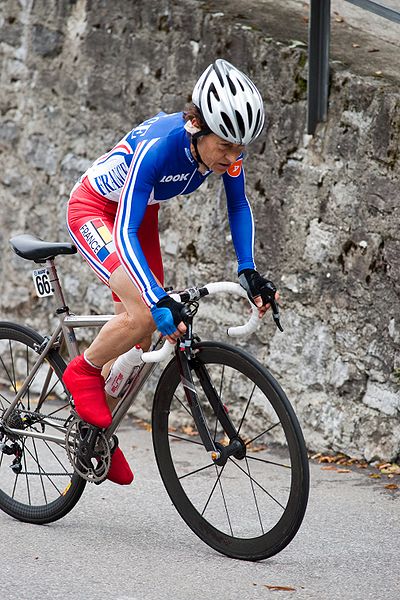
Longo has competed in seven
Olympic Games
Jeannie Longo, the legendary French champion who at the age of 52 frequently competes against cyclists not even born when she first rode in the Olympic Games, is in trouble following three questionable incidents around doping control in the last year.

According to the Fédération Française de Cyclisme, Longo twice gave insufficient details as to her whereabouts this year and missed one test entirely in June when anti-doping officials arrived at a hotel at which she had listed herself as staying, but the Haute-Savoie cyclist was not there and could not be contacted - however, Longo, known for living a somewhat unusual lifestyle, famously does not own either a computer or a mobile telephone.

Chances are there'll be those who say that since Longo comes from a different generation of cyclists - not just the one that came before today's, but the one before that - she deserves to be cut some slack. After all, for much of her career doping was so prevalent in the sport that it was virtually accepted and, often, hardly even hidden. We don't think that should be the case. Much as we admire Longo, who has been World Champion 13 times and French Champion an incredible 59 times, cycling is always more important than one cyclist and, now that it's clawed its way back to something approaching respectability after a series of high-profile scandals saw all-important sponsors leaving in droves for fear of being associated with drugs and in doing so almost killing the sport, even a personality as towering as Longo must be barred from competition if she can be shown to be guilty of doping.

However, Longo is not as other cyclists. Her case shows why automatic suspension - she could be barred from anything between three months to two years, a longer ban likely ending her career - is proof that one rule cannot be applied to all cyclists. It may work for the vast majority, who have grown up with portable computers, mobile phones, wi-fi and 24 hour access to the Internet, but it doesn't work for the semi-reclusive Longo and in her case failure to attend doping control should not automatically be seen as suspicious.