
Showing posts with label Stage 1. Show all posts
Showing posts with label Stage 1. Show all posts
Thursday, 7 June 2012
Emakumeen Bira 2012 Stage 1
Top Ten
1. 11 TEUTENBERG, Ina Yoko SPECIALIZED-LULULEMON 2:29:44
2. 146 OLDS, Shelley AA DRINK-LEONTIEN.NL ST
3. 13 WORRACK, Trixi SPECIALIZED-LULULEMON ST
4. 1 V. VLEUTEN, Annemiek RABOBANK ST
5. 51 BRAS, Martine DOLMANS-BOELS C.T. ST
6. 113 PIETERS, Amy SKILL-ARGOS ST
7. 123 AMIALIUSIK, Alena BE PINK ST
8. 105 GUNNEWIJK, Loes GREENEDGE-AIS ST
9. 34 JANELIUNAITE, Edita DIADORA-PASTA ZARA ST
10. 25 FERRIER, Christel HITEC PRODUCTS-MISTRAL HOME ST
(Full results)


Friday, 25 May 2012
Exergy Tour Stage 1 Review and Stage 2 Preview
 |
| Tara Whitten |
"We are all absolutely heartbroken for Kristin, but we are ready to rally and do this for her and her hometown." (Tayler Wiles, Exergy-Twenty12)Ignoring the pain, she was up in seconds and back on her bike to finish the stage; the combination of lost time and reduced speed in the latter half making her eventual 13th place and time of 4'17.88" remarkable. She'll undergo surgery today, during which stabilising pins will be inserted into the bone, and will then begin to concentrate on making a full recovery in time for the Olympics - get well soon Kristin!
Gillian Carleton (Canada) looked to be in with a good chance of winning when she set the bar at 4'9.98", which remained fastest time for 30 minutes until team mate Tara Whitten shaved off 0.34" - which, following Armstrong's misfortune, earned her the victory. Fellow Canadian Clara Hughes (Specialized-Lululemon) took third with 4'10.55", her team once again achieving their now customary domination of the top ten with no fewer than five placings. Nicole Cooke (Faren-Honda), the only British rider in the race, was 61st with 4'38.56".
Top Ten
1. Tara Whitten Team TIBCO 4'09.64"
2. Gillian Carleton Canada +0.34"
3. Clara Hughes Specialized-Lululemon +0.91"
4. Ina Yoko Teutenberg Specialized-Lululemon +2.52"
5. Evelyn Stevens Specialized-Lululemon +2.77"
6. Alison Powers Now & Noverstis +2.84"
7. Shara Gillow Orica GreenEdge +4.27"
8. Jade Wilcoxson Optum p/b Kelly Ben. +5.54"
9. Trixi Worrack Specialized- Lululemon +5.86"
10. Amber Neben Specialized- Lululemon +7.01"
(Full result)


It doesn't look as though the weather will be to many people's tastes - maximum temperatures of around 14C aren't too bad (though a north-north-westerly 16kph wind will make it feel a good 2-3C cooler than that), but rain and thunderstorms look extremely likely.
Friday, 4 May 2012
Giro d'Italia Stage 1
It really doesn't yet seem very long since the start of the current cycling season and the Flanders Classics feel as though they started just a week or so ago. Yet, somehow, it's already early May - and that means it's time for the first of those three pivotal points about which the cycling fan's year revolves: the legend that is the Giro d'Italia.

This year, the 103-year-old race makes a sortie far beyond Italy's borders and deep into the North, the opening three stages being hosted in Denmark. Stage 1 is an 8.7km individual time trial, serving as time trials do to exhibit each rider on his own in front of the crowds and allowing us to have a look at who has form, who plans on peaking for the Tour de France and who simply left the new season training until too late and doesn't have a hope. Of course, in any Grand Tour there is always a high possibility that any rider to start Stage 1 will not finish Stage 21: the finish line in three weeks and 3,503.9km away - anything could happen during that time, and a very great deal will.
Nevertheless, this is our opportunity to narrow the field down to fifteen men who - if fortune is on their side - could win. Twitter is the place to discuss the race (#Giro) in the meantime.
Sunday, 5 February 2012

Wednesday, 1 February 2012
Saturday, 21 January 2012
Vuelta a Andalucia Prologue Preview

The Vuelta a Andalucia kicks off on the 19th of February, providing us with a chance to get an early look at riders' form and - for fans in cycling's North European homelands - a reminder of what the sun looks like. It's an event with a long pedigree, having first been run in 1925 (though that was the last one until 1955), and has been won by some of the greatest names in the sport over the years, including Rudi Altig, Freddy Mertens, Gerrie Knetemann, Oscar Freire and Joost Posthuma.
 |
| Castillo de Sancti Petri, San Fernando (image credit: Peejayem CC BY-SA 2.5) |


 |
| The parcours (click for enlargement) (mapping: OpenStreetMap CC BY-SA 2.0) |
 |
| It's a pancake-flat parcours - expect to see the time trial specialists getting up to full speed. |
 |
| Iglesia de San Pedro y San Pedro (image credit: Peejayem CC BY-SA 2.5) |

The return journey uses the opposite side of the road which, for the first 800m, is straight and good quality; thus allowing riders to get a fast start. It then reaches same rough section as before by the Calle del Pinto Torres Aley (5a), but the hazard is increased here because vehicles leaving the marshy area to the right leave large amounts of sand (and, in wet weather, mud) on the road, making it slippery. Caution is required as far as the first roundabout (5). Getting around the roundabout is straightforward - the bends are reasonably tight, but the road is wide and offers plenty of room for a bike. The race is now on the 461m section between roundabouts, the surface on this side being equally as good as the opposite but the passage about the next roundabout is also tight (4). The following 406m section is very good and ends in a less technical roundabout (3), as is the next half kilometre; though the open area to the right (3a), which appears to be used as a car and lorry park, tends to result in sand on the road - and as ever with trucks, possible diesel spills. If the wind is blowing from the east, riders may also need to look out for carrier bags and other litter blown across from this area.
 |
| Salt marshes to the east of the parcours (image credit: Peejayem CC BY-SA 2.5) |

More stages: Pro 1 2 3 4 (not yet available)
Provisional start list
Provisional start list
Sunday, 11 September 2011
Jens Voigt abandons Tour of Britain
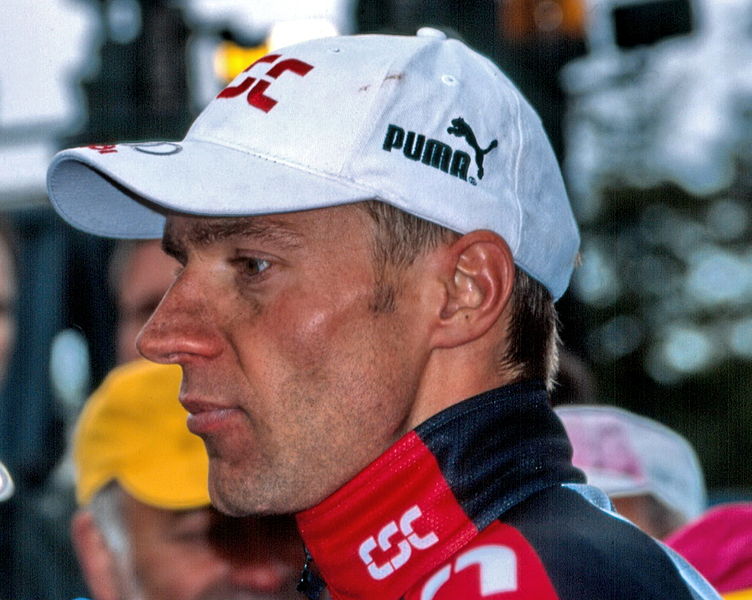
The 39-year-old LeopardTrek rider had become caught up in a crash involving several riders and his decision to quit was announced by organisers at 13:15. The team announced at 15:32 that he was waiting to have a suspected broken finger X-rayed in hospital, then in a website update later in the afternoon confirmed that the finger is broken and that Voigt will require an operation to repair it.
Voigt's move leaves the Luxembourg-based team without a leader; as one of their strongest riders, this may prove disastrous and is the latest in a series of unfortunate recent events including Andy Schleck's forced departure from the Grand Prix Cyclistes of Québec and Montréal with chronic tooth ache and a disappointing Vuelta a Espana.
"He was our guy for the general classification here,” said directeur sportif Torsten Schmidt on the team's website. “He had a good chance for a strong showing because the time trial in this race can be so decisive."
Meanwhile, Sky's Steve Cummings - who was also in the crash - continued to race after receiving attention by race medics.
Saturday, 2 July 2011
Tour de France: Stage 1 debrief
What a start to the 2011 Tour! As predicted, the first crash happened on the treacherous Passage de Gois and then it was crash after crash after crash - as soon as those caught up or held back by an accident caught up, there was another one to chop the peloton into pieces and spread it all over the place.
There wasn't much sign of people taking it easy and checking one another out today, as soon as the race proper kicked off Lieuwe Westra (Vacansoleil), Jérémy Roy (FDJ) and Perrig Quemeneur of local team Europcar leapt ahead and began working on a lead which, at one point, saw them more than seven minutes in front of the peloton. It wasn't long before the other team's top riders began to move up to the front and, gradually, the built the pace up and chased - it took most of the day, though, and the breakaway wasn't put back in their place until a few kilometres from the end.
The second crash saw Anthony Chartreau from Europcar go down, along with another rider from his team and two from Movistar after apparently clipping a piece of street furniture. One of the Movistar riders took a while to get back up again, but seemed alright.
It was a beautiful day in Vendee with a glorious sun in cloudless blue skies. By the looks of things, they've had a lot of sun down that way so far this year because the countryside along the road following the coast looked almost semi-arid, like the less productive regions of Spain. However, fields full of crops suggest water is available. Needless to say, there were vast crowds lining the roads and a good selection of national flags proving that the sport enjoys an international following.
Another crash, apparently once again due to street furniture, not much further on took down TeJay van Garderen (HTC_Highroad), Ivan Basso (Liquigas), Romaine Felliu (Vacansoleil) and Jurgen van de Walle (Omega Pharma Lotto). TeJay was quickly back onboard and surrounded by HTC domestiques helping him to fight his way back up the ranks. Van de Walle looked worst affected, his jersey being badly ripped. Frank Schleck only just avoided becoming caught up too, literally escaping by a few tyre widths.
Nobody quite knew how the new UCI rules for intermediate sprints would work out, but in the end the general consensus was that they were a success. Comments on Twitter, that immediate gauge of public opinion, ranged from "Great! made the sprint as exciting as a stage finish!" to "Horrible - one sprint at the end is bad enough, there's no need for added danger" but were definitely weighted towards the positive. The leading group maintained their advantage into the sprint, which extended over 3km, meaning there was no doubt they'd be taking the top three point allocations but there was everything to play for for those a little further back. In the end, Roy took first, Westra second, Quemeneur third and then Tyler Farrar fourth, Andre Greipel fifth. Mark Cavendish, the world's fastest sprinter, put in a good show but an error of judgement allowed Farrar to surge ahead, at which point the Manxman apparently gave up and rolled across the line in 11th place.
Omega-Pharma Lotto were by this time dominating the front of the peloton with a phalanx of their riders keep things ticking over at a respectable rate. The order began to break down a bit as teams organised themselves in preparation for the feeding station at Rosnay, 104km into the stage. Matt Goss and Fabian Cancellara were seen ferrying bidons back to their teams - unusual behaviour for cyclists in their league, perhaps indicative that neither of them had any intention of winning the stage or even the race. There were no crashes as riders grabbed their musettes, feeding stations being notorious as one of the most dangerous sections in any race, but another incident a few kilometres on brought the peloton to a halt once again: what at first seemed to be yet another crash turned out to have been caused by a small group of riders taking what commentators refer to as a "nature break," known to rest of us as a piss, and other riders misreading the situation.
Camera crews caught up with Sky leader and best British hope Bradley Wiggins a little way further on - his fitness this year is obvious. There is not a gram of fat on his body and his legs look like steel cables. Whether or not we'll see him on the podium in three weeks remains to be seen, but if he stays out of trouble he'll almost certainly finish much higher up than he did last win when he could only manage 24th place, a very disappointing result after he achieved 4th the year before.
A bottleneck going into a tight lefthand bend packed the riders so tightly into a narrow section that Linus Gerdemann (LeopardTrek) and Vincent Jerome (Europcar) were spat out the side, off the road and into the ditch. Lucky for them, they came to rest in a patch of soft grass - it was a hard crash and had it have happened in an urban area on concrete, the Tour might have been over for both of them. Gerdemann seemed to have problems getting his gears and chain working afterwards, but was soon back on and on his way.
With 50km to go, the breakaway group were being well and truly reeled in. Their advantage, whittled away for some time now, was down to three minutes and the trio were beginning to tire but there was no sign of any let-up from the baying mob behind them. David Arroyo, a runner-up in the Giro d'Italia, followed Cancellara's example and ran domestique duties here, carrying bidons from the Movistar team car to his team mates. It was also at about this point that Cadel Evans (BMC) started to assert himself at the front of the pack, pushing his way forward and fighting to stay there - evidence that he intended to account well for himself in this stage.
23km on and the gap between the leading group and peloton was down to under two minutes. Omega were still hogging all the front spots in the main group, but with Sky, HTC-Highroad and Euskaltel-Euskadi also holding their position it remained impossible to make a prediction with any certainty of accuracy. Then another crash took down Sky's Rigoberto Uran who, at this late stage, had to ride hard to regain his position.
As the race entered the final 30km, crossing some strangely corrugated terrain made of a series of small dips and hills, the leaders' advantage was reduced to 44 seconds. They'd had their fun and were going to be returned to anonymity without further delay by the main group which was bearing down upon them like hawks. 5km on and it was down another 10 seconds and after another five it was eroded away to vitually nothing - with the race now taking place on a long, straight road, the peloton were visible just 11 seconds away, bearing down upon them mercilessly. Philippe Gilbert moved into position, ready to show them how a bike should be ridden.
Then, what will be the highlight of the stage for many people: a Devil sighting! Didi stood at the roadside in his trademark costume, jumpimg with his usual energy up and down and waving his trident about. Several people noted that he's looking a lot slimmer these days - at almost 60 years of age, keeping up with the peloton might require a slightly more proactive approach to fitness than that assumed by the noticeably rounded Devil of previous years. Good to see it, too - in his 18 years of devilment, Didi has become one of the most popular figures in cycling and the colour he adds to racing will always be welcome. May whatever diabolical plan he has in mind remain a part of the Tour for many more years.
A very fast section followed with the peloton looking more like a motorbike race from the helicopter, such was the high speed maintained. Then, another enormous crash - a spectator got too close, was hit by an Astana rider and caused an accident involving around 30 bikes, more than enough to bring the race to a stand-still once again and splitting the peloton into several groups. Those ahead of the crash built up a lead, those in the crash formed various groups depending on how quickly they could extricate themselves, those behind it watched in despair as the others began to build up a lead which with just a few kilometres to go would be all but impossible to claw back.
 The final 2km were uphill. This had led to some confusion among those of us who like to predict stage outcomes earlier, because it created uncertainty as to which sort of rider would be best suited to the stage profile. Would it be a stage specialist who could build up a big lead in the flatlands earlier on? Would it be an all-rounder or possibly one of those sprinters who can keep up a high speed for a long time? Or would it be a climber? What's more, there were a total of nine roundabouts in those last 2km and with the crash messing everything up the only thing that was certain was that there were still many riders in with a chance of a victory.
Luxembourg's Andy Schleck had been fortunate enough to escape the crash entirely, having been near the front when it happened and this led many people to hope he might triumph - an unexpected early win for the highly popular and well-liked rider. Schleckmania became heated when his group built up a 39" over Alberto Contador, who had been behind the crash - the exact number of seconds' lead gained by the Spaniard when he controversially decided not to wait for Andy lost his chain in Stage 16 last year - with Tweets buzzing back and forth on the subject of how funny it would be if Andy beat his rival by this time. Andy has publically said that he has forgiven Contador for the chain incident, but it seems his legions of fans have not. In the end, it went to the sprinters - Andy, along with Bradley Wiggins, fell right back, taking 39th and Wiggins 67th. Another crash didn't help and would usually have invoked the rule stating that all riders behind a crash in the final 3km receive the same time, but for some reason this was overlooked at first, then apparently brought back into play when the final results as published on the ASO website changed.
In the end, though, it turned out that while the terrain was testing for the sprinters, it wasn't steep enough to prevent them laying down the power and streaming ahead those who, like Schleck, are so highly specialised to the climbs they just can't perform in the lowland flats. It was Fabian Cancellara, fed up of his earlier domestique duties, who made the first attack, emerging out of the pack like a rocket and blasting towards the finish line. Many spectators assumed there and then he'd win, but it was not to be because Philipe Gilbert, rated the number one rider in the world on the IG Markets index, was even faster. He gave chase and caught him but didn't overtake, keeping him just ahead which allowed others to follow. Then, he dropped the Swiss time trialler with metres to go, crossing the line in first place with a trail of riders in his slipstream.
It was, without doubt, one of the most thrilling first stages for many years and somehow, despite the carnage, all riders remain in the race.
General Classification:
1. Philippe Gilbert (4h41'31")
2. Cadel Evans (+3")
3. Thor Hushovd (+6")
4. Joaquin Rojas
5. Jurgen van den Broeck
6. Geraint Thomas
7. Andreas Klöden
8. Rein Taaramäe
9. Chris Horner
10. Tony Martin (3-10 received same time)
Yellow jersey (overall) - Philippe Gilbert; green jersey (points) - Philippe Gilbert (will be worn tomorrow by Cadel Evans); Polka dot jersey (climber) - Philippe Gilbert; White jersey (youth) - Geraint Thomas; combativity - Perrig Quemeneur; team - Omega-Pharma Lotto.
 |
| Perrig Quemeneur led a breakaway from the first kilometre and deservedly wins the combativity award. |
There wasn't much sign of people taking it easy and checking one another out today, as soon as the race proper kicked off Lieuwe Westra (Vacansoleil), Jérémy Roy (FDJ) and Perrig Quemeneur of local team Europcar leapt ahead and began working on a lead which, at one point, saw them more than seven minutes in front of the peloton. It wasn't long before the other team's top riders began to move up to the front and, gradually, the built the pace up and chased - it took most of the day, though, and the breakaway wasn't put back in their place until a few kilometres from the end.
The second crash saw Anthony Chartreau from Europcar go down, along with another rider from his team and two from Movistar after apparently clipping a piece of street furniture. One of the Movistar riders took a while to get back up again, but seemed alright.
It was a beautiful day in Vendee with a glorious sun in cloudless blue skies. By the looks of things, they've had a lot of sun down that way so far this year because the countryside along the road following the coast looked almost semi-arid, like the less productive regions of Spain. However, fields full of crops suggest water is available. Needless to say, there were vast crowds lining the roads and a good selection of national flags proving that the sport enjoys an international following.
 |
| Jurgen van de Walle went down in one of several crashes, but despite a badly-torn jersey was not injured. |
Another crash, apparently once again due to street furniture, not much further on took down TeJay van Garderen (HTC_Highroad), Ivan Basso (Liquigas), Romaine Felliu (Vacansoleil) and Jurgen van de Walle (Omega Pharma Lotto). TeJay was quickly back onboard and surrounded by HTC domestiques helping him to fight his way back up the ranks. Van de Walle looked worst affected, his jersey being badly ripped. Frank Schleck only just avoided becoming caught up too, literally escaping by a few tyre widths.
Nobody quite knew how the new UCI rules for intermediate sprints would work out, but in the end the general consensus was that they were a success. Comments on Twitter, that immediate gauge of public opinion, ranged from "Great! made the sprint as exciting as a stage finish!" to "Horrible - one sprint at the end is bad enough, there's no need for added danger" but were definitely weighted towards the positive. The leading group maintained their advantage into the sprint, which extended over 3km, meaning there was no doubt they'd be taking the top three point allocations but there was everything to play for for those a little further back. In the end, Roy took first, Westra second, Quemeneur third and then Tyler Farrar fourth, Andre Greipel fifth. Mark Cavendish, the world's fastest sprinter, put in a good show but an error of judgement allowed Farrar to surge ahead, at which point the Manxman apparently gave up and rolled across the line in 11th place.
 |
| Fabian Cancellara, one of the world's most successful riders, decided to do a bit of domestique duty today! |
Omega-Pharma Lotto were by this time dominating the front of the peloton with a phalanx of their riders keep things ticking over at a respectable rate. The order began to break down a bit as teams organised themselves in preparation for the feeding station at Rosnay, 104km into the stage. Matt Goss and Fabian Cancellara were seen ferrying bidons back to their teams - unusual behaviour for cyclists in their league, perhaps indicative that neither of them had any intention of winning the stage or even the race. There were no crashes as riders grabbed their musettes, feeding stations being notorious as one of the most dangerous sections in any race, but another incident a few kilometres on brought the peloton to a halt once again: what at first seemed to be yet another crash turned out to have been caused by a small group of riders taking what commentators refer to as a "nature break," known to rest of us as a piss, and other riders misreading the situation.
Camera crews caught up with Sky leader and best British hope Bradley Wiggins a little way further on - his fitness this year is obvious. There is not a gram of fat on his body and his legs look like steel cables. Whether or not we'll see him on the podium in three weeks remains to be seen, but if he stays out of trouble he'll almost certainly finish much higher up than he did last win when he could only manage 24th place, a very disappointing result after he achieved 4th the year before.
 |
| Linus Gerdemann was in a crash that looked serious, but he and Vincent Jerome were saved by a soft landing. |
With 50km to go, the breakaway group were being well and truly reeled in. Their advantage, whittled away for some time now, was down to three minutes and the trio were beginning to tire but there was no sign of any let-up from the baying mob behind them. David Arroyo, a runner-up in the Giro d'Italia, followed Cancellara's example and ran domestique duties here, carrying bidons from the Movistar team car to his team mates. It was also at about this point that Cadel Evans (BMC) started to assert himself at the front of the pack, pushing his way forward and fighting to stay there - evidence that he intended to account well for himself in this stage.
23km on and the gap between the leading group and peloton was down to under two minutes. Omega were still hogging all the front spots in the main group, but with Sky, HTC-Highroad and Euskaltel-Euskadi also holding their position it remained impossible to make a prediction with any certainty of accuracy. Then another crash took down Sky's Rigoberto Uran who, at this late stage, had to ride hard to regain his position.
As the race entered the final 30km, crossing some strangely corrugated terrain made of a series of small dips and hills, the leaders' advantage was reduced to 44 seconds. They'd had their fun and were going to be returned to anonymity without further delay by the main group which was bearing down upon them like hawks. 5km on and it was down another 10 seconds and after another five it was eroded away to vitually nothing - with the race now taking place on a long, straight road, the peloton were visible just 11 seconds away, bearing down upon them mercilessly. Philippe Gilbert moved into position, ready to show them how a bike should be ridden.
 |
| The Devil, seen here receiving a medal from Andy Schleck, put in an appearance. |
A very fast section followed with the peloton looking more like a motorbike race from the helicopter, such was the high speed maintained. Then, another enormous crash - a spectator got too close, was hit by an Astana rider and caused an accident involving around 30 bikes, more than enough to bring the race to a stand-still once again and splitting the peloton into several groups. Those ahead of the crash built up a lead, those in the crash formed various groups depending on how quickly they could extricate themselves, those behind it watched in despair as the others began to build up a lead which with just a few kilometres to go would be all but impossible to claw back.

Luxembourg's Andy Schleck had been fortunate enough to escape the crash entirely, having been near the front when it happened and this led many people to hope he might triumph - an unexpected early win for the highly popular and well-liked rider. Schleckmania became heated when his group built up a 39" over Alberto Contador, who had been behind the crash - the exact number of seconds' lead gained by the Spaniard when he controversially decided not to wait for Andy lost his chain in Stage 16 last year - with Tweets buzzing back and forth on the subject of how funny it would be if Andy beat his rival by this time. Andy has publically said that he has forgiven Contador for the chain incident, but it seems his legions of fans have not. In the end, it went to the sprinters - Andy, along with Bradley Wiggins, fell right back, taking 39th and Wiggins 67th. Another crash didn't help and would usually have invoked the rule stating that all riders behind a crash in the final 3km receive the same time, but for some reason this was overlooked at first, then apparently brought back into play when the final results as published on the ASO website changed.
 |
| Philippe Gilbert rode well and won the General, Points and Mountain Classifications for today. |
In the end, though, it turned out that while the terrain was testing for the sprinters, it wasn't steep enough to prevent them laying down the power and streaming ahead those who, like Schleck, are so highly specialised to the climbs they just can't perform in the lowland flats. It was Fabian Cancellara, fed up of his earlier domestique duties, who made the first attack, emerging out of the pack like a rocket and blasting towards the finish line. Many spectators assumed there and then he'd win, but it was not to be because Philipe Gilbert, rated the number one rider in the world on the IG Markets index, was even faster. He gave chase and caught him but didn't overtake, keeping him just ahead which allowed others to follow. Then, he dropped the Swiss time trialler with metres to go, crossing the line in first place with a trail of riders in his slipstream.
It was, without doubt, one of the most thrilling first stages for many years and somehow, despite the carnage, all riders remain in the race.
General Classification:
1. Philippe Gilbert (4h41'31")
2. Cadel Evans (+3")
3. Thor Hushovd (+6")
4. Joaquin Rojas
5. Jurgen van den Broeck
6. Geraint Thomas
7. Andreas Klöden
8. Rein Taaramäe
9. Chris Horner
10. Tony Martin (3-10 received same time)
Yellow jersey (overall) - Philippe Gilbert; green jersey (points) - Philippe Gilbert (will be worn tomorrow by Cadel Evans); Polka dot jersey (climber) - Philippe Gilbert; White jersey (youth) - Geraint Thomas; combativity - Perrig Quemeneur; team - Omega-Pharma Lotto.
Tour de France: Stage 1 Preview
After 49 long weeks, the day is finally here - the highlight of the cycling calendar and one of the most eagerly anticipated dates in sport: today brings Stage 1 of the Tour de France.
It's an unusual one this year, because rather than a prologue as is usually the case Stage 1 is a proper road stage taking in a U-shaped 191.5km of the Vendée department in Western France, birthplace of Eleanor of Aquitaine, the only woman to have been queen of both France and England and one of the most powerful people in Medieval Europe. The Tour returns to the Passage du Gois, a tidal causeway visited in 1999 when it proved to have a pronounced effect on the day's results due to the slippery, algae-encrusted surface causing a crash which split the peloton by six minutes. Similar carnage may happen today, providing the 198 riders who are taking part with a good introduction to what promises to be one of the most challenging, thrilling Tours for many years.
There's nothing much in the way of climbing over the first 125km today. In fact, until Les Sables D'Olonne where the road turns inland, when the riders will follow the flat coastline and the parcours reaches no altitude more dizzying than 9m above sea level. Who knows what will happen here? Some riders - especially those more endurance-orientated sprinters who can remain plugging away at a high rate pretty much indefinitely may choose to do so and win their chance to wear the yellow jersey. They may as well, because this is a Tour designed to favour the climbers and once reaching the mountains it's all going to be about them. On the other hand, they might all want to check each other out, assess who looks on good form and who doesn't and save themselves for a final every-man-for-himself dash at the finish.
Roughly halfway through the stage is Avrillé, which brings us to the beautiful 16th Century Château de la Guignardière. The château was built for King Henri II's favourite baker, no less, and has a collection of reproduction Easter Island figures in the garden. Avrillé is also the location of the stage's sprint over a 3km section with 20 points on offer for the victor. Britain's Mark Cavendish, who hasn't been riding half as well this year as he's proved himself able to do in the past, could decide to show what he's capable of here, reminding everyone why it is he's called the fastest man on two wheels and as a result become the first man to wear the green jersey this year. It's then downhill - gently - to the food station at Rosnay. By this point the race will already have covered 104km and so the domestiques will be ferrying musettes back to the captains in preparation for the road to Saint-Michel-Mont-Mercure which may only climb 250m in 70km, a gradient so slight as to go undetected, but remains enough to make its demands on the body. In between, they'll pass through several villages that are characteristic of this part of France including Mouilleron-en-Pareds, birthplace of Georges Clemenceau who, as head of the French Government during World War One was a signatory of the Treaty of Versailles.

Directly after passing through Saint-Michel-Mont-Mercure the parcours drops steeply into a rolling section of around 11km, the turns sharply heavenwards for the only categorised climb of the day in the shape of the Category 4 228m hill to Les Herbiers where, as it was the location of Thursday's team presentation, the spectators are already fired up and riders can expect an ecstatic welcome.
So, who'll win it today? It's always very hard to tell at this point in a big race. The riders in the top bracket, those who have a real chance of standing on the podium in Paris in three weeks' time, tend to hold back in the early stages - especially when it's a flat stage and the likely General Classification winners are all climbers - so the competition can be handed over to the rest of the pack. Since they tend to be the riders who receive less attention, this means it can be tricky to judge their form. However, it does appear that a battle between Highroad's Mark Cavendish and Sky's Ben Swift is on the cards: Swift is making his Tour debut this year and has hinted several times on Twitter and in press interviews that he plans to go after the Manx Missile. He's been tipped as the Next Big Thing in British cycling by many and has everything to play for, so might fancy wearing the green jersey tomorrow. But then, if he does well in the sprint, he might fancy a go at the yellow.
The one thing that's certain is that the long wait since last year's Tour will soon be forgotten in today's excitement.
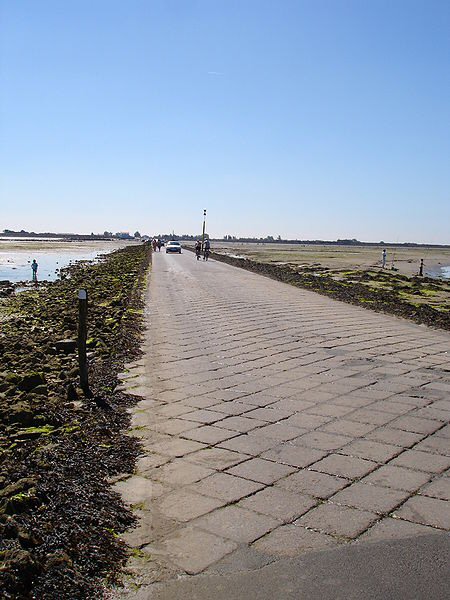 |
| Passage du Gois: scene of carnage in 1999. Who can predict what it will bring today? |
It's an unusual one this year, because rather than a prologue as is usually the case Stage 1 is a proper road stage taking in a U-shaped 191.5km of the Vendée department in Western France, birthplace of Eleanor of Aquitaine, the only woman to have been queen of both France and England and one of the most powerful people in Medieval Europe. The Tour returns to the Passage du Gois, a tidal causeway visited in 1999 when it proved to have a pronounced effect on the day's results due to the slippery, algae-encrusted surface causing a crash which split the peloton by six minutes. Similar carnage may happen today, providing the 198 riders who are taking part with a good introduction to what promises to be one of the most challenging, thrilling Tours for many years.
There's nothing much in the way of climbing over the first 125km today. In fact, until Les Sables D'Olonne where the road turns inland, when the riders will follow the flat coastline and the parcours reaches no altitude more dizzying than 9m above sea level. Who knows what will happen here? Some riders - especially those more endurance-orientated sprinters who can remain plugging away at a high rate pretty much indefinitely may choose to do so and win their chance to wear the yellow jersey. They may as well, because this is a Tour designed to favour the climbers and once reaching the mountains it's all going to be about them. On the other hand, they might all want to check each other out, assess who looks on good form and who doesn't and save themselves for a final every-man-for-himself dash at the finish.
 |
| Château de la Guignardière. You don't get a place like this for cooking sausage rolls in Greg's. |

Directly after passing through Saint-Michel-Mont-Mercure the parcours drops steeply into a rolling section of around 11km, the turns sharply heavenwards for the only categorised climb of the day in the shape of the Category 4 228m hill to Les Herbiers where, as it was the location of Thursday's team presentation, the spectators are already fired up and riders can expect an ecstatic welcome.
 |
| Ben Swift (Sky). |
The one thing that's certain is that the long wait since last year's Tour will soon be forgotten in today's excitement.
Subscribe to:
Posts (Atom)