Showing posts with label Col d'Izoard. Show all posts

Thursday, 8 December 2011

What's with... Louison Bobet?


Bobet on Izoard
(image credit: Dave's Bike Blog)
Louis Bobet, born on the 12th of March in 1925, shared his name with his father so the nickname Louison came about when his family needed to differentiate between them. In Brittany, Louison is a common boy's name but elsewhere in France it's more usually a girl's name; so when he first started racing he used Louis but Louison caught on later (as did "La Bobette," which he is said to have loathed), and was spread by other riders who made fun of him due to his habit of crying when he performed badly.

Bobet's father was a baker but seems to have had an interest in sports because he gave his son a bike when the boy was just two years old and immediately started teaching him to ride it - within six months, the toddler was apparently able to ride 6km - also encouraging Louison's sister to play table tennis and his brother Jean to play football (Jean also became a cyclist in the end, but didn't have Louison's talent). His Uncle Raymond, the president of a Paris cycling club, recognised promise in the boy and took over his training, persuading him and his parents that he might make a living on the bike. He came second in his first race in 1938, later making it through to unofficial Youth Championships of 1943 when he came sixth; the race being won by none other than Raphaël Géminiani who would go on to become one of the most successful riders of the 1940s and 1950s - the beginnings of the (sometimes friendly, sometimes not so friendly) rivalry that would persist even when the two men became team mates years later. Around this time, Bobet acted as a messenger for the Resistance, smuggling secret missives right under the noses of the Nazis - detection would almost certainly have led to execution, either summarily or very soon afterwards. After D-Day, he joined the newly-formed French Army and served in the east of the country, helping to drive the Nazis out of their alpine strongholds.

First Races
Having been demobilised in December 1945, Bobet applied for a racing licence and was accidentally sent one declaring him to be an Independent - the semi-professional class of riders that were then permitted to compete in major professional races (including the Tour de France) provided they met their own costs. We don't know if he originally planned to send it back and explain the mistake, but if he did he soon realised that it would allow him to compete in both professional and amateur events - and he was sure enough of his abilities to do so (in the future, several riders put their dislike of Bobet down to his tendency to consider himself a cut or two above the rest - whom he seems to have viewed as common oiks). Having won 2nd place in the Breton Championships, he rode in the Nationals and, having attacked a pair of experienced professionals who had broken away from the peloton, dropped one before beating the other in a final sprint (during that race, he also competed against 1929 Champion and Tour veteran Marcel Bidot, who would later become his manager).

(image credit: Polygoon Hollands Nieuws
 CC BY-SA 3.0)
With the National Champion title came a professional contract from Stella, a Nantes-based bike manufacturer. The team was little-known outside Brittany until Bobet and a team mate entered the Parisian Boucles de la Seine in 1947 and which he won, crossing the finish line alone with a six-minute gap between himself and the next rider. That was enough to get him an invite to join the national team in that year's Tour de France.

However, the Tour turned out to be vastly more difficult than Bobet had expected and he abandoned during Stage 9, the Alps reducing him to tears. The press savagely attacked him for his weakness and the public scorned him for being soft; rather unfairly since they'd made a hero of René Vietto in 1934 and continued treating him as such even when his apparent heroism turned out to be distinctly tarnished. Then, in 1948, the management of the Stella team was taken over by Maurice Archambaud. Archambaud, who had won a total of ten Tour stages and worn the yellow jersey fourteen times, was a man highly qualified to spot Tour promise in a rider and he spotted it in Bobet even when nobody else did. He decided that Bobet would benefit from his expertise, and he was right: that year, Bobet took the overall lead after Stage 3. He lost it the next day, but then took it back by winning Stage 6. At this point, he had a 20-minute advantage over 2nd place Gino Bartali. Bartali would win, after a superhuman effort aimed at preventing his country from descending into civil war that has become one of the most-told instances in the Tour mythos, but Bobet came 4th - an incredible feat from a man who had been written off a year before.

The 1949 Tour was a disaster and he dropped out in Stage 11 as soon as the race reached the mountains. The next year, he raced alongside Géminiani for the first time. Géminiani, who had a habit of creating nicknames for other riders by taking a syllable from their name, changing it and then repeating it, rechristened Bobet Zonzon - which he didn't like very much but decided he could live with. After all, it was better than "Crybaby," which had become his nickname in 1947. Besides, the two men had become friends despite frequent and sometimes fierce arguments - and Bobet was presumably well aware that he didn't have many friends. The pair had hoped one of them would be in with a chance of winning that year as Fausto Coppi was absent after breaking his pelvis earlier in the year at the Giro d'Italia, but they ended up spending much of the race vying with one another for second and third place as neither stood a hope of standing up to the wild, fire-breathing Ferdy Kübler. Stan Ockers got the better of them and took second place overall, but Bobet must have been pleased with third - especially since Géminiani was fourth. Better still - and strangely, in view of his previous history - Bobet won the King of the Mountains with little difficulty, taking the jersey in Stage 11 (the first for which it was awarded) and wearing it with the exception of one single day for the rest of the race.

Bobet had another off-year in 1951, cracking so badly in the mountains that new manager Marcel Bidot gave up on him and ordered the riders he'd commanded to assist him to help Géminiani instead. He was not entered the following year - yet, Bidot still saw promise and entered him for the Critérium International, Paris-Nice and the GP des Nations and Bobet won all three, along with a number of other races. Bidot explained his faith in the rider later:

"Bobet is a good climber and time-triallist who rides with authority and intelligence. He is careful with his preparation, careful with his efforts and totally serious. An outstanding rider but has a lack of confidence. He is extremely nervous, sensitive, worried and susceptible. But with experience he will overcome the problems. A charming friend, happy, often joking and with spirit, but some days he shuts himself off, wrapped in his worries."

He was back on the start line at the Tour in 1953.

Tour Success
That year, Bobet won Stage 18, one of the most remarkable stages of post-war Tour history and a classic, text book example of team tactics. His team mate Adolphe Deledda, who was out in front riding with a breakaway group, received the message that Bobet had dropped Jesus Lorono on the way down from the Col de Vars and was on his way. So, he left the group and took his time while Bobet caught up, then helped him all the way to the Col d'Izoard.
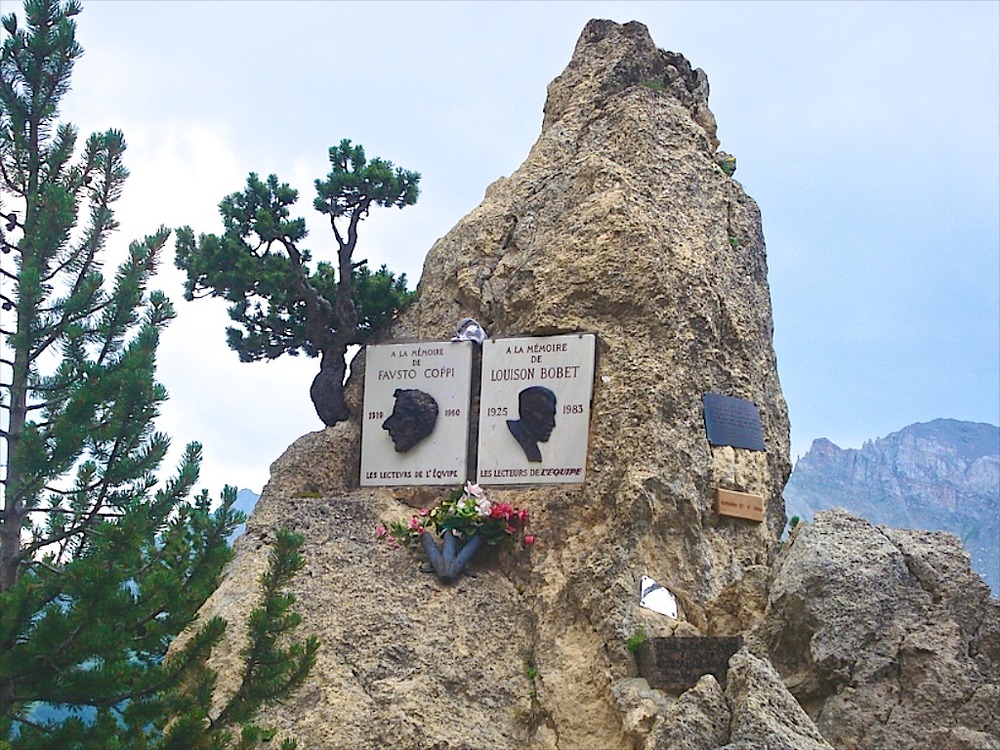
Memorial to Bobet and Coppi, Izoard
(image credit: Podium Cafe)
The landscape of Izoard is frequently compared to that of the Moon, and in those days the road was no better: merely a rough track made of loose stones picking its way between the boulders. Yet Bobet, having had chance to replenish his energy supplies while Deledda nursed him there, attacked it "as if he had wings," according to race historian Bill McGann. At the top, waiting to see the race go by, was Fausto Coppi with the Woman in White, his mistress Giulia Locatelli. Bobet, as we have noted, considered himself above the hoi-polloi; but he knew greatness when he saw it and thanked the Italian for coming as he sailed by.

When he reached Briançon, he had a five minute advantage - enough to retain the yellow jersey for the rest of the race. A perfect individual time trial in Stage 20 won him the race with an advantage of 14 minutes. When he crossed the finish line he was greeted by Maurice Garin, winner of the first Tour, there to celebrate the 50th.

It was not long after the race was over before his victory began to be picked apart. Coppi had not been there and Bartali, at 38, was not the man he had once been. Koblet, the winner in 1951, had abandoned following a crash in Stage 10 and Kübler hadn't entered. The general consensus was that while Bobet's Izoard win had been impressive, the opposition throughout the race had not been up to much. 1954 was a different matter entirely - the Italian team still hadn't replaced its greatest ever stars but the Belgians and the Dutch were formidable - and Kübler was back. Bobet took the yellow jersey in Stage 3, but lost it in Stage 7 to Wout Wagtmans who kept it for four days before Gilbert Bauvin took it in Stage 11. All the while, Bobet fought hard to get it back, eventually doing so in Stage 13 and keeping it to the end. Another perfect time trial gave him 15 minutes on Kübler - and this time, nobody could deny he'd won a hard race.

In 1955, Pierre Rolland appeared to be the strongest French rider and Bidot ordered Bobet to support him. However, Rolland's strength faded in the mountains, unable to withstand the sheer ferocity of repeated attacks on the unforgiving climbs by a young Luxembourgish rider named Charly Gaul. Bobet, though suffering from a saddle sore that would later lead to an oft-told tale in which he couldn't bring himself to describe the affected body parts when asked for details of the surgery he underwent after the race, completely bamboozling her by insisting that he had experienced problems with his pockets. Géminiani, who had been listening in, decided the time had come to end the lady's confusion. "Oh for heaven's sake, Zonzon," he interrupted, "tell her you've got bloody balls."

(image credit: Dave's Bike Blog)
Yet Bobet rode on, and suffered for it. The saddle sore led to necrosis and a large quantity of rotting flesh had to be cut away from his groin, in some cases stopping just short of important organs. He won that year - the first man to win three consecutive Tours, but in doing so he had destroyed his chances of winning again and he knew it. He entered again in 1958 but was visibly unwell throughout the race, suffering badly as he drove himself on and somehow finished in 7th place overall. He never finished another Tour after that.

The Man
Bobet, as we have noted, was not popular among other riders who found him stuck-up and distant. A large part of that perhaps needs to be reattributed to his being several years ahead of his time - the rest, meanwhile, can be put down to the fact that he genuinely was rather an obsequious little snob who believed himself to be the very pinnacle of sporting endeavour: as Géminiani (his friend, remember) said, "He really thought that, after him, there'd be no more cycling in France." When he refused point blank to wear the yellow jersey the frst time he won the right to do so, explaining that he wouldn't wear synthetic fibres, it wasn't because he considered the cheaper material not befitting his status; it was because as a man who had suffered saddle sores in the past he realised that natural fibres would allow sweat to wick away from his skin (any modern rider who has suffered the same affliction and been ordered to wear soft cotton underwear by a doctor knows this is the case). He acted like a Hollywood star, which was put down to self-importance; but could also be seen as an understanding that the cult of personality was going to be how he made his living once he retired, thus predating the boxers and footballers who make fortunes selling their image to the fashion industry today. When he attacked his country for its involvement with the war against Communist rebels in Indochina, it wasn't because he was unpatriotic or, as many claimed, himself a Marxist - he explained that he was simply a pacifist, thus anticipating the wider adoption of anti-war beliefs in the 1960s.

As might be expected of a man who was so concerned for his own health, Bobet refused to take drugs at a time when doping was beyond rampant in a sport not yet woken up by the death of amphetamine-addled Tom Simpson on Mont Ventoux. Whether or not he did take them is debatable - he may have believed he did not, but Jacques Anquetil and Eddy Merckx were reduced to paroxysms of laughter at a formal dinner organised by the Tour's organisers when Bobet, having informed them that he never doped, added that before races he had drunk small bottles of an unknown fluid prepared for him by his personal soigneur Raymond Le Bert (he was ahead of his time on that one, too - nobody else had ever employed a soigneur of their own).

Bobet also gave rise to what is now a Tour tradition - he was the first rider to divide up the money he won for the race and distribute it among his domestiques. However, he didn't do so out of pure altruism: he was so furious at what he saw as his team's treachery in helping Nello Lauredi (who shares a record three Critérium du Dauphiné victories with Charly Mottet, Luis Ocaña and Bernard Hinault, fact fans!) to win the sprint finish of Stage 13 in 1953 that he took the team to task at dinner that night. Tempers flared as the team took a one for all route and argued that they'd supported the rider most likely to win the stage while Bobet - unsurpringly, went down the all for one road and countered that since he was the team leader they should have supported him. Before too long, the team manager had a fight on his hands and before too long, the riders were refusing to support Bobet altogether. He had to think fast and came up with a solution - would they support him if he agreed to split the money he won with their help between them? Of course, they agreed - in this way, a humble domestique makes far more money than he otherwise would from a Tour - and so did Bobet, who was more than intelligent enough to realise that a Tour victor makes more money from his glory after the race than he does by winning it.

After the Glory
On Mont Ventoux
(image credit: Mariocipo.sportblog)
In retirement, Bobet became involved in a number of business ventures and used his fame to ensure they got attention. The best-known of these was his development and promotion of the distinctly scientifically-shaky alternative health treatment thelassotherapy, which was invented in Brittany in the 19th Century and claims to improve well-being through the absorption of beneficial minerals found in sea water (administered using a variety of methods including hot and cold showers, muscle rubs and going for a swim). He opened a thelassotherapy resort at Quiberon and, with his canny understanding of the power of celebrity, named it after himself. It's still in operation to this day, albeit under the new name Miramar Crouesty, and going by the numerous favourable reviews on independent French tourism websites is doing very well.

Bobet died of cancer on the day following his 58th birthday in 1983 and is buried in the cemetery at Saint-Méen-le-Grand, the town where he was born. In addition to his three General Classifaction and one King of the Mountains victories at the Tour, Bobet also won the Mountains Classification at the Giro d'Italia in 1951; the World Championship in 1954; the National Championship in 1950 and 1951; the Critérium des As (1949, 1950, 1953 and 1954); Milan-San Remo, the Giro di Lombardia and the Desgrange-Colombo Trophy in 1951; the Critérium International (1951 and 1952); the Tour of Flanders, the Critérium du Dauphiné and the Tour de Luxembourg (1955); Paris-Roubaix in 1956 and Bordeaux-Paris in 1959.

Not bad for a crybaby.

Thursday, 21 July 2011

Tour de France: Stage 18 Preview

If you want to demonstrate to someone what the Tour de France is - the horror, the pain, the beauty and the skill - then you could do far worse than show them today's stage. This is the Big One, the Queen, possibly even the Decider.

In this 200.5km stage, riders must tackle three Hors-Categorie mountains, the harshest test in what is a three-week series of challanges, the most deadly weapon in the Tour's well-stocked arsenal. Proceedings kick off in Pinerolo where Stage 16 came to a close, the Italian town acting as a stage town for the first time this year. The peloton leaves on the S589 as it heads from the city centre, passing some good new buildings before entering the flat countryside to the south. This first section is likely to encourage early breakaways as riders with no chance of picking up big points in the high mountains race ahead in an attempt to get to the intermediate sprint (starting today after 46.5km), meaning that we're likely to see a repeat of yesterday when various riders attempted to escape the pack right from the end of the neutral zone. It might be a short while before anyone meets with any success, but it'll come early so that those within the escape group can pick up whatever points they can.

The road is almost perfectly straight with the exception of a large roundabout at the junction with the SP161 which passes above on a fly-over - however, with the entrance and exit to the roundabout being slightly off-set to the left, negotiating the central island requires little deviation and other than spreading the pack out a little with have virtually no noticeable effect - and then heads on to another; this second one being trickier. Very soon it becomes possible to see the Castello di Osasco, standing at the north-western corner of a village. A little way on is a difficult roundabout with a kinked entrance that may trick some riders into taking the wrong line and subsequently losing time. Just past Garzigliani the road crosses two rivers before continuing south through a little hamlet named Casenuove and straight through a crossroads.

Rocca di Cavour.
The road is straight and untechnical as it enters Cavour, 9.5km from the start. This large town has grown up immediately north of the strange Rocca; an peculiar hill rising to 50m from the expansive flatlands all around a little like a miniature Mont Ventoux. Geological inspection of the Rocca reveals it to be a granite inselberg or monadnock - an isolated mountain - of which all but the visible tip has been buried by alluvial sediments. Archaeological survey reveals petroglyphs at various points about the rock and there are ruined fortifications. From here, the course heads south-west along more straight, flat roads to Bagnolo Piemonte which has an especially good-looking castle and views to the Alpine foothills rising just a few kilometres away. The road south leads to Barge, which marks 20km thus far travelled.

Castello di Envie.
Barge has in recent years become home to a vibrant Chinese community, which raises the prospect of an interesting fusion cuisine that would be ideal for a long-distance cyclist's needs. The great Lombardi San Giovanni Battista church is the town's most famous site, but with luck the weather will be clear enough for the camera operators to get some shots of the Rocca at Cavour, which looks particularly impressive from here. Taking the road east, the peloton heads around the forested hills which rise to over 1000m and onwards to Envie with a castle that was completely destroyed by Savoyard forces, then purchased and rebuilt in Romantic Gothic style by a Count Guasco Castelletto.

Saluzzo.
After 31.5km, the parcours reaches Revello which, with its many old and slightly unkempt buildings, looks like the location of every film Vittorio De Sica ever made. The route through town is tight with several corners, which may be difficult if wet, but the riders soon leave town and head east on the SP26 towards Saluzzo. Standing on a small rise and with many medieval towers and spires, Saluzzo is an impressive site when approached from the surrounding flat regions, though its better seen from the opposite angle to that from which the Tour arrives when it has the Alps as a backdrop. Highlight is the Casa Cavassa, once the stately home of the local lords but now put to far better use housing the town's museum and a beautiful synagogue, which still stands though the once vibrant Jewish community was all but wiped out in WW2, despite brave attempts by some locals to save them. In Saluzzo, the parcours changes onto the SR589 which looks to be a complicated process involving various roundabouts, corners and narrow urban streets - however, this does mean we'll get to see the attractive architecture throughout the town.

We then head south-east once more via Manta, site of another reconstructed castle - this one, a 14th Century stately home, stands on the sight of a 12th Century real castle - and on to the next town Verzuolo, separated from its neighbour by one field. Verzuolo would undoubtedly be a far more attractive place were it not for the large industrial plant on the eastern side of town but like the majority of Italian communities it has many other sights to recommend it. including one of the most beautiful castles along this stage and some ancient churches as pleasing to look at as they are interesting to explore. Verzulo marks today's intermediate sprint which, though uphill, climbs just 26m and as a result is likely to be hotly contested by any riders making up a breakaway group or - if no breakaway has formed - by the sprinters in the peloton who are going to have little chance to add to their successes for the remainder of the Tour.

On the southern edge of Verzuolo, the peloton turns south-west at a roundabout and travels toward Piasco, site of the world's only harp museum, and continues west around another roundabout to Venasca - the name, derived from an ancient word, is believed most likely to mean either "water" or "poison." As is often the case in Italy, this small town of around 1500 people has a church fit for a city - the Baroque Parrocchiale Maria Assunta was built in the 18th Century and has a richly decorated interior with what has been called the finest selection of marble sculpture and statues in Piedmont. The road skirts the town to the north, avoiding the narrow streets, but the church should be visible over the surroundings rooftops. The next town we pass through is Brossasco where the road turns north-west to reach the middle of the community, then south-west to carry us further along the SP8. This require two corners to be rounded, but they don't look as though they'll cause any problems.

After 63.5km, the parcours reaches Melle. This village, which a hundred years ago had a population of almost 2500 people but is now home to less than 400, is located in a narrow gap between the forested hills to the north and those that have been gradually closing in from the south for some kilometres now; leaving no doubt that we're heading into the mountains. It's still a long way to the summit, but along this stretch the Tour has begun the long and challenging climb to the summit of Col Agnel, the highest point of this year's race.

Casteldefino
Further west we come to Frassino, site of an avalanche in 1850 that destroyed the village along with two others and killed 80 people, then past Rore to Sampeyre on the banks of an artificial lake created by a dam. Sampeyre has become something of a mountain biking centre in recent years with the many trails leading down from the mountains - which rise to over 3000m - being especially popular among downhillers. The road through the town is straightforward, becoming the SP105 as it exits to the west before passing through Calchesio and then rises through four switchbacks to Caldane before continuing west towards Casteldefino, which marks 85.5km ridden. As the name suggests, there was a castle here but it's now ruined - there's much more to see along the narrow medieval streets, some of which have buildings with old murals painted on their exterior walls. The lower parts of the town are almost 100m below the higher parts, so passage through involves two switchbacks at the western and eastern ends before the road moves on to Rabioux as the assault on the summit really gets under way.

Pontechianale Lake in winter.
As the road approaches Castello it's possible to see the Frazione Castello dam which has created a large lake. Once, when it was dry land, there were buildings here including a church, the tower of which would until recently emerge from the waters when levels were low but it's now collapsed. The peloton will travel along the lake's northern shore for 2km until it reaches the remaining, dry part of Pontechianale where the road becomes the SP251 and passes into a stunningly beautiful valley, largely uninhabited until it reaches Chianale 5.5km further up.

Col Agnel
Chianale marks the beginning of the final section of the 23.7km climb. From here onwards we are officially at high altitude - high enough for oxyhaemoglobin levels in the blood to begin falling rapidly, bringing about altitude sickness. Somewhat surprisingly in view of its familiarity among cyclists and people who follow the sport and the incredible scenery in the region, Col Agnel is one of the less well-known Alpine passes which makes it possible to ride over without seeing a single car on a good day. Let's hope it remains that way. All surprising in view of the same fame among the cycling fraternity is that this is only the second time it's been featured in the Tour, the first time having been as recently as 2008 when it was climbed from the opposite side.

The summit is reached by no fewer than seventeen switchbacks, each one a challenge in its own right as the bends - where the road moves up a level - can be much steeper than the average gradient of the climb (6.5%). As the rider crest the mountain, they cross the border and are once more in France to begin the long, steep and very fast descent which extends for just over 20km, taking in another six switchbacks which at this speed are extremely hazardous, along the D205. They pass through the tiny village of Fontgillarde, past Chateau-Renard and Pierre-Grosse before reaching Molines-en-Queyras, at which point they will have travelled 121km, leaving almost 80km to go. The village has an interesting church, destroyed in the 16th Century, rebuilt in the 17th and renovated in the 21st. The low, square tower is topped by a wooden construction with open sides, leaving the bells fully visible, and looks very rustic - however, the interior is a complete contrast, being lavishly decorated with a bright blue ceiling adored with gold decorations. The peloton will have to negotiate another pair of switchbacks on the way into the village before changing onto the D5 at a simple junction by the church. The road then passes by La Rua and follows the course of a rock-strewn mountain stream before veering off into a wooded section and, via another switchback, down to La Casse, across the river and left around a roundabout to Château-Ville-Vieille and the feeding station where musettes stuffed with energy bars and suchlike will no doubt be very welcome after Col Agnel, and especially since there are two more high mountains still to be climbed. Nearby is the village Chateau-Queyras, and on a rocky outcrop stands 13th Century Fort Queyras which survived a Savoyard siege even though the village was destroyed.

Fort-Queyras
The road travels south-west, clinging to the mountainside above the river and becomes the D902 after 131.5km before turning north-west into a valley of alpine meadows leading towards Les Moulins and, after 3.5km, Arvieux at the start of the second Hors-Categorie climb to the 2360m summit of Col d'Izoard, 14.1km long with an average gradient of 7.3%.

To get up requires nine switchbacks and, once there, there's La Casse Déserte. This strange, lunar landscape, its name translating as The Broken Desert, has been called the most difficult section ever ridden in the Tour and is arguably more feared than Mont Ventoux. There are scrubby pine trees in the valley, but the steep slopes are pale and bare, giving the place an unearthly, lifeless appearance. It is undoubtedly one of the strangest places Nature has created anywhere in Europe. There's a monument up here, formed from a natural menhir, to Louison Bobet and Fausto Coppi, and a museum of Tour history - but very few cyclists ever make it here to visit.

La Casse Déserte
The parcours then descends via nine switchbacks into a green valley which, after the deathly La Casse Déserte, seems like the Garden of Eden. Another seventeen switchbacks take the road down almost 400m to Le Laus, where it once again becomes straight and comparatively level as it heads to Cervières where the river is directed through a sixteen-stepped "staircase," clearly visible as the riders pass to the south of the village before continuing the descent through the valley past another artificial lake and dam towards Briançon, a town we passed through yesterday, with the enormous and seemingly impregnable fortress that dominates the entire region.

Col du Galibier
Getting through Briançon is a reasonably simple process despite the corners and roundabouts because the town has been planned so as to permit the transport of heavy vehicles and goods such as cannon to the fort, meaning the roads are easy to get around by bike. We leave the town along the D1091 heading north-west towards La Salle-les-Alpes where the church of Saint Marcellin has some unusual and quite unsettling carvings in its stonework, then on to the spa town Le Monêtier-les-Bains which, with 22.5km to go, marks the beginning of the final climb: the 22.8km, 4.9% ascent to one of the most famous places in cycling, the Col du Galibier. This section may be made even more difficult by the weather - just two days ago, it snowed and there are likely to still be patches of slush in some places to catch the unwary and the tired. The summit is acting as the finish line for the very first time, though the mountain has been climbed by the Tour 31 times since its first appearance in 1947 and is the highest stage finish in the race's history. Whoever reaches the summit first is very likely to also reach the summit of the podium when the race ends in Paris following the next two stages.

Predictions: There's at least a 90% chance that today will be won by a Schleck, an Evans or a Contador. This is the sort of stage upon which Andy Schleck excels and after a not-especially-brilliant few stages, he's got a lot to prove. His form doesn't seem what it was last year, but let's not forget just how good a climber he is - provided the fast descents don't get the better of him, he's in with a good chance in this one; not least of all because he can keep going when others cannot. The same is true of Frank, but if he's to win Andy will first need to be in poor form and second admit to it, sacrificing his own race to help his brother win.

Cadel Evans is a favourite of many - he's been climbing spectacularly well this year and is much more comfortable when descending than the Schlecks. He's also not so worried when the weather turns bad, so if there's still snow on Galibier he'll be in a much better position to cope with it.

However, Contador has to be the top choice today. Following a lack-lustre performance on the earlier climbs, either due to sandbagging or genuine fatigue from the Giro d'Italia, he's really found his legs. Added encouragement comes from the fact that, with a large portion of the cycling world turned against him following his troubles with anti-doping measures, he arguably has even more to prove than Andy does: few things say "screw you guys" than winning this stage and then providing a crystal-clear testing record for the entire race would. Also, Contador has an extremely skillful assistant in Sammy Sanchez, an amazing climber in his won right, who has sworn his aid.

Weather: Looking good for the majority of the parcours with plenty of sun and winds no more than 10kph in the lowlands - however, maximum temperatures could reach 28 degrees C which is getting a bit too warm for comfort. Weather forecasting becomes much more difficult at altitude and conditions can change rapidly in the mountains, but at present it's also looking reasonable for Agnel and d'Izoard - though winds of up to 30kmph at the summits could cause problems. Galibier is a different matter - the summit is predicted to be misty and there are still some slushy patches following the snowfall two days ago. No new snow is predicted, but a 40kmph wind and 6 degrees C ambient temperature will make it feel very cold and could cause muscle aches and pains; especially for the climbers who have far lower levels of body fat than other cyclists.

DEVIL WATCH: As the old saying goes, the Devil is in the mountains. Oh alright, we may have got that a bit wrong - but when it comes to the Tour Devil, the pointy places are usually the best spots to find him as the peloton will be travelling more slowly and he gets a better opportunity to show himself to his admiring public. He could be on Agnel or the Col d'Izoard, but Galibier is probably more likely since it's the finish. We'll be expecting him somewhere around halfway up.