Showing posts with label Brittany. Show all posts

Thursday, 8 December 2011

What's with... Louison Bobet?


Bobet on Izoard
(image credit: Dave's Bike Blog)
Louis Bobet, born on the 12th of March in 1925, shared his name with his father so the nickname Louison came about when his family needed to differentiate between them. In Brittany, Louison is a common boy's name but elsewhere in France it's more usually a girl's name; so when he first started racing he used Louis but Louison caught on later (as did "La Bobette," which he is said to have loathed), and was spread by other riders who made fun of him due to his habit of crying when he performed badly.

Bobet's father was a baker but seems to have had an interest in sports because he gave his son a bike when the boy was just two years old and immediately started teaching him to ride it - within six months, the toddler was apparently able to ride 6km - also encouraging Louison's sister to play table tennis and his brother Jean to play football (Jean also became a cyclist in the end, but didn't have Louison's talent). His Uncle Raymond, the president of a Paris cycling club, recognised promise in the boy and took over his training, persuading him and his parents that he might make a living on the bike. He came second in his first race in 1938, later making it through to unofficial Youth Championships of 1943 when he came sixth; the race being won by none other than Raphaël Géminiani who would go on to become one of the most successful riders of the 1940s and 1950s - the beginnings of the (sometimes friendly, sometimes not so friendly) rivalry that would persist even when the two men became team mates years later. Around this time, Bobet acted as a messenger for the Resistance, smuggling secret missives right under the noses of the Nazis - detection would almost certainly have led to execution, either summarily or very soon afterwards. After D-Day, he joined the newly-formed French Army and served in the east of the country, helping to drive the Nazis out of their alpine strongholds.

First Races
Having been demobilised in December 1945, Bobet applied for a racing licence and was accidentally sent one declaring him to be an Independent - the semi-professional class of riders that were then permitted to compete in major professional races (including the Tour de France) provided they met their own costs. We don't know if he originally planned to send it back and explain the mistake, but if he did he soon realised that it would allow him to compete in both professional and amateur events - and he was sure enough of his abilities to do so (in the future, several riders put their dislike of Bobet down to his tendency to consider himself a cut or two above the rest - whom he seems to have viewed as common oiks). Having won 2nd place in the Breton Championships, he rode in the Nationals and, having attacked a pair of experienced professionals who had broken away from the peloton, dropped one before beating the other in a final sprint (during that race, he also competed against 1929 Champion and Tour veteran Marcel Bidot, who would later become his manager).

(image credit: Polygoon Hollands Nieuws
 CC BY-SA 3.0)
With the National Champion title came a professional contract from Stella, a Nantes-based bike manufacturer. The team was little-known outside Brittany until Bobet and a team mate entered the Parisian Boucles de la Seine in 1947 and which he won, crossing the finish line alone with a six-minute gap between himself and the next rider. That was enough to get him an invite to join the national team in that year's Tour de France.

However, the Tour turned out to be vastly more difficult than Bobet had expected and he abandoned during Stage 9, the Alps reducing him to tears. The press savagely attacked him for his weakness and the public scorned him for being soft; rather unfairly since they'd made a hero of René Vietto in 1934 and continued treating him as such even when his apparent heroism turned out to be distinctly tarnished. Then, in 1948, the management of the Stella team was taken over by Maurice Archambaud. Archambaud, who had won a total of ten Tour stages and worn the yellow jersey fourteen times, was a man highly qualified to spot Tour promise in a rider and he spotted it in Bobet even when nobody else did. He decided that Bobet would benefit from his expertise, and he was right: that year, Bobet took the overall lead after Stage 3. He lost it the next day, but then took it back by winning Stage 6. At this point, he had a 20-minute advantage over 2nd place Gino Bartali. Bartali would win, after a superhuman effort aimed at preventing his country from descending into civil war that has become one of the most-told instances in the Tour mythos, but Bobet came 4th - an incredible feat from a man who had been written off a year before.

The 1949 Tour was a disaster and he dropped out in Stage 11 as soon as the race reached the mountains. The next year, he raced alongside Géminiani for the first time. Géminiani, who had a habit of creating nicknames for other riders by taking a syllable from their name, changing it and then repeating it, rechristened Bobet Zonzon - which he didn't like very much but decided he could live with. After all, it was better than "Crybaby," which had become his nickname in 1947. Besides, the two men had become friends despite frequent and sometimes fierce arguments - and Bobet was presumably well aware that he didn't have many friends. The pair had hoped one of them would be in with a chance of winning that year as Fausto Coppi was absent after breaking his pelvis earlier in the year at the Giro d'Italia, but they ended up spending much of the race vying with one another for second and third place as neither stood a hope of standing up to the wild, fire-breathing Ferdy Kübler. Stan Ockers got the better of them and took second place overall, but Bobet must have been pleased with third - especially since Géminiani was fourth. Better still - and strangely, in view of his previous history - Bobet won the King of the Mountains with little difficulty, taking the jersey in Stage 11 (the first for which it was awarded) and wearing it with the exception of one single day for the rest of the race.

Bobet had another off-year in 1951, cracking so badly in the mountains that new manager Marcel Bidot gave up on him and ordered the riders he'd commanded to assist him to help Géminiani instead. He was not entered the following year - yet, Bidot still saw promise and entered him for the Critérium International, Paris-Nice and the GP des Nations and Bobet won all three, along with a number of other races. Bidot explained his faith in the rider later:

"Bobet is a good climber and time-triallist who rides with authority and intelligence. He is careful with his preparation, careful with his efforts and totally serious. An outstanding rider but has a lack of confidence. He is extremely nervous, sensitive, worried and susceptible. But with experience he will overcome the problems. A charming friend, happy, often joking and with spirit, but some days he shuts himself off, wrapped in his worries."

He was back on the start line at the Tour in 1953.

Tour Success
That year, Bobet won Stage 18, one of the most remarkable stages of post-war Tour history and a classic, text book example of team tactics. His team mate Adolphe Deledda, who was out in front riding with a breakaway group, received the message that Bobet had dropped Jesus Lorono on the way down from the Col de Vars and was on his way. So, he left the group and took his time while Bobet caught up, then helped him all the way to the Col d'Izoard.
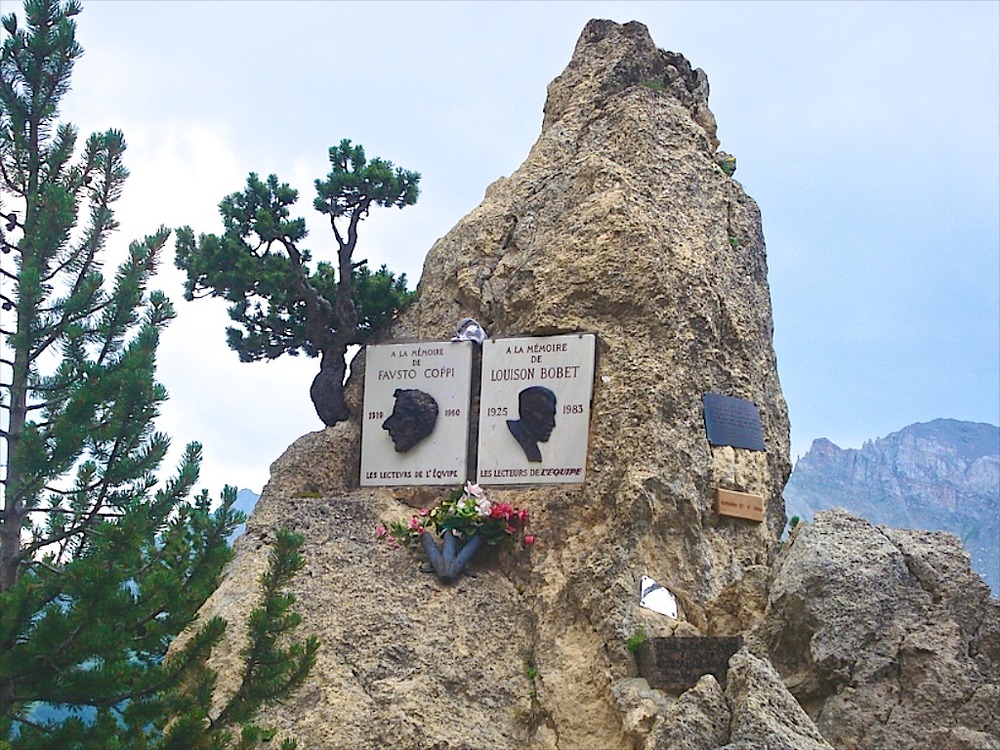
Memorial to Bobet and Coppi, Izoard
(image credit: Podium Cafe)
The landscape of Izoard is frequently compared to that of the Moon, and in those days the road was no better: merely a rough track made of loose stones picking its way between the boulders. Yet Bobet, having had chance to replenish his energy supplies while Deledda nursed him there, attacked it "as if he had wings," according to race historian Bill McGann. At the top, waiting to see the race go by, was Fausto Coppi with the Woman in White, his mistress Giulia Locatelli. Bobet, as we have noted, considered himself above the hoi-polloi; but he knew greatness when he saw it and thanked the Italian for coming as he sailed by.

When he reached Briançon, he had a five minute advantage - enough to retain the yellow jersey for the rest of the race. A perfect individual time trial in Stage 20 won him the race with an advantage of 14 minutes. When he crossed the finish line he was greeted by Maurice Garin, winner of the first Tour, there to celebrate the 50th.

It was not long after the race was over before his victory began to be picked apart. Coppi had not been there and Bartali, at 38, was not the man he had once been. Koblet, the winner in 1951, had abandoned following a crash in Stage 10 and Kübler hadn't entered. The general consensus was that while Bobet's Izoard win had been impressive, the opposition throughout the race had not been up to much. 1954 was a different matter entirely - the Italian team still hadn't replaced its greatest ever stars but the Belgians and the Dutch were formidable - and Kübler was back. Bobet took the yellow jersey in Stage 3, but lost it in Stage 7 to Wout Wagtmans who kept it for four days before Gilbert Bauvin took it in Stage 11. All the while, Bobet fought hard to get it back, eventually doing so in Stage 13 and keeping it to the end. Another perfect time trial gave him 15 minutes on Kübler - and this time, nobody could deny he'd won a hard race.

In 1955, Pierre Rolland appeared to be the strongest French rider and Bidot ordered Bobet to support him. However, Rolland's strength faded in the mountains, unable to withstand the sheer ferocity of repeated attacks on the unforgiving climbs by a young Luxembourgish rider named Charly Gaul. Bobet, though suffering from a saddle sore that would later lead to an oft-told tale in which he couldn't bring himself to describe the affected body parts when asked for details of the surgery he underwent after the race, completely bamboozling her by insisting that he had experienced problems with his pockets. Géminiani, who had been listening in, decided the time had come to end the lady's confusion. "Oh for heaven's sake, Zonzon," he interrupted, "tell her you've got bloody balls."

(image credit: Dave's Bike Blog)
Yet Bobet rode on, and suffered for it. The saddle sore led to necrosis and a large quantity of rotting flesh had to be cut away from his groin, in some cases stopping just short of important organs. He won that year - the first man to win three consecutive Tours, but in doing so he had destroyed his chances of winning again and he knew it. He entered again in 1958 but was visibly unwell throughout the race, suffering badly as he drove himself on and somehow finished in 7th place overall. He never finished another Tour after that.

The Man
Bobet, as we have noted, was not popular among other riders who found him stuck-up and distant. A large part of that perhaps needs to be reattributed to his being several years ahead of his time - the rest, meanwhile, can be put down to the fact that he genuinely was rather an obsequious little snob who believed himself to be the very pinnacle of sporting endeavour: as Géminiani (his friend, remember) said, "He really thought that, after him, there'd be no more cycling in France." When he refused point blank to wear the yellow jersey the frst time he won the right to do so, explaining that he wouldn't wear synthetic fibres, it wasn't because he considered the cheaper material not befitting his status; it was because as a man who had suffered saddle sores in the past he realised that natural fibres would allow sweat to wick away from his skin (any modern rider who has suffered the same affliction and been ordered to wear soft cotton underwear by a doctor knows this is the case). He acted like a Hollywood star, which was put down to self-importance; but could also be seen as an understanding that the cult of personality was going to be how he made his living once he retired, thus predating the boxers and footballers who make fortunes selling their image to the fashion industry today. When he attacked his country for its involvement with the war against Communist rebels in Indochina, it wasn't because he was unpatriotic or, as many claimed, himself a Marxist - he explained that he was simply a pacifist, thus anticipating the wider adoption of anti-war beliefs in the 1960s.

As might be expected of a man who was so concerned for his own health, Bobet refused to take drugs at a time when doping was beyond rampant in a sport not yet woken up by the death of amphetamine-addled Tom Simpson on Mont Ventoux. Whether or not he did take them is debatable - he may have believed he did not, but Jacques Anquetil and Eddy Merckx were reduced to paroxysms of laughter at a formal dinner organised by the Tour's organisers when Bobet, having informed them that he never doped, added that before races he had drunk small bottles of an unknown fluid prepared for him by his personal soigneur Raymond Le Bert (he was ahead of his time on that one, too - nobody else had ever employed a soigneur of their own).

Bobet also gave rise to what is now a Tour tradition - he was the first rider to divide up the money he won for the race and distribute it among his domestiques. However, he didn't do so out of pure altruism: he was so furious at what he saw as his team's treachery in helping Nello Lauredi (who shares a record three Critérium du Dauphiné victories with Charly Mottet, Luis Ocaña and Bernard Hinault, fact fans!) to win the sprint finish of Stage 13 in 1953 that he took the team to task at dinner that night. Tempers flared as the team took a one for all route and argued that they'd supported the rider most likely to win the stage while Bobet - unsurpringly, went down the all for one road and countered that since he was the team leader they should have supported him. Before too long, the team manager had a fight on his hands and before too long, the riders were refusing to support Bobet altogether. He had to think fast and came up with a solution - would they support him if he agreed to split the money he won with their help between them? Of course, they agreed - in this way, a humble domestique makes far more money than he otherwise would from a Tour - and so did Bobet, who was more than intelligent enough to realise that a Tour victor makes more money from his glory after the race than he does by winning it.

After the Glory
On Mont Ventoux
(image credit: Mariocipo.sportblog)
In retirement, Bobet became involved in a number of business ventures and used his fame to ensure they got attention. The best-known of these was his development and promotion of the distinctly scientifically-shaky alternative health treatment thelassotherapy, which was invented in Brittany in the 19th Century and claims to improve well-being through the absorption of beneficial minerals found in sea water (administered using a variety of methods including hot and cold showers, muscle rubs and going for a swim). He opened a thelassotherapy resort at Quiberon and, with his canny understanding of the power of celebrity, named it after himself. It's still in operation to this day, albeit under the new name Miramar Crouesty, and going by the numerous favourable reviews on independent French tourism websites is doing very well.

Bobet died of cancer on the day following his 58th birthday in 1983 and is buried in the cemetery at Saint-Méen-le-Grand, the town where he was born. In addition to his three General Classifaction and one King of the Mountains victories at the Tour, Bobet also won the Mountains Classification at the Giro d'Italia in 1951; the World Championship in 1954; the National Championship in 1950 and 1951; the Critérium des As (1949, 1950, 1953 and 1954); Milan-San Remo, the Giro di Lombardia and the Desgrange-Colombo Trophy in 1951; the Critérium International (1951 and 1952); the Tour of Flanders, the Critérium du Dauphiné and the Tour de Luxembourg (1955); Paris-Roubaix in 1956 and Bordeaux-Paris in 1959.

Not bad for a crybaby.

Wednesday, 6 July 2011

The astounding power of crème de cassis

If you can't be in France for the Tour, the next best thing is to watch it with a French friend - especially if it happens to be passing through the part of France they once called home, as was the case yesterday when I watched with our Breton friend Virginie. Better still, Virginie had actually been to France two days ago and had come home with several bottles of decent Breton wine, crème de cassis, some sort of evil coconuttish liquor stuff and a jar of hare terrine which yours truly didn't eat ('cos I don't eat meat) but of which Mrs. Orbea took full advantage, declaring it "well nice."

Picking out one face among the Tour crowds
is like finding a needle in a haystack made of
millions and millions of very similar needles.
Now, plenty of us have been to France - it receives millions of tourists every year - and seeing the places you've visited is always fun, but it's nothing compared to what an expat experiences when they see the villages in which the grew up. "Zere is le church where Ah first received communion! And just over zere is le field where Ah first 'ad sex and smoked marijuana! Zat is le pub from which Ah am banned for life from ze days when Ah was le punk rockeur! Mon Dieue! Zey are passing through Trégornan! Zat is where my fazzer lives!"

So there we were, five of us looking out for an elderly Frenchman standing on a roadside verge somewhere in North-Western France - our chances of spotting him somewhat reduced due to Virginie being the only one among us with any idea what he looks like.

The riders arrived at Trégornan. "Eet eez so beautiful!" and then...adverts! Onoes!

Could it be that creme de cassis
confers psychic powers upon
those who sup of its blackcurranty
sweetness?

If you're lucky enough to live in one of the cycling nations - France, Italy, Belgium, Luxembourg or the Netherlands - you probably get to watch the Tour relatively unhassled by people trying to sell you stuff, but here in the UK, where the TV channels haven't quite cottoned on to how popular cycling is becoming over here these days, the cost of buying the right to show live footage is offset by having commercial breaks roughly every five minutes. The Universe being the sort of place it is, this means that you can guarantee with 99% certainty that you will miss the bit of France you particularly wanted to see/the day's big crash/the peloton negotiating a hoard of zombies in the road and so on.

Virginie thought the moment has passed when the adverts were over, but decided she was mistaken. "Oh, wait, wait - zis could be eet! Oui!" It was a very long, straight road with literally thousands of people, further reducing our chances.

"There he is! There he is!" You'll notice that the - ahem - French accent is gone. The reason for that is that all five of us were yelling it, and since four of us are Brits we drowned out the Frenchie. We'd all seen him - an old man dressed in a long black coat and black hat - and Viriginie phoned him immediately for confirmation. We had been correct - but how in the name of Henri Desgrange had we all known it was him?

It's good stuff, that crème de cassis.

Monday, 4 July 2011

Tour de France: Stage 3 Debrief

We said earlier that today's stage was the sort to encourage early breakaways, and that proved to be accurate - a five-man group led by Movistar's José Iván Gutiérrez and FDJ's Mickaël Delage got on the case within the first kilometre and kept pumping the gas almost all the way to the end, rapidly building a hefty lead on the main group. Although the gap gradually eroded away they did an admirable job in keeping up the pace, holding it for a lot longer than many people thought they'd be capable (though we'd like to point out that, not long after the breakaway, erm, brokeaway, we Tweeted: "PerezMoreno, Guiterrez, Bouet, Terpstra leading the field by 3'20". They could keep this up for a long time today. #tdf" Yes, we rule).

Vendee is a region that, like a lot of the stages in the north western corner of La France, tends to be a bit overlooked by many fans which in a way is understandable, because the scenery really can't compare to the majestic spectacle of the Haute-Pyrenees and the Alps, nor to the grandeur of Paris and some of the southern cities. However, we saw some of the very finest scenery the non-mountainous bits of the country have to offer today - the landscape is flat but colourful and the Jade Coast is nothing less than stunning, easily making it onto our list of Places Where We'll Live When We Win The Lottery. The shrimp-fishing huts atop stilts on the beaches are particularly charming and the coastal towns remain unspoiled, as they hopefully will unless a load of Lottery-winning Brits gets wind of it and prices the locals out of the housing market.

Pornic. A bit like epic, only better. ;-)
Before too long, that impudent breakaway group were leading the peloton by a full 6'47". Successful though it was, it seemed an odd tactic as far as Gutiérrez was concerned because whilst he was by no means a favourite he could have had an outside chance at a decent GC place today. By taking part so early, he threw away his chances. If that was all in order to get team-mate Jose Joaquin Rojas onto the podium - as was the case when he took third - it's an example of supreme self-sacrifice.

Poor Nicholas Roche got a puncture a little further up the road, but the mechanics were with him quickly and swapped the front wheel so he didn't have to work that hard to get back in the thick of it. The breakaway had a 6'52" lead at the feeding station, flashing through long before the peloton which was now being led by none other than the Tour's only ever vegan, David Zabriskie - and if a vegan is that keen to get his musette, all those people who think vegan food is bland and tasteless are obviously mistaken. Either that or he was just desperate for the small amounts of salmon he says he'll eat to keep his iron levels up.

Garmin, apparently fully recovered from their excellent and victorious efforts in the time trial yesterday, had spent a bit of time at the front of the peloton but Saxobank seemed keen to muscle in, no doubt desperate to get their leader Alberto Contador a few notches up the board after his disastrous start to the Tour. It remains to be seen if his poor placing so far is due to circumstances out of his control, such as the crashes of Stage 1 and a not particularly shining team effort yesterday, or whether it's down to tiredness from the Giro d'Italia and the mental stress of the ongoing doping allegation. Whatever it is, the old cliche about the French supporting the underdog doesn't seem to apply in his case: he started the day in 75th place and would have needed a lot more than 50 picograms/ml of some not-very-effective bronchodilator  in his dinner last night to achieve a top place today, yet the Bertie-bashing that took place in the team presentation continues unabated with one Twitterer suggesting that someone should "fill Contador's feedbag with spiders." At least it's funny. Well, except for spiders.

We were treated today to the sight of one of those traditions that mystifies some people (there were certainly a lot of users on Twitter who had trouble understanding what was going on) - as the peloton passed through the hometown of one rider, the local boy was allowed to ride on ahead of the group and build up a big enough advantage so that he could stop to chat and receive best wishes from family and friends. Once the others arrived, he rejoined in his previous position and was on his way. Can you imagine anything like that happening in any other sport? It's things like this, which exist despite the intense competition, that makes cycling the wonderful thing that it is and reminds fans why we love it so much.

As the sprint section neared, there was no doubt that the breakaway were going to take the lion's share of the points. Delage was first through and collected his 20 points, then Gutiérrez was second for 17 with the 15, 13 and 11 going to their comrades. The main group were there soon after, with Mark Cavendish through in 5th place to take 10. A lot of people - including us - have been beginning to think that perhaps all is not well with Cav, if perhaps the Missile is running out of fuel, but he proved today that he's still got what it takes when he muscled his way through the pack with almost imperceivable effort. Unfortunately, later events saw him lose the points...


Once the sprint was done, it was just a few kilometres before the St. Nazaire bridge came into sight, looking not unlike a sort of skeletal, synthetic miniature Mont Ventoux in the way it rose above the flat landscape. This was the only categorised climb of the day and, realising that the lead group would be hard-pressed to maintain their advantage over it, HTC-Highroad moved to the front of the pack and began putting on the pressure, beginning the final stage of reeling them back and putting them back in their positions while a few riders misjudged a corner slightly and got a bit of mountain biking in over a grassy roundabout. In photographs, the bridge didn't look an especially difficult climb but on the stage profile it showed up as a steep-sided isosceles spike, revealing it to be one to be reckoned with. That Category 4 classification should have been a bit of a giveaway too - though the climb up to the central span was on a very good quality road and, while steep, not too long, the strong crosswinds that howl in from the Atlantic make it more challenging than it at first appears, as reflected by the categorisation. The helicopter footage was every bit as scenic as predicted, and it has to be said that if there's one thing the French do very well it's engineering graceful curves into architecture.

The long cruise back down must have come as a great relief to aching knees and, once down, tyres came into contact with Breton soil. The Bretons love cycling in a way that counts as obsessive even by French standards and had come out in droves to cheer on the riders, a welcome sight to HTC and Garmin who had taken control at the front of the peloton, already jockeying for position ready for the final stretch. Vladimir Karpets of Katusha developed a problem and had to swap bikes - the team car was with him in an instant, but he lost enough time for it to be uncertain if he'd be able to catch up again. Bravely using team cars to assist him, he managed to get in with a small group hanging some way off the back of the peloton and from there, with an heroic effort, clawed his way back up. We got some interesting shots of Lars Baks who, having run domestique duty to the HTC team car, was on his way back to his team mates with so many bidons stuffed into his pockets and up his jersey that he looked like a cross between Quasimodo and a deformed camel.

Round about the 30km to go point was an absolutely exquisite example of the field art produced by French farmers for the Tour - an enormous bicycle with a hay bale frame and rotating wheels each made of twelve tractors. A chainring, also rotating, was made of eight quad bikes and the whole thing finished off to perfection with a vast bottle of wine in the bottle cage - probably the best effort of this Tour and possibly the best ever. If you haven't clicked the link already, do so now - it really needs to be seen to be believed. Twitterer Ms Biscuit Sea Star was "Trying to figure out the haybale gear inches. Tres bon!" Soon afterwards, a BMC rider - we never did work out which one, but it looked like George Hincapie - crashed, taking down two of his team mates with him. Luckily neither riders nor bikes were injured and all were back on and heading off almost as soon as it happened.
Delage deserved the Combativity award,
but so did 
Gutiérrez
Delage and Gutiérrez were still hammering away, though it was obvious that the gap couldn't last very much longer. The former was awarded the Combativity prize for his efforts, but it's a pity there aren't two because both deserved it and probably wouldn't have done so well without one another's help. Meanwhile, HTC were getting into one of their well-rehearsed formations with 13km to go, guarding Cavendish to prevent him becoming swamped and getting him into the ideal position for an assault on the finish. The pressure built up still further with the peloton accelerating and making it apparent that the final sprint was going to be a good one. Then Confidis' Rein Taaramae experienced every racing cyclist's nightmare - a puncture just 11km from the finish line, leaving him no chance of catching up and getting a good result, probably not helped at all by the legal requirement for all French bikes - including professional racing bikes according to fellow blogger Inrng - to be fitted with "lawyer's lips," those little tabs seen on the drop-outs of some bikes in other nations which are supposed to prevent the wheel falling out if the quick-release isn't fastened (do they actually work? I've never had the opportunity to find out, because I'm not stupid enough to not do up the quick release). He managed 65th overall and was lucky to get that.

The final 6km were fairly technical with a series of tight bends and assorted road furniture/traffic caling measures heading into Redon, but this provided HTC with another opportunity to show off when the split into two groups to negotiate a roundabout and then merged back together like fluid. These guys spend a lot of time practicing this sort of stuff and it shows. By now, they were all set and ready to launch the Missile - it looked like a classic tactical win was on the cards. But then, just before the Flamme Rouge, something went wrong - whilst rounding a bend, someone either misjudged their line or was forced out of it, putting Cav perilously close to the crowd barriers so he had to slow right down and lose 60m or more in the process. Precisely what happened is as of yet unclear - Cav, looking gutted and angry after the race was over, blamed the rider who got in front of him. However, for anyone who watched it on helicopter footage it looked like a Sky rider had made a mistake and forced several riders to swerve, setting up a domino effect with the Manxman at the end. In the end, it was Tyler Farrar who reached the line first, thus becoming the first American ever to win a stage of the Tour de France on Independence Day.

Cav and Thor: controversially disqualified from the intermediate sprint
After the race, the real shitstorm kicked off when judges announced that due to a very minor bit of pushing and shoving during the intermediate sprint, Cavendish and Thor Hushovd were not getting any points - this must have come as a real slap in the face to Cav right after having what looked like a definite stage victory pulled away from him and if there were any camera teams within earshot we'll probably never be allowed to hear an unedited version of his reaction. It has to be said that, in view of their peculiar insistence on saddles being level yesterday, the UCI do seem to be being a bit of  load of arses just lately and there'll be few people who agree this judgement is necessary. Hushovd has subsequently proved himself a big man in more than stature - as Cavendish himself Tweeted: "Just heard that Thor's offered to take the punishment solely. What a true gentleman. I reckon it won't change fuck-all though. But thank you." We haven't heard the last of this one.

Stage 3 results:

1.Tyler Farrar, Garmin-Cervelo 4:40:21
2.Romain Feillu, Vacansoleil same time
3. Jose Rojas, Movistar
4.Sébastien Hinault, Ag2r
5.Mark Cavendish, Htc-Highroad
6,Thor Hushovd, Garmin-Cervelo
7.Julian Dean, Garmin-Cervelo
8.Borut Bozic, Vacansoleil
9.André Greipel, Omega Pharma–Lotto
10.Jimmy Engoulvent, Saur-Sojasun 3-10 received same time


Overall results after Stage 3

1.Thor Hushovd, Garmin-Cervelo 9:46:46
2.David Millar, Garmin-Cervelo same time
3.Cadel Evans, BMC Racing 00:01
4.Geraint Thomas, Sky Pro Cycling 00:04
5.Linus Gerdemann, Leopard Trek 00:04
6.Boasson Hagen Edvald, Sky Pro Cycling 00:04
7.Frank Schleck, Leopard Trek 00:04
8.Andy Schleck, Leopard Trek 00:04
9.Jakob Fuglsang, Leopard Trek 00:04
10.Bradley Wiggins, Sky Pro Cycling 00:04


(That was, shall we say, fundamentally different to our prediction - we reckoned Cav would do well, but even the Asda Extra Special tea-leaves we favour aren't good enough to foresee shenanigans like the one that robbed the Missile of what looked set to be a definite win for him. You could say we failed there. We also liked Sky's chances, thinking either Wiggo or the Welsh Warrior might be in the top three, but 'twas not to be. In fact, it was all quiet on the Sky front and none of them made it into the top ten today never mind the podium. Are you sulking after coming fourth in the TTT, chaps? Our final tip was Swifty, but even his youthful enthusiasm wasn't enough - he finished 66th, but he's a good lad and we still think he'll have some good stages later on. So all in all, we might have to concede that we don't actually rule all that much after all. On the other hand, we weren't too far off the mark with DEVIL WATCH - Didi was sighted just down the road from the 20km banner, not far at all from our prediction at Le Poteau-Vert. You know the best place to come for all your future DEVIL WATCH needs - unless we bollocks that one up over the next few days, anyway.)