Showing posts with label 1914. Show all posts

Saturday, 28 June 2014

Daily Cycling Facts 28.06.2014

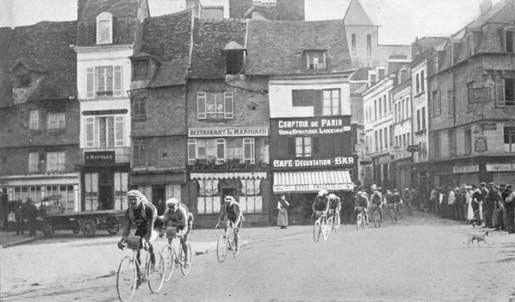
The Tour de France has begun on this day three times - 1914, 1969 and 1985. By 1914, eleven years since the first edition, the race had been increased to 15 stages and the total distance was 5,405km; making stages on average 360km in length. In fact, the longest was 470km - while this is as long as two long stages together in a modern Tour, riders had a rest day after ever stage. There were eight plain stages and seven mountain stages, time trials not being introduced until 1927. Today is also the anniversary of the assassination of Archduke Franz Ferdinand in Sarajevo: one month and once day later the First World War began, then six days after that Germany invaded Belgium and declared itself at war with France. There would not be another Tour for five years.

Le Tour, 1914
The assassination was the tipping point at which Europe descended into war rather than the cause, of course: her most powerful forces (Great Britain, Germany, Austro-Hungary and France) had been building up their armies for decades, peering nervously at one another and turning the entire continent into a powderkeg. The relationship between France and Germany had been especially frosty for a very long time due to the question of Alsace, the region that has changed hands between the two countries numerous times and where, until comparatively recently, the majority of the population spoke a German dialect (that row led in a roundabout way to the invention of the Tour, as it happens, but describing how with sufficient detail to make doing so worthwhile would take a lengthy article of its own); as a result the parcours went from Belfort, which sits between the Vosges and Jura and is just kilometres from Alsace to Longwy near the Luxembourgian border. That way, it stayed well clear of the German border for a fourth consecutive year.

Le Grand Départ, 1914
The number of starters had grown enormously since the first Tour, meaning that reporters and race officials were no longer able to recognise every rider; so for the first time each bike had a number displayed upon it. Don Kirkham and Ivan Munro became the first Australian riders to take part, racing for Phebus-Dunlop they would come 17th and 20th respectively.

Philippe Thys and his Peugeot-Wolber team mate Henri Pélissier were favourites, but also racing were six previous winners: Louis Trousselier (1905), Lucien Petit-Breton (1907, 1908), François Faber (1909), Octave Lapize (1910), Gustave Garrigou (1911) and Odile Defraye (1912). Three riders would win after the war - Firmin Lambot (1919, 1922), Léon Scieur (1921) and Lucien Buysse (and 1926). Thys also won in 1913 and in 1920 would become the first man to win three Tours; Pélissier won in 1923. Eleven Tour winners with fifteen victories between them in one edition remains a record, and one that's unlikely to be broken. When Thys won Stage 1, beating several of his main rivals in the sprint and the rest by at least 3'21", he looked set to dominate the race - though Jean Rossius, who second with the same time, came very close to taking the lead on Stage 2, which he won. However, on that occasion it was Thys who was second, also recording the same time, so they shared leadership. This situation remained until after Stage 5.

On the third stage, riders arrived at a checkpoint (in those days, they had to stop and sign their names to prove they hadn't taken shortcuts) an hour late and found that the official in charge had got bored and left a subordinate to wait for them. As a result, they were given incorrect instructions and ended up riding 30km in the wrong direction, completely unaware until organisers discovered the mistake and sent a car to find them so that they could be brought back and the race could be restarted. Emile Engel, who had won stages in the Independents class in 1909 and 1910, won his only stage as a professional, sponsored rider that day (later on he was in a collision with another rider named Maurice Brocco. The language he used when explaining to Brocco why it was his fault was so strong that he was disqualified); Thys, Rossius and several others finished joint fifth. Stage 4, the longest at 470km, went to the Swiss Oscar Egg with Pélissier second for the same time, Thys and Rossius were joint fourth. It was on Stage 5, when Egg won again, that Thys finally managed to get away from Rossius and gained upper the hand; he was third and Rossius was fifth.

Stage 6 brought the riders to the Pyrenees and the climbers took over. Lambot won the stage whilst Thys was second, 7'40" behind him. Rossius was eleventh, 1h02'09" behind the winner: overall victory slipped from his grasp. The Tunisian Ali Neffati was hit by an official race car on the Aubisque and couldn't finish the stage; fortunately for him the rules of the day allowed him to remain in the race after his likely time had been determined and he was given 42nd place and raced again. Jean Alavoine won the sixth stage of his career when he was first over the finish line for Stage 7, leading a group of five men that, in addition to himself, included Marcel Buysse (2nd), Thys (3rd), Pélissier (4th) and Rossius (5th). The mountains were left behind in Stage 8 for the 370km trip between Perpignan and Marseilles and the weather was so hot that the riders didn't want to race, riding at little more than walking pace. Henri Desgrange, trying to prevent a boring stage, stopped the race and rapidly organised an impromptu sprinting contest eventually won by Lapize (who got into an argument with Egg - Egg's language, like that of Engel earlier the same day, was found disagreeably coarse, but he escaped with a fine). Stage 9 took a mountainous 338km route from Marseilles to Nice: Rossius won with a 6'54" led over joint second Pélissier and Thys, but by now his overall disadvantage was so great that it no longer mattered. François Faber, who had become the first foreigner to win the Tour in 1909, was spotted taking a drink from a motorcycle and being pushed, for which he was awarded a 90' penalty - that didn't matter either, any chance he may have had at the start of the race were long gone now.

Pélissier's disadvantage was 44'30" at the start of Stage 10, but he was the only man in the race able to take on Thys and still thought he might be able to do so, fighting hard to win Stage 10 - he managed it and took back more than 10', starting Stage 11 34'27" behind. That day, the finished together so the gap remained untouched after Garrigou won; after Stage 12, which he won, he reduced it by another 2'37" whilst Thys was sixth - the only stage in which he didn't finish in the top five.

Philippe Thys
Faber won Stages 13 and 14. Pélissier was still 31'50" at the beginning of Stage 14, but then an opportunity fell into his lap: on the way to Dunkirk, one of Thys' wheels collapsed. The rules stated that a rider had to either repair all faults himself (strictly without outside help) or wait for a race official to declare it irreparable, in which case a replacement part could be provided from the team car. Thys realised that following correct procedure was likely to cost him too much time, so he took a risk and went off in search of a bike shop to buy a new wheel (it was a big risk, because officials were being especially firm that year: earlier in the race, one of the sponsored riders threw away a half-eaten sandwich. Seconds later it was pounced upon by an independent, thanking his lucky stars for some free food - and the professional rider got a 30' penalty for assisting a rider who wasn't a member of his team). Officials spotted him and he was penalised 30', which sent Pélissier haring off towards Dunkirk in an attempt to make up the remaining 1'50" and take control of the race. Precisely what happened next is a mystery: Pélissier said that there were spectators in the road at Dunkirk and they wouldn't let him through. This happened, rather conveniently, at a time when there were no race officials nor police officers around to back him up, which has led many to wonder if he was simply unable to counter the heroic - and successful - attempts Thys made to preserve his lead. Pélissier would win the final stage, but took back no more time.

When the riders returned to the real world after the race, Europe was a very different place. The war began just two days later, and a few weeks after that Desgrange used his L'Auto newspaper to publish the following letter to his champions:
"For 14 years, Le Auto has appeared every day.  It has never let you down. So listen my dear fellows, my dear Frenchmen.  There can be no question that a Frenchman succumbs to a German.  GO! Go without Pity!"
Faber, Petit-Breton and Lapize would not return in 1919 when the Tour next took place: Faber was shot in the back while trying to rescue a fallen comrade from no man's land between the trenches, Petit-Breton died when he was hit by a car while serving as an Army message carrier and Lapize, who became a fighter pilot, was shot down over Flirey and died a few days later. They were not the only ones, but most of those who could only dream of Tour success are now forgotten.


In 1969 there were 22 stages and the race covered 4,110km - seven more stages than 1914, but 1,295 fewer kilometres. After a few decades in which the Tour was open only to national teams, commercially sponsored trade teams returned in 1962. However, after a riders' protest against ani-doping tests in 1966 (which organisers believed had been provoked by sponsors, who wanted the problem covered up rather than brought out into the open where they might become associated with it) they decided to return to national teams (or at least, that was the official reason: in his book Le Tour (ISBN 0-340-54268-3), Geoffrey Nicholson argues that the decision may have been prompted by accusations that the race caused too many road closures and that by reintroducing national teams teams they were trying to drum up patriotic support). Trade teams countered by refusing to allow their best riders to compete, which is why Eddy Merckx didn't take part in the Tour of 1968. Organisers relented and the trade teams returned on 1969 (with Eddy Merckx, once political intervention - and the hundreds of protesting fans who surrounded the Belgian Federation's headquarters - had seen to it that his highly questionable doping conviction from the Giro d'Italia earlier in the year had been quashed), initially on the understanding that the race would revert to national teams every few years. 43 years later, this has not happened.

Eddy Merckx
Merckx had not yet won a Tour, but he'd already been World Champion and won a Giro, three editions of Milan-San Remo, a Tour of Flanders, Paris-Roubaix, Gent-Wevelgem, Liège-Bastogne-Liège and La Flèche Wallonne; the spectators that saw him on the start line were already realising that here was a rider whose talent was far greater than any of those who had come before him. He had made no secret of the fact that he was there to win, yet one thing stood in his way - for a period of eighteen days between the positive test at the Giro and the start of the Tour, he'd been suspended from competition. That was enough time without race practice to affect his form, and he was not at his best. Rudi Altig of Salvarani knew that and he put it to good use by beating the Belgian by 7" in the prologue. Stage 1a ended at Merckx's hometown Sint-Pieters-Woluwe and he was determined to win, but now Marino Basso took advantage of his reduced form and sprinted past him in the last 50m (Sint-Pieters-Woluwe is also home to the Palais Stoclet, a private home that must be seen if you ever happen to be in the area as it's the finest example of 20th Century architecture anywhere in the world); Altig finished outside of the top ten but was able to retain the yellow jersey when the first 96 finishers were awarded the same time.

Stage 1b was a team time trial, in which Faema beat Bic by 46" and Salvarani by 48". Merckx therefore started the next day in yellow, but he didn't chase when a group led by his team mate Julien Stevens escaped because none of his rivals went with them. He finished 16" after Stevens, which meant Stevens took the maillot jaune. "It was a great moment for him to take over the yellow jersey. I was quite happy to give it up - temporarily; it's much too conspicious," he said later. Only a year ago, the moment the break got away, Merckx would have been after them and kept going until he'd hunted down every single member regardless of whether they presented him with any sort of challenge or even if they were team mates - he was maturing, and that made him even more dangerous. Stage 3 went to Eric Leman of the Flandria team, this time the first 116 riders over the line were given the same time and so Stevens remained in yellow for another day. He'd have lost it on Stage 4 when Rik van Looy escaped, making good use of the terrain (described as flat stage officially, it's actually rather hilly and precisely the sort of parcours a Flanders Classics specialist such as van Looy can use to his advantage) - not because he thought he had any chance of winning the Tour, but in an attempt to get himself noticed by the selection panel for the World Championships; he managed to build up a considerable gap that, if he'd kept it to the end, would have got him into yellow. Stevens wasn't ready to give it up just yet, however, and went after him  accompanied by seven other riders. Among them was René Pijnen, who rode with van Looy on the Willem II-Gazelle team (ah, those heady days when a bicycle manufacturer and cycling team were happy to associate themselves with a cigar firm), who set about trying to disrupt the chase. The others turned on him and using the various means and ways by which an unwanted rider can be ejected from a group (including, but not limited too, verbal warnings that the unfavoured one is going to be kicked into a ditch or wall just as soon as there's a reasonable chance that the race officials are looking the other way) got rid of him. Stevens finished 42" after van Looy and kept the yellow jersey, the rest of the group were 2" behind and Pijnens arrived 53" later (van Looy got his ticket to the Worlds and came 24th; so did Stevens, but he won a silver medal).

Julien Stevens
The following day, the Tour reached the mountains of Alsace and everything changed. Stevens had used up too much energy the day before; he couldn't stay with the break led by Désiré Letort, who had been in the Stage 4 chase group, and lost the jersey. Joaquim Agostinho won the stage by 18" against Altig; Letort was tenth he'd won enough time to put himself into the overall lead the only time he wore the maillot jaune in his nine years as a professional - but Merckx was now in second place overall with a disadvantage of only 9". It was no surprise the next day, when the race climbed its first serious mountains (including the Grand Ballon, Alsace's highest point, and the Ballon d'Alsace which, on the 11th of July 1905, had been the first mountain the Tour ever climbed) when he converted that disadvantage into a 2'03" advantage. He was 28th on Stage 7 but none of the riders that came before him were close enough to cause much concern and Altig remained 2'03" behind, so Merckx was confident going into the Stage 8a individual time trial. It didn't go quite as well as he might have liked with only 2" being added to his lead, but it was still early days and while he was 29th behind stage winner Michele Dancelli in 8b that afternoon, Altig recorded the same time so again nothing changed.

In Stage 9, Merckx and Roger Pingeon escaped together. Merckx had the strength to win mountain stages even though he was built like a sprinter, but Pingeon's lighter build left him less tired at the end of the stage and he was able to win the sprint. For Altig, a sprint specialist, the stage was an unmitigated disaster: he finished in 76th place, 7'59" behind Pingeon and Merckx, which cost him. Now trailing Merckx by 10'04" overall, his chance to win was lost.

Pingeon was now in second place overall, but trailed Merckx by 5'21" in the General Classification. Herman van Springel won with a 2'01" lead the next day but was much to far down the leadership to make any difference at all, and the 5'21" stayed intact. Then Merckx won Stage 11, adding another 22", then 1'28" when he was third behind Felice Gimondi on Stage 12. He maintained it at 7'11" for the next two stages (which went to Guido Reybrouck and Agostinho) and had no reason at all to win the time trial in Stage 15 - but he did, and finished with 8'03" advantage overall. Raymond Delisle beat him by 2'45" on Stage 16 after a small group away up Portet d'Aspet; since he too was no rival there was even less reason for Merckx to bother himself with winning Stage 17. But Merckx had a greater competitive drive than anyone else, as well as the legs to go with it - he went solo for 140km over Tourmalet and the Aubisque; and when the stage finished and he'd beaten Dancelli by 7'56", he was 16'18" ahead overall. Pingeon may have technically been in second place, but it was irrelevant now: Merckx had reduced the entire field to the level of also-rans. Barry Hoban won Stages 18 and 19, thus becoming the first British rider to win two consecutive days at the Tour (it would be 29 years before Cavendish repeated his feat, then did it again - twice - a year later).

Pierre Matignon's unexpected victory in Stage 20 is worthy of note. He was the lowliest of domestiques, in the race purely to act as a servant for Frimatic's leader Agostinho; and he started the stage in 86th place. Three hours behind Merckx, he'd given up all hope of a good result so long ago that he'd spent much of the intervening time locked in a private competition with Sonolor's André Wilhem to become lanterne rouge, because being last in the Tour gains a rider far more media attention and race contracts than finishing anywhere else outside the top ten does. Wilhelm decided he was unable to ride as slowly as Matignon and gave up the battle early in the stage, sprinting away from him.

Puy-de-Dôme
Up at the front of the peloton, the leaders (or those that were left; around 45 riders had abandoned by this point) were biding their time, waiting for the final decisive climb up the corkscrew road to the summit of the Puy-de-Dôme. When Wilhelm rode away, Matignon punctured and, being a domestique, was left to fend for himself because he wasn't important enough for the team to try to help him back into the race. They wouldn't expect to see him the next day, and at that point Matignon would have been certain he'd been on his way home later that evening. Ah, what the hell - he decided he may as well hurry up a bit, perhaps he'd at least get a chance to see the stage being won. Then he caught the peloton, so when it slowed to pass through the feeding station with 66km to go he grabbed a musette and attacked. The leaders watched him go and remained steadfastly unconcerned. Over the following 20km, he built up a 3' lead. The leaders still weren't especially concerned, but when he had 5"with 30km to go they decided it would be better to be safe than sorry - a chase group, made up of domestiques who'd pleased their masters sufficiently to be permitted a chance to get themselves on television, was sent off to catch him and return him to his rightful position. They couldn't catch him; he had a lead of seven and a half minutes when he got to within 20km of the finish line. Now Peugeot began to worry - at this rate, there was a chance that a complete unknown was going to rob Pingeon of his second place in the General Classification, so they sent a serious chase group of strong climbers off to do the job. They got within 2km of him by 10km to go, at which point Merckx decided he'd better sort things out. When he launched, Matignon's fun could last only seconds longer.

Or could it? Merckx got within sight of his quarry just as Matignon turned onto the final section towards the summit, a private track that rises for 5km at 12.5%, but with 500m to go he still hadn't caught up. Angry now, he stomped on the pedals and lurched forward after a man who was clearly suffering and weaving about all over the road in a desperate attempt to deal with the gradient. He didn't look back again. From then onwards, he saw nothing - there was nothing to see, the universe was him, his bike, a gradient and the pain. Then there was also the summit, and 1'25" there was Merckx. The most unimportant man in the Tour had won one of its most prestigious stages, and in doing so he had beaten the greatest cyclist that ever lived. He died in 1987, aged only 44.

Van Springel and Spruyt won Stages 21 and 22a, but it was far too late for anything to change now. Merckx increased his advantage to 17'54" in the Stage 22b time trial. He'd won six stages and worn the maillot jaune for seventeen days, as well as winning the General Classification, the King of the Mountains and the Points competition, all after turning up to the race after missing two valuable weeks of preparation. What was he going to do to his rivals next year?


In 1985, cycling had left the Era of Merckx behind and now another one, the Age of Hinault, was coming to an end as the Breton aimed for a fifth and final Tour; which would make him Merckx and Anquetil's equal. He had been beaten by Laurent Fignon the year before and the American Greg Lemond came close several times - now Fignon was away recovering from surgery on his knee, so the La Vie Claire team dealt with the Lemond problem by signing him up. A deal was reached - if Lemond looked the better bet for overall victory, Hinault would ride for him. If Hinault was better, Lemond would ride for him.

There were 22 stages and a prologue that year, covering 4,109km in total. For the first time, the multi-coloured Combination jersey was inflicted upon the eyes of spectators (it had been white when the classification was introduced in 1968, then the classification vanished in 1975 and the white jersey was given to the leader of the new Youth classification instead. In 1980 it reappeared as the TF1 GP but lasted only three years. After reintroduction in 1985, it vanished again in 1989 and has never returned), but otherwise there were no major changes to the way the race was run in 1984. Hinault won the prologue - he had to, really, because it was in Brittany and he was a Breton folk hero. He beat Lemond by 21", but a 6km time trial gives no indication of what will happen later in a three-week Grand Tour.

As is usually the case, the General Classification contenders didn't worry too much about the first week and Hinault didn't mind when Eric Vanderaerden took the yellow jersey in Stage 1 thanks to time bonuses. Rudy Matthijs won Stages 1 and 2, then La Vie Claire beat Kwantum by a minute in the Stage 3 team time trial, which sounds an even better result when one bears in mind that they did so on their standard road race bikes rather than using specialised time trial machines like the other teams did; which may be why a huge mob of fans climbed over the barriers to get to them. Hinault, who felt uncomfortable in crowds and had felled a well-built shipyard worker during an angry protest at Paris-Nice in 1982, flew into a panic and landed the sort of punch that would make a boxer proud on the chin of a press photographer. Police bundled him into a car and sped him away to his hotel before he set his sights on another target.

Eric Vanderaerden
Vanderaeden stayed in yellow, but Hinault was 32" behind him in second place and La Vie Claire riders occupied the next seven places in the overall top ten too. Kim Andersen (who now works with Frank and Andy Schleck), who was with the team, escaped in a breakaway during Stage 4; Kwantum's Gerrit Sollevend won the stage but Andersen ended up in the maillot jaune with an advantage of 19" over Vanderaerden and 1'01" over Hinault. Little changed during Stage 5 which was won by another Kwantum rider, Henri Manders; then, once initial winners Vanderaerden and Sean Kelly had been penalised for irregular sprinting, Lemond came second behind Francis Castaing (Peugeot) the next day, picking up sufficient time bonuses to place himself third overall with a 2" advantage over Hinault. Ludwig Wijnants won Stage 7, the gap between Lemond and Hinault stayed the same.

It all changed with the Stage 8 time trial. All great Tour riders can perform well on any type of parcours, like many of the very best Hinault was especially good in a time trial - and he won this one by 2'20", taking back the maillot jaune with a 2'30" advantage over second place Lemond. This time, police were ready and he was protected from the crowd - or the crowd was protected from him - by a police escort. Dietrich Thurau (Hitachi) was judged to have drafted behind another rider and penalised, though he made it quite clear he disagreed with the decision. He was still furious at the start of Stage 9 the next morning when he spotted the chief of the race judges, a man named Raymond Trine, and then it was his turn for trouble: he had his hands clenched around Trine's throat when the race started, at which point he dropped him and ran to his bike, jumped on and started pedaling. After the stage had finished, he was apparently quite surprised when informed that he'd been thrown out. That stage, and the next, were hilly, so some of the less well-known riders used them to gain time on rivals while the General Classification contenders conserved energy for the upcoming mountains where bigger gains could be found: Maarten Ducrot and Jørgen V. Pedersen shared them. On Stage 10, the British rider Paul Sherwen (who is now the "Voice of the Tour" for people who watch it on TV in Britain, Australia and the USA) crashed in the first kilometre of Stage 10; two team mates stayed with him to help get back to the peloton, but he told them to go on without him rather than risk their own chances. He tried desperately to catch up, riding solo for more than six hours over six tough climbs, but could not; when he reached the finish line (he'd met the aravan coming back the other way some kilometres down the road - everyone had assumed he'd abandoned and the finish line infrastructure was being packed away) he was more than an hour behind Pedersen and a full 23 minutes beyond the maximum time. He should therefore have been eliminated, but judges were so impressed by his efforts that just as had been the case following a similar incident in 1979, the rule was waived and he stayed to ride again the following day. In the General Classification, Lemond won back a few seconds and, when they arrived at the Alps for Stage 11, he was 2'16" behind Hinault.

Parra at the Vuelta, 1989
Luis Alberto Herrera and Fabio Enrique Parra climbed the Alps like a short flight of stairs because they were both Colombian and had grown up training on Andean roads that started at far higher altitudes than those at which Alpine roads stopped. Herrera rode for Cafe de Colombia, but his team were only interested in the King of the Mountains and so he had no reason not to agree when Hinault suggested they work together. La Vie Claire management forbade Lemond from following them - they'd decided now who the boss was. The Breton crossed the finish line 7" after the Colombian and his overall lead rose to four minutes - the next day he took things much easier and finished 16th, making sure he recorded the same time as 10th place Lemond.

Hinault was apparently still feeling the effects of the mountains in the Stage 13 time trial because Vanderaerden beat him by 1'07". This, however, was not enough to break into the overall Top Ten; meanwhile, Lemond finished 19th, 1'23" slower than Hinault. The Breton's advantage rose to 5'23". Stage 14 was hilly - no problem at all for Herrera, who attacked early to pick up some more King of the Mountains points. This time, Lemond was given the go-ahead to chase, accompanied by Robert Millar, Pedro Delgado and six others while Hinault stayed where he was. They couldn't catch him, but did well to finish 47" later. Hinault was with Panasonic's Phil Anderson around 1'30" down the road, but in the final kilometre they were in a crash with three others. Race rules state that, if a rider crashes within the final 3km, his or her overall time will not be reduced for the time that passes until he or she is back on the bike but that the rider must get to the finish line unaided. This was fortunate for Hinault because he was on the ground for some time while doctors attended to him but lost only 1'50" overall, though his face and the maillot jaune were covered in blood when he got back on his bike. What was less fortunate was that he'd broken his nose.

Lemond in yellow, 1990
Few people expected him to show up at the start of Stage 15, but Hinault was tougher than that - he had two black eyes, his nose was bandaged and he was having difficulty breathing, but he was there. Incredibly, he lost no time that day, then added 6" the next by first matching and then beating the American as Eduardo Chozas and Frédéric Vichot won the stages. Stage 17 nearly proved to be his undoing - featuring Tourmalet and Luz-Ardiden, two of the toughest climbs in the Pyrenees, it was simply too much for a man in his condition and he was unable to respond when Lemond escaped with Delgado and Stephen Roche. Further on, Delgado attacked. Roche went after him, which forced Lemond to respond because Roche was close enough to potentially become a General Classifiation rival. Lemond believed that he had a better chance of chasing down Delgado and could even win the stage, which in turn he might be able to upgrade into overall leadership over the next few stages; but when he asked team manager Paul Koechli for position he was refused. Instead, they ordered him to wait for Hinault and help him limit time losses, claiming that the Breton was only 40" back down the road. Koechli may have been mistaken, but Lemond maintains that it was a lie told because they were afraid he might pretend not to have received the order and go for glory if he knew the truth, which was than Hinault was actually some minutes away (later, the team claimed that Lemond had in fact been given permission and had made it all up rather than admit he wasn't strong enough). Lemond slowed, waited, then slowed some more. Various other riders sailed past him, but still Hinault hadn't caught up. Eventually, the finish line came within sight and he had no choice but to cross it at a gentle pace 2'52" behind Delgado, the man he still says he knew he could have beaten. Hinault 1'11" later, though with an overall lead still standing at 2'25". Lemond was, understandably, furious; especially when he realised he'd been lied to. Hinault was grateful that he'd proved himself faithful, and promised that next year he - Le Patron - would ride as Lemond's domestique.

Roche won Stage 18a and Régis Simon won Stage 18b before the race left the mountains behind, then Vanderaerden and Johan Lammerts won the two plain stages that followed. None of them posed any sort of challenge to Hinault who still led by 1'59" after Stage 20. Stage 21 was the last time trial and turned out to be Lemond's ever Tour stage win, but the 5" by which he beat Hinault made no difference now when there was only Stage 22 left. Matthijs finished the Tour as he had started by winning that last stage, while Hinault's final overall advantage was 1'42". He had equalled Anquetil and Merckx, but next year would be different: another era had ended and, while Lemond won three Tours and is one of the greats by any standards and although Miguel Indurain won five and Lance Armstrong won seven, it's been a long time since fans saw a rider in the same vein as Merckx, Hinault and their like. At the time of writing, it was also the last time a Frenchman won the Tour - they need another, soon.

Hinault, his face battered after Stage 14
The 1985 race had two major effects. The first came as a result that there had been too many time trials in the last few years, which gave some riders what was perceived to be an unfair advantage - it took a while to happen, but in the early 1990s race organisers found themselves in agreement and times trial kilometres started to decrease. Nowadays there'll usually be one or two individual time trials, one team time trial and sometimes a prologue, though any one of them can be omitted (interestingly, if time trial results hadn't counted towards General Classification results in 1985, the overall outcome would have been very different: Herrera would have won with an advantage of 16", Delgado would have been second and Lemond would have been third at +2'28. Hinault would have been eighth at +4'47". The second was that Hinault was the first rider to win using clipless pedals, having worked closely with LOOK during their development. It was largely as a result of his victory that they replaced the older type, with toe cages and straps, as rapidly as they did.


Cyclists born today: Vasil Kiryienka (USSR, 1981); Leslie Rawlins (Trinidad and Tobago, 1954); Pietro Guerra (Italy, 1943); Simone Cadamuro (Italy, 1976); Filiberto Mercado (Mexico, 1938); Rafael Montiel (Colombia, 1981); Lucien Victor (Belgium, 1931, died 1995); Ernst Fuhrimann (Switzerland, 1913); Julio Cesar Rodríguez (Colombia, 1966).

Saturday, 24 May 2014

Daily Cycling Facts 24.05.2014

The Giro d'Italia started on this date five times - in 1914, 1922, 1947, 1950 and 1992.


The Epic 1914 Giro
1914. The stage isn't known and the rider isn't named,
but he looks like Giuseppe Azzini.
1914 was the last edition before the outbreak of the First World War and the first to decide the eventual winner on overall time rather than points, the same system having been used at the Tour de France the year before (the 1903 and 1904 Tours had also been decided in this way). Whilst the parcours was comparatively short at 3,256km (some sources put it even shorter at 3,162km), the race consisted of only eight stages which meant, as was common in those times, stages far longer than riders today face - though we should be fair to modern riders and remember that early Grand Tours had many more rest days. Five stages were more than 400km, Stages 1 and 8 were 468km (some sources say 428km; either way they began at midnight) and the shortest stage, 5, was 328km; for which reason it's considered by many historians to have been the hardest Giro of all time. Stage 3, 430km in length, took longer than any other stage in Giro history to be completed with Costante Girardengo first over the line after 19h20'47".

Costante Girardengo
As if the distances weren't bad enough, the riders also faced severe weather, incompetent officials who supplied them with incorrect directions on numerous occasions and widespread cheating by other riders, many of whom drafted behind cars, and fans who spread nails over the roads to slow down riders they didn't like. It's perhaps unsurprising, therefore, that the average speed of 23.375kph was the lowest ever and only eight out of 81 starters finished - another record. Among those to fail was Giuseppe Azzini, leader of the General Classification for one stage after winning Stages 4 and 5 - he went missing during Stage 6 and couldn't be found anywhere. Organisers discovered the next day at a farmhouse, fast asleep in bed.


1921 winner Giovanni Brunero was favourite to win in 1922, but he faced stiff competition from Girardengo and Gaetano Belloni. He finished the first stage with a good lead, but was then docked 25 minutes for cheating. Rather than giving up, he redoubled his efforts and mounted some long-distance solo breakaways which, bit by bit, enabled him to claw his way back into contention. He then won Stage 7 with a time good enough to take the General Classification leadership, which he retained for the remaining three stages. He took 119h43' to complete the 3,095km - neither Girardengo nor Belloni finished.

1947 covered 3,843km in 19 stages and saw Fausto Coppi finally exert his dominance over Gino Bartali, who had taken what would prove to be his last Giro victory the previous year - but the old warhorse wasn't ready to let the younger man go without a fight just yet. They spent the first stage sizing one another up and allowed Renzo Zanazzi to win (Zanazzi, who few remember now, had won Stage 10 the previous year, would also win Stage 5b and finished a stage in third place in 1948, 1950 and 1952 - at the time of writing, he's still alive), but Bartali attacked hard in Stage 2 and finished with a 1'41" advantage. Coppi was the better man in the mountains from Stage 4, but he wasn't quite good enough to prevent his rival taking the General Classification on that same stage and then keeping it all the way through to Stage 15. However, in Stage 16 Bartali finally cracked on the Passo di Pordoi, at 2,239m the highest paved road in the Dolomites - and Coppi beat him to the finish by 4'24". From that points onwards, his victory was as good as decided and he rode less aggressively, keeping himself out of harm's way and won the race with a 1'43" advantage.

Hugo Koblet
Bartali raced again in 1950, when the race consisted of 18 stages over 3,981km, and looked a likely contender when Coppi broke his pelvis in Stage 9 - but now he also faced problems from the Swiss Hugo Koblet who, having won Stages 6 and 8, realised that he too stood a good chance in Coppi's absence. A rider as clever as he was famously handsome, Koblet rode wisely and effectively and led the General Classification from that point onwards; eventually beating the Italian by 5'12" and becoming the first foreigner to win a Giro.

The 1992 edition covered 3,835km in 22 stages. Miguel Indurain gained an early lead in the time trial, but it was on Stage 9 - the first summit finish that year - that he really got the upper hand when he dropped all his main rivals and gained a 30" advantage over Claudio Chiappucci. When he then dominated the final time trial, he secured his winning time of 103h36'08", 5'12" ahead of Chiappucci who took second place. Later that year, he would become the sixth man to achieve the Giro-Tour double when he also won the Tour de France (and the next year, he would become the only man to have achieved two Giro-Tour doubles in consecutive years).

Sean Kelly
John James "Sean" Kelly is frequently listed as the most successful Irish cyclist in history, but he was much more than that - alongside Bernard Hinault, he was one of the most successful cyclists anywhere in the world and remained so for much of the decade.

One of cycling's most iconic images - Sean Kelly
at Paris-Roubaix
Born in Waterford on this day in 1956 to John and Nellie, who made their living from a 48-acre farm, Sean (the name was chosen to prevent confusion at home) has never been much of a talker. Friends at school believed him unintelligent (or believed that he thought he was, at least) and, while he appears the type who may have turned out to be a genius at maths or physics had a teacher ever have been able to discover such a latent talent, he never got the chance to prove it and they never got the chance to find it - aged just 13, he was taken out of school and went to work on the farm. His older brother Joe, still at school, obtained a bike at about the same time to cycle to and from classes every day and Sean got a bike of his own so that they could go for rides together. When Joe began racing (and winning), Sean followed him once again: his very first race was an eight-mile handicap on the 4th of June 1960. Setting out three minutes ahead of the more experienced riders, he remained three minutes ahead at the halfway point and then increased his lead on the return journey to win the race. Two years later, he was National Amateur Champion; a title he held for two years.

In 1975, Kelly travelled with a certain Pat McQuaid and his brother Kieron (coincidentally, Kelly shares his birthday with Pat and Kieron's cousin John McQuaid, who represented Ireland at the 1988 Olympics) to South Africa, where they planned to use the Rapport Tour as part of the preparation for the upcoming Olympics. Aware that the country was being boycotted due to the government's refusal to end apartheid, they entered under false names; however, they were caught and banned from competition for six months by the Irish Federation and then from the Olympics for life. Though this seemed a disaster, it would prove advantageous for Kelly who would, in all likelihood, have found himself outclassed by the top European cyclists at the Games; instead, he entered the 1976 Tour of Britain where he faced opponents closer to his own level and won Stage 6, then came second on Stage 7. This earned him an invitation to join a club based in Metz, which offered him a salary equal to £25 a week, four francs (40p) for every kilometre of every race he won and free bed and board - he accepted, then paid the club back by winning 18 of the 25 races he entered with them, including the amateur version of the Giro di Lombardia.

Unsurprisingly, bosses from professional teams began to take note; among them the legendary Cyrille Guimard and Jean de Gribaldy. De Gribaldy had in fact made him an offer previously but was turned down as Kelly then wished to remain an amateur - this time, though, wanted him so much that he made hasty preparations to go to Ireland to track the rider down, despite having no idea where he lived and not even being sure he's recognise him if he saw him. He did know, meanwhile, where Kelly's parents' farm was located, roughly at least; so, taking an English-speaking rider to act as translator, he flew to Dublin and took a taxi to Curraghduff - a distance of 164km. Eventually, they tracked down the farm only to be told that their quarry was out in the fields somewhere on a tractor and so they ordered the taxi driver to cruise around the lanes looking for him. When they found him, they went to his brother-in-law's house where de Gribaldy offered him £4,000 a year with bonuses - more than three times what the Metz club had been paying him. But, being a simple country boy, Kelly felt loyal to his old club and asked for time to think things over, to which de Gribaldy agreed. Metz offered him more money but couldn't match what de Gribaldy could offer. Kelly, feeling guilty for considering turning his back on the team that had given him his first opportunity, asked de Gribaldy for £6,000, certain the Frenchman would turn his back and walk away. De Gribaldy wrote up a new contract on the spot and Flandria-Velda, at long last, had its great new hope.

The Cavendish of his day, Kelly
was a devastatingly fast sprinter
Now loyal to de Gribaldy, Kelly remained with Flandria for two seasons. However, Flandria was really two outfits: the A team, who raced in the top events around Europe; and the B team which remained confined to smaller, local races in France where they were used as little more than an advertising gimmick for Flandria's mopeds and bikes - while Kelly even to this day is a country boy at heart, he'd glimpsed cycling's upper echelons now and knew that he could get there. The chance to do so appeared to come at the end of 1978 when Michel Pollentier, who had been thrown out of the Tour de France that year when the doctor in charge of taking samples discovered that the rider in front of him in the queue was attempting to fill the jar via a tube connected to a condom filled with somebody else's urine hidden under his armpit demanded that he lift his jersey to prove that he too wasn't using such a device (he was, but later redeemed himself by being one of the first riders to warn others of the dangers of doping when he admitted he'd needed treatment for drug addiction when his racing career came to an end), left to set up his own team. Freddy Maertens, another ex-Flandria rider, wanted him too, as did several other teams that had been hovering around, but when Pollentier secured sponsorship from the very generous Splendor bicycle manufacturer he was able to offer the Irishman a better salary than his rivals.

Unfortunately, Pollentier was not cut out for team management and his new squad faced serious problems - among others, the bikes they rode were of such low quality that they couldn't enter Paris-Roubaix in their first year. Kelly responded by doing what he'd done at school, withdrawing into himself and getting on with things, even winning a few races - including two stages at the Vuelta a Espana (Stage 1 and 8a, 1979) - and, in time, things began to improve as team logistics were ironed out. Meanwhile, Splendor had been joined by Wickes and EuropDecor as sponsors and money was plentiful, Pollentier easily matching offers made by other teams as they tried to lure Kelly away. In 1981, he was paid £30,000 plus bonuses - an astonishingly high figure at a time when the average annual salary in Britain was just over £8,500. However, when Pollentier brought another sprinter - Eddy Planckaert - into the team, Kelly began to wonder what his role was and when he heard that de Gribaldy was assembling a new team decided to find out more.

De Gribaldy had long been known as a rather unconventional manager with a tendency to pick up riders nobody else wanted. More often than not, they'd let him down; but from time to time he'd discover an overlooked diamond. Kelly was of course not overlooked, his results to date had been far too good for that, but he was viewed in a very similar way to Mark Cavendish today - get him in the right position for the final sprint of a race and he was all but unbeatable, but if you wanted a rider who could win stage races look elsewhere. De Gribaldy thought differently - he believed that Kelly had the potential to be more than a sprinter, and this time he signed him up as team leader. Other managers no doubt assumed this was just another de Gribaldy eccentricity, but that year the Irishman won Paris-Nice. Then, he won the Points competition at the Tour de France. The year after that, he won Paris-Nice again, and the Points competition again too. And the Tour de Suisse, and the Critérium International. When he won the Giro di Lombardia, beating Francesco Moser, Hennie Kuiper and Greg LeMond, he proved himself capable of doing battle with the best riders in the world.

Kelly's Paris-Nice record is legendary - having won those first two, he would also win for the following five consecutive years; an achievement unmatched by any rider before or since. This created a sense, especially now that he'd learned climb and ride breaks almost as well as he sprinted, that it was only a matter of time before Kelly won a Tour -  that accolade would escape him, though he finished in the top ten three times with a best result of fourth place. He did win a Grand Tour, however, taking the 1988 Vuelta a Espana with a 1'27" advantage over Raimund Dietzen. He was also a remarkably talented Classics rider, winning nine Monuments (Milan-San Remo twice, Paris-Roubaix twice, Liège-Bastogne-Liège twice and the Giro di Lombardia three times) and came very close to adding his name to those of Eddy Merckx, Roger de Vlaeminck and Rik van Looy, the only men to have won all five Monuments, when he finished the Ronde van Vlaanderen in second place three times.

Kelly today, as rooted in the soil and
unpretentious as he always was
Kelly has been the subject of numerous books on cycling, some of them concerned with his own great achievements and others using his career as a frame work to examine a remarkable period in cycling - when he first raced in Europe, Eddy Merckx was the king. His first Tour de France, 1978, was also the Tour debut of Bernard Hinault. Greg Lemond and Laurent Fignon, Francesco Moser and Robert Millar, Jan Raas and many others all came and went in the time that Kelly was winning races. When he retired in 1994, Miguel Indurain had already won three Tours and was eyeing up his fourth while a young American rider named Lance Armstrong began to show he might one day do well, too.

Today, Kelly works as a cycling commentator for Eurosport and still sounds like a farmer's son from rural Ireland. In 2000, he rode across the USA to raise money for a charity that works with blind and partially sighted people. He created and is still actively involved in the Belgium-based Sean Kelly Cycling Academy, home of the Sean Kelly Racing Team that he also established and which has brought a number of promising new Irish and Belgian riders to the sport. Anyone who has listened to him, following his superb dissection of race tactics and admired his enormous knowledge of cycling history, will be in no doubt that his school friends were very, very wrong about him.

Bo Hamburger
Bo Hamburger, born in Frederiksberg, Denmark on this day in 1970, began his professional career with TVM in 1991 and, in 1994, finished the Tour de France in 20th place after winning Stage 8. He improved in the coming years with 1995, then 13th in 1996 and took the silver medal at the 1997 World Championships. Having switched to Casino-C’est Votre Équipe for 1998 he won La Flèche Wallonne, came fifth at the Amstel Gold Race and then 15th again at the Tour, then had a couple of quiet years before joining CSC and winning the National Championship in 2000.

However, his time with CSC would be short, because at the 2001 Tour the team sacked him after he failed a test for EPO. This was the period before reliable tests for the drug had been developed, meaning that when his B sample proved to be below the minimum level that would have caused suspension from competition, he escaped further charges and returned the following season with Alexia Alluminio. Later, in his autobiography, he admitted to using EPO and growth hormones between 1995 and 1997. He says that he stopped taking EPO in 1997 when he discovered that he had a naturally high haematocrit count which, in the days when the only test for the drug was to count red blood cells in an athlete's sample, would have caused him to fail tests had he continued using it. In 2009, Denmark's Ekstra Bladet newspaper received intelligence that he was involved in a financial pyramid scheme and decided to expose him, later getting a scoop when a hidden camera caught him and an accomplice stealing a journalist's video camera.

Left: Antoine Mazairac. Right: Willy Falck Hansen
Antonius "Antoine" Hendrikus Mazairac, born in Roosendal, Netherlands on this day in 1901, won a silver medal for the Sprint at the 1928 Olympics. He died in Dortmund, Germany, on the 1st of September 1966.

Matthew Lloyd, born in Melbourne on this day in 1983, turned professional with Predictor-Lotto in 2007 and was "released" from the team at the end of 2011. This led initially to rumours that he had been caught doping, but the team was quick to reveal th decision had been made due to "behavioural problems" (they chose not to expand on this, citing respect for his privacy as the reason) following an accident involving a car that left him with spinal injuries. In November 2011, he signed a two-year contract with Lampre-ISD and remains with them in 2013. In 2010, he became the first Australian to achieve victory in Grand Tour King of the Mountains, winning the competition at the Giro d'Italia.

Other cyclists born on this day: Christian Stahl (USA, 1983); Joanne Kiesanowski (New Zealand, 1979); Jonas Persson (Sweden, 1913, died 1986); Barthélemy Gillard (Belgium, 1935); Kanako Tanikawa (Japan, 1970); Peter Meinert Nielsen (Denmark, 1966); Fernand Saivé (Belgium, 1900, died 1981); Steffen Kjærgaard (Norway, 1973).

Friday, 28 June 2013

Daily Cycling Facts 28.06.2013

The Tour de France has begun on this day three times - 1914, 1969 and 1985. By 1914, eleven years since the first edition, the race had been increased to 15 stages and the total distance was 5,405km; making stages on average 360km in length. In fact, the longest was 470km - while this is as long as two long stages together in a modern Tour, riders had a rest day after ever stage. There were eight plain stages and seven mountain stages, time trials not being introduced until 1927. Today is also the anniversary of the assassination of Archduke Franz Ferdinand in Sarajevo: one month and once day later the First World War began, then six days after that Germany invaded Belgium and declared itself at war with France. There would not be another Tour for five years.

Le Tour, 1914
The assassination was the tipping point at which Europe descended into war rather than the cause, of course: her most powerful forces (Great Britain, Germany, Austro-Hungary and France) had been building up their armies for decades, peering nervously at one another and turning the entire continent into a powderkeg. The relationship between France and Germany had been especially frosty for a very long time due to the question of Alsace, the region that has changed hands between the two countries numerous times and where, until comparatively recently, the majority of the population spoke a German dialect (that row led in a roundabout way to the invention of the Tour, as it happens, but describing how with sufficient detail to make doing so worthwhile would take a lengthy article of its own); as a result the parcours went from Belfort, which sits between the Vosges and Jura and is just kilometres from Alsace to Longwy near the Luxembourgian border. That way, it stayed well clear of the German border for a fourth consecutive year.

Le Grand Départ, 1914
The number of starters had grown enormously since the first Tour, meaning that reporters and race officials were no longer able to recognise every rider; so for the first time each bike had a number displayed upon it. Don Kirkham and Ivan Munro became the first Australian riders to take part, racing for Phebus-Dunlop they would come 17th and 20th respectively.

Philippe Thys and his Peugeot-Wolber team mate Henri Pélissier were favourites, but also racing were six previous winners: Louis Trousselier (1905), Lucien Petit-Breton (1907, 1908), François Faber (1909), Octave Lapize (1910), Gustave Garrigou (1911) and Odile Defraye (1912). Three riders would win after the war - Firmin Lambot (1919, 1922), Léon Scieur (1921) and Lucien Buysse (and 1926). Thys also won in 1913 and in 1920 would become the first man to win three Tours; Pélissier won in 1923. Eleven Tour winners with fifteen victories between them in one edition remains a record, and one that's unlikely to be broken. When Thys won Stage 1, beating several of his main rivals in the sprint and the rest by at least 3'21", he looked set to dominate the race - though Jean Rossius, who second with the same time, came very close to taking the lead on Stage 2, which he won. However, on that occasion it was Thys who was second, also recording the same time, so they shared leadership. This situation remained until after Stage 5.

On the third stage, riders arrived at a checkpoint (in those days, they had to stop and sign their names to prove they hadn't taken shortcuts) an hour late and found that the official in charge had got bored and left a subordinate to wait for them. As a result, they were given incorrect instructions and ended up riding 30km in the wrong direction, completely unaware until organisers discovered the mistake and sent a car to find them so that they could be brought back and the race could be restarted. Emile Engel, who had won stages in the Independents class in 1909 and 1910, won his only stage as a professional, sponsored rider that day (later on he was in a collision with another rider named Maurice Brocco. The language he used when explaining to Brocco why it was his fault was so strong that he was disqualified); Thys, Rossius and several others finished joint fifth. Stage 4, the longest at 470km, went to the Swiss Oscar Egg with Pélissier second for the same time, Thys and Rossius were joint fourth. It was on Stage 5, when Egg won again, that Thys finally managed to get away from Rossius and gained upper the hand; he was third and Rossius was fifth.

Stage 6 brought the riders to the Pyrenees and the climbers took over. Lambot won the stage whilst Thys was second, 7'40" behind him. Rossius was eleventh, 1h02'09" behind the winner: overall victory slipped from his grasp. The Tunisian Ali Neffati was hit by an official race car on the Aubisque and couldn't finish the stage; fortunately for him the rules of the day allowed him to remain in the race after his likely time had been determined and he was given 42nd place and raced again. Jean Alavoine won the sixth stage of his career when he was first over the finish line for Stage 7, leading a group of five men that, in addition to himself, included Marcel Buysse (2nd), Thys (3rd), Pélissier (4th) and Rossius (5th). The mountains were left behind in Stage 8 for the 370km trip between Perpignan and Marseilles and the weather was so hot that the riders didn't want to race, riding at little more than walking pace. Henri Desgrange, trying to prevent a boring stage, stopped the race and rapidly organised an impromptu sprinting contest eventually won by Lapize (who got into an argument with Egg - Egg's language, like that of Engel earlier the same day, was found disagreeably coarse, but he escaped with a fine). Stage 9 took a mountainous 338km route from Marseilles to Nice: Rossius won with a 6'54" led over joint second Pélissier and Thys, but by now his overall disadvantage was so great that it no longer mattered. François Faber, who had become the first foreigner to win the Tour in 1909, was spotted taking a drink from a motorcycle and being pushed, for which he was awarded a 90' penalty - that didn't matter either, any chance he may have had at the start of the race were long gone now.

Pélissier's disadvantage was 44'30" at the start of Stage 10, but he was the only man in the race able to take on Thys and still thought he might be able to do so, fighting hard to win Stage 10 - he managed it and took back more than 10', starting Stage 11 34'27" behind. That day, the finished together so the gap remained untouched after Garrigou won; after Stage 12, which he won, he reduced it by another 2'37" whilst Thys was sixth - the only stage in which he didn't finish in the top five.

Philippe Thys
Faber won Stages 13 and 14. Pélissier was still 31'50" at the beginning of Stage 14, but then an opportunity fell into his lap: on the way to Dunkirk, one of Thys' wheels collapsed. The rules stated that a rider had to either repair all faults himself (strictly without outside help) or wait for a race official to declare it irreparable, in which case a replacement part could be provided from the team car. Thys realised that following correct procedure was likely to cost him too much time, so he took a risk and went off in search of a bike shop to buy a new wheel (it was a big risk, because officials were being especially firm that year: earlier in the race, one of the sponsored riders threw away a half-eaten sandwich. Seconds later it was pounced upon by an independent, thanking his lucky stars for some free food - and the professional rider got a 30' penalty for assisting a rider who wasn't a member of his team). Officials spotted him and he was penalised 30', which sent Pélissier haring off towards Dunkirk in an attempt to make up the remaining 1'50" and take control of the race. Precisely what happened next is a mystery: Pélissier said that there were spectators in the road at Dunkirk and they wouldn't let him through. This happened, rather conveniently, at a time when there were no race officials nor police officers around to back him up, which has led many to wonder if he was simply unable to counter the heroic - and successful - attempts Thys made to preserve his lead. Pélissier would win the final stage, but took back no more time.

When the riders returned to the real world after the race, Europe was a very different place. The war began just two days later, and a few weeks after that Desgrange used his L'Auto newspaper to publish the following letter to his champions:
"For 14 years, Le Auto has appeared every day.  It has never let you down. So listen my dear fellows, my dear Frenchmen.  There can be no question that a Frenchman succumbs to a German.  GO! Go without Pity!"
Faber, Petit-Breton and Lapize would not return in 1919 when the Tour next took place: Faber was shot in the back while trying to rescue a fallen comrade from no man's land between the trenches, Petit-Breton died when he was hit by a car while serving as an Army message carrier and Lapize, who became a fighter pilot, was shot down over Flirey and died a few days later. They were not the only ones, but most of those who could only dream of Tour success are now forgotten.


In 1969 there were 22 stages and the race covered 4,110km - seven more stages than 1914, but 1,295 fewer kilometres. After a few decades in which the Tour was open only to national teams, commercially sponsored trade teams returned in 1962. However, after a riders' protest against ani-doping tests in 1966 (which organisers believed had been provoked by sponsors, who wanted the problem covered up rather than brought out into the open where they might become associated with it) they decided to return to national teams (or at least, that was the official reason: in his book Le Tour (ISBN 0-340-54268-3), Geoffrey Nicholson argues that the decision may have been prompted by accusations that the race caused too many road closures and that by reintroducing national teams teams they were trying to drum up patriotic support). Trade teams countered by refusing to allow their best riders to compete, which is why Eddy Merckx didn't take part in the Tour of 1968. Organisers relented and the trade teams returned on 1969 (with Eddy Merckx, once political intervention - and the hundreds of protesting fans who surrounded the Belgian Federation's headquarters - had seen to it that his highly questionable doping conviction from the Giro d'Italia earlier in the year had been quashed), initially on the understanding that the race would revert to national teams every few years. 43 years later, this has not happened.

Eddy Merckx
Merckx had not yet won a Tour, but he'd already been World Champion and won a Giro, three editions of Milan-San Remo, a Tour of Flanders, Paris-Roubaix, Gent-Wevelgem, Liège-Bastogne-Liège and La Flèche Wallonne; the spectators that saw him on the start line were already realising that here was a rider whose talent was far greater than any of those who had come before him. He had made no secret of the fact that he was there to win, yet one thing stood in his way - for a period of eighteen days between the positive test at the Giro and the start of the Tour, he'd been suspended from competition. That was enough time without race practice to affect his form, and he was not at his best. Rudi Altig of Salvarani knew that and he put it to good use by beating the Belgian by 7" in the prologue. Stage 1a ended at Merckx's hometown Sint-Pieters-Woluwe and he was determined to win, but now Marino Basso took advantage of his reduced form and sprinted past him in the last 50m (Sint-Pieters-Woluwe is also home to the Palais Stoclet, a private home that must be seen if you ever happen to be in the area as it's the finest example of 20th Century architecture anywhere in the world); Altig finished outside of the top ten but was able to retain the yellow jersey when the first 96 finishers were awarded the same time.

Stage 1b was a team time trial, in which Faema beat Bic by 46" and Salvarani by 48". Merckx therefore started the next day in yellow, but he didn't chase when a group led by his team mate Julien Stevens escaped because none of his rivals went with them. He finished 16" after Stevens, which meant Stevens took the maillot jaune. "It was a great moment for him to take over the yellow jersey. I was quite happy to give it up - temporarily; it's much too conspicious," he said later. Only a year ago, the moment the break got away, Merckx would have been after them and kept going until he'd hunted down every single member regardless of whether they presented him with any sort of challenge or even if they were team mates - he was maturing, and that made him even more dangerous. Stage 3 went to Eric Leman of the Flandria team, this time the first 116 riders over the line were given the same time and so Stevens remained in yellow for another day. He'd have lost it on Stage 4 when Rik van Looy escaped, making good use of the terrain (described as flat stage officially, it's actually rather hilly and precisely the sort of parcours a Flanders Classics specialist such as van Looy can use to his advantage) - not because he thought he had any chance of winning the Tour, but in an attempt to get himself noticed by the selection panel for the World Championships; he managed to build up a considerable gap that, if he'd kept it to the end, would have got him into yellow. Stevens wasn't ready to give it up just yet, however, and went after him  accompanied by seven other riders. Among them was René Pijnen, who rode with van Looy on the Willem II-Gazelle team (ah, those heady days when a bicycle manufacturer and cycling team were happy to associate themselves with a cigar firm), who set about trying to disrupt the chase. The others turned on him and using the various means and ways by which an unwanted rider can be ejected from a group (including, but not limited too, verbal warnings that the unfavoured one is going to be kicked into a ditch or wall just as soon as there's a reasonable chance that the race officials are looking the other way) got rid of him. Stevens finished 42" after van Looy and kept the yellow jersey, the rest of the group were 2" behind and Pijnens arrived 53" later (van Looy got his ticket to the Worlds and came 24th; so did Stevens, but he won a silver medal).

Julien Stevens
The following day, the Tour reached the mountains of Alsace and everything changed. Stevens had used up too much energy the day before; he couldn't stay with the break led by Désiré Letort, who had been in the Stage 4 chase group, and lost the jersey. Joaquim Agostinho won the stage by 18" against Altig; Letort was tenth he'd won enough time to put himself into the overall lead the only time he wore the maillot jaune in his nine years as a professional - but Merckx was now in second place overall with a disadvantage of only 9". It was no surprise the next day, when the race climbed its first serious mountains (including the Grand Ballon, Alsace's highest point, and the Ballon d'Alsace which, on the 11th of July 1905, had been the first mountain the Tour ever climbed) when he converted that disadvantage into a 2'03" advantage. He was 28th on Stage 7 but none of the riders that came before him were close enough to cause much concern and Altig remained 2'03" behind, so Merckx was confident going into the Stage 8a individual time trial. It didn't go quite as well as he might have liked with only 2" being added to his lead, but it was still early days and while he was 29th behind stage winner Michele Dancelli in 8b that afternoon, Altig recorded the same time so again nothing changed.

In Stage 9, Merckx and Roger Pingeon escaped together. Merckx had the strength to win mountain stages even though he was built like a sprinter, but Pingeon's lighter build left him less tired at the end of the stage and he was able to win the sprint. For Altig, a sprint specialist, the stage was an unmitigated disaster: he finished in 76th place, 7'59" behind Pingeon and Merckx, which cost him. Now trailing Merckx by 10'04" overall, his chance to win was lost.

Pingeon was now in second place overall, but trailed Merckx by 5'21" in the General Classification. Herman van Springel won with a 2'01" lead the next day but was much to far down the leadership to make any difference at all, and the 5'21" stayed intact. Then Merckx won Stage 11, adding another 22", then 1'28" when he was third behind Felice Gimondi on Stage 12. He maintained it at 7'11" for the next two stages (which went to Guido Reybrouck and Agostinho) and had no reason at all to win the time trial in Stage 15 - but he did, and finished with 8'03" advantage overall. Raymond Delisle beat him by 2'45" on Stage 16 after a small group away up Portet d'Aspet; since he too was no rival there was even less reason for Merckx to bother himself with winning Stage 17. But Merckx had a greater competitive drive than anyone else, as well as the legs to go with it - he went solo for 140km over Tourmalet and the Aubisque; and when the stage finished and he'd beaten Dancelli by 7'56", he was 16'18" ahead overall. Pingeon may have technically been in second place, but it was irrelevant now: Merckx had reduced the entire field to the level of also-rans. Barry Hoban won Stages 18 and 19, thus becoming the first British rider to win two consecutive days at the Tour (it would be 29 years before Cavendish repeated his feat, then did it again - twice - a year later).

Pierre Matignon's unexpected victory in Stage 20 is worthy of note. He was the lowliest of domestiques, in the race purely to act as a servant for Frimatic's leader Agostinho; and he started the stage in 86th place. Three hours behind Merckx, he'd given up all hope of a good result so long ago that he'd spent much of the intervening time locked in a private competition with Sonolor's André Wilhem to become lanterne rouge, because being last in the Tour gains a rider far more media attention and race contracts than finishing anywhere else outside the top ten does. Wilhelm decided he was unable to ride as slowly as Matignon and gave up the battle early in the stage, sprinting away from him.

Puy-de-Dôme
Up at the front of the peloton, the leaders (or those that were left; around 45 riders had abandoned by this point) were biding their time, waiting for the final decisive climb up the corkscrew road to the summit of the Puy-de-Dôme. When Wilhelm rode away, Matignon punctured and, being a domestique, was left to fend for himself because he wasn't important enough for the team to try to help him back into the race. They wouldn't expect to see him the next day, and at that point Matignon would have been certain he'd been on his way home later that evening. Ah, what the hell - he decided he may as well hurry up a bit, perhaps he'd at least get a chance to see the stage being won. Then he caught the peloton, so when it slowed to pass through the feeding station with 66km to go he grabbed a musette and attacked. The leaders watched him go and remained steadfastly unconcerned. Over the following 20km, he built up a 3' lead. The leaders still weren't especially concerned, but when he had 5"with 30km to go they decided it would be better to be safe than sorry - a chase group, made up of domestiques who'd pleased their masters sufficiently to be permitted a chance to get themselves on television, was sent off to catch him and return him to his rightful position. They couldn't catch him; he had a lead of seven and a half minutes when he got to within 20km of the finish line. Now Peugeot began to worry - at this rate, there was a chance that a complete unknown was going to rob Pingeon of his second place in the General Classification, so they sent a serious chase group of strong climbers off to do the job. They got within 2km of him by 10km to go, at which point Merckx decided he'd better sort things out. When he launched, Matignon's fun could last only seconds longer.

Or could it? Merckx got within sight of his quarry just as Matignon turned onto the final section towards the summit, a private track that rises for 5km at 12.5%, but with 500m to go he still hadn't caught up. Angry now, he stomped on the pedals and lurched forward after a man who was clearly suffering and weaving about all over the road in a desperate attempt to deal with the gradient. He didn't look back again. From then onwards, he saw nothing - there was nothing to see, the universe was him, his bike, a gradient and the pain. Then there was also the summit, and 1'25" there was Merckx. The most unimportant man in the Tour had won one of its most prestigious stages, and in doing so he had beaten the greatest cyclist that ever lived. He died in 1987, aged only 44.

Van Springel and Spruyt won Stages 21 and 22a, but it was far too late for anything to change now. Merckx increased his advantage to 17'54" in the Stage 22b time trial. He'd won six stages and worn the maillot jaune for seventeen days, as well as winning the General Classification, the King of the Mountains and the Points competition, all after turning up to the race after missing two valuable weeks of preparation. What was he going to do to his rivals next year?


In 1985, cycling had left the Era of Merckx behind and now another one, the Age of Hinault, was coming to an end as the Breton aimed for a fifth and final Tour; which would make him Merckx and Anquetil's equal. He had been beaten by Laurent Fignon the year before and the American Greg Lemond came close several times - now Fignon was away recovering from surgery on his knee, so the La Vie Claire team dealt with the Lemond problem by signing him up. A deal was reached - if Lemond looked the better bet for overall victory, Hinault would ride for him. If Hinault was better, Lemond would ride for him.

There were 22 stages and a prologue that year, covering 4,109km in total. For the first time, the multi-coloured Combination jersey was inflicted upon the eyes of spectators (it had been white when the classification was introduced in 1968, then the classification vanished in 1975 and the white jersey was given to the leader of the new Youth classification instead. In 1980 it reappeared as the TF1 GP but lasted only three years. After reintroduction in 1985, it vanished again in 1989 and has never returned), but otherwise there were no major changes to the way the race was run in 1984. Hinault won the prologue - he had to, really, because it was in Brittany and he was a Breton folk hero. He beat Lemond by 21", but a 6km time trial gives no indication of what will happen later in a three-week Grand Tour.

As is usually the case, the General Classification contenders didn't worry too much about the first week and Hinault didn't mind when Eric Vanderaerden took the yellow jersey in Stage 1 thanks to time bonuses. Rudy Matthijs won Stages 1 and 2, then La Vie Claire beat Kwantum by a minute in the Stage 3 team time trial, which sounds an even better result when one bears in mind that they did so on their standard road race bikes rather than using specialised time trial machines like the other teams did; which may be why a huge mob of fans climbed over the barriers to get to them. Hinault, who felt uncomfortable in crowds and had felled a well-built shipyard worker during an angry protest at Paris-Nice in 1982, flew into a panic and landed the sort of punch that would make a boxer proud on the chin of a press photographer. Police bundled him into a car and sped him away to his hotel before he set his sights on another target.

Eric Vanderaerden
Vanderaeden stayed in yellow, but Hinault was 32" behind him in second place and La Vie Claire riders occupied the next seven places in the overall top ten too. Kim Andersen (who now works with Frank and Andy Schleck), who was with the team, escaped in a breakaway during Stage 4; Kwantum's Gerrit Sollevend won the stage but Andersen ended up in the maillot jaune with an advantage of 19" over Vanderaerden and 1'01" over Hinault. Little changed during Stage 5 which was won by another Kwantum rider, Henri Manders; then, once initial winners Vanderaerden and Sean Kelly had been penalised for irregular sprinting, Lemond came second behind Francis Castaing (Peugeot) the next day, picking up sufficient time bonuses to place himself third overall with a 2" advantage over Hinault. Ludwig Wijnants won Stage 7, the gap between Lemond and Hinault stayed the same.

It all changed with the Stage 8 time trial. All great Tour riders can perform well on any type of parcours, like many of the very best Hinault was especially good in a time trial - and he won this one by 2'20", taking back the maillot jaune with a 2'30" advantage over second place Lemond. This time, police were ready and he was protected from the crowd - or the crowd was protected from him - by a police escort. Dietrich Thurau (Hitachi) was judged to have drafted behind another rider and penalised, though he made it quite clear he disagreed with the decision. He was still furious at the start of Stage 9 the next morning when he spotted the chief of the race judges, a man named Raymond Trine, and then it was his turn for trouble: he had his hands clenched around Trine's throat when the race started, at which point he dropped him and ran to his bike, jumped on and started pedaling. After the stage had finished, he was apparently quite surprised when informed that he'd been thrown out. That stage, and the next, were hilly, so some of the less well-known riders used them to gain time on rivals while the General Classification contenders conserved energy for the upcoming mountains where bigger gains could be found: Maarten Ducrot and Jørgen V. Pedersen shared them. On Stage 10, the British rider Paul Sherwen (who is now the "Voice of the Tour" for people who watch it on TV in Britain, Australia and the USA) crashed in the first kilometre of Stage 10; two team mates stayed with him to help get back to the peloton, but he told them to go on without him rather than risk their own chances. He tried desperately to catch up, riding solo for more than six hours over six tough climbs, but could not; when he reached the finish line (he'd met the aravan coming back the other way some kilometres down the road - everyone had assumed he'd abandoned and the finish line infrastructure was being packed away) he was more than an hour behind Pedersen and a full 23 minutes beyond the maximum time. He should therefore have been eliminated, but judges were so impressed by his efforts that just as had been the case following a similar incident in 1979, the rule was waived and he stayed to ride again the following day. In the General Classification, Lemond won back a few seconds and, when they arrived at the Alps for Stage 11, he was 2'16" behind Hinault.

Parra at the Vuelta, 1989
Luis Alberto Herrera and Fabio Enrique Parra climbed the Alps like a short flight of stairs because they were both Colombian and had grown up training on Andean roads that started at far higher altitudes than those at which Alpine roads stopped. Herrera rode for Cafe de Colombia, but his team were only interested in the King of the Mountains and so he had no reason not to agree when Hinault suggested they work together. La Vie Claire management forbade Lemond from following them - they'd decided now who the boss was. The Breton crossed the finish line 7" after the Colombian and his overall lead rose to four minutes - the next day he took things much easier and finished 16th, making sure he recorded the same time as 10th place Lemond.

Hinault was apparently still feeling the effects of the mountains in the Stage 13 time trial because Vanderaerden beat him by 1'07". This, however, was not enough to break into the overall Top Ten; meanwhile, Lemond finished 19th, 1'23" slower than Hinault. The Breton's advantage rose to 5'23". Stage 14 was hilly - no problem at all for Herrera, who attacked early to pick up some more King of the Mountains points. This time, Lemond was given the go-ahead to chase, accompanied by Robert Millar, Pedro Delgado and six others while Hinault stayed where he was. They couldn't catch him, but did well to finish 47" later. Hinault was with Panasonic's Phil Anderson around 1'30" down the road, but in the final kilometre they were in a crash with three others. Race rules state that, if a rider crashes within the final 3km, his or her overall time will not be reduced for the time that passes until he or she is back on the bike but that the rider must get to the finish line unaided. This was fortunate for Hinault because he was on the ground for some time while doctors attended to him but lost only 1'50" overall, though his face and the maillot jaune were covered in blood when he got back on his bike. What was less fortunate was that he'd broken his nose.

Lemond in yellow, 1990
Few people expected him to show up at the start of Stage 15, but Hinault was tougher than that - he had two black eyes, his nose was bandaged and he was having difficulty breathing, but he was there. Incredibly, he lost no time that day, then added 6" the next by first matching and then beating the American as Eduardo Chozas and Frédéric Vichot won the stages. Stage 17 nearly proved to be his undoing - featuring Tourmalet and Luz-Ardiden, two of the toughest climbs in the Pyrenees, it was simply too much for a man in his condition and he was unable to respond when Lemond escaped with Delgado and Stephen Roche. Further on, Delgado attacked. Roche went after him, which forced Lemond to respond because Roche was close enough to potentially become a General Classifiation rival. Lemond believed that he had a better chance of chasing down Delgado and could even win the stage, which in turn he might be able to upgrade into overall leadership over the next few stages; but when he asked team manager Paul Koechli for position he was refused. Instead, they ordered him to wait for Hinault and help him limit time losses, claiming that the Breton was only 40" back down the road. Koechli may have been mistaken, but Lemond maintains that it was a lie told because they were afraid he might pretend not to have received the order and go for glory if he knew the truth, which was than Hinault was actually some minutes away (later, the team claimed that Lemond had in fact been given permission and had made it all up rather than admit he wasn't strong enough). Lemond slowed, waited, then slowed some more. Various other riders sailed past him, but still Hinault hadn't caught up. Eventually, the finish line came within sight and he had no choice but to cross it at a gentle pace 2'52" behind Delgado, the man he still says he knew he could have beaten. Hinault 1'11" later, though with an overall lead still standing at 2'25". Lemond was, understandably, furious; especially when he realised he'd been lied to. Hinault was grateful that he'd proved himself faithful, and promised that next year he - Le Patron - would ride as Lemond's domestique.

Roche won Stage 18a and Régis Simon won Stage 18b before the race left the mountains behind, then Vanderaerden and Johan Lammerts won the two plain stages that followed. None of them posed any sort of challenge to Hinault who still led by 1'59" after Stage 20. Stage 21 was the last time trial and turned out to be Lemond's ever Tour stage win, but the 5" by which he beat Hinault made no difference now when there was only Stage 22 left. Matthijs finished the Tour as he had started by winning that last stage, while Hinault's final overall advantage was 1'42". He had equalled Anquetil and Merckx, but next year would be different: another era had ended and, while Lemond won three Tours and is one of the greats by any standards and although Miguel Indurain won five and Lance Armstrong won seven, it's been a long time since fans saw a rider in the same vein as Merckx, Hinault and their like. At the time of writing, it was also the last time a Frenchman won the Tour - they need another, soon.

Hinault, his face battered after Stage 14
The 1985 race had two major effects. The first came as a result that there had been too many time trials in the last few years, which gave some riders what was perceived to be an unfair advantage - it took a while to happen, but in the early 1990s race organisers found themselves in agreement and times trial kilometres started to decrease. Nowadays there'll usually be one or two individual time trials, one team time trial and sometimes a prologue, though any one of them can be omitted (interestingly, if time trial results hadn't counted towards General Classification results in 1985, the overall outcome would have been very different: Herrera would have won with an advantage of 16", Delgado would have been second and Lemond would have been third at +2'28. Hinault would have been eighth at +4'47". The second was that Hinault was the first rider to win using clipless pedals, having worked closely with LOOK during their development. It was largely as a result of his victory that they replaced the older type, with toe cages and straps, as rapidly as they did.


Cyclists born today: Vasil Kiryienka (USSR, 1981); Leslie Rawlins (Trinidad and Tobago, 1954); Pietro Guerra (Italy, 1943); Simone Cadamuro (Italy, 1976); Filiberto Mercado (Mexico, 1938); Rafael Montiel (Colombia, 1981); Lucien Victor (Belgium, 1931, died 1995); Ernst Fuhrimann (Switzerland, 1913); Julio Cesar Rodríguez (Colombia, 1966).