Showing posts with label Charly Gaul. Show all posts

Sunday, 8 December 2013

Daily Cycling Facts 08.12.2013

Jeff Louder
(image credit: Fanny Schertzer CC BY-SA 3.0)
Happy birthday to BMC's Jeff Louder, winner of a Redlands Bicycle Classic and a Tour of Utah (his home state). He was born in Salt Lake City on this day in 1977.

Frits Pirard, who was born on this day in Breda, Netherlands in 1954, won the GP Ouest-France, Stage 2 of the Critérium du Dauphiné and his National 50km Track Championship in 1979; Stage 1 at the Tour de France in 1983 and the National Track Points Championship in 1986.

Spanish rider Manuel Domínguez, born in Barredos on this day in 1962, won Stage 7 at the 1987 Tour de France

Paul Brydon, born in Christchurch, New Zealand on this day in 1951, won a bronxe medal for the 4000m Team Pursuit at the 1974 Commonwealth Games.

Hernandes Quadri Júnior won the Volta Ciclistica Internacional de Santa Catarina in 1992 and 1995, then the Brazilian Road Race Championship in 2003. He was born in Santo Antônio de Platina on this day in 1967.

Ignatas Konovalovas, who was born in Panevėžys, Lithuania on this day in 1985, was National Time Trial Champion in 2006, 2008 and 2009. In 2008 he also won Stage 2 at the Tour of Luxembourg and was entered for the Giro d'Italia the next year where he won Stage 21 with the Cervelo Test Team. He rode the Giro again in 2010, coming 6th in Stage 21. Making his Tour de France debut later in the year, he came 4th on Stage 19. With the demise of the Test Team he moved onto the Basque Movistar team for 2011, but had a less successful year.

Charly Gaul
Gaul leading the Nelux team, 1958
"The Angel of the Mountains" Charly Gaul, a rider known for breaking away from the peloton to climb the steepest mountains of the Tour de France and Giro d'Italia alone, was born on this day in  Pfaffenthal, Luxembourg in 1932.

Gaul was National Road Champion of Luxembourg six times and National Cyclo Cross Champion twice. He won the Giro twice (1956 and 1959), also winning the King of the Mountains classification on each occasion and the Tour de France in 1958, in addition to the Tour King of the Mountains in 1955 and 1956. He was also the man who first invented the fine art of urinating on the move, developing it after Louison Bobet and Gastone Nencini attacked during a Giro d'Italia "comfort break" rather than waiting for everyone to rejoin the race as is the tradition. Although popular among fans, Gaul was admired rather than liked by other riders - rarely spoke and would perhaps best be described as mood; he was not a man to take insult lightly (those who knew him recall his tremendous ego), and Bobet must have been unsettled when the Luxembourgish rider told him, "I will get my revenge. I will kill you. Remember I was a butcher. I know how to use a knife."

Gaul was a rider who detested the heat of Southern Europe, meaning that his Giro wins were largely down to a combination of his climbing and his ability to keep going in conditions so cold that others could not function. This was especially true at the 1956 Giro when a blizzard struck on Monte Bondone, forcing 46 out of 89 starters to drop out. Gaul, however, kept going, seemingly impervious to the weather and was soon far ahead. At one point, organisers sent out in a car to find him discovered him in an appalling state at a roadside bar where they had to tear off his soaked jersey and rub him down with warm water to restore him to a fully conscious state. Then, he set off once more. A reporter for VeloNews saw him cross the finish line and later wrote, "His face a wrinkled mess, his hands and feet turned blue, Gaul took the pink jersey, and won the Giro two days later by 3m27s over Magni. The young Luxembourger had etched his name into the annals of not only cycling, but all sports with one of the courageous and remarkable upsets in modern times."

That Gaul doped, especially during hot stages when he suffered, is a given - after all, he rode at a time when doping was carried out by most, in the pre-Simpson days when professional cycling had not yet admitted that there was a problem that needed to be dealt with. Yet even though drugs were prevalent, his use of them achieved near-legendary status and although he was famed for his impassive expressions as he glided up a mountain that had others grimacing in agony, he was sometimes seen literally frothing at the mouth. Many years later Marcel Ernzer, who had ridden as a domestique for Gaul at the height of his powers, would recall a conversation he once had:
"Charly's going to die."
"Why do you say that?"
"Because Charly takes too many pills."
"But everybody takes them."
"Yes, but Charly a lot more than the others."
Following his divorce from his second wife, Gaul became a virtual recluse and lived in a forest hut for many years with only his dog for company (that he remembered little of his success raises the possibility that he may have suffered a serious mental illness, perhaps severe depression which may have been brought on by the drugs) but would sometimes be spotted by eagle-eyed reporters at the roadside if the Tour passed through the Luxembourg Ardennes. His exile was ended by his third wife, whom he met in 1983, and he was found a job as an archivist in the national sports ministry by the Grand Duchy as a way of thanking him for what he had done - it was a job that suited him perfectly, for he had little requirement to interact with others and plenty of time to think, gradually putting himself back together. It took six years, then he made his first public appearance since retirement at the 1989 Tour. He became a regular sight on the finish line stages after that, but many people failed to recognise him: overweight, bearded and scruffy, he looked more like a tramp than a legend. Gaul died two days before his 73rd birthday; though his three General Classifications and four King of the Mountains victories at the Grand Tours have been surpassed by many, the style in which he won them made him all but unbeatable when conditions suited him and he is frequently listed as the greatest climber cycling has ever known.


Other cyclists born on this day: Zhou Suying (China, 1960); Saad Fadzil (Malaysia, 1948); Jean-François Van Der Motte (Belgium, 1913, died 2007); Yang Hui-Cheon (South Korea, 1982); Helge Fladby (Norway, 1894, died 1971); Ivanir Lopes (Brazil, 1971); Carlos Alvarado (Costa Rica, 1954); Jonathan Suárez (Venezuela, 1982); Takehisa Kato (Japan, 1941); Trương Kim Hùng (South Vietnam, 1951); George Crompton (Canada, 1913).

Friday, 6 December 2013

Daily Cycling Facts 06.12.2013

Contador, 29 today
(image credit: VirtKitty CC BY-SA 2.0) 
Alberto Contador
"El Pistolero," Alberto Contador, who won three Tours de France, two Giri d'Italia (but was stripped of one Tour and one Giro following a very controversial and long-running doping investigation), two editions of the Vuelta a Espana, a host of Grand Tour jerseys other than the overall winner jersey, Vuelta a Castilla y León, Volta ao Algarve, Paris-Nice and most of the other races you can think of. He was born in Pinto, Spain in 1982.

Contador, widely considered among the best climbers in the world during a period extending from 2007 to 2011 (as a junior, he was nicknamed Pantani - not a name that cyclists bandy about without really meaning it) and is only the fifth man to have won all three Grand Tours. In common with several other climbing specialists, he is also devastatingly fast in the time trials - a combination that makes him such a hard opponent to beat in a stage race.

Yet, Contador's career almost never happened: in 2004, his second professional year, the Spanish rider had been ill with headaches for several days prior to the Vuelta a Asturias. Then, just 40km into Stage 1, he suffered convulsions and collapsed. Medical investigation revealed cavernous angioma, a disorder in which blood vessels (usually within the brain, but other organs can be affected) become filled with stagnant blood. He required a dangerous operation which left a scar that can sometimes be seen when he takes off his helmet after a sweaty stage, running from one ear right over his head to the other. He resumed training as soon as he was able to do so, and eight months later won Stage 5 at the 2005 Tour Down Under. The following year, he crashed while riding to the team bus after a stage at the Vuelta a Burgos and was rendered unconscious - due to his medical history, he was rushed to hospital and given a CAT scan but no link was found.

Like many other cyclists at his level, Contador's career has been affected by doping allegations. The first came in 2006 when his ONCE-Liberty Seguros team was prevented from starting the Tour de France after several riders - himself included - were implicated in Operación Puerto. He was cleared, and returned in in time for the Vuelta a Burgos at which he crashed as outlined above. He was briefly without a team after that season came to a close until being signed up by Discovery in January 2007; returning the favour with a superb win at Paris-Nice, a textbook example of team tactics in which his domestiques continually worked on their leader's rivals and ground away at them until nobody had the energy to prevent him taking the race. During the same year at the Tour de France, race leader Michael Rasmussen was disqualified after it was shown that he had misled the team during a three-week period prior to the race, making himself unavailable to anti-doping officials. That left Contador in the lead - for once, anti-doping efforts worked in his favour.

In 2008, he was unable to take part in the Tour for a second time, again due to his team: Astana were not permitted to ride due to widespread doping in the past, despite the fact that most of the management and riders had been recruited in the time since the incidents in question. However, the team received an invitation to participate in the Giro d'Italia one week before the race was due to start and, despite a serious lack of training (he was sunbathing on a beach at home in Spain when he was informed) Contador won, the first foreign rider to have done so for twelve years - but earned a place in the hearts of Italian fans when he told them that winning their beloved Grand Tour "was a really big achievement, bigger than if I'd had a second victory in the Tour de France." Later in the year, he also raced in the Vuelta a Espana which that year included an ascent of the legendary Alto de l'Angliru, the steepest mountain in any Grand Tour. All the teams had sent strong climbers to be in with a chance of surviving the stage, which meant that while Contador was first up the mountain - and won the leader's jersey - he didn't win the sort of advantage he would have done over lesser men. However, few other riders in history have been capable of keeping the pace high through the subsequent flat stages and time trial like Contador could. He won, becoming the fifth rider to have won all three Grand Tours during their career (the others are Anquetil, Gimondi, Merckx and Hinault).

(image reuse information)
In 2009, the media learned that Lance Armstrong was to return from retirement solely in order to compete in another Tour and printed stories ranging from the feasible to the lurid claiming that a row had broken out between the riders over who would lead the team. Contador has since explained that he simply wanted an assurance that he would lead, denying that the row was anything like the feud described by some journalists. In the event, manager Johan Bruyneel was clever enough to see through the Armstrong legend and understand that the Texan's best years were in the past, leaving Contador in the top position. His faith paid off: Contador won with an advantage of more than four minutes over second place Andy Schleck (after some superb duels in the mountains) and almost five and half over Armstrong in third place. Unfortunately, a genuine feud broke out after the race when Contador said of Armstrong, "I have never admired him and never will" - an opinion in which he is not alone, numerous riders having expressed their belief that Armstrong affected the Tour and professional cycling negatively despite the armies of new fans he brought. Armstrong replied by saying that "a champion is also measured on how much he respects his teammates and opponents," which even his most ardent supporters will accept is a bit rich coming from a man who has completely ostracised others when he's suspected them of not having his best interests at heart or, in his terminology, being a troll.

2010 brought a strong start to the season, leaving Contador as favourite for the Tour. However, there were those who had taken note of Andy Schleck's increasing strength and wondered if it might be his year instead. Then - Stage 15 and Chaingate, as the incident when Schleck's chain came off on a steep climb and Contador didn't wait for him has become known. It was not, as Contador's detractors - and there are many - claimed a mere example of bad sportsmanship, though. Schleck had himself failed to wait when Contador was caught up in a crash during Stage 3, leading many to wonder if the close friendship between the two riders had fallen by the wayside, like so many riders a victim of the pursuit for Tour de France victory. Schleck fixed his bike and rode hard, but out on his own on the mountain he was unable to catch up. Contador won the stage by 39 seconds - the exact time by which he later won the overall General Classification. The fall-out was ugly - he faced an angry crowd that booed him as he donned the yellow jersey at the end of the stage. Schleck too was  upset, stating his opinion that the Spaniard had acted unsportingly, but Contador issued an apology hours later. The two riders have since patched up their differences and are once again friends.

Contador's apology to Schleck

In Sepetember 2010, after the Tour was over, Contador revealed to the world that a sample he had provided during a rest day between Stages 16 and 17, had subsequently tested positive for the banned bronchodilator Clenbuterol but claimed he had no idea how the drug had got into his system. Later, he said that he thought it might have been from eating contaminated beef - though its use in cattle feed is illegal in the European Union, it is known to be used by farmers as it promotes the growth of lean meat which fetches a higher price than fatty meat. This explanation was considered plausible by doctors and several experts said that as the drug's effects on athletic performance are negligible, they could see no reason that the rider would have deliberately used it. The miniscule amount that was found in the sample also seems to support the theory. However, use of Clenbuterol in Spain is exceedingly rare - tests carried out in 2008 and 2009 on more than 19,000 samples taken from Spanish cattle showed no evidence at all that it was being used while a Europe-wide testing programme involving more than 83,000 samples during the same period recorded just one positive result. There was also the unfortunate discovery of plastic residue in the rider's blood - an indication that he might have received a transfusion of stored blood, either his own or form someone else, as is carried out by cyclists and other athletes to boost their red blood cell levels. However, the test process that discovered the residue is not approved by the World Anti-Doping Authority and as such its findings can not be used as evidence.

As already stated, the amount of Clenbuterol discovered in Contador's positive sample was minute, some 40 times lower than the amount that would result in an automatic ban (not, as earlier reports claimed, 400 times lower) - an amount that at least one doctor has stated was 180 times lower than the rider would have needed to gain any sort of increase in performance whatsoever. Nevertheless, in these post-Festina Affair/Operación Puerto times, professional cycling is in no doubt that it cannot afford any more major scandals if it is to retain any sort of credibility and authorities have had to come down hard on offending riders to save face and leave nobody in doubt that their intention is to stamp out doping once and for all - thus, Contador was handed a provisional suspension pending further investigation; though this had little effect on him as his season had already ended.

Contador's scar from brain surgery can
still be seen
(image credit: GoldenBembel CC BY 2.0)
In January 2011, the Spanish Cycling Federation announced it intended to ban him from racing for a year; but later accepted his explanation and upheld his appeal, clearing him of all charges and freeing him to return to competition in time for the Volta a Algarve. He also took part in the Tour de France, earning himself new fans and the respect of many riders by retaining his dignity at the Tour Presentation when crowd hurled abuse at him and again during the race with a superb mountain attack on the Col du Télégraphe and Galibier in Stage 19; later saying that he had attacked for his own amusement. Yet despite good physical form and some excellent days, Contador rode differently in that Tour. It looked as though part of him was broken, a spark had been suffocated by the sheer weight of the  doping allegations and investigation. It wasn't a pleasant thing to watch. His case was due to be heard by the Court for Arbitration in Sport in June 2011, but was delayed until August after the Tour. It was then delayed again until November, then put back again and he began the 2012 season with the case still hanging over him. Finally, in February that year, a decision was made; to fans worldwide, who had expected a short ban at worst, it came as a shock - although the Court had heard there was no evidence that Contador had intentionally doped, it decided that the drug had probably got into his body via a contaminated food supplement rather than via contaminated beef (the latter being his explanation) and handed him a two-year backdated ban and stripped him of all results since July 2010. The ban would expire in August, leaving him unable to compete in the Tour de France, and his contract with SaxoBank was terminated, sparking off rumours about the future of the team and where he might go in the future; however, it surprised few in July when it was announced he would return to SaxoBank.

From the day that his ban was announced, many believed that he would dominate the Vuelta a Espana from the first stage to the last when he returned. In fact, it turned out to be a far more interesting race than that - for the first seventeen stages, Contador played cat-and-mouse games with Joaquim Rodríguez, who continually came out on top. Some wondered if he was no longer the rider he'd once been, others suspected he was being subtle, leaving it until a time when he could prove to the world that he could win at any time he chose to do so. If that was his plan, the moment came in Stage 17 when he finished 6" ahead of a leading group and took two minutes from Rodriguez, becoming race leader and remaining so until Madrid where he won with an overall advantage of 1'16".

Whatever one thinks of Contador, and there are many who dislike him intensely, it seems very likely that had be not have been prevented from taking part in two Tours and without the stress he had to bear in 2011, there's a very real possibility that he might have won five by now. SaxoBank-Sungard manager Bjarne Riis has continued to support the rider, stating that he believes Contador is capable of winning all three Grand Tours in a single year - something that no other rider has ever achieved and which would be seen by many as a greater accomplishment than the Triple Crown (two Grand Tours and a World Championship). He is now 31, and if he regains the form he once had for 2014 he might still do that.


Charly Gaul
Charly Gaul, 1932-2005
Contador may be among the greatest climbers of his generation, but Charly Gaul, who died on this day in 2004 at the age of 72 (two days before he would have turned 73), was in another class altogether: they called him "The Angel of the Mountains" for a reason - when conditions suited him (which meant heavy rain, icy winds and, ideally, a blizzard), he was quite simply the finest climber cycling has ever seen.

Gaul first showed his talent when he was just 17 years old and riding in the Österreich Rundfahrt by setting a new record on the infamaous Grossglockner, typically in weather so awful the rest of the field wished they were somewhere else. Cycling writer Charlie Woods was there to see it...
The Grossglockner is slightly higher than Mont Ventoux and just as formidable. One can imagine the youngster engaging rather sheepishly with such a monster. He knew that he could climb well on ordinary hills, but this was no man's land. At half-distance, however, despite his manager's exhortations to caution, his class told and he found himself alone in the lead. A few moments of giddy pleasure were soon dispatched by the ever-present need to keep the pedals turning; he was, after all, still in no man's land. This show of force was greeted by another, a thunderstorm and the first squalls of rain probably cooled the fever of his labours and brought with it a lighter, freer atmosphere. He had always been at ease in rainfall [and] beginning to pedal now with an edge of fierce affirmation, he perhaps completely forgot himself for a long series of ramps and bends... To such an extent that not only did he win the stage but broke the existing record for the climb." (Alchin, Richard and Bell, Adrian (eds), Golden Stages of the Tour de France, Mousehold Press, UK, ISBN 1-874739-28-5, p46)
Gaul's climbing technique was, for his time, unique, and in the early days other riders laughed at him because he didn't choose the bigger gears that their machismo demanded they chose. Some, though, knew better; Raphaël Géminiani said that Gaul was "a murderous climber, always the same sustained rhythm, a little machine with a lower gear than the rest, turning his legs at a speed that would break your heart, tick tock, tick tock, tick tock..."

Later, Gaul would become known for breaking away from the peloton to climb the steepest mountains of the Tour de France and Giro d'Italia alone, he was also National Road Champion of Luxembourg six times and National Cyclo Cross Champion twice. He won the Giro twice (1956 and 1959), also winning the King of the Mountains classification on each occasion and the Tour de France in 1958, in addition to the Tour King of the Mountains in 1955 and 1956, and it was he who first invented the fine art of urinating on the move, developing it after another rider attacked during a peloton comfort break, which earned him his other nickname Monsieur Pipi - which he hated, and which was only used behind his back because despite enormous popularity among fans, Gaul could be distinctly unpleasant and even frighteningly aggressive - he once terrified Louison Bobet when he told him: ""I will get my revenge. I will kill you. Remember I was a butcher. I know how to use a knife;" hence another nickname: The Dark Angel). That was not the end of it - though Bobet backed down, realising he had made a very dangerous enemy, Gaul was not a man who forgave easily: two years later during which time the pair had not spoken to one another and Bobet probably thought it was all forgotten, he was surprised when without warning the little Luxembourger confronted him. "You are ready, Monsieur Bobet?" he snarled. "I'll give you a chance. I'll attack on the Luitel climb. I'll even tell you which hairpin. You want to win the Tour more than I do? Easy. I've told you what you need to know." Then, on the climb, Gaul drove the pace so high that Bobet was utterly destroyed. Only Bahamontes could stay with Gaul, but then he cracked too.

Like several other pure climbers, Gaul was a formidable rider in a time trial; unlike the vast majority of lightly-built climbers, including his rival (and friend; one of very few) Bahamontes, Gaul was not afraid of a steep descent. In fact, he seems not to have feared anything very much; except, perhaps, for himself - after retirement, he ran a cafe for a short while and then became a virtual recluse, living with only his dog for company in a forest hut for many years, and the fact that he remembered little of his success raises the possibility that he may have suffered a serious mental illness, perhaps severe depression. This would not have been helped by his excessive drug use; many riders recalled how he frequently foamed at the mouth, and his lack of expression on the mountains when others grimaced in pain is indication that he was quite literally "out of it," mentally disconnected from his suffering legs. Occasionally, if the Tour passed nearby, he would go and watch, knowing that nobody would recognise and bother him now that he was fat and bearded. He was saved when he met his third wife, Josée,  in 1983, and she must have been a truly remarkable woman to have wanted anything to do with such a difficult character. Six years later, he made his first official public appearance since retirement.

Gaul died two days before his 73rd birthday. His total of three General Classification and four King of the Mountain victories at the Grand Tours has been surpassed many times, but in the opinion of many, including those who won more than he did and even Bahamontes whose claim to be the greatest climber is more convincing on he opinion of some than Gaul's, the style in which he won them makes him without equal.

They may have laughed at his low gears and hamster-wheel cadence when he first appeared in the peloton, but they stopped when he beat them all. Nowadays, all the pure climbers use the same technique.


Rachel Atherton
(image credit: Black Country Biker)
Gaul was very good at riding up mountains, a rider who is very good at riding down them is Rachel Atherton who was born on this day in 1987. Atherton began riding BMX when she was eight, then moved on to mountain bikes when she was eleven. Seven years later, she was selected as The Times Sportswoman of the Year after becoming British, European and World Junior Downhill Champion. She then added numerous wins to her palmares before becoming the first British woman to win the World Downhill Championships at Elite level in 2008.

Paul Crake is an Australian professional cyclist who was born in Canberra on this day in 1976. He is also a five-time winner of the Empire State Building Run-up and in 2003 became the first person to make it up the 1,576 steps in less than 10 minutes.

Leandro Faggin, a gold medalist at the 1956 Olympics in Melbourne, died in Padua on this day in 1970, the city in which he was born, aged just 37.

Other cyclists born on this day: Marat Ganayev (USSR, 1964); Stéphane Augé (France, 1974); Raino Koskenkorva (Finland, 1926); Félix Suárez (Spain, 1950); Luisa Seghezzi (Italy, 1965); Hugo Miranda (Chile, 1925); Guglielmo Malatesta (Italy, 1891, died 1920).

Saturday, 8 December 2012

Daily Cycling Facts 08.12.2012

Jeff Louder
(image credit: Fanny Schertzer CC BY-SA 3.0)
Happy birthday to BMC's Jeff Louder, winner of a Redlands Bicycle Classic and a Tour of Utah (his home state). He was born in Salt Lake City on this day in 1977.

Frits Pirard, who was born on this day in Breda, Netherlands in 1954, won the GP Ouest-France, Stage 2 of the Critérium du Dauphiné and his National 50km Track Championship in 1979; Stage 1 at the Tour de France in 1983 and the National Track Points Championship in 1986.

Spanish rider Manuel Domínguez, born in Barredos on this day in 1962, won Stage 7 at the 1987 Tour de France

Paul Brydon, born in Christchurch, New Zealand on this day in 1951, won a bronxe medal for the 4000m Team Pursuit at the 1974 Commonwealth Games.

Hernandes Quadri Júnior won the Volta Ciclistica Internacional de Santa Catarina in 1992 and 1995, then the Brazilian Road Race Championship in 2003. He was born in Santo Antônio de Platina on this day in 1967.

Ignatas Konovalovas, who was born in Panevėžys, Lithuania on this day in 1985, was National Time Trial Champion in 2006, 2008 and 2009. In 2008 he also won Stage 2 at the Tour of Luxembourg and was entered for the Giro d'Italia the next year where he won Stage 21 with the Cervelo Test Team. He rode the Giro again in 2010, coming 6th in Stage 21. Making his Tour de France debut later in the year, he came 4th on Stage 19. With the demise of the Test Team he moved onto the Basque Movistar team for 2011, but had a less successful year.

Charly Gaul
Charly Gaul, 1932-2005
"The Angel of the Mountains" Charly Gaul, a rider known for breaking away from the peloton to climb the steepest mountains of the Tour de France and Giro d'Italia alone, was born on this day in  Pfaffenthal, Luxembourg in 1932.

Gaul was National Road Champion of Luxembourg six times and National Cyclo Cross Champion twice. He won the Giro twice (1956 and 1959), also winning the King of the Mountains classification on each occasion and the Tour de France in 1958, in addition to the Tour King of the Mountains in 1955 and 1956. He was also the man who first invented the fine art of urinating on the move, developing it after Louison Bobet and Gastone Nencini attacked during a Giro d'Italia "comfort break" rather than waiting for everyone to rejoin the race as is the tradition. Although popular among fans, Gaul was admired rather than liked by other riders - rarely spoke and would perhaps best be described as mood; he was not a man to take insult lightly (those who knew him recall his tremendous ego), and Bobet must have been unsettled when the Luxembourgish rider told him, "I will get my revenge. I will kill you. Remember I was a butcher. I know how to use a knife."

Gaul was a rider who detested the heat of Southern Europe, meaning that his Giro wins were largely down to a combination of his climbing and his ability to keep going when others could not function. This was especially true in 1956 when a blizzard struck on Monte Bondone, forcing 46 out of 89 starters to drop out. Gaul, however, kept going, seemingly impervious to the weather and was soon far ahead. At one point, organisers sent out in a car to find him discovered him in an appalling state at a roadside bar where they had to tear off his soaked jersey and rub him down with warm water to restore him to a fully conscious state. Then, he set off once more. A reporter for VeloNews saw him cross the finish line and later wrote, "His face a wrinkled mess, his hands and feet turned blue, Gaul took the pink jersey, and won the Giro two days later by 3m27s over Magni. The young Luxembourger had etched his name into the annals of not only cycling, but all sports with one of the courageous and remarkable upsets in modern times."

That Gaul doped, especially during hot stages when he suffered, is a given - after all, he rode at a time when doping was carried out by most, in the pre-Simpson days when professional cycling had not yet admitted that there was a problem that needed to be dealt with. Yet even though drugs were prevalent, his use of them achieved near-legendary status and although he was famed for his impassive expressions as he glided up a mountain that had others grimacing in agony, he was sometimes seen literally frothing at the mouth. Many years later Marcel Ernzer, who had ridden as a domestique for Gaul at the height of his powers, would recall a conversation he once had:
"Charly's going to die."
"Why do you say that?"
"Because Charly takes too many pills."
"But everybody takes them."
"Yes, but Charly a lot more than the others."
Following his divorce from his second wife, Gaul became a virtual recluse and lived in a forest hut for many years with only his dog for company (that he remembered little of his success raises the possibility that he may have suffered a serious mental illness, perhaps severe depression which may have been brought on by the drugs) but would sometimes be spotted by eagle-eyed reporters at the roadside if the Tour passed through the Luxembourg Ardennes. His exile was ended by his third wife, whom he met in 1983, and he was found a job as an archivist in the national sports ministry by the Grand Duchy as a way of thanking him for what he had done - it was a job that suited him perfectly, for he had little requirement to interact with others and plenty of time to think, gradually putting himself back together. It took six years, then he made his first public appearance since retirement at the 1989 Tour. He became a regular sight on the finish line stages after that, but many people failed to recognise him: overweight, bearded and scruffy, he looked more like a tramp than a legend. Gaul died two days before his 73rd birthday; though his three General Classifications and four King of the Mountains victories at the Grand Tours have been surpassed by many, the style in which he won them made him all but unbeatable when conditions suited him and he is frequently listed as the greatest climber cycling has ever known.


Other cyclists born on this day: Zhou Suying (China, 1960); Saad Fadzil (Malaysia, 1948); Jean-François Van Der Motte (Belgium, 1913, died 2007); Yang Hui-Cheon (South Korea, 1982); Helge Fladby (Norway, 1894, died 1971); Ivanir Lopes (Brazil, 1971); Carlos Alvarado (Costa Rica, 1954); Jonathan Suárez (Venezuela, 1982); Takehisa Kato (Japan, 1941); Trương Kim Hùng (South Vietnam, 1951); George Crompton (Canada, 1913).

Thursday, 6 December 2012

Daily Cycling Facts 06.12.2012

Contador, 29 today
(image credit: VirtKitty CC BY-SA 2.0) 
Alberto Contador
Happy birthday to "El Pistolero," Alberto Contador, who has won three Tours de France, two Giros d'Italia, one Vuelta a Espana, a host of Grand Tour jerseys other than the overall winner jersey, Vuelta a Castilla y León, Volta ao Algarve, Paris-Nice and most of the other races you can think of. He was born in Pinto, Spain in 1982.

Contador, widely considered the best climber in the world today (as a junior, he was nicknamed Pantani - not a name that cyclists bandy about without really meaning it) and is only the fifth man to have won all three Grand Tours. He married his long-term girlfriend Macarena in November 2011 and we wish him all the best in the investigation into his alleged positive test for doping. Many fans don't like Contador, but as far as we're concerned if you love cycling, you should love him too - to see him climb is one of the most beautiful sights in the sport. Unusually for a climbing specialist, he is also devastatingly fast in the time trials - a combination that makes him such a hard opponent to beat in a stage race.

Yet, Contador's career almost never happened: in 2004, his second professional year, the Spanish rider had been ill with headaches for several days prior to the Vuelta a Asturias. Then, just 40km into Stage 1, he suffered convulsions and collapsed. Medical investigation revealed cavernous angioma, a disorder in which blood vessels (usually within the brain, but other organs can be affected) become filled with stagnant blood. He required a dangerous operation which left a scar that can sometimes be seen when he takes off his helmet after a sweaty stage, running from one ear right over his head to the other. He resumed training as soon as he was able to do so, and eight months later won Stage 5 at the 2005 Tour Down Under. The following year, he crashed while riding to the team bus after a stage at the Vuelta a Burgos and was rendered unconscious - due to his medical history, he was rushed to hospital and given a CAT scan but no link was found.

Like many other cyclists at his level, Contador's career has been affected by doping allegations. The first came in 2006 when his ONCE-Liberty Seguros team was prevented from starting the Tour de France after several riders - himself included - were implicated in Operación Puerto. He was cleared, and returned in in time for the Vuelta a Burgos at which he crashed as outlined above. He was briefly without a team after that season came to a close until being signed up by Discovery in January 2007; returning the favour with a superb win at Paris-Nice, a textbook example of team tactics in which his domestiques continually worked on their leader's rivals and ground away at them until nobody had the energy to prevent him taking the race. During the same year at the Tour de France, race leader Michael Rasmussen was disqualified after it was shown that he had misled the team during a three-week period prior to the race, making himself unavailable to anti-doping officials. That left Contador in the lead - for once, anti-doping efforts worked in his favour.

In 2008, he was unable to take part in the Tour for a second time, again due to his team: Astana were not permitted to ride due to widespread doping in the past, despite the fact that most of the management and riders had been recruited in the time since the incidents in question. However, the team received an invitation to participate in the Giro d'Italia one week before the race was due to start and, despite a serious lack of training (he was sunbathing on a beach at home in Spain when he was informed) Contador won, the first foreign rider to have done so for twelve years - but earned a place in the hearts of Italian fans when he told them that winning their beloved Grand Tour "was a really big achievement, bigger than if I'd had a second victory in the Tour de France." Later in the year, he also raced in the Vuelta a Espana which that year included an ascent of the legendary Alto de l'Angliru, the steepest mountain in any Grand Tour. All the teams had sent strong climbers to be in with a chance of surviving the stage, which meant that while Contador was first up the mountain - and won the leader's jersey - he didn't win the sort of advantage he would have done over lesser men. However, few other riders in history have been capable of keeping the pace high through the subsequent flat stages and time trial like Contador could. He won, becoming the fifth rider to have won all three Grand Tours during their career (the others are Anquetil, Gimondi, Merckx and Hinault).

(image reuse information)
In 2009, the media learned that Lance Armstrong was to return from retirement solely in order to compete in another Tour and printed stories ranging from the feasible to the lurid claiming that a row had broken out between the riders over who would lead the team. Contador has since explained that he simply wanted an assurance that he would lead, denying that the row was anything like the feud described by some journalists. In the event, manager Johan Bruyneel was clever enough to see through the Armstrong legend and understand that the Texan's best years were in the past, leaving Contador in the top position. His faith paid off: Contador won with an advantage of more than four minutes over second place Andy Schleck (after some superb duels in the mountains) and almost five and half over Armstrong in third place. Unfortunately, a genuine feud broke out after the race when Contador said of Armstrong, "I have never admired him and never will" - an opinion in which he is not alone, numerous riders having expressed their belief that Armstrong affected the Tour and professional cycling negatively despite the armies of new fans he brought. Armstrong replied by saying that "a champion is also measured on how much he respects his teammates and opponents," which even his most ardent supporters will accept is a bit rich coming from a man who has completely ostracised others when he's suspected them of not having his best interests at heart or, in his terminology, being a troll.

2010 brought a strong start to the season, leaving Contador as favourite for the Tour. However, there were those who had taken note of Andy Schleck's increasing strength and wondered if it might be his year instead. Then - Stage 15 and Chaingate, as the incident when Schleck's chain came off on a steep climb and Contador didn't wait for him has become known. It was not, as Contador's detractors - and there are many - claimed a mere example of bad sportsmanship, though. Schleck had himself failed to wait when Contador was caught up in a crash during Stage 3, leading many to wonder if the close friendship between the two riders had fallen by the wayside, like so many riders a victim of the pursuit for Tour de France victory. Schleck fixed his bike and rode hard, but out on his own on the mountain he was unable to catch up. Contador won the stage by 39 seconds - the exact time by which he later won the overall General Classification. The fall-out was ugly - he faced an angry crowd that booed him as he donned the yellow jersey at the end of the stage. Schleck too was  upset, stating his opinion that the Spaniard had acted unsportingly, but Contador issued an apology hours later. The two riders have since patched up their differences and are once again friends.

Contador's apology to Schleck

In Sepetember 2010, after the Tour was over, Contador revealed to the world that a sample he had provided during a rest day between Stages 16 and 17, had subsequently tested positive for the banned bronchodilator Clenbuterol but claimed he had no idea how the drug had got into his system. Later, he said that he thought it might have been from eating contaminated beef - though its use in cattle feed is illegal in the European Union, it is known to be used by farmers as it promotes the growth of lean meat which fetches a higher price than fatty meat. This explanation was considered plausible by doctors and several experts said that as the drug's effects on athletic performance are negligible, they could see no reason that the rider would have deliberately used it. The miniscule amount that was found in the sample also seems to support the theory. However, use of Clenbuterol in Spain is exceedingly rare - tests carried out in 2008 and 2009 on more than 19,000 samples taken from Spanish cattle showed no evidence at all that it was being used while a Europe-wide testing programme involving more than 83,000 samples during the same period recorded just one positive result. There was also the unfortunate discovery of plastic residue in the rider's blood - an indication that he might have received a transfusion of stored blood, either his own or form someone else, as is carried out by cyclists and other athletes to boost their red blood cell levels. However, the test process that discovered the residue is not approved by the World Anti-Doping Authority and as such its findings can not be used as evidence.

As already stated, the amount of Clenbuterol discovered in Contador's positive sample was minute, some 40 times lower than the amount that would result in an automatic ban (not, as earlier reports claimed, 400 times lower) - an amount that at least one doctor has stated was 180 times lower than the rider would have needed to gain any sort of increase in performance whatsoever. Nevertheless, in these post-Festina Affair/Operación Puerto times, professional cycling is in no doubt that it cannot afford any more major scandals if it is to retain any sort of credibility and authorities have had to come down hard on offending riders to save face and leave nobody in doubt that their intention is to stamp out doping once and for all - thus, Contador was handed a provisional suspension pending further investigation; though this had little effect on him as his season had already ended.

Contador's scar from brain surgery can
still be seen
(image credit: GoldenBembel CC BY 2.0)
In January 2011, the Spanish Cycling Federation announced it intended to ban him from racing for a year; but later accepted his explanation and upheld his appeal, clearing him of all charges and freeing him to return to competition in time for the Volta a Algarve. He also took part in the Tour de France, earning himself new fans and the respect of many riders by retaining his dignity at the Tour Presentation when crowd hurled abuse at him and again during the race with a superb mountain attack on the Col du Télégraphe and Galibier in Stage 19; later saying that he had attacked for his own amusement. Yet despite good physical form and some excellent days, Contador rode differently in that Tour. It looked as though part of him was broken, a spark had been suffocated by the sheer weight of the  doping allegations and investigation. It wasn't a pleasant thing to watch. His case was due to be heard by the Court for Arbitration in Sport in June 2011, but was delayed until August after the Tour. It was then delayed again until November, then put back again and he began the 2012 season with the case still hanging over him. Finally, in February that year, a decision was made; to fans worldwide, who had expected a short ban at worst, it came as a shock - although the Court had heard there was no evidence that Contador had intentionally doped, it decided that the drug had probably got into his body via a contaminated food supplement rather than via contaminated beef (the latter being his explanation) and handed him a two-year backdated ban and stripped him of all results since July 2010. The ban would expire in August, leaving him unable to compete in the Tour de France, and his contract with SaxoBank was terminated, sparking off rumours about the future of the team and where he might go in the future; however, it surprised few in July when it was announced he would return to SaxoBank.

From the day that his ban was announced, many believed that he would dominate the Vuelta a Espana from the first stage to the last when he returned. In fact, it turned out to be a far more interesting race than that - for the first seventeen stages, Contador played cat-and-mouse games with Joaquim Rodríguez, who continually came out on top. Some wondered if he was no longer the rider he'd once been, others suspected he was being subtle, leaving it until a time when he could prove to the world that he could win at any time he chose to do so. If that was his plan, the moment came in Stage 17 when he finished 6" ahead of a leading group and took two minutes from Rodriguez, becoming race leader and remaining so until Madrid where he won with an overall advantage of 1'16".
Whatever one thinks of Contador, it seems very likely that had be not have been prevented from taking part in two Tours and without the stress he had to bear in 2011, there's a very real possibility that he might have won five by now. SaxoBank-Sungard manager Bjarne Riis has continued to support the rider, stating that he believes Contador is capable of winning all three Grand Tours in a single year - something that no other rider has ever achieved and which would be seen by many as a greater accomplishment than the Triple Crown (two Grand Tours and a World Championship). Now aged 29, there's a chance that he might still do that.

Charly Gaul
Charly Gaul, 1932-2005
 "The Angel of the Mountains," Charly Gaul, died on this day in 2004 at the age of 72. Gaul was a rider known for breaking away from the peloton to climb the steepest mountains of the Tour de France and Giro d'Italia alone, he was also National Road Champion of Luxembourg six times and National Cyclo Cross Champion twice. He won the Giro twice (1956 and 1959), also winning the King of the Mountains classification on each occasion and the Tour de France in 1958, in addition to the Tour King of the Mountains in 1955 and 1956. It was Gaul who first invented the fine art of urinating on the move, developing it after another rider attacked during a peloton comfort break, which earned him the nickname Monsieur Pipi - a name he hated.

Despite enormous popularity among fans, Gaul rarely spoke and could be surly (sometimes, even aggressive - he once terrified Louison Bobet when he told him: ""I will get my revenge. I will kill you. Remember I was a butcher. I know how to use a knife.") - after retirement, he became a virtual recluse and lived with only his dog for company in a forest hut for many years (that he remembered little of his success raises the possibility that he may have suffered a serious mental illness, perhaps severe depression), occasionally turning up to watch the Tour but recognised by few when he did so, until he met his third wife in 1983; six years later, he made his first official public appearance since retirement.

Gaul died two days before his 73rd birthday. His record of three General Classification and four King of the Mountain victories at the Grand Tours has been surpassed many times, but in the opinion of many the style in which he won them makes him the greatest climber that cycling has ever known.


Rachel Atherton
(image credit: Black Country Biker)
Gaul was very good at riding up mountains, a rider who is very good at riding down them is Rachel Atherton who was born on this day in 1987. Atherton began riding BMX when she was eight, then moved on to mountain bikes when she was eleven. Seven years later, she was selected as The Times Sportswoman of the Year after becoming British, European and World Junior Downhill Champion. She then added numerous wins to her palmares before becoming the first British woman to win the World Downhill Championships at Elite level in 2008.

Paul Crake is an Australian professional cyclist who was born in Canberra on this day in 1976. He is also a five-time winner of the Empire State Building Run-up and in 2003 became the first person to make it up the 1,576 steps in less than 10 minutes.

Leandro Faggin, a gold medalist at the 1956 Olympics in Melbourne, died in Padua on this day in 1970, the city in which he was born, aged just 37.

Other cyclists born on this day: Marat Ganayev (USSR, 1964); Stéphane Augé (France, 1974); Raino Koskenkorva (Finland, 1926); Félix Suárez (Spain, 1950); Luisa Seghezzi (Italy, 1965); Hugo Miranda (Chile, 1925); Guglielmo Malatesta (Italy, 1891, died

Tuesday, 26 June 2012

Daily Cycling Facts 26.06.12

On this day in 1819, two years after Baron von Drais introduced his Laufmaschine (which is generally considered to have been the first bicycle), W.K. Chesterton jnr. was granted a US Patent protecting a velocipede he'd invented. Unfortunately, all records and diagrams of his machine were destroyed in a fire at the New York Patent Office in 1836; as a result, we have no idea what the bike looked like or what improvements he had made to earlier designs.

The Tour de France began on this day in 1921, 1958, 1960, 1971, 1975 and 1980. In 1921, the race covered 5,484km in 15 stages, making the average stage length an astonishing 365.6km. None of them were that length, however; the shortest was 272km and the longest 482km. For comparison, the longest stage in 2012 is 220km.

Captured in one of the Tour's most famous images, riders
stop for much-needed refreshments in 1921
The Tour's fame had spread - as cyclists from other nations had taken part and done well, fans from those same nations had become interested so, for the first time, foreign press teams arrived to follow the race. This was to the dismay of the organisers for two reasons - firstly, it was a relatively boring Tour with few notable events, secondly the French riders were outclassed by the Belgians on almost every stage. The Pélissier brothers had elected to stay away after Henri's clash with organisers the previous year over a discarded tyre and had no intention of ever returning to the race; since Henri was at that time the best stage racer in France, this left France at a disadvantage. They had hoped that the absence of Belgian Philippe Thys (whom Henri Desgrange believed would have won five or six Tours had the First World War not put a temporary atop to racing) would even things up a bit, but it didn't.

Mottiat (left) and Scieur
Louis Mottiat won the first stage; Honoré Barthélemy had eleven punctures but still managed to take second place ahead of Leon Scieur, who came second behind Romain Bellenger on Stage 2 and thus became overall leader. When he then won Stage 3 he increased his General Classification advantage over second place Hector Heusghem to 12'38", and he'd widened it to just under 30' by the end of Stage 5. Heusghem, though, was a much better climber than Scieur and when the race reached the mountains in Stage 6, he rode off alone over Tourmalet and took back 24'. For the next few stages, it looked as though the race was going to be an epic battle between the two men.

In Stage 9, by which time Desgrange had taken to penalising riders whom he considered not to be riding aggressively enough in an attempt to liven up the race, the battle ended when Scieur gained another ten minutes. Heusghem thought he had a chance to remain in contention during Stage 10 when Scieur punctured and broke with tradition by attacking, but Scieur caught him up, gave him a stern talking-to on the subject of how gentlemen ought to behave in competition, then dropped him and won both the stage and another six minutes.

From that point on, he was untouchable and with five stages to go Desgrange was furious. He declared that on Stage 13 the "second class" riders (the amateurs) would set off two hours before the "first class" (professional) riders, which he hoped would enable a few of them to get into a position where the top riders would need to work to beat them. An amateur, Félix Sellier, won the stage but without enough of an advantage to change matters to any great extent (four years later, Sellier won Stage 13 without the benefit of a two-hour headstart); meanwhile Scieur and Heusghem finished in the exact same time and so the leadership remained the same. Now even more angry, Desgrange declared that on the next stage the starting order would be reversed and the "first class" riders would set out two hours earlier. Precisely how he intended this to stop Scieur and Heusghem's stranglehold is a mystery; but it never happened anyway because the riders had had more than enough of being messed around and threatened to strike unless they were allowed to get on with the race in the normal manner.

Albert Dejonghe high on Tourmalet, 1921
Stage 14 brought the most dramatic incident: Scieur hit a pothole which destroyed his rear wheel, snapping eleven spokes. The rules of the time stated that a rider had to personally repair any damage to his bike unless it had been judged irreparable by a race official, and anyone caught doing otherwise faced a stiff penalty - as Eugène Christophe had discovered in 1913 when, after having to repair his snapped forks in a forge, he was penalised for receiving outside assistance in the form of a seven-year-old boy named Corni who had pumped the bellows for him as he worked. Unfortunately, Tour de France race officials are like policemen - when you need one, they're nowhere to be seen; and as every rider also had to finish each stage with every bit of equipment with which he'd begun (the rule that had sparked off Henri Pélissier's ongoing fight with Desgrange) he had no choice but to take the old wheel with him to prove that he really had needed the replacement supplied by the team car. Having strapped it to his back, he rode 300km to the finish line with the spokes cutting into his back. The scars remained visible for fifteen years, but he didn't lose the maillot jaune.

Scieur lost a few minutes on the last stage, but his overall advantage was now so great that barring a serious crash his victory was never in any danger. His prize was 15,000 Francs; however, Victor Lenaers, who won the "second class" classification, had picked up more bonuses along the way and made 20,000F. Scieur entered the Tour three more times in subsequent years, but he never again finished nor won a stage.


In 1958, when the Tour was broadcast live on television for the very first time, the race consisted of 24 stages covering a total distance of 4,319km - made even more of a challenge by the organisers' decision to have no rest days. 120 riders started, split equally between ten teams: one French, one Belgian, one Italian and one Spanish while the Germans and Swiss sent a combined team, as did the Dutch and Luxembourgians. In addition there was an international team with riders from Britain, Portugal, Austria and Denmark, as well as three French regional teams, Centre-Midi, West/South West and Paris/North East. Even before the race began the French team was split by internal politics: Jacques Anquetil, mindful of the fact that Raphael Géminiani and Louison Bobet were both General Classification contenders in their own right and could, if they felt like it, easily become his greatest rivals, didn't want both of them on his team. So, he approached team manager Marcel Bidot and requested that only one of them be selected. Bidot chose Bobet; Géminiani, who had served the team for ten seasons, was packed off the Centre-Midi. He later bought a donkey, named it Marcel and presented it to Bidot to let him know that he considered him a jackass.

Friendlier times: Geminiani and Anquetil
One rider that Anquetil probably felt far more comfortable about was Luxembourg's Charly Gaul. Gaul cared nothing for niceties and tradition and was well aware that none of his team would be able to match him in the mountains, which is where he would make his move. He told, therefore, that since they would be unable to help him he planned to keep any money he won for himself rather than share it among them as had become Tour custom. They responded by declaring that if that was to be the case, he most certainly wouldn't have their help either there or anywhere else in the race. Most people wrote him off there and then, because no man can win the Tour alone. Gaul didn't care.

The race started in Belgium's capital to mark the Brussels World Fair and, just as he would five times during his career, André Darrigade won Stage 1; then Gerrit Voorting, Gilbert Bauvin, Jean Gainche, Tino Sabbadini and Martin van Geneugden won the following five. The Italian Arigo Padovan won Stage 7 in a sprint, but judges found him guilty of "irregular sprinting" and relegated him to second - Brian Robinson was upgraded to first and Britain had its first ever stage winner. Gaul, meanwhile, was struggling. On the flat, he was an unexceptional rider and without the help of his team he was losing significant time. Most climbers don't perform particularly well in time trials,  Gaul was an exception and could hold his own on a good day - he won Stage 8, which would have set alarm bells ringing for Mr Chrono Anquetil, but without enough of an advantage to get himself out of apparent danger. His rivals now wrote him off, but still he didn't care.

In Stage 9, Darrigade got away in a large breakaway and won both the stage and the yellow jersey. The rest of the French team were ten minutes down the road and, out of desperation, asked Géminiani to help catch Gastone Nencini when he threatened to put a serious dent in Anquetil's time by escaping the peloton. The exact wording of Géminiani's refusal has not been recorded, but we're probably safe in assuming it would have been quite robust.

Enough climbing talent to make a thousand mortal grimpeurs:
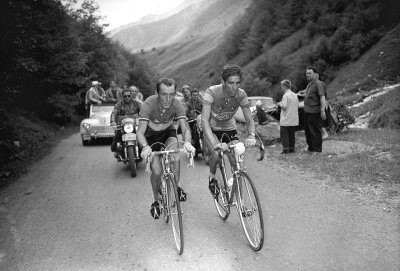
Gaul and Bahamontes
He would get his revenge in Stage 13 when the race reached the Pyrenees, however. Federico Bahamontes (the only rider who could get near Gaul in the mountains) was having an off-day and his attempts to escape failed; while Gaul, who detested hot weather, rarely did well in the Pyrenees and, following his own half-hearted attempt at an escape, was riding in the peloton with his usual, unusual pedaling style ("...always the same sustained rhythm, a little machine with a lower gear than the rest, turning his legs at a speed that would break your heart, tick tock, tick tock, tick tock," Géminiani described it). Thus nobody escaped and all the favourites finished together, which put Géminiani in the maillot jaune.

The next day, Bahamontes was back and in a big way. This time his escape worked and he was off up the mountains like an eagle, cruising to a solo win. Vito Favero was second over the line after a group sprint and won a 30" bonus which put him into first place overall, then he was second again the next day and extended his lead. Stages 16 and 17 were flat - Pierino Baffi won one, then André Darrigade won the next; but little changed.

"The Ventoux is not like an other col"
In 1958, Mont Ventoux had not yet been nicknamed "the mountain that can kill" (as it would after Tom Simpson died from dehydration and exhaustion - and, we shouldn't forget, a belly full of amphetamines - there in 1967). Yet even before the invention of the bicycle it was known to be a strange and eerie place where people could rapidly find themselves ill and in trouble, as Jean Malléjac and Ferdinand Kübler had found when they failed to show the old volcano the respect it demanded in 1955: Malléjac hadn't even realised he'd collapsed when the doctors got to him, lying flat on the stony ground with one leg still trying to turn the pedals and he didn't regain consciousness for a quarter of an hour (he was one of six men to collapse that day). Kübler had believed himself able to tame the mountain. Géminiani tried to warn him: "Watch out, Ferdy - the Ventoux is not like any other col." Kübler, with his curious habit of referring to himself in the third person, replied: "Ferdy is not like any other rider." Then he tried to sprint to the summit, and hadn't got very far before he was reduced to begging for a push from spectators to get over. On the way down, ashen-faced and in a cold sweat, he found a bar and started drinking heavily. "Ferdy has killed himelf on the Ventoux," he told a press conference that night, then abandoned and never returned to the Tour. Ventoux was feared, and all through the race the riders had been dreading the individual time trial to the summit in Stage 18.

Gaul truly was not like any other rider, though he knew very well that even he had to respect Ventoux. However - and this is why he was different to all the riders than came before him and all those since - it was almost as though Ventoux respected him. The lower, forested slopes of Ventoux are like a hellishly over-heated sauna in June and the weird lunar terrain at the top is dry and so hot that the powerful winds feel as though they sear exposed skin, especially on le col de tempêtes ("the storm pass") near the summit where the wind blows at more than 90kph for 240 days every year and has been recorded at 320kph. That should have been the very worst of sort of place for Gaul, but as he began his methodical clockwork ascent - tick tock, tick tock, tick tock - it seemed like he rode in a personal bubble, sealed from the heat and dead air. Perhaps Ventoux knew his name and was reminded of the ancient Gauls who thought it was the home of their god Vintur, in doing so gave it its own name. More likely, it was just that for three weeks that year Gaul found the best form of his life (and, probably, the combination of drugs that worked best for him; Gaul took a lot of drugs) and briefly became the finest grimpeur that the world has ever known. Either way, he did the climb in 1h02'09", which remained a record until Jonathan Vaughters beat it more than three decades later, and he jumped to third place in the General Classification. His attempt to win the Tour had begun.

Gastone Nencini
Nencini won Stage 19, partly because he was such a good descender and partly because Gaul had mechanical problems on the way up the Alps to Gap, then Bahamontes once again spread his wings on the way to Briançon and won Stage 20. Stage 21 consisted of 219km to Aix-les-Bains and when they awoke that morning the riders were dismayed to see the dreadful weather and feel the cold. At the 1958 Giro d'Italia, a group of riders led by Bobet had broken the unspoken rule that no rider should be attacked while he'd stopped for a "nature break" and denied him the stage win; so after he'd seen the weather and found it to his liking he went to Bobet and told him precisely where he planned to attack, knowing that he had a third ace still to play - not only was he a phenomenally talented climber and a good time trial rider, he had an enormous capacity to absorb suffering and when other riders battled just to survive he could keep going on and on and on, just like he had done at the 1956 Giro d'Italia when he rode solo for 88km through a blizzard ("This day surpassed anything seen before in terms of pain, suffering and difficulty," said Jacques Goddet). He attacked exactly where he'd said he would and neither Bobet nor the peloton could do anything but watch as, slowly and surely, the little Luxembourgian vanished into the distance. After the stage, L'Equipe journalist Michel Claret wrote:
"I was on a motorbike and I had to stop at Granier for a hot grog. I was so cold that afterwards it was an hour before I could start writing. I remember only a curtain of rain. A deluge without an Ark. The caravan dissolved from the moment it entered the sea of clouds that followed the pretty chalets of  Chamrousse. Now we know what it means to be 'soaked to the bone.' I thought of Jacques Anquetil, whose face was becoming more and more triangular and yellow. I thought of them all, the known and the unknown, sailors carried away by the flood and who tried desperately to avoid being shipwrecked. One man escaped from the storm. Charly Gaul."
For three weeks in 1958 - which, happily,
coincided with the Tour de France - Gaul
took climbing to a level never seen before
nor since
Gaul finished seven minutes and fifty seconds ahead of second place Jan Adriaensens, while the favourites were nowhere to be seen. Géminiani started the day in yellow and should have been awarded a prize simply for his cheek in asking the French team to help him stay in it - they returned the favour he'd done for them in Stage 9, though once again the exact words used somehow never made it into print. Afterwards, he slipped from first to second, exchanging places with Favero, but with Gaul now only 67" behind everything depended on the Stage 23 time trial.
"Gaul stood up on the pedals and, in the blink of an eye, he was twenty metres ahead. Then he disappeared round the next bend. The dark angel had passed; he fled in a cloud of dust." - Michel Claret
Anquetil would become the undisputed, unbeatable king of the time trial within two years, but he wasn't quite at that level yet despite his overall victory in 1957. If he'd stayed nearer the top of the General Classification, he might well have won his second Tour on Stage 23. He hadn't, though, and the morning before it was held he abandoned after claiming to be ill. Neither Géminiani nor Favero were much good racing against the clock and lost three minutes each; when Gaul won, beating Nencini by 48", the maillot jaune was his and with one flat stage left he would face no further challenges. When he rolled over the finish line in Paris (after a stage in which Darrigade collided with a race official - the rider needed five stitches, the official died eleven days later of internal injuries) he became the first Luxembourgian to win a Tour since Nicolas Frantz in 1928, and his average speed was calculated to have been 36.919kph - a new record.


Le Tour, 1960
In 1960, the Tour consisted of 21 stages (one split) covering a total distance of 4,173km. In the past, the start town of each stage was either the finish town of the last or very near to it; for the first time this year organisers were able to select stage towns far apart, knowing that France's rail network would get the riders to the start line safely and without problems. Jacques Anquetil had won the Giro d'Italia earlier in the year, which made him a favourite until he announced he hadn't recovered well enough and would not take part, while Louison Bobet's career was coming to an end and he'd decided 1959 would be last Tour (in the Autumn of 1960 he was in a car crash, ater which he retired). Charly Gaul also stayed away, which left only four men considered to be General Classification contenders - Federico Bahamontes (Spain), Gastone Nencini (Italy), Henri Anglade and Roger Rivière (both France, the latter being the leader of the French national team in Anquetil's absence). Organisers feared a boring race.

Belgian rider Julien Schepens won Stage 1a and Rivière won the 1b time trial. In Stage 2 Nencini got away in a break and took the maillot jaune while Bahamontes fell ill and was forced to abandon long before the mountains where he might have won; now the contenders numbered only three.

Anglade, with Shay Elliott in 1965
Fate wasn't going to let Nencini stay in yellow without a few challenges, though, and when he crashed on Stage 3 it passed briefly to Joseph Groussard and then on to Anglade who had got away in a break during Stage 4. On Stage 6, in an attempt to get it back, Rivière escaped Nencini, Jan Adriaensens and others. Realising that the all the teams having a rider in the break would discourage attempts to chase them down, Anglade - who was bitter at once again not having been selected as team leader - asked manager Marcel Bidot to order him to stop the attack and return to the peloton because the move would also improve Nencini and Adriaensens' times; he knew that both might prove more than a match for him. It's not quite clear if Bidot refused, believing that Rivière had a good shot at winning time at a better shot than Anglade at overall victory, or if Rivière simply ignored it (since Anglade was known for being arrogant and pompous and was generally disliked, it's quite likely that Bidot refused). In the short term, the attack worked: the break lasted and Rivière won the stage. In the long term, it failed terribly: just as Anglade had feared, Adriaensen started the next day in yellow and Nencini won significant time too; France would not possess the jersey again that year and Anglade still insists to this very day (he's 78 at the time of writing) that it was on Stage 6 that France lost the Tour. The organisers were not at all happy because, when the main group arrived some thirteen minutes after the leaders it ruined the prospects of any hitherto unidentified rider who might have later emerged as a contender and so the race continued to be between three men.

It was also the start of a rivalry between Rivière and Nencini - Anglade saw it and, for all his faults, it worried him because he knew that Rivière would try to follow his enemy on the descents when the race reached the mountains, something that Raphaël Géminiani said only a man with a death wish would ever try to do.

Little changed - or happened - over the next three stages, then in Stage 10 the race reached the Pyrenees. Usually, climbers dislike descents because they don't have the physical mass to stop their bikes skipping about uncontrollably, examples being Jean Robic who would have bidons filled with lead handed to him at the summits to weight his bike down and Federico Bahamontes who had once been so afraid to tackle a descent alone that he preferred to lose time by stopping to wait for the other riders to catch up - he passed the time by having an ice cream and enjoying the view. A modern example would be Andy Schleck, who on a good day climbs like his countryman Charly Gaul (who wasn't scared of descents or anything else except, later in his life, himself) and looks distinctly nervous on the way back down. Nencini, however, could do both - he won time on the Aubisque and while Adriaensens worked with Jozef Planckaert to try to win it back, the beginning of the end of the Belgian team's chances at winning overall started when they couldn't catch him. Rivière won the stage, Nencini took the yellow jersey he'd lost in Stage 3.

Roger Riviere - the bush saved him, but he would spend the
remainder of his life in a wheelchair
Nencini increased his advantage by another minute on Stage 11, but Rivière remained convinced that his stronger French team would be able to claw it back. On Stage 14, Nencini decided to use the descent of the Col de Perjuret to win more time and took off down the mountainside as though nothing in the whole world could hurt him. Anglade's prediction was proven correct: Rivière gave chase. So too were his concerns - Rivière had nothing like Nencini's ability and, after losing control on a corner, he hit a low stone wall and plunged 20m down the side of the mountain before landing in a bush. He originally claimed that he'd tried to brake but that the brakes didn't work which, he said, made him think there had been oil on the rims; this was hotly denied by the team's mechanic who had served numerous riders and came with impeccable credentials. Then doctors announced that they'd found a packet of Palfium painkillers in his pocket, and he admitted that he'd doped himself with so many that he was simply to numb to brake in time. The bush he'd landed in had absorbed some of the impact and probably saved his life; but the two broken vertebrae he suffered prevented him from ever regaining full use of his limbs and he spent the rest of his life - which ended at the age of 40 when he died of throat cancer - in a wheelchair.

Nencini was left without serious challengers. Several riders tried to make up time on the following stages but his advantage was simply too great; only withdrawal would have prevented him from winning what must have felt a hollow victory.


Merckx
Eleven years later in 1971, there were 22 stages covering 3,689km - one of them, Stage 15, was only 19.6km long and is the shortest mass-start stage in Tour history - and the organisers had created a route with more mountains than usual. The race had returned to the commercially-sponsored trade teams format some years before: Molteni was far and away the favourite because it was home to a rider who was better than any ever seen before - Eddy Merckx, who was enjoying the best year of his career and would win 45% of the races he entered that season, an unprecedented figure, and because he'd stayed away from the Giro d'Italia to concentrate on preparing for his third Tour victory he was on better form than ever before.

He won, like everybody always knew he would, but it wasn't the simple process that so many expected it to be: Luis Ocaña came very, very close to beating him and might even have won overall had misfortune not intervened. In fact, the Spaniard was so good that Merckx had done him the very great honour of declaring him a rival: all other riders were to Merckx just amusing, meaningless distractions like humans to the gods. Or flies to wanton boys, of course; he was The Cannibal and he killed them for sport.

There were a few notable differences to previous years: when the riders needed to travel the 204km from Le Touquet to Rungis during the rest day between Stages 6b and 7, they were transported by aeroplane for the first time in the history of the race. Also, there would now be points on offer for the first riders through the intermediate sprints. One thing that remained the same was the split stages. Riders hated them and had complained after five were included in 1970, yet this year there were three - Stage 1a, 1b, and 1c, 6a and 6b and 16a and 16b; the organisers' argument being that the UCI had banned stages over a certain length to try to limit the temptation to dope, though riders suspected that the fact that split stages generated more income had rather a lot more to do with it.

Ocaña
Molteni won the prologue team time trial, and Merckx started in yellow; then Eric Leman, Gerben Karstens and Albert van Vlierberghe shared the three parts of Stage 1 between them with Rini Wagtmans taking the jersey in 1b, though Merckx had it back again after 1c.

Merckx went after an attacking Joop Zoetemelk and was followed by thirteen others in the mountains of Alsace in Stage 2, then beat Roger de Vlaeminck in a sprint to win the stage. The riders in the break gained ten minutes over those who had stayed in the peloton - which effectively ended the chances of any of them that might have been hoping to take Merckx on.

Rini Wagtmans, Jean-Pierre Genet, Pietro Guerra, Leman and Mauro Simonetti won the next five stages, then de Vlaeminck took himself out of contention by crashing heavily in Stage 7. The next day Ocaña attacked, and he did so so savagely that a surprised Merckx couldn't respond. Zoetemelk and Agostinho launched an attack of their own so afterwards and also gained time; by the end of the stage Merckx still led, but Zoetemelk was 36" behind him and Ocaña 37". The gap between the two challengers remained intact through Stage 10 where Merckx had a puncture and lost time; allowing Zoetemelk into the lead with Ocaña in second place. On Stage 11, Ocaña attacked again and caught Merckx by surprise for a second time - Zoetemelk, Agostinho and Lucien van Impe chased, but it wasn't long until only van Impe had the strength to continue. Ocaña attacked again and this time van Impe was finished, settling for second place six minutes behind the Spaniard. Merckx was third, nine minutes behind, and years later he admitted that for a little while he gave up all hope of a third Tour victory that day. Meanwhile, the pace had been so high that only 39 riders finished within the time limit and the organisers had to extend it to avoid eliminating so many that the race would be made less interesting.

Merckx started trying to win back the maillot jaune the very next day, but his attempt was thwarted by a serious error of judgement on the part of the Molteni manager - when Joseph Bruyère punctured, the team was ordered to wait and help him back into the race. It was a kind decision, but professional cycling has no room for kindness - as the other teams well knew, because as soon as they found themselves unchecked by Molteni riders they set off in hot pursuit of Merckx. What's more, the day was so hot that the glue holding tyres onto some riders' wheels melted and they crashed, Molteni lost a few men as a result. It's harsh, but Bruyère was just a domestique and it would have been far wiser to sacrifice him; kindness meant that Merckx only took back two minutes when he could have taken much more and he would be less well-defended in the future if he needed it. The time limit had to be extended once again after stage winner Luciano Armani and the lead group reached the finish line a record one hour ahead of schedule, arriving at Marseilles to find the Tour village only half ready - the mayor was so embarrassed that he never invited the Tour to his city again.

Ocaña was still wearing yellow. Although Merckx won the Stage 13 individual time trial, he only clawed back a few more seconds and the next day the race would reach the Pyrenees. Merckx excelled at everything, but he didn't excel quite so much at climbing as he did at everything else because he was too muscular and sometimes the skinny grimpeurs could get away from him; Ocaña, on the other hand, specialised in climbing. Merckx knew then that he was going to have to use his greater bulk to make up time on the descents. The trouble was, Ocaña was good at descending too.


It rained heavily on Stage 14, but after Ocaña had matched him move for move on the way up Merckx took off down the Col de Mente at a terrifyingly high speed. It turned out to be too fast even for him: his tyres lost their grip and he slewed straight into a wall. Ocaña slammed on his brakes but, having been trying to stay as close as possible, was not able to stop in time and collided with him. Merckx was fine; back on his feet in seconds he was soon speeding away down the mountain. Ocaña had difficulty releasing himself from his toe clips but was also on his feet moments later, then had to wait while his wheel was replaced. As a result, he was right in the path of Joop Zoetemelk when he too lost control and smashed into him at full speed, followed by Agostinho and another rider. That was to be the end of the 1971 Tour for the only man who could have beaten The Cannibal and he was rushed by helicopter to hospital. Merckx became race leader by default, having been convinced by race directors Felix Levitan and Jacques Goddet not to abandon as a mark of respect, which he had initially wanted to do. Instead, he chose not to attend the winners' ceremony at the end of the stage and, the next day, refused to wear the maillot jaune.

From that point onwards, the race belonged entirely to Merckx. Van Impe and Zoetemelk tried on Stage 16 but Merckx stayed with them no matter what they did. Perhaps deciding that the best way he could pay tribute to his fallen rival was by winning even more decisively, he attacked in Stage 17 and took another two minutes. He had no need at all to win the Stage 20 time trial but he still did - and won overall with an advantage of 9'51" over second place Zoetemelk.


When the Tour next began on this day, four years later in 1975, Merckx was back and hoping to become the first man to win six times, though he claimed he wasn't because then people would expect him to win even more - if that was indeed true, it seems odd that he'd earlier made it clear to his Molteni team that he wanted to ride the Tour rather than the Giro d'Italia, which was their first choice. The race did not go according to his plans.

Cees Priem, winner of Stage 1a, seen winning
Stage 13 in 1980
There were 22 stages covering a total of 3,999km and a number of differences from previous years; the most notable of these being the relocation of the finish line from the Vélodrome de Vincennes, were it had been since 1968, to the Champs-Élysées in Paris. This was reflection of the fact that, despite being largely ceremonial due to the tradition that the race leader would not be attacked on the final stage, it had enjoyed increasing popularity and it was felt that a more prestigious location was deserved, in addition to which the Champs-Élysées can also hold many more of the fans who now showed up each year to see the riders finish. For the first time since 1962, the race didn't include a team time trial - this would not be repeated until 1995. Another big change was the decision to no longer award time bonuses for stage wins, which had led to long stretches in the maillot jaune and even overall victory for riders considered not to have really earned it in the past. Finally, there was a major rethink of jerseys: the King of the Mountains competition dated to 1933 and had grown from a similar concept known as the meilleur grimpeur competition, but it wasn't until 1975 that the leader and overall winner were marked out with the now familiar polka dot jersey; meanwhile, the Combination jersey - awarded to the rider with the best placings in all categories and seen as a competition for the all-rounders - was retired, as was its multi-coloured jersey that included details from all the other classification jerseys and was one of the ugliest things ever seen in cycling. When the Combination classification was first introduced in 1968, the jersey had been white; that colour was now re-used for the all-new Youth category's jersey.

Merckx's claims that he didn't especially want to win seemed even more unlikely to have been genuine when he started the race, because he rode in a highly aggressive manner right from the gun.  Immediately, however, there were signs that his reign was coming to an end - Francesco Moser trounced him in the prologue time trial and then matched him all the way through Stage 1a, which was won by Cees Priem after their high pace split the peloton into two. In Stage 1b he again set a high pace, but this time Raymond Poulidor and Bernard Thevenet (whose attendance had also been unsure due to a case of shingles) stayed with him.

 The race settled down for the next few stages, as it tends to do on the long flat stretch through Northern France; then Merckx asserted his authority by beating Moser in the Stage 6 individual time trial and took the yellow jersey. Moser responded by winning the next stage, then Barry Hoban won the eighth and final Tour stage of his career - which would be the record for a British rider until Mark Cavendish beat it by winning Stage 19 in 2009.

Joop Zoetemelk
Stage 9 was another split stage, the first half going to Theo Smit and the second - another individual time trial - to Merckx. In Stage 10 the riders arrived at the Pyrenees, but the climbers decided not to launch their attacks just yet and the General Classification remained unaltered. Stage 11 was very different: Joop Zoetemelk and Thevenet escaped, leaving Merckx - who was never quite as good on the climbs as he was everywhere else - frantically trying to reduce damage. They beat him by a minute - many other favourites were so far back that their prospects of challenging The Cannibal ended there, less than halfway through the race, but those who remained in contention knew that the attempt to depose Merckx had begun.

Gerrie Knetemann won the flat Stage 12, then in Stage 13 the race reached the Massif Central where Michel Pollentier (who would win the Giro two years later, then the year after that got caught trying to fool a dope test using a plastic tube connected to a condom filled with somebody else's urine hidden under his armpit and thus gave away a method that had reportedly been used by a great many riders for a great many years) won.

Puy-de-Dôme
Merckx chased when Zoetemelk attacked on Stage 14 as the finish line atop the dormant Puy-de-Dôme volcano approached. He knew perfectly well that many cycling fans, especially the French - were fed up with him dominating the sport, but when a spectator jumped into the road it took him completely by surprise and he was unable to protect himself as the man punched him hard in the kidney. He caught Zoetemelk, but was left in too much pain to deal with Lucien van Impe's stage-winning attack.

Stage 15 followed after a rest day and was even more dramatic: a Bianchi team car went over a cliff and fell 150m; incredibly the occupants were not badly hurt. Later on, Thevenet dropped Merckx who seemed too tired to do anything about it - the Frenchman won the stage by two minutes and started the next day in yellow. He won by the same margin the next day and extended his overall lead even further - had Merckx met his match?

Bernard Thevenet, the man who beat Merckx
(image credit: Ken CC BY 2.0)
Before Stage 17 even began, Merckx suffered another injury. He'd been on his way from the hotel to the start line when a collision with Ole Ritter (who was riding his one and only Tour but was a veteran of nine Giri d'Italia) which caused him to crash heavily to the ground. In great pain he went ahead and completed the stage anyway (despite not caring about the race, remember?) but the pain didn't get any better. That evening, after taking x-rays, the team's doctor informed him that he had a broken cheekbone; which gave him great difficulty eating - he had entered five Tours before 1975 and won every one of them, but he knew now that his chances of winning again were gone. He could still take second place since Stage 10 had removed so many potential rivals, however, so he remained in the race in order to be able to share the prizes among the team mates who had served him through the last six years.

Thevenet beat Merckx by two minutes and forty-seven seconds, and another chapter in cycling's history came to an end.


Five years later, in 1980, a new one had begun - some of the characters from 1975 were still around, but a new king had arisen in the shape of Le Patron Bernard Hinault. The old Combination classification made a reappearance, but this time it was an extra prize offered by the TF1 television network and known as the Grand Prix TF1 - as an unofficial prize, there was no jersey. Meanwhile, a new rule stated that the last rider to finish each stage between Stages 14 and 20 would be eliminated from the competition - this was a response to Philippe Tesnière and Gerhard Schönbacher who had spent much of 1979 in a private competition to be lanterne rouge, which guaranteed almost as much media attention and lucrative post-Tour criterium contracts as winning. In their attempts to be the last rider over the line before the time limit, they'd stopped only just short of resorting to track stands and everything had become rather silly. The Spanish teams had decided to concentrate on their own Grand Tour, the Vuelta a Espana, that year; likewise the Italian teams had put all their effort into the Giro d'Italia. Both teams had therefore kept many o their riders away - there were a few Spaniards, but Francesco Moser was the only Italian in the race.

Hennie Kuiper
Hinault had won in 1978 and 1979 and had also won the Giro earlier in the year, so he was favourite. When he started in his characteristically aggressive style and won the prologue, the eventual outcome looked to be a done deal; but Hennie Kuiper and especially Joop Zoetemelk (who had recently joined Ti-Raleigh, the strongest team in cycling at that time) were expected to make life difficult for him later on in the race. He was not happy, though, because Stages 5 and 6 featured some of the cobbled roads from Paris-Roubaix, a race he hated, and when they'd featured in 1979 he'd lost significant time. He complained bitterly and, in his typically grouchy Breton manner, hinted that he was going to order the other riders to strike. He never did, but even the Tour director listened when Le Patron spoke and a compromise was reached: Stage 5 went ahead as planned, but Stage 6 was rerouted to avoid the toughest section.

Ti-Raleigh on their way to winning the team time trial, 1980
Jan Raas won Stage 1a, Ti-Raleigh won the Stage 1b team time trial and their leader Gerrie Knetemann took the yellow jersey, then Rudy Pevenage won Stage 2 after escaping in a group that included Hinault's team mate Yvon Bertin, who got his own chance to wear yellow. Henk Lubberding won Stage 3 but without enough time gained to get the jersey, Bertin lost enough for it to pass on to Pevenage. Hinault won Stage 4, an individual time trial, but Pevenage kept the jersey until the next day when Hinault escaped with Kuiper, won again and gained two minutes. Something about that stage, combined with the cold and wet weather, left numerous riders suffering tendinitis; a problem that Hinault had suffered in the past and which now returned. The next day he was visibly in pain and spent most of the stage hanging off the back of the peloton discussing matters with the doctor in the team car. Jean-Louis Gauthier won, and while Hinault wasn't written off just yet  Kuiper and Zoetemelk took note.

Ti-Raleigh won the Stage 7a team time trial, then 7b went to Jan Raas, 8 to Bert Oosterbosch, 9 to  Raas again and 10 to Cees Priem. Tendinitis or not, Hinault was a good enough time trial rider to win back the maillot jaune in Stage 11 even though he came fifth behind Zoetemelk - who, only 21" behind in the General Classification, felt a renewed confidence. Knetemann won Stage 12, then the Tour reached the Pyrenees for Stage 13 - and Hinault was not on the start line, having decided the night before that his pain was too great. Zoetemelk became race leader by default, but the next day he refused to wear the yellow jersey.

High in the Pyrenees, Zoetemelk in yellow
From that point onwards, Zoetemelk and Ti-Raleigh rode extraordinarily intelligently. When Raymond Martin escaped, he was allowed to get on with it because he was too far down in the General Classiication to make a difference. On Stage 16, Ti-Raleigh's Johan van der Velde lost control and caused a crash that left Zoetemelk with injuries to his arm and thigh, but he was soon back onboard and, while some riders went off to keep an eye on Kuiper, the remainder helped him back to the front of the race. The next day, when he was in pain and heavily bruised, they came together once again and kept him cloe to Kuiper all the way. Ludo Loos was permitted to get away and win by five minutes on Stage 18 because he too was far down in the overall standings, then the Irishman won the second Tour stage of his career when he too was judged no threat. By Stage 20, Zoetemelk had recovered considerably and was able to win the last individual time trial, ending the stage with an overall advantage of seven minutes. Kelly won again in Stage 21 and Pol Verschuere scored his first stage victory in Stage 22, but the race had already been won - Kuiper gained only 5" by the end of the race.

Many fans said that Zoetemelk would not have won had Hinault not been forced to abandon, and it's very possible that this was indeed the case. However, the Dutchman argued that this did not invalidate his achievement: "Surely winning the Tour is a question of health and robustness? If Hinault does not have that health and robustness and I have, that makes me a valid winner," he said. Hinault agreed, and later that year won the World Championship.

Riders born on this day: Greg LeMond (USA, 1961); Jonny Clay (Great Britain, 1963); Pat Tolhoek (Netherlands, 1965); Liam Horner (Ireland, 1943, died 2003); Leo Marchiori (Canada, 1898, died 1949); Luis Santamarina (Spain, 1942); Maximilian Levy (Germany, 1987); Jerzy Głowacki (Poland, 1950); Ludovic Zanoni (Romania, 1935); Jack Heid (USA, 1924, died 1987); Kensley Reece (Barbados, 1945); Andrzej Bek(Poland, 1951).