Showing posts with label ronde van vlaanderen. Show all posts

Sunday, 25 May 2014

Daily Cycling Facts 25.05.2014

Karel van Wijnendaele
On this day in 1913, the inaugural Ronde van Vlaanderen was held. Like many of the older cycle races, it was organised to promote a newspaper, in this case the Flemmish Sportwereld. Only 37 riders turned up to race (some sources say 27), a major disappointment for the paper's co-founder and race organiser Karel van Wijnendaele (real name Carolus Ludovicus Steyaert, 16.11.1882 - 20.12.1961 - he took his pseudonym from the name of the village where he was born, ) who had become editor on the 1st of January that year. "Sportwereld was so young and so small for the big Ronde that we wanted. We had bitten off more than we could chew," he later said. "It was hard, seeing a band of second-class riders riding round Flanders, scraping up a handful of centimes to help cover the costs. The same happened in 1914. No van Hauwaert, no Masselis, no Defraeye, no Mosson, no Mottiat, no van den Berghe, all forbidden to take part by their French bike companies."

When van Wijnendaele was eighteen months old, his father died - which left his mother to raise her fifteen children alone. This meant, of course, that as soon as the boy reached fourteen years and could leave school he needed to find work - which he did, carrying out odd jobs for a baker and looking after cows, washing bottles and doing other odd jobs for rich French-speaking families in Brussels. He hated the way they looked down on him for his poverty, but their prejudice was what drove him on to make something of himself and, like so many others in the early days of the sport, he turned to cycling as a way to make extra money. "Being born into a poor family, that was my strength," he later said. "If you're brought up without frills and you know what hunger is, it makes you hard enough to withstand bike races." He must have been an exceptionally bright lad - his education would have been extremely basic, but when he realised he was never going to make his fortune from racing he turned to writing about it instead. His skill as a writer was good enough that by 1909 he was cycling correspondent to two national titles.

In that first year, the race started in Ghent with the parcours consisting of a 324km loop through Flanders and back towards Ghent where it ended at a wooden track at Mariakerke, running through Sint-Niklaas, Aalst, Oudenaarde, Kortrijk, Veurne, Ostend, Torhout, Roeselare and Bruges along the way. As was standard in races of the time, all riders were expected to be entirely self-reliant and, permitted no assistance from team vehicles or mechanics, had to carry spare parts and perform all roadside repairs themselves. The prize fund added up to 1,100 Belgian francs and the money Sportwereld made from the event covered less than half that cost.

Paul Deman, 1889-1961
The winner - with a time of 12h3'10" - was 25-year-old Paul Deman, who would also win Bordeaux-Paris the following year before becoming involved in espionage during the First World War when he acted as a cycle courier smuggling top secret documents into the Netherlands, which remained neutral. He was eventually caught by the Germans and imprisoned in Leuven to await execution by firing squad - fortunately, the Armistice was declared just in time to save him and he returned to cycling; winning Paris-Roubaix in 1920 and Paris-Tours three years later.

Despite van Wijnendaele's dismay, word had spread by 1914 with riders generally appreciative of the race and in 1914 47 showed up. The French teams still forbade their members from entry, but Alcyon's Marcel Buysse - a Belgian himself - recognised that the race was destined for great things and refused to pay heed; entering and winning the second edition. In time, the Ronde became a symbol of Flemmish national pride and so successful that the enormous crowds of spectators would cause problems, and the race is now perhaps the second most popular of the Monuments after Paris-Roubaix which it precedes by one week on the racing calendar.

All but forgotten: Luigi Annoni
The Giro d'Italia started on this day once, in 1921, when it covered 3,107km in ten stages. Costante Girardengo, then aged 28 and arguably the strongest cyclist the world had yet seen, was by far the favourite and led the General Classification from the start of the race after winning the first four stages. Stage 5, however, was a complete and unmitigated disaster - having suffered a series of mechanical failures, he decided he'd had enough, dismounted, drew a cross on the road and declared "Girardengo si ferma qui" ("Girardengo stops here"). Gaetano Belloni had caught him up in the GC the day before, so the leadership went to him when he won the stage and he kept it the next day too despite losing the stage to Luigi Annoni. However, Giovanni Brunero won Stage 7 and then rode carefully; keeping out of harm's way but ensuring he completed each of the remaining three stages with a time good enough to remain in front overall. Annoni won Stage 8, then Belloni won Stage 9 and 10 - but neither could catch Brunero, who won with an advantage of 41".

The Parkhotel Valkenburg Classic took place on this date in 2012 with Marianne Vos starting as favourite. During the race, an official motorbike on the parcours turned out to be slower than she was and failed to get out of her way in time; she crashed hard and broke her collarbone. Nevertheless, she remounted and finished the race, taking second place just behind her team mate Annemiek van Vleuten.

Geraint Thomas
Born in Cardiff on this day in 1986, Geraint Thomas began cycling competitively when he was ten years old with a local club, the Maindy Flyers - named after a Cardiff velodrome with a famous uneven track caused by subsidence. He also raced for the Cardiff CC and Just In Front clubs with whom he began to enjoy some success including a National Junior Championship and a silver medal at European Championships, which earned him a place on British Cycling's Olympic Academy. In 2004, he became World Junior Scratch Champion, then in 2005 he took the National Elite title for the same event and shared gold medal for the team pursuit race with Mark Cavendish, Steven Cummings and Ed Clancy. That same year, his career almost came to an early end: during a training ride in Sydney: a shard of metal lying in the road was thrown into his wheel when the rider in front of him him hit it, causing him to crash - onto the metal, which ruptured his spleen and caused massive internal bleeding.

Geraint Thomas
His spleen had to be removed, but he made a full recovery and, two years later, entered his first Tour de France with Barloworld; the first Welshman in the race since Colin Lewis in 1968 (though since Lewis was born in Devon, his status as a Welshman is a little shaky). He was 140th, just one away from Lanterne Rouge, but had finished in the top 20 for two stages - but merely finishing a Tour is an achievement, especially if it's your first and you're Benjamin du Tour (the youngest rider in the race). He chose to stay away the next year, instead riding the Giro d'Italia before returning to Britain in order to train for the Beijing Olympics where he, Ed Clancy and Bradley Wiggins won the Team Pursuit. His 2009 season was severely limited after a crash during the individual time trial at Tirreno-Adriatico when he misjudged a corner, hitting crowd barriers and fracturing his nose and pelvis. He returned to competition late in the year to take 6th place overall at the Tour of Britain and, on the 30th of October, set a individual sprint world record time under current rules at the UCI World Track Championships by finishing the 4km in 4'15.105" - 3.991" slower than the fastest time ever recorded, set by Chris Boardman thirteen years earlier but using a riding position since banned under international competition rules. At the end of the year, he announced that he would be leaving Barloworld to ride for the new British team Sky.

His first season with Sky would be a good one, kicking off with team time trial victory at the Tour of Qatar before he went on to four consecutive top ten stage finishes at the Critérium du Dauphiné and then the National Road Race Champion title. He also rode the Tour de France again, finishing the prologue in fifth place, second on Stage 3 and leading the Youth Category (in which he would eventually come ninth overall) for a short time. 2011 got off to an even better start with second place at the Dwars door Vlaanderen, possible indication that he may have the makings of a future Classics winner, then in May he won the Bayern-Rundfahrt - his first professional stage race victory and the first time the race had ever been won by a British rider. He would wear the white jersey again at the Tour that year after finishing Stage 1 in sixth place, then kept it until Stage 7 after Sky finished the second stage team time trial in third place - he would be one of several Sky riders to lose significant time in that stage when they waited for team captain Bradley Wiggins who had been in a crash and, it turned out, would not be able to continue. On the Hourquette d’Ancizan as the race entered the Pyrenees, Thomas led an early break and would twice stare injury in the eyes, losing control and very nearly crashing twice within just a few seconds - his determination that day earned him the Combativity award. For 2012, he took part in the Giro d'Italia but then concentrated on track cycling in the run up to the Olympics.

Thomas proud of his Welsh roots - when told that flags of non-participating nations would not be permitted at the 2008 Olympics (Wales, as a part of the United Kingdom, counted as such; though non-recognised might have been a more accurate term), he said: "It would be great to do a lap of honour draped in the Welsh flag if I win a gold medal, and I'm very disappointed if this rule means that would not be possible." With Ed Clancy, Stephen Burke and Peter Kennaugh, he won the Team Pursuit - he had to complete his lap of honour in the Union flag, but the crowd made up for it with masses of red dragons held aloft.

Thomas has been a vocal opponent of doping in cycling. In 2008, when Barloworld team mater Moisés Dueñas was thrown out of the Tour for France due to a positive test for EPO, Thomas was forthright in his opinions. "Duenas, when I last heard, was facing a five-year prison sentence in France, which I hope he gets," he told the BBC. "It’s about time people realised it can’t happen anymore. I guess you will always get people who will try to cheat the system, not just in sport but in everyday life. Saying that, if someone is fraudulent in a business, wouldn’t they be facing a prison term? I don’t see how riders taking drugs to win races and lying to their teams is any different. Bang them up and throw away the key!"

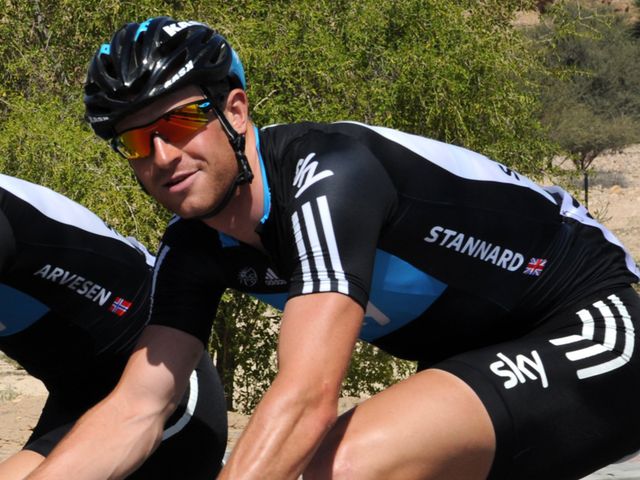
Ian Stannard
Thomas' Sky team mate Ian Stannard shares his birthday but is one year younger. Born in Chelmsford, Great Britain, he made his professional debut as a trainee with T-Mobile in 2007 having been invited to join the team when managers chopped out several older riders in an attempt to move on from a series of doping scandals and present a more youthful squad at that summer's races. However, he would remain with them for less than a year; moving on to Landbouwkrediet-Tönissteiner in 2008 - the year he took part in the Tour of Britain and came third overall, riding for a GB national team, an unusual sight in a race usually competed by trade teams

In 2009 he switched again, this time to ISD (now Farnese Vini-Selle Italia), and rode the Giro d'Italia - his first Grand Tour, where he came 160th. At the end of the season he announced that he would be moving to Sky for 2010, with whom he immediately revealed himself to be a Classics specialist of some note when he took third place at Kuurne-Brussels-Kuurne. He remained with Sky in 2012, and won the National Road Race Championship; and is still with them in 2013 when top ten finishes at Milan-San Remo and Dwars door Vlaanderen suggest that he's on the cusp of his best years.


Daan de Groot
Daan de Groot, born in Amterdam on this day in 1933, won Stage 13 at the 1952 Tour de France after using what can only be described as unusual tactics. The stage ran for 205 flat kilometres between Millau, now world famous for its 343m tall Viaduc (the tallest bridge in the world), and Albi, home to one of the world' most spectacular cathedrals (which began life in 1287 as a fortress and remains the largest brick-built structure in the world). Both lie in the Tarn, which is in that part of Southern France that's just a little too far from the Mediterranean and Atlantic to enjoy cool breezes and it gets very, very hot indeed - as it had done that day, and the peloton were suffering.

1933-1981
De Groot had been dropped by the peloton and many of the other riders in the autobus must have thought the sun had gone to the Dutchman's head when he suddenly stopped, got of his bike and dived into a field of cabbages - the Dutch are, after all, not well-accustomed to searing heat. A few were probably convinced when he picked some leaves from one of the plants and wrapped two around his neck and placed one underneath his casquette.

However, he was a wiser man than they thought. With the cool, fleshy leaves protecting him he recovered and was able to sprint off to catch the peloton, then gradually made his way up to the front. Realising that the heat had now had a similar effect on the entire pack, he attacked and nobody could chase him down. Someway up the road, the blackboard man told him that he had an advantage of treize minutes, half an hour - but, as he spoke very poor French, he thought he had three minutes and accelerated, going on to win the stage by 20 minutes.

De Groot's wife died in 1981. A year later, aged 48, he committed suicide.


Joseph M. Papp
Born in Parma, Ohio on this day in 1975, Joe Papp began cycling competitively in 1989 and joined the US National Team five years later and achieved some impressive results. In 2006, a sample he provided at the Tour of Turkey tested positive for testosterone metabolites and he received a two-year ban - unusually, it was also ruled that all his results since 2001 would be disqualified, which led to widespread complaints from fans.

However, while testifying in the Floyd Landis case, Papp confessed to having been a part of an extensive doping program that had been in place for some time and listed the many drugs he and other cyclists regularly used, also admitting that he had almost lost his following a relatively minor crash that caused massive internal bleeding due to his use of EPO. As a respected cycling author, he has since become considered something of an expert on doping - his detailed descriptions of what cyclists use, when, why and what it does to them enabled WADA to successfully argue against Landis' claim that he would not have used testosterone at the 2006 Tour de France because it would not have helped him improve his performance. While he was quick to testify against Landis, he was also one of the first to extend the hand of friendship in 2010 after the Pennsylvania-born rider finally decided to come clean. That same year, Papp was charged with distributing banned performance drugs, a charge to which he pleaded guilty before naming 180 athletes to whom drugs had been supplied. The case was eventually sealed, indication that related cases are still in progress, and in 2011 Papp was handed a three-year suspended sentence.

Today, Papp gives many speeches each year in which he outlines the dangers of doping in an attempt to discourage others. He has never officially retired from cycling and as such remains on the US Anti-Doping Agency's test pool list, having to provide them with accurate details of his whereabouts for a period of one hour every day of the year. He has never missed a test.


Georg Totschnig
Born in Latenbach on this day in 1971, in 2005 Georg Totschnig became the first Austrian to win a stage at the Tour de France since Max Bulla in 1931 when he beat no less a figure than Lance Armstrong. He'd been part of a break that had escaped early in Stage 14, then he, Walter Bénéteau and Stefano Garzelli split the group when they rode off alone. Bénéteau and Garzelli fell back on the final climb to Ax 3 Domaines, but Totschnig kept going hard and held Armstrong off all the way; eventually crossing the line with a 56" advantage. His achievement earned him the Austrian Sportsperson of the Year award.

Branislau Samoilau, born in Vitebsk on this day in 1985, won the Under-23 Liège-Bastogne-Liège in 2004, was Belorussian Under-23 Time Trial Champion in 2005 and 2006, then took the Elite title in 2007, 2008, 2009 and 2010. He's also not a bad stage racer, having come 22nd overall at the 2007 Giro d'Italia and 16th overall at the 2011 Tour de Suisse. Now riding with Movistar, he may well develop into a talented all-rounder  in the coming years.

Erki Pütsep, born in Jõgeva on this day in 1976, was Estonian Road Race Champion in 2004, 2006 and 2007.

Jean-Pierre Danguillaume, born in Joué-lès-Tours on this day in 1946, won seven stages at the Tour de France (Stage 22 1970, Stage 18 1971, Stage 6 1973, Stages 17 and 18 1974 and Stages 11 and 13b in 1977) in addition to the Peace Race (1969), GP Ouest-France (1971), the Critérium International (1973) and numerous other races over the course of his eight competitive years, riding for Peugeot throughout. Were it not for the fact that his career coincided with that of Eddy Merckx, he might be remembered as one of the great riders.

Evgeni Petrov, born in Ufa, USSR on this day in 1978, became Russian National Time Trial Champion in 2000 - and took the World Under-23 titles for the TT and road race too. He won Stage 2a at the Tour de l'Ain a year later and another National TT title and the General Classifications at the Tour de Slovénie Tour de l'Avenir in 2002. The subsequent few years were less successful until 2007 when he was 7th overall at the Giro d'Italia. In 2005, he was thrown out of the Tour de France after recording a haematocrit reading greater than 50%, deemed likely indication of EPO use or blood transfusion, and was barred from competition for two weeks.

Other births: Orla Jørgensen (Denmark, 1904, died 1947); Juan Alberto Merlos (Argentina, 1945); Marian Kegel (Poland, 1945, died 1972); Wes Chowen (USA, 1939); Tarja Owens (Ireland, 1977); Patrick Jonker (Australia, 1969); Walter Signer (Switzerland, 1937); Igor Patenko (USSR, 1969); Jameel Kadhem (Bahrain, 1971); Tanya Lindenmuth (USA, 1979); Jhon García (Colombia, 1974).

Sunday, 4 May 2014

Daily Cycling Facts 04.05.2014

The Ronde van Vlaanderen was held on this day - one of only two in May (the other was the first edition in 1913) - in 1941 and was won for the second time by Achiel Buysse, the rider who, two years later, would become the first man to win three times. The Ronde, as we've noted previously, was the only Classic to continue on occupied home soil throughout the duration of the Second World War, Belgium having been overthrown by the Nazis the previous year. In 1941, a number of Nazi officers - presumably cycling fans themselves - became involved in the running of the race which would lead to problems following the Liberation when organisers were faced with accusations of collaboration.

La Flèche Wallonne has also fallen on this day. The first time was in 1957, the 21st edition, when Raymond Impanis was the fastest man over the 226km parcours between Charleroi - Liège. The second was the 28th edition, which took place in 1964. That year, the race covered 215km from Liège to Charleroi and was won by Gilbert Desmet. The race has never been held in May since then. It was also the last time that it was held on the day before the Liège-Bastogne-Liège Monument, thus bringing to an end the famous Le Weekend Ardennais.

Aleksandr Kolobnev
Born in Vyksa in the USSR on this day in 1981, Aleksandr Kolobnev spent his first professional riders riding as a trainee with Italian teams before signing up to Dutch Rabobank in 2005, a year after winning a National Championship. It was with CSC from 2007 that he really began to make his mark in the stage races, winning a stage at Pari-Nice and also doing well in the Classics and one-day events, ending up in the podium a number of times. In 2010 he joined Katusha, won another National Championship and came second at Liège-Bastogne-Liège - results sufficiently impressive for the team to send him to the Tour de France in 2011.

Aleksandr Kolobnev
(image credit: Heidas CC BY-SA 3.0)
That year's Tour was widely acclaimed as having been the first in many years that saw no riders caught taking performance-enhancing drugs; however, Kolobnev fell foul of a Stage 5 doping control when he tested positive for hydrochlorothiazide - a diuretic drug that, while having no performance-enhancing effects of its own, can be used to mask the presence of other drugs which might offer a competitive advantage. His B-sample confirmed the discovery and he was fined an amount equal to 1500 Swiss francs by the Russian Cycling Federation. The UCI felt that this was lenient and subsequently appealed to the Court for Arbitration on Sport, asking that he be banned for two years - the Court has not yet heard the case and Kolobnev remains subject to a provisional suspension.


Julie Paulding was born in Birkenhead, Great Britain on this day in 1969 and originally competed in athletics, specialising in 400 and 800m running events until myalgic encephalomyelitis (commonly known as ME or chronic fatigue syndrome) forced her to give up sports and her job as a physical education teacher. At her worst, Paulding could not even walk up a flight of stairs - but was helped to recovery by a friend, Steve. Steve told her that cycling has been shown to be a more efficient aid towards recovering from the condition than running and so she took it up; beginning on a stationary bike and later moving onto the track, where it began to become apparent that she had the potential to embark on a second athletic career. In 2002, she won a silver medal for the 500m Time Trial at the Commonwealth Games and, one year previously, she and Steve married. They now live near Manchester to be close to the National Velodrome and Julie works as a development officer with Scottish Cycling.

Mark Jamieson, born in Dandenong, Australia on this day in 1984 began racing when he was ten years old and showed sufficient promise to be awarded a scholarship at the Australian Institute of Sport. In 2002, he became Junior World Champion in Pursuit and Under-23 National Time Trial Champion in 2004 and 2005, then National Pursuit Champion at Elite level in 2008. On the 15th of February 2010, he pleaded guilty to multiple charges of unlawful sexual intercourse with a 15-year-old girl and one count of indecent assault against a girl aged under 16, offences that took place between November 2008 and January 2009. The court found that the the first girl had been an apparently willing participant and, as the second offence was relatively minor (he had tried to kiss her), sentenced him to a thirty month suspended prison sentence with a three-year good behaviour bond after taking into account the facts of the case and the psychological problems he had suffered.

Westley Gough, who was born on this day in 1988, was selected for the New Zealand Track Team at the 2008 Olympics and rode in the Pursuit Team during the preliminary races, helping the team qualify for the final - at which point, he stepped aside to allow Hayden Roulston to ride. When the team then won a bronze medal, the International Olympic Committee had an extra medal cast and awarded it to Gough in recognition of his efforts.

The UCI Paracycling World Cup got underway in Sydney on this day in 2011.

Other cyclists born on this day: Emil Lindgren (Sweden, 1985); Wu Kin San (Hong Kong, 1985); Mario Lusiani (Italy, 1903, died 1964); Peter Roes (Belgium, 1964); Roger Rinderknecht (Switzerland, 1981); Zbigniew Szczepkowski (Poland, 1952); Kazuo Takikawa (Japan, 1962); Denfield McNab (Belize, 1943).

Monday, 10 June 2013

Daily Cycling Facts 10.06.2013

The Ronde van Vlaanderen was held on this day in 1945 - the latest in the year the race has ever been run and less than one year after Belgium was liberated from Nazi control. It had been the only Classic to continue on occupied home soil for the full duration of the War and a small number of German officers - cycling fans, presumably - had actually become involved in the organisation of the race.

This led to big problems once peace was declared as organisers faced accusations of collaboration. This was a serious issue for Karel Van Wijnendaele, who had set up the first edition right back in 1913 because he was also the editor of Sportwereld, the newspaper that ran the race, and journalists found guilty of collaboration were banned for life from their profession. Fortunately, he was able to have his ban overturned when he supplied a letter from none other than General Bernard Montgomery, thanking him for risking his life by providing a safe house to British pilots as they attempted to return to safety after being shot down.

Sportwereld's rival Het Volk saw the accusations as a prime opportunity to increase its own readership that year and announced that it would organise its own race, to be called the Omloop van Vlaanderen. In Flemmish, omloop has an identical meaning to ronde; which the Ronde's oganisers felt made the names too similar. Their concerns were supported by the Belgian Cycling Federation and Het Volk were ordered to change the name of their event to the Omloop Het Volk - and later, the Omloop Het Nieuwsblad, by which  name by which it's still known today. The Ronde finished that year at Wetteren, as it would do until 1961, and the winner was Sylvain Grysolle. Three years later, he won the Omloop Het Volk too.

Jean Robic
Jean Robic
Reading any book on cycling will soon reveal that, over its 150 years, cycling has produced a number of riders whom one might describe as the type to stand out in a crowd. In some cases, they do so for all the right reasons - Hugo Koblet, for example, or Charly Gaul when he wasn't doing one of his frothing-at-the-mouth rabid jackal death-faces, and Ben Swift and Mark Cavendish (Swifty and Cav included at the insistence of Mrs. Cyclopunk). There are also those who are "not conventionally attractive," the Cadels and Andys ("They've got something" - Mrs. C again) and there are those whose looks made small children burst into tears, none of whom will be listed here out of respect for the dead and the feelings of those still with us. Then there was Jean Robic, who looked as though he belonged on the side of a church tower with a drainpipe sticking out of his mouth. He also had a tendency to wear unusual glasses, weird bug-eyed goggles and, strangest of all for the times, a leather helmet; the combined effect made him look uncannily like he might be more used to traveling by flying saucer than by bicycle.

It would be wonderful to say that he made up for it with a kind, generous and endearing personality, but he didn't.

Robic was born on this day in 1921 in Vouziers, which is in the French Ardennes, but in common with most Celts he was proud of his ancient heritage and claimed to be a Breton like his father; which, combined with those odd looks, gave rise to his nickname Le Farfadet de la lande Bretonne, "the Hobgoblin of Brittany Moor." The family moved to Brittany when Jean was seven and set up home in Radenac, still a tiny village and the sort that the charitable might claim has rustic charm (locals probably think it's a bit of a dump), where his father - a keen racing cyclist himself - set up a bike shop and taught his son the trade, also encouraging him to become the sort of rider he'd probably once dreamed of being. It looked for a while as though fixing bikes was as close as Jean would get to making a living from racing, because he didn't make much of an impression when he got a job with the H. Sausin cycle factory. The New York-born journalist René de Latour was one of the few to remember him:
"If anybody had told you or me in 1939 that this skinny kid of 17, with ears large enough to be of help with a back wind blowing—if we had been told that here was a future winner of the Tour de France, we would just have laughed... His arrival in the Paris area was not sensational. Robic won a few races out in the villages but this did not mean much. We had hundreds of boys like him in France."
When war broke out and Northern France fell to Nazi occupation, many of the most important races were brought to a halt. This did Robic a huge favour, because it forced him into the sort of small, local race apprenticeship period that he badly needed if he was ever going to develop into a champion. In 1943, L'Auto, which had run a race between Le Mans and Paris when fighting brought a temporary end to Paris-Roubaix (and which would be accused of collaboration and shut down after the war) got permission to start running the race again. Robic entered the second wartime edition, which took place in 1944 (the Nazis, who used cycling events to try to convince the French that life was going on as normal and draw their attention away from all the millions of people they were murdering, made sure the race was filmed and widely shown. It can be seen here) - it was due to a crash in the race, and the fractured skull it left him with, that he adopted the leather helmet; hence his other nickname Tête de Cuir, Leatherhead.

Robic's advantage - he had the lightness to climb and the
strength to attack on the flat stages
Big-headed as ever, Robic had told his new wife Raymonde that he would be bringing back the maillot jaune as a wedding present when he entered the first post-war Tour in 1947, but nobody else expected him to even stand a chance despite the fact that, at 1.61m tall and a wiry 60kg in weight, he had the classic build of a climber (like many climbers, he loathed descending and would arrange for a soigneur to hand him a lead-filled bidon - or mercury, when solid bidons were banned - at the top of a climb in order to weight down his bike and help prevent it skipping around on the way down). Much to their surprise, he won three stages. De Latour still didn't think he could win because he was too inconsistent, but at the end of the Stage 19 time trial Robic had got himself into third place overall. He couldn't improve on that by the time the race reached the start of Stage 21 and, since the final stage is largely ceremonial and an unwritten law states that the leader must not be attacked on the way into Paris, it looked as though Pierre Brambilla would win. Robic, meanwhile, had no time for traditional niceties and bore respect for nobody but himself - with help from Edouard Fachleitner (it was later claimed that Robic told him, "Ride with me. You'll come second but I'll give you 100,000 francs") he attacked repeatedly and so savagely that Brambilla became ill. When the two men reached the Parc des Princes, they had an advantage of thirteen minutes and, for the first time, Robic was leading the race. Despite the ferocity of his attacking, Robic couldn't catch Briek Schotte (who was the only Flandrien, some say) but once time bonuses had been awarded he became the first man to have won a Tour without wearing the yellow jersey whilst competing for it, and legend has it that Brambilla was so disgusted he went home, buried his bike in his garden and swore he'd never ride again.

Brambilla did ride again, though; including another four Tours - which makes the story look rather as though it's probably just another one of those apocryphal, romantic tales that constitute a good quarter of all cycling history (and long may it remain thus -  journalist Jock Wadley knew Brambilla and said that his greatest regret was that he never thought to ask him if the buried bike story was true until after he'd died. We should be grateful for that, just in case it turned out to be a myth). What's more, the Fachleitner bribe might not have actually happened, either: Pierre Chany, L'Equipe's chief cycling journalist and a man who reported on no fewer than 49 editions of the Tour, said that the rumour was stared by René Vietto who hated Robic and would stop at nothing to blacken his reputation (Vietto, incidentally, is at the centre of two of cycling's romantic tales. You can read about both of them here).

With his hook nose and diminutive stature, Robic
bore an uncanny resemblance to Mr. Punch
Robic was almost universally hated by the other riders. The peloton in the heat of a race is not a place where polite language is always used, but Robic was said to be so foul-mouthed that he offended even the earthiest sons of the French soi. This also did little to endear him to race organisers - on at least one occasion, when he and others finished outside a time limit, his verbal response to the news would lead to him being the only rider not invited to continue if the judges then relented for some reason. He was also bad-tempered, always angry, fond of insulting others and a braggart, once claiming to have "a Coppi in each leg" and on another occasional dismissing Gino Bartali (who won two Tours de France and three Giri d'Italia, nine King of the Mountains and 29 stages) entirely. André Mahé, who finished in second place behind Ferdy Kübler in Stage 1 at the 1947 Tour, said that when Robic went to a restaurant he'd stand in the doorway and wait until all the diners had stopped eating and were looking at him, then proclaim "Oui! C'est moi - Robic!" ("Yes! It is I - Robic!") As is almost invariably the case, however, there was another side to him: when his father died in an accident (a branch that he was trying to saw off a tree fell on him), he spent a large portion of winnings on buying a haberdasher's shop and setting her up in business and he would also write to her while away on the Tour. He was brave, too: after the war, it was revealed that he had risked torture and execution at the hands of the Nazis by using his bike to transport secret messages between Resistance cells and even though he smashed several bones in his spine in a crash at the 1953 Tour, he was back on the start line in 1954. A very few people looked deeper and saw that side of him - one of them was Louison Bobet, who despite being a Breton himself was once Robic's arch-enemy (interestingly, Bobet also carried messages for the Reistance during the war). Perhaps it was because Bobet knew how it felt to be the most hated man in the peloton (find out why here) that he was waiting to pay his respects when Robic finished his last race in 1967, 24 years after his first professional contract.

Robic was also a talented cyclo cross
rider - he was National Champion in 1945
and World Champion in 1950
The general impression is that life always tasted sour to Robic, but in retirement it got worse. Raymonde's family owned a cafe called Au Rendez-vous des Bretons near Montparnasse Station, which he took over; but it failed. Then Raymonde - whom he seems to have loved deeply - left him for another man and he fell into depression. For a while he refereed wrestling events, a sort of "sports-based entertainment" version much like the American type popular today that relied heavily on crowd-pleasing stunts such as when "heels" who disagreed with his decisions would lift him above their heads and throw him out of the ring. For a man as full of himself and his abilities as Robic, that must have hurt even more than the damage it surely did to his injured spine. Then, he went for a long period without employment and took to walking the streets, hoping to meet somebody who might offer him any sort of paid work at all - or, some say, a drink.

Eventually, an old friend took pity and gave him a job; allowing him to begin piecing his life back together. He even learned to moderate his language and behaviour, in time making friends with other cyclists in addition to Bobet and developing a social network, which is why he was driving home from a party given in honour of Joop Zoetemelk, just after the Dutchman's 1980 Tour victory, when he was killed in an accident. The street on which he lived as a child in Radenac has been renamed after him and a room in the village hall has been converted into a museum of his achievements.

Christophe Bassons
Christophe Bassons was born in Mazamet, France on this day in 1974 and started to race mountain bikes in 1991, when he was sixteen. A year later, he took to road racing and in 1995, while studying for his degree in civil engineering, he won the Tour du Tarn et Garonne and the Military World Time Trial Championship. He signed a contract to ride professionally for Force Sud in 1996 and then, when the team broke up in March, Festina-Lotus, where he remained until Willy Voet's mobile pharmacy was stopped by customs and the cycling world was torn apart by the Festina Affair of 1998.

Christophe Bassons
Thus began one of the worst scandals ever to hit cycling, sparking off a cycle of admissions, denials, investigations, accusations and counter-accusations. Yet two of Festina's convicted riders, Christophe Moreau and Armin Meier, both of whom wisely decided the best option was to confess shortly after they were arrested, were vociferous in their insistence that Bassons was entirely innocent. Opened up for all to see, professional cycling was reminiscent of Bosch's scenes of Hell, but Bassons was an angel far removed from the rotteness - Jean-Luc Gatellier, a writer who studied the Affair for L'Equipe, agreed: "It's true he's not one of them and he hasn't come out of the same mould... it's true that Christophe Bassons doesn't belong to the family of cheats and the corrupted," he said. As a result, the rider had little difficulty in securing a contract with La Française des Jeux when the Festina team died.

Bassons was among the lowliest of domestiques and, had be not have been singled out as the sole innocent man among a gang of criminals, he's probably have come out of the Affair no less anonymous than he had been before the story broke and would have been able to get on with his career. However, while subjected to intense scrutiny by some (his good character remained steadfastly intact), he was hailed as a hero by others and was chosen as something of an unofficial figurehead for the new, clean cycling that fans hoped would emerge when the scandal finally ebbed - assuming, of course, that cycling survived, which looked far from certain at some points. He was invited first to write for Vélo, in which he referred to riders who opposed quarterly medical checks (then used in an effort to catch dopers, or at least to be seen to be doing something to catch dopers) as hypocrites, then for Le Parisien. Basson's articles were generally considered harmless, amusing fripperies that shed a little light on the fit-for-public-consumption inner workings of the peloton; but once in a while they revealed a glimpse of its dark heart, stretched to over-capacity as it laboured to keep the EPO-thickened blood flowing through the sport. In one, he mentioned Lance Armstrong's rise back to the top of cycling after his recovery from cancer, which he said had been viewed as highly suspicious by many riders.

One day, Bassons claimed that as the Tour was climbing Alpe d'Huez, Lance Armstrong rode alongside him and delivered what sounded very much like a warning. It had been, the Texan said, a mistake to keep talking about doping. Bassons replied that he was concerned about future generations and what might happen to them if doping continued. "Why don't you go home, then?" Armstrong asked, which many took to be a politer way to say "if you don't like it, go." Armstrong confirmed later that the exchange had in act taken place, but explained it differently: "His accusations aren't good for cycling, for his team, for me, for anybody," he said. "If he thinks cycling works like that, he's wrong and he would be better off going home." He's still sticking to that story.

Bassons had either seriously misjudged the peloton's mood with regard to doping or he was simply far too angelic to survive in such as dirty world as late 1990s cycling. Whichever it was, the sport was not yet willing to clean up its act - after all, the Festina Affair wasn't the first scandal that had been survived. When Tom Simpson died, ranks were closed, a few new measures put into place to make it look as though steps had been taken and riders reminded one another to be a bit more careful in the future; the journalists went away and nothing much changed. Seven years earlier, when Knud Enemark Jensen collapsed, fractured his skull and later died at the Olympics, the same thing happened; and five years before that when Jean Malléjac came close to dying on Mont Ventoux, the same mountain where Simpson died. It had been that way ever since the days of Choppy Warburton, in the 1890s, and it remained so until Operación Puerto in 2006 when cycling finally realised something had to be done - and that time, set about doing it. Also, he had made a powerful enemy in Armstrong, who was well on his way to winning a Tour and beginning to put together a marketing and public representation team far beyond anything cycling had ever before seen - he may not have been liked by all the riders, but if they were going to have to pick sides there was no doubt they'd be on his, where the money was.

Very soon, he found that riders he once thought were friends would completely blank him. If he tried to instigate a breakaway, nobody would go with him. When he walked into a room, he was ignored. Sometimes, when he was surrounded by 200 men in a peloton, the atmosphere was distinctly threatening. It wasn't long until he cracked and, the morning after Stage 11 at the Tour that year, he got up at 05:30 and packed his bags. He took the time to say goodbye to his team mates ("one rider didn't look at me and refused to shake my hand," he said. "That hurt.") On his way out, he met team manager Marc Madiot, who had admitted to using amphetamines during his own career, and was told that he was letting down the squad.

Bassons has turned his back on cycling - or
cycling turned his back on him - but he
remains active in sport
His team mates, old and new, were almost unanimous in their condemnation: "I was the only one to talk to Bassons [at Force Sud]... He doesn't listen to anyone. Bassons is an individualist. Even in a race he doesn't easily lend a hand. He rides for himself," said an uncharacteristically serious Thierry Bourguignon, usually the (somewhat tediously) zany clown of the peloton. He found a handful of new friends, some of them powerful figures - "His solitude was the living proof that nothing fundamental has changed in the morals of the milieu, "said the journalist Jean-Michel Rouet. "Christophe Bassons died at the stake, burned by his passion. On official communiqués, he left two words: non partant. The peloton had already forgotten rider number 152."

The French Minister of Sports Marie-George Buffet was another to take his side. "Rather than fighting against doping, they're fighting its opponent," she said and wrote to him to let him know he had her support, congratulating for having the courage to speak up, but the ProTour remained too hostile an environment - in 2000, he went to the second-category Jean Delatour team; then at the end of 2001, when he was still only 26 and would have been about to begin his best years, he retired. That same year he qualified as a sports teacher and took up a job with the Ministry of Sports and Youth in Bordeaux, where he is now in charge of anti-doping. In a 2012 interview with Bicycling magazine he revealed that in his early years as a professional, team manager Bruno Roussel (who was later given a one-year suspended sentence and fined 50,000 francs for his part in the Affair) had approached him and said, "You’re a young rider, so in the first couple of years we’d prefer that you don’t do any heavy doping with EPO or human growth hormones. But you can you lighter things such as cortisone." He also said that, later on, he'd been given the choice of a 30,000 francs-per-month contract if he remained clean or 300,000 if he would take EPO - and had opted for the former.

Lance Armstrong, who was called the greatest Tour rider of all time by some, has since been declared guilty of doping, is charged with playing a part in the greatest sporting conspiracy to have ever taken place and has been stripped of all of his seven Tour victories.

Andy Schleck
Andy Schleck at the prologue of the Critérium du Dauphiné,
2012
Born in Lëtzebuerg on this day in 1985, Andy Raymond Schleck comes from a Luxembourgish cycling dynasty - his older brother Frank is also a professional cyclist (and rides for the same team), his father Johny was National Road Race Champion in 1965 and 1973 and rode six Tours de France and his grandfather Auguste came third in the GP Faber of 1926 and 1927 and in the Independents National Road Race Championship of 1928. Oldest brother Steve is a politician. A little-known fact about Andy is that during his youth he was a cyclo cross rider of considerable promise, winning the National Junior Championship in 2002.

In 2004, Andy joined the amateur Vélo Club de Roubaix and was spotted immediately by Tour veteran turned directeur sportif par excellence Cyrille Guimard, a man whose proteges have won numerous prestigious races including seventeen Grand Tours. Among them was Laurent Fignon, of whom he said Andy reminded him, adding that the Luxembourgish rider was one of the greatest natural talents he had ever seen. When he won the Flèche du Sud that same year, he was noticed also by Bjarne Rijs, manager of Frank's team CSC, and offered a trainee contract. Just a year later he was a full professional and got his first taste of a ProTour at the Volta a Catalunya and won the time trial at the National Championships (Frank won the road race).

Having won two stages of the 2006 Sachsen Tour, Rijs deemed his young rider ready for a Grand Tour in 2007 and sent him to the Giro d'Italia, where he finished four stages in third place, won the Youth category and took second place in the General Classification - a stunning result for a Grand Tour debut. The following year he rode his first Tour de France, finishing the Alpe d'Huez stage in third place and proving to the world that a rider destined to be remembered as one of the great climbers had arrived. He was twelfth in the General Classification and won the Youth category, but more importantly had been an instrumental part of CSC's efforts to win the Teams competition - their total prize money equalled €621,210, not far off €0.4 million more than second place Silence-Lotto's €233,450.

Schleck is known as one of the peloton's nice guys. Here,
he awards a medal to Didi Senft, The Devil - who is not as
popular with riders as he is among the fans
In 2009, Schleck won Liège-Bastogne-Liège, one of the toughest and most prestigious Classics - and thus established himself as many people's favourite for the Tour. In fact, there was only one thing in his way, and that was his friend Alberto Contador. Schleck is, without a doubt, one of the top General Classification contenders of his generation and on a good day in the mountains no man alive can beat him, Contador included; Contador, meanwhile, is one of the greatest of all time, and unlike Andy he time trials almost as well as he climbs. That gave him the advantage he needed, Andy had to settle for second place and the Youth category once again. When July in 2010 rolled around, a lot of people looked at Andy and thought it was to be his year. Contador, who by that point had alread won four Grand Tours, was still very much in his prime; but Andy had grown up. His form had always been good, but a year earlier he still had the unformed, softer look of a boy; now he was chiseled, harder and purposeful - when the race got to the high mountains in the Pyrenees and Alps, would Contador be able to hold him off? For a long time it looked as though he might not: whenever he attacked and looked over his shoulder to see who'd followed him, there was Andy smiling back. Then, the Luxembourger won Stage 8, took the maillot jaune from Cadel Evans and held it for six stages through the Alps and the flat stages en route to the Pyrenees, where many expected him to increase his lead, perhaps even prove himself a better climber than Contador, and win the race.

It was not to be. During Stage 15, as the race climbed the last mountain of the day on the way to Bagnères-de-Luchon, Schleck dropped his chain. Contador chose that moment to attack, assisted by Denis Menchov, Samuel Sanchez and a number of other climbers looking to improve their times. By the time he'd set off again he was alone with nobody able to help him make up the gap. Contador took the maillot jaune at the finish line, along with a 39" advantage - the exact same time by which he would win overall five stages later. It remains one of the most controversial incidents in recent Tour history, attacked and defended by equal numbers: Sean Kelly was disgusted with what he saw as a total lack of sportsmanship and Gerard Vroomen said that while Contador had gained a great chance to win, he'd lost his chance to win greatly; meanwhile, Eddy Merckx, Bernard Hinault and Miguel Indurain saw nothing wrong in what he'd done. Contador said that he hadn't realised Schleck was in trouble and apologised (but even those who want to believe him, this writer included, have difficulty accepting his claims: the video of the incident makes it look very unlikely that he didn't know). Schleck says that he accepts the explanation and the apology; they remain friends.

In the Leopard Trek kit
Four days after the 2010 Tour, Andy and Frank gave a press conference in which the announced they would be leaving CSC at the end of the season and would ride with a new Luxembourg-based team managed by Brian Nygaard and Kim Andersen. The team was to be called Leopard True Racing, but when the young Danish rider Jakob Fuglsang announced that he too would be joining, he revealed that it would be Leopard Trek. The announcement of Team Sky was one of the biggest things to ever hit British cycling, but the buzz surrounding Leopard Trek was worlwide and in a different league altogether and kept growing as some of the most popular and talented figures in professional cycling were confirmed for the squad, many of them asset-stripped from CSC; among them was Stuart O'Grady, Oliver Zaugg, Joost Posthuma, Wouter Weylandt, Brice Feillu, Maxime Monfort, Lunis Gerdemann, the legendary Fabian Cancellara and, perhaps most popular of all, Jens Voigt; thier combined UCI points made the team number one in the world before it even officially existed. They also took media-savviness to a whole new level, like a multi-platinum selling rock band making maximum and effective use of social network websites, their own excellently-designed site, TV and magazines. One of the most recognisable and stylish team kits, tour buses that looked like space shuttles, Mercedes team cars and the gorgeous Trek Madones the team rode were the icing on the cake - Leopard Trek meant business, and they had the talent and the budget to take on the world and win.

There are those who say that Leopard Trek never delivered what they promised, but that's just because many fans expected them to win everything. In fact they were highly successful during the single year for which the team existed with numerous victories in the one-day events and the stage races. One of the most impressive was Andy's spectacular Stage 18 triumph at the Tour, when he rode away from the peloton on the 2,645m Col du Galibier. Nobody could get anywhere near him that day and, once again, it looked as though the Tour was his. In the following stages, however, his avantage was gradually eroded and by the time the Stage 20 time trial came around, he had just 57" on second place Cadel Evans. He lost, and Evans because the first Australian to win a Tour.

In August 2011, Geox team manager Joxean Fernandez Matxin claimed on Twitter that he'd heard Leopard Trek and RadioShack were to merge for 2012, but few believed him and when officials from both teams denied it the story seemed dead in the water. Then, further information began to leak out - Leopard Trek's Brian Nygaard was apparently none the wiser, but there were persistent tales of mysterious meetings between Leopard owner Flavio Becca and RadioShack manager Johan Bruyneel. Gazzetto dello Sport, the reliable Italian newspaper that owns the Giro d'Italia, said that it had received confirmation the new team would be called RadioShack-Trek; if that was a guess it was a good one, because when the team was confirmed it was RadioShack-Nissan Trek.

Andy follows Cadel on the Alpe d'Huez
Though Andy became the official winner of the 2010 Tour after Contador's controversial two-year ban in the wake of a failed anti-doping test (an honour he was reluctant to accept, having remained a steadfast supporter of the beleaguered Spanish rider throughout the long and drawn-out trial), 2012 didn't get off to a good start. His performances in the Classics was so poor that Bruyneel packed him and Frank off to an extra training camp. Frank then became a last-minute choice for the Giro after Fuglsang was injured; he abandoned with an injured shoulder but, for three weeks the spotlight was not on Andy, giving him excellent opportunity to train. Tour organisers announced that there would be more than 100km of time trials and less emphasis on the mountains, which in the opinion of many fans ruled him out of contention. However, sometimes - when he really needs to - Andy can ride time trials. He did so in Stage 19 at the 2010 Tour, looking for a while like he might even beat Contador (though ultimately, he didn't). The 2012 Tour, in which the mountains played less of a part than in previous years, was never going to be Andy's race and RadioShack's problems (Bruyneel was involved in the same legal case that saw Lance Armstrong lose his seven Tour victories, as outlined in the section on Bassons above) added to his woes, then a crash in the time trial during June's Critérium du Dauphiné left him with injuries that forced him to abandon that race and, a short while later, announce that he would not be riding in the Tour. Brother Frank did go to the Tour, but a failed doping test (and a subsequent one-year ban, declared when the court ruled he was unlikely to have deliberately doped) didn't help matters either.

In the first half of 2013 Schleck finished the Gran Premio Città di Camaiore, the first ProTour event he had completed in almost a year, but would abandon several more races - he failed to finish due to mechanical problems, illness or injury in the Tour Down Under (dropping out in the last stage when he was 40' behind leader Tom-Jelte Slagter of Blanco, it looked rather as though he'd have been in last place had he have finished), Tour of Oman, Tour Méditerranéen, Tirreno–Adriatico and the Amstel Gold Race. Results from races he did finish - 91st at the Città di Camaiore, 57th at the Critérium International, 86th at La Flèche Wallonne and 46th at Liège–Bastogne–Liège - were far from promising, with only 25th at the Tour of California hinting that there was any of the talent he'd once shown left.

So - what happened to Andy Schleck? Is he finished? Only time will tell - Andy was such a prodigious talent that he became a household name (even among some non-cycling households) at an age when most riders are still anonymous domestiques and for that reason it's very easy to forget how young he is: in 2013 he will turn 28, the age that throughout the history of the sport has seen many riders begin the best years of their careers. Perhaps age will bring with it a new toughness, a greater ability to deal with the pain, brutality and cruelty of professional cycling and professional cyclists, and perhaps Andy will win a Tour by his own merits after all.


On this day in 1899, 44-year-old composer Ernest Chausson lost control of his bicycle while riding down a hill on his estate in Limay, Yvelines, crashed into a wall and died instantly. Chausson's father made his fortune working with Baron Haussmann, whose 1850s redevelopment of Paris gave us much of the grand architecture that is familiar to cycling fans from the last stage of the Tour de France as it rolls along the Champs-Élysées each year. He was buried in the Cimetière du Père-Lachaise, not far from the graves of Albert Champion (who won Paris-Roubaix the same year Chausson died and set up the Champion spark plug firm), Laurent Fignon (winner of two Tours and one Giro) and Félix François Faure, who was president of France from 1895-1899 and whose determination to see the Dreyfus Affair permanently declared res judicata indirectly gave rise to the events that led to the creation of the Tour de France.

Other cyclists born on this day: Alois Wacha (Austria, 1888); Donna Gould (Australia, 1966); Natsue Seki (Japan, 1966); Lucien De Brauwere (Belgium, 1951); Nico de Jong (Netherlands, 1887, died 1966); Carlo Bomans (Belgium, 1963); Luigi Roncaglia (Italy, 1943).

Saturday, 25 May 2013

Daily Cycling Facts 25.05.2013

Karel van Wijnendaele
On this day in 1913, the inaugural Ronde van Vlaanderen was held. Like many of the older cycle races, it was organised to promote a newspaper, in this case the Flemmish Sportwereld. Only 37 riders turned up to race (some sources say 27), a major disappointment for the paper's co-founder and race organiser Karel van Wijnendaele (real name Carolus Ludovicus Steyaert, 16.11.1882 - 20.12.1961 - he took his pseudonym from the name of the village where he was born, ) who had become editor on the 1st of January that year. "Sportwereld was so young and so small for the big Ronde that we wanted. We had bitten off more than we could chew," he later said. "It was hard, seeing a band of second-class riders riding round Flanders, scraping up a handful of centimes to help cover the costs. The same happened in 1914. No van Hauwaert, no Masselis, no Defraeye, no Mosson, no Mottiat, no van den Berghe, all forbidden to take part by their French bike companies."

When van Wijnendaele was eighteen months old, his father died - which left his mother to raise her fifteen children alone. This meant, of course, that as soon as the boy reached fourteen years and could leave school he needed to find work - which he did, carrying out odd jobs for a baker and looking after cows, washing bottles and doing other odd jobs for rich French-speaking families in Brussels. He hated the way they looked down on him for his poverty, but their prejudice was what drove him on to make something of himself and, like so many others in the early days of the sport, he turned to cycling as a way to make extra money. "Being born into a poor family, that was my strength," he later said. "If you're brought up without frills and you know what hunger is, it makes you hard enough to withstand bike races." He must have been an exceptionally bright lad - his education would have been extremely basic, but when he realised he was never going to make his fortune from racing he turned to writing about it instead. His skill as a writer was good enough that by 1909 he was cycling correspondent to two national titles.

In that first year, the race started in Ghent with the parcours consisting of a 324km loop through Flanders and back towards Ghent where it ended at a wooden track at Mariakerke, running through Sint-Niklaas, Aalst, Oudenaarde, Kortrijk, Veurne, Ostend, Torhout, Roeselare and Bruges along the way. As was standard in races of the time, all riders were expected to be entirely self-reliant and, permitted no assistance from team vehicles or mechanics, had to carry spare parts and perform all roadside repairs themselves. The prize fund added up to 1,100 Belgian francs and the money Sportwereld made from the event covered less than half that cost.

Paul Deman, 1889-1961
The winner - with a time of 12h3'10" - was 25-year-old Paul Deman, who would also win Bordeaux-Paris the following year before becoming involved in espionage during the First World War when he acted as a cycle courier smuggling top secret documents into the Netherlands, which remained neutral. He was eventually caught by the Germans and imprisoned in Leuven to await execution by firing squad - fortunately, the Armistice was declared just in time to save him and he returned to cycling; winning Paris-Roubaix in 1920 and Paris-Tours three years later.

Despite van Wijnendaele's dismay, word had spread by 1914 with riders generally appreciative of the race and in 1914 47 showed up. The French teams still forbade their members from entry, but Alcyon's Marcel Buysse - a Belgian himself - recognised that the race was destined for great things and refused to pay heed; entering and winning the second edition. In time, the Ronde became a symbol of Flemmish national pride and so successful that the enormous crowds of spectators would cause problems, and the race is now perhaps the second most popular of the Monuments after Paris-Roubaix which it precedes by one week on the racing calendar.

All but forgotten: Luigi Annoni
The Giro d'Italia started on this day once, in 1921, when it covered 3,107km in ten stages. Costante Girardengo, then aged 28 and arguably the strongest cyclist the world had yet seen, was by far the favourite and led the General Classification from the start of the race after winning the first four stages. Stage 5, however, was a complete and unmitigated disaster - having suffered a series of mechanical failures, he decided he'd had enough, dismounted, drew a cross on the road and declared "Girardengo si ferma qui" ("Girardengo stops here"). Gaetano Belloni had caught him up in the GC the day before, so the leadership went to him when he won the stage and he kept it the next day too despite losing the stage to Luigi Annoni. However, Giovanni Brunero won Stage 7 and then rode carefully; keeping out of harm's way but ensuring he completed each of the remaining three stages with a time good enough to remain in front overall. Annoni won Stage 8, then Belloni won Stage 9 and 10 - but neither could catch Brunero, who won with an advantage of 41".

The Parkhotel Valkenburg Classic took place on this date in 2012 with Marianne Vos starting as favourite. During the race, an official motorbike on the parcours turned out to be slower than she was and failed to get out of her way in time; she crashed hard and broke her collarbone. Nevertheless, she remounted and finished the race, taking second place just behind her team mate Annemiek van Vleuten.

Geraint Thomas
Born in Cardiff on this day in 1986, Geraint Thomas began cycling competitively when he was ten years old with a local club, the Maindy Flyers - named after a Cardiff velodrome with a famous uneven track caused by subsidence. He also raced for the Cardiff CC and Just In Front clubs with whom he began to enjoy some success including a National Junior Championship and a silver medal at European Championships, which earned him a place on British Cycling's Olympic Academy. In 2004, he became World Junior Scratch Champion, then in 2005 he took the National Elite title for the same event and shared gold medal for the team pursuit race with Mark Cavendish, Steven Cummings and Ed Clancy. That same year, his career almost came to an early end: during a training ride in Sydney: a shard of metal lying in the road was thrown into his wheel when the rider in front of him him hit it, causing him to crash - onto the metal, which ruptured his spleen and caused massive internal bleeding.

Geraint Thomas
His spleen had to be removed, but he made a full recovery and, two years later, entered his first Tour de France with Barloworld; the first Welshman in the race since Colin Lewis in 1968 (though since Lewis was born in Devon, his status as a Welshman is a little shaky). He was 140th, just one away from Lanterne Rouge, but had finished in the top 20 for two stages - but merely finishing a Tour is an achievement, especially if it's your first and you're Benjamin du Tour (the youngest rider in the race). He chose to stay away the next year, instead riding the Giro d'Italia before returning to Britain in order to train for the Beijing Olympics where he, Ed Clancy and Bradley Wiggins won the Team Pursuit. His 2009 season was severely limited after a crash during the individual time trial at Tirreno-Adriatico when he misjudged a corner, hitting crowd barriers and fracturing his nose and pelvis. He returned to competition late in the year to take 6th place overall at the Tour of Britain and, on the 30th of October, set a individual sprint world record time under current rules at the UCI World Track Championships by finishing the 4km in 4'15.105" - 3.991" slower than the fastest time ever recorded, set by Chris Boardman thirteen years earlier but using a riding position since banned under international competition rules. At the end of the year, he announced that he would be leaving Barloworld to ride for the new British team Sky.

His first season with Sky would be a good one, kicking off with team time trial victory at the Tour of Qatar before he went on to four consecutive top ten stage finishes at the Critérium du Dauphiné and then the National Road Race Champion title. He also rode the Tour de France again, finishing the prologue in fifth place, second on Stage 3 and leading the Youth Category (in which he would eventually come ninth overall) for a short time. 2011 got off to an even better start with second place at the Dwars door Vlaanderen, possible indication that he may have the makings of a future Classics winner, then in May he won the Bayern-Rundfahrt - his first professional stage race victory and the first time the race had ever been won by a British rider. He would wear the white jersey again at the Tour that year after finishing Stage 1 in sixth place, then kept it until Stage 7 after Sky finished the second stage team time trial in third place - he would be one of several Sky riders to lose significant time in that stage when they waited for team captain Bradley Wiggins who had been in a crash and, it turned out, would not be able to continue. On the Hourquette d’Ancizan as the race entered the Pyrenees, Thomas led an early break and would twice stare injury in the eyes, losing control and very nearly crashing twice within just a few seconds - his determination that day earned him the Combativity award. For 2012, he took part in the Giro d'Italia but then concentrated on track cycling in the run up to the Olympics.

Thomas proud of his Welsh roots - when told that flags of non-participating nations would not be permitted at the 2008 Olympics (Wales, as a part of the United Kingdom, counted as such; though non-recognised might have been a more accurate term), he said: "It would be great to do a lap of honour draped in the Welsh flag if I win a gold medal, and I'm very disappointed if this rule means that would not be possible." With Ed Clancy, Stephen Burke and Peter Kennaugh, he won the Team Pursuit - he had to complete his lap of honour in the Union flag, but the crowd made up for it with masses of red dragons held aloft.

Thomas has been a vocal opponent of doping in cycling. In 2008, when Barloworld team mater Moisés Dueñas was thrown out of the Tour for France due to a positive test for EPO, Thomas was forthright in his opinions. "Duenas, when I last heard, was facing a five-year prison sentence in France, which I hope he gets," he told the BBC. "It’s about time people realised it can’t happen anymore. I guess you will always get people who will try to cheat the system, not just in sport but in everyday life. Saying that, if someone is fraudulent in a business, wouldn’t they be facing a prison term? I don’t see how riders taking drugs to win races and lying to their teams is any different. Bang them up and throw away the key!"

Ian Stannard
Thomas' Sky team mate Ian Stannard shares his birthday but is one year younger. Born in Chelmsford, Great Britain, he made his professional debut as a trainee with T-Mobile in 2007 having been invited to join the team when managers chopped out several older riders in an attempt to move on from a series of doping scandals and present a more youthful squad at that summer's races. However, he would remain with them for less than a year; moving on to Landbouwkrediet-Tönissteiner in 2008 - the year he took part in the Tour of Britain and came third overall, riding for a GB national team, an unusual sight in a race usually competed by trade teams

In 2009 he switched again, this time to ISD (now Farnese Vini-Selle Italia), and rode the Giro d'Italia - his first Grand Tour, where he came 160th. At the end of the season he announced that he would be moving to Sky for 2010, with whom he immediately revealed himself to be a Classics specialist of some note when he took third place at Kuurne-Brussels-Kuurne. He remained with Sky in 2012, and won the National Road Race Championship; and is still with them in 2013 when top ten finishes at Milan-San Remo and Dwars door Vlaanderen suggest that he's on the cusp of his best years.


Daan de Groot
Daan de Groot, born in Amterdam on this day in 1933, won Stage 13 at the 1952 Tour de France after using what can only be described as unusual tactics. The stage ran for 205 flat kilometres between Millau, now world famous for its 343m tall Viaduc (the tallest bridge in the world), and Albi, home to one of the world' most spectacular cathedrals (which began life in 1287 as a fortress and remains the largest brick-built structure in the world). Both lie in the Tarn, which is in that part of Southern France that's just a little too far from the Mediterranean and Atlantic to enjoy cool breezes and it gets very, very hot indeed - as it had done that day, and the peloton were suffering.

1933-1981
De Groot had been dropped by the peloton and many of the other riders in the autobus must have thought the sun had gone to the Dutchman's head when he suddenly stopped, got of his bike and dived into a field of cabbages - the Dutch are, after all, not well-accustomed to searing heat. A few were probably convinced when he picked some leaves from one of the plants and wrapped two around his neck and placed one underneath his casquette.

However, he was a wiser man than they thought. With the cool, fleshy leaves protecting him he recovered and was able to sprint off to catch the peloton, then gradually made his way up to the front. Realising that the heat had now had a similar effect on the entire pack, he attacked and nobody could chase him down. Someway up the road, the blackboard man told him that he had an advantage of treize minutes, half an hour - but, as he spoke very poor French, he thought he had three minutes and accelerated, going on to win the stage by 20 minutes.

De Groot's wife died in 1981. A year later, aged 48, he committed suicide.


Joseph M. Papp
Born in Parma, Ohio on this day in 1975, Joe Papp began cycling competitively in 1989 and joined the US National Team five years later and achieved some impressive results. In 2006, a sample he provided at the Tour of Turkey tested positive for testosterone metabolites and he received a two-year ban - unusually, it was also ruled that all his results since 2001 would be disqualified, which led to widespread complaints from fans.

However, while testifying in the Floyd Landis case, Papp confessed to having been a part of an extensive doping program that had been in place for some time and listed the many drugs he and other cyclists regularly used, also admitting that he had almost lost his following a relatively minor crash that caused massive internal bleeding due to his use of EPO. As a respected cycling author, he has since become considered something of an expert on doping - his detailed descriptions of what cyclists use, when, why and what it does to them enabled WADA to successfully argue against Landis' claim that he would not have used testosterone at the 2006 Tour de France because it would not have helped him improve his performance. While he was quick to testify against Landis, he was also one of the first to extend the hand of friendship in 2010 after the Pennsylvania-born rider finally decided to come clean. That same year, Papp was charged with distributing banned performance drugs, a charge to which he pleaded guilty before naming 180 athletes to whom drugs had been supplied. The case was eventually sealed, indication that related cases are still in progress, and in 2011 Papp was handed a three-year suspended sentence.

Today, Papp gives many speeches each year in which he outlines the dangers of doping in an attempt to discourage others. He has never officially retired from cycling and as such remains on the US Anti-Doping Agency's test pool list, having to provide them with accurate details of his whereabouts for a period of one hour every day of the year. He has never missed a test.


Georg Totschnig
Born in Latenbach on this day in 1971, in 2005 Georg Totschnig became the first Austrian to win a stage at the Tour de France since Max Bulla in 1931 when he beat no less a figure than Lance Armstrong. He'd been part of a break that had escaped early in Stage 14, then he, Walter Bénéteau and Stefano Garzelli split the group when they rode off alone. Bénéteau and Garzelli fell back on the final climb to Ax 3 Domaines, but Totschnig kept going hard and held Armstrong off all the way; eventually crossing the line with a 56" advantage. His achievement earned him the Austrian Sportsperson of the Year award.

Branislau Samoilau, born in Vitebsk on this day in 1985, won the Under-23 Liège-Bastogne-Liège in 2004, was Belorussian Under-23 Time Trial Champion in 2005 and 2006, then took the Elite title in 2007, 2008, 2009 and 2010. He's also not a bad stage racer, having come 22nd overall at the 2007 Giro d'Italia and 16th overall at the 2011 Tour de Suisse. Now riding with Movistar, he may well develop into a talented all-rounder  in the coming years.

Erki Pütsep, born in Jõgeva on this day in 1976, was Estonian Road Race Champion in 2004, 2006 and 2007.

Jean-Pierre Danguillaume, born in Joué-lès-Tours on this day in 1946, won seven stages at the Tour de France (Stage 22 1970, Stage 18 1971, Stage 6 1973, Stages 17 and 18 1974 and Stages 11 and 13b in 1977) in addition to the Peace Race (1969), GP Ouest-France (1971), the Critérium International (1973) and numerous other races over the course of his eight competitive years, riding for Peugeot throughout. Were it not for the fact that his career coincided with that of Eddy Merckx, he might be remembered as one of the great riders.

Evgeni Petrov, born in Ufa, USSR on this day in 1978, became Russian National Time Trial Champion in 2000 - and took the World Under-23 titles for the TT and road race too. He won Stage 2a at the Tour de l'Ain a year later and another National TT title and the General Classifications at the Tour de Slovénie Tour de l'Avenir in 2002. The subsequent few years were less successful until 2007 when he was 7th overall at the Giro d'Italia. In 2005, he was thrown out of the Tour de France after recording a haematocrit reading greater than 50%, deemed likely indication of EPO use or blood transfusion, and was barred from competition for two weeks.

Other births: Orla Jørgensen (Denmark, 1904, died 1947); Juan Alberto Merlos (Argentina, 1945); Marian Kegel (Poland, 1945, died 1972); Wes Chowen (USA, 1939); Tarja Owens (Ireland, 1977); Patrick Jonker (Australia, 1969); Walter Signer (Switzerland, 1937); Igor Patenko (USSR, 1969); Jameel Kadhem (Bahrain, 1971); Tanya Lindenmuth (USA, 1979); Jhon García (Colombia, 1974).