Showing posts with label racers. Show all posts

Friday, 22 August 2014

Daily Cycling Facts 22.08.2014

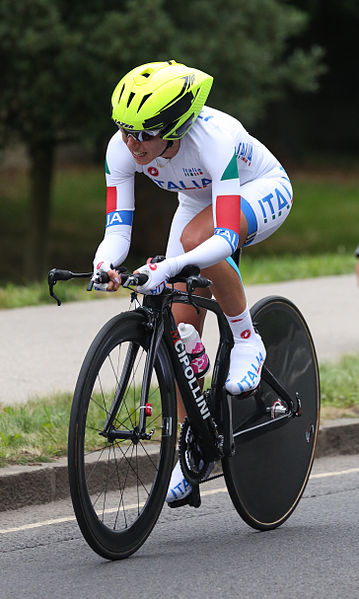
Tatiana Guderzo
Guderzo at the 2012 Olympics
Born in Marostica, Italy on this day in 1984, Tatiana Guderzo came second at the World Junior Independent Time Trial Championhips in 2002, then became famous in the cycling world with overall General Classification victory at the Eko Tour Dookola Polski, a gold medal at the European Under-23 Independent Time Trial Championship and a silver in the World Elite Road Race Championship in 2004. She turned professional with Top Girls Fassa Bortolo Hausbrandt Caffé for the 2005 season, and her name has been a regular inclusion among the top results of many of the most prestigious women's races in the world ever since.

In 2005, Guderzo became Elite National ITT Champion but missed out on another gold at the European U-23 ITT Championships, taking the silver instead; in 2006 she won Stage 2 at the Emakumeen Bira - one of the most important races on the women's calendar, was third in the National ITT Championship and the European U-23 Pursuit Championship and second at the European U-23 Road Race and ITT Championships, then in 2007 she won the Elite National Pursuit Championship. In 2008, she won a bronze medal at the Olympics when she came third in the road race, and one year later she became World Road Race Champion when she beat three of the most legendary riders in the history of the sport - Marianne Vos, Noemi Cantele and Kristin Armstrong - by 19 seconds at Mendrisio, Switzerland. She won the National ITT Championship again and was third in the Giro Donne (the last women's Grand Tour, equal in importance to the Tour de France) in 2010; then in 2011 she was fourth at the Giro Donne and won the pursuit race at the National Track Championships. She won the National ITT Championship again in 2012, then returned to the Giro with her MCipollini-Giordana team in 2012 and came seventh overall.

Guderzo remained with MCipollini for 2013 and got her season off to a good start with another National Time Trial Championship victory and second place overall at the Giro del Trentino Alto Adige-Südtirol, then took four top ten stage finishes and second place overall at the Giro Rosa (the new name for the Giro Donne), a stage win (7) at the Thuringen Rundfahrt and fourth overall at the Route de France. She is with the same team, now called Ale-Cipollini, in 2014.


Theo Bos
Bos takes on Chris Hoy, World
Track Championships 2008
Born in Hierden, Netherlands on this day in 1983, Theo Bos is one of the few sprinters active today able to take on - and beat - Mark Cavendish. He has become, therefore, one of the most popular riders in the modern professional peloton. His older brother Jan has also had some success in cycling, but is better known as a speed skater.

Bos was enormously successful as an amateur, winning the Junior World Track Championship 1km in 2002, then the 1km and Sprint at the European Under-23 Track Championships and at the National Championships, where he competed at Elite level, in 2003; a year after that he became World Elite Sprint Champion, then successfully defended his Sprint title and added the National Keirin title at the Nationals. In 2005 he won the 1km at the World Championships, in 2006 the Sprint and Keirin events at both the Worlds and the Nationals; at the Moscow round of the World Cup that year he also broke the 200m world record, which had stood for eleven years (a faulty computer originally gave him a time of 9.086", which would have been superhuman, his actual time of 9.772" was still enough). He would keep the World Sprint Champion and both National titles in 2007 and won the European Omnium Championship in 2008.

Bos at the 2008 Olympics
In February 2009, having joined the Rabobank ProContinental team, Bos won the 160km Prémio de Abertura road race - his first major success away from the track. He followed it with victory at the Ronde van Noord-Holland and the Omloop van Kempen, then won Stages 1, 2 and 4 at the Olympia's Tour (now very much a sprint specialist, his results on the other stages were far lower and as a result he didn't place in the overall top ten, despite the team also winning the Prologue) - the year brought controversy as well as glory, however: at the Tour of Turkey, he was involved in a crash during the final sprint of the last stage. The UCI subsequently decided that Bos had caused the accident by grabbing hold of Daryl Impy, then levied a fine and banned him for one month; Bos admits that he did come into contact with Impy, but says that he did so not to try to slow him down but to push him away as the South African was forcing him into the crowd barrier alongside the road.

The following year he moved to the Cervélo Test Team and rode his first Grand Tour, the Vuelta a Espana, where he twice broke into the top ten with ninth place on Stages 5 and 13. These results earned him a contract with Rabobank's top World Tour team for 2011 and, ten years after his first victory, Bos moved to the top level of road cycling. He won two stages at the Tour of Oman (beating Cavendish into second place on Stage 1) that year and took third place stage finishes at the Tours of Britain and Beijing, and to date in 2012 he has won the Dwars door Drenthe, two stages at the Tour of Turkey, one stage at the Benelux Tour and the 197km Veenendal-Veenendal road race. In 2013, Bos won Stage 2 at the Volta ao Algarve, Stages 1 and 2 at the Tour de Langkawi, Stage 1 at the Criterium International, Stage 3 at the Tour of Norway and Stage 2 at the Ster Elektrotoer; in 2014 he won the General and Points Classifications at the World Ports Classic, four stages at the Tour de Langkawi and one stage at the Tour of Poland.


Omer Huyse
Omer Huyse, born in Kortrijk, Belgium on this day in 1898, won Stage 5 at the eventful 1924 Tour de France, when he raced as a second class rider (sponsored, but deemed unlikely to win stages or overall) for the O. Lapize team. He was ninth overall that year, then returned in 1925 to come seventh and again in 1926 when he was thirteenth.

Jokin Mújika, born in Itsasondo, Euskadi on this day in 1962, won Stage 7 at the Tour de l'Avenir in 1986 and was Spanish Cyclo Cross Champion in 1994 and 1996

New Zealander Des Thomson, who was born on this day in 1942, represented his nation in the road race and the independent time trial at the Olympics in 1964, then the road race and 100km team time trial in 1968, but was unable to take home medals in either instance. He was far more successful at the Commonwealth Games of 1966, where he won the silver medal in the road race.

Erik Hoffman, born in Windhoek, Namibia on this day in 1981, won the National Road Race Championship in 2007.

Other cyclists born on this day: Marcelo Arriagada (Chile, 1973); Richard Trinkler (Switzerland, 1950); Gianluca Brambilla (Italy, 1987); Endrio Leoni (Italy, 1968); Haakon Sandtorp (Norway, 1911, died 1974); Oleg Bondarik (Belarus, 1976).

Tuesday, 24 September 2013

Daily Cycling Facts 24.09.2013

Victoria Pendleton
Victoria Pendleton
Born in Stotfold on this day in 1980, Victoria Louise Pendleton is a multiple World, European, National and Olympic Champion and one of the few female British cyclists to have become a household name at home and around the world. Her father, Max, was once National Grass-Track Champion, Victoria began her career in the same discipline, riding her first race - a 400m event - at Fordham near Cambridge when she was nine years old. Aged 16, she was spotted by a coach from British Cycling but chose instead to complete her education, not becoming a professional rider until she'd graduated in Sport Science at Northumbria University.

In 2003, Pendleton won the Scratch race at the Sydney round of the World Cup, also coming second in the Sprint; the latter being the event in which she would later specialise and which she won at the Manchester round a year later. In 2005 she won the Keirin at Los Angeles, then the Sprint at the World Championships and at Manchester, and in 2006 at the Commonwealth Games. 2007 would be her real break-through year, starting off victories in the Sprint, 500m TT and Keirin at Manchester, followed by the Sprint and Keirin (and Team Sprint, riding with Shanaze Reade - whose birthday falls one day before Pendleton's) at the World Championships, the Sprint and 500m at the Nationals and Keirin at Sydney. in 2008, again riding with Reade, she won the Team Sprints at Copenhagen and the Worlds, also winning the Individual Sprint at the Worlds and the Olympics; at the Nationals she won the Sprint, Team Sprint and Keirin and at Manchester the Sprint, 500m and Keirin. 2009 was a quieter year with two victories - the Sprints at Copenhagen and the Worlds. She successfully defended the latter in 2010 and won the Keirin and Team Sprint (with Jess Varnish) at the Cali round of the World Cup, then rode with Varnish again to win the Team Sprint at the 2011 European Championships where she also won the Keirin.

Pendleton and Shanaze Reade
Since the 2008 Olympics, when Anna Meares got through to the finals due to the relegation of Guo Shang, she and Pendleton have been rivals. Lurid tales of sworn enmity and blistering hatred have been somwhat over-embellished by the media - presumably, these are the journalists who don't bother to actually watch women's racing and thus have to invent drama rather than reporting the real drama taking place on the track, but it's probably safe to say that they don't exchange Christmas cards. As a result, when they competed against one another in the Sprint in London at the 2012 Games, the race was immediately termed a grudge match, the decider and all sorts of other poetic things. It did not pass without incident: during the race, Pendleton veered very slightly out of her lane, crossing into Meares'. Meares reacted by pushing her away, using her elbow on Pendleton's leg. Some fans - mostly British, but a fair few from elsewhere including Australia - were initially angry at the judges' decision to relegate the British rider; however, once the slow-motion replay had been aired, all but the most die-hard Pendleton fans admitted that Meares had won fair and square. Pendleton had announced that, after many years of hinting that she would retire after the Games, this would be her last race; it was not the best note upon which to leave. However, having won the Keirin four days earlier and the Sprint at the Worlds in Melbourne in April, she undoubtedly left cycling at a highpoint in her career.

Whilst Pendleton is widely admired in the media - often as much for her looks as for her athletic achievements - her career has not been without controversy. Her decision to appear in glamourous photo shoots published by FHM and Esquire magazines, at a time when many female athletes are demanding to be taken seriously for their sport and not depicted as sex symbols, was widely criticised. Likewise, she has occasionally been accused of appearing on too many TV shows and advertisements; however, she has also been congratulated for raising the profile of women's cycling in this way.


Oenone Wood
Oenone Wood in 2007
Born in Newcastle, New South Wales on this day in 1980, Oenone Wood won the silver medal at both the National Road Race and Individual Time Trial Championships and was third overall at La Flèche Wallonne and the Trophée d'Or Féminin in 2003, then in 2004 she won both the National titles, the Trofeo Alfredo Binda, the Bay Classic, the Geelong Tour, Stage 1 at the Giro Donne and the World Cup. The following year, she turned professional with Equipe Nürnberger Versicherung.

In 2005, she won the World Cup, the National ITT Championships and Geelong for a second time, Stages 1, 3a and 6 at the Tour de l'Aude and Stages 1b, 2 and the General Classification at Le Tour du Grand Montréal; in 2006 - still with Nürnberger Versicherung - a third Geelong, the GP International Dottignies, Stage 8 at the Giro Donne and a silver medal for the Road Race and a gold for the ITT at the Commonwealth Games. She then moved to T-Mobile for 2007 and won Le Tour du Grand Montréal. Wood remained with the team, which began the year as Highroad and ended it as Columbia Women, through 2008; winning another National Road Race Championship and two stages as well as second place overall at the Tour of New Zealand. She retired at the end of the year, having achieved 81 podium finishes in her short professional career.


Michelle Ferris, born in Warrnambool, Australia on this day in 1976, won silver in the Women's Sprint at the Olympics in 1996 and 2000.

Erich Maechler, born in Hochdorf, Switzerland on this day in 1960, won Stage 21 at the Tour de France in 1986. The following year he won Milan-San Remo, then returned to the Tour and wore the maillot jaune for six days. Over the course of his career he also won stages at the Tour de Suisse, Tirreno-Adriatico and the Critérium du Dauphiné.

Stef Clement, born in Tilburg, Netherlands on this day 1982, was National Individual Time Trial Champion in 2006, 2007, 2009 and 2011.

Other cyclists born on this day: Neurouth (France, 1881, died 1914); Michel van Haecke (Belgium, 1971); Donald Allan (Australia, 1949); Jorge Mariné (Spain, 1941); Karsten Stenersen (Norway, 1971); Dirk Heirwegh (Belgium, 1955); Ivano Maffei (Italy, 1958); Marie Purvis (Great Britain, 1961); Morten Therkildsen (Denmark, 1983); Jacques Gestraut (France, 1939); Lorenzo Bosisio (Italy, 1944); Gunnar Sköld (Sweden, 1894, died 1971); Charles Hewett (USA, 1929).

Monday, 23 September 2013

Daily Cycling Facts 23.09.2013

Emma Johansson
Emma Johansson at the 2012 National Championships
Emma Karolina Johansson, born in Sollefteå, Sweden on this day in 1983,  began her athletic life as a cross-country skier, then won the Junior National Cross Country Mountain Bike Championships in 2000 before successfully defending it and adding the Junior National Individual Time Trial Championship a year later. She gained a place at a specialist cycling school in Skara, then moved to Spain in order to pursue her dream of becoming a professional. Unfortunately, she soon discovered that women's cycling was underdeveloped in Spain so, with help from her old cycling club Härnösand CK back home in Sweden, she moved to the Netherlands. In 2005 she won the Elite National ITT Championship, then turned professional with the Basque team Bizkaia-Panda Software-Durango in 2006. The following year, with Vlaanderen-Capri Sonne-T Interim, she won the National ITT Championship for a second time; in 2008 she won it again, took a silver medal at the Olympics, was third at the National Road Race Championship and won the Trophée d'Or Féminin.

Johansson won the Ronde van Drenthe in 2009, which put her into the lead in the World Cup - she was only the second Swedish cyclist ever to have done so. She then had an excellent year at the Classics in 2010 with a victory at the Omloop Het Nieuwsblad, fourth in the Ronde van Vlaanderen and third in La Flèche Wallonne before going on to win a second Trophée d'Or Féminin. In 2011 she joined Hitec Products-UCK which - now known as Hitec Products-Mistral Home - and won the Omloop Het Nieuwsblad again, regained the National Road Race title and then won the Thüringen-Rundfahrt der Frauen; in 2012 she won the Tour de Free State, the National ITT and Road Race Championships and Stage 9 and fifth place overall at the Giro Donne.

2013 brought a move to a new team, Orica-AIS, and Johansson became the second most successful female rider in the world when she proved herself able to rival Marianne Vos: in fact, for a brief time late in the year (and, to be fair, partly due to the way that the UCI work out rankings), she actually took over from Vos at the top of the UCI world rankings - the first time Vos hadn't occupied the top place for several years. Johansson had come second to Vos several times, but she had also scored some very impressive wins, including a few in which she beat the Dutch woman when she was favourite - her greatest triumphs were the Emakumeen Bira and the Thuringen Rundfahrt, in both of which she won two stages as well as the General Classification.

Shanaze Reade
Shanaze Danielle Reade was born in Crewe, Great Britain, on this day in 1988. When she was 10 years old, she became bored of shot put and 100m sprint running, the sports in which she'd previously competed, so she bought a second-hand BMX for £1 and started racing it. Twelve years later, she was a four-time World Champion.

She'd also picked up one unique honour: in 2006, she had become 19 & Over Elite Men British National Number One after racing in the Men's National Series through 2005 - not only is she a woman, she was also only 17 years old. Some of the men didn't like it, but most were happy to have such a talented rider competing alongside them: "some spit their dummies out but I just let them get on with it! It's really quite fun to watch when I kick their booties," she said.

Reade also won her first World Championship title in 2006, coming first in the Junior class; in 2007, 2008 and 2010 she was World Champion at Elite level and, in 2007 and 2008, also won the Elite Woman Supercross Championship. Famous in BMX for her explosive power, Reade started track racing in 2007 - her first race was the Team Sprint at the Manchester round of the World Cup, where she teamed up with Anna Blyth to take second place behind Willy Kanis and Yvonne Hijgenaar of the Netherlands, they beat Kristine Bayley and track racing superhero Anna Meares of Australia; however, the outcome might have been very different - the Dutch team made a false start, causing commissaires to restart the race, but Reade had not heard their signal and had already completed one lap at full sprint pace when she realised. Just over a month later she was selected at the last moment to replace Blyth and rode with Victoria Pendleton to win the Team Sprint at the World Championships - Hijgenaar and Kanis were second, Bayley and Meares third again.

Reade and Pendleton, 2008
In 2008, when BMX became an Olympic sport for the first time, Reade decided to take a break from track racing - she was the only female British rider to compete in the event. After crashing in the first qualifier, she set the fastest time in the second heat and went through to the quarter-finals where she crashed again but took enough points to race in the final. After spending much of the race holding onto Anne-Caroline Chausson's rear wheel, she crashed out of the race. She returned to the track the following year and was selected for the British squad at the World Championships, once again riding with Pendleton in the Team Sprint; this time, they lost out to the Australian team made up of Meares and Kaarle McCulloch and took silver. She competed in BMX again at the 2012 Olympics but, despite being favourite, finished in sixth place.


Born in Abergavenny on this day in 1972, Julian Winn is a Welsh cyclist who since 2005 has served as coach at Beicio Cymru, the Welsh cycling federation. Winn was second in the Manx International in 1997 and won a stage at the Prudential Tour (formerly the Milk Race, now the Tour of Britain) a year later; then turned professional with the Linda McCartney team in 1999 and found success at a number of races. In 2003 he signed to the Danish Fakta team and went to the Giro d'Italia where he finished two stages in the top 20 and came 83rd overall; the best result of his career came in 2002 when he won the British National Road Race Championships.

Martin Elmiger, born in Hagendorn, Switzerland on this day in 1978, was National Road Race Champion in 2001, 2005 and 2007. In 2007 he won the Tour Down Under.

Other cyclists born on this day: Geoff Smith (Australia, 1942); Michael Rich (West Germany, 1969); Behrouz Rahbar (Iran, 1945); Yoshio Shimura (Japan, 1940); Zsolt Vinczeffy (Hungary, 1974); Karen Strong-Hearth (Canada, 1953); Ambrogio Beretta (Italy, 1908, died 1988); Harry Lodge (Great Britain, 1967); Alois Holík (Czechoslovakia, 1947); Robert Varga (France, 1941); Henri Andrieux (France, 1931, died 2008).

Saturday, 31 August 2013

Daily Cycling Facts 31.08.2013

Matti Breschel
Born in Ballerup, Denmark on this day in 1984, Matti Breschel won the Junior National Road Race Championship in 2001, then did sufficiently well in junior and amateur road races over the following few years to draw the attention late in 2003 of PH, a Danish-based UCI category team that has made a habit of finding promising young riders and shaping them into future stars - Mads Christensen and Anders Lund were both riding for the same during the same period. In the year he spent with them, he won four races and came third in the Elite National Championships - PH had done its work, and Breschel moved onto CSC where he would remain until the end of 2010.

When the news of his transfer to CSC was first announced, Breschel was charmingly modest and insisted that he would spend the year learning how to race professionally and didn't expect to do well. In fact, he took second place on Stage 3  and second overall at the Tour of Qatar (crossing the line a respectful few centimetres after the winner, his friend and mentor Lars Michaelson) and was later third again at the Nationals. Two years later, at his first Giro d'Italia, he finished Stage 18 in third place; in 2008 he was second in the Nationals, won Stage 21 at the Vuelta a Espana and then came third at the World Championships.

In 2009, Breschel won the National Championship; in 2010 he was 11th at Milan-San Remo, eighth at Gent-Wevelgem, 15th at the Ronde van Vlaanderen and won the Dwars door Vlaanderen. Towards the end of the season he came second again at the Worlds before announcing that he would be switching to Rabobank for 2011. His first year with them passed without victory, but in 2012 he was third at Gent-Wevelgem and won Stage 3 at the Vuelta Ciclista a Burgos. At the end of the year, with Rabobank withdrawing funding from its men's team in the wake of Lance Armstrong's exposure as a drugs cheat, Breschel departed for Saxobank-Tinkoff; a season in which he achieved top ten stage finishes at the Giro d'Italia and Tour de Suisse and came fourth at the Danish National Road Race Championship and won two stages at the Post Danmark Rundt (where he finished third overall) looks promising - he is a rider with the potential to do very well over the next four or five years.

Laurent Fignon
Fignon wins the Giro d'Italia, 1989
Laurent Patrick Fignon was the polar opposite of the old "cyclists as poor boys with hungry eyes" stereoype - his background was decidedly middle class and he even went to university, studying material science at  Paris 13 in Villateneuse, though he dropped out soon after the course began and joined the army. Nevertheless, in a sport where the majority of athletes hadn't even passed their school exams, he was soon nicknamed "The Professor."

Fignon won the Tour de France in 1983, but probably wouldn't have done had Bernard Hinault not been kept away by a knee injury. He and Hinault couldn't have been more different - Hinault was a rough, tough son of the soil, a Breton Celt to his very core and a man who thought nothing of using his fists to end a disagreement; Fignon was from Paris, the sort of man who knew which knife and fork to use for every course in a fine restaurant and might have used philosophical points where Hinault used fists. The rivalry that formed between them when the Breton's glory days began to fade in 1984 was, therefore, a godsend for the newspapers - and it cuminated in Fignon winning the Tour by 10'22. Brains had soundly thrashed brawn.

In June 2009, when he was 49 years old, Fignon told reporters that he had been diagnosed with cancer two months earlier and was undergoing chemotherapy. The treatment was not successful; he died on the 31st of August the following year. There is more on him here.


Edouardo Molinar, who was born in Rocca Canovese, Italy on this day in 1907, won Stage 13 and the overall King of the Mountains and was third in the General Classification at the Vuelta a Espana in 1935, then came third in the King of Mountains and tenth overall at the Giro d'Italia a year later.

Bill Strickland, born in Gary, Indiana on this day in 1964, is an author who has become famous primarily for his books on cycling. He has written factual guides, autobiographical pieces and biographies, among them Mountain Biking - the Ultimate Guide to the Ultimate Bike, Ten Points and Tour de Lance; but his most famous is his first book The Quotable Cyclist. Strickland  also competes in amateur road and cyclo cross events.

Other cyclists born on this day: Adolf Schreiber (Liechtenstein, 1913, died 1983); Salvatore Puccio (Italy, 1989); Morgan Kneisky (France, 1987); Cássio Freitas (Brazil, 1965); Paulino Martínez (Spain, 1952); Michiel Elijzen (Netherlands, 1982); Ron Hayman (Canada, 1954); Arend van 't Hof (Netherlands, 1933); Juan de Armas (Uruguay, 1922); Taj Mihelich (USA, 1973); Byron James (Guyana, 1967).

Thursday, 22 August 2013

Daily Cycling Facts 22.08.2013

Tatiana Guderzo
Guderzo at the 2012 Olympics
Born in Marostica, Italy on this day in 1984, Tatiana Guderzo came second at the World Junior Independent Time Trial Championhips in 2002, then became famous in the cycling world with overall General Classification victory at the Eko Tour Dookola Polski, a gold medal at the European Under-23 Independent Time Trial Championship and a silver in the World Elite Road Race Championship in 2004. She turned professional with Top Girls Fassa Bortolo Hausbrandt Caffé for the 2005 season, and her name has been a regular inclusion among the top results of many of the most prestigious women's races in the world ever since.

In 2005, Guderzo became Elite National ITT Champion but missed out on another gold at the European U-23 ITT Championships, taking the silver instead; in 2006 she won Stage 2 at the Emakumeen Bira - one of the most important races on the women's calendar, was third in the National ITT Championship and the European U-23 Pursuit Championship and second at the European U-23 Road Race and ITT Championships, then in 2007 she won the Elite National Pursuit Championship. In 2008, she won a bronze medal at the Olympics when she came third in the road race, and one year later she became World Road Race Champion when she beat three of the most legendary riders in the history of the sport - Marianne Vos, Noemi Cantele and Kristin Armstrong - by 19 seconds at Mendrisio, Switzerland. She won the National ITT Championship again and was third in the Giro Donne (the last women's Grand Tour, equal in importance to the Tour de France) in 2010; then in 2011 she was fourth at the Giro Donne and won the pursuit race at the National Track Championships. She won the National ITT Championship again in 2012, then returned to the Giro with her MCipollini-Giordana team in 2012 and came seventh overall.

Guderzo remained with MCipollini for 2013 and got her season off to a good start with another National Time Trial Championship victory and second place overall at the Giro del Trentino Alto Adige-Südtirol, then took four top ten stage finishes and second place overall at the Giro Rosa (the new name for the Giro Donne), a stage win (7) at the Thuringen Rundfahrt and fourth overall at the Route de France.


Theo Bos
Bos takes on Chris Hoy, World
Track Championships 2008
Born in Hierden, Netherlands on this day in 1983, Theo Bos is one of the few sprinters active today able to take on - and beat - Mark Cavendish. He has become, therefore, one of the most popular riders in the modern professional peloton. His older brother Jan has also had some success in cycling, but is better known as a speed skater.

Bos was enormously successful as an amateur, winning the Junior World Track Championship 1km in 2002, then the 1km and Sprint at the European Under-23 Track Championships and at the National Championships, where he competed at Elite level, in 2003; a year after that he became World Elite Sprint Champion, then successfully defended his Sprint title and added the National Keirin title at the Nationals. In 2005 he won the 1km at the World Championships, in 2006 the Sprint and Keirin events at both the Worlds and the Nationals; at the Moscow round of the World Cup that year he also broke the 200m world record, which had stood for eleven years (a faulty computer originally gave him a time of 9.086", which would have been superhuman, his actual time of 9.772" was still enough). He would keep the World Sprint Champion and both National titles in 2007 and won the European Omnium Championship in 2008.

Bos at the 2008 Olympics
In February 2009, having joined the Rabobank ProContinental team, Bos won the 160km Prémio de Abertura road race - his first major success away from the track. He followed it with victory at the Ronde van Noord-Holland and the Omloop van Kempen, then won Stages 1, 2 and 4 at the Olympia's Tour (now very much a sprint specialist, his results on the other stages were far lower and as a result he didn't place in the overall top ten, despite the team also winning the Prologue) - the year brought controversy as well as glory, however: at the Tour of Turkey, he was involved in a crash during the final sprint of the last stage. The UCI subsequently decided that Bos had caused the accident by grabbing hold of Daryl Impy, then levied a fine and banned him for one month; Bos admits that he did come into contact with Impy, but says that he did so not to try to slow him down but to push him away as the South African was forcing him into the crowd barrier alongside the road.

The following year he moved to the Cervélo Test Team and rode his first Grand Tour, the Vuelta a Espana, where he twice broke into the top ten with ninth place on Stages 5 and 13. These results earned him a contract with Rabobank's top World Tour team for 2011 and, ten years after his first victory, Bos moved to the top level of road cycling. He won two stages at the Tour of Oman (beating Cavendish into second place on Stage 1) that year and took third place stage finishes at the Tours of Britain and Beijing, and to date in 2012 he has won the Dwars door Drenthe, two stages at the Tour of Turkey, one stage at the Benelux Tour and the 197km Veenendal-Veenendal road race. In 2013, Bos won Stage 2 at the Volta ao Algarve, Stages 1 and 2 at the Tour de Langkawi, Stage 1 at the Criterium International, Stage 3 at the Tour of Norway and Stage 2 at the Ster Elektrotoer


Omer Huyse
Omer Huyse, born in Kortrijk, Belgium on this day in 1898, won Stage 5 at the eventful 1924 Tour de France, when he raced as a second class rider (sponsored, but deemed unlikely to win stages or overall) for the O. Lapize team. He was ninth overall that year, then returned in 1925 to come seventh and again in 1926 when he was thirteenth.

Jokin Mújika, born in Itsasondo, Euskadi on this day in 1962, won Stage 7 at the Tour de l'Avenir in 1986 and was Spanish Cyclo Cross Champion in 1994 and 1996

New Zealander Des Thomson, who was born on this day in 1942, represented his nation in the road race and the independent time trial at the Olympics in 1964, then the road race and 100km team time trial in 1968, but was unable to take home medals in either instance. He was far more successful at the Commonwealth Games of 1966, where he won the silver medal in the road race.

Erik Hoffman, born in Windhoek, Namibia on this day in 1981, won the National Road Race Championship in 2007.

Other cyclists born on this day: Marcelo Arriagada (Chile, 1973); Richard Trinkler (Switzerland, 1950); Gianluca Brambilla (Italy, 1987); Endrio Leoni (Italy, 1968); Haakon Sandtorp (Norway, 1911, died 1974); Oleg Bondarik (Belarus, 1976).

Monday, 24 September 2012

Daily Cycling Facts 24.09.12

Victoria Pendleton
Victoria Pendleton
Born in Stotfold on this day in 1980, Victoria Louise Pendleton is a multiple World, European, National and Olympic Champion and one of the few female British cyclists to have become a household name at home and around the world. Her father, Max, was once National Grass-Track Champion, Victoria began her career in the same discipline, riding her first race - a 400m event - at Fordham near Cambridge when she was nine years old. Aged 16, she was spotted by a coach from British Cycling but chose instead to complete her education, not becoming a professional rider until she'd graduated in Sport Science at Northumbria University.

In 2003, Pendleton won the Scratch race at the Sydney round of the World Cup, also coming second in the Sprint; the latter being the event in which she would later specialise and which she won at the Manchester round a year later. In 2005 she won the Keirin at Los Angeles, then the Sprint at the World Championships and at Manchester, and in 2006 at the Commonwealth Games. 2007 would be her real break-through year, starting off victories in the Sprint, 500m TT and Keirin at Manchester, followed by the Sprint and Keirin (and Team Sprint, riding with Shanaze Reade - whose birthday falls one day before Pendleton's) at the World Championships, the Sprint and 500m at the Nationals and Keirin at Sydney. in 2008, again riding with Reade, she won the Team Sprints at Copenhagen and the Worlds, also winning the Individual Sprint at the Worlds and the Olympics; at the Nationals she won the Sprint, Team Sprint and Keirin and at Manchester the Sprint, 500m and Keirin. 2009 was a quieter year with two victories - the Sprints at Copenhagen and the Worlds. She successfully defended the latter in 2010 and won the Keirin and Team Sprint (with Jess Varnish) at the Cali round of the World Cup, then rode with Varnish again to win the Team Sprint at the 2011 European Championships where she also won the Keirin.

Pendleton and Shanaze Reade
Since the 2008 Olympics, when Anna Meares got through to the finals due to the relegation of Guo Shang, she and Pendleton have been rivals. Lurid tales of sworn enmity and blistering hatred have been somwhat over-embellished by the media - presumably, these are the journalists who don't bother to actually watch women's racing and thus have to invent drama rather than reporting the real drama taking place on the track, but it's probably safe to say that they don't exchange Christmas cards. As a result, when they competed against one another in the Sprint in London at the 2012 Games, the race was immediately termed a grudge match, the decider and all sorts of other poetic things. It did not pass without incident: during the race, Pendleton veered very slightly out of her lane, crossing into Meares'. Meares reacted by pushing her away, using her elbow on Pendleton's leg. Some fans - mostly British, but a fair few from elsewhere including Australia - were initially angry at the judges' decision to relegate the British rider; however, once the slow-motion replay had been aired, all but the most die-hard Pendleton fans admitted that Meares had won fair and square. Pendleton had announced that, after many years of hinting that she would retire after the Games, this would be her last race; it was not the best note upon which to leave. However, having won the Keirin four days earlier and the Sprint at the Worlds in Melbourne in April, she undoubtedly left cycling at a highpoint in her career.

Whilst Pendleton is widely admired in the media - often as much for her looks as for her athletic achievements - her career has not been without controversy. Her decision to appear in glamourous photo shoots published by FHM and Esquire magazines, at a time when many female athletes are demanding to be taken seriously for their sport and not depicted as sex symbols,  was widely criticised. Likewise, she has occasionally been accused of appearing on too many TV shows and advertisements; however, she has also been congratulated for raising the profile of women's cycling in this way.


Oenone Wood
Oenone Wood in 2007
Born in Newcastle, New South Wales on this day in 1980, Oenone Wood won the silver medal at both the National Road Race and Individual Time Trial Championships and was third overall at La Flèche Wallonne and the Trophée d'Or Féminin in 2003, then in 2004 she won both the National titles, the Trofeo Alfredo Binda, the Bay Classic, the Geelong Tour, Stage 1 at the Giro Donne and the World Cup. The following year, she turned professional with Equipe Nürnberger Versicherung.

In 2005, she won the World Cup, the National ITT Championships and Geelong for a second time, Stages 1, 3a and 6 at the Tour de l'Aude and Stages 1b, 2 and the General Classification at Le Tour du Grand Montréal; in 2006 - still with Nürnberger Versicherung - a third Geelong, the GP International Dottignies, Stage 8 at the Giro Donne and a silver medal for the Road Race and a gold for the ITT at the Commonwealth Games. She then moved to T-Mobile for 2007 and won Le Tour du Grand Montréal. Wood remained with the team, which began the year as Highroad and ended it as Columbia Women, through 2008; winning another National Road Race Championship and two stages as well as second place overall at the Tour of New Zealand. She retired at the end of the year, having achieved 81 podium finishes in her short professional career.


Michelle Ferris, born in Warrnambool, Australia on this day in 1976, won silver in the Women's Sprint at the Olympics in 1996 and 2000.

Erich Maechler, born in Hochdorf, Switzerland on this day in 1960, won Stage 21 at the Tour de France in 1986. The following year he won Milan-San Remo, then returned to the Tour and wore the maillot jaune for six days. Over the course of his career he also won stages at the Tour de Suisse, Tirreno-Adriatico and the Critérium du Dauphiné.

Stef Clement, born in Tilburg, Netherlands on this day 1982, was National Individual Time Trial Champion in 2006, 2007, 2009 and 2011.

Other cyclists born on this day: Neurouth (France, 1881, died 1914); Michel van Haecke (Belgium, 1971); Donald Allan (Australia, 1949); Jorge Mariné (Spain, 1941); Karsten Stenersen (Norway, 1971); Dirk Heirwegh (Belgium, 1955); Ivano Maffei (Italy, 1958); Marie Purvis (Great Britain, 1961); Morten Therkildsen (Denmark, 1983); Jacques Gestraut (France, 1939); Lorenzo Bosisio (Italy, 1944); Gunnar Sköld (Sweden, 1894, died 1971); Charles Hewett (USA, 1929).


Sunday, 23 September 2012

Daily Cycling Facts 23.09.12

Emma Johansson
Emma Johansson at the 2012 National Championships
Emma Karolina Johansson, born in Sollefteå, Sweden on this day in 1983,  began her athletic life as a cross-country skier, then won the Junior National Cross Country Mountain Bike Championships in 2000 before successfully defending it and adding the Junior National Individual Time Trial Championship a year later. She gained a place at a specialist cycling school in Skara, then moved to Spain in order to pursue her dream of becoming a professional. Unfortunately, she soon discovered that women's cycling was underdeveloped in Spain so, with help from her old cycling club Härnösand CK back home in Sweden, she moved to the Netherlands. In 2005 she won the Elite National ITT Championship, then turned professional with the Basque team Bizkaia-Panda Software-Durango in 2006. The following year, with Vlaanderen-Capri Sonne-T Interim, she won the National ITT Championship for a second time; in 2008 she won it again, took a silver medal at the Olympics, was third at the National Road Race Championship and won the Trophée d'Or Féminin.

Johansson won the Ronde van Drenthe in 2009, which put her into the lead in the World Cup - she was only the second Swedish cyclist ever to have done so. She then had an excellent year at the Classics in 2010 with a victory at the Omloop Het Nieuwsblad, fourth in the Ronde van Vlaanderen and third in La Flèche Wallonne before going on to win a second Trophée d'Or Féminin. In 2011 she joined Hitec Products-UCK which - now known as Hitec Products-Mistral Home - remains her home at the time of writing and won the Omloop Het Nieuwsblad again, regained the National Road Race title and then won the Thüringen-Rundfahrt der Frauen; in 2012 she won the Tour de Free State, the National ITT and Road Race Championships and Stage 9 and fifth place overall at the Giro Donne.

Shanaze Reade
Shanaze Danielle Reade was born in Crewe, Great Britain, on this day in 1988. When she was 10 years old, she became bored of shot put and 100m sprint running, the sports in which she'd previously competed, so she bought a second-hand BMX for £1 and started racing it. Twelve years later, she was a four-time World Champion.

Shanaze Reade
(Image copyright Crewe TV)
She'd also picked up one unique honour: in 2006, she had become 19 & Over Elite Men British National Number One after racing in the Men's National Series through 2005 - not only is she a woman, she was also only 17 years old. Some of the men didn't like it, but most were happy to have such a talented rider competing alongside them: "some spit their dummies out but I just let them get on with it! It's really quite fun to watch when I kick their booties," she said.

Reade also won her first World Championship title in 2006, coming first in the Junior class; in 2007, 2008 and 2010 she was World Champion at Elite level and, in 2007 and 2008, also won the Elite Woman Supercross Championship. Famous in BMX for her explosive power, Reade started track racing in 2007 - her first race was the Team Sprint at the Manchester round of the World Cup, where she teamed up with Anna Blyth to take second place behind Willy Kanis and Yvonne Hijgenaar of the Netherlands, they beat Kristine Bayley and track racing superhero Anna Meares of Australia; however, the outcome might have been very different - the Dutch team made a false start, causing commissaires to restart the race, but Reade had not heard their signal and had already completed one lap at full sprint pace when she realised. Just over a month later she was selected at the last moment to replace Blyth and rode with Victoria Pendleton to win the Team Sprint at the World Championships - Hijgenaar and Kanis were second, Bayley and Meares third again.

Reade and Pendleton, 2008
In 2008, when BMX became an Olympic sport for the first time, Reade decided to take a break from track racing - she was the only female British rider to compete in the event. After crashing in the first qualifier, she set the fastest time in the second heat and went through to the quarter-finals where she crashed again but took enough points to race in the final. After spending much of the race holding onto Anne-Caroline Chausson's rear wheel, she crashed out of the race. She returned to the track the following year and was selected for the British squad at the World Championships, once again riding with Pendleton in the Team Sprint; this time, they lost out to the Australian team made up of Meares and Kaarle McCulloch and took silver. She competed in BMX again at the 2012 Olympics but, despite being favourite, finished in sixth place.


Born in Abergavenny on this day in 1972, Julian Winn is a Welsh cyclist who since 2005 has served as coach at Beicio Cymru, the Welsh cycling federation. Winn was second in the Manx International in 1997 and won a stage at the Prudential Tour (formerly the Milk Race, now the Tour of Britain) a year later; then turned professional with the Linda McCartney team in 1999 and found success at a number of races. In 2003 he signed to the Danish Fakta team and went to the Giro d'Italia where he finished two stages in the top 20 and came 83rd overall; the best result of his career came in 2002 when he won the British National Road Race Championships.

Martin Elmiger, born in Hagendorn, Switzerland on this day in 1978, was National Road Race Champion in 2001, 2005 and 2007. In 2007 he won the Tour Down Under.

Other cyclists born on this day: Geoff Smith (Australia, 1942); Michael Rich (West Germany, 1969); Behrouz Rahbar (Iran, 1945); Yoshio Shimura (Japan, 1940); Zsolt Vinczeffy (Hungary, 1974); Karen Strong-Hearth (Canada, 1953); Ambrogio Beretta (Italy, 1908, died 1988); Harry Lodge (Great Britain, 1967); Alois Holík (Czechoslovakia, 1947); Robert Varga (France, 1941); Henri Andrieux (France, 1931, died 2008).

Friday, 31 August 2012

Daily Cycling Facts 31.08.12

Matti Breschel
Born in Ballerup, Denmark on this day in 1984, Matti Breschel won the Junior National Road Race Championship in 2001, then did sufficiently well in junior and amateur road races over the following few years to draw the attention late in 2003 of PH, a Danish-based UCI category team that has made a habit of finding promising young riders and shaping them into future stars - Mads Christensen and Anders Lund were both riding for the same during the same period. In the year he spent with them, he won four races and came third in the Elite National Championships - PH had done its work, and Breschel moved onto CSC where he would remain until the end of 2010.

When the news of his transfer to CSC was first announced, Breschel was charmingly modest and insisted that he would spend the year learning how to race professionally and didn't expect to do well. In fact, he took second place on Stage 3  and second overall at the Tour of Qatar (crossing the line a respectful few centimetres after the winner, his friend and mentor Lars Michaelson) and was later third again at the Nationals. Two years later, at his first Giro d'Italia, he finished Stage 18 in third place; in 2008 he was second in the Nationals, won Stage 21 at the Vuelta a Espana and then came third at the World Championships.

In 2009, Breschel won the National Championship; in 2010 he was 11th at Milan-San Remo, eighth at Gent-Wevelgem, 15th at the Ronde van Vlaanderen and won the Dwars door Vlaanderen. Towards the end of the season he came second again at the Worlds before announcing that he would be switching to Rabobank for 2011. His first year with them passed without victory, but in 2012 he was third at Gent-Wevelgem and won Stage 3 at the Vuelta Ciclista a Burgos.

Laurent Fignon
Fignon wins the Giro d'Italia, 1989
Laurent Patrick Fignon was the polar opposite of the old "cyclists as poor boys with hungry eyes" stereoype - his background was decidedly middle class and he even went to university, studying material science at  Paris 13 in Villateneuse, though he dropped out soon after the course began and joined the army. Nevertheless, in a sport where the majority of athletes hadn't even passed their school exams, he was soon nicknamed "The Professor."

Fignon won the Tour de France in 1983, but probably wouldn't have done had Bernard Hinault not been kept away by a knee injury. He and Hinault couldn't have been more different - Hinault was a rough, tough son of the soil, a Breton Celt to his very core and a man who thought nothing of using his fists to end a disagreement; Fignon was from Paris, the sort of man who knew which knife and fork to use for every course in a fine restaurant and might have used philisophical points where Hinault used violence. The rivalry that formed between them when the Breton's glory days began to fade in 1984 was, therefore, a godsend for the newspapers - and it cuminated in Fignon winning the Tour by 10'22. Brains had soundly thrashed brawn.

In June 2009, when he was 49 years old, Fignon told reporters that he had been diagnosed with cancer two months earlier and was undergoing chemotherapy. The treatment was not successful; he died on the 31st of August the following year


Edouardo Molinar, who was born in Rocca Canovese, Italy on this day in 1907, won Stage 13 and the overall King of the Mountains and was third in the General Classification at the Vuelta a Espana in 1935, then came third in the King of Mountains and tenth overall at the Giro d'Italia a year later.

Bill Strickland, born in Gary, Indiana on this day in 1964, is an author who has become famous primarily for his books on cycling. He has written factual guides, autobiographical pieces and biographies, among them Mountain Biking - the Ultimate Guide to the Ultimate Bike, Ten Points and Tour de Lance; but his most famous is his first book The Quotable Cyclist. Strickland  also competes in amateur road and cyclo cross events.

Other cyclists born on this day: Adolf Schreiber (Liechtenstein, 1913, died 1983); Salvatore Puccio (Italy, 1989); Morgan Kneisky (France, 1987); Cássio Freitas (Brazil, 1965); Paulino Martínez (Spain, 1952); Michiel Elijzen (Netherlands, 1982); Ron Hayman (Canada, 1954); Arend van 't Hof (Netherlands, 1933); Juan de Armas (Uruguay, 1922); Taj Mihelich (USA, 1973); Byron James (Guyana, 1967).

Wednesday, 22 August 2012

Daily Cycling Facts 22.08.12

Tatiana Guderzo
Guderzo at the 2012 Olympics
Born in Marostica, Italy on this day in 1984, Tatiana Guderzo came second at the World Junior Independent Time Trial Championhips in 2002, then became famous in the cycling world with overall General Classification victory at the Eko Tour Dookola Polski, a gold medal at the European Under-23 Independent Time Trial Championship and a silver in the World Elite Road Race Championship in 2004. She turned professional with Top Girls Fassa Bortolo Hausbrandt Caffé for the 2005 season, and her name has been a regular inclusion among the top results of many of the most prestigious women's races in the world ever since.

In 2005, Guderzo became Elite National ITT Champion but missed out on another gold at the European U-23 ITT Championships, taking the silver instead; in 2006 she won Stage 2 at the Emakumeen Bira - one of the most important races on the women's calendar, was third in the National ITT Championship and the European U-23 Pursuit Championship and second at the European U-23 Road Race and ITT Championships, then in 2007 she won the Elite National Pursuit Championship. In 2008, she won a bronze medal at the Olympics when she came third in the road race, and one year later she became World Road Race Champion when she beat three of the most legendary riders in the history of the sport - Marianne Vos, Noemi Cantele and Kristin Armstrong - by 19 seconds at Mendrisio, Switzerland. She won the National ITT Championship again and was third in the Giro Donne (the last women's Grand Tour, equal in importance to the Tour de France) in 2010; then in 2011 she was fourth at the Giro Donne and won the pursuit race at the National Track Championships. She won the National ITT Championship again in 2012, then returned to the Giro in 2012 and came seventh overall.

Theo Bos
Bos takes on Chris Hoy, World
Track Championships 2008
Born in Hierden, Netherlands on this day in 1983, Theo Bos is one of the few sprinters active today able to take on - and beat - Mark Cavendish. He has become, therefore, one of the most popular riders in the modern professional peloton. His older brother Jan has also had some success in cycling, but is better known as a speed skater.

Bos was enormously successful as an amateur, winning the Junior World Track Championship 1km in 2002, then the 1km and Sprint at the European Under-23 Track Championships and at the National Championships, where he competed at Elite level, in 2003; a year after that he became World Elite Sprint Champion, then successfully defended his Sprint title and added the National Keirin title at the Nationals. In 2005 he won the 1km at the World Championships, in 2006 the Sprint and Keirin events at both the Worlds and the Nationals; at the Moscow round of the World Cup that year he also broke the 200m world record, which had stood for eleven years (a faulty computer originally gave him a time of 9.086", which would have been superhuman, his actual time of 9.772" was still enough). He would keep the World Sprint Champion and both National titles in 2007 and won the European Omnium Championship in 2008.

Bos at the 2008 Olympics
In February 2009, having joined the Rabobank ProContinental team, Bos won the 160km Prémio de Abertura road race - his first major success away from the track. He followed it with victory at the Ronde van Noord-Holland and the Omloop van Kempen, then won Stages 1, 2 and 4 at the Olympia's Tour (now very much a sprint specialist, his results on the other stages were far lower and as a result he didn't place in the overall top ten, despite the team also winning the Prologue) - the year brought controversy as well as glory, however: at the Tour of Turkey, he was involved in a crash during the final sprint of the last stage. The UCI subsequently decided that Bos had caused the accident by grabbing hold of Daryl Impy, then levied a fine and banned him for one month; Bos admits that he did come into contact with Impy, but says that he did so not to try to slow him down but to push him away as the South African was forcing him into the crowd barrier alongside the road.

The following year he moved to the Cervélo Test Team and rode his first Grand Tour, the Vuelta a Espana, where he twice broke into the top ten with ninth place on Stages 5 and 13. These results earned him a contract with Rabobank's top World Tour team for 2011 and, ten years after his first victory, Bos moved to the top level of road cycling. He won two stages at the Tour of Oman (beating Cavendish into second place on Stage 1) that year and took third place stage finishes at the Tours of Britain and Beijing, and to date in 2012 he has won the Dwars door Drenthe, two stages at the Tour of Turkey, one stage at the Benelux Tour and the 197km Veenendal-Veenendal road race.


Omer Huyse
Omer Huyse, born in Kortrijk, Belgium on this day in 1898, won Stage 5 at the eventful 1924 Tour de France, when he raced as a second class rider (sponsored, but deemed unlikely to win stages or overall) for the O. Lapize team. He was ninth overall that year, then returned in 1925 to come seventh and again in 1926 when he was thirteenth.

Jokin Mújika, born in Itsasondo, Euskadi on this day in 1962, won Stage 7 at the Tour de l'Avenir in 1986 and was Spanish Cyclo Cross Champion in 1994 and 1996

New Zealander Des Thomson, who was born on this day in 1942, represented his nation in the road race and the independent time trial at the Olympics in 1964, then the road race and 100km team time trial in 1968, but was unable to take home medals in either instance. He was far more successful at the Commonwealth Games of 1966, where he won the silver medal in the road race.

Erik Hoffman, born in Windhoek, Namibia on this day in 1981, won the National Road Race Championship in 2007.

Other cyclists born on this day: Marcelo Arriagada (Chile, 1973); Richard Trinkler (Switzerland, 1950); Gianluca Brambilla (Italy, 1987); Endrio Leoni (Italy, 1968); Haakon Sandtorp (Norway, 1911, died 1974); Oleg Bondarik (Belarus, 1976).

Saturday, 21 January 2012

Vuelta a Andalucia Starters

The universally popular Jens Voigt will be racing
(image credit: Kuebi CC BY-SA 3.0)
Subject to change, not all riders yet confirmed.


RadioShack-Nissan-Trek
  1   IRIZAR ARANBURU, Markel
  2   BENNATI, Daniele
  3   GERDEMANN, Linus
  4   MONFORT, Maxime
  5   SCHLECK, Frank
  6   VOIGT, Jens
  7   ZUBELDIA AGIRRE, Haimar
Rabobank
  11   MOLLEMA, Bauke
  12   KRUIJSWIJK, Steven
  13   MATTHEWS, Michael
  14   GARATE, Juan Manuel
  15   LLAMAZALES Barredo, Carlos
  16   NIERMANN, Grischa
  17   KELDERMAN, Wilco
Vacansoleil-DCM
  21   HUMMEL, Kenny Van
  22   RUIJGH, Rob
  23   POELS, Wout
  24   LIGTHART, Pim
  25   MARCATO, Marco
  26   CARRARA, Matteo
  27   SELVAGGI, Mirko
Katusha
  31   FRIERE, Oscar
  32   MORENO FERNANDEZ, Daniel
  33   HORRACH RIPPOLL, Joan
  34   FLORENCIO, Xavier
  35   ISAYCHEV, Vladimir
  36   TROFIMOV, Yuri
  37   VORGANOV, Eduard
  38   MENCHOV, Denis
Jurgen van de Walle
(image credit: Thomas Ducroquet CC BY-SA 3.0) 
Lotto - Belisol
  41   VANENDERT, Dennis
  42   VANENDERT, Jelle
  43   WALLE, Jurgen van de
  44   LEIJEN, Joost van
  45   WILLEMS, Frederick
Movistar
  61   VALVERDE, Alejandro
Team NetApp
  71   KONIG, Leopold
  72   HUZARSKI, Bartosz
  73   BRANDL, Matthias
  74   BARTA, Jan
  75   SCHORN, Daniel
  76   HOLLENSTEIN, Reto
  77   DIETZIKER, Andreas
Spider Tech Powered by C10
  81   ANDERSON, Ryan
  82   BOIVIN, Guillaume
  83   HOULE, Hugo
  84   GILBERT, Martin
  85   LACOMBE, Keven
  86   PARISIEN, Francois
  87   SELANDER, Bjorn
Cofidis
  91   MATE MARDONES, Luis Angel
  92   DEMARET, Jean-Eudes
  93   BUFFAZ, Mickael
  94   DUMOULIN, Samuel
  95   DUQUE, Leonardo Fabio
  96   MONIER, Damien
  97   VALENTIN, Tristan