Showing posts with label Vlaanderen. Show all posts

Friday, 26 April 2013

Daily Cycling Facts 26.04.2013

Tom Simpson, 1937-1967
The Ronde van Vlaanderen was held on this day in 1961 - the year that Tom Simpson became the first  British rider to have ever won the race (he's still the only British man to have won; Nicole Cooke won the  Ronde voor Vrouwen in 2007). Unfortunately for the legions of fans who idolise Simpson nearly half a century after his death on Mont Ventoux during the 1967 Tour de France, he almost certainly wouldn't have won had it not been for the powerful gale that blew throughout the day. Tom was out in front on his own as the finish line approached, but the Italian Nino Defilippis - who was a much faster sprinter than Tom - was catching up fast, overtaking him in the last section. Then to Simpson's delight, Defilippis stopped pushing: he grabbed his chance and powered back into the lead, crossing the line with a minute advantage.

Later, Defilippis claimed that because the gale had blown down the banner over the finish he hadn't known where to stop. The Italians complained, of course, believing that their man should have won; however, both Defillipis and Simpson had completed two circuits and, since the organisers felt that this was more than adequate opportunity for everyone to have worked things out for themselves, the complaint was not upheld. Defillipis then approached Simpson and asked if he would be willing to ask the judges to declare the race a draw, pointing out that the last Italian to win a Classic had been in 1953. Simpson looked at him, then replied: "An Englishman hasn't won one since 1896!"

La Flèche Wallonne has also been held on this day - the 22nd edition, in 1958. It started in Charleroi and ended in Liège, as it had for the preceding ten years, following a 235km parcours in between. The winner was Rik Van Steenbergen, who had also won nine years earlier in 1949.

Jesús Loroño
The Vuelta a Espana began on this day in 1957, 1973, 1977 and 1993. 1957 covered 2,957km in - unusually - only 16 stages, the least since the first edition in 1935. Eagle of Toledo Federico Bahamontes won the King of the Mountains for the first time, adding it to the title he'd taken at the Giro d'Italia the previous year. Jesús Loroño was never quite as good as Bahamontes in the mountains, but he was the better rider on the flat stages and, as such, took the General Classification lead from him in Stage 9 and kept it to the end of the race.

1973 covered 3,061km in 21 stages and was won by Eddy Merckx who, having already won four Tours de France and three Giri d'Italia, became the third man (after Jacques Anquetil and Felice Gimondi) to have won all three Grand Tours during his career. Five days after the Vuelta ended, the Giro began - and when he won that too, he became the first man to win both races in a single year (winning the Tour de France as well was too much even for Merckx, who stayed away in 1973; to date, nobody has achieved what would be cycling's ultimate accolade). Luis Ocaña, who would win the Tour that year, took second place and Bernard Thévenet, who would win the Tour in 1975 and 1977 was third, while Merckx would win a fifth and final Tour, the Giro and the World Championship in 1974 - making the podium at the end of this edition of the race perhaps the highest concentration of professional cycling talent ever seen.

"Swiss Tony" Rominger
In 1977, the race covered 2,785km divided between a prologue and 19 stages. Merckx was still racing, but his best years were gone and he stayed away to concentrate on the Tour de France, which would be his last Grand Tour. Instead, Belgium's hopes passed on to Freddy Maertens, and he would not let the fans down - he led the General Classification from the beginning to the end of the race and the thirteen stages he won remains a record record 35 years later.

1993 brought the second of a record three consecutive wins for the Swiss Tony Rominger. By his side through much of the 3,605km (20 stage) parcours was Alex Zülle, seven years his junior and from a rival team but also Swiss, who appeared to be serving some sort of apprenticeship and finished only 29" behind him (third place Laudelino Cubino required another 8'54"). He learned well, going on to win two consecutive Vueltas of his own in 1996 and 1997; unfortunately, one of the skills he may have picked up from his master was the use of EPO - Rominger was never caught, but has long been under suspicion due to his association with the infamous Dr. Michele Ferrari. Zülle, meanwhile, found himself entangled in the Festina Affair of 1998 and confessed that he had used the drug.

Mont Ventoux
"Father of Humanism" Petrarch, accompanied by his brother, became the first man since antiquity to climb Mont Ventoux on this day in 1336 - the Gauls, who named in Vintur after their god of mountains, had been up it in ancient times and may have worshipped it as his domain. Modern cyclists worship Ventoux too: though not especially high nor steep, it's become infamous as one of the world's most difficult climbs and since the death of British rider Tom Simpson in the 1967 Tour de France, it's a place of pilgrimage. Simpson is not the only cyclist to have known Ventoux's wrath: it very nearly finished off Eddy Merckx three years later, and Jean Malléjac came close to death when the Tour climbed the mountain in 1995 - an event that inspired Antoine Blondin to write:
"There are few happy memories of this sorcerer's cauldron. We have seen riders reduced to madness under the effect of the heat or stimulants, some coming back down the hairpins they thought they were climbing, others brandishing their pumps and accusing us of murder... Falling men, tongues hanging out, selling their soul for a drop of water, a little shade..."
"Ventoux is not like any other col..."
That same day, Ferdy Kübler was warned to show his respects. "Watch put, Ferdi," Raphaël Géminiani told him, "Ventoux is not like any other col." Kubler, as full of himself as ever, replied "Ferdi is not like any other rider." He soon found out that to Vintur, a Tour de France winner is nothing when he fails to show his respects and, after trying to prove his supremacy by sprinting up, he was reduced to begging spectators to push him up. Having been overtaken again and again by riders less foolhardy than himself, he eventually reached the summit twenty minutes after the race leader and crashed several times on the way down before finding a bar and giving up. He never entered the Tour again.

In Petrarch's day, the mountain would have been very different to today as the extensive logging that from the 12th Century provided timber to the Toulon shipyards had not yet stripped away the trees, leaving the slopes bare and and with the weird, lunar appearance that makes it such an uncanny place today; though he'd doubtless have been keeping a careful eye open for the wolves and bears that lived up there in those days (or not - as Daniel Freibos points out, it's highly likely that Petrarch made it all up and never climbed the mountain at all). The heat and wind on Ventoux are remorseless, especially in those deforested sections where there is no shelter from either. The wind can be worse than the heat - meteorologists at the summit weather station have known it bend iron poles and burn out anemometers. In the 1970s, a car was blown off the road and wrecked. The man who was driving had gone for help and was blown over a wall but survived. His wife had left the car while he was gone - her body was found by soldiers stationed on the mountain a short while later, battered beyond recognition. The wind had stoned her to death.

(For the very best description of Ventoux, and what it's like to ride it, see William Fotheringham's "Put Me Back On My Bike - In Search of Tom Simpson," Yellow Jersey Press, 2002.)

Tommy Hall
Tommy Hall was born in Croydon but the exact date isn't known. Some sources say that he was born on the 4th of June 1880, which would be the right year if 72 - the age his gravestone says he was when he died on this day in 1949 - is correct; but the Birth Register says William Thomas Hall (his real name) he was born  between October and December in 1887. Meanwhile, the 1901 Census says that he was 24 and living with his parents at 104 Shepherd's Bush Road in London and was employed a a cycle maker - in which case, he'd have been born in 1877 or 1878. His father's occupation is given as furniture maker and he must have earned a good living, because the house still stands and is quite an imposing building.

Tommy Hall with motorpacer
Hall turned professional in 1900 (which suggests the 1887 birthdate is unlikely) and set a new World Motorpaced Hour Record in 1903 when he covered 87.391km. Following his retirement in 1914, he coached the British Olympic team as is revealed by a scan of his ID card from the 1924 Games which can be seen on a website devoted to him (which seems to no longer be updated, rather sadly) set up by a relative. He was buried in Stoke Newington where his gravestone, complete with a carved bicycle, can still be seen in Abney Park Cemetery.


Allan Peiper
According to a stereotype that has been around since the earliest days of the sport, male cyclists start out as skinny boys with hungry eyes who see racing as their only chance to escape grinding poverty (the same is very much not true with the women because no female cyclist, no matter how good she is, is ever going to retire rich unless the world achieves some much-needed changes. Most female riders discover the sport while at university). According to Lance Armstrong, one thing that many professional riders have in common is an absent of abusive father.

Like all stereotypes, both are only partially true: there have been many cyclists from financially comfortable and even wealthy backgrounds and for every hungry boy who learned to fear his father - or never knew him - there are at least four who owe everything they later achieved to their father's support and encouragment. Allan Peiper, meanwhile, is the embodiment of both. Those who knew him as a child say that he was bright but, like a lot of intelligent children, he absolutely loathed school and would show up for morning registration before sneaking out to go and ride his bike. His homelife was awful - his father was a violent drunk and his mother, who had to work herself to the point of illness to support her family, was rarely around to care for him.

As soon as he could, he left school and found a job in a factory which permitted him to save enough money to move to Belgium where he knew he'd have a better chance of making it as a cyclist - he made the journey when he was just 16 and found lodgings above a butcher's shop for a while before his excellent results brought him to the attention of Eddy Planckaert, who invited him to lodge with his family. The Planckaerts are probably the closest thing to a cycling dynasty: Eddy's brothers Willy and Walter were also highly successful professional cyclists, as is Eddy's son Francesco and his nephew (Willy's son) Jo, and a young cyclist trying to make his name thousands of miles from home could not have wished for a better home.

Benefiting from Planckaert mentorship, he became good enough by 1982 to follow so many foreign cyclists in joining the legendary Athletic Club de Boulogne Billencourt and, a year later, was offered a professional contract with Peugeot, racing alongside people such as Phil Anderson, Stephen Roche and Sean Yates and, with them, would go on to become one of the 1980s and 1990s' most successful riders from a country not traditionally known as a producer of great cyclists.

Peter Nelson
Professional cycling can be a cut-throat business, and while cyclists try to give the impression that they're never anything less than 100% sportsmanlike when there's any chance of a camera nearby they've been known to resort to distinctly unsportsmanlike behavour at other times. One who was far above all that was Australia's legendary champion Peter Nelson, born on this day in 1931.

When he was still a boy, Nelson's older brothers returned from fighting in the Second World War and he saw them as nothing less than heroes; copying them in everything they did - including sport. However, it soon became apparent that he was far better than them at any sport he tried: they would later remember that he was "someone who could take up any sport and excel at it." Before long, he was offered a place on the National Swimming Team - but he turned it down because he had decided to devote his life to cycling. After receiving an invitation from Olympian cyclist Jim Nestor, Nelson joined the Sturt CC and began riding 800km each week on the club's outdoor track, despite also working full time at a sports store.

In 1951, he earned a place on the Olympis squad after becoming state champion over 15, 25 and 50 miles and, while traveling to Helsinki to compete in the Games, he met the runner Marjorie Jackson. Following a two-year period in which they both enjoyed enormous success, Nelson and Jackson married; retiring from sport and taking over a almond farm.

Nelson was known for the kindness, compassion and care he showed towards other cyclists and would offer free board to any competing in races near to his Adelaide home. He died of leukaemia on the 2nd of February in 1977, when he was 45 years old.

Charly Wegelius
Charly Wegelius
(image credit: Ludovic Péron CC BY-SA 3.0)
Charly Wegelius was born in Finland on this day in 1977, the son of banker and showjumper Christopher Wegelius, but has spent most of his life in the United Kingdom where he was educated at Bootham in York, a prestigious public school that has produced numerous notable sportsmen, politicians and scientists.

His career was marked by injury and controversy. He was seriously injured before his professional career even got under way in a quad bike (ATV) accident that left him with a ruptured spleen - after removing the damaged organ, doctors told him he'd never be able to race again. He did, of course, and earned a trainee contract with the Linda McCartney team in 1999; and after revealing himself as an extremely useful domestique on mountain stages was offered a place with Mapei for 2000. He could also ride well in a time trial and came 5th in the event at the 2002 Commonwealth Games.

In 2005, he refused to ride in support of his national team's leader Roger Hammond (Wegelius has British nationality and has always raced under a British licence) at the World Championships, instead assisting the leader of his Liquigas trade team (fellow British rider Tom Southwell did the same, assisting his Barloworld leader). He would later apologise and express regret, repaying in full the cost of his attendance at the event. Despite his apology and attempt to make good, he was never again selected for the national team.

However, this rebellious streak, combined with the appeal of a rider who returns from serious injury, is at least partially responsible for Wegelius' considerable popularity among British cycling fans; among whom he was held in far higher esteem than the majority of career-long domestiques could ever dream of being. He  repaid them in 2007 when he entered the Tour de France for the first time and came 45th overall - by far the best British rider (David Millar was 68th and Geraint Thomas 140th - one place above Lanterne Rouge superstar Wim Vansevenant), even if he was 1h41'05" behind winner Alberto Contador. He rode two more Tours: the first in 2009 when he came 60th after replacing Thomas Dekker who had been barred from entry a few days before the race began due to a sample that tested positive for EPO; then again in 2010 but was forced to abandon after picking up a virus. His account of how he made the decision to give up is moving.

Wegelius retired from competition in 2011 after competing in the first Giro di Padania, but remains popular among fans on Twitter.

Incidentally, his surname is pronounced "vay-gay-lee-ooss."

Other cyclists born on this day: Jon Andrews (New Zealand, 1967); Tsubasa Kitatsuru (Japan, 1985); Michel Scob (France, 1935, died 1995); Wilde Baridón (Uruguay, 1941); Jacek Morajko (Poland, 1981); Giacomo Gaioni (Italy, 1905, died 1988); Herbert Richter (East Germany, 1947); Ferruccio Manza (Italy, 1943); Philippe Chevalier (France, 1961).

Thursday, 26 April 2012

Daily Cycling Facts 26.04.12

Tom Simpson, 1937-1967
The Ronde van Vlaanderen was held on this day in 1961 - the year that Tom Simpson became the first and only British rider to have ever won the race. Unfortunately for the legions of fans who idolise Simpson nearly half a century after his death on Mont Ventoux during the 1967 Tour de France, he almost certainly wouldn't have won had it not been for the powerful gale that blew throughout the day. Tom was out in front on his own as the finish line approached, but the Italian Nino Defilippis - who was a much faster sprinter than Tom - was catching up fast, overtaking him in the last section. Then to Simpson's delight, Defilippis stopped pushing: the wind had blown down the banner marking the finish and he wasn't sure where it was - so he grabbed his chance and powered back into the lead, crossing the line with a minute advantage.

The Italians complained, of course, feeling that their man should have won. However, both Defillipis and Simpson had completed two circuits and, since the organisers felt that this was more than adequate opportunity for everyone to have worked things out for themselves, the complaint was not upheld. Defillipis then approached Simpson and asked if he would be willing to ask the judges to declare the race a draw, pointing out that the last Italian to win a Classic had been in 1953. Simpson looked at him, then replied: "An Englishman hasn't won one since 1896!"

La Flèche Wallonne has also been held on this day - the 22nd edition, in 1958. It started in Charleroi and ended in Liège, as it had for the preceding ten years, following a 235km parcours in between. The winner was Rik Van Steenbergen, who had also won nine years earlier in 1949.

Jesús Loroño
The Vuelta a Espana began on this day in 1957, 1973, 1977 and 1993. 1957 covered 2,957km in - unusually - only 16 stages, the least since the first edition in 1935. Eagle of Toledo Federico Bahamontes won the King of the Mountains for the first time, adding it to the title he'd taken at the Giro d'Italia the previous year. Jesús Loroño was never quite as good as Bahamontes in the mountains, but he was the better rider on the flat stages and, as such, took the General Classification lead from him in Stage 9 and kept it to the end of the race.

1973 covered 3,061km in 21 stages and was won by Eddy Merckx who, having already won four Tours de France and three Giri d'Italia, became the third man (after Jacques Anquetil and Felice Gimondi) to have won all three Grand Tours during his career. Five days after the Vuelta ended, the Giro began - and when he won that too, he became the first man to win both races in a single year (winning the Tour de France as well was too much even for Merckx, who stayed away in 1973; to date, nobody has achieved what would be cycling's ultimate accolade). Luis Ocaña, who would win the Tour that year, took second place and Bernard Thévenet, who would win the Tour in 1975 and 1977 was third, while Merckx would win a fifth and final Tour, the Giro and the World Championship in 1974 - making the podium at the end of this edition of the race perhaps the highest concentration of professional cycling talent ever seen.

"Swiss Tony" Rominger
In 1977, the race covered 2,785km divided between a prologue and 19 stages. Merckx was still racing, but his best years were gone and he stayed away to concentrate on the Tour de France, which would be his last Grand Tour. Instead, Belgium's hopes passed on to Freddy Maertens, and he would not let the fans down - he led the General Classification from the beginning to the end of the race and the thirteen stages he won remains a record record 35 years later.

1993 brought the second of a record three consecutive wins for the Swiss Tony Rominger. By his side through much of the 3,605km (20 stage) parcours was Alex Zülle, seven years his junior and from a rival team but also Swiss, who appeared to be serving some sort of apprenticeship and finished only 29" behind him (third place Laudelino Cubino required another 8'54"). He learned well, going on to win two consecutive Vueltas of his own in 1996 and 1997; unfortunately, one of the skills he may have picked up from his master was the use of EPO - Rominger was never caught, but has long been under suspicion due to his association with the infamous Dr. Michele Ferrari. Zülle, meanwhile, found himself entangled in the Festina Affair of 1998 and confessed that he had used the drug.

Mont Ventoux
"Father of Humanism" Petrarch, accompanied by his brother, became the first man since antiquity to climb Mont Ventoux on this day in 1336 - the Gauls, who named in Vintur after their god of mountains, had been up it in ancient times and may have worshipped it as his domain. Modern cyclists worship Ventoux too: though not especially high nor steep, it's become infamous as one of the world's most difficult climbs and since the death of British rider Tom Simpson in the 1967 Tour de France, it's a place of pilgrimage. Simpson is not the only cyclist to have known Ventoux's wrath: it very nearly finished off Eddy Merckx three years later, and Jean Malléjac came close to death when the Tour climbed the mountain in 1995 - an event that inspired Antoine Blondin to write:
"There are few happy memories of this sorcerer's cauldron. We have seen riders reduced to madness under the effect of the heat or stimulants, some coming back down the hairpins they thought they were climbing, others brandishing their pumps and accusing us of murder... Falling men, tongues hanging out, selling their soul for a drop of water, a little shade..."
"Ventoux is not like any other col..."
That same day, Ferdy Kübler was warned to show his respects. "Watch put, Ferdi," Raphaël Géminiani told him, "Ventoux is not like any other col." Kubler, as full of himself as ever, replied "Ferdi is not like any other rider." He soon found out that to Vintur, a Tour de France winner is nothing when he fails to show his respects and, after trying to prove his supremacy by sprinting up, he was reduced to begging spectators to push him up. Having been overtaken again and again by riders less foolhardy than himself, he eventually reached the summit twenty minutes after the race leader and crashed several times on the way down before finding a bar and giving up. He never entered the Tour again.

In Petrarch's day, the mountain would have been very different to today as the extensive logging that from the 12th Century provided timber to the Toulon shipyards had not yet stripped away the trees, leaving the slopes bare and and with the weird, lunar appearance that makes it such an uncanny place today; though he'd doubtless have been keeping a careful eye open for the wolves and bears that lived up there in those days (or not - as Daniel Freibos points out, it's highly likely that Petrarch made it all up and never climbed the mountain at all). The heat and wind on Ventoux are remorseless, especially in those deforested sections where there is no shelter from either. The wind can be worse than the heat - meteorologists at the summit weather station have known it bend iron poles and burn out anemometers. In the 1970s, a car was blown off the road and wrecked. The man who was driving had gone for help and was blown over a wall but survived. His wife had left the car while he was gone - her body was found by soldiers stationed on the mountain a short while later, battered beyond recognition. The wind had stoned her to death.

(For the very best description of Ventoux, and what it's like to ride it, see William Fotheringham's "Put Me Back On My Bike - In Search of Tom Simpson," Yellow Jersey Press, 2002.)

Tommy Hall
Tommy Hall was born in Croydon but the exact date isn't known. Some sources say that he was born on the 4th of June 1880, which would be the right year if 72 - the age his gravestone says he was when he died on this day in 1949 - is correct; but the Birth Register says William Thomas Hall (his real name) he was born  between October and December in 1887. Meanwhile, the 1901 Census says that he was 24 and living with his parents at 104 Shepherd's Bush Road in London and was employed a a cycle maker - in which case, he'd have been born in 1877 or 1878. His father's occupation is given as furniture maker and he must have earned a good living, because the house still stands and is quite an imposing building.

Tommy Hall with motorpacer
Hall turned professional in 1900 (which suggests the 1887 birthdate is unlikely) and set a new World Motorpaced Hour Record in 1903 when he covered 87.391km. Following his retirement in 1914, he coached the British Olympic team as is revealed by a scan of his ID card from the 1924 Games which can be seen on a website devoted to him (which seems to no longer be updated, rather sadly) set up by a relative. He was buried in Stoke Newington where his gravestone, complete with a carved bicycle, can still be seen in Abney Park Cemetery.


Allan Peiper
According to a stereotype that has been around since the earliest days of the sport, male cyclists start out as skinny boys with hungry eyes who see racing as their only chance to escape grinding poverty (the same is very much not true with the women because no female cyclist, no matter how good she is, is ever going to retire rich unless the world achieves some much-needed changes. Most female riders discover the sport while at university). According to Lance Armstrong, one thing that many professional riders have in common is an absent of abusive father.

Like all stereotypes, both are only partially true: there have been many cyclists from financially comfortable and even wealthy backgrounds and for every hungry boy who learned to fear his father - or never knew him - there are at least four who owe everything they later achieved to their father's support and encouragment. Allan Peiper, meanwhile, is the embodiment of both. Those who knew him as a child say that he was bright but, like a lot of intelligent children, he absolutely loathed school and would show up for morning registration before sneaking out to go and ride his bike. His homelife was awful - his father was a violent drunk and his mother, who had to work herself to the point of illness to support her family, was rarely around to care for him.

As soon as he could, he left school and found a job in a factory which permitted him to save enough money to move to Belgium where he knew he'd have a better chance of making it as a cyclist - he made the journey when he was just 16 and found lodgings above a butcher's shop for a while before his excellent results brought him to the attention of Eddy Planckaert, who invited him to lodge with his family. The Planckaerts are probably the closest thing to a cycling dynasty: Eddy's brothers Willy and Walter were also highly successful professional cyclists, as is Eddy's son Francesco and his nephew (Willy's son) Jo, and a young cyclist trying to make his name thousands of miles from home could not have wished for a better home.

Benefiting from Planckaert mentorship, he became good enough by 1982 to follow so many foreign cyclists in joining the legendary Athletic Club de Boulogne Billencourt and, a year later, was offered a professional contract with Peugeot, racing alongside people such as Phil Anderson, Stephen Roche and Sean Yates and, with them, would go on to become one of the 1980s and 1990s' most successful riders from a country not traditionally known as a producer of great cyclists.

Peter Nelson
Professional cycling can be a cut-throat business, and while cyclists try to give the impression that they're never anything less than 100% sportsmanlike when there's any chance of a camera nearby they've been known to resort to distinctly unsportsmanlike behavour at other times. One who was far above all that was Australia's legendary champion Peter Nelson, born on this day in 1931.

When he was still a boy, Nelson's older brothers returned from fighting in the Second World War and he saw them as nothing less than heroes; copying them in everything they did - including sport. However, it soon became apparent that he was far better than them at any sport he tried: they would later remember that he was "someone who could take up any sport and excel at it." Before long, he was offered a place on the National Swimming Team - but he turned it down because he had decided to devote his life to cycling. After receiving an invitation from Olympian cyclist Jim Nestor, Nelson joined the Sturt CC and began riding 800km each week on the club's outdoor track, despite also working full time at a sports store.

In 1951, he earned a place on the Olympis squad after becoming state champion over 15, 25 and 50 miles and, while traveling to Helsinki to compete in the Games, he met the runner Marjorie Jackson. Following a two-year period in which they both enjoyed enormous success, Nelson and Jackson married; retiring from sport and taking over a almond farm.

Nelson was known for the kindness, compassion and care he showed towards other cyclists and would offer free board to any competing in races near to his Adelaide home. He died of leukaemia on the 2nd of February in 1977, when he was 45 years old.

Charly Wegelius
Charly Wegelius
(image credit: Ludovic Péron CC BY-SA 3.0)
Charly Wegelius was born in Finland on this day in 1977, the son of banker and showjumper Christopher Wegelius, but has spent most of his life in the United Kingdom where he was educated at Bootham in York, a prestigious public school that has produced numerous notable sportsmen, politicians and scientists.

His career was marked by injury and controversy. He was seriously injured before his professional career even got under way in a quad bike (ATV) accident that left him with a ruptured spleen - after removing the damaged organ, doctors told him he'd never be able to race again. He did, of course, and earned a trainee contract with the Linda McCartney team in 1999; and after revealing himself as an extremely useful domestique on mountain stages was offered a place with Mapei for 2000. Unusually for a climber, he could also ride well in a time trial and came 5th in the event at the 2002 Commonwealth Games.

In 2005, he refused to ride in support of his national team's leader Roger Hammond (Wegelius has British nationality and has always raced under a British licence) at the World Championships, instead assisting the leader of his Liquigas trade team (fellow British rider Tom Southwell did the same, assisting his Barloworld leader). He would later apologise and express regret, repaying in full the cost of his attendance at the event. Despite his apology and attempt to make good, he was never again selected for the national team.

However, this rebellious streak, combined with the appeal of a rider who returns from serious injury, is at least partially responsible for Wegelius' considerable popularity among British cycling fans; among whom he was held in far higher esteem than the majority of career-long domestiques could ever dream of being. He  repaid them in 2007 when he entered the Tour de France for the first time and came 45th overall - by far the best British rider (David Millar was 68th and Geraint Thomas 140th - one place above Lanterne Rouge superstar Wim Vansevenant), even if he was 1h41'05" behind winner Alberto Contador. He rode two more Tours: the first in 2009 when he came 60th after replacing Thomas Dekker who had been barred from entry a few days before the race began due to a sample that tested positive for EPO; then again in 2010 but was forced to abandon after picking up a virus. His account of how he made the decision to give up is moving.

Wegelius retired from competition in 2011 after competing in the first Giro di Padania, but remains popular among fans on Twitter.

Incidentally, his surname is pronounced "vay-gay-lee-ooss."

Other births: Jon Andrews (New Zealand, 1967); Tsubasa Kitatsuru (Japan, 1985); Michel Scob (France, 1935, died 1995); Wilde Baridón (Uruguay, 1941); Jacek Morajko (Poland, 1981); Giacomo Gaioni (Italy, 1905, died 1988); Herbert Richter (East Germany, 1947); Ferruccio Manza (Italy, 1943); Philippe Chevalier (France, 1961).

Saturday, 31 March 2012

Marianne Vos out of Flanders

Marianne Vos will not ride in Sunday's Ronde van Vlaanderen voor Vrouwen - the 24-year-old Dutch phenomenon has 'flu and wishes to recover as soon as possible rather than place her participation in other races in jeopardy.

Sarah Duster will now lead the Rabobank team says the Rabosport website. "It is especially unfortunate for Marianne," said team manager Jeroen Blijlevens. "The Tour of Flanders was one of her major goals in the spring. We hope that she is fit again soon."

Vos, who has already won the two opening rounds of the Women's World Cup, was the favourite for the race. Her brother Anton announced the news on Twitter:
Anton Vos ‏ @anton_vos
Marianne start NIET in de Ronde van Vlaanderen, ze is ziek en wil de rest van haar seizoen niet in gevaar brengen.
Very best wishes, Marianne - with a bit of luck, you'll recover every bit as fast as you can ride a bike!

Thursday, 29 March 2012

Ronde van Vlaanderen 2012

Mens's Parcours - Women's Parcours - Favourites - TV Coverage

Men's parcours - click to enlarge
(image credit: Flanders Classics)
For many fans and riders, the professional cycling calendar revolves around the Classics - even the Grand Tours are secondary in the opinions of some. The Classics revolve around the five Monuments, which means that since the Flanders Classics are often considered the most important Classics, the Ronde van Vlaanderen is the Monument of the Flanders Classics it is, for some people, the most important race of the year.

It's not hard to see why. The Ronde has history, having begun right back in 1913 and continuing through the Second World War (the only Classic to have done so on Nazi-occupied soil - see our "24 Ronde van Vlaanderen Facts" for more) and the sheer difficulty of the race has only added to its legend. This year's edition, which will take place on Sunday the 1st of April, is no different - the 255km parcours takes in some of the toughest cobbles and climbs Belgium can offer, and with the creme-de-la-creme of international cycling taking part competition will be exceptionally high.

Men's Parcours
The initial part from Brugge is relatively straight forward with a small slimb just after 30km into Torhout, this year's Dorp de Ronde - a village or town along the route, chosen to be celebrated by the race, and in this case the birthplace of Karel Van Wijnendaele who first dreamed up the Ronde and directed it for many years (Podium Cafe has a very excellent article on that). Then, the terrain settles down again until 85km, ready for a nasty little climb at Kruishoutem followed by the 1.8km Huisepontweg cobbled section. Then, almost as soon as that's over, there's another 2km of cobbles at Doorn.

Paddestraat
(image credit: LimoWreck CC BY-SA 3.0)
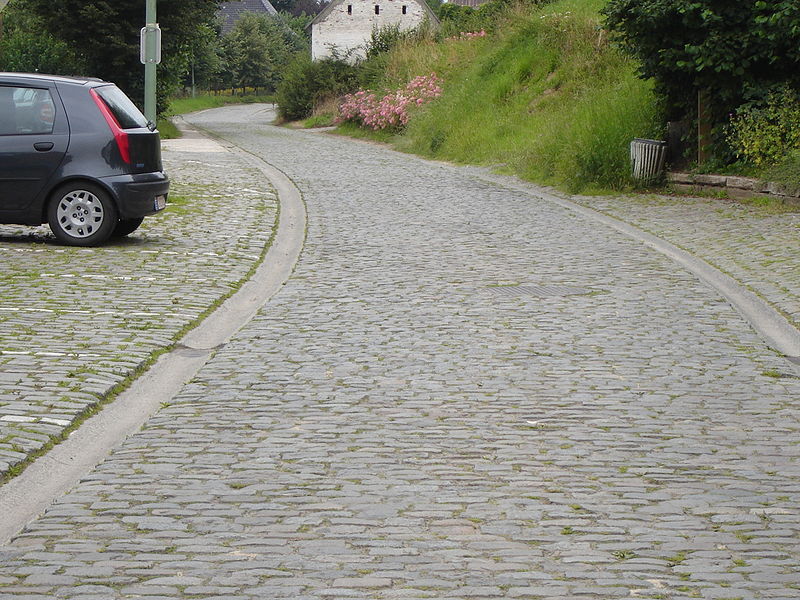
The first of two feed stations comes round at 102.7km, where riders will want to load up on the energy gels because 6.6km away is the first of the big climbs: Taaienberg, which only reaches 57m above sea level and is only 0.8km long, but at its steepest part hits 18% - and it's cobbled for half a kilometre, just to prevent it being too easy. Eikenberg comes next, 6.4km up the road and just nudging 10% at the steepest part with cobbles for 1.1km. Three more sets of cobbles follow: Holleweg (117.1km), 1.5km; Ruiterstraat (18.6km), 0.8km; Kerkgate (121.9km), 1.5km. Climb 3 is the Molenberg (131.3km), a narrow cobbled lane that hits 14.2% at the toughest section. 4.7km away is Paddestraat, the longest cobbles at 2.2km and the site of a monument to the race and those who were fastest to complete the section. The name, which translates into English as Mushroom Street, suggests it can be damp; and it can be - if it's rained any time recently (which is usually has in Flanders) the stones become treacherously slippery.

9.7km from Paddestraat is Climb 4, Rekelberg (145.7km). There are no cobbles here and, reaching "only" 9%, it's a fairly easy section by the standards of this race. 3.3km away is Berendries, Climb 5 and as steep as 12.34%, partially sunken into the surrounding landscape and sometimes very slippery as a result. A much easier 7.8km leads to Climb 6, Valkenberg (156.8km), which hits 15%; then there are 20.5km in which to let the knees stop burning before arrival at Climb 7 - Oude Kwaremont which, though not too steep at 11% maximum, has 1.5km of cobbles. Paterberg, Climb 8 (183km) follows. With a maximum gradient of 20%, it's the second steepest section of the race and frequently the site of abandonments.

Just over 10km from Paterberg is the legendary, malevolent Koppenberg (Climb 9, 189.6km), one of the most feared climbs in professional cycling. Officially, the steepest part of Koppenberg is 22%, but as the riders pack themselves into the narrow 600m cobbled section between the banks either side some of them will have no choice but to take the inside line around the bend where it reaches 25%. Not all of them will make it up without having to get off and push and some won't ever make it to the top. The second feeding station at 192.2km will be a welcome sight, offering an opportunity to raise blood sugar levels and bring some relief to starved, agonised muscles.

Men's altimetry - click to enlarge
(image credit: Flanders Classics)
The riders will just have had time to gulp down an energy gel (best way - the faster you eat them, the less you taste them) by the time they arrive at the 2km Mariaborrestraat cobbles and then Climb 10, Steenbeekdries at 194.9km with a maximum gradient of 12.8%. Another 08km of cobbles lies at Donderij, then Climb 11 at 210.1km - Kruisberg, long at 1.875km but mercifully 9%.

Having looped around, the parcours makes a second ascent of Oude Kwaremont and Paterberg for Climbs 12 and 13 (220km, 223.4km) before moving on to Hoogberg-Hotond (Climb 14, 230.4km), the highest point in the race at 110m reached after a little under 3km of climbing - the gradient is low, 8% at the steepest part. Oude Kwaremont and Paterberg are climbed for a third time in the final 17km (Climbs 15 and 16, 240.2km and 243.6km) before the last approach to Oudenaarde and the finish line. (Parcours details)

Ronde van Vlaanderen voor Vrouwen
Women's Parcours - click to enlarge
(image credit: Flanders Classics)
The Ronde's organisers were among the first to realise that running a women's race alongside the men's would bring extra spectators and, since the infrastructure and TV crews were already in place, bring enormous benefits for women's cycling. Thus, the inaugural Ronde van Vlaanderen voor Vrouwen took place in 2004 and has been held every year since, gradually becoming one of the premier events on the women's racing calendar and, as by far the most difficult of the one-day races, a much sought-after victory by the top riders.

The parcours starts and ends in Oudenaarde, following a less complex route of 127km in total. The flat initial section is shorter than the men's at 39km, then the riders arrive at Paddestraat, followed by Rekelberg (48.6km); Berendries (52.1km); Valkenberg (59.8km); Kaperij (72.1km, max. gradient 8%); Kanarieberg (79.4km, max. 14%); Kruisberg (91.2km); Oude Kwaaremont (101km); Paterberg (104.4km) and Hoogberg-Hotond (111.4km). (Parcours details)

Women's altimetry - click to enlarge
(image credit: Flanders Classics)
The Race-Losing Curse, a.k.a Cyclopunk's Top Tip
Tom Boonen
(image credit: Tete de la Course CC BY-SA 2.0)
Tom Boonen (Omega Pharma-QuickStep) is on excellent form right now and has already proved he's got the legs for Flanders this year with second place at the Omloop Het Nieuwsblad and stunning wins at Gent-Wevelgem and the E3 Harelbeke, making him the favourite of many fans and riders alike. However, he's not going to be allowed to simply cruise up to the finish and take the trophy - this is hard race with a hard parcours, which can easily ruin anyone's chances even without 24 other teams sending their hardest men to try to keep him from victory.

Among them are Sky's Edvald Boasson Hagen, undoubtedly one of the toughest 24-year-olds cycling has ever seen and a rider who has already proved himself in the Classics on several occasions; and Fabian Cancellara, the World Time Trial Champion-turned-Classics-specialist who has twice missed out on what seemed likely triumphs in recent weeks and will want this race both to prove his detractors wrong and for psychological value in the run-up to next Sunday's Paris-Roubaix. Then there's the entire BMC team: Gilbert, Ballan, Phinney, Hincapie, Hushovd, van Avermaet, Burghardt, Quinziato - any one of them could win this race. (Start list, subject to change)

Marianne Vos
The Race-Losing Curse only applies to men's races - in any race involving the incredible 24-year-old Dutch woman Marianne Vos, simply listing her as favourite and waiting for yet another near-inevitable victory will see you through at least 99% of the time. With a very strong Rabobank team behind her and with 11 races already won since New Year she was the immediate favourite this year, despite the race having slipped her grasp in the past - however, on Saturday morning it was announced that she's ill and won't be riding, so as to recover and avoid jeopardising the rest of the season. Get well soon, Marianne!

That leaves at least 20 riders with a very real chance of reaching the top step of the podium. Marianne's team mates Sarah Duster and Annemiek van Vleuten are obvious choices, but so are Evelyn Stevens, Ina-Yoko Teutenberg and Trixi Worrack(Specialized-Lululemon), Emma Pooley (AA Drink-Leontien.nl), Judith Arndt and Loes Gunnewijk (GreenEDGE), Emma Johansson (Hitec Products-Mistral Home), Nicole Cooke (Faren-Honda) and numerous others. Vos is a superstar and her absence will always detract from any race, but with less than 24 hours to go this announcement throws everything into a fascinating state of flux. (Start list subject to change)

TV coverage
In Britain, Eurosport are covering the race in two parts. The first begins at 11:45GMT, the second at 14:15, then there's highlights at 17:00 and 21:50. The broadcaster is likely to have coverage in other nations too, check local listings for details. There are likely to be numerous online streams of varying legality; as ever Sports-Livez is a good place to start with several channels, many of them non-georestricted.

Official Site
Sarah Connolly on the Women's Race
Jens (Podium Cafe) on the exclusion of the Muur
Graham Watson on Cancellara's chances

Wednesday, 21 March 2012

Prize disparity at the Dwars door Vlaanderen

Here's an interesting little factoid for you all. The winner of the men's race at the Dwars door Vlaanderen will receive €5785. The winner of the women's race will receive €1000.
The women's race is, of course, much shorter than the men's - 81.5km compared to either 199.5 or 201km (the former is the distance stated on the route details, the latter is stated elsewhere). So if we divide the prize by the distance, we find that the winning woman is going to receive €12.67 for each kilometre; around 44% of the  €29 (199.5km) or €28.78 (201km) that the winning man will receive.
Margriet Kloppenburg
(image credit: Margriet Kloppenberg)
Or at least, that's what Cyclopunk thought. Since then, Danish road and cyclo cross rider Margriet Kloppenburg (see the comments after this article), who says she's happy just to be able to race, has informed me that the top prize is not in fact €1000 at all - that's the entire prize fund for the women's race, to be shared among the winning riders. I'd wondered about that when I read the event rules, but the idea that €1000 could be the whole pot was so ridiculous I dismissed it.

Any one of them could earn more than  €1000 each week working in a full-time job. Split between them, it's peanuts. In fact, with the way food prices have increased in the last couple of years, their prizes would only just about allow them to afford a packet of peanuts.

That, of course, is why there are so few women's races mid-week: the riders are working in full time jobs, because the prize money and team salaries don't give them enough money to live on. It's also why women's cycling isn't as "developed" (as Pat McQuaid likes to say) as men's cycling - it's not that female riders are any less competitive, it's because they simply don't have the time to devote to their sport like the men do.

Come on, Pat. Sort it out.
(image credit: Oblongo CC BY-SA 2.0) 
The Dwars door Vlaanderen is showing the way ahead by including a women's race and it's not the organiser's fault that so little money is available - the problem is that the sport simply doesn't have the sponsorship. The way to get more sponsors is to have more exposure, because commercial companies other than those directly involved with bicycle or athletic equipment manufacture (with the possible exception of Rabobank and one or two others) don't hand over the cash for the good of cycling. They do it because they want to advertise stuff to the fans. The way to get more exposure? More races. The UCI can help with that one by encouraging more existing men's events to run corresponding women's races, like the Dwars does. It wouldn't hurt if some of that vast pile of cash they've been bragging about recently could be used to help support women's cycling, too.


Kloppenberg also says that the women's prize fund at this Sunday's Gent-Wevelgem is, incredibly, only €500;which may be why at the time of writing the information isn't available on the Flanders Classics website - the poor organisers are probably embarrassed.


Come on, Pat. Sort it out.

Tuesday, 20 March 2012

Dwars door Vlaanderen 2012

The parcours - click to enlarge
(image credit: Flanders Classics)
For many cyclists and fans, this week is better than Christmas, all their birthdays, Chanukah, Eid, Diwali, Maghi, Saturnalia, Walpurgisnact and the Feast of the Beast all rolled into one with sprinkles on top - it's Vlaamse Wielerweek, the ten-day "week" that kicks off with the Dwars door Vlaanderen on the 21st of March, ends with the Ronde van Vlaanderen on the 1st of April and features rather a lot of the finest cycle racing and a whole lot of cobbled climbs in between.

The Dwars door Vlaanderen is known for being a tough race with plenty of the short but steep climbs that characterise cycling in that part of the world. So guess what the organisers have done this year? That's right - they've seen to it that it's even harder than year. This is, after all, Flanders; where the riders are riders and the cobbles are nervous. There's a new climb called Berendries (maximum gradient 14%) located 120.7km into the parcours which won't be an especially welcome sight to those already suffering sore knees after Niuewe Kwaaremont (86.9km, max. 8%), Kattenberg (106.3km, max.8.2%) and Leberg (114.9km, max.14%), then once that's over they still have Valkenberg (125.8, max. 12.8%), Eikenberg (138.6km, max. 10%), Steenbeekdries (142.7km, max. 6.7%), Knockteberg (156.9km, max. 13.3%), notorious Oude Kwaaremont with 1.6km of cobbles (163.8km, max. 11.6%), and the ridiculously steep Paterberg (167.3km, max. 20%) and another four climbs of varying if slightly-lesser malevolence once that lot's been seen to.

Altimetry - click to enlarge
(image credit: Flanders Classics)
Sounds like a whole lot of fun - if you happen to enjoy seeing people suffer. Which all cycling fans do, of course. Being one of the most famous and prestigious events on the Spring racing calendar, the Dwars will be completely ignored by all British television channels; so it's lucky for us that there'll be various naughty live streams available online. You probably already have a favoured supplier for that sort of thing, but if you haven't Sports-Livez is always a god place to start. Load up your fridge with Leffe, stock up on frites and enjoy the race.


The Race-Losing Curse, also known as Cyclopunk's Top Victory Tip: Sky's Juan Antonio Flecha looked like he had as good a chance as anyone for this one - right up until he broke his hand earlier this month. Team mate Mathew Hayman will probably do alright, but doesn't look a potential winner and Cav is likely to die; with the rest of the team very unlikely to get a foot on the podium it's not looking as though a Sky victory is on the cards.

In fact, the outcome of this race is very difficult to predict - there are no obvious winners that leap from the start list but there are many, many riders with a fighting chance. So, for the hell of it, let's say Sylvain Chavanel; but keep an eye on Oscar Freire - he may be 36 and he may be better-known for the sprinty Classics, but he's a tricksy little bugger and has won more than one race with his brain.


Dwars organisers are, shall we say, a little more enlightened than their counterparts at certain other events and so for the first time in 2012 they've added a women's race running along a section of the men's parcours for a total of five laps, covering a total distance of 81.5km. It's not the longest race on the women's calendar by any means and, to be brutally honest, does rather have the feel of having been tacked onto the men's race simply to keep up with a - positive - trend; but it's now been shown time and time again that running women's races alongside men's races brings serious benefits to women's cycling and the sport in general, so we can expect to see this race grow and develop in the coming years. While short, let's not forget that there's an ascent of Holsraat (max. 12%) each time they go round - an easy race it categorically is not. The chances of catching live footage anywhere are probably considerably less than zero, but links will be posted here if any become available.

Men's start list
Women's start list