Showing posts with label Obree. Show all posts

Wednesday, 11 September 2013

Daily Cycling Facts 11.09.2013

Kathy Watt
Kathy Watt
Born Kathryn Ann Watt in Australia on this day in 1964, Kathy Watt is the daughter of marathon runner Geoff Watt, who died of exposure when she was five years old. Kathy initially followed her father into running and won a National Championship racing as a Junior, only taking up cycling to maintain fitness whilst recovering from tendon problems. She very rapidly discovered that she was much better at cycling than at running; in 1990 she won gold in the Road Race at the Commonwealth Games and came third overall at the Giro Donne.

In 1992, Watt became Elite National Road Race Champion for the first time - she would hold the title again in 1993, 1994 and 1998), and she also won the gold medal for the Road Race at the Olympics that year. In 1994, she won another Commonwealth Games Road Race gold and came second overall at the Giro Donne, in 1995 she was third at the World Individual Time Trial Championships and seventh overall at the Tour de France Féminin and in 1996 she won the National Time Trial title. In 1996, she became involved in a legal row with the National Cycling Federation which had chosen her to compete in the Pursuit event at that year's Olympics, then rescinded and gave the place to Lucy Tyler-Sharman, whom she had beaten at the National Track Championships in February after the US-born Australian track specialist suffered an asthma attack. Watt's Olympic place was not without conditions - the Federation had stipulated that, should another rider record a world-class time in the run-up to the Games then that rider would replace Watt. Tyler-Sharman subsequently did so, recording a time five seconds faster than Watt's National Championships personal best and only 0.2" behind the World Record; nevertheless, after an unusually fast hearing the Court for Arbitration in Sport found in Watt's favour and she was reinstated. She finished the event in eighth place.

Watt won the Oceania Championships Time Trial in 1997, then entered a period in which she seemed condemned to stay on the lower steps of the podium with a series of second and third places up until her retirement in 2000, inspired partly by another selection row in which she was unsuccessful. However, three years later she returned with the intention of competing in the 2004 Olympics; but then retired again when she didn't qualify - and then made another comeback in 2005, when she won the Chrono Champenois-Trophée Européen, this time intending to qualify for the 2006 Commonwealth Games, where she was second in the Time Trial. She won the National Time Trial Championship for a second time that year too, then in 2007 she won the Road Race at the Oceania Games and Stages 1, 2, 3, 4 and the General Classification at the Tour of Perth, before adding numerous podium finishes and a few further victories to her palmares over the following two years until her eventual retirement in 2009, when she was 45 years old.

Graeme Obree
Born in Nuneaton on this day in 1965 but raised in Scotland, Graeme Obree was one of the few British cyclists to approach household name status in Britain before Cavendish, Wiggins and Team Sky became superstars. This was largely due to Britain's love of eccentric inventors and to the record he set on a bike that newspapers misleadingly claimed to have been made out of old washing machines.

Obree's first official race was a 10-mile individual time trial, in which he competed wearing a pair of school shorts, an anorak and Doctor Marten boots. He assumed that the start and finish line were in the same place and, having passed the start line on his way back in, had got off his bike and was getting changed into fresh clothes when a race official pointed out his error; he got back on and finished with a time of 30' - not a bad result for a first attempt. He has suffered from bipolar disorder for most of his life and made the first of his three suicide attempts while still a teenager; during the 1990s he took an overdose of aspirin, using dirty water from a puddle to swallow the pills. However, even when in a problematic situation he is sometimes able to think big: when his bike shop failed and he was being pursued for outstanding college fees (and had started sniffing welding gas), he decided upon an unusual way of getting himself out of difficulty - he would set a new Hour Record. He says that, from the day the idea first came to him, he always told himself not that he would attempt the record, but that he would break it.

Obree in the "preying mantis" position
aboard Old Faithful
He did not use a conventional bike, instead designing and building one of his own with an unusual frame and handlebar set-up that allowed him to adopt a position, which became known as "preying mantis," more like that of a downhill skier than a cyclist. opening up his lungs. The bottom bracket was narrower than standard, keeping his knees tucked in for greater aerodynamic efficiency, the fork was one-sided and the chainstays were elevated; the handlebars were narrow and connected to a 0mm reach stem of the old-fashioned quill type. There was also a healthy dose of Obree eccentricity - the tyres were "one banana" wide and the wheels span on with taken from a washing machine, its designer reasoning that since the device they came from had been designed to rotate at 1,200rpm they would be better quality than typical bike bearings. For some reason, this proved highly appealing to journalists, who then ignored the rest of the bike and began the "made of old washing machine parts" myth; he later said that he wished he'd never mentioned it because people took less interest in the numerous other innovative features of the bike and his achievements aboard it.

He named it Old Faithful, and it was far from the prettiest bike ever made - in fact, were it not for the three-spoke carbon fibre wheels and the 53x13 (110"), it looked rather like a Raleigh folding shopper bike from the 1970s. On the 16th of July in 1993, he took it to Hamar Olympic Hall velodrome in Norway and made his attempt at beating the record set by Francesco Moser's nine-year-old 51.151km record - and failed to beat it by a kilometre. But Obree, despite his illness, does not give up easily once he's set out to do something. He had booked the velodrome for 24 hours and so, rather than going home, he decided he would make another attempt the following morning. Lacking the budget to employ a support team with highly trained masseur, he came up with a typically Obreean method to prevent his muscles seizing up over night - he drank several pints of water before going to bed, thus ensuring that he would wake up within a couple of hours needing to visit the lavatory. When he did, he stretched and then drank more water to make sure he'd wake up again. Then, on the 17th, he went back onto the track and recorded 51.596, taking the record.

It lasted for only six days - on the 23rd, Chris Boardman rode 52.270km on the track at Bordeaux, using a bike with a carbon fibre frame and tri-bars. Meanwhile, Francesco Moser was working towards a new Veteran's Hour Record with a new bike that allowed him to copy Obree's "preying mantis" position; on the 15th of January 1994 he did it at altitude (thus in thinner air, creating less resistance) in Mexico City.

Obree and Boardman had become rivals. Obree beat the Englishman in the Pursuit at the World Track Championships in 1993 and won the title; but it wasn't enough: their rivalry came from the Hour Record, and that's where it would be settled. Most riders, backed up by a big-name bike manufacturer, would set out on their mission to regain the Record on a brand new, top-secret machine following many millions of dollars' worth of research - Obree simply made a few minor adjustments to Old Faithful (including bolting a pair of shoes onto the pedals so that his foot wouldn't slip off, as had happened at the World Championships). Then he got himself into the right mental state and, on the 19th of April, went to the same Bordeaux track used by Boardman to set his own record. Obree rode 52.713km, beating Boardman by 443m.

Less than five months later, Obree's record was broken by Miguel Indurain. The UCI now became concerned that innovative new bike designs were making it too easy for old records to be broken, thus the "preying mantis" position was banned in 1994, Obree being informed of the ban hours before he was due to use Old Faithful on the Pursuit at the World Championships. This, he felt (and, according to many, with some justification) was unfair; he refused to adopt a conventional position and was disqualified from the race. He responded by redesigning Old Faithful's handlebars to allow a new position known as "superman," with his arms out in front over the front wheel (Boardman used the position when he set his 1996 record at 56.375km); this two was banned after he won the Pursuit at the Worlds in 1995.

Obree's brother, Gordon, died in a car accident late in 1994, sparking off a new cycle of depression that coincided with his debut as a professional rider. He signed to Le Groupemont for the 1995 season but team manager Patrick Valcke was unable to understand his illness, firing him for what he saw as "lack of professionalism" - however, this may in fact have been fortunate from Obree's point of view because, shortly before the Tour de France that year, the team collapsed with its sponsor backed out cycling amid accusations that it was a disguised pyramid scheme. Obree says there was another reason he was sacked: having been selected to ride the Tour, he discovered that to have any chance at all of keeping up with the competition, he was going to have to dope - which he point-blank refused to do under any circumstances. "I feel I was robbed by a lot of these bastards taking drugs," he says, then adds: "I also hate the way that people think anyone who has ever achieved anything on a bike must have been taking drugs."

A prone bike. Obree's design is longer and lower and will be
fitted with a light-weight, aerodynamic shell
His illness became progressively worse over the coming years and, in 2001, he was discovered unconscious after attempting to hang himself in a barn near to stables where a horse belonging to his family was kept. It was at this point that his bipolar disorder was revealed to the world, his wife Anne - a nurse - attempting to explain the condition. In 2011, having split up from Anne, Obree revealed during a newspaper interview that he is homosexual and said that confusion prior to realising it had been a major cause of his depression and suicide attempts. He had come out to his family in 2005; almost two years after coming out in public he remains one of the very few sportsmen to have been brave enough to do so - and has doubtless been a source of inspiration and encouragement to many others. He seems happier now, and his intelligence makes his engaging and entertaining in interviews. In 2011, he revealed that, aged 47, he was setting out to beat the World Human-Powered Vehicle (HPV) Land-Speed record, using a prone bike (upon which the rider lies in a flat-out position) that he first thought up while lying in the bath and is building himself. Parts of it are made from old saucepans.

Lucien Buysse
Lucien Buysse
Born in Wontergem, Belgium on this day in 1892, Lucien Buysse entered the last Tour de France before the First World War in 1914 with Alcyon-Soly but didn't finish the race. He survived the War, then returned to cycling with Legnano-Pirelli in 1919 and rode another Tour; once again, he did not finish. He didn't enter for the following three years but finished the 1920 Paris-Roubaix in third place, then in 1923 he went back to the Tour with older brother Marcel's M. Buysse-Colonial team, won Stage 8 and finished in eighth place overall. In 1924 and 1925 he rode with Automoto purely to support Ottavio Bottecchia, for which reason he frequently described as having been the first domestique in Tour history. He came third in 1924, then second in 1925.

In 1926, the Tour was reduced to 17 stages, there having been 18 in 1925 - however, it was most definitely not easier. For a start, riders would face the Alps twice, on the way out and the way back in and again, and Henri Desgrange (who believed that the ideal Tour would be one in which only one rider finished) hadn't cut a stage for their benefit - he did it to increase the average stage length. What's more, the parcours followed the nations borders more closely than ever before or since; making this the longest Tour in history at 5,745km (for comparison, the 2012 edition is 3,497km). Bottecchia, having won the previous two editions, was most fans' favourite, but many others fancied Alcyon's Adelin Benoit who had surprised everyone with a stage win and five days in the maillot jaune in 1925. A classic battle was expected, but as tends to be the way in the Tour it turned out far better than anyone had hoped. Right from the first stage unexpected things happened, beginning with a perfect solo break by Buysse, accompanied by another brother named Jules (there was a Michel, too), which lasted until the end of the stage where he won by thirteen minutes. Stage 2 ended with a bunch sprint won by little-known Belgian rider Aimé Dossche, who had picked up his first professional contract with Automoto at the the start of the year but seems to have switched to Christophe (which, like Automoto, was co-sponsored by Hutchinson at that time) before the Tour; so the GC remained virtually unchanged. Then in Stage 3 Gustaaf van Slembrouck managed to grab a lead that kept him in the maillot jaune for six days.

During Stage 3, Buysse received news that his infant daughter had died (some historians say she died before the Tour) but, after thinking things over, decided to honour his family's request that he continue and try to win a stage that could be dedicated to the memory. Stage 4 was perhaps too soon and went to Félix Sellier instead; Stage 5 to Adelin Benoit. Another little-known Belgian named Joseph van Daam won Stage 6 after judges declared that Sellier had broken race regulations (van Daam would win two more later on, so he was much more famous when the race ended), then Nicolas Frantz won Stage 7; since Frantz had finished fourth in 1925 and showed enormous promise, instantly made him a favourite too. Van Daam won Stage 8, this time on his own merit, then Frantz took Stage 9. The race had truly begun now, with a new challenger making things difficult for Bottecchia and Benoit.


Tour director HenriDesgrange, ever since he'd been convinced that it was possible to send the race over the high mountains without the riders dying, rebelling or being eaten by bears (something that, perhaps unfortunately in the eyes of some fans, has yet to happen in the Tour) and that in fact the public enjoyed the race more when it was an heroic spectacle, was always on the look-out for ways to make the parcours more difficult. Stage 10 went far beyond anything from previous years - and, say the ever-dwindling number of people who were there to see it, since. In terms of distance, it wasn't the longest stage that year - ten stages were longer, the longest 433km - but its 326km took the riders over some of the toughest roads in France, and they set out at midnight to be in with a chance of finishing by the following afternoon. Matters were not improved by a storm on the Col d'Aspin, but the Buysse brothers were made of stern stuff: while the rest of the peloton survived, they attacked hard and Lucien won after riding for seventeen hours. He had taken the maillot jaune, but better still he could dedicate the hardest stage in the history of the Tour to the memory of his daughter.


Buysse on Tourmalet
When he won Stage 11 two days later, he gained a lead of more than an hour over his nearest rival. From now on, he was able to stay tucked safely away in the peloton, conserving his energy and simply making sure that he finished (which didn't prevent him winning the meilleur grimpeur, a prize for the best climber from the days before the King of the Mountains competition). Frantz won two more stages once the race returned to the flatlands, but he didn't have a hope of getting anywhere near the leader now and had to be content with second place. As they crossed the finish line in Paris behind stage winner Dossche, the gap between them was 1h22'25" (Buysse's overall time was 238h44'25" - around two-and-three-quarter times as long as Cadel Evan's 2011 winning time); a far greater memorial to his daughter than a stage win.

Buysse retired in 1933, by which time he was 41 years old - still a young man by today's standards,  but well into middle-age by those of the time. He lived for almost half a century more, dying at the age of 87 on the 3rd of January in 1980.


Lieuwe Westra, riding at the time of writing for Vacansoleil-DCM, was born in Mûnein, Netherlands on this day in 1982. Having been a regular inclusion in the top ten placings since turning professional in 2006, 2012 has been the best year of Westra's career to date with one stage win, third place in the Points competition and second place overall at Paris-Nice, second place at the Dreidaagse van De Panne, second place at the Tour of Belgium, victory at the National Independent Time Trial Championship and first place overall at the Post Danmark Rundt. 2013 was also a success with a stage win at the Tour of California and victory at the National Time Trial Championship.

Roberto Chiappa, born in Terni, Italy on this day in 1973, was Under-19 World Sprint Champion in 1991, Amateur World Tandem Champion in 1993. World Military Sprint Champion in 1994, Italian Keirin Champion from 2004 to 2008 and National Sprint Champion from 2004 to 2010.

Matthew Gilmore, born in Gent, Belgium on this day in 1972, has held one World Track Championship title, five European Track Championships titles and one from the National Championships - the Australian National Championships, having raced with an Australian licence during the first years of his career on account of his father, 1967 Australian National Road Race Champion Graeme Gilmore. Graeme married Tom Simpson's sister; Matthew is, therefore, Tom's nephew.

Dainis Ozols, born in Smiltene, Latvia on this day in 1966, won the Irish Rás Tailteann in 1989, the Regio Tour and a bronze medal for in the Road Race at the Olympics in 1992, the Circuit Franco-Belge in 1993 and was National Independent Time Trial Champion in 1997, 1998 and 1999. Every now and then, a rider comes along who, for no apparent reason, completely confuses race announcers, reporters and on-screen graphics technicians.Ozols was one of them; his name was, more frequently than not, given as Ozolos and occasionally with other surplus letters, while his nationality was often incorrectly listed as Lithuanian or Polish.

Other cyclists born on this day: Willi Fuggerer (Germany, 1941); Christophe Le Mével (France, 1980); Karen Matamoros (Costa Rica, 1982); Suleman Ambaye (Ethiopia, 1935); Vitool Charernratana (Thailand, 1942); Marc Willers (New Zealand, 1985); René Andring (Luxembourg, 1939); Miguel Mora (Spain, 1936, died 2012); Mariano Piccoli (Italy, 1970); Patricio Almonacid (Chile, 1979); Claude Magni (France, 1950); Denis Pelizzari (France, 1960); Roman Čermák (Czechoslovakia, 1959); John Thorsen (Australia, 1957).

Saturday, 27 April 2013

Daily Cycling Facts 27.04.2013

Emile Faingnaert
The Ronde van Vlaanderen was held on this day in 1947, when it was won by Emiel Faingnaert. After retiring from racing, Faingnaert ran a bike shop for many years in his hometown Sint-Martens-Lierde where there is now a monument dedicated to his memory.

The Vuelta a Espana began on this day in 1962, 1967, 1972, 1976 and 1992. Jacques Anquetil had already won two Tours de France and a Giro d'Italia by this point and he entered the 1962 edition, which included 17 stages and covered 2,806km, leaving nobody in any doubt that he was there to become the first man to have won all three Grand Tours. It was generally agreed that he stood a better chance than anyone else of doing so, too; but Fate, being what it is, saw to it that he did not - a gastric condition prevented him from winning any stages and, eventually, caused him to abandon the race. The Saint Raphael-Helyett team remained all but invincibly strong with him out of action and then in his absence; team mates Rudi Altig and Seamus Elliot (the first Irish rider to make an impact on the European cycling circuit and who would tragically commit suicide four years after retiring in 1967) swapped the red jersey (which distinguished the race leader during that period) back and forth between themselves throughout the race. Elliot led for a total of nine stages, but then rode a disastrous Stage 15 time trial that saw him finish overall in third place with a disadvantage of 7'17" behind Altig - the first German to win a Vuelta (the Irish would have to wait more than a quarter of a century for their first win, courtesy of Sean Kelly in 1988).

Jan Janssen
1967 consisted of 18 stages, two split, covering 2,940.5km in total. Jan Janssen became the first Dutch rider to win and took the Points competition too. Stages 5 and 16 were won by Tom Simpson - his final Grand Tour victories before his death on Mont Ventoux during Stage 13 at the Tour de France later that year.

1972 once again consisted of 18 stages, two split, the total distance this time being 3,079km. José Manuel Fuente, one of the few riders of the day capable of doing battle and occasionally beating Eddy Merckx (who would not enter the Vuelta until the following year, when he won), won both the General Classification and the King of the Mountains.

In 1976 there were 19 stages, covering 3,340km. José Pesarrodona won, beating Luis Ocaña (who had been Merckx's other main rival) by 1'03", largely on account of a superb Stage 19b time trial where he finished just one second behind stage winner Dietrich Thurau. A Belgian rider, Eric Jacques - then virtually unknown and now virtually forgotten - took a surprise second place in Stage 8, sufficient to put him at the top of the General Classification leadership. Looking at the rest of his career, it comes as somewhat less of a surprise that he failed a doping control after the stage. In those pre-Festina, Puerto and Giro Blitz days the punishments for doping were considerably less than they are today and he received no penalty other than being docked ten minutes; it was, however, enough to ruin his chances and he finished the race in 16th place overall.

Tony Rominger

1992 included 20 stages and covered 3,395km. The race was open right from the start after favourites Stephen Roche, Robert Millar, Erik Breukink and Steven Rooks all showed up on noticeably less-than-first-rate form, leaving most people undecided between Tony Rominger and Pedro Delgado - but then Rominger crashed and was left with an injured knee and concussion which caused him to lose three minutes in the Stage 6 time trial. Meanwhile, Breukink had recovered somewhat and won the stage, though with only a slight advantage over surprise second place Jesús Montoya - hitherto known purely as a climber, Montoya's time was sufficient to put him into the overall lead. However, Rominger would also recover fast and, two stages later when the race ventured into France to climb 1,720m Luz Ardiden in the Pyrenees, he dropped all of his rivals one by one - while he would never catch a breakaway led by eventual stage winner Laudelino Cubino and put himself back into contention. Montoya, leading since Stage 6, began to worry after Pedro Delgado was fastest up Lagos de Covadonga to win Stage 13, and from that point on concentrated on beating him; managing to retain the leadership through to Stage 17. The big mistake they both made was in forgetting about Rominger who was working hard to claw his way back up and took a decisive win in the Stage 18 time trial, putting himself into the overall leadership. From that point onwards he was unstoppable and cemented his race victory when he also won the following stage. It would be the first time the Vuelta had ever been won by a Swiss rider and the first step along the way to becoming the first man to win in three consecutive years.

Obree's 1994 Hour Record
Obree aboard "Old Faithful"
(public domain image)
On this day in 1994, Nuneaton-born Scottish cyclist Graeme Obree set the second of his two Hour Records; both classified among the Human Effort records achieved on bikes with notable differences to that ridden by Eddy Merckx when he set his own record in 1972 and which was decided to be the approved "standard" bike by the UCI.

In fact, Obree's bike - Old Faithful - was very different to the one used by Merckx. For a start, he'd built it himself and it was ridden in an extremely unconventional style. Rather than the drop handlebars used on most track and road bikes, the bars were positioned further back, creating a much shorter distance between them and the saddle (known as "reach"). He would then ride with his upper torso over the bars which he gripped below his chest, thus achieving a streamlined profile similar to that of a skier. The custom bottom bracket was much narrower than standard and elevated chain stays allowed the use of straight cranks, thus permitting him to keep his knees in, and a single-sided streamlined fork reduced the frontal area of the bike. It also featured bearings taken from a washing machine - after noticing that parts in some machines rotate at speeds as high as 1,200rpm, he reasoned that the bearings must therefore be of better quality than those used in bikes. He later regretted telling people this, as the bearings story proved to be of especial appeal to journalists who then ignored the innovation on show on the rest of Old Faithful and wrote silly headlines about a bike made of old washing machine parts.

Old Faithful doesn't look fast at first glance. In fact, it looks a bit like a folding shopper bike (albeit one that somebody's fitted with very expensive carbon fibre wheels) and it wouldn't be unfair to say it's not the most aesthetically-pleasing steed ever to hit the velodrome. Looks can be deceiving -  it's very fast indeed and aboard it Obree covered 52.713km in sixty minutes, almost half a kilometre more than previous record holder Chris Boardman. Shortly afterwards, the UCI banned the bike and Obree's riding position.


Today marks the anniversary of the 1979 birth of Scottish professional cyclist James McCallum, who was born in Glasgow and currently rides for Rapha-Condor-Sharp. A natural athlete, McCallum competed in several sports before deciding to concentrate on cycling and, in 2001, became Scottish National Kilo Champion, then British Circuit Race Champion in 2007. Nowadays, he runs Mach 10 - a sports coaching company he set up - and is involved with Champions in Schools, a charity that aims to educate schoolchildren in the benefits of a healthy lifestyle and provide them with access to sport.

Jayme Richardson-Paris is a Paralympian cyclist born in New South Wales on this day in 1989. She began her athletic career as a swimmer but instinctively felt that it was not the sport she would excel in and, after looking around, settled on cycling. This provided her with more difficulties than it does for most people: whilst Jayme was still in the womb, her mother suffered a uterine rupture. After performing an emergency caesarean birth, doctors believed she was dead. Fortunately, both mother and baby survived; but a part of Jayme's brain had been damaged, leaving her with cerebellar ataxia (a condition that makes coordinated movements difficult, leading to "chronic clumsiness"), gross motor retardation and epilepsy. With therapy, her condition improved sufficiently for her to be picked to compete in National events and she began winning races - a lot of races, including twelve in 2011 alone. Her ambition is now to win two gold medals at the 2012 Paralympics in London.

The Basque time trial expert Jonathan Castroviego was born in Getxo on this day in 1987 and joined Euskaltel-Euskadi in 2010 - an unusual choice for the team, as it's traditionally been made up of climbers and specialises in winning gruelling mountain races, but one that paid off the following year when he won the Tour de Romandie after beating Taylor Phinney by 0.27" in the individual time trial. Earlier that year at Tirreno-Adriatico, he had beaten Cadel Evans and David Zabriskie in a time trial - evidence that, as he enters his best years over the coming four seasons, he will emerge as a serious talent.

Other cyclists born on this day: Petra Walczewski (Switzerland, 1968); Roel Paulissen (Belgium, 1976); Riho Suun (USSR, 1960); Santia Tri Kusuma (Indonesia, 1981); Rory Gonsalves (Antigua and Barbuda, 1979); Gianfranco Contri (Italy, 1970); Sergey Tereshchenkov (USSR, 1938, died 2006); Aleksey Kolesov (Kazakhstan, 1984); Harry Steevens (Netherlands, 1945); Gilson Alvaristo (Brazil, died 1956); José Luis Tellez (Mexico, 1938).

Tuesday, 11 September 2012

Daily Cycling Facts 11.09.12

Kathy Watt
Kathy Watt
Born Kathryn Ann Watt in Australia on this day in 1964, Kathy Watt is the daughter of marathon runner Geoff Watt, who died of exposure when she was five years old. Kathy initially followed her father into running and won a National Championship racing as a Junior, only taking up cycling to maintain fitness whilst recovering from tendon problems. She very rapidly discovered that she was much better at cycling than at running; in 1990 she won gold in the Road Race at the Commonwealth Games and came third overall at the Giro Donne.

In 1992, Watt became Elite National Road Race Champion for the first time - she would hold the title again in 1993, 1994 and 1998), and she also won the gold medal for the Road Race at the Olympics that year. In 1994, she won another Commonwealth Games Road Race gold and came second overall at the Giro Donne, in 1995 she was third at the World Individual Time Trial Championships and seventh overall at the Tour de France Féminin and in 1996 she won the National Time Trial title. In 1996, she became involved in a legal row with the National Cycling Federation which had chosen her to compete in the Pursuit event at that year's Olympics, then rescinded and gave the place to Lucy Tyler-Sharman, whom she had beaten at the National Track Championships in February after the US-born Australian track specialist suffered an asthma attack. Watt's Olympic place was not without conditions - the Federation had stipulated that, should another rider record a world-class time in the run-up to the Games then that rider would replace Watt. Tyler-Sharman subsequently did so, recording a time five seconds faster than Watt's National Championships personal best and only 0.2" behind the World Record; nevertheless, after an unusually fast hearing the Court for Arbitration in Sport found in Watt's favour and she was reinstated. She finished the event in eighth place.

Watt won the Oceania Championships Time Trial in 1997, then entered a period in which she seemed condemned to stay on the lower steps of the podium with a series of second and third places up until her retirement in 2000, inspired partly by another selection row in which she was unsuccessful. However, three years later she returned with the intention of competing in the 2004 Olympics; but then retired again when she didn't qualify - and then made another comeback in 2005, when she won the Chrono Champenois-Trophée Européen, this time intending to qualify for the 2006 Commonwealth Games, where she was second in the Time Trial. She won the National Time Trial Championship for a second time that year too, then in 2007 she won the Road Race at the Oceania Games and Stages 1, 2, 3, 4 and the General Classification at the Tour of Perth, before adding numerous podium finishes and a few further victories to her palmares over the following two years until her eventual retirement in 2009, when she was 45 years old.

Graeme Obree
Born in Nuneaton on this day in 1965 but raised in Scotland, Graeme Obree was one of the few British cyclists to approach household name status in Britain before Cavendish, Wiggins and Team Sky became superstars. This was largely due to Britain's love of eccentric inventors and to the record he set on a bike that newspapers misleadingly claimed to have been made out of old washing machines.

Obree's first official race was a 10-mile individual time trial, in which he competed wearing a pair of school shorts, an anorak and Doctor Marten boots. He assumed that the start and finish line were in the same place and, having passed the start line on his way back in, had got off his bike and was getting changed into fresh clothes when a race official pointed out his error; he got back on and finished with a time of 30' - not a bad result for a first attempt. He has suffered from bipolar disorder for most of his life and made the first of his three suicide attempts while still a teenager; during the 1990s he took an overdose of aspirin, using dirty water from a puddle to swallow the pills. However, even when in a problematic situation he is sometimes able to think big: when his bike shop failed and he was being pursued for outstanding college fees (and had started sniffing welding gas), he decided upon an unusual way of getting himself out of difficulty - he would set a new Hour Record. He says that, from the day the idea first came to him, he always told himself not that he would attempt the record, but that he would break it.

Obree in the "preying mantis" position
aboard Old Faithful
He did not use a conventional bike, instead designing and building one of his own with an unusual frame and handlebar set-up that allowed him to adopt a position, which became known as "preying mantis," more like that of a downhill skier than a cyclist. opening up his lungs. The bottom bracket was narrower than standard, keeping his knees tucked in for greater aerodynamic efficiency, the fork was one-sided and the chainstays were elevated; the handlebars were narrow and connected to a 0mm reach stem of the old-fashioned quill type. There was also a healthy dose of Obree eccentricity - the tyres were "one banana" wide and the wheels span on with taken from a washing machine, its designer reasoning that since the device they came from had been designed to rotate at 1,200rpm they would be better quality than typical bike bearings. For some reason, this proved highly appealing to journalists, who then ignored the rest of the bike and began the "made of old washing machine parts" myth; he later said that he wished he'd never mentioned it because people took less interest in the numerous other innovative features of the bike and his achievements aboard it.

He named it Old Faithful, and it was far from the prettiest bike ever made - in fact, were it not for the three-spoke carbon fibre wheels and the 53x13 (110"), it looked rather like a Raleigh folding shopper bike from the 1970s. On the 16th of July in 1993, he took it to Hamar Olympic Hall velodrome in Norway and made his attempt at beating the record set by Francesco Moser's nine-year-old 51.151km record - and failed to beat it by a kilometre. But Obree, despite his illness, does not give up easily once he's set out to do something. He had booked the velodrome for 24 hours and so, rather than going home, he decided he would make another attempt the following morning. Lacking the budget to employ a support team with highly trained masseur, he came up with a typically Obreean method to prevent his muscles seizing up over night - he drank several pints of water before going to bed, thus ensuring that he would wake up within a couple of hours needing to visit the lavatory. When he did, he stretched and then drank more water to make sure he'd wake up again. Then, on the 17th, he went back onto the track and recorded 51.596, taking the record.

It lasted for only six days - on the 23rd, Chris Boardman rode 52.270km on the track at Bordeaux, using a bike with a carbon fibre frame and tri-bars. Meanwhile, Francesco Moser was working towards a new Veteran's Hour Record with a new bike that allowed him to copy Obree's "preying mantis" position; on the 15th of January 1994 he did it at altitude (thus in thinner air, creating less resistance) in Mexico City.

Obree and Boardman had become rivals. Obree beat the Englishman in the Pursuit at the World Track Championships in 1993 and won the title; but it wasn't enough: their rivalry came from the Hour Record, and that's where it would be settled. Most riders, backed up by a big-name bike manufacturer, would set out on their mission to regain the Record on a brand new, top-secret machine following many millions of dollars' worth of research - Obree simply made a few minor adjustments to Old Faithful (including bolting a pair of shoes onto the pedals so that his foot wouldn't slip off, as had happened at the World Championships). Then he got himself into the right mental state and, on the 19th of April, went to the same Bordeaux track used by Boardman to set his own record. Obree rode 52.713km, beating Boardman by 443m.

Less than five months later, Obree's record was broken by Miguel Indurain. The UCI now became concerned that innovative new bike designs were making it too easy for old records to be broken, thus the "preying mantis" position was banned in 1994, Obree being informed of the ban hours before he was due to use Old Faithful on the Pursuit at the World Championships. This, he felt (and, according to many, with some justification) was unfair; he refused to adopt a conventional position and was disqualified from the race. He responded by redesigning Old Faithful's handlebars to allow a new position known as "superman," with his arms out in front over the front wheel (Boardman used the position when he set his 1996 record at 56.375km); this two was banned after he won the Pursuit at the Worlds in 1995.

Obree's brother, Gordon, died in a car accident late in 1994, sparking off a new cycle of depression that coincided with his debut as a professional rider. He signed to Le Groupemont for the 1995 season but team manager Patrick Valcke was unable to understand his illness, firing him for what he saw as "lack of professionalism" - however, this may in fact have been fortunate from Obree's point of view because, shortly before the Tour de France that year, the team collapsed with its sponsor backed out cycling amid accusations that it was a disguised pyramid scheme. Obree says there was another reason he was sacked: having been selected to ride the Tour, he discovered that to have any chance at all of keeping up with the competition, he was going to have to dope - which he point-blank refused to do under any circumstances. "I feel I was robbed by a lot of these bastards taking drugs," he says, then adds: "I also hate the way that people think anyone who has ever achieved anything on a bike must have been taking drugs."

A prone bike. Obree's design is longer and lower and will be
fitted with a light-weight, aerodynamic shell
His illness became progressively worse over the coming years and, in 2001, he was discovered unconscious after attempting to hang himself in a barn near to stables where a horse belonging to his family was kept. It was at this point that his bipolar disorder was revealed to the world, his wife Anne - a nurse - attempting to explain the condition. In 2011, having split up from Anne, Obree revealed during a newspaper interview that he is homosexual and said that confusion prior to realising it had been a major cause of his depression and suicide attempts. He had come out to his family in 2005; almost two years after coming out in public he remains one of the very few sportsmen to have been brave enough to do so - and has doubtless been a source of inspiration and encouragement to many others. He seems happier now, and his intelligence makes his engaging and entertaining in interviews. In 2011, he revealed that, aged 47, he was setting out to beat the World Human-Powered Vehicle (HPV) Land-Speed record, using a prone bike (upon which the rider lies in a flat-out position) that he first thought up while lying in the bath and is building himself. Parts of it are made from old saucepans.

Lucien Buysse
Lucien Buysse
Born in Wontergem, Belgium on this day in 1892, Lucien Buysse entered the last Tour de France before the First World War in 1914 with Alcyon-Soly but didn't finish the race. He survived the War, then returned to cycling with Legnano-Pirelli in 1919 and rode another Tour; once again, he did not finish. He didn't enter for the following three years but finished the 1920 Paris-Roubaix in third place, then in 1923 he went back to the Tour with older brother Marcel's M. Buysse-Colonial team, won Stage 8 and finished in eighth place overall. In 1924 and 1925 he rode with Automoto purely to support Ottavio Bottecchia, for which reason he frequently described as having been the first domestique in Tour history. He came third in 1924, then second in 1925.

In 1926, the Tour was reduced to 17 stages, there having been 18 in 1925 - however, it was most definitely not easier. For a start, riders would face the Alps twice, on the way out and the way back in and again, and Henri Desgrange (who believed that the ideal Tour would be one in which only one rider finished) hadn't cut a stage for their benefit - he did it to increase the average stage length. What's more, the parcours followed the nations borders more closely than ever before or since; making this the longest Tour in history at 5,745km (for comparison, the 2012 edition is 3,497km). Bottecchia, having won the previous two editions, was most fans' favourite, but many others fancied Alcyon's Adelin Benoit who had surprised everyone with a stage win and five days in the maillot jaune in 1925. A classic battle was expected, but as tends to be the way in the Tour it turned out far better than anyone had hoped. Right from the first stage unexpected things happened, beginning with a perfect solo break by Buysse, accompanied by another brother named Jules (there was a Michel, too), which lasted until the end of the stage where he won by thirteen minutes. Stage 2 ended with a bunch sprint won by little-known Belgian rider Aimé Dossche, who had picked up his first professional contract with Automoto at the the start of the year but seems to have switched to Christophe (which, like Automoto, was co-sponsored by Hutchinson at that time) before the Tour; so the GC remained virtually unchanged. Then in Stage 3 Gustaaf van Slembrouck managed to grab a lead that kept him in the maillot jaune for six days.

During Stage 3, Buysse received news that his infant daughter had died (some historians say she died before the Tour) but, after thinking things over, decided to honour his family's request that he continue and try to win a stage that could be dedicated to the memory. Stage 4 was perhaps too soon and went to Félix Sellier instead; Stage 5 to Adelin Benoit. Another little-known Belgian named Joseph van Daam won Stage 6 after judges declared that Sellier had broken race regulations (van Daam would win two more later on, so he was much more famous when the race ended), then Nicolas Frantz won Stage 7; since Frantz had finished fourth in 1925 and showed enormous promise, instantly made him a favourite too. Van Daam won Stage 8, this time on his own merit, then Frantz took Stage 9. The race had truly begun now, with a new challenger making things difficult for Bottecchia and Benoit.


Tour director HenriDesgrange, ever since he'd been convinced that it was possible to send the race over the high mountains without the riders dying, rebelling or being eaten by bears (something that, perhaps unfortunately in the eyes of some fans, has yet to happen in the Tour) and that in fact the public enjoyed the race more when it was an heroic spectacle, was always on the look-out for ways to make the parcours more difficult. Stage 10 went far beyond anything from previous years - and, say the ever-dwindling number of people who were there to see it, since. In terms of distance, it wasn't the longest stage that year - ten stages were longer, the longest 433km - but its 326km took the riders over some of the toughest roads in France, and they set out at midnight to be in with a chance of finishing by the following afternoon. Matters were not improved by a storm on the Col d'Aspin, but the Buysse brothers were made of stern stuff: while the rest of the peloton survived, they attacked hard and Lucien won after riding for seventeen hours. He had taken the maillot jaune, but better still he could dedicate the hardest stage in the history of the Tour to the memory of his daughter.


Buysse on Tourmalet
When he won Stage 11 two days later, he gained a lead of more than an hour over his nearest rival. From now on, he was able to stay tucked safely away in the peloton, conserving his energy and simply making sure that he finished (which didn't prevent him winning the meilleur grimpeur, a prize for the best climber from the days before the King of the Mountains competition). Frantz won two more stages once the race returned to the flatlands, but he didn't have a hope of getting anywhere near the leader now and had to be content with second place. As they crossed the finish line in Paris behind stage winner Dossche, the gap between them was 1h22'25" (Buysse's overall time was 238h44'25" - around two-and-three-quarter times as long as Cadel Evan's 2011 winning time); a far greater memorial to his daughter than a stage win.

Buysse retired in 1933, by which time he was 41 years old - still a young man by today's standards,  but well into middle-age by those of the time. He lived for almost half a century more, dying at the age of 87 on the 3rd of January in 1980.


Lieuwe Westra, riding at the time of writing for Vacansoleil-DCM, was born in Mûnein, Netherlands on this day in 1982. Having been a regular inclusion in the top ten placings since turning professional in 2006, 2012 has been the best year of Westra's career to date with one stage win, third place in the Points competition and second place overall at Paris-Nice, second place at the Dreidaagse van De Panne, second place at the Tour of Belgium, victory at the National Independent Time Trial Championship and first place overall at the Post Danmark Rundt.

Roberto Chiappa, born in Terni, Italy on this day in 1973, was Under-19 World Sprint Champion in 1991, Amateur World Tandem Champion in 1993. World Military Sprint Champion in 1994, Italian Keirin Champion from 2004 to 2008 and National Sprint Champion from 2004 to 2010.

Matthew Gilmore, born in Gent, Belgium on this day in 1972, has held one World Track Championship title, five European Track Championships titles and one from the National Championships - the Australian National Championships, having raced with an Australian licence during the first years of his career on account of his father, 1967 Australian National Road Race Champion Graeme Gilmore. Graeme married Tom Simpson's sister; Matthew is, therefore, Tom's nephew.

Dainis Ozols, born in Smiltene, Latvia on this day in 1966, won the Irish Rás Tailteann in 1989, the Regio Tour and a bronze medal for in the Road Race at the Olympics in 1992, the Circuit Franco-Belge in 1993 and was National Independent Time Trial Champion in 1997, 1998 and 1999. Every now and then, a rider comes along who, for no apparent reason, completely confuses race announcers, reporters and on-screen graphics technicians.Ozols was one of them; his name was, more frequently than not, given as Ozolos and occasionally with other surplus letters, while his nationality was often incorrectly listed as Lithuanian or Polish.

Other cyclists born on this day: Willi Fuggerer (Germany, 1941); Christophe Le Mével (France, 1980); Karen Matamoros (Costa Rica, 1982); Suleman Ambaye (Ethiopia, 1935); Vitool Charernratana (Thailand, 1942); Marc Willers (New Zealand, 1985); René Andring (Luxembourg, 1939); Miguel Mora (Spain, 1936, died 2012); Mariano Piccoli (Italy, 1970); Patricio Almonacid (Chile, 1979); Claude Magni (France, 1950); Denis Pelizzari (France, 1960); Roman Čermák (Czechoslovakia, 1959); John Thorsen (Australia, 1957).

Sunday, 6 May 2012

Cycling Evening News 06.05.12

Giro d'Italia (video) - Two Days of Bedford - Tour of the Gila - The 100mph bike designed in the bath and made from genius - Nibali to leave Liquigas - US start for future Giro? - Other News (links) - Cycling

Giro d'Italia Stage 2
Sunday brought the first road race stage, a 206km loop from Bjarne Riis' hometowen Herning up to the Limfjorden (an enormous, brackish fjord that cuts off the north of the country rom the south, effectlively turning it into an island) north of Holsterbro, then south along the western coastline including a ride along the 13.2km Bøvling Klit isthmus separating Nissumfjord from the North Sea. Having travelled as far as Ringkobingfjord, they headed inland again for a straight 50km run back to Herning. This being Denmark, the parcours was flat all the way - a situation that looked likely to encourage the likes of Mark Cavendish (Sky), Theo Bos (Rabobank) and the other sprint specialists to show what they're capable of doing at the long, straight final section to the finish line.

The first half of the race was ruled by a three-man break consisting of Olivier Kaisen (Lotto-Belisol), Alfredo Balloni (Farnese Vini-Selle Italia.) and Miguel Rubiano (Androni Giacattoli-Venezuela), who managed to push their lead up to thirteen minutes for a while and had the race have been a few days further in, they might have been allowed to get away with it. However, with the teams seeking to assert their authority at this stage of the proceedings, they were all caught with 40km to go. Taylor Phinney, who gained the pink jersey yesterday with his individual time trial win, had a lot of work to do today to hang onto it - and he'll be more surprised than most that he still gets to wear it tomorrow after his chain came off with 8km to go leaving him with around half a minute to make up if he was to remain in contention. That he did so is testament to just how fast he is, and just how useful Danilo Wyss, who dropped back to assist him, can be.

We all knew that, barring disaster, this stage was going to end in a sprint and so the teams had already got their sprinters into position before the final corner with around 150m left. That proved fortunate because at that point Bos touched the wheel of the rider in front of him and then collided with Alexander Kristoff, who hit the barriers and finished with a bleeding face. Of course, the accident had no influence on the eventual outcome because the end of this stage might as well have been made for the Manxman, and he was the first of a bunch of sixteen over the line. Orica-GreenEDGE's Matt Goss followed him while Geoffrey Soupe (FDJ-Bigmat) hung on or dear life and an unexpected third. Cav's Sky team mate Geraint Thomas took tenth.


Cav - could it have been any different?
Top Ten
  1.  Mark Cavendish Sky 4h53'12"
  2.  Matthew Goss Orica-Green Edge ST
  3.  Geoffrey Soupe FDJ-BigMat ST
  4.  Tyler Farrar Garmin-Barracuda ST
  5.  Roberto Ferrari Androni Giocattoli-Venezuela ST
  6.  Mark Renshaw Rabobank ST
  7.  Thor Hushovd BMC ST
  8.  Daniele Bennati RadioShack-Nissan ST
  9.  William Bonnet FDJ-BigMat ST
  10.  Geraint Thomas Sky ST
(Full results and GC when available)

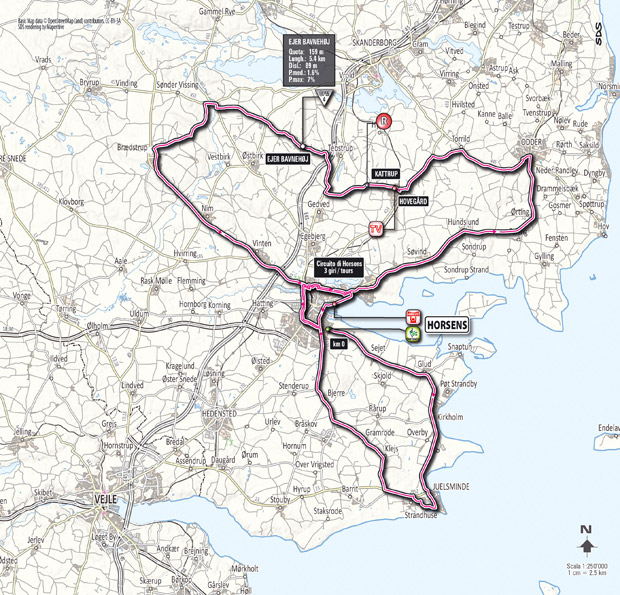
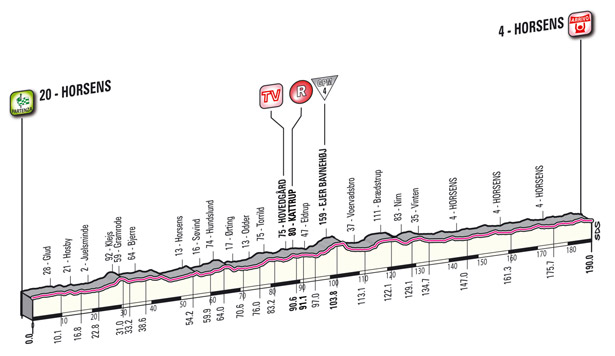
On Monday, Stage 3 (map, profile) is the last in Denmark before a "rest day," actually spent traveling down to Italy for the remainder of the race. 190km in length, starting and ending in Horsens on the east of the country, it's another flat parcours liable to finish once again with a sprint. The riders will pass through Horsens three times along the way.

As far as the weather goes on Monday, the factor that will most cheer the riders is a notable drop in windspeed between morning and afternoon - from 22kph down to around 10kph, which is insufficient to give any problems. It's enough to take the edge off the temperature early in the day - with 4C in sheltered spots near the start feeling more like 2C. When it drops, the maximum 11C will be unaffected. There's a 30% chance of rain, but if it comes it'll be in fast-moving showers that will end almost as soon as they begin.


Stages 1 / 2 / 3 / 4 / 5 / 6 / 7 / 8 / 9 / 10 / 11 / 12 / 13 / 14 / 15 / 16 / 17 / 18 / 19 / 20 / 21


Two Days of Bedford
Giro got you in the mood for some hardcore bike action? Craving the sweet scent of chain oil and the thrill of lycra flashing past your face at 45kph? Can't quite stretch to filling up the tanks on the Gulfstream IV for a jolly over to Denmark? Well then - if you live anywhere in the British South-East or southern part of the Midlands, you might be interested to know about the Two Days of Bedford.

The long-running event consists of four stages over two days (6th and 7th of May) with a 7.4km team time trial followed by an 80km road race on the Sunday, then a 6.4km individual time trial and an 85km race made up of nine laps of the Milbrook Vehicle Testing Facility - and believe me, you will not get more excitement for what it'll cost you to get to this race anywhere in the country (and you won't even have to change your pounds for krone). (More information here)

Sarah Storey crashed with 2km to go, landing in a patch of nettles which she said prevented her from losing skin. On Twitter after the race, she blamed the crash on the rider in front of her after turning "left+right on herself to avoid a tiny hole in the tarmac," then thanked well-wishers:
Sarah Storey ‏ @MrsSarahStorey
Thanks for the messages peeps,I'm fine just shocked at amount of unnecessary swerving+hard braking going on by a v small minority of riders.
Nikola Butler also crashed:
Nikola Butler ‏ @nik_tweet
one minute I was trying to sprint up the hill and the next minute I was on my face. Someone rode into my back wheel :-( sore 
Nikola Butler ‏ @nik_tweet
no idea whose fault it was. Just one of those bunch sprint things maybe
Stage 1 (Team Time Trial)
  1.  Node 4-Giordana 10'08"
  2.  For Viored +1"
  3.  Scott Contessa Epic +8"
  4.  Matrix Fitness-Prendas +14"
  5.  Abergavenny RC +30"

Stage 2 Top Ten
  1.  Amy Roberts Scott Contessa Epic  2h09'30"
  2.  Ciara Horne Node 4-Giordana ST
  3.  Lucy Garner Node 4-Giordana +15"
  4.  Sarah Reynolds Matrix Fitness-Prendas ST
  5.  Corrinne Hall Node 4-Giordana ST
  6.  Emily Kay Scott Contessa Epic ST
  7.  Laura Massey Vivelo Bikes ST
  8.  Lauren Creamer Abergavenny RC ST
  9.  Tamina Oliver Abergavenny RC ST
  10.  Harriet Owen Node 4-Giordana ST

Tour of the Gila
Stage 4 was an urban criterium race around a 1.74km square Silver City parcours with three bonus sprints and course hazards that include, according to the race bible, "rough pavement and errant pedestrians." The Pro Women completed 25 laps to make a total of 43.5km, the Pro Men 40 laps for 69.5km - precisely the sort of race in which a rider such as Kristin Armstrong (Exergy Twenty12), who at 38 specialises in the sort of endurance athleticism necessary on long stages (and which has seen her win the three stages prior to this one) might lose time to the younger women.

Loren Rowney
That turned out to be the case, though far less so than expected: while Armstrong came ninth, she was only 4" behind winner Loren Rowney (FCS Rouse presented by Mr. Restore, loaned by Specialized-Lululemon) and thus sees her General Classification lead only drop to 4'46" (from 5'01" after Stage 3) once bonification times have been taken into account. She was at the front for the first half of the race but, perhaps realising that she stood little chance of winning, chose to work for her team by chasing down attacks - not an entirely selfless decision, as it also enabled her to save some juice for the final Gila Monster stage. FCS Rouse guessed what she was up to,  simply waited until the final part of the race when they knew she'd be tired and made sure they had a rider ready to respond each and every time it looked like someone might make a break for the line. The plan was to tag along with an Exergy or Now and Novartis sprint train and see what they could do, but when Rowney found herself six riders back at the final corner she thought her chance was lost. Then, in a turn of good luck, the seven leaders took a fraction of a second longer than she'd expected to launch, allowing her to the velocity she'd carried through the bend to power into the lead and hold them off to the line.

Top Ten
  1.  Loren Rowney FCS Rouse p/b Mr. Restore 1h04'45"
  2.  Carmen Small Optum p/b Kelly Benefit ST
  3.  Christina Gokey-Smith Now & Novartis for MS ST
  4.  Alison Powers Now & Novartis for MS ST
  5.  Joanie Caron Colavita-ESPNW ST
  6.  Olivia Dillon Now & Novartis for MS ST
  7.  Jade Wilcoxson Optum p/b Kelly Benefit ST
  8.  Emma Grant Optum p/b Kelly Benefit ST
  9.  Kristin Armstrong Exergy Twenty12 +04"
  10.  Janel Holcomb Optum p/b Kelly Benefit ST
(Full results and GC)

Alejandro Borrajo
Marlon Alirio Perez Arango (Colombia-Comcel) pleased his team's sponsors and the spectators alike with a superb solo break, attacking the peloton and getting away only a few minutes from the start and then riding alone with an advantage hovering about the minute mark until Bissel decided enough was enough and got their hooks into him with twelve laps to go - he finished 65th in the end, but he's the man the fans will have been talking about on the way home. As the race neared its conclusion, Jamis-Sutter Home took the opportunity to show us all how a lead-out train ought to be conducted with all their men at the front of the pack protecting their top sprinters, brothers Alejandro and Anibal Borrajo, and getting them into perfect position - Alejandro proved fastest of a bunch of 21 while Anibal was right behind him for second place. Afterwards, Anibal dedicated the victory to an older brother who died a few days ago. Rory Sutherland took eleventh place and retains his GC lead, his overall advantage now up to 33" from 26".

Top Ten
  1.  Alejandro Alberto Borrajo Jamis/Sutter Home 1h33'40"
  2.  Anibal Andres Borrajo Jamis/Sutter Home ST
  3.  Luca Damiani Kenda/5-Hour Energy ST
  4.  Eric Young Bissel ST
  5.  Francisco Mancebo Competitive Cyclist ST
  6.  Weimar Roldan GW-Shimano ST
  7.  Avila Vanegas Edwin ST
  8.  Chad Beyer Competitive Cyclist ST
  9.  Gavin Mannion Bontrager Livestrong ST
  10.  Shawn Milne Kenda/5-Hour Energy ST
(Full results and GC)


Sunday brings the climax of the race, and what a climax it is - the 170.1km Gila Monster (map and profile) is almost certainly the toughest stage in North American professional cycling with two Category 4 climbs (16.1km, 2,070m; 166km, same), two Cat 2s (Anderson Vista, 83km, 2,284m; Wild Horse Mesa/Meadow Creek, 89km, 2,278m) and a Cat 1(Anderson Vista climbed from the opposite direction, 120km).

The 100mph bike - designed in the bath and made from genius
The remarkable Graeme Obree
Anyone who knows the story of Graeme Obree's Hour Record will know that the bike upon which he broke it, Old Faithful, used washing machine bearings. Anybody who knows a little more will know that the Scotsman later regretted telling anyone that, because it was all the newspapers cared about.

Obree is now planning to set a new record by becoming the first man to travel on a bicycle - on road and without pacing - at 100mph (161kph) aboard a new bike which, in characteristic Obreean style, he dreamed up while lying in the bath and later sketched out on bits of wallpaper. Once again, the ever-resourceful Obree has used items found about the house: this time, the rests that will support his shoulders as he lays prone on the carbon fibre-skinned machine have been made from an old saucepan. Hence Sunday's Telegraph headline: "The 100mph bike – designed in the bath and made from an old saucepan."

Hopefully, this time around, more people will look beyond that one single fact and remember that Obree is a remarkable engineer who builds his bikes from a wide range of remarkable materials, not only old washing machines and pots and pans; the most important being ingenuity and genius.

Nibali to leave Liquigas
Tuttobiciweb reports that Vincenzo Nibali has chosen not to sign an extended contract with Liquigas-Cannondale - said to be worth 1.8 million euros per year. According to rumour the 27-year-old, who already has one Grand Tour under his belt after winning the 2010 Vuelta a Espana, is being courted by BMC and Astana, both of which are said to be offering him 2.5 million euros per year.

"We made an offer, we gave him time to think it over, he has not responded. For us, the matter is closed," says Liquigas directeur sportif Paolo Dal Lago.

Giro may start in USA - one day
Organisers of the Tour de France looked seriously into the possibility of taking the race to the USA in the past but concluded that, at the time, the expense of doing so was simply too great. Nevertheless, it's an idea that has remained on a back-burner ever since. After all, American companies have been pouring sums of money into the sport that make the majority of European contributions look relatively puny, and American and Canadian riders are a fixture in the Grand Tour pelotons - in fact, it sometimes looks as though the old prediction that the USA would turn out to be the future home of cycling might eventually prove true.

Michele Acquarone
Now Giro d'Italia director Michele Acquarone has turned up the heat, because he wants his race to be the first Grand Tour to cross the Atlantic.

"To do this would be very expensive - at the present time, with the world's economy in the state it is, it's simply not an option," he admitted to Sportwereld. "But cycling is now global, increasingly so, and the Giro should be a driving force in that evolution. When we're through the financial crisis and cycling has dealt with its problems, this dream should be achievable. Imagine: we start in the US, have a few stages on Amercian soil, then the riders fly buiness class overnight to Italy... I really think this is possible."

Other News and Features
"Stephen Roche: Triple Crown 25 years on" (Cyclosport.org)

"Irish Para-cycling world champion Colin Lynch reveals dazzling new gold prosthetic" (Inside World Parasport)

"Top collegiate cyclists make their move in Ogden" (Standard-Examiner, Utah)

"Rwanda: Soras Boost Ascension De Mille Collines Cycling Tour" (AllAfrica)

Cycling
Newswire
Britain
"Cyclist knocked down on Gosport to Fareham bus route praises driver for saving his life" (The News, Portsmouth)

"Cycling in Leicester is just too dangerous" (This Is Leicestershire)

Worldwide
"Cyclists gear up for cross-Canada trek" (Times Colonist)

"A blessing for those who brave city streets on two wheels" (New York Times)

"Kids join the cycling fun at bike rodeo" (Silver City Sun-News)

"Santa Barbara Bicycle Coalition to Honor Three Women for Cycling Volunteerism" (NoozHawk)

"It's wedding bells and bikes for this couple" (AsiaOne)