Showing posts with label Italian. Show all posts

Friday, 30 May 2014

Daily Cycling Facts 30.05.2014

Igor Abakoumov
Igor Abakoumov
Igor Abakoumov, born on this day in 1981 in Berdyansk, Ukraine, when it was a part of the USSR, became a Belgian citizen on the 15th of September 2001 and, the following year, signed his first professional contract and began riding with the UCI 3 team Van Hemert Groep. Gradually, he amassed results sufficient to earn himself a place with the Pro Tour team Astana in 2007 - and was then left in the lurch when sponsors withdrew their support following the drugs scandals of 2007, even though he had never tested positive.

""I have no news: [Marc] Biver is 'dead'; Bruyneel is 'dead'; the UCI was told to wait. I have a contact, it's true, but I prefer to remain in the ProTour," he said, expressing his frustration at not knowing what was going on and whether Astana would secure new funding in time to apply for a ProTour licence in 2008 or whether he would have to start again, hoping another ProTour might pick him up. In the end, he could wait no longer and it became apparent that only the top riders stood a chance of being taken by the other teams, so great was the stigma that Astana riders bore in the wake of Operacion Puerto. He had to accept an offer from the ProContinental team Mitsubishi-Jartazi instead, and remained at that level with ISD-Neri in 2009. In 2010 he rode for the ISD Continental team and ended his career at the close of the season.

Gabriella Pregnolato
Gabriella Pregnolato, born in Italy on this day in 1971, won the GP della Liberazione in 1991 and the National Time Trial Championship in 1996 and 1997. In 1998, she won the Giro del Friuli and in 1999 Stages 1 and 12 at the Giro Donne, Stage 14 at the Tour de France Féminin and a third National TT title. In 2000,  her penultimate season, she won it or the fourth time and, after many attempts, the Road Race Championship too.

Tim Gould
Tim Gould, born in Matlock on this day in 1964, had already enjoyed a successful career in cyclo cross (with six consecutive Three Peaks Championship titles from 1984) when he turned to mountain biking in the early 1990s - and became even more successful. In 1990, he took a bronze medal for the World Cross Country Championships and gold in the hill climb, the latter being the discipline at which he excelled. In 1991, he became British XC Champion and won two rounds of the Grundig World Cup in addition to the Grundig Challenge Cup.

Perhaps his greatest claim to fame was beating the horse in the William Hill Man v. Horse v. Bike race of 1990 - and event in which a runner, a horseback rider and a mountain biker compete to be the fastest over a cross country course. Jacqui Phelan (co-founder of NORBA, founder of the Women's Mountain Bike & Tea Society and famous for riding mountain bikes fitted with drop handlebars) had lost to the horse by a few seconds in 1985, when bikes were first added to the race, but since then the horse had easily won - Gould was the first human being to win.

A Wright Cycle Co. racing machine
Wilbur Wright, a bicycle builder, died on this day in 1912. He's better known - alongside brother Orville - as the inventor of the first working heavier-then-air aircraft, and as the brothers never made bikes in any great quantity they probably wouldn't be any better-remembered than any other small-scale turn-of-the-last-century bike builders today had it not have been for their aircraft. However, we owe them thanks for one innovation: they were the first to come up with the idea of machining the threads of the left-hand side of the bottom bracket and crank in an anti-clockwise direction, thus preventing the crank from loosening in use.

Other cyclists born on this day: Zdeněk Košta (Czechoslovakia, 1923); Peter Wrolich (Austria, 1974); Olavi Linnonmaa (Finland, 1920, died 1995); Mario Traxl (Austria, 1964); Tom Cordes (Netherlands, 1966); Virgilio Pereyra (Uruguay, 1928); Hugh Walton (Canada, 1955).

Sunday, 1 September 2013

Daily Cycling Facts 01.09.2013

Franco Bitossi
Franco Bitossi
Born in Camaioni di Carmignano on this day in 1940, the Italian Franco Bitossi became known to friends as Cuore Matto - "Crazy Heart," on account of the cardiac arrythmia that would frequently cause him to have to stop halfway through a race. His palmares, built up over the course of a 17-year professional career, is for that reason all the more impressive.

Bitossi had three successful years as an amateur, during which time he was noticed by 1960 Tour winner Gastone Nencini, who took him under his wing and gave him advice; then got picked up by Philco, managed by Fiorenzo Magni, as soon as he reached the age of 21, the minimum age for professionals at that time - which came as something of a surprise because his arrythmia had already been detected and he'd assumed he wouldn't be able to compete at the top level as a result. He won a stage at the Tre Giorni del Sud that year, 1961, then in 1963 he came second on Stage 20 at the Giro d'Italia and third overall in the King of the Mountains after arrythmia suffered in the first three stages suddenly cleared up. The year after that he attained five podium finishes (but no wins) as the season got under way, then went back to the Giro and won Stages 3, 16, 17 and 20, was second on four others, finished in tenth place overall and won the King of the Mountains. In 1965 he won the Tour de Suisse, then took one stage, seventh place overall and another King of the Mountains at the Giro. After six early-season victories in 1966, Bitossi won Stages 14 and 16 and a third King of the Mountains at the Giro (coming eighth overall this time) and went to the Tour de France where he won Stages 5 and 17; then he won Tirreno-Adriatico and the Giro di Lombardia in 1967.

One of the best-known truths in cycling is that climbers cannot sprint and vice versa. Climbers are usually finely-boned, sinewy greyhound-like creatures with body fat levels that, were professional cyclists normal human beings, would get doctors worried; their job being to get their bodies and their bikes up the great climbs as quickly as possible. Sprinters are heavy, heavily muscled; homo sapiens robustus compared to the climbers' h. sapiens gracile. They are highly specialised to their environments and do not trespass into one another's territory - except, that is, for Bitossi; who, in 1968 and after all those King of the Mountains trophies, came second in the Points competition at the Giro, then won it at the Tour (where he was also second on the Mountains); and he would win the Points at the Giro in 1969 and 1970. Interestingly, the only other male rider to have performed so well on the climbs and the sprints was Eddy Merckx, who won the General Classification in 1970 and the Points and GC in 1973 - and who also suffered from a heart defect that, had he have been riding as an amateur today, would have prevented his selection for a professional team.

Left: Marino Basso; right: Bitossi
Bitossi never did so well in the Grand Tours again after 1970 as his heart condition worsened, but he remained a force with which to be reckoned for many years. In 1971 he won twelve victories in addition to the National Road Race Championship, then nine victories in 1972 (when he was beaten by an infinitesimal amount by his team mate Marino Basso to the World Champiobship title) and 1973 respectively and 18 in 1974 including Stages 6, 8 and 18 at the Giro. He won six times the following year, the most prestigious being Stage 15 at the Giro and 11 times, including another National Championhip in 1976, and then ten times in total over 1977 and 1978 - a period during which he began to excel in cyclo cross as much as on the road, winning the National Championship in both years.

He is estimated to have won at least 158 races across the course of his career, not including amateur events, yet is frequently described by journalists who interview him as humble, welcoming, humourous and deeply respectful of the riders he raced against. Who knows what he might have achieved without his heart condition?

Riccardo Riccò
Born in Formigine on this day in 1983, Italian Riccardo Riccò is a former professional cyclist who became best known for his second place General Classification finish at the 2008 Giro d'Italia, when he also won the Youth category, but has since become more famous for doping.

Riccò at the 2008 Giro d'Italia
Riccò's first taste of success came in 2001 when he won the National Junior Cyclo Cross Championship. Two years later he won the Coppa della Pace and a stage at the Baby Giro, then in 2004 he became Under-23 National Road Race Champion and in 2005 the Settimana Ciclistica Lombarda and a stage at the U-23 Giro della Toscana. Professional teams began to take an interest that year and he settled on a contract with Saunier Duval-Prodir for 2006, riding his first Tour de France with them and then, late in the season, winning the Japan Cup. He remained with the team throughout 2007, when he won the Points competition at Tirreno-Adriatico and his first Grand Tour stage, Stage 15 at the Giro d'Italia, which he finished in sixth place overall; then when he returned to the Giro in 2008 he won Stages 2 and 8, was third overall on Points and second overall in the General Classification. The new star of Italian cycling, he was selected for Saunier's Tour de France squad later in the summer - and, after Stage 11, the news broke that a sample he'd provided following Stage 4 had tested positive for the EPO variant CERA. He was the third rider to be caught using the same drug that year and was thrown out of the race immediately, after which manager Mauro Gianetti withdrew the team voluntarily, then sacked the rider.

Riccò expressed his anger to journalists. "I spent a night in the police station and it was like being in prison," he said. "The magistrate listened to what I had to say. They searched my bags but only found some vitamins that we all use and so they decided to let me go home." He was being half-truthful - his hotel room had been searched and no illegal drugs were found, but a selection of unexplained medical equipment - including intravenous drips and syringes - had been; it was also revealed that he had sped away from Stage 4 apparently in an attempt to evade testers, but they had caught up with him in heavy traffic and obtained the sample (it was also revealed that CERA's manufacturer, Roche Pharmaceuticals, had been working in secret with WADA to develop and perfect a test for the drug, which had previously been undetectable). For once in his life, Riccò decided that honesty was the best policy and made a full confession, stating that he had used CERA to prepare himself for the Tour and that he had done so entirely independently and without the knowledge of anyone at Saunier. He also publicly apologised to the team and to fans and later told journalists that the drug had been supplied to him by Carlo Santuccione, whose licence to practice a a doctor had been suspended from 1995 to 2000 and would be removed for life in 2007 after the investigation into the Oil For Drugs doping ring, of which he was believed to have been ringleader (Santuccione, incidentally, had worked at the University of Ferrara's Biomedical Institute alongside Francesco Conconi, who is thought to have been the man who first brought EPO into cycling and who later served on the medical committee of the Italian Olympic committee CONI, which funded his research into new anti-doping tests - which he then used to devise new ways to get around the tests). It was expected that Riccò would be shown leniency on account of his compliance, but initially he was not and received the full two-year ban. Once again he expressed bitterness to journalists, whilst admitting "I made a mistake and it's fair that I pay;" in March 2009, the Court of Arbitration in Sport reduced the ban to 20 months. As the ban was backdated, he was free to return to competion in March the following year and did so with Irish-based Ceramica Flaminia.
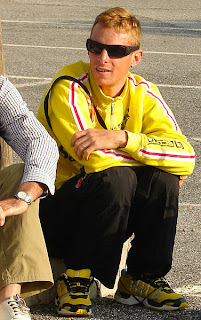
Riccò in 2007
When a rider returns from a doping ban, he or she will usually experience problems finding a contract to ride at the same level as prior to their ban - this is partially because of the loss of race experience and partially because the top teams can afford to be choosy and don't wish to be seen as providing a home for convicted dopers - hence his step back to ProContinental Ceramica. However, his results over the next five months, including overall victory at the Österreich-Rundfahrt, were sufficient to pique the interest of the ProTour teams. Riccò was not the sort of rider who felt that he should repay the second chance Ceramica had given him by riding a full season for them; so he appears to have had few of any qualms about terminating his contract with them in August and going to the ProTour team Vacansoleil-DCM. He won the Coppa Sabatini with them late in the year, then came seventh at the season-opening GP de Ouverture in 2011.

Seven days after the Ouverture, on the 6th of February, Riccò was rushed to hospital. He was in critical condition with acute kidney failure believed to have been caused by a non-medical autologous transfusion (ie, using his own blood) performed using blood that was 25 days old and had presumably been incorrectly stored, which he is alleged to have admitted to the doctor who treated him. He could very easily have died, but fortunately recovered well enough to be discharged after only two weeks. Vacansoleil sacked him, though he insisted that he had neither made the alleged admission to the doctor nor ever used blood doping (in October that year, reports were published that he had admitted it; these were quickly denied by his lawyer). He also claimed that he would be retiring from cycling and began a new life working in a bar, but later announced that he would make a return. According to reports Amore & Vita offered him a contract with the conditions that he worked with the Italian authorities to help end doping in sport and that he would be sacked if proof arose that he had in fact received an illegal transfusion - if such a contract was offered, he refused it and instead signed to Meridiana-Kamen. He was expected to make his return to racing with them at the Kroz Srbiju, beginning on the 19th of June; however, eight days before the race began CONI suspended him and launched an investigation. On the 19th of April 2012, the Tribunale Nazionale Antidoping found him guilty of the use and attempted use of prohibited methods and banned him from any involvement in professional cycling for a period of 12 years.


Émile Masson Jr., born in Hollogne-aux-Pierres, Belgium on this day in 1912, won La Flèche Wallonne and Stage 17a at the Tour de France in 1938 and Paris-Roubaix in 1939. After the Second World War he returned to cycling and became National Road Race Champion in 1946 (when he also won Bordeaux-Paris) and again in 1947. He died on 2nd of January 2011, aged 95. Masson was the son of Émile Masson Snr., who won Stages 11 and 12 at the Tour in 1922 and his own Bordeaux-Paris a year later.

Andrea Ferrigato, who was born in Schio, Italy on this day in 1969, won Stage 12 at the Giro d'Italia in 1994. Three years later, he won Stage 5 at Tirreno-Adriatico and first place at the GP Ouest-France.

Other cyclists born on this day: Arthur F. Andrews (USA, 1876); Giorgio Ursi (Italy, 1943); Jean Govaerts (Belgium, 1938); Erhard Neumann (USA, 1932, died 2002); Huub Duyn (Netherlands, 1984); Juho Jaakonaho (Finland, 1882, died 1964); Wayne Burgess (South Africa, 1971); Hong Seong-Ik (South Korea, 1940); Alfred Ebanks (Cayman Islands, 1953); Iñaki Lejarreta (Spain, 1983); André Bar (Belgium, 1935).

Thursday, 30 May 2013

Daily Cycling Facts 30.05.2013

Igor Abakoumov
Igor Abakoumov
Igor Abakoumov, born on this day in 1981 in Berdyansk, Ukraine, when it was a part of the USSR, became a Belgian citizen on the 15th of September 2001 and, the following year, signed his first professional contract and began riding with the UCI 3 team Van Hemert Groep. Gradually, he amassed results sufficient to earn himself a place with the Pro Tour team Astana in 2007 - and was then left in the lurch when sponsors withdrew their support following the drugs scandals of 2007, even though he had never tested positive.

""I have no news: [Marc] Biver is 'dead'; Bruyneel is 'dead'; the UCI was told to wait. I have a contact, it's true, but I prefer to remain in the ProTour," he said, expressing his frustration at not knowing what was going on and whether Astana would secure new funding in time to apply for a ProTour licence in 2008 or whether he would have to start again, hoping another ProTour might pick him up. In the end, he could wait no longer and it became apparent that only the top riders stood a chance of being taken by the other teams, so great was the stigma that Astana riders bore in the wake of Operacion Puerto. He had to accept an offer from the ProContinental team Mitsubishi-Jartazi instead, and has remained at that level ever since.

Gabriella Pregnolato
Gabriella Pregnolato, born in Italy on this day in 1971, won the GP della Liberazione in 1991 and the National Time Trial Championship in 1996 and 1997. In 1998, she won the Giro del Friuli and in 1999 Stages 1 and 12 at the Giro Donne, Stage 14 at the Tour de France Féminin and a third National TT title. In 2000,  her penultimate season, she won it or the fourth time and, after many attempts, the Road Race Championship too.

Tim Gould
Tim Gould, born in Matlock on this day in 1964, had already enjoyed a successful career in cyclo cross (with six consecutive Three Peaks Championship titles from 1984) when he turned to mountain biking in the early 1990s - and became even more successful. In 1990, he took a bronze medal for the World Cross Country Championships and gold in the hill climb, the latter being the discipline at which he excelled. In 1991, he became British XC Champion and won two rounds of the Grundig World Cup in addition to the Grundig Challenge Cup.

Perhaps his greatest claim to fame was beating the horse in the William Hill Man v. Horse v. Bike race of 1990 - and event in which a runner, a horseback rider and a mountain biker compete to be the fastest over a cross country course. Jacqui Phelan (co-founder of NORBA, founder of the Women's Mountain Bike & Tea Society and famous for riding mountain bikes fitted with drop handlebars) had lost to the horse by a few seconds in 1985, when bikes were first added to the race, but since then the horse had easily won - Gould was the first human being to win.

A Wright Cycle Co. racing machine
Wilbur Wright, a bicycle builder, died on this day in 1912. He's better known - alongside brother Orville - as the inventor of the first working heavier-then-air aircraft, and as the brothers never made bikes in any great quantity they probably wouldn't be any better-remembered than any other small-scale turn-of-the-last-century bike builders today had it not have been for their aircraft. However, we owe them thanks for one innovation: they were the first to come up with the idea of machining the threads of the left-hand side of the bottom bracket and crank in an anti-clockwise direction, thus preventing the crank from loosening in use.

Other cyclists born on this day: Zdeněk Košta (Czechoslovakia, 1923); Peter Wrolich (Austria, 1974); Olavi Linnonmaa (Finland, 1920, died 1995); Mario Traxl (Austria, 1964); Tom Cordes (Netherlands, 1966); Virgilio Pereyra (Uruguay, 1928); Hugh Walton (Canada, 1955).

Saturday, 1 September 2012

Daily Cycling Facts 01.09.12

Franco Bitossi
Franco Bitossi
Born in Camaioni di Carmignano on this day in 1940, the Italian Franco Bitossi became known to friends as Cuore Matto - "Crazy Heart," on account of the cardiac arrythmia that would frequently cause him to have to stop halfway through a race. His palmares, built up over the course of a 17-year professional career, is for that reason all the more impressive.

Bitossi had three successful years as an amateur, during which time he was noticed by 1960 Tour winner Gastone Nencini, who took him under his wing and gave him advice; then got picked up by Philco, managed by Fiorenzo Magni, as soon as he reached the age of 21, the minimum age for professionals at that time - which came as something of a surprise because his arrythmia had already been detected and he'd assumed he wouldn't be able to compete at the top level as a result. He won a stage at the Tre Giorni del Sud that year, 1961, then in 1963 he came second on Stage 20 at the Giro d'Italia and third overall in the King of the Mountains after arrythmia suffered in the first three stages suddenly cleared up. The year after that he attained five podium finishes (but no wins) as the season got under way, then went back to the Giro and won Stages 3, 16, 17 and 20, was second on four others, finished in tenth place overall and won the King of the Mountains. In 1965 he won the Tour de Suisse, then took one stage, seventh place overall and another King of the Mountains at the Giro. After six early-season victories in 1966, Bitossi won Stages 14 and 16 and a third King of the Mountains at the Giro (coming eighth overall this time) and went to the Tour de France where he won Stages 5 and 17; then he won Tirreno-Adriatico and the Giro di Lombardia in 1967.

One of the best-known truths in cycling is that climbers cannot sprint and vice versa. Climbers are usually finely-boned, sinewy greyhound-like creatures with body fat levels that, were professional cyclists normal human beings, would get doctors worried; their job being to get their bodies and their bikes up the great climbs as quickly as possible. Sprinters are heavy, heavily muscled; homo sapiens robustus compared to the climbers' h. sapiens gracile. They are highly specialised to their environments and do not trespass into one another's territory - except, that is, for Bitossi; who, in 1968 and after all those King of the Mountains trophies, came second in the Points competition at the Giro, then won it at the Tour (where he was also second on the Mountains); and he would win the Points at the Giro in 1969 and 1970. Interestingly, the only other male rider to have performed so well on the climbs and the sprints was Eddy Merckx, who won the General Classification in 1970 and the Points and GC in 1973 - and who also suffered from a heart defect that, had he have been riding as an amateur today, would have prevented his selection for a professional team.

Left: Marino Basso; right: Bitossi
Bitossi never did so well in the Grand Tours again after 1970 as his heart condition worsened, but he remained a force with which to be reckoned for many years. In 1971 he won twelve victories in addition to the National Road Race Championship, then nine victories in 1972 (when he was beaten by an infinitesimal amount by his team mate Marino Basso to the World Champiobship title) and 1973 respectively and 18 in 1974 including Stages 6, 8 and 18 at the Giro. He won six times the following year, the most prestigious being Stage 15 at the Giro and 11 times, including another National Championhip in 1976, and then ten times in total over 1977 and 1978 - a period during which he began to excel in cyclo cross as much as on the road, winning the National Championship in both years.

He is estimated to have won at least 158 races across the course of his career, not including amateur events, yet is frequently described by journalists who interview him as humble, welcoming, humourous and deeply respectful of the riders he raced against. Who knows what he might have achieved without his heart condition?

Riccardo Riccò
Born in Formigine on this day in 1983, Italian Riccardo Riccò is a former professional cyclist who became best known for his second place General Classification finish at the 2008 Giro d'Italia, when he also won the Youth category, but has since become more famous for doping.

Riccò at the 2008 Giro d'Italia
Riccò's first taste of success came in 2001 when he won the National Junior Cyclo Cross Championship. Two years later he won the Coppa della Pace and a stage at the Baby Giro, then in 2004 he became Under-23 National Road Race Champion and in 2005 the Settimana Ciclistica Lombarda and a stage at the U-23 Giro della Toscana. Professional teams began to take an interest that year and he settled on a contract with Saunier Duval-Prodir for 2006, riding his first Tour de France with them and then, late in the season, winning the Japan Cup. He remained with the team throughout 2007, when he won the Points competition at Tirreno-Adriatico and his first Grand Tour stage, Stage 15 at the Giro d'Italia, which he finished in sixth place overall; then when he returned to the Giro in 2008 he won Stages 2 and 8, was third overall on Points and second overall in the General Classification. The new star of Italian cycling, he was selected for Saunier's Tour de France squad later in the summer - and, after Stage 11, the news broke that a sample he'd provided following Stage 4 had tested positive for the EPO variant CERA. He was the third rider to be caught using the same drug that year and was thrown out of the race immediately, after which manager Mauro Gianetti withdrew the team voluntarily, then sacked the rider.

Riccò expressed his anger to journalists. "I spent a night in the police station and it was like being in prison," he said. "The magistrate listened to what I had to say. They searched my bags but only found some vitamins that we all use and so they decided to let me go home." He was being half-truthful - his hotel room had been searched and no illegal drugs were found, but a selection of unexplained medical equipment - including intravenous drips and syringes - had been; it was also revealed that he had sped away from Stage 4 apparently in an attempt to evade testers, but they had caught up with him in heavy traffic and obtained the sample (it was also revealed that CERA's manufacturer, Roche Pharmaceuticals, had been working in secret with WADA to develop and perfect a test for the drug, which had previously been undetectable). For once in his life, Riccò decided that honesty was the best policy and made a full confession, stating that he had used CERA to prepare himself for the Tour and that he had done so entirely independently and without the knowledge of anyone at Saunier. He also publicly apologised to the team and to fans and later told journalists that the drug had been supplied to him by Carlo Santuccione, whose licence to practice a a doctor had been suspended from 1995 to 2000 and would be removed for life in 2007 after the investigation into the Oil For Drugs doping ring, of which he was believed to have been ringleader (Santuccione, incidentally, had worked at the University of Ferrara's Biomedical Institute alongside Francesco Conconi, who is thought to have been the man who first brought EPO into cycling and who later served on the medical committee of the Italian Olympic committee CONI, which funded his research into new anti-doping tests - which he then used to devise new ways to get around the tests). It was expected that Riccò would be shown leniency on account of his compliance, but initially he was not and received the full two-year ban. Once again he expressed bitterness to journalists, whilst admitting "I made a mistake and it's fair that I pay;" in March 2009, the Court of Arbitration in Sport reduced the ban to 20 months. As the ban was backdated, he was free to return to competion in March the following year and did so with Irish-based Ceramica Flaminia.

Riccò in 2007
When a rider returns from a doping ban, he or she will usually experience problems finding a contract to ride at the same level as prior to their ban - this is partially because of the loss of race experience and partially because the top teams can afford to be choosy and don't wish to be seen as providing a home for convicted dopers - hence his step back to ProContinental Ceramica. However, his results over the next five months, including overall victory at the Österreich-Rundfahrt, were sufficient to pique the interest of the ProTour teams. Riccò was not the sort of rider who felt that he should repay the second chance Ceramica had given him by riding a full season for them; so he appears to have had few of any qualms about terminating his contract with them in August and going to the ProTour team Vacansoleil-DCM. He won the Coppa Sabatini with them late in the year, then came seventh at the season-opening GP de Ouverture in 2011.

Seven days after the Ouverture, on the 6th of February, Riccò was rushed to hospital. He was in critical condition with acute kidney failure believed to have been caused by a non-medical autologous transfusion (ie, using his own blood) performed using blood that was 25 days old and had presumably been incorrectly stored, which he is alleged to have admitted to the doctor who treated him. He could very easily have died, but fortunately recovered well enough to be discharged after only two weeks. Vacansoleil sacked him, though he insisted that he had neither made the alleged admission to the doctor nor ever used blood doping (in October that year, reports were published that he had admitted it; these were quickly denied by his lawyer). He also claimed that he would be retiring from cycling and began a new life working in a bar, but later announced that he would make a return to cycling. According to reports Amore & Vita offered him a contract with the conditions that he worked with the Italian authorities to help end doping in sport and that he would be sacked if proof arose that he had in fact received an illegal transfusion - if such a contract was offered, he refused it and instead signed to Meridiana-Kamen. He was expected to make his return to racing with them at the Kroz Srbiju, beginning on the 19th of June; however, eight days before the race began CONI suspended him and launched an investigation. On the 19th of April 2012, the Tribunale Nazionale Antidoping found him guilty of the use and attempted use of prohibited methods and banned him from any involvement in professional cycling for a period of 12 years.


Émile Masson Jr., born in Hollogne-aux-Pierres, Belgium on this day in 1912, won La Flèche Wallonne and Stage 17a at the Tour de France in 1938 and Paris-Roubaix in 1939. After the Second World War he returned to cycling and became National Road Race Champion in 1946 (when he also won Bordeaux-Paris) and again in 1947. He died on 2nd of January 2011, aged 95. Masson was the son of Émile Masson Snr., who won Stages 11 and 12 at the Tour in 1922 and his own Bordeaux-Paris a year later.

Andrea Ferrigato, who was born in Schio, Italy on this day in 1969, won Stage 12 at the Giro d'Italia in 1994. Three years later, he won Stage 5 at Tirreno-Adriatico and first place at the GP Ouest-France.

Other cyclists born on this day: Arthur F. Andrews (USA, 1876); Giorgio Ursi (Italy, 1943); Jean Govaerts (Belgium, 1938); Erhard Neumann (USA, 1932, died 2002); Huub Duyn (Netherlands, 1984); Juho Jaakonaho (Finland, 1882, died 1964); Wayne Burgess (South Africa, 1971); Hong Seong-Ik (South Korea, 1940); Alfred Ebanks (Cayman Islands, 1953); Iñaki Lejarreta (Spain, 1983); André Bar (Belgium, 1935).

Tuesday, 19 June 2012

RIP Aldo Ronconi

Aldo Ronconi
20.09.1918 - 12.06.2012
Aldo Ronconi was born in Brisighella, Ravenna on the 20th of September 1918 and turned professional with the Legnano team in 1940, winning the Giro dell'Umbria that year. After the Second War, he became National Road Race Champion in 1946, also winning the Giro di Toscana and Stage 15 at the Giro d'Italia.

Ronconi entered the Tour de France for the first time in 1947, the first edition of the race since 1939. That year, the Italian team was made up of Italians resident in France as the peace treaty between the two nations had not yet been formalised and they were, therefore, technically still at war. He won Stage 3, wore the maillot jaune for two days, and was fourth in the overall General Classification. After retiring from competition in 1952, he ran a bike shop in Faenza for many years and was well-known among the local cycling enthusiasts; remaining in the city until his death last Tuesday at the age of 93.

"How ExperiencePlus customers met Aldo Ronconi," ExperiencePlus

Wednesday, 30 May 2012

Daily Cycling Facts 30.05.12

Igor Abakoumov
Igor Abakoumov
Igor Abakoumov, born on this day in 1981 in Berdyansk, Ukraine, when it was a part of the USSR, became a Belgian citizen on the 15th of September 2001 and, the following year, signed his first professional contract and began riding with the UCI 3 team Van Hemert Groep. Gradually, he amassed results sufficient to earn himself a place with the Pro Tour team Astana in 2007 - and was then left in the lurch when sponsors withdrew their support following the drugs scandals of 2007, even though he had never tested positive.

""I have no news: [Marc] Biver is 'dead'; Bruyneel is 'dead'; the UCI was told to wait. I have a contact, it's true, but I prefer to remain in the ProTour," he said, expressing his frustration at not knowing what was going on and whether Astana would secure new funding in time to apply for a ProTour licence in 2008 or whether he would have to start again, hoping another ProTour might pick him up. In the end, he could wait no longer and it became apparent that only the top riders stood a chance of being taken by the other teams, so great was the stigma that Astana riders bore in the wake of Operacion Puerto. He had to accept an offer from the ProContinental team Mitsubishi-Jartazi instead, and has remained at that level ever since.

Gabriella Pregnolato
Gabriella Pregnolato, born in Italy on this day in 1971, won the GP della Liberazione in 1991 and the National Time Trial Championship in 1996 and 1997. In 1998, she won the Giro del Friuli and in 1999 Stages 1 and 12 at the Giro Donne, Stage 14 at the Tour de France Féminin and a third National TT title. In 2000,  her penultimate season, she won it or the fourth time and, after many attempts, the Road Race Championship too.

Tim Gould
Tim Gould, born in Matlock on this day in 1964, had already enjoyed a successful career in cyclo cross (with six consecutive Three Peaks Championship titles from 1984) when he turned to mountain biking in the early 1990s - and became even more successful. In 1990, he took a bronze medal for the World Cross Country Championships and gold in the hill climb, the latter being the discipline at which he excelled. In 1991, he became British XC Champion and won two rounds of the Grundig World Cup in addition to the Grundig Challenge Cup.

Perhaps his greatest claim to fame was beating the horse in the William Hill Man v. Horse v. Bike race of 1990 - and event in which a runner, a horseback rider and a mountain biker compete to be the fastest over a cross country course. Jacqui Phelan (co-founder of NORBA, founder of the Women's Mountain Bike & Tea Society and famous for riding mountain bikes fitted with drop handlebars) had lost to the horse by a few seconds in 1985, when bikes were first added to the race, but since then the horse had easily won - Gould was the first human being to win.

A Wright Cycle Co. racing machine
Wilbur Wright, a bicycle builder, died on this day in 1912. He's better known - alongside brother Orville - as the inventor of the first working heavier-then-air aircraft, and as the brothers never made bikes in any great quantity they probably wouldn't be any better-remembered than any other small-scale turn-of-the-last-century bike builders today had it not have been for their aircraft. However, we owe them thanks for one innovation: they were the first to come up with the idea of machining the threads of the left-hand side of the bottom bracket and crank in an anti-clockwise direction, thus preventing the crank from loosening in use.

Other births: Zdeněk Košta (Czechoslovakia, 1923); Peter Wrolich (Austria, 1974); Olavi Linnonmaa (Finland, 1920, died 1995); Mario Traxl (Austria, 1964); Tom Cordes (Netherlands, 1966); Virgilio Pereyra (Uruguay, 1928); Hugh Walton (Canada, 1955).


Saturday, 4 February 2012

Giro di Sardegna cancelled

Just days after it was announced that preparations for the 2012 Holland Ladies' Tour have been suspended while the organisation that runs it seeks new sponsorship, their counterparts at the Giro di Sardegna have revealed that they too are experiencing difficulties and have been forced to cancel this year's edition which was due to start on February the 21st.

The race began in 1958 and was held annually, except for 1979 and 1981, until 1983. It was then not held from 1984 to 1996 when it returned for two editions before vanishing again until 2009. Among others, it has been won by Rik Van Looy, Eddy Merckx, Jacques Anquetil and Roger De Vlaeminck.

Rather than lacking commercial sponsorship, organisers blame local government - stating that they have yet to be paid by towns wishing to host starts and finishes in the race and are still owed money from previous editions, leading to a 150,000 euro hole in the budget.

Saturday, 9 July 2011

Giro Donne Stage 9 - Vos victorious

Vos at 24 is compared to Eddy
Merckx. The way things are
going, she's going to be even
better in another couple of years.
There were no surprises at the end of today's Giro Donne when Marianne Vos was the first to cross the finish line; in fact, with the stage ending near the summit of a 1620m high mountain, it would have been more a surprise had she not have done. But then why beat around the bush here? With the 24-year-old Dutch cyclist going from strength to strength it's a only a surprise when she doesn't win anything she enters.

Vos is that very rare thing: a cycling polymath. She excels in all disciplines, which has drawn comparisons to Eddy Merckx, including time trialing - and with tomorrow's final stage being a TT, which would be her 30th triumph this season alone, she's an easy favourite for the top spot on the podium. In addition to the overall General Classification, she also leads the Points and Mountains classifications.

Stage 9 Results:
1. Marianne Vos (Netherlands) Nederland Bloei           3:12:03  
2. Emma Pooley (UK) Garmin - Cervelo                   +0:00:12  
3. Judith Arndt (Germany) HTC Highroad Women     +0:00:22  
4. Tatiana Guderzo (Italy) SC MCipollini Giordana     +0:00:25  
5. Mara Abbott (USA) Diadora - Pasta Zara          +0:00:33  
6. Tatiana Antoshina (Russia) Gauss                           +0:00:50  
7. Ruth Corset (Australia) Bizkaia-Durango          +0:00:57  
8. Claudia Häusler (Germany) Diadora - Pasta Zara    +0:01:03  
9. Emma Johansson (Sweden) Hitec Products - UCK +0:01:33  
10. Elena Berlato (Italy) Top Girls Fassa Bortolo         +0:01:55

General Classification:
1. Marianne Vos (Netherlands) Nederland Bloeit              25:20:08  
2. Emma Pooley (UK) Garmin - Cervelo                       +0:02:48  
3. Judith Arndt (Germany) HTC Highroad Women        +0:08:07  
4. Tatiana Guderzo (Italy) SC MCipollini Giordana        +0:08:21  
5. Ruth Corset (Australia) Bizkaia-Durango              +0:11:48  
6. Tatiana Antoshina (Russia) Gauss                              +0:12:01  
7. Sylwia Kapusta (Poland) Gauss                                +0:12:18  
8. Mara Abbott (USA) Diadora - Pasta Zara             +0:13:47  
9. Emma Johansson (Sweden) Hitec Products - UCK  +0:14:20  
10. Shara Gillow (Australia) Bizkaia-Durango               +0:14:38

Monday, 4 July 2011

Giro Donne: Stage 4 preview

The incredible Marianne Vos dominated in yesterday's Giro Donne stage, just as she dominates a large part of women's cycling, over a parcours characterised by a roller-coasteresque series of short but steep climbs and correspondingly hairy descents which took their toll: a number of riders abandoned, including Shelley Olds who departed before the stage started due to ongoing problems with the cracked ribs she sustained in the Nature Valley Women's GP crash last month. There are few cyclists - either male or female - who have Vos' ability to soak up the sheer stress placed upon the body by that sort of terrain and she was an obvious stage winner from the moment the altitude profile was first available. Emma Pooley, who apparently packs the strength of ten average cyclists into a body the size of two thirds of an average cyclist, was a clear contender for the podium and achieved a respectable second, just 19" after the Dutch star. Meanwhile, nobody else could get anywhere near them as the finish line approached - third place Judith Arndt was a full 2'50" behind Vos.

Piazza Saffi, Forli

Today is about as different as it's possible to be with a winding course that looks as though a drunken spider paddled through a pool of ink before embarking upon a roughly figure of 8-shaped tour of a map of Romagna, one of the most popular regions among Italian cyclists. There's one fairly hefty climb up to just shy of 300m in the first 20km - where Vos, if she wants to hang onto her Mountains Classification jersey, will no doubt once again pull out the stops and lead the pack to the summit - and then it's flatland sprinting all the way to the finish line 50km away. The official Giro Donne website doesn't exactly provide the wealth of information offered by the Tour de France site (in fact, you could even describe it as "a bit rubbish"), which means that for the time being the mysterious amputation of some 30km off the end of the profile remains apparently without reason. We can't find out for certain if a section of the stage has actually been abandoned or if the webmasters just didn't bother showing another 30km of flatness. However, Podium Cafe state that "stage 4 has been shortened a bit for some reason" and since they know what they're talking about we suspect that this will prove to be the case. Whatever's happened to it, this is a stage for the sprinters and, with British champion Lizzie Armitstead out of action, all bets are off - there are a number of extremely capable riders waiting in the wings, any one of whom could be today's victor.

Judith Arndt
The fun begins in the ancient town of Forlimpopoli, location of a solid and surprisingly Moorish-looking castle that sits, incongruously to North European eyes who expect castles to be perched atop rocky crags or at least on steep-sided grassy hills, in the middle of a large, paved square. The route takes in a quick loop about town before hanging a sharp right towards the south, passing through flat fields and on to the village of Ospadaletto,  and then to Bertinoro. Bertinoro has an unusual and rather pleasant custom - each September, it hosts a Hospitality Festival in which families attach envelopes to the Colonna delle Anelle, a column erected in 1300 which stands in the town. Anybody - be they local or stranger - can then take one of these envelopes which contains the address of the family that placed it and an invitation to join them for dinner. It's also the site of a castle dating from 1000 AD and, in the 15th Century, was home to Obadiah ben Abraham, an important and highly-respected rabbi.
She's a climber by trade, but if Mara Abbott builds
up a lead on the day's only hill and then just keeps
turning the pedals to a high placing we won't be
at all surprised.

From there, the riders continue south until they reach the foothills of the Apennine Mountains before swinging west at Polenta towards Meldola, once an important centre of the silk industry but now largely reliant on agriculture and furniture manufacture. It's then a long, straight route north until the route swings around an airport before switching south-east ,passing Forlimpopoli along its northern bypass and continuing to Panighina where it once again turns north and follows a long, flat loop to Forli. Forli was instrumental in the Unification of Italy, the 150th anniversary of which is being celebrated by the Giro Donne this year - so if you're lucky enough to have access to televised footage, or better still able to get there today, there's every chance of  big celebration.

We said at the start of this post that it's difficult to predict a winner today, but nobody would be at all surprised if Marianne Vos managed it yet again: her ability as an all-rounder has earned her the honour of being referred to as the Eddy Merckx of women's cycling and she can perform as well in a sprint as she can on a mountainside and she'll almost certainly be in the top ten. As for the rest? Mara Abbott could be a contender - while her palmares shows a talent perhaps more tuned the climbs, she won this race last year and, as a competitive swimmer and qualified yoga instructor, has the endurance to keep turning the pedals at a decent cadence for a long time; which is precisely what needs to be done through long, flat sections. On the other hand, Judith Arndt is among the few riders with a chance - albeit quite a small one with Vos in on the action - of a top five position when the Giro is over, so she'll be wanting to shrink her disadvantage. With a range of German and World Championships to her name, she's a definite contender today.

Sunday, 3 July 2011

Giro Donne: Stage 3 debrief

Marianne Vos, rapidly becoming
one of our very favourite cyclists,
won another stage.
The action in France was once again matched over the border in Italy today where the riders in this year's Giro Donne battled it out over challenging terrain. Just for good measure and to make sure everyone was awake, it started off with a quick lap on cobbles and then entered into a fast descent through fog which made the dangerous hairpin bends slippery and soon accounted for one rider when Evelyn Stevens took what at first looked like a heavy fall. Thankfully, she was rapidly back onboard and hammering downwards as quickly as before.

Ina Teutenberg, who took seventh place yesterday, soon decided that the time was ripe for a breakaway and accelerated ahead, soon gaining an advantage of around five minutes. However, it was still early in the race and the peloton were content to let her go, confident that she would burn herself out on the multiple climbs as indeed proved to be the case. Unfortunately, the world hasn't quite got the whole gender equality thing sorted out just yet and so women's racing is largely ignored in comparison to men's; which means that at present we have very little data on what actually happened during the stage - thanks to Podium Cafe who seem to be the only news source to have got anything online as of yet and also to Amanda Miller of HTC-Highroad who, despite having actually been in the race today, found the energy to knock out a blogpost on it. We shall, hopefully, have more information tomorrow morning.

We predicted this morning that the stage would go to Marianne Vos, simply because no other female rider can absorb pain like she can, and we were correct. She really had no rivals up the evil-looking final couple of kilometres which resemble a vertical cliff rather than a road on the stage profile - while other riders concentrated on getting themselves up, Vos attacked all the way and reached the summit 19" before Emma Pooley, a rider with the power-to-weight ratio of a cheetah and who was the only rider able to keep anywhere near her. As a result, Vos regains the pink leader's jersey while also holding both the yellow (which in this race signifies Queen of the Mountains) and the points classification too.

Stage results:


1.   Marianne Vos (Netherlands) Nederland Bloeit, 2h58'04"
2.   Emma Pooley (UK) Garmin-Cervélo +19"
3.   Judith Arndt (Germany) HTC-Highroad +2'50"
4.   Rasa Leleivyte (Lithuania) Vaiano Solaristech - new youth classification leader
5.   Emma Johansson (Sweden) Hitec Products
6.   Ruth Corset (Australia) Bizkaia Durango
7.   Tatiana Guderzo (Italy) MCipollini-Giambenini 3-7 received same time
8.   Sylwia Kapusta (Poland) Gauss +2'59"
9.   Tatiana Antoshina (Russia) Gauss +3'12"
10. Fabiana Luperini (Italy) MCipollini-Giambenini +3'24"


Overall results:


1.   Marianne Vos (Netherlands) Nederland Bloeit 7h50'46"
2.   Sylwia Kapusta (Poland) Gauss +08"
3.   Emma Pooley (UK) Garmin-Cervélo +36"
4.   Shara Gillow (Australia) Bizkaia Durango +1'15"
5.   Sharon Laws (UK) Garmin-Cervélo +1'19"
6.   Grace Verbeke (Belgium) TopSport Vlaanderen +2'16"
7.   Christel Ferrier-Bruneau (France) Gauss +2'19"
8.   Judith Arndt (Germany) HTC-Highroad +3'07"
9.   Linda Villumsen (New Zealand) AA Drink-Leontien +3'12"
10. Emma Johansson (Sweden) Hitec +3'14"

Giro Donne: Stage 3 preview

Very interesting terrain for Stage 3 of the Giro Donne today: whereas there are no climbs bigger than 300m, there are a hell of a lot of them and they're all very steep indeed - in fact, the stage profile looks more like a short wavelength sine wave than an altitude profile.

Starting the day with a sharp descent of some 200m down to just above sea level may encourage another split if those riders with the skill to maintain control while plummeting earthwards use it as an opportunity to build up a big lead over the rest, a lead that should be easily maintained through the only flat section of the stage, a 10km blast along the seafront at Porto Potenza Picena which, with its classically Mediterranean architecture combined with modern facilties and blue harbour, is known as one of the most beautiful locations long this section of the Adriatic coastline - a reputation the local authorities are keen to retain, hence the regular refuse collections which have seen it awarded Blue Flag status for the high quality and cleanliness of the local beaches.
Porto Potenza Picenta


There'll be no time for a paddle though, no matter how much it'd relieve the discomfort of sweaty feet, because the parcours turns sharply inland and then becomes a roller coaster. It heads back over the same 200m climb and then into a fast descent back down to near sea level again before entering a very steep climb back up to around 200m, a categorised climb that, coming 35km into the race, is going to be the first of many tests.

Once into the municipality of Montelupone, things turn distinctly craggy with two sharp climbs before a steep sided valley which offers little respite, being just seven or eight km wide. Nevertheless, other than the flat seafront section, this is the only place where the sprinters will get a chance to shine today and a high speed battle is very likely. They'll soon be brought back to heel though, because the valley comes to an abrupt halt with the ascent of the next 200m peak. Then it's yet another plummet, this time to 100m above sea level in a valley so narrow there's virtually no flat land at all and then the day's second categorised climb up to around 220m. Anyone with any sense will try to give the old knees a bit of a breather on the way down because, over the next 20km, there's two more categorised hills with which to contend. Once more, they top out at around 200m but are so closely-spaced that the gradients are positively cruel. The next section is much the same, with a descent and then a climb of 100m or so before the final downhill.

Then, it's time for the real decider - a climb so steep it looks like a vertical wall on the profile, rising to around 319m in around 2.5km. This equals a gradient about as steep as a bicycle can be ridden up and, coming at the end of a 104.3km stage, may persuade a few riders at the back to abandon - though they'll hopefully bear in mind that the next couple of days feature far fewer climbs and derive from that sufficient comfort to stick it out. The stage finishes in the town of Fermo, which dates from 264BC and which has been besieged and conquered by various armies over the centuries; traces of its ancient defensive walls built of massive blocks of masonry without mortar can still be seen - for the riders, it may feel as though they're climbing the walls rather than the hill.

Morrovale
Along the way the races passes through Montelupone which, as a largely agricultural area, features many villages with little to offer other than beauty and as such are visited only in passing by tourists, thus leaving them unspoiled and quintessentially Italian. The best of them all, however, is a little further south at Morrovalle which is just about everything an Italian hilltop village ought to be. The Basilica of Santa Croce and the picturesque Jerusalem Tower of  Sant 'Elpidio a Mare are two of the most famous buildings in the area, as is the cathedral at Fermo.


So, likely winners today? Bearing in mind the harsh terrain which is going to favour those who are as happy climbing as they are descending and those who can keep going no matter how much it hurts, Marianne Vos is really the only choice as far as the cycling press are concerned and we're liable to agree because there are very few riders - among the men and the women - who have the ability to absorb pain that she has and she excels in all forms of road cycling. Emma Pooley, with her incredible power-to-weight ratio, will probably do well too, we'll happily predict a top five finish for her. Valentina Scandolara will be wanting to keep her Queen of the Mountains title and, with her performance on climbs far bigger than these, there's very little reason why she won't be able to do so. Vos and Scandolara in first and second (though not necessarily in that order) and Pooley in third seems a probable arrangement on the podium later to us.

Saturday, 2 July 2011

Giro Donne: Stage 2 preview

It's a pity, really, that the Giro Donne - which has become the most important stage race in women's cycling since other prestigious races met their demise (usually due to lack of interest from sponsors) - takes place when it does, because there's some other race starting off in France today and it tends to get all the attention. Cycling fans would be well advised to keep at least a partial watch on the Italian action if they can do so whilst in the grips of Tour fever, because today's Stage 2 is the definition of "a real humdinger."

Abruzzo could have been made with cycling in mind.
Taking place in the mountainous Abruzzo region, right in the middle of Italy where it includes a big chunk of the Appennino Centrale, the day begins and ends at Pescocostanzo - but a time trial it certainly ain't. The terrain is used to great effect, creating a 91km stage that features both enormous climbs and equally enormous descents, doing so not by the inclusion of a high mountain but with a deep valley. Pescostanzo lies 1395m above sea level, high enough to catch out any riders who've been neglecting the altitude training before they even get started, and features a short descent of around a hundred metres in a few kilometres just outside town - while it's unlikely that anyone will want to really push the boat out in such an early section of the stage, it ought to be enough to spread the riders out a little. Yesterday, they all seemed happy enough to ride as a group for the greater part of the day, but once the field is broken up into leading and following groups we may well see some early attacks taking place as team leaders send out fast domestiques to test the form of rivals.

Look for climbing ability when choosing
your favourites for today. Having won
the Mountains classification in the Tour
du Grand Montréal in 2007, German 25-
year-old Claudia Häusler is a definite
contender.

Next comes a relatively flat section of 10km where the altitude hovers around the 1300m, then the day's main descent. Anyone who feels especially comfortable riding fast downhill and built up a small advantage coming out of Pescoconstanzo will have an opportunity to turn it into a big advantage here, because this descent is equally the equal of anything in the Tour de Suisse or even Tour de France - in fact, this could be one of the most exciting features of any race taking place today, and on a day like today that's really saying something. The route drops from 1300m to 400m in 24km to the poet Ovid's homecity Sulmona, also the home of confetti, the sweet sugared almonds which have become associated with the city and which the riders may find are passed to them by local fans turning out to see the race.

Big leads are not necessarily the same thing as safe leads in this race though, because any rider who has one and wishes to maintain it is going to need to be ready to endure the pain of a serious climb back out of the valley: it's back up to almost 1300m over the following 18km to reach the summit of Madonna Regina once the route has turned back into the Majella National Park, considered by many to be the most beautiful part of Abruzzo which is itself considered one of the most beautiful parts of Italy and where wolves and lynxes are still to be found, albeit in tiny numbers. Maybe a few'll give chase to help persuade any stragglers that riding fast up the mountain is a good idea. Another steep descent down to 900m follows before a climb back up to 1400m in 8km, giving an average gradient of 4.8km which, while not an especially steep hill, would test the thigh muscles of any rider at this late stage.

Britain's Emma Pooley is small,
light and very, very fit - which
may prove to give her a big
advantage today.
By this time, we should have a good idea of what the general classification is going to look like once today is over: the sprinters will have dropped right back from the top ten today as the grimpeurs take precedence and dominate the leadership board. However, those same sprinters - assuming they have the energy after today's ordeal - do have one final chance to earn some points because once the last big climb is over there's a gradual downhill section which, losing 100m in about 7km, should suit the faster riders rather well. The climbers, having got up there first, may already be on the next section but sprinters further back will be able to make up some of the difference here. That last section  features a final climb of just over 100m back to Pescoconstanzo. If the race hasn't already been decided by means of a huge lead built up in the big climbs earlier on, it could still be fought and lost here.

Who'll do well today? Marianne Vos will, because that's what she does - Scarlett Callovi said "Marianne Vos is unbeatable" after yesterday's stage. British champion Lizzie Armitstead may put in a good show too, because there are not so many climbers among female cyclists as there are among the men so her endurance racing skills may give her the tolerance for pain to keep going up the mountains when others need to slacken off the pace. Then there's Emma Pooley, who may be more of a Classics specialist but weighs just 50kg and is super fit, a combination which can count for a very great deal on this sort of terrain. But, with such an impressive starting list, nothing is certain at this time.

Saturday, 25 June 2011

Giro boss Zomegnan for the boot?

Rumours are afoot that Giro d'Italia director Angelo Zomegnan faces mutiny from within the ranks following the UCI's controversial decision to make last-minute alterations to his 2011 Giro route. Zomegnan has been credited with revitalising the Grand Tour after its popularity declined to such an extent that many cyclists and fans began to question whether it should even be a Grand Tour. It had, gradually, become boring.

The ex-journalist began his quest to inject new life into what was once the jewel of Italian cycling in 2004, introducing new and challenging stages that tested riders to the limits. His efforts paid off - the 2010 Giro was hailed by many as one of the best ever.

However, the 2011 event was not such a success. In an attempt to celebrate the 150th anniversary of the unification of Italy, Zomegnan tried to route the stages so as to visit as many regions of the nation as he possibly could. While this was to the benefit of Italian fans, of whom many got to see one of their most beloved national events for the first time, it was not popular among riders who complained bitterly about the long distances to be travelled between the finish and start lines of stages. Teams had also complained for some years that the race placed unreasonable demands upon them and put them in danger, which saw the UCI decide with just hours' notice to remove Zomegnan's planned climb and frankly terrifying descent of Monte Crostis, one of the highest mountains in the Dolemites, following the tragic death of Belgian Wouter Weylandts in Stage 3.

Zomegnan's management style has earned him few friends - he's known to be both confrontational and quick to anger. His reaction to the UCI's decision is proof of this: "...they know nothing about it," he said. "It was a political decision. The UCI man comes, he takes three Garibaldi and he goes back to his office and he stayed in his office...the true worry is that these people are making these decisions without knowing anything. We cannot put into their hands our destiny."

Attempts to route the Giro so as to visit as many regions as possible in 2011 were not popular with riders who disliked the travelling between some stages.
However, he is not a man who cannot admit he has made a mistake. "There are a lot of things to change for 2012, we have a lot of obligations," he allows. "It was the 150th Italian celebration, we had to go to a lot of regions, seventeen, too much."

There are obvious parallels between Zomagnan and Henri Desgrange. Both were journalists, both passionate about cycling, both with management styles best termed challenging for those beneath them, both have sought to push riders to the very limits - Desgrange once said that his ideal Tour would be one in which only one rider made it to the end, and it was he, of course, who created the greatest cycling event of them all. When asked to comment on rider's criticism of the difficult stages he brought in, Zomegnan replied: "They can stay at home if the prefer." Perhaps he can equal Desgrange's achievement?

If the rumours of secretive meetings between Zomegnan and Giro rights holder RCS MediaGroup are true, he may not be around to organise the race in 2012. This would be a great pity - this year, he got it wrong but he can learn from that and get it back on track.