Showing posts with label Denmark. Show all posts

Wednesday, 27 June 2012

Another Cyclopunk Exclusive: Schlecks' new sponsors!

Hot on the heels of news that Johan Bruyneel is in a spot of bother and today's revelation that Jakob Fuglsang has been made to go to his bedroom without any tea and has to stay there for the rest of the season, Cyclopunk's Copenhagen-based sister newspaper Overskud Lort has come up with the strongest evidence yet that the Brothers Schleck will be racing for a new team backed by a German sponsor in 2013.

Overskud Lort undercover journalist Spionclopunk has obtained apparently genuine documents showing that well-known candy manufacturer Haarigen Jungen - which amusingly produced black licorice coins named negertaler as late as 1993 - has signed an agreement to supply the new and as-yet un-named team (instructions on how to write and pronounce the new team's name are expected to be published a few months after it's revealed) with one bag of fizzy jelly rainbow-coloured frogs per day. It's understood that the sweets will be used to bribe Jens Voigt, whom the Schlecks recruited some years ago to prevent bigger boys from stealing their lunch money when UCI officials are looking the other way.

It's still not entirely clear how the team is to be financed, though Andy Schleck has been overheard saying that he knows a magical pixie who has promised him a pot of gold.

Sunday, 6 May 2012

Cycling Evening News 06.05.12

Giro d'Italia (video) - Two Days of Bedford - Tour of the Gila - The 100mph bike designed in the bath and made from genius - Nibali to leave Liquigas - US start for future Giro? - Other News (links) - Cycling

Giro d'Italia Stage 2
Sunday brought the first road race stage, a 206km loop from Bjarne Riis' hometowen Herning up to the Limfjorden (an enormous, brackish fjord that cuts off the north of the country rom the south, effectlively turning it into an island) north of Holsterbro, then south along the western coastline including a ride along the 13.2km Bøvling Klit isthmus separating Nissumfjord from the North Sea. Having travelled as far as Ringkobingfjord, they headed inland again for a straight 50km run back to Herning. This being Denmark, the parcours was flat all the way - a situation that looked likely to encourage the likes of Mark Cavendish (Sky), Theo Bos (Rabobank) and the other sprint specialists to show what they're capable of doing at the long, straight final section to the finish line.

The first half of the race was ruled by a three-man break consisting of Olivier Kaisen (Lotto-Belisol), Alfredo Balloni (Farnese Vini-Selle Italia.) and Miguel Rubiano (Androni Giacattoli-Venezuela), who managed to push their lead up to thirteen minutes for a while and had the race have been a few days further in, they might have been allowed to get away with it. However, with the teams seeking to assert their authority at this stage of the proceedings, they were all caught with 40km to go. Taylor Phinney, who gained the pink jersey yesterday with his individual time trial win, had a lot of work to do today to hang onto it - and he'll be more surprised than most that he still gets to wear it tomorrow after his chain came off with 8km to go leaving him with around half a minute to make up if he was to remain in contention. That he did so is testament to just how fast he is, and just how useful Danilo Wyss, who dropped back to assist him, can be.

We all knew that, barring disaster, this stage was going to end in a sprint and so the teams had already got their sprinters into position before the final corner with around 150m left. That proved fortunate because at that point Bos touched the wheel of the rider in front of him and then collided with Alexander Kristoff, who hit the barriers and finished with a bleeding face. Of course, the accident had no influence on the eventual outcome because the end of this stage might as well have been made for the Manxman, and he was the first of a bunch of sixteen over the line. Orica-GreenEDGE's Matt Goss followed him while Geoffrey Soupe (FDJ-Bigmat) hung on or dear life and an unexpected third. Cav's Sky team mate Geraint Thomas took tenth.


Cav - could it have been any different?
Top Ten
  1.  Mark Cavendish Sky 4h53'12"
  2.  Matthew Goss Orica-Green Edge ST
  3.  Geoffrey Soupe FDJ-BigMat ST
  4.  Tyler Farrar Garmin-Barracuda ST
  5.  Roberto Ferrari Androni Giocattoli-Venezuela ST
  6.  Mark Renshaw Rabobank ST
  7.  Thor Hushovd BMC ST
  8.  Daniele Bennati RadioShack-Nissan ST
  9.  William Bonnet FDJ-BigMat ST
  10.  Geraint Thomas Sky ST
(Full results and GC when available)

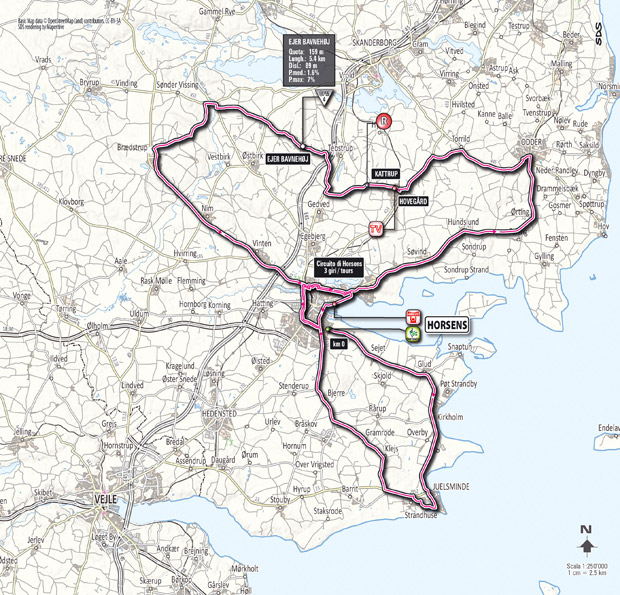
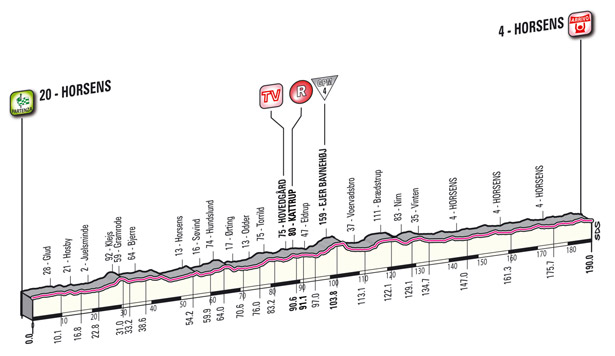
On Monday, Stage 3 (map, profile) is the last in Denmark before a "rest day," actually spent traveling down to Italy for the remainder of the race. 190km in length, starting and ending in Horsens on the east of the country, it's another flat parcours liable to finish once again with a sprint. The riders will pass through Horsens three times along the way.

As far as the weather goes on Monday, the factor that will most cheer the riders is a notable drop in windspeed between morning and afternoon - from 22kph down to around 10kph, which is insufficient to give any problems. It's enough to take the edge off the temperature early in the day - with 4C in sheltered spots near the start feeling more like 2C. When it drops, the maximum 11C will be unaffected. There's a 30% chance of rain, but if it comes it'll be in fast-moving showers that will end almost as soon as they begin.


Stages 1 / 2 / 3 / 4 / 5 / 6 / 7 / 8 / 9 / 10 / 11 / 12 / 13 / 14 / 15 / 16 / 17 / 18 / 19 / 20 / 21


Two Days of Bedford
Giro got you in the mood for some hardcore bike action? Craving the sweet scent of chain oil and the thrill of lycra flashing past your face at 45kph? Can't quite stretch to filling up the tanks on the Gulfstream IV for a jolly over to Denmark? Well then - if you live anywhere in the British South-East or southern part of the Midlands, you might be interested to know about the Two Days of Bedford.

The long-running event consists of four stages over two days (6th and 7th of May) with a 7.4km team time trial followed by an 80km road race on the Sunday, then a 6.4km individual time trial and an 85km race made up of nine laps of the Milbrook Vehicle Testing Facility - and believe me, you will not get more excitement for what it'll cost you to get to this race anywhere in the country (and you won't even have to change your pounds for krone). (More information here)

Sarah Storey crashed with 2km to go, landing in a patch of nettles which she said prevented her from losing skin. On Twitter after the race, she blamed the crash on the rider in front of her after turning "left+right on herself to avoid a tiny hole in the tarmac," then thanked well-wishers:
Sarah Storey ‏ @MrsSarahStorey
Thanks for the messages peeps,I'm fine just shocked at amount of unnecessary swerving+hard braking going on by a v small minority of riders.
Nikola Butler also crashed:
Nikola Butler ‏ @nik_tweet
one minute I was trying to sprint up the hill and the next minute I was on my face. Someone rode into my back wheel :-( sore 
Nikola Butler ‏ @nik_tweet
no idea whose fault it was. Just one of those bunch sprint things maybe
Stage 1 (Team Time Trial)
  1.  Node 4-Giordana 10'08"
  2.  For Viored +1"
  3.  Scott Contessa Epic +8"
  4.  Matrix Fitness-Prendas +14"
  5.  Abergavenny RC +30"

Stage 2 Top Ten
  1.  Amy Roberts Scott Contessa Epic  2h09'30"
  2.  Ciara Horne Node 4-Giordana ST
  3.  Lucy Garner Node 4-Giordana +15"
  4.  Sarah Reynolds Matrix Fitness-Prendas ST
  5.  Corrinne Hall Node 4-Giordana ST
  6.  Emily Kay Scott Contessa Epic ST
  7.  Laura Massey Vivelo Bikes ST
  8.  Lauren Creamer Abergavenny RC ST
  9.  Tamina Oliver Abergavenny RC ST
  10.  Harriet Owen Node 4-Giordana ST

Tour of the Gila
Stage 4 was an urban criterium race around a 1.74km square Silver City parcours with three bonus sprints and course hazards that include, according to the race bible, "rough pavement and errant pedestrians." The Pro Women completed 25 laps to make a total of 43.5km, the Pro Men 40 laps for 69.5km - precisely the sort of race in which a rider such as Kristin Armstrong (Exergy Twenty12), who at 38 specialises in the sort of endurance athleticism necessary on long stages (and which has seen her win the three stages prior to this one) might lose time to the younger women.

Loren Rowney
That turned out to be the case, though far less so than expected: while Armstrong came ninth, she was only 4" behind winner Loren Rowney (FCS Rouse presented by Mr. Restore, loaned by Specialized-Lululemon) and thus sees her General Classification lead only drop to 4'46" (from 5'01" after Stage 3) once bonification times have been taken into account. She was at the front for the first half of the race but, perhaps realising that she stood little chance of winning, chose to work for her team by chasing down attacks - not an entirely selfless decision, as it also enabled her to save some juice for the final Gila Monster stage. FCS Rouse guessed what she was up to,  simply waited until the final part of the race when they knew she'd be tired and made sure they had a rider ready to respond each and every time it looked like someone might make a break for the line. The plan was to tag along with an Exergy or Now and Novartis sprint train and see what they could do, but when Rowney found herself six riders back at the final corner she thought her chance was lost. Then, in a turn of good luck, the seven leaders took a fraction of a second longer than she'd expected to launch, allowing her to the velocity she'd carried through the bend to power into the lead and hold them off to the line.

Top Ten
  1.  Loren Rowney FCS Rouse p/b Mr. Restore 1h04'45"
  2.  Carmen Small Optum p/b Kelly Benefit ST
  3.  Christina Gokey-Smith Now & Novartis for MS ST
  4.  Alison Powers Now & Novartis for MS ST
  5.  Joanie Caron Colavita-ESPNW ST
  6.  Olivia Dillon Now & Novartis for MS ST
  7.  Jade Wilcoxson Optum p/b Kelly Benefit ST
  8.  Emma Grant Optum p/b Kelly Benefit ST
  9.  Kristin Armstrong Exergy Twenty12 +04"
  10.  Janel Holcomb Optum p/b Kelly Benefit ST
(Full results and GC)

Alejandro Borrajo
Marlon Alirio Perez Arango (Colombia-Comcel) pleased his team's sponsors and the spectators alike with a superb solo break, attacking the peloton and getting away only a few minutes from the start and then riding alone with an advantage hovering about the minute mark until Bissel decided enough was enough and got their hooks into him with twelve laps to go - he finished 65th in the end, but he's the man the fans will have been talking about on the way home. As the race neared its conclusion, Jamis-Sutter Home took the opportunity to show us all how a lead-out train ought to be conducted with all their men at the front of the pack protecting their top sprinters, brothers Alejandro and Anibal Borrajo, and getting them into perfect position - Alejandro proved fastest of a bunch of 21 while Anibal was right behind him for second place. Afterwards, Anibal dedicated the victory to an older brother who died a few days ago. Rory Sutherland took eleventh place and retains his GC lead, his overall advantage now up to 33" from 26".

Top Ten
  1.  Alejandro Alberto Borrajo Jamis/Sutter Home 1h33'40"
  2.  Anibal Andres Borrajo Jamis/Sutter Home ST
  3.  Luca Damiani Kenda/5-Hour Energy ST
  4.  Eric Young Bissel ST
  5.  Francisco Mancebo Competitive Cyclist ST
  6.  Weimar Roldan GW-Shimano ST
  7.  Avila Vanegas Edwin ST
  8.  Chad Beyer Competitive Cyclist ST
  9.  Gavin Mannion Bontrager Livestrong ST
  10.  Shawn Milne Kenda/5-Hour Energy ST
(Full results and GC)


Sunday brings the climax of the race, and what a climax it is - the 170.1km Gila Monster (map and profile) is almost certainly the toughest stage in North American professional cycling with two Category 4 climbs (16.1km, 2,070m; 166km, same), two Cat 2s (Anderson Vista, 83km, 2,284m; Wild Horse Mesa/Meadow Creek, 89km, 2,278m) and a Cat 1(Anderson Vista climbed from the opposite direction, 120km).

The 100mph bike - designed in the bath and made from genius
The remarkable Graeme Obree
Anyone who knows the story of Graeme Obree's Hour Record will know that the bike upon which he broke it, Old Faithful, used washing machine bearings. Anybody who knows a little more will know that the Scotsman later regretted telling anyone that, because it was all the newspapers cared about.

Obree is now planning to set a new record by becoming the first man to travel on a bicycle - on road and without pacing - at 100mph (161kph) aboard a new bike which, in characteristic Obreean style, he dreamed up while lying in the bath and later sketched out on bits of wallpaper. Once again, the ever-resourceful Obree has used items found about the house: this time, the rests that will support his shoulders as he lays prone on the carbon fibre-skinned machine have been made from an old saucepan. Hence Sunday's Telegraph headline: "The 100mph bike – designed in the bath and made from an old saucepan."

Hopefully, this time around, more people will look beyond that one single fact and remember that Obree is a remarkable engineer who builds his bikes from a wide range of remarkable materials, not only old washing machines and pots and pans; the most important being ingenuity and genius.

Nibali to leave Liquigas
Tuttobiciweb reports that Vincenzo Nibali has chosen not to sign an extended contract with Liquigas-Cannondale - said to be worth 1.8 million euros per year. According to rumour the 27-year-old, who already has one Grand Tour under his belt after winning the 2010 Vuelta a Espana, is being courted by BMC and Astana, both of which are said to be offering him 2.5 million euros per year.

"We made an offer, we gave him time to think it over, he has not responded. For us, the matter is closed," says Liquigas directeur sportif Paolo Dal Lago.

Giro may start in USA - one day
Organisers of the Tour de France looked seriously into the possibility of taking the race to the USA in the past but concluded that, at the time, the expense of doing so was simply too great. Nevertheless, it's an idea that has remained on a back-burner ever since. After all, American companies have been pouring sums of money into the sport that make the majority of European contributions look relatively puny, and American and Canadian riders are a fixture in the Grand Tour pelotons - in fact, it sometimes looks as though the old prediction that the USA would turn out to be the future home of cycling might eventually prove true.

Michele Acquarone
Now Giro d'Italia director Michele Acquarone has turned up the heat, because he wants his race to be the first Grand Tour to cross the Atlantic.

"To do this would be very expensive - at the present time, with the world's economy in the state it is, it's simply not an option," he admitted to Sportwereld. "But cycling is now global, increasingly so, and the Giro should be a driving force in that evolution. When we're through the financial crisis and cycling has dealt with its problems, this dream should be achievable. Imagine: we start in the US, have a few stages on Amercian soil, then the riders fly buiness class overnight to Italy... I really think this is possible."

Other News and Features
"Stephen Roche: Triple Crown 25 years on" (Cyclosport.org)

"Irish Para-cycling world champion Colin Lynch reveals dazzling new gold prosthetic" (Inside World Parasport)

"Top collegiate cyclists make their move in Ogden" (Standard-Examiner, Utah)

"Rwanda: Soras Boost Ascension De Mille Collines Cycling Tour" (AllAfrica)

Cycling
Newswire
Britain
"Cyclist knocked down on Gosport to Fareham bus route praises driver for saving his life" (The News, Portsmouth)

"Cycling in Leicester is just too dangerous" (This Is Leicestershire)

Worldwide
"Cyclists gear up for cross-Canada trek" (Times Colonist)

"A blessing for those who brave city streets on two wheels" (New York Times)

"Kids join the cycling fun at bike rodeo" (Silver City Sun-News)

"Santa Barbara Bicycle Coalition to Honor Three Women for Cycling Volunteerism" (NoozHawk)

"It's wedding bells and bikes for this couple" (AsiaOne)


Thursday, 12 January 2012

Copenhagen earns €31 million from Worlds

The World Championships, which were held in Copenhagen last September, generated around €31.2 million of income for the city, it has been announced - around €26 for every resident of the Danish city.

75% of that is believed to have come from overseas, either from tourists visiting the event as part of a holiday to the Scandinavian nation or there specifically for the event. Approximately 118,000 hotel rooms were booked for the weekend throughout Denmark and tourists reported many campsites were so packed full of motorhomes, caravans and tents that they were forced to turn people away.

Thursday, 22 September 2011

Copenhagen Road course

Geels Skov (© Jørgen Larsen CC3.0)
Stage Map: click here

If there was ever a parcours guaranteed to please spectators - and TV crews, for that matter, which pleases even more spectators - then it's got to be the route around Rudersdal. It's got some difficult corners, some lightning-fast straights and even, though this part of Denmark is pancake flat, so respectable climbing: only 105m per lap, but that soon adds up: the Elite Men will climb 1785m in total, which would take them higher that the highest point of the Col d'Aubisque. It also passes through some very beautiful landscapes, making it not unlike a stage in a tour. However, it has one advantage from a spectator's point of view: instead of the usual several hours of waiting followed by two minutes of excitement before the long haul journey to tomorrow's parcours, fans can see the peloton pass by several times - the Junior Women will complete five circuits, Junior Men nine circuits, Elite Women ten circuits, Under-23 Men twelve circuits and the Elite Men seventeen circuits (plus a 28km section from the Rådhuspladsen in Copenhagen city centre.


The circuit begins on the Kongevejen, a highway running along the western perimetre of the Geels Skov - a forest which has become as famous for its mountain biking trails, some of them running along ancient roads still rutted from the wheels of the logging carts that once ran along them, as it has for the anemones that completely obscure the leaf litter every Spring. In the centre of the forest stands what now appears to be a natural hill, unremarkable but for rising up like a tiny Mont Ventoux from the otherwise flat surroundings. In fact, it's not natural at all; having been specifically built as a ski jump in 1947 and remaining in use until 1980 when the site was returned to nature. Today, Geels Skov is a quiet, peaceful and very beautiful place, but it's seen its share of violence - in 1945, Yngve Marinus Nielsen and his wife Hildur Ruth were brought here by Resistance operatives and executed with a machine gun. Though the couple, both hairdressers, were known to have collaborated with the Nazis, the execution caused much controversy as it took place two days after Denmark was liberated.

Church in Søllerød, near the route (© Claus B. Storgaard CC2.5)
The riders set out from the car park halfway along the road at 55°48'16.87"N 12°28'37.41"E, near the entrance to the mountain bike blue trail - in other words, a trail considered to be moderately difficult and thus suited to riders with some experience, and head north-west for 0.7km, descending a fairly steep hill to a right turn onto Øverødvej. Arriving at a roundabout 0.18km later, they take another right onto Vangebovej which, having passed by a car park and some buildings, heads into the forest. There are pedestrian crossings immediately before the first turning, the white sections of which can become slippery when wet, then a raised central section immediately afterwards. There are further crossings both immediately before and immediately after the second turn, as well as a central reservation which would be very easy to hit if the corner was taken too fast or simply by too many riders at the same time. The reservation continues in three parts for 196m with two gaps permitting cars to turn into side-roads - these could be used by riders on the right-hand side of the road to swap to the left in order to take the quickest line through the upcoming bend, a gentle left. The remaining 0.6km is straight and climbs, reasonably steeply in parts.

The next bend is a very gentle right, leading into a short straight of 225m with a very slight descent - possibly a good spot for a breakaway group to attack, gaining a slight lead before hammering on the gas when out of sight around the coming medium left whilst the peloton can't see what's going on. The next straight, 0.53km, leads to a 90 degree left onto Mothsvej - however, as the roads are wide, they're shouldn't be any issues in getting around the corner at speed provided the pack is sufficiently spread out so as not to force anyone into the little traffic island (with signs on metal poles) in the middle of Vangerbovej as they enter the turn.


A much tighter 90 degree left 200m later, meanwhile, could require caution. It's on a narrower section of road with gravelly paths either side - a front wheel slipping on gravel could very quickly lead to the bike hitting a kerbstone and catapulting the rider into the rather scratchy looking hedges shielding the houses from the road. A very similar right-hander lies 65m ahead before the road straightens for 154, leading to the grand cast iron gates of Søllerød Slot, a baroque mansion dating to 1740 and set in parkland with a formal garden. (The house, incidentally, was occupied by Johan Frederik Vilhelm Schlegel; a lawyer who according to the auto-translated page on the house I'm currently reading earned himself an Access to IT qualification in 1787. Clever guy.)

Emma Pooley - a dead cert for
second place in the Elite Women,
we reckon
(© John Chapman CC3.0)
Turning right at the gates leads along Søllerødvej and a section that would be perfectly straight were it not for two very slight deviations, first right and then left. Descending slightly, this could prove to be a very fast part of the race before the tight left corner joining onto Altemosevej (55°48'37.92"N 12°30'33.48"E)  which climbs quite considerably for the next 323m; not enough to make the slightest bit of difference to the Voses, Pooleys and Monforts, but unwelcome to the Cavendishes - especially in the final few laps. There are short metal bollards along the edges of the road after the turn, caution being required to avoid them, and as a main route through a suburban area is very much the sort of place where buses sometimes spill diesel. 323m later, the section ends at a medium right bend - there's a crossing with chequered white squares, rather like the stripes of a zebra crossing, immediately upon entering the bend which could be extremely slippery if the road is wet. Note the bike lane to the left of the road, which will be running alongside for some time - for much of its length, it's in much better condition than the road. If only all the world was like Denmark!

Wiggins for Elite Men silver?
(© Adambro CC3.0)
The following section is narrow and, in places, overhung by trees which at this time of year especially can result in slippery leaves on the road. However, it runs straight for 0.53km and as such will likely generate high speeds before the next turn, a gentle left leading past a grassy bank on the left - hence potentially slippery road surface after rain - and a tiny, very pretty thatched cottage on the right. There is a narrow, raised speed hump 1.63km from the start of the road and a tight right turn onto Egebaekvej 163m later (the turn coming shortly before an 18th Century mansion with extensive formal gardens that helicopter-borne camera operators will probably be unable to resist), then only very slight deviations for the following 0.59km to a bridge leading over the E47 and E55 motorways. To the left, as the road crosses the bridge, there's a very low kerb separating the road from the cycle lane which riders will need to avoid and to the right, a low kerb made of blocks of stone separating the road from a gravel path. There is forest either side of the road as the riders leave the bridge, thus a potential for slippery leaves. There is no kerb on the right from this point, leading to leaves and twigs collecting along the side of the road - best avoided in case of punctures - except for a short section running along a metal barrier 129m after the bridge; riders will need to avoid hugging the right-hand edge of the road to avoid this.

Having followed a slight bend to the right 0.38km after the bridge, the roadside vegetation on the right includes what looks to be a stumpy, thorny hedge after the route passes a somewhat ramshackle half-timbered thatched cottage on the left. Punctures are extremely likely in this section.

As the athletics and sports centre at Rundforbi Parken comes into view on the right (55°49'36.27"N 12°32'28.22"E), any riders who have been making use of the cycle path will need to be cautious of the bollards around the entrance to the car park on the opposite side just past a pedestrian crossing. There are more on the right, but these are positioned where they won't be immediately in a rider's line - however, catching the right-side pedal on one could be disastrous. The end of the section at Rundforbivej comes 1.23km after the motorway.

Sommer's Automobilmuseum (© The Owner, used with thanks)
The corner is tight with a painted pedestrian crossing and a traffic island with metal signs, caution thus being required here. Another pedestrian crossing lies just around the corner, then the road passes through a short narrow section with bollards either side 0.48km later and then travels by a small lake on the right a short while later. There's another slightly narrowed section at the end of the white fence on the right just past the lake, then a traffic island 380m after the lake. Large industrial plants on both sides of the road as the race enters a wide bend (55°49'9.37"N 12°31'45.27"E) to the left immediately after the traffic island will increase the possibility of diesel spills. Sommer's Automobilmuseum on the left is must-visit for petrolheads visiting the races, as it has a collection of more than 60 vintage and/or rare cars including some unique examples. The road is straight for 135m, then reaches two pedestrian crossings either side of a traffic light-controlled crossroads, widening and becoming a dual carriageway and thus ensuring plenty of room so that the central reservation - split into three parts after the crossroads - doesn't get in the way and cause problems.

While most people are backing
Wiggo, Thor or Gilbert, we rather
fancy Geraint Thomas' chances for
the Elite Men title... (© Petit Brun CC2.50)
After 175m from the last pedestrian crossing, the route arrives at another and a right turn onto Skodborgsvej - this is the point (55°48'54.09"N 12°31'46.99"E) where the Elite Men will join the circuit following the 28km ride from the Rådhuspladsen in Copenhagen city centre on Sunday. Another pedestrian crossing, and a central traffic island, lie just around the apex as the race enters the long, mostly straight penultimate section heading south-west back over the motorway (55°48'53.55"N 12°31'43.03"E) and on towards the Kongevejen. There are another two pedestrian crossings on the other side, this time hit head-on and as such unlikely to be hazardous, then the road narrows down to two lanes again. There's another traffic island 275m after the crossing, with a further hazard caused by the horse chestnut trees on the right of the road around 100m later - the spiky shells of the conkers can cause punctures and become slippery when mashed up by car tyres, plus the conkers themselves can act like ball-bearings under wheels. There are seven more traffic islands in the next 0.6km as the road enters a wide bend to the left.

The route enters a long straight with overhanging trees before being divided by another central reservation leading to a crossroads, once again with pedestrian crossings either side - the road becomes quite narrow for a short stretch until the end of the central reservation, then passes a lay-by 137m later (55°48'27.48"N 12°30'29.71"E). The following section has trees lining the roadsides, meaning slippery leaves and snapped collarbones for anyone who crashes into a trunk. After a short while, a turn for Mothsvej passes by on the right, followed by traffic islands 0.24km later as the road leads to a roundabout.

...and for Elite Women gold, can
Marianne Vos be beaten?
We very much doubt it
(© Rolf van der Zwart CC2.0)
The first exit leads straight on, with caution being required to avoid the cobbled traffic island immediately after the roundabout. There are more trees lining both sides of the road but the road is straight, smooth and unchallenging until the next traffic island 0.37km ahead, followed by a crossroads and the island's twin on the other side. We then enter a suburban area with a series of raised speed humps coming in close succession, followed by another smooth stretch leading to the right turn at the junction with Kongevejen (55°47'50.05"N 12°28'55.52"E) - it's not an especially difficult transition in the dry, but a selection of pedestrian crossings (immediately before and after the turn), street furniture (road sign in the middle of the road immediately after the turn), sunken, knobbly kerb (around the right-hand edge of the turn) and central reservation (immediately after the turn) could make it potentially very difficult when wet. With both roads being main routes, there's a reasonably high possibility of fuel spillages - rain combined with  patch of diesel halfway through the turn could very easily end the race for anyone sufficiently misfortunate as to hit it.

This end of Kongevejen, like the northern part at the start of the race, is a wide highway with plenty of room for a mass sprint to the finish at the end of the final lap of each race. A final climb leads up into Geels Skov, past an obelisk-shaped milestone marking the last 300m of the lap and on to the finish line, back at the same point from which the race started.

For a guide to the 28km section featured in the Elite Men's race only, click here.

Monday, 19 September 2011

Copenhagen UCI World Road Racing Championships


This is what the future will look like; or what the
present already looks like if you're lucky enough
to live in Copenhagen. The Bryggebroen was the
first bridge to span the city's harbour for 150 years
and is reserved for cyclists and pedestrians.
(© Stig Nygaard CC2.0)
Copenhagen is, without even the shadow of a doubt, a very fine place indeed to be a cyclist. It was the UCI's first official Bike City and achieved third place in a list of the 11 Most Cycling-Friendly Cities in the World in 2009. An estimated 36% of the population cycle to work, clocking up a seriously impressive 1.1 million kilometres each day between them - and the municipality aims to increase that percentage to 50% in the next three years. It's even given rise to a new verb used by architects and town planners: to copenhagenise means to create a cycling infrastructure including dedicated cycle paths, bike lanes, public bike programs, secure parking and even public access maintenance facilities, and it's become widely recognised as a sure-fire way to improve the urban landscape and the quality of life enjoyed by citizens.

Vejrpigen
(© Archer10 CC2.0)
If there's one thing guaranteed to get more people on bikes, it's a large-scale, well-run bike race; so it's a safe bet that the city would have been overjoyed when it was picked to be the host of the 2011 UCI Road Race World Championships - and that they'll have really pushed the boat out in getting prepared, ensuring one of the best events in years. All races - time trials and road races alike - will start at the spectacular Rådhuspladsen, the City Hall Square where they'll be overseen by someone who ought to know a thing or two about cycling: the Vejrpigen, the Weathergirl, is a mechanised sculpture high up in the Richshuset tower. Ever since 1936, she's come out with her umbrella and dog if it's going to rain and her gilded bike when it'll be fine.

By tradition, Copenhagen is said to have begun life in 1167 when royal advisor Bishop Absalom built a castle on the island of Slotsholmen, nowadays home to the Christiansborg Palace where the castle's remains can be seen preserved in subterranean excavations. However, archaeological evidence has shown that there was already a sizable town here at that time. Once the castle was built, the town was in an ideal position to take advantage of the excellent natural harbour - indeed, the name Copenhagen is derived from the medieval Danish word Køpmannæhafn, meaning merchant's harbour - and begin to grow into a city, receiving a royal charter in 1254.

Rådhuspladsen - the start of all this year's races
(© Karri Huhtanen CC2.0)
After the Second World War - during which the Danes refused to co-operate with Nazi policy, despite being occupied by them - Copenhagen continued to grow and began transformation into the modern city that it is today, occupying numerous natural and man-made islands and combining traditional Scandinavian architecture with the strikingly modern. Now that the harbour's importance has declined, the city has looked to tourism to form an important part of the economy; becoming one of the top destinations for European tourists and especially attractive to the sort of young tourists who go to Amsterdam, Reykjavik and Barcelona. This, combined with the city's deep love and respect for the bicycle, adds up to one thing - this year's World Championships are set to be one of the most spectacular cycling events in years.