Showing posts with label Bruyneel. Show all posts

Saturday, 23 August 2014

Daily Cycling Facts 23.08.2014

Johan Bruyneel
Bruyneel in 2007
Born in Izegem, Belgium on this day in 1964, Johan Bruyneel has been one of the highest-profile figures in professional cycling for almost a quarter of a century - as a rider and as a manager, and for good reasons and bad.

Bruyneel got his first taste of racing glory when he took third place at the Juniors' Trofee van Vlaanderen Reningelst in 1983. Three years after that he won the Amateur Ronde van België, then turned professional with SEFB in 1987 and remained with them until 1989, the year that he won Stages 2 and 9 at the Tour de Suisse. In 1990, riding for Lotto Superclub, he won the Tour de l'Avenir and marked himself out as a man to watch in future Grand Tours; he also rode his first Tour de France that year and - remarkably, for a debutant, finished Stage 17 in second place and was 17th overall. He was not as fortunate at the Tour in 1991 with 35th overall, but he won Stage 12 at the Vuelta a Espana in 1992 and triumphed at the GP des Nations. 1993 was his real break-through year: he not only won Stage 6 at the Tour, but did it at an average speed of 49.417kph - then a record, and since bettered only twice - and was seventh overall. Two years later he won Stage 7, though he would later express disappointment at how he'd won: having launched an attack early on in the stage, he'd found himself desperately hanging to Miguel Indurain's back wheel for much of the parcours before getting the better of him in a sprint. Most riders and fans would claim that simply keeping up with Indurain - especially when the five-time Tour winner was going all-out to win time on his rivals - was sufficiently worthy to make the victory morally his, but Bruyneel apparently felt that since he'd been in Indurain's slipstream for so much of the day he had an unfair advantage in the final sprint to the finish line. At the following Tour he came within centimetres of a career-ending injury when he lost control during a descent on Stage 7, coming off the road and plunging into a ravine. As ever when such things happen, spectators fell silent and for a moment or two, then a few people peered over the edge - just as the rider clambered back up to the road and onto his bike to complete the stage (he abandoned a few days later). He stayed away from the Tour in 1997, then abandoned after Stage 9 in 1998, which would be his last year as a professional rider.

With UCI president Pat McQuaid
Whilst Bruyneel's riding career would be the envy of any cyclist, it was as a manager that he found his greatest success. Immediately after retiring, he was invited to manage US Postal - the team that counted among its number a young American rider who, after showing promise for some years, had finished that year's Vuelta a Espana in fourth place. His name was Lance Armstrong, and he welcomed the new manager's plans to knock the team into shape: US Postal was, according to Armstrong, "the Bad News Bears, a mismatch of bikes, cars, clothing, equipment" and the team was run on an annual budget of "only" $3 million (directeurs sportif and managers of women's professional teams will doubtless be wondering how the team ever made ends meet). At the time of writing, we have reason to doubt the methods Bruyneel used to get his riders race-ready - he is at the centre of a doping investigation that, if he and others are found guilty, could prove to be a greater scandal than the Festina Affair or Operacion Puerto - but there is no doubt at all that when it comes to the logistics and practicalities of running a professional cycling team, he is extraordinarily talented: within a year, US Postal had been transformed from a rag-tag bunch of gifted mavericks into one of the most polished, well-drilled teams ever seen in cycling. Armstrong, of course, went on to win an unprecedented seven consecutive Tours; Alberto Contador won another - his first - in 2007 and the other riders on the team were victorious at a huge number of races during the decade that Bruyneel controlled the outfit.

In 2007, Bruyneel announced that he was going to leave cycling. However, he was then approached by representatives of the Kazakhstan government and offered a position managing the Astana team which, earlier that year, had been accused of running a doping ring and was thrown out of the Tour. Apparently not a man to back down from a challenge (nor, one assumes, a fat cheque), he accepted. Levi Leipheimer and Contador went with him; the team was again blocked from the Tour in 2008, but Contador won the Giro d'Italia and the Vuelta a Espana while Leipheimer was second at the Vuelta and won the Tour of California. Astana was allowed back into the Tour in 2009 and Contador won in superb style with Armstrong, who had decided to return from retirement, taking third; they also won the team classifications at the Tour and the Giro, another Tour of California (Leipheimer), Paris-Nice (Contador) and numerous other races.

With the ONCE team
Bruyneel left Astana at the end of 2009, but he still wasn't ready to retire and became manager of RadioShack, a team part-owned by Armstrong. With eight members of the 2008 Tour-winning Astana squad also making the move (Contador, who had gone to SaxoBank, was the only one that did not) and several very talented riders from elsewhere signed up to the team, RadioShack looked a force to be reckoned with in 2010 and did indeed win an impressive 23 times, but the season was not without setbacks - in May, it was revealed that Bruyneel was being investigated by the Belgian Federation due to an accusation made by Floyd Landis that he ran a doping ring whilst manager of US Postal and, though RadioShack won the teams classification at the Tour (the second time an American team did so; the other being, of course, US Postal in 2009). At the end of the year rumours that RadioShack and LeopardTrek would merge for 2012 were confirmed, though Leopard owner Flavio Becca claimed that his team was taking over RadioShack's sponsors and some of its riders, thus making it sound more like a corporate take-over than a merger. The resulting team was to be called RadioShack-Nissan, its aim was to propel Andy Schleck to a Tour win - and the differences in how Bruyneel and Becca described its birth were the first indication of friction.

Andy Schleck, along with older brother Frank and several other members of the team, performed considerably less well than expected in the first few months of 2012 - only Fabian Cancellara seemed to have good form, but he ended up out of action after suffering a quadruple collarbone fracture at the Ronde van Vlaanderen. Hints began to emerge that the riders were not happy: Andy dropped heavy hints he wasn't happy about Bruyneel's decision to keep the Schleck's preferred directeur sportif Kim Andersen away from the Tour (and even indicated that he would remain in touch within him during the race), while Frank was understandably not impressed to be accused of "letting the team down" when he abandoned the Giro with an injured shoulder. Jakob Fuglsang openly criticised team management and was not selected for the Tour squad as a result; it was later reported that his salary had been with-held as a punishment, and few fans will have been surprised when he announced that he would be leaving for Astana at the end of the year. Before long, there were rumours that the Schlecks would be going too, either to an existing team or to a newly-formed one: a dangerous situation for Bruyneel, because the brothers had done the same before when they left SaxoBank - and had asset-stripped it of good riders in doing so.

The biggest controversy of the year came in May at the Tour of California - as Bruyneel stepped off the plane onto US soil, he was met by USADA officials who served him with a subpoena as part of their own investigation into doping at US Postal. Further details soon became public, revealing that the scale and scope of the investigation was enormous: in addition to Bruyneel, US Postal's official doctor Pedro Celaya, the notorious Dr. Michele Ferrari and a number of other figures were being investigated, including Lance Armstrong. The case has not yet reached its conclusion as important questions, such as how did Armstrong - who was stripped of his seven Tour de France victories, did not bother contesting the decision to do so and eventually confessed to using EPO - manage to avoid being caught out when he had been submitted to so many anti-doping tests still need to be answered.

For the time being at least, though, Bruyneel's career in professional cycling is over: in April 2014, he was banned from having any involvement whatsoever in professional cycling for ten years, and extraordinarily long sanction that reflects the serious nature of the fraud.


Manfred Donike
Born in Köttingen, Germany on this day in 1933, Manfred Donike was a highly successful cyclist during the 1950s and 1960s when he rode for a number of professional teams including Bismarck, Express, Altenburger, Feru-Underberg and Torpedo; with the exception of Feru, which was based in Switzerland, he spent his career with German teams. In 1954 he won the National Amateur Madison Championship with Paul Vadder, he would also win the Elite Professional madison at the Nationals three years later with Edi Gieseler and reached the podium in numerous other races, though not at the Tours de France he rode in 1960 and 1961.

Donike's influence on professional cycling has been far greater than his race results suggest, however: after retiring from competition at the end of 1962, he was offered a place at the University of Cologne where he studied chemistry and graduated in 1965 - and then dedicated his life to the fight against doping. In 1972, he perfected the gas chromatography and mass spectrometry method of detecting traces of performance-enhancing drugs and masking agents in samples of riders' urine; it remains the most accurate method available today. Five years later, he became the director of the German Sports University's Institute of Biochemistry.

Donike died of a heart attack aboard an aeroplane traveling between Frankfurt and Johannesburg in 1995, whilst on his way to act as chief of the anti-doping program at a race in Zimbabwe, and the Manfred Donike Institute of Doping Analysis at the German Sports University was named in his honour a short while later. His oldest son, also named Manfred and a successful cyclist in his own right had died of a heart attack two years earlier; his younger son Alexander also enjoyed race success and subsequently worked for the UCI.


Eddie Smart, born in Cardiff on this day in 1946, rode for Wales at the 1966 Commonwealth Games in the kilo, pursuit, scratch, sprint and road races - his best result was 15th, in the kilo. Later, he became co-ordinator for the Welsh federation's track team and assisted annually in the organisation of the Junior Tour of Wales. Smart was killed on the 6th of February in an accident on the M4 motorway; a memorial fund was set up to raise money for the restoration of the Maindy track in Cardiff and a shield commissioned in his honour and named after him is awarded to the most successful Welsh rider each year.

Hennie Top, born in Wekerom on this day in 1956, was Dutch Road Race Champion in 1980, 1981 and 1982 and, in 1985, won Stages 1 and 16 at the Tour de France Féminin. She later became coach to the US National Women's team.

Russell Downing
Russell Downing, born in Rotherham, Great Britain on this day in 1978, won numerous races between 2002 and 2009, then found fame by winning the Tour of Ireland. In 2010, he joined the new Team Sky and became their first victorious British rider when he won Stage 2 at the Critérium International that same year. He went on to win the General Classification at the Tour de la Région Wallonne later that summer and had his contract extended to cover 2011, when he rode his only Grand Tour - the Giro d'Italia, where he finished Stage 18 in eighth place before coming 140th overall. In 2012 he joined Continental team Endura Racing and, so far, has achieved six victories over the season including the prestigious Lincoln International. He also won a silver medal at the National Criterium Championships. Downing is the younger brother of Dean, who is also a successful cyclist; the both rode for NFTO in 2014 - the year that Russell came fourth in the road race at the Commonwealth Games.

Other cyclists born on this day: Kemal Küçükbay (Turkey, 1982); Enrico Poitschke (Germany, 1969); Mike Gambrill (GB, 1935); Janildes Fernandes (Brazil, 1980); Hubert Seiz (Switzerland, 1960); Tulus Widodo Kalimanto (Indonesia, 1965); George Van Meter (USA, 1932, died 2007); Majid Naseri (Iran, 1968); Anatoly Stepanenko (USSR, 1949); Edwin Mena (Ecuador, 1958); Andrea Faccini (Italy, 1966); Cristóbal Pérez (Colombia, 1952); Manu Snellinx (Belgium, 1948); Werner Weckert (Switzerland, 1938); Mouhcine Lahsaini (Morocco, 1985).

Thursday, 24 October 2013

Daily Cycling Facts 24.10.2013

Octave Lapize
Born in Montrouge, Paris on this day in 1887, Octave Lapize had already been Elite National Cyclo Cross Champion, Amateur National Road Race Champion, won a stage at the Tour of Belgium (1907), won Paris-Auxerre and been third in a 100km race on the track at the Olympics in London (1908) by the time he turned professional with Biguet-Dunlop in 1909. When he did so, his manager Paul Ruinart warned the cycling world that they should prepare themselves for some crushing defeats because Lapize was, he said, "the best rider of his generation. He can and must win everything, because he has all the gifts of a perfect cyclists."

He was indeed a phenomenal all-rounder, able to sprint, climb, endure the inhumanly long stages of the era and - perhaps most importantly - had the intelligence to outwit his rivals at a time when most stage racers relied on the simple method of riding as fast as possible for as long as possible. During the first few months of his professional career it looked like Ruinart had been right when the rider won a bronze medal at the National Cyclo Cross Championships and enjoyed victory on the road at Milan-Varese, Paris-Dreux and Paris-Roubaix; his opponents must, therefore, have felt some relief when he dropped out of his first Tour de France that summer after suffering badly in the freezing, snowy conditions that hit the race that year. However, Lapize went away and began immediately preparing for the next edition and when he rolled up to the start line in 1910 he had become an altogether different rider - leaner, fitter, meaner. These were factors that would stand him in good stead because, after seven years in which Tour director Henri Desgrange had kept his race away from the high mountains (which, he worried, would prove impossible to ride and where bears might eat the riders), the parcours was taking the peloton over the highest roads in the Pyrenees.

Lapize on Tourmalet, 1910
The man who had persuaded Desgrange that high mountain stages should be added was Adolphe Steinès, who had designed the route every year since the first Tour in 1903. In 1905 he had convinced Desgrange that a smaller mountain, Ballon d'Alsace, would add spectacle and it had proved popular with fans; this year, following a January fact-finding mission in which he was warned by locals that the col was barely passable in July (and would probably have died if a search party hadn't found him after he tried to make it over the pass in heavy snow and fell into a ravine), he'd talked the director into letting him add the 2,115m Col du Tourmalet, almost 1,000m higher than Ballon d'Alsace. Rivals of L'Auto, the newspaper Desgrange edited, said that the parcours was "dangerous" and "bizarre," and when it was first published no fewer that 26 riders asked for their names to be taken off the start list. Nevertheless, the mountains stayed and the Tour entered a new era - though Desgrange was still sufficiently worried that the experiment would prove a disaster that, when the race reached the Pyrenees in Stage 9 and he saw how much the riders struggled, he temporarily made Victor Breyer director just in case the whole affair descended into embarrassing farce on the harder climbs in the next stage.

The tall, powerfully-built Luxembourgian François Faber, who had won the Tour the previous year after such an impressive performance in the first half of the race (including five consecutive stage wins, still a record 103 years later) that organisers asked him to ease off a bit to make the race appear more interesting, now found himself at a serious disadvantage - no matter how much of a lead he could gain on the flat stages, he lost it all on the big climbs where the smaller, lighter riders left him far behind. Nevertheless, he did extraordinarily well despite a dog causing him to crash in tage 7 and led the race for ten stages from Stage 2, even winning on the small mountains of Stage 4 - but when the peloton reached the Pyrenees in Stage 9 Lapize beat him, then did so again the following day when they climbed Tourmalet. Lapize was the first man to the top, but could only get there by dismounting and pushing his bike; Gustave Garrigou, who ended the race in third place, was the only man to ride to the top and earned a bonus of 100 francs for doing so. According to legend, when Lapize passed the race officials waiting at the top, he hissed one single word at them: "Assassins!" In fact, those who were there to hear it remembered that it was "Vous êtes des assassins! Oui, des assassins!" - and that he shouted it, rather than hissed.

Lapize on Tourmalet, 1910
Faber had done sufficiently well in the earlier stages to maintain his lead and hoped to add to it in the flat stages to come, but then when he had a puncture in Stage 12 Garrigou helped Lapize to attack; Lapize thus became race leader with three stages to go. Lapize also won Stage 14; by the final stage, Stage 15, he was six points ahead of the Luxembourgian - the outcome of the race in those days being decided according to a points system (still used, in modified fashion, to decide the Points competition run alongside the General Classification and King of the Mountains to this day). When Lapize punctured shortly after the start of the final stage, Faber tried to seize his chance and sprinted away, hoping to gain an insurmountable lead and win back the race. However, he too punctured; he finished the stage in fourth place, beating sixth place Lapize by 6'01", but this only won him back two points - Lapize had won the Tour.

Lapize also won Paris-Roubaix in 1910, then he won it again the next year and became the first man to have won three times and three times consecutively - Gaston Rebry would match him with a third victory a quarter of a century later, but it would be 70 years until Francesco Moser managed to match the three consecutive victories (to date, nobody else has done so). He also won Paris-Tours, Paris-Brussels and became National Road Race Champion in 1911, a title he successfully defended in 1912; that year, he won Paris-Brussels again and also Stage 6 at the Tour. In 1913 he won Paris-Brussels for a third time, a record both for total wins and consecutive wins that has been matched once (Félix Sellier, 1924) and beaten once (Robbie McEwen, 2008), then in 1914 he won Stage 8 at the Tour.

On the same day that the 1914 Tour de France began, the Archduke Ferdinand was assassinated in Sarajevo and the First World War began. A week after the Tour ended, Germany invaded Belgium and declared war on France. Lapize joined up to fight, becoming a fighter pilot. He survived until the 14th of July in 1917 - that day, he was shot down over Flirey in Meurthe-et-Moselle near the German border and died shortly afterwards in hospital, aged 29 years.

Emilia Fahlin
Born in Örebro on this day in 1988, Emilia Fahlin entered her first bike race when she was 12 years old. Only four other riders took part, and she was the fourth to finish - however, she caught the racing bug and, four years later in 2005, she became Junior Road Race Champion of Sweden, also taking second place in the Junior National Individual Time Trial Championship. The following year she lost her title (but won a bronze medal); however, good results in stage races brought her to the attention of the T-Mobile team. She signed her first professional contract with them for 2007 and stayed as the team gradually transformed into HTC-Highroad before dissolving at the end of 2011.

Right from the start of her professional career, Fahlin was successful. In her first year she won the Under-23 Skandisloppet in Sweden, finished Stage 3 at the Tour of Poland in third place and was second at the Sparkassen Giro. In 2008 she won Stage 3 at the Redlands Classic, took the Elite National Road Race Championship title and then dominated the U-23 Svanesunds 3-dagars by winning three of the total four stages (and coming second on the one she didn't win). The year after that she won the Tour of California Women's Criterium and the National Individual Time Trial Championship, then in 2010 she won the National ITT and Road Race Championships. She kept the ITT title in 2011 and was third in the Road Race; then won the Prologue and Stages 2, 5 and 6 at the Tour de l'Ardèche but was unable to make it into the Emma Pooley-led top 5 overall finishers.

Following the demise of Highroad, Fahlin joined Specialized-Lululemon and helped towards the team's victory in the team time trial at the Energiwacht Tour. She took second place in the Road Race and third in the ITT at the Nationals, then came 19th in the Road Race at the Olympics before finishing the season with good top ten results at the Route de France and Lotto-Decca Tour. In 2013 she moved on to Hitec Products-UCK and, in June, became National Road Race Champion.

Levi Leipheimer
Leipheimer in 2005
Born in Butte, Montana on this day in 1973, Levi Leipheimer was for many years one of the most popular riders in the ProTour peloton: partly for his longevity (he remained competitive in the Grand Tours right up until 2012, when he was 37 years old) and excellent results (he was third at the Tour de France in 2007) but also for his caring nature - he supports animal welfare organisations and, with his wife Odessa Gunn (also a professional cyclist), runs a sanctuary for mistreated animals at home in California.

As a youth, Leipheimer was more interested in skiing than other sports and didn't start cycling until an accident kept him away from the slopes. As has been the case with a surprisingly large number of riders who came to cycling by accident, he showed promise right from the start and, in 1995, was signed up as a trainee with the British MS Maestro-Frigas team. He won the Tour de la Province de Namur with them but although the team continued in 1996, under the new name Sit&Sit-FS Maestro, his contract was not extended; instead he split his time between racing as an  Independent and for the Einstein team. He enjoyed one victory that year - a criterium at Burlingame in the US, but also failed a doping test when a sample he provided at the National Criterium Championships turned out to be positive for ephedrine. He was, therefore, stripped of the title and had to give back the prize money he'd won at the event, but claimed that the drug had got into his system via an antihistamine medicine he'd used to combat hayfever; race rules have since been altered to allow riders to use the drug with a doctor's note. In 1997 he was picked up by the Comptel Data Systems team and enjoyed seven victories in American races, then in 1998 and 1999 he went to Saturn Cycling and won another seven times, including two General Classifications  at the Tour of Beuce in Canada. Now very much on the international professional cycling radar, Johan Bruyneel's US Postal came calling; Leipheimer rode alongside Lance Armstrong with the team in 2000 and 2001.

In 2001 Leipheimer rode the Vuelta a Espana, his first Grand Tour, as a domestique for Roberto Heras - but then performed so well in the final stage, a time trial, that he overtook Heras and took third place in the General Classification and the Points competition. He was the first American rider to have ever finished the Vuelta in the top three. Heras, who had won in 2000, was fourth and not at all impressed with what had happened, but Leipheimer had done enough to earn himself a more lucrative contract with Rabobank for 2002: the year that he made his debut at the Tour de France and finished in eighth place. In 2003 he was eighth at the Critérium du Dauphiné but otherwise performed poorly all year, managing only 58th place at the Vuelta; he experienced a return to form in 2004 and was ninth at the Tour, then departed the team for Gerolsteiner with whom he was sixth at the Tour de France and won the General Classification and the King of the Mountains at the Tour of Germany. In 2006 he won the Critérium du Dauphiné and was 13th at the Tour de France; in 2007 he returned to Johan Bruyneel, riding for the team now known as Discovery Channel Pro Cycling, and won the Tour of California and Stage 19 at the Tour de France before his third place finish. Bruyneel became manager of Astana for 2008 and 2009 and Leipheimer moved with him; in 2008 he won the Tour of California again and took two stages at the Vuelta, where he was second overall, then in 2009 he won the Tour of California (for a record third time), the Vuelta Castilla y Leon and the Tour of the Gila, also taking sixth place at the Giro d'Italia. He didn't finish the Tour de France that year, breaking his wrist in a crash in Stage 12 while he was in fourth place in the General Classification.

Leipheimer in 2011
Leipheimer moved with Bruyneel in 2010 to RadioShack. He won the Tour of the Gila again, then came 13th at the Tour de France before winning the Tour of Utah; in 2011 he won the Tour de Suisse, the Tour of Utah and the USA ProCycling Challenge. In 2012 he joined Omega Pharma-QuickStep and won the Tour de San Luis before finishing his tenth Tour de France in 31st place. At the Tour of California that year, Bruyneel had been served with a subpoena as part of USADA's investigation into doping at US Postal. The full extent of the investigation at that time was not known; however, within a few months it had exploded into perhaps the biggest doping scandal to have ever hit cycling and led to Bruyneel's dismissal as manager of RadioShack-Nissan. Leipheimer  was one of the riders who gave evidence against Lance Armstrong, who was subsequently stripped of his seven Tour de France victories, and in doing so admitted the truth about his own doping before accepting a six month ban to expire in March 2013 - he was also stripped of all his race results gained between June 1999 and July 2006, as well as for July in 2007.

Other cyclists born on this day: Caroline Buchanan (Australia, 1990); Chris Carmichael (USA, 1961); Jill Kintner (USA, 1981); Peter Rogers (Australia, 1974); Emil Richli (Switzerland, 1904, died 1934); Joseph Farrugia (Malta, 1955); Marie-Hélène Prémont (Canada, 1977); Mario van Baarle (Netherlands, 1965); Koichi Azuma (Japan, 1966); Roland Königshofer (Austria, 1962); Rudolf Juřícký (Czechoslovakia, 1971); Rodolfo Caccavo (Argentina, 1927, died 1958); Johann Summer (Austria, 1951); Ezio Cardi (Italy, 1948).

Wednesday, 24 October 2012

Daily Cycling Facts 24.10.12

Octave Lapize
Born in Montrouge, Paris on this day in 1887, Octave Lapize had already been Elite National Cyclo Cross Champion, Amateur National Road Race Champion, won a stage at the Tour of Belgium (1907), won Paris-Auxerre and been third in a 100km race on the track at the Olympics in London (1908) by the time he turned professional with Biguet-Dunlop in 1909. When he did so, his manager Paul Ruinart warned the cycling world that they should prepare themselves for some crushing defeats because Lapize was, he said, "the best rider of his generation. He can and must win everything, because he has all the gifts of a perfect cyclists."

He was indeed a phenomenal all-rounder, able to sprint, climb, endure the inhumanly long stages of the era and - perhaps most importantly - had the intelligence to outwit his rivals at a time when most stage racers relied on the simple method of riding as fast as possible for as long as possible. During the first few months of his professional career it looked like Ruinart had been right when the rider won a bronze medal at the National Cyclo Cross Championships and enjoyed victory on the road at Milan-Varese, Paris-Dreux and Paris-Roubaix; his opponents must, therefore, have felt some relief when he dropped out of his first Tour de France that summer after suffering badly in the freezing, snowy conditions that hit the race that year. However, Lapize went away and began immediately preparing for the next edition and when he rolled up to the start line in 1910 he had become an altogether different rider - leaner, fitter, meaner. These were factors that would stand him in good stead because, after seven years in which Tour director Henri Desgrange had kept his race away from the high mountains (which, he worried, would prove impossible to ride and where bears might eat the riders), the parcours was taking the peloton over the highest roads in the Pyrenees.

Lapize on Tourmalet, 1910
The man who had persuaded Desgrange that high mountain stages should be added was Adolphe Steinès, who had designed the route every year since the first Tour in 1903. In 1905 he had convinced Desgrange that a smaller mountain, Ballon d'Alsace, would add spectacle and it had proved popular with fans; this year, following a January fact-finding mission in which he was warned by locals that the col was barely passable in July (and would probably have died if a search party hadn't found him after he tried to make it over the pass in heavy snow and fell into a ravine), he'd talked the director into letting him add the 2,115m Col du Tourmalet, almost 1,000m higher than Ballon d'Alsace. Rivals of L'Auto, the newspaper Desgrange edited, said that the parcours was "dangerous" and "bizarre," and when it was first published no fewer that 26 riders asked for their names to be taken off the start list. Nevertheless, the mountains stayed and the Tour entered a new era - though Desgrange was still sufficiently worried that the experiment would prove a disaster that, when the race reached the Pyrenees in Stage 9 and he saw how much the riders struggled, he temporarily made Victor Breyer director just in case the whole affair descended into embarrassing farce on the harder climbs in the next stage.

The tall, powerfully-built Luxembourgian François Faber, who had won the Tour the previous year after such an impressive performance in the first half of the race (including five consecutive stage wins, still a record 103 years later) that organisers asked him to ease off a bit to make the race appear more interesting, now found himself at a serious disadvantage - no matter how much of a lead he could gain on the flat stages, he lost it all on the big climbs where the smaller, lighter riders left him far behind. Nevertheless, he did extraordinarily well despite a dog causing him to crash in tage 7 and led the race for ten stages from Stage 2, even winning on the small mountains of Stage 4 - but when the peloton reached the Pyrenees in Stage 9 Lapize beat him, then did so again the following day when they climbed Tourmalet. Lapize was the first man to the top, but could only get there by dismounting and pushing his bike; Gustave Garrigou, who ended the race in third place, was the only man to ride to the top and earned a bonus of 100 francs for doing so. According to legend, when Lapize passed the race officials waiting at the top, he hissed one single word at them: "Assassins!" In fact, those who were there to hear it remembered that it was "Vous êtes des assassins! Oui, des assassins!" - and that he shouted it, rather than hissed.

Lapize on Tourmalet, 1910
Faber had done sufficiently well in the earlier stages to maintain his lead and hoped to add to it in the flat stages to come, but then when he had a puncture in Stage 12 Garrigou helped Lapize to attack; Lapize thus became race leader with three stages to go. Lapize also won Stage 14; by the final stage, Stage 15, he was six points ahead of the Luxembourgian - the outcome of the race in those days being decided according to a points system (still used, in modified fashion, to decide the Points competition run alongside the General Classification and King of the Mountains to this day). When Lapize punctured shortly after the start of the final stage, Faber tried to seize his chance and sprinted away, hoping to gain an insurmountable lead and win back the race. However, he too punctured; he finished the stage in fourth place, beating sixth place Lapize by 6'01", but this only won him back two points - Lapize had won the Tour.

Lapize also won Paris-Roubaix in 1910, then he won it again the next year and became the first man to have won three times and three times consecutively - Gaston Rebry would match him with a third victory a quarter of a century later, but it would be 70 years until Francesco Moser managed to match the three consecutive victories (to date, nobody else has done so). He also won Paris-Tours, Paris-Brussels and became National Road Race Champion in 1911, a title he successfully defended in 1912; that year, he won Paris-Brussels again and also Stage 6 at the Tour. In 1913 he won Paris-Brussels for a third time, a record both for total wins and consecutive wins that has been matched once (Félix Sellier, 1924) and beaten once (Robbie McEwen, 2008), then in 1914 he won Stage 8 at the Tour.

On the same day that the 1914 Tour de France began, the Archduke Ferdinand was assassinated in Sarajevo and the First World War began. A week after the Tour ended, Germany invaded Belgium and declared war on France. Lapize joined up to fight, becoming a fighter pilot. He survived until the 14th of July in 1917 - that day, he was shot down over Flirey in Meurthe-et-Moselle near the German border and died shortly afterwards in hospital, aged 29 years.

Emilia Fahlin
Born in Örebro on this day in 1988, Emilia Fahlin entered her first bike race when she was 12 years old. Only four other riders took part, and she was the fourth to finish - however, she caught the racing bug and, four years later in 2005, she became Junior Road Race Champion of Sweden, also taking second place in the Junior National Individual Time Trial Championship. The following year she lost her title (but won a bronze medal); however, good results in stage races brought her to the attention of the T-Mobile team. She signed her first professional contract with them for 2007 and stayed as the team gradually transformed into HTC-Highroad before dissolving at the end of 2011.

Right from the start of her professional career, Fahlin was successful. In her first year she won the Under-23 Skandisloppet in Sweden, finished Stage 3 at the Tour of Poland in third place and was second at the Sparkassen Giro. In 2008 she won Stage 3 at the Redlands Classic, took the Elite National Road Race Championship title and then dominated the U-23 Svanesunds 3-dagars by winning three of the total four stages (and coming second on the one she didn't win). The year after that she won the Tour of California Women's Criterium and the National Individual Time Trial Championship, then in 2010 she won the National ITT and Road Race Championships. She kept the ITT title in 2011 and was third in the Road Race; then won the Prologue and Stages 2, 5 and 6 at the Tour de l'Ardèche but was unable to make it into the Emma Pooley-led top 5 overall finishers.

Following the demise of Highroad, Fahlin joined Specialized-Lululemon and helped towards the team's victory in the team time trial at the Energiwacht Tour. She took second place in the Road Race and third in the ITT at the Nationals, then came 19th in the Road Race at the Olympics before finishing the season with good top ten results at the Route de France and Lotto-Decca Tour.

Levi Leipheimer
Leipheimer in 2005
Born in Butte, Montana on this day in 1973, Levi Leipheimer was for many years one of the most popular riders in the ProTour peloton: partly for his longevity (he remained competitive in the Grand Tours right up until 2012, when he was 37 years old) and excellent results (he was third at the Tour de France in 2007) but also for his caring nature - he supports animal welfare organisations and, with his wife Odessa Gunn (also a professional cyclist), runs a sanctuary for mistreated animals at home in California.

As a youth, Leipheimer was more interested in skiing than other sports and didn't start cycling until an accident kept him away from the slopes. As has been the case with a surprisingly large number of riders who came to cycling by accident, he showed promise right from the start and, in 1995, was signed up as a trainee with the British MS Maestro-Frigas team. He won the Tour de la Province de Namur with them but although the team continued in 1996, under the new name Sit&Sit-FS Maestro, his contract was not extended; instead he split his time between racing as an  Independent and for the Einstein team. He enjoyed one victory that year - a criterium at Burlingame in the US, but also failed a doping test when a sample he provided at the National Criterium Championships turned out to be positive for ephedrine. He was, therefore, stripped of the title and had to give back the prize money he'd won at the event, but claimed that the drug had got into his system via an antihistamine medicine he'd used to combat hayfever; race rules have since been altered to allow riders to use the drug with a doctor's note. In 1997 he was picked up by the Comptel Data Systems team and enjoyed seven victories in American races, then in 1998 and 1999 he went to Saturn Cycling and won another seven times, including two General Classifications  at the Tour of Beuce in Canada. Now very much on the international professional cycling radar, Johan Bruyneel's US Postal came calling; Leipheimer rode alongside Lance Armstrong with the team in 2000 and 2001.

In 2001 Leipheimer rode the Vuelta a Espana, his first Grand Tour, as a domestique for Roberto Heras - but then performed so well in the final stage, a time trial, that he overtook Heras and took third place in the General Classification and the Points competition. He was the first American rider to have ever finished the Vuelta in the top three. Heras, who had won in 2000, was fourth and not at all impressed with what had happened, but Leipheimer had done enough to earn himself a more lucrative contract with Rabobank for 2002: the year that he made his debut at the Tour de France and finished in eighth place. In 2003 he was eighth at the Critérium du Dauphiné but otherwise performed poorly all year, managing only 58th place at the Vuelta; he experienced a return to form in 2004 and was ninth at the Tour, then departed the team for Gerolsteiner with whom he was sixth at the Tour de France and won the General Classification and the King of the Mountains at the Tour of Germany. In 2006 he won the Critérium du Dauphiné and was 13th at the Tour de France; in 2007 he returned to Johan Bruyneel, riding for the team now known as Discovery Channel Pro Cycling, and won the Tour of California and Stage 19 at the Tour de France before his third place finish. Bruyneel became manager of Astana for 2008 and 2009 and Leipheimer moved with him; in 2008 he won the Tour of California again and took two stages at the Vuelta, where he was second overall, then in 2009 he won the Tour of California (for a record third time), the Vuelta Castilla y Leon and the Tour of the Gila, also taking sixth place at the Giro d'Italia. He didn't finish the Tour de France that year, breaking his wrist in a crash in Stage 12 while he was in fourth place in the General Classification.

Leipheimer in 2011
Leipheimer moved with Bruyneel in 2010 to RadioShack. He won the Tour of the Gila again, then came 13th at the Tour de France before winning the Tour of Utah; in 2011 he won the Tour de Suisse, the Tour of Utah and the USA ProCycling Challenge. In 2012 he joined Omega Pharma-QuickStep and won the Tour de San Luis before finishing his tenth Tour de France in 31st place. At the Tour of California that year, Bruyneel had been served with a subpoena as part of USADA's investigation into doping at US Postal. The full extent of the investigation at that time was not known; however, within a few months it had exploded into perhaps the biggest doping scandal to have ever hit cycling and led to Bruyneel's dismissal as manager of RadioShack-Nissan. Leipheimer  was one of the riders who gave evidence against Lance Armstrong, who was subsequently stripped of his seven Tour de France victories, and in doing so admitted the truth about his own doping before accepting a six month ban to expire in March 2013 - he was also stripped of all his race results gained between June 1999 and July 2006, as well as for July in 2007.

Other cyclists born on this day: Caroline Buchanan (Australia, 1990); Chris Carmichael (USA, 1961); Jill Kintner (USA, 1981); Peter Rogers (Australia, 1974); Emil Richli (Switzerland, 1904, died 1934); Joseph Farrugia (Malta, 1955); Marie-Hélène Prémont (Canada, 1977); Mario van Baarle (Netherlands, 1965); Koichi Azuma (Japan, 1966); Roland Königshofer (Austria, 1962); Rudolf Juřícký (Czechoslovakia, 1971); Rodolfo Caccavo (Argentina, 1927, died 1958); Johann Summer (Austria, 1951); Ezio Cardi (Italy, 1948).

Thursday, 23 August 2012

Daily Cycling Facts 23.08.12

Johan Bruyneel
Bruyneel in 2007
Born in Izegem, Belgium on this day in 1964, Johan Bruyneel has been one of the highest-profile figures in professional cycling for almost a quarter of a century - as a rider and as a manager, and for good reasons and bad.

Bruyneel got his first taste of racing glory when he took third place at the Juniors' Trofee van Vlaanderen Reningelst in 1983. Three years after that he won the Amateur Ronde van België, then turned professional with SEFB in 1987 and remained with them until 1989, the year that he won Stages 2 and 9 at the Tour de Suisse. In 1990, riding for Lotto Superclub, he won the Tour de l'Avenir and marked himself out as a man to watch in future Grand Tours; he also rode his first Tour de France that year and - remarkably, for a debutant, finished Stage 17 in second place and was 17th overall. He was not as fortunate at the Tour in 1991 with 35th overall, but he won Stage 12 at the Vuelta a Espana in 1992 and triumphed at the GP des Nations. 1993 was his real break-through year: he not only won Stage 6 at the Tour, but did it at an average speed of 49.417kph - then a record, and since bettered only twice - and was seventh overall. Two years later he won Stage 7, though he would later express disappointment at how he'd won: having launched an attack early on in the stage, he'd found himself desperately hanging to Miguel Indurain's back wheel for much of the parcours before getting the better of him in a sprint. Most riders and fans would claim that simply keeping up with Indurain - especially when the five-time Tour winner was going all-out to win time on his rivals - was sufficiently worthy to make the victory morally his, but Bruyneel apparently felt that since he'd been in Indurain's slipstream for so much of the day he had an unfair advantage in the final sprint to the finish line. At the following Tour he came within centimetres of a career-ending injury when he lost control during a descent on Stage 7, coming off the road and plunging into a ravine. As ever when such things happen, spectators fell silent and for a moment or two, then a few people peered over the edge - just as the rider clambered back up to the road and onto his bike to complete the stage (he abandoned a few days later). He stayed away from the Tour in 1997, then abandoned after Stage 9 in 1998, which would be his last year as a professional rider.

With UCI president Pat McQuaid
Whilst Bruyneel's riding career would be the envy of any cyclist, it was as a manager that he found his greatest success. Immediately after retiring, he was invited to manage US Postal - the team that counted among its number a young American rider who, after showing promise for some years, had finished that year's Vuelta a Espana in fourth place. His name was Lance Armstrong, and he welcomed the new manager's plans to knock the team into shape: US Postal was, according to Armstrong, "the Bad News Bears, a mismatch of bikes, cars, clothing, equipment" and the team was run on an annual budget of "only" $3 million (directeurs sportif and managers of women's professional teams will doubtless be wondering how the team ever made ends meet). At the time of writing, we have reason to doubt the methods Bruyneel used to get his riders race-ready - he is at the centre of a doping investigation that, if he and others are found guilty, could prove to be a greater scandal than the Festina Affair or Operacion Puerto - but there is no doubt at all that when it comes to the logistics and practicalities of running a professional cycling team, he is extraordinarily talented: within a year, US Postal had been transformed from a rag-tag bunch of gifted mavericks into one of the most polished, well-drilled teams ever seen in cycling. Armstrong, of course, went on to win an unprecedented seven consecutive Tours; Alberto Contador won another - his first - in 2007 and the other riders on the team were victorious at a huge number of races during the decade that Bruyneel controlled the outfit.

In 2007, Bruyneel announced that he was going to leave cycling. However, he was then approached by representatives of the Kazakhstan government and offered a position managing the Astana team which, earlier that year, had been accused of running a doping ring and was thrown out of the Tour. Apparently not a man to back down from a challenge (nor, one assumes, a fat cheque), he accepted. Levi Leipheimer and Contador went with him; the team was again blocked from the Tour in 2008, but Contador won the Giro d'Italia and the Vuelta a Espana while Leipheimer was second at the Vuelta and won the Tour of California. Astana was allowed back into the Tour in 2009 and Contador won in superb style with Armstrong, who had decided to return from retirement, taking third; they also won the team classifications at the Tour and the Giro, another Tour of California (Leipheimer), Paris-Nice (Contador) and numerous other races.

With the ONCE team
Bruyneel left Astana at the end of 2009, but he still wasn't ready to retire and became manager of RadioShack, a team part-owned by Armstrong. With eight members of the 2008 Tour-winning Astana squad also making the move (Contador, who had gone to SaxoBank, was the only one that did not) and several very talented riders from elsewhere signed up to the team, RadioShack looked a force to be reckoned with in 2010 and did indeed win an impressive 23 times, but the season was not without setbacks - in May, it was revealed that Bruyneel was being investigated by the Belgian Federation due to an accusation made by Floyd Landis that he ran a doping ring whilst manager of US Postal and, though RadioShack won the teams classification at the Tour (the second time an American team did so; the other being, of course, US Postal in 2009). At the end of the year rumours that RadioShack and LeopardTrek would merge for 2012 were confirmed, though Leopard owner Flavio Becca claimed that his team was taking over RadioShack's sponsors and some of its riders, thus making it sound more like a corporate take-over than a merger. The resulting team was to be called RadioShack-Nissan, its aim was to propel Andy Schleck to a Tour win - and the differences in how Bruyneel and Becca described its birth were the first indication of friction.

Andy Schleck, along with older brother Frank and several other members of the team, performed considerably less well than expected in the first few months of 2012 - only Fabian Cancellara seemed to have good form, but he ended up out of action after suffering a quadruple collarbone fracture at the Ronde van Vlaanderen. Hints began to emerge that the riders were not happy: Andy dropped heavy hints he wasn't happy about Bruyneel's decision to keep the Schleck's preferred directeur sportif Kim Andersen away from the Tour (and even indicated that he would remain in touch within him during the race), while Frank was understandably not impressed to be accused of "letting the team down" when he abandoned the Giro with an injured shoulder. Jakob Fuglsang openly criticised team management and was not selected for the Tour squad as a result; it was later reported that his salary had been with-held as a punishment, and few fans will have been surprised when he announced that he would be leaving for Astana at the end of the year. Before long, there were rumours that the Schlecks would be going too, either to an existing team or to a newly-formed one: a dangerous situation for Bruyneel, because the brothers had done the same before when they left SaxoBank - and had asset-stripped it of good riders in doing so.

The biggest controversy of the year came in May at the Tour of California - as Bruyneel stepped off the plane onto US soil, he was met by USADA officials who served him with a subpoena as part of their own investigation into doping at US Postal. Further details soon became public, revealing that the scale and scope of the investigation was enormous: in addition to Bruyneel, US Postal's official doctor Pedro Celaya, the notorious Dr. Michele Ferrari and a number of other figures were being investigated, including Lance Armstrong. The case continues.

Manfred Donike
Born in Köttingen, Germany on this day in 1933, Manfred Donike was a highly successful cyclist during the 1950s and 1960s when he rode for a number of professional teams including Bismarck, Express, Altenburger, Feru-Underberg and Torpedo; with the exception of Feru, which was based in Switzerland, he spent his career with German teams. In 1954 he won the National Amateur Madison Championship with Paul Vadder, he would also win the Elite Professional madison at the Nationals three years later with Edi Gieseler and reached the podium in numerous other races, though not at the Tours de France he rode in 1960 and 1961.

Donike's influence on professional cycling has been far greater than his race results suggest, however: after retiring from competition at the end of 1962, he was offered a place at the University of Cologne where he studied chemistry and graduated in 1965 - and then dedicated his life to the fight against doping. In 1972, he perfected the gas chromatography and mass spectrometry method of detecting traces of performance-enhancing drugs and masking agents in samples of riders' urine; it remains the most accurate method available today. Five years later, he became the director of the German Sports University's Institute of Biochemistry.

Donike died of a heart attack aboard an aeroplane traveling between Frankfurt and Johannesburg in 1995, whilst on his way to act as chief of the anti-doping program at a race in Zimbabwe, and the Manfred Donike Institute of Doping Analysis at the German Sports University was named in his honour a short while later. His oldest son, also named Manfred and a successful cyclist in his own right had died of a heart attack two years earlier; his younger son Alexander also enjoyed race success and subsequently worked for the UCI.


Eddie Smart, born in Cardiff on this day in 1946, rode for Wales at the 1966 Commonwealth Games in the kilo, pursuit, scratch, sprint and road races - his best result was 15th, in the kilo. Later, he became co-ordinator for the Welsh federation's track team and assisted annually in the organisation of the Junior Tour of Wales. Smart was killed on the 6th of February in an accident on the M4 motorway; a memorial fund was set up to raise money for the restoration of the Maindy track in Cardiff and a shield commissioned in his honour and named after him is awarded to the most successful Welsh rider each year.

Hennie Top, born in Wekerom on this day in 1956, was Dutch Road Race Champion in 1980, 1981 and 1982 and, in 1985, won Stages 1 and 16 at the Tour de France Féminin. She later became coach to the US National Women's team.

Russell Downing
Russell Downing, born in Rotherham, Great Britain on this day in 1978, won numerous races between 2002 and 2009, then found fame by winning the Tour of Ireland. In 2010, he joined the new Team Sky and became their first victorious British rider when he won Stage 2 at the Critérium International that same year. He went on to win the General Classification at the Tour de la Région Wallonne later that summer and had his contract extended to cover 2011, when he rode his only Grand Tour - the Giro d'Italia, where he finished Stage 18 in eighth place before coming 140th overall. In 2012 he joined Continental team Endura Racing and, so far, has achieved six victories over the season including the prestigious Lincoln International. He also won a silver medal at the National Criterium Championships. Downing is the younger brother of Dean, who is also a successful cyclist.

Other cyclists born on this day: Kemal Küçükbay (Turkey, 1982); Enrico Poitschke (Germany, 1969); Mike Gambrill (GB, 1935); Janildes Fernandes (Brazil, 1980); Hubert Seiz (Switzerland, 1960); Tulus Widodo Kalimanto (Indonesia, 1965); George Van Meter (USA, 1932, died 2007); Majid Naseri (Iran, 1968); Anatoly Stepanenko (USSR, 1949); Edwin Mena (Ecuador, 1958); Andrea Faccini (Italy, 1966); Cristóbal Pérez (Colombia, 1952); Manu Snellinx (Belgium, 1948); Werner Weckert (Switzerland, 1938); Mouhcine Lahsaini (Morocco, 1985).

Wednesday, 27 June 2012

Another Cyclopunk Exclusive: Schlecks' new sponsors!

Hot on the heels of news that Johan Bruyneel is in a spot of bother and today's revelation that Jakob Fuglsang has been made to go to his bedroom without any tea and has to stay there for the rest of the season, Cyclopunk's Copenhagen-based sister newspaper Overskud Lort has come up with the strongest evidence yet that the Brothers Schleck will be racing for a new team backed by a German sponsor in 2013.

Overskud Lort undercover journalist Spionclopunk has obtained apparently genuine documents showing that well-known candy manufacturer Haarigen Jungen - which amusingly produced black licorice coins named negertaler as late as 1993 - has signed an agreement to supply the new and as-yet un-named team (instructions on how to write and pronounce the new team's name are expected to be published a few months after it's revealed) with one bag of fizzy jelly rainbow-coloured frogs per day. It's understood that the sweets will be used to bribe Jens Voigt, whom the Schlecks recruited some years ago to prevent bigger boys from stealing their lunch money when UCI officials are looking the other way.

It's still not entirely clear how the team is to be financed, though Andy Schleck has been overheard saying that he knows a magical pixie who has promised him a pot of gold.

Monday, 21 May 2012

The superteam that wasn't


The Schlecks in the SaxoBank days


RadioShack-Nissan, formed from the pre-existing RadioShack and LeopardTrek squads, was put together with one main purpose - to propel a Schleck, probably Andy but Frank would do too, to victory in the Tour de France.

With every day that comes, it looks more as if that's not going to happen. The brothers have had a dismal Spring Classics season during which both of them were embarrassed on the harsh, leg-breaking hills of Flanders and the Ardennes and now Frank has abandoned the Giro d'Italia. Did they spend the winter drinking beer and guzzling frites (or whatever it is that Luxembourgians do in the winter)? Are they both just that type of cyclist that burns brightly for a few years and then fizzles out? Or is something else preventing them, especially Andy, from fulfilling the promise of the last few years?

Something, or someone, such as Johan Bruyneel, perhaps. Frank says that the reason he abandoned the Giro is because he was in pain - "My right shoulder has been hurt and dislocated and since I was sitting wrong on the bike my entire left side is numb. I have been focused and that’s why I’ve kept riding four days after my crash, hoping it would get better every day," he explained on the team's website.

Johan Bruyneel
So does Bruyneel think that his rider did the right thing - after all, nothing's worth the risk of making an injury even worse, is it? Apparently, he's not convinced. "I am very disappointed that he has given up. I am especially disappointed that he has given up and that he has let the team down," he told German newspaper Tageblatt, then goes on to attack the rest of the squad too: "Currently, none of the team at the level that was expected. Only Fabian Cancellara, before his accident. Everyone else has failed. Currently, not one single rider is ready for the Tour de France; not one."

It's not been long since Bruyneel annoyed the brothers with his announcement that their preferred directeur sportif Kim Andersen was banned from accompanying them to the Tour, then refused to give his reasons: "I’m not going to go into any controversy, that’s my version and I’m not going to go into Andy said this or that. The decision has been made and the decision stays like it is," he told Cycling News. Andy, meanwhile, seemed well aware that his status as a Tour de France General Classification contender gives him a certain amount of leeway, saying that whatever happened Andersen would "be in the race." Did he mean that he plans to remain in contact with Andersen throughout the Tour, by internet or phone?

Kim Andersen
Now, I've never managed a professional cycling team and I have every respect for Bruyneel's greater experience in that area. However, I've been a manager for several different companies since the mid 1990s, when Bruyneel was a successful rider, and the most important thing I've learned is that you cannot treat your employees in the way he's currently doing. Some management training programmes instruct that it's more important to be respected than liked. What they fail to understand is that a manager can't have respect unless he or she is liked: being respected is not the same as being feared, and if your employees fear you they'll also hate you. You need to allow them a certain amount of say around the workplace, because if they don't they'll hate working for you. If they hate you and hate working for you, they lose their enthusiasm and start sabotaging your business (and stealing stuff, in the case of most businesses). Then they find somewhere else to work, somewhere where the manager isn't an arsehole.

Bruyneel would be very wise to remember that Andy and Frank have probably got Bryan Nygaard's cellphone number and email address, as well as Andersen's, and that despite the Schlecks' softy, butter-wouldn't-melt choirboy images they've proved once already that they're not afraid to strike out for pastures new, asset-stripping their previous team as they do so.

EDIT 23.06.12
Rumours currently doing the rounds suggest that the Schlecks are indeed planning to form a new team. Dutch newspaper De Telegraaf claims that the Luxembourgian brothers have been convinced that doing is so is the best way forward since Bruyneel's latest legal problems, in which he is being accused of running a doping ring, and have already signed up an un-named German company to act as co-sponsor.

The Schlecks' contract with RadioShack-Nissan doesn't expire until 2014, but the newspaper also says that "some German riders" (also un-named, but not necessarily riders from teams other than RadioShack: Jens Voigt, Linus Gerdemann, Andreas Klöden and Robert Wagner are all German, Voigt having already once followed the Schlecks to pastures new when the three of them left CSC for Leopard Trek) have already been approached and believes that Andersen would be the most likely choice to become manager.

One big question that remains is what will the suits in the Trek boardroom decide to do now? If the current investigations don't spell the death of Bruyneel's RadioShack team - and there's a good chance that they will - can the manufacturer afford to continue its association with them? Will they cut their ties? Frank Schleck, of course, has got a little bit of a tarnish on his public image - that €7000 transfer from his bank account into one owned by a certain Dr. Eufemiano Fuentes a few years back. He was subsequently cleared of all suspicion that he'd been up to anything untoward and he's been every bit as whiter-than-white as Andy ever since. Will that, combined with Andy's angelic public persona, be enough to keep the boys on their Madones in 2013, or could Trek decide that they need to make a complete break from the entire situation, perhaps even taking a year or two out of team sponsorship?


Saturday, 12 May 2012

Evening Cycling News 12.05.12

Giro Stage 7 (video) - Meersman abandons - Chongming World Cup start list - Tour of California - Bruyneel subpoena - Ruiter Dakkapellen closes women's team - New team for Davide Rebellin - Scott-Contessa struck by thieves - British riders recreate 1955 Peace Race - The news you might have missed - BBC Radio to broadcast Beryl Burton play

Giro d'Italia Stage 7
Paolo Tiralongo
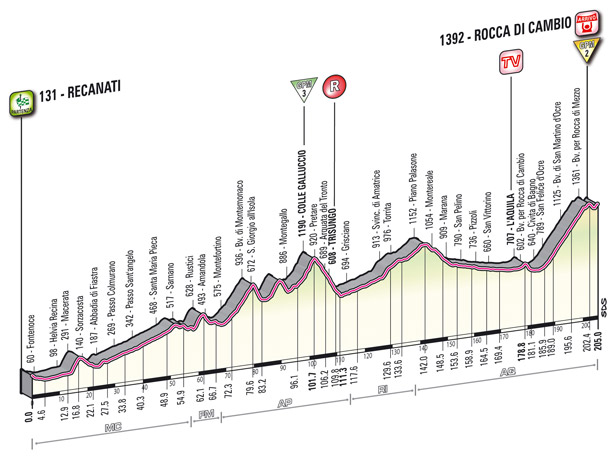
Saturday's parcours (are we really a week into the Giro already?) extended over 205km between Recanati and Rocca di Cambio (the highest village in the Apennines, where evidence of an earthquake in 2009 can still be seen despite the wealth the Campo Felice ski resort has brought). Like Stage 6, it was rated as a medium mountain stage, but the Cat 3 and Cat 2 along the way are far more like proper mountains than Friday's hills - the Cat 3 rises to 1,190m and the Cat 2 to 1,392m (British fans should remember that this "medium mountain" is 48m higher than Ben Nevis, the highest mountain in the British Isles) and as we've seen over the last couple of stages, Giro organisers use a system all of their own when hinting at how difficult a stage might be. 

Recanati was established as a city in 1150CE, growing up from villages that formed around three castles and became an independent republic 140 years later, but two necropolises dating from Neolithic times are evidence that the region was inhabited long before that. After a short downhill section over the first 5km, most of the first half of the race headed upwards with five hills leading to Cat 2 Col Galluccio some 96.1km into the race. A fast descent led into a long climb up an uncategorised 1,152km mountain (142km), then the riders enjoyed a chance to recover on a 46km descent to a little hill that came just before the 800m climb to the final few kilometres. The final 3km of this stage looked difficult on paper and seemed guaranteed to make a sprint finish improbable: the first 1.38km descended around 70m, then the remainder swung steeply upward and climbed 92m in a little over 1.6km; hitting a gradient of 10% over one 100m section 0.5km from the finish line. (Profilefinal 3km)

Ryder Hesjedal
Reto Hollenstein (NetApp), Matteo Rabbotini (Farnese Vini-Selle Italia), Fumiyuki Beppu (Orica-GreenEDGE) and Mirko Selvaggi (Vacansoleil-DCM) took off early in the stage and had grabbed a lead of 7'05" after just 27km. As the stage drew towards its end, it was obvious that Mark Cavendish (Sky) fully realised how close he came to disaster yesterday when he finished within a minute of the time limit - keeping himself securely in the most populous part of the peloton, he let the momentum of the pack carry him up the hills. 

As the finish line came within sight, José Herrada (Movistar) had a 100m lead but was rapidly caught and dropped, then Michele Scarponi (Lampre-ISD) powered away and must have believed he had it in the bag - but Paolo Tiralongo (Astana) was on him, following in his slipstream. The two Italians battled all the way over the last 300m, then Tiralongo fired up the afterburners with 100m to go, muscled his way past and was first over the line for the second Giro stage win of his career before collapsing on the cobbles completely exhausted. Frank Schleck was a slightly unexpected third, suggesting that RadioShack-Nissan manager Johan Bruyneel's emergency training camps after the Schlecks' dismal Classics campaign worked, while Ryder Hesjedal (Garmin-Barracuda) was fifth and becomes the new race leader with a 15" advantage over Tiralongo. He is the first Canadian to wear the maglia rosa leader's jersey.

Top Ten
  1.  Paolo Tiralongo Astana 5h51'03"
  2.  Michele Scarponi Lampre-ISD ST
  3.  Frank Schleck RadioShack-Nissan +3"
  4.  Joaquin Rodriguez Oliver Katusha ST
  5.  Ryder Hesjedal Garmin-Barracuda +5"
  6.  Domenico Pozzo Vivo Colnago CSF ​​Bardiani +9"
  7.  Daniel Moreno Fernandez Katusha ST
  8.  Ivan Basso Liquigas-Cannondale ST
  9.  Mikel Nieve Ituralde Euskaltel-Euskadi +11"
  10.  Gianluca Brambilla Colnago CSF ​​Bardiani ST


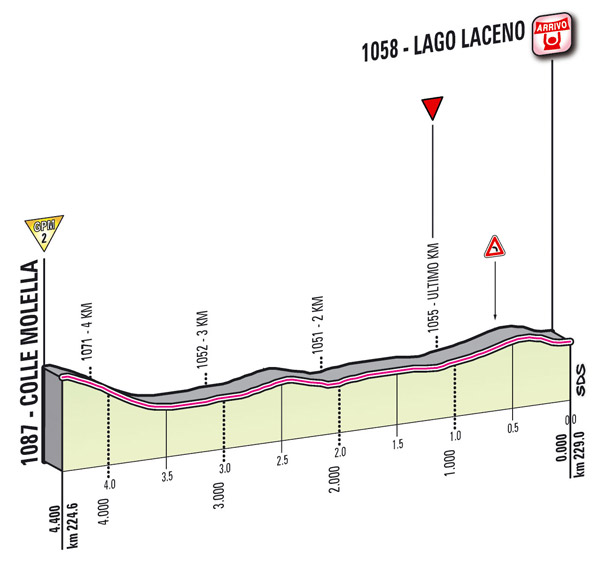
Stage 8 is another medium mountain parcours (profile) over 229km between Sulmona and Lago Laceno. Sulmona - once home to the poet Ovid - lies on the flat and fertile Valle Peligna, formed when a prehistoric lake was filled in a a result of a series of earthquakes; but the riders head skywards almost immediately as they climb the uncategorised 1,284m Piano delle Cinque Miglia. The descent is gentle at first, then becomes steep before a short flat section followed by a smaller climb preceding a fast 10km descent to the foot of the day's first opportunity for King of the Mountains points, Cat 4 Valico di Macerone (684m, 61.9km). The middle section, from 65.5km to 197.3km, is hilly rather than mountainous with nothing too challenging; the highest point (Montemerano, 836m, 193.5km) coming at the end of a long, rather than steep, climb. The last climb, Colle Molella, is far more difficult - from 212.2km it ascends 589m to the 1087m summit in 12.2km, giving an average gradient of only around 7%, but more like 12% at the steepest point according to Climbbybike. Depending on the combined effect of all those little hills along the way, this is a stage that could conceivably go to a sprinter: the final 3km are flat with a left-hand turn leading into the last 500m.

The weather on Sunday isn't going to impress - there's a 90% chance of rain and temperature highs of 14C will feel much cooler at altitude. Winds should be no stronger than 19kph.


Meersman abandons
Gianni Meersman (Lotto-Belisol), who was reported by  Sportwereld  to be suffering from a "tilted pelvis" this morning, has become the fifth rider to abandon this year's Giro after experiencing problems climbing some 70km into Saturday's Stage 7. The 26-year-old Belgian explained that while he could have finished the stage and possibly even remained competitive on future flat stages, he felt it unwise to risk compounding the problem that stems from a crash in Stage 2.

Tour of Chongming Island World Cup start list
Click to enlarge
Tour of California
Among many (European) fans, there is still a feeling that US races are insignificant frivolities, at best gaudy sideshow entertainment to keep us entertained between the grand European tours and at worst amateur attempts by the the upstart American racing scene to emulate the splendour across the Atlantic.

It's complete rubbish, of course. The Americans gave the world several of the best riders both male and female of the last three decades, they make some of the finest bikes in the world, several of their races are spectacular - how could they not be in a nation that has such a varied, beautiful landscape and so much of it - and the Tour of California, which feels far more venerable than an event in only its sixth year, is the best of them all.

Stage 1
The Tour returns this year in its usual eight stage format covering 1,180.5km, starting in Santa Rosa on the 13th of May and ending in Los Angeles on the 13th. Along the way, it visits San Franciso, San Jose, Big Bear Lake and Beverley Hills, as well as climbing mountains as high as 2,210m. Stage 1 starts in Santa Rosa (home to three-time winner Levi Leipheimer, who is racing this year but will not contest the title due to ongoing problems with injuries caused when he was hit by a car earlier this year), taking a 186.5km route first north, then west to the coast before heading south and east back to Santa Rosa. There are several climbs: an uncategorised 230m hill at 70km, three categorised hills rising to 457m (Cazadero and two climbs on Fort Ross Road) in a 20km section starting at 100km and a fifth to around 270m at 149km (Coleman Valley). At 175km, the parcours flattens out and rises only slightly on the approach to the finish line, meaning this stage is likely to end in a sprint. There are two intermediate sprints, the first coming after 52.2km, the second after 142.8km

Bruyneel served US subpoena?
According to widespread rumours, RadioShack-Nissan boss Johan Bruyneel was served with a subpoena as he stepped off his plane and onto US soil this week on his way to the Tour of California. Though the rumours remain unconfirmed, it doesn't take a huge leap of the imagination to connect the story to Floyd Landis, who rode for Bruyneel's US Postal team between 2002-2004 and is currently subject to federal investigation related to the "Floyd Fairness Fund" he set up to pay for his legal team when he was accused of doping.  (More)

Ruiter Dakkapellen closes women's team
It's always a sad occasion when a cycling team is forced to come to an end. A team is not an easy thing to put together, and keeping it together is even more difficult - managers, helpers and, away from the big salary glitz of the men's ProTour, riders put in a great deal of effort, more frequently inspired by their love of the sport than by the salaries they might receive. Even more sad is when a team facing financial hardship takes the all too common decision to save money by closing down its women's team, as has been the case with Ruiter Dakkapellen now that their main sponsor has gone bankrupt.

It's not the team management's fault, really. After all, in times when even high-profile squads such as the legendary HTC-Highroad can fall by the wayside when new backing can't be found, securing sponsorship for a relatively little-known men's team such as Ruiter is a task that would challenge Hercules. Doing the same for a women's team, when women's cycling is entirely ignored by the majority of the media and has suffered for years from what sometimes seems almost willful neglect at the hands of the UCI, would be enough to make Hercules throw his hands in the air and give up. Perhaps the managers will be fortunate and find a new company to sponsor the men. The chances of doing the same for the women is unlikely, so they're forced to release the riders so that they can seek contracts elsewhere.

Can the UCI help to prevent this happening? Almost certainly. They could provide more financial assistance to races - several have found themselves in difficulty recently, and races are what create exposure. They could also encourage more race organisers to run women's races alongside men's races, as has already been done at many of the Flanders Classics and at Britain's Halfords Tour Series - and in both cases has generated increased interest. They could create a dedicated women's cycling commission to look into what needs to be done if women's cycling is to be saved and listen more to the riders and managers, many of whom have some extremely interesting ideas. Will they? Past experiences suggest not.

Good luck Joan Boskamp, Ilona Hoeksma, Anne Heijkoop, Britt Jochems, Nathalie van Katwijk, Tessa van Nieuwpoort, Julia Soek, Lisanne Soemanta, Noortje Tabak, Annelies Visser, Hannah Welter and Melanie Woering. See you all on a parcours soon.

New team for Davide Rebellin
The 40-year-old, who returned to cycling with Christina Watches-Onfone last year from a two-year suspension after he tested positive for EPO-variant CERA at the 2008 Olympics, will now ride for Croatian Continental team Meridiana-Kamen.

British rider David McLean, who has been with Meridiana since 2011, is favourable. "What was clear when I was training with him was that firstly he is very, very good still and secondly this guy is extremely professional," he said in his blog. "He lives a dedicated lifestyle that is based solely around cycling, he has no distractions, no family, no worries, just the bike."

Scott-Contessa struck by thieves
Beth Crumpton completed the Czech
MTB World Cup round in a borrowed
bike - and still came ninth!
The Scott Contessa MTB team was targeted by thieves who stole all the junior riders' bikes last night, just a day and a half before the start of the Nove Mesto na Morave round of the World Cup in the Czech Republic...
Beth Crumpton ‏ @BethCrumptoncant believe all junior bikes were stolen last night at czech, thankyou so much to @tracy_moseley and Annie for letting me and Al borrow!
Other News
"Cyclist Willow Rockwell gives up her Olympic dream" (ESPNW)

"Moyse mulling her sporting future" (The Guardian, Canada)

"BMX: Olympian Shanaze inspires young Jamie’s world bid" (This Is Wiltshire)

"Stolen Hog Hill bike recovered by police" (Cycling Weekly)

Cycling 
British riders recreate 1955 Peace Race
It's been six years since the Peace Race was last held - once Eastern Europe's answer to the Tour de France, it gradually became superceded by other events and vanished: the end of a cycling era. This year, it lives again in the form of the Alf Buttler Peace Race Tribute Ride, in which cyclists will retrace the 2,414km and thirteen stages taken by the inaugural 1955 race between Prague (Czech Republic) and Warsaw (Poland).

Remarkably, the Ride came about as the result of one man's vision. Alan Buttler came up with the idea as a memorial to his father, a mechanic and manager with the British cycling team in the 1950s, 1960s and 1970s and who died in 2008. Alan, accompanied by Geoff Wiles (whom some might remember as British Road Race Champion in 1976 and as the man who brought BMX to Britain), has been keeping a blog journal of their travels - it makes for fascinating reading. 

The news you might have missed
Britain
"London cyclists invited to join Alex Dowsett and Sarah Storey on Nocturne Peloton ride this Thursday" (road.cc)

"Champion cyclist urges Leeds kids to saddle up" (Yorkshire Evening Post)

Worldwide 
"Travel picks: top ten cycling destinations" (Reuters)

"Olver to be honored for cycling efforts" (Gazettenet, MA, USA)

"Cycling: At 76, mountain biking 'hoon' has no plans to slow down" (NZHerald)

"Help train cycling officials, Ale begs CFN, NSC" (Vanguard, Nigeria)

Wooden bikes - "Craftsman turns love of cycling into new business" (Idaho Statesman)

BBC Radio 4 to broadcast Burton play
Burton was arguably the mot successful
British athlete of all time
Those commemorating the anniversary of the birth of the legend that was Beryl Burton will be pleased to know that later this year a short play telling the story of her life and remarkable career is to be broadcast on BBC Radio 4. Titled La Yorkshire Dame a Bicyclette, the play will star Maxine Peake - who also wrote the script, her first - as the British cyclist who won numerous titles and set world records during the 1950s and 60s.

"Despite beating men and women in championships across the globe, Beryl received no support, training or sponsorship and in fact, very little acclaim in the UK and Maxine wanted to dramatise her story," says producer Justine Potter. No date has yet been set for the broadcast, but it is likely to go out in the station's 45-minute Afternoon Drama (formerly and popularly Afternoon Play) slot.

Radio 4 is available worldwide on the Internet.