Wednesday, 13 March 2013

Daily Cycling Facts 13.03.2013

The 13th of March is the earliest day in the year that the Ronde van Vlaanderen has ever been held, falling on this date in 1921 and 1932. 1921 was the fifth edition of the race, which had started in 1913 but was not held during the First World War, and the winner was René Vermandel who also became Belgian Cyclo Cross Champion that year (and would be National Road Race Champion in 1922 and 1924). Vermandel was an early example of what we now term a Classics specialist - in addition to this victory, he took 2nd place three years later, won Liege-Bastogne-Liege in 1923 and 1924, 2nd at Paris-Roubaix in 1923 and 3rd at the semi-Classis Paris-Brussels in 1920 and 1922.

In 1932, the winner was Romain Gijssels - he'd also won in 1931 and therefore became the second rider to have won twice (the first was Gerard Debaets in 1927) and the first to have won in two consecutive years.

Paris-Nice began on this day in 1951 and 1956. 1951 was the first edition since 1946 and was organised after encouragement from Jean Medecin, the Mayor of Nice, who wanted to increase tourism in the area. This also led to a change in the race's name, and it became Paris-Côte d'Azur - however, fans and riders alike continued to refer to it as Paris-Nice and the name was officially changed back the following year. The race leader's jersey went through one of its many changes that year, becoming yellow with orange piping, and the winner was Roger Decock, who won the Ronde van Vlaanderen one year later. The 1956 winner was Fred de Bruyne, who also won the Ronde van Vlaanderen a year afterwards (and Paris-Roubaix, and Paris-Tours).

Tom Danielson
(image credit: Coda2 CC BY-SA 2.0)
Tom Danielson
Tom Danielson, born in East Lyme, Connecticut on this day in 1978, won the Collegiate Mountain Bike Championships in 2001 before becoming a professional road racer with the Mercury team in 2002 - the year he won the Tour of Qinghai Lake. A year later he won the Malaysian Tour de Langkawi, the Tour de Toona and the Redlands Classis, results good enough to get him a contract with Fassa Bortolo where he rode with Alessandro Petacchi and then with Discovery for two three seasons from 2005. That year, he rode his first Grand Tours, abandoning the Giro d'Italia after Stage 8 and later managing a very respectable 7th overall at the Vuelta a Espana.

He abandoned the Giro after Stage 19 in 2006 but won the Tour of Austria and improved his Vuelta result to 6th overall - to date, his best Grand Tour finish. The following years were quieter with fewer victories and in less prestigious events, until 2011 when he was easily the strongest American rider at the Tour de France and finished in 9th place - evidence that, aged 33 at the time of writing, he may prove to be a late bloomer.

Though primarily known as an all-rounder, Danielson excels in the mountains - at this moment, he holds the roecord for the fastest ever ascents of Mount Washington (set during the Race to the Clouds in 2002) and the Mount Evans Hillclimb in 2004. His time in the Mount Evans race, which uses the highest surfaced road in North America at 4,307m, was 1h41'20".

Louison Bobet
Louison Bobet, the first rider to win three consecutive Tours de France (but not the first to win three - that was Philippe Thys in 1913, 1914 and 1920), died on this day in 1983 - one day after his 58th birthday. Bobet was unpopular with other riders during his time and was accused of winning an easy race in 1953 - his 1954 and 1955 wins, however, were hard-fought victories over strong rivals. He was often accused of snobbery, but at least some of his peculiar habits can be viewed as ahead of their time from a modern standpoint.

However, he was more popular with fans - at the height of his fame, he traveled from France with the British rider Vic Jenner and a journalist named Jock Wadley from Sporting Cyclist to give an award at the Royal Albert Hall in London, flying over the channel in an aeroplane chartered for the occasion by Jenner. When they arrived at French Customs, it turned out that neither  Jenner nor Wadley had remembered to bring their passports with them. Fortunately, the customs officials were so busy trying to chat to Bobet and get his autograph that they completely forgot to ask for documents.


On this day in 1906, human rights advocate, suffragist and proto-feminist Susan B. Antony died in New York at the age of 86. Anthony is of interest to cyclists for her efforts to get women riding bikes and for what has become her most famous quote:
"Let me tell you what I think of bicycling. I think it has done more to emancipate women than anything else in the world. It gives women a feeling of freedom and self-reliance. I stand and rejoice every time I see a woman ride by on a wheel…the picture of free, untrammeled womanhood."
Olivier Asmaker
One of Asmaker's rare wins
(image credit: Antoine Blondin CC BY-SA 3.0)
Olivier Asmaker, born in Savigny-sur-Orge on this day in 1973, had a rather undistinguished career with his only major win being the UCI 2.2 Tour de Picardie in 2001. Yet, time and time again, there he was on the start line of some of the most prestigious races in cycling, none of which he came close to winning - the Grand Prix du Midi Libre, the Grand Prix de Wallonie, the Grand Prix de Sabinanigo, even the Critérium du Dauphiné. In fact, having signed with CSC in 2001, he almost certainly would have ridden the Tour de France that year had he not broken a collar bone earlier in the season.

Finally, at some point during the 2002 season, a team official began to wonder about the rider they'd been paying for all those years and who was so often seen in the shadow of his close friend Laurent Jalabert. He wasn't selected for the Tour that year and, as the season came to a close, he was informed that his contract would not be renewed - and despite a desperate search, nobody else wanted him either so he returned to amateur racing. Two years later, he retired from cycling and became a policeman.


Marta Vilajosana
(image credit: Ciclismo Femenino)
Marta Vilajosana, born in Barcelona in this day in 1975 (some sources say the 13th of April) won four bronze medals in the National Time Trial Championships (1998, 1999, 2002 and 2006), then silver medals for both the National Time Trial and Road Race in 2007. Finally, in 2009, she won the gold for the Road Race. She also won Stage 5 at the Giro Donne in 2006.

Wing Kam-po is a Chinese cyclist born in Hong Kong on this day in 1973 and has won several of the Far Eastls most important races, including the Tour of the South China Sea (1999 and 2001) and the Tour of the Philippines (1997) as well as several World Championship races. During the 2009 Chinese National Games, Wong and his Hong Kong team arrived at the stadium ten minutes early and were not permitted to enter by security guards. An argument broke out, culminating in the guards attacking the cyclists - coach Zhang Pak-min was badly beaten and Wong was pushed to the ground, injuring his leg. When the guards threatened to smash up a team car the police were called and the team was finally allowed into the stadium.

Lars Michaelsen, born in Copenhagen on this day in 1969, won the first stage at the 1997 Vuelta a Espana and wore the race leader's yellow jersey (since changed to gold and then red) for three days. He also achieved consistently good results at Paris-Roubaix but gave up his chances of a win to assist team captains, most notably Fabian Cancellara in 2006. The next year he finished in 11th place despite mechanical issues.

Other cyclists born on this day: Simon Geschke (Germany, 1986); Joseph Rosemeyer (Germany, 1872, died 1919); Eduardo Graciano (Mexico, 1967); Hideki Miwa (Japan, 1969); Charles Leodo (Togo, 1953); Akbar Poudeh (Iran, 1932); Roman Saprykin (USSR, 1974); Lars Michaelsen (Denmark, 1969); Denys Kostiuk (Ukraine, 1982).

Tuesday, 12 March 2013

Daily Cycling Facts 12.03.2013

Jacques Anquetil won the first of his
five Paris-Nice victories in 1957
Paris-Nice began on this day in 1953, 1955 and 1957. In 1953, the race finally began to be seen by riders as a worthy event in its own right and therefore one that was desirable to win, rather than a race to be used in preparation for other competitions. The winner that year was Jean-Pierre Munch, who also won Stages 3b and 4. The rest of his career was less notable, his only other major victory being Nancy-Strasbourg one year earlier.

1955 brought a victory for Jean Bobet, the less-talented younger brother of Louison (who was celebrating his 30th birthday as the race began, see below) - the winner three years earlier. The race leader's jersey was changed to white and the Points competition leader's jersey to pink.

1957 brought a first victory in this race for Jacques Anquetil, who would go on to become the first rider to win three, then four and finally five editions. The same year, Jean Leulliot - as editor of Route et Piste, the magazine that owned and organised Paris-Nice - became race director.

Louison Bobet
Bobet on Izoard
(image credit: Dave's Bike Blog)
On this day in 1925, Louison Bobet was born in Brittany. He was christened Louis, a name he shared with his father, so the nickname Louison came about when his family needed to differentiate between them - in Brittany, Louison is a common boy's name but elsewhere in France it's more usually used as a girl's name; so when he first started racing he used Louis but Louison caught on later (as did "La Bobette," which he is said to have loathed), and was spread by other riders who made fun of him due to his habit of crying when he performed badly.

Bobet's father was a baker but seems to have had an interest in sports because he gave his son a bike when the boy was just two years old and immediately started teaching him to ride it - within six months, the toddler was apparently able to ride 6km. Jean was encouraged to play football, while Louison and their sister were encouraged to play table tennis - Louison won the Breton Table Tennis Championship during his teenage years. His Uncle Raymond, the president of a Paris cycling club, recognised promise in the boy and took over his training, persuading him and his parents that he might make a living on the bike. He came second in his first race in 1938, later making it through to unofficial Youth Championships of 1943 when he came sixth; the race being won by none other than Raphaël Géminiani who would go on to become one of the most successful riders of the 1940s and 1950s - the beginnings of the (sometimes friendly, sometimes not so friendly) rivalry that would persist even when the two men became team mates years later. Around this time, Bobet acted as a messenger for the Resistance, smuggling secret missives right under the noses of the Nazis - detection would almost certainly have led to execution, either summarily or very soon afterwards. After D-Day, he joined the newly-formed French Army and served in the east of the country, helping to drive the Nazis out of their alpine strongholds.

Having been demobilised in December 1945, Bobet applied for a racing licence and was accidentally sent one declaring him to be an Independent - the semi-professional class of riders that were then permitted to compete in major professional races (including the Tour de France) provided they met their own costs. We don't know if he originally planned to send it back and explain the mistake, but if he did he soon realised that it would allow him to compete in both professional and amateur events - and he was sure enough of his abilities to do so (in the future, several riders put their dislike of Bobet down to his tendency to consider himself a cut or two above the rest - whom he seems to have viewed as common oiks). Having won 2nd place in the Breton Championships, he rode in the Nationals and, having attacked a pair of experienced professionals who had broken away from the peloton, dropped one before beating the other in a final sprint (during that race, he also competed against 1929 Champion and Tour veteran Marcel Bidot, who would later become his manager).

(image credit: Polygoon Hollands Nieuws
 CC BY-SA 3.0)
With the National Champion title came a professional contract from Stella, a Nantes-based bike manufacturer. The team was little-known outside Brittany until Bobet and a team mate entered the Parisian Boucles de la Seine in 1947 and which he won, crossing the finish line alone with a six-minute gap between himself and the next rider. That was enough to get him an invite to join the national team in that year's Tour de France.

However, the Tour turned out to be vastly more difficult than Bobet had expected and he abandoned during Stage 9, the Alps reducing him to tears. The press savagely attacked him for his weakness and the public scorned him for being soft; rather unfairly since they'd made a hero of René Vietto in 1934 and continued treating him as such even when his apparent heroism turned out to be distinctly tarnished. Then, in 1948, the management of the Stella team was taken over by Maurice Archambaud. Archambaud, who had won a total of ten Tour stages and worn the yellow jersey fourteen times, was a man highly qualified to spot Tour promise in a rider and he spotted it in Bobet even when nobody else did. He decided that Bobet would benefit from his expertise, and he was right: that year, Bobet took the overall lead after Stage 3. He lost it the next day, but then took it back by winning Stage 6. At this point, he had a 20-minute advantage over 2nd place Gino Bartali. Bartali would win, after a superhuman effort aimed at preventing his country from descending into civil war that has become one of the most-told instances in the Tour mythos, but Bobet came 4th - an incredible feat from a man who had been written off a year before.

The 1949 Tour was a disaster and he dropped out in Stage 11 as soon as the race reached the mountains. The next year, he raced alongside Géminiani for the first time. Géminiani, who had a habit of creating nicknames for other riders by taking a syllable from their name, changing it and then repeating it, rechristened Bobet Zonzon - which he didn't like very much but decided he could live with. After all, it was better than "Crybaby," which had become his nickname in 1947. Besides, the two men had become friends despite frequent and sometimes fierce arguments - and Bobet was presumably well aware that he didn't have many friends. The pair had hoped one of them would be in with a chance of winning that year as Fausto Coppi was absent after breaking his pelvis earlier in the year at the Giro d'Italia, but they ended up spending much of the race vying with one another for second and third place as neither stood a hope of standing up to the wild, fire-breathing Ferdy Kübler. Stan Ockers got the better of them and took second place overall, but Bobet must have been pleased with third - especially since Géminiani was fourth. Better still - and strangely, in view of his previous history - Bobet won the King of the Mountains with little difficulty, taking the jersey in Stage 11 (the first for which it was awarded) and wearing it with the exception of one single day for the rest of the race.

Bobet had another off-year in 1951, cracking so badly in the mountains that new manager Marcel Bidot gave up on him and ordered the riders he'd commanded to assist him to help Géminiani instead. He was not entered the following year - yet, Bidot still saw promise and entered him for the Critérium International, Paris-Nice and the GP des Nations and Bobet won all three, along with a number of other races. Bidot explained his faith in the rider later:
"Bobet is a good climber and time-triallist who rides with authority and intelligence. He is careful with his preparation, careful with his efforts and totally serious. An outstanding rider but has a lack of confidence. He is extremely nervous, sensitive, worried and susceptible. But with experience he will overcome the problems. A charming friend, happy, often joking and with spirit, but some days he shuts himself off, wrapped in his worries."
He was back on the start line at the Tour in 1953.

That year, Bobet won Stage 18, one of the most remarkable stages of post-war Tour history and a classic, text book example of team tactics. His team mate Adolphe Deledda, who was out in front riding with a breakaway group, received the message that Bobet had dropped Jesus Lorono on the way down from the Col de Vars and was on his way. So, he left the group and took his time while Bobet caught up, then helped him all the way to the Col d'Izoard.
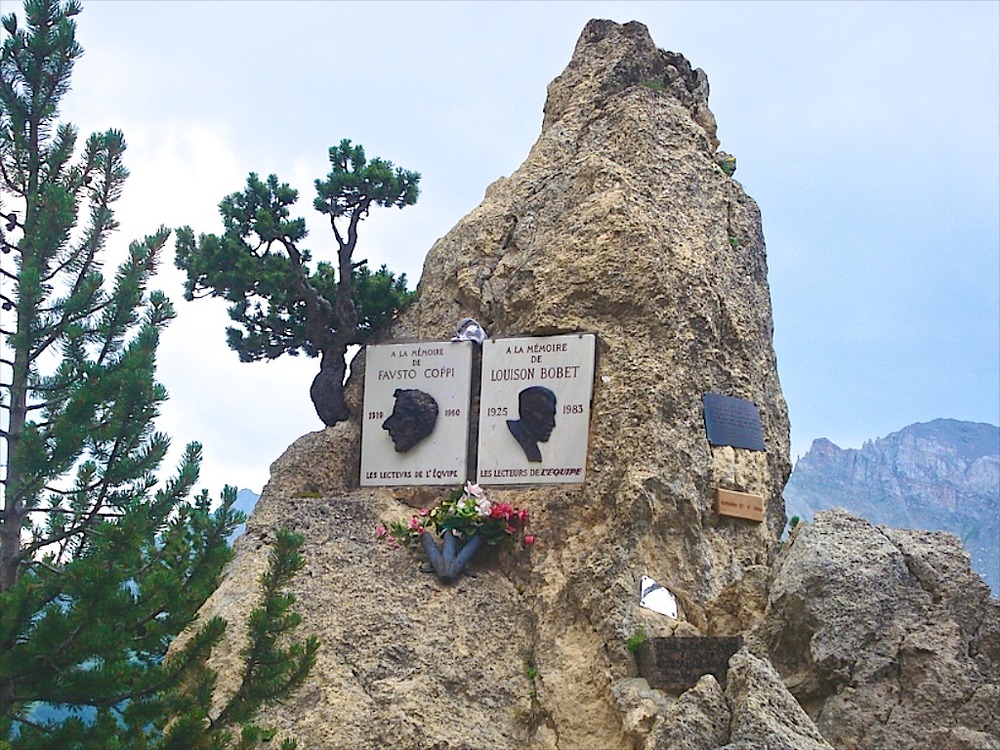
Memorial to Bobet and Coppi, Izoard
(image credit: Podium Cafe)
The landscape of Izoard is frequently compared to that of the Moon, and in those days the road was no better: merely a rough track made of loose stones picking its way between the boulders. Yet Bobet, having had chance to replenish his energy supplies while Deledda nursed him there, attacked it "as if he had wings," according to race historian Bill McGann. At the top, waiting to see the race go by, was Fausto Coppi with the Woman in White, his mistress Giulia Locatelli. Bobet, as we have noted, considered himself above the hoi-polloi; but he knew greatness when he saw it and thanked the Italian for coming as he sailed by.

When he reached Briançon, he had a five minute advantage - enough to retain the yellow jersey for the rest of the race. A perfect individual time trial in Stage 20 won him the race with an advantage of 14 minutes. When he crossed the finish line he was greeted by Maurice Garin, winner of the first Tour, there to celebrate the 50th.

It was not long after the race was over before his victory began to be picked apart. Coppi had not been there and Bartali, at 38, was not the man he had once been. Koblet, the winner in 1951, had abandoned following a crash in Stage 10 and Kübler hadn't entered. The general consensus was that while Bobet's Izoard win had been impressive, the opposition throughout the race had not been up to much. 1954 was a different matter entirely - the Italian team still hadn't replaced its greatest ever stars but the Belgians and the Dutch were formidable - and Kübler was back. Bobet took the yellow jersey in Stage 3, but lost it in Stage 7 to Wout Wagtmans who kept it for four days before Gilbert Bauvin took it in Stage 11. All the while, Bobet fought hard to get it back, eventually doing so in Stage 13 and keeping it to the end. Another perfect time trial gave him 15 minutes on Kübler - and this time, nobody could deny he'd won a hard race.

In 1955, Pierre Rolland appeared to be the strongest French rider and Bidot ordered Bobet to support him. However, Rolland's strength faded in the mountains, unable to withstand the sheer ferocity of repeated attacks on the unforgiving climbs by a young Luxembourgish rider named Charly Gaul. Bobet, though suffering from a saddle sore that would later lead to an oft-told tale in which he couldn't bring himself to describe the affected body parts when asked for details of the surgery he underwent after the race, completely bamboozling her by insisting that he had experienced problems with his pockets. Géminiani, who had been listening in, decided the time had come to end the lady's confusion. "Oh for heaven's sake, Zonzon," he interrupted, "tell her you've got bloody balls."

(image credit: Dave's Bike Blog)
Yet Bobet rode on, and suffered for it. The saddle sore led to necrosis and a large quantity of rotting flesh had to be cut away from his groin, in some cases stopping just short of important organs. He won that year - the first man to win three consecutive Tours, but in doing so he had destroyed his chances of winning again and he knew it. He entered again in 1958 but was visibly unwell throughout the race, suffering badly as he drove himself on and somehow finished in 7th place overall. He never finished another Tour after that.

Bobet, as we have noted, was not popular among other riders who found him stuck-up and distant. A large part of that perhaps needs to be reattributed to his being several years ahead of his time - the rest, meanwhile, can be put down to the fact that he genuinely was rather an obsequious little snob who believed himself to be the very pinnacle of sporting endeavour: as Géminiani (his friend, remember) said, "He really thought that, after him, there'd be no more cycling in France." When he refused point blank to wear the yellow jersey the frst time he won the right to do so, explaining that he wouldn't wear synthetic fibres, it wasn't because he considered the cheaper material not befitting his status; it was because as a man who had suffered saddle sores in the past he realised that natural fibres would allow sweat to wick away from his skin (any modern rider who has suffered the same affliction and been ordered to wear soft cotton underwear by a doctor knows this is the case). He acted like a Hollywood star, which was put down to self-importance; but could also be seen as an understanding that the cult of personality was going to be how he made his living once he retired, thus predating the boxers and footballers who make fortunes selling their image to the fashion industry today. When he attacked his country for its involvement with the war against Communist rebels in Indochina, it wasn't because he was unpatriotic or, as many claimed, himself a Marxist - he explained that he was simply a pacifist, thus anticipating the wider adoption of anti-war beliefs in the 1960s.

As might be expected of a man who was so concerned for his own health, Bobet refused to take drugs at a time when doping was beyond rampant in a sport not yet woken up by the death of amphetamine-addled Tom Simpson on Mont Ventoux. Whether or not he did take them is debatable - he may have believed he did not, but Jacques Anquetil and Eddy Merckx were reduced to paroxysms of laughter at a formal dinner organised by the Tour's organisers when Bobet, having informed them that he never doped, added that before races he had drunk small bottles of an unknown fluid prepared for him by his personal soigneur Raymond Le Bert (he was ahead of his time on that one, too - nobody else had ever employed a soigneur of their own).

On Mont Ventoux
(image credit: Mariocipo.sportblog)
Bobet also gave rise to what is now a Tour tradition - he was the first rider to divide up the money he won for the race and distribute it among his domestiques. However, he didn't do so out of pure altruism: he was so furious at what he saw as his team's treachery in helping Nello Lauredi (who shares a record three Critérium du Dauphiné victories with Charly Mottet, Luis Ocaña and Bernard Hinault, fact fans!) to win the sprint finish of Stage 13 in 1953 that he took the team to task at dinner that night. Tempers flared as the team took a one for all route and argued that they'd supported the rider most likely to win the stage while Bobet - unsurpringly, went down the all for one road and countered that since he was the team leader they should have supported him. Before too long, the team manager had a fight on his hands and before too long, the riders were refusing to support Bobet altogether. He had to think fast and came up with a solution - would they support him if he agreed to split the money he won with their help between them? Of course, they agreed - in this way, a humble domestique makes far more money than he otherwise would from a Tour - and so did Bobet, who was more than intelligent enough to realise that a Tour victor makes more money from his glory after the race than he does by winning it.

In retirement, Bobet became involved in a number of business ventures and used his fame to ensure they got attention. The best-known of these was his development and promotion of the distinctly scientifically-shaky alternative health treatment thelassotherapy, which was invented in Brittany in the 19th Century and claims to improve well-being through the absorption of beneficial minerals found in sea water (administered using a variety of methods including hot and cold showers, muscle rubs and going for a swim). He opened a thelassotherapy resort at Quiberon and, with his canny understanding of the power of celebrity, named it after himself. It's still in operation to this day, albeit under the new name Miramar Crouesty, and going by the numerous favourable reviews on independent French tourism websites is doing very well.

Bobet died of cancer on the day following his 58th birthday in 1983 and is buried in the cemetery at Saint-Méen-le-Grand, the town where he was born. In addition to his three General Classifaction and one King of the Mountains victories at the Tour, Bobet also won the Mountains Classification at the Giro d'Italia in 1951; the World Championship in 1954; the National Championship in 1950 and 1951; the Critérium des As (1949, 1950, 1953 and 1954); Milan-San Remo, the Giro di Lombardia and the Desgrange-Colombo Trophy in 1951; the Critérium International (1951 and 1952); the Tour of Flanders, the Critérium du Dauphiné and the Tour de Luxembourg (1955); Paris-Roubaix in 1956 and Bordeaux-Paris in 1959.

Not bad for a crybaby.

The Death of Andrei Kivilev
Andrei Kivilev, 1973-2003
(reuse information)
Right back in 1991, the UCI began moves to make the wearing of protective helmets compulsory in all races - which at the time were unpopular with riders for an assortment of reasons; some examples being that they made your head sweaty, they were heavy, they looked funny and simple conservative resistance to change. So, in Paris-Nice that year, there was a rider's protest and the new rules were not put into place.

Then, in the same race 12 years later, Kazakh rider Andrei Kivilev got into a crash with Cofidis team mate Marek Rutkiewicz and Gerolsteiner's Volker Ordowski. The two men he'd hit were unhurt and finished the stage but Kivilev fell heavily, hitting his head hard on the road and did not get up. When doctors reached him moments later, he was in a coma.

Kivilev was taken immediately to the nearest hospital at Saint-Chamond, then to the intensive care unit at St. Etienne from where it was announced that he'd sustained two broken ribs and a serious skull fracture. The next morning - the 12th of March - he died at 10am. He was 29 and left behind his wife and six-month-old baby son.

The following stage was dedicated to Kivilev's memory and ridden slowly, without attacks. Meanwhile, the UCI once again suggested making helmets compulsory in all races and this time - partly due to how much they'd improved since 1991 and largely because of the shock of seeing a popular, prominent rider such as Kivilev killed in such an apparently minor, everyday crash - there was little opposition. At first, the rule was not stringently enforced and riders would often remove their helmets during steep climbs; but now all UCI-sanctioned events demand riders wear them at all times and will disqualify any rider who removes his or her helmet during a race.

(image credit: thomasrdotorg CC BY 2.0)
Phil Anderson
Phil Anderson was born in London on this day in 1958 but moved to Melbourne in Australia with his family during early childhood. His reputation for crashing frequently - which remained with him throughout his career - did not prevent him from winning the Tour of New Zealand while still an amateur in 1977. A year later he won gold at the Commonwealth Games and the National Amateur Road Race Championship, also riding with the victorious National Amateur Time Trial team; then - as have so many promising riders from English-speaking nations - he joined the legendary Athletic Club de Boulogne-Billancourt and took up residence in France to be at the heart of the sport. That season, riding alongside Robert Millar, he won the amateur GP des Nations and the prestigious Issoire criterium.

Turning professional in 1980 with Peugeot-Esso-Michelin, Phil recalls a distinct sense that French riders were getting preferential treatment over the foreign counterparts. However. as is typical of him, he didn't sulk - "I had to go a bit deeper or had to be a little better than some of my colleagues on the team. But that hardened me, and put pressure on me, and I think became part of my make-up in the end," he says. He won two races and finished on the podium in three others that year before moving to Belgium to concentrate on criteriums. he won the Tour de l'Ause that year and - more importantly - made four appeareances on the Tour de France podium, coming 10th overall.

Most impressively of all, his third place finish on Stage 5 had put him into the overall lead and so he became both the first Australian and first non-European to wear the yellow jersey - by accident. He said after the race that he had been assigned to help his team's General Classification contender through the mountainous stage (the only one in the Pyrenees that year), but gone into what he called "survival mode" as he worked to get himself up the climbs:
"I forgot my instructions and just sort of went in to survival mode over a number of mountain passes, just staying up with some of the top riders, and before I knew it, my team director came up beside me in his car and told me, 'Listen, what happened to your leader, the guy that you've been instructed to watch today?' you know. And to help if he has any troubles, or just pace him back if he's having some troubles. And I said, 'Oh gee, that's right. Where is he?' And he said, 'he's five or ten minutes back, in the next group.' I said, 'No worries I'll wait up for him.' He said, 'No, no, stay up here, you're doing OK, just stay out of trouble and try and hang on as long as possible."
The rest is Tour legend. Anderson not only kept going, he kept up with Bernard Hinault when the Badger was at the height of his powers and only Lucien van Impe could get away to win the stage. Afterwards, he said that the first thing on his mind was relief at escaping the chore of rinsing out his sweaty jersey that evening: "Oh yes, great, I don't have to wash my old jersey tonight, you know, get a new one."

(image credit: Steel Wül)
In 1982, he won Stage 2 and the overall Youth Classification, then won a second Tour de l'Aude and 9th overall at the Tour de France in 1983. In the 1984 Tour he was 10th, then a year later he won the Critérium du Dauphiné - frequently evidence that a rider is destined to be a Tour winner within the coming years - along with the Tour de Suisse, Tour Méditerranéen and Volta a Catalunya, also driving himself hard to achieve 2nd place at Gent-Wevelgem and the Tour of Flanders, and once again he came 5th in the Tour. His 1986 result was a shock - 39th overall, suggesting that the arthritis that would be diagnosed a few years later had already begun to cause problems. He rode seven more Tours, his last in 1994 (he missed 1988), but his best result was 27th in 1987; however, he had a successful year in 1991 when he won Stages 1, 3 and the General Classification at the Tour of Britain, Stages 6, 6 and the General Classification at the Tour Méditerranéen and Stage 10 at the Tour de France.

Anderson retired in 1994, having moved Australian cycling several steps along the path that began with Ivor Munro and Don Kirkham when they became the first Australians to ride in the Tour in 1914. Could Anderson have won a Tour? The general consensus is that had he only have been born a couple of years earlier or later, yes. Unfortunately, he happened to be one of those riders whose best years coincided with one of the all-time Tour greats: had Hinault not then been the rider he was, Australia's first Tour win might have come some three decades before Cadel Evans in 2011. Australia recognised that - Anderson has never been thought of in his home nation as an also-ran and was lauded as a hero as early as 1987 when he was awarded the Order of Australia. Retirement has been good to him - he invested some of his prize money in a farm in Jamieson, Victoria, where he still lives. In 2000, he received the Australian Sports Medal and then a year later the Centenary Medal.


On this day in 2011, John Allan Butterworth set a new Para-Cycling World Record when he completed 1000m in 1'07.615". Butterworth's left arm is a prosthetic, which clips into a socket mounted on his handlebar. In 2004, Alois Kaňkovský set a new record for a Czech rider when he rode 1000m in 1'02.452" at Aquascalientes, Mexico.

Jeremy Hunt
(image credit: Thomas Ducroquet CC BY-SA 3.0)
Jeremy Hunt, who is now of British nationality, was born on this day in Macklin, Canada in 1974. He turned professional with Banesto (the team that became Movistar) in 1996, riding in support of Miguel Indurain following some good amateur results including an overall win at the 1992 Junior Tour de Lorraine and stages at the Commonwealth Bank Classic, and remained with them for a four year period during which he became British Road Race Champion and added numerous further stage wins. In 2000, he moved on to BigMat-Auber93, winning the Sea Otter Clasic that year and a second National Road Race Championship a year later, then spent a season with MBK-Oktos. For the next four seasons he joined Mr.Bookmaker.com-Palmans and remained a part of the team through the transformation into Unibet, then signed with Crédit Agricole for 2008 and rode his first Grand Tour, the Vuelta a Espana. The following year he was with Cervélo TestTeam, entering his first Tour de France in 2010, then signed to Sky for 2011 and finished the Tour of Qatar in sixth place overall; later in the season he rode with the British team at the World Championships, helping to make Mark Cavendish the first British World Champion since Tom Simpson 46 years previously.


Ed Clancy
Born in Barnsley on this day in 1985, Ed Clancy is another British cyclist whose career has been associated with that of Mark Cavendish - he rode with the Manx Missile to take second place in the Madison at the 2004 National Track Championships, before Cav decided to concentrate on road cycling (and eventually carved out one of the most illustrious careers the sport has ever known) while Clancy remained primarily in the velodrome. The majority of Clancy's successes have been in Team Pursuit events; he rode with the victorious squad at the World Championships in 2005, 2007, 2008 and 2012, during numerous rounds of the World Cup from 2006 onwards and at the the Olympic Games of 2008 and 2012. However, he also performs well in Omnium (World Champion 2010, bronze Olympics 2012) and on road (winner 2009 Eddy Soens Memorial and Stage 5 2011 Tour of Korea).


Damian McDonald was born in Wangaratta, Australia on this day in 1972. He was part of his nation's reserve team at the Olympics in 1992 but did not compete in the main team's silver medal-winning ride, then won a gold medal at the Commonwealth Games two years later. In 1996, he was part of the main Olympic team and won the first Malaysian Tour of Langkawi. On the 23rd of March 2007, McDonald was driving through the Burnley Tunnel in Melbourne when a broken-down truck caused a  pile-up with two other trucks and four cars, one of which exploded. The tunnel's automatic safety system instructed people in the tunnel to leave their vehicles and walk to safety. He died in the resulting fire during which temperatures inside the tunnel reached 1000C, leaving behind his wife and two-year-old son.

Stanislas Bober, born on this day in 1930 in Nanterre, won Stage 3 at the 1953 Tour de France - the first year Louison Bobet won overall.

André Desvages, born in France on this day in 1944, won Stage 5a at the Tour de France in 1968. However, he is chiefly remembered for the time he served as technical director of the Gitanes team, during which he signed up a young Breton rider named Bernard Hinault.

Serbian Ivan Stević was born in Belgrade on this day in 1980. On the 20th of July as he crossed the finish line while winning Stage 4 at the Tour of Qinghai Lake, he stuck his middle finger up (an offensive gesture) at  mechanic who had made joke about his fitness. Judges disqualified him from the rest of the race in response. In October the same year, the UCI disqualifed all his results for a two-year period from the 17th of September 2008 after he was found to have used or attempted to use "a prohibited substance or method."

Other cyclists born on this day: Ed Clancy (Great Britain, 1985); Dietmar Hauer (Austria, 1968); Marcel Beumer (Netherlands, 1969); Jens Mouris (Netherlands, 1980); Frank Weber (Germany, 1963); Daniel Becke (Germany, 1978); Zhu Yongbiao (China, 1976); Marcello Bartalini (Italy, 1962); Milan Perič (Czechoslovakia, 1928, died 1967); Magnus Knutsson (Sweden, 1963); Gregorio Aldo Arencibia (Cuba, 1947).

Monday, 11 March 2013

Daily Cycling Facts 11.03.2013

Paris-Nice started on this day in 1973, 1981, 1982, 2001 and 2007. 1973 brought the second of Raymond Poulidor's two consecutive wins, but was the second of four for his Gan-Mercier-Hutchinson team because Joop Zoetemelk won the next two editions. The race that year covered the shortest parcours in its history, just 850km - less than half the longest, 1,955km in 1959.

Contador at Paris-Nice, 2007
(image credit: Goldenbembel CC BY 2.0)
Stephen Roche became the first Irishman to win in 1981 - and with Sean Kelly winning the next year and then  for the following six in a row, Ireland became the nation with the third highest number of victories in the history of this race. In addition to the second Irish win, 1982 saw the death of Jean Leulliot, who had been involved in the race ever since 1951 when the event - which had been run once since the Second World War, in 1946, but not again - was revived by Route et Piste magazine at the suggestion of Nice's mayor Jean Medecin who thought it would attract tourists, then became race director in 1957. After his death, his daughter Josette took over and became possibly the only female director of a major international event in the history of cycling. That wasn't the only notable aspect of Paris-Nice that year - it also started in a foreign country for the first time: at Luingne in Belgium.

Dario Frigo won in 2001, when the race began in Nevers - an excellent result for a relatively little-known rider, but one that he may not have won fairly: at the Tour de France four years later, he was arrested after police found ten doses of EPO hidden in his wife's car and his career came to an end. Alberto Contador won in 2007 after his Discovery team gave a textbook demonstration of tactics and their effectiveness, skillfully grinding away at Gerolteiner until they were powerless to assist leader Davide Rebellin as he tried in vain to keep up with the Spaniard on the final climb. The classification leaders' jerseys have been altered numerous times during the history of Paris-Nice and 2007 saw changes to two: the Points jersey changed back to green for the first time since 1954 and the Youth jersey became white after being blue and white since the classification's introduction in 2002.


Christian Henn
(image credit: Diane Krauss CC BY-SA 3.0)
Christian Henn, born on this day in 1964 in Heidelberg, is a retired cyclist who won a bronze medal in the 1988 Olympics and Stage 13 of the 1995 Vuelta a Espana, later becoming National Road Race Champion in 1996. In 2007, he and several ex-team mates (Rolf Aldag, Erik Zabel, Udo Boelts and Bert Dietz) admitted to having used EPO while riding for Telekom (the team that would become T-Mobile and, eventually, HTC-Highroad who took one of the strictest lines against doping until closing at the end of 2011) in the 1990s.

Slovenian mountain biker Blaža Klemenčič was born on this day in 1980 and won several honours in competitive skiing and mountain climbing before cycling. She won the European MTB Marathon Championship in 2004 and was 4th in the same event in 2010.

Jan Zybert, born in Lodz, Poland in 1908, won 3rd place in the sprint at his National Track Championships in 1927 and competed in the 1928 Olympics. His real name was Jan Siebert, a Jewish surname, and he is believed to have died sometime in 1943 either during his country's occupation by the Nazis or in a death camp.

On this day in 2003, Kazakh rider Andrei Kivilev collided with Cofidis team mate Marek Rutkiewicz and Gerolsteiner's Volker Ordowski at the Paris-Nice. The two men he'd hit were unhurt and finished the stage but Kivilev fell heavily, hitting his head hard on the road and did not get up. When doctors reached him moments later, he was in a coma and died the next day, leaving behind his wife and baby son. Kivilev's death forced riders to accept a new UCI proposal to make the wearing of helmets compulsory in all races and, as such, has almost certainly saved many lives.

Steffen Wesemann, born in Wolmirstedt, Germany on this day in 1971, won the Peace Race a record five times (1992, 1996, 1997, 1999, 2003). He also won the 2004 Tour of Flanders and came 3rd at Paris-Roubaix in 2007 before retiring in 2008.

Peter Bissell was born on this day in 2007 at Hitchen, UK. He was 2004 British Hill Climb Champion and, in 2006, became Under-23 Road Race Champion. He was born on the 11th of March 1986 in Stevenage, Hertfordshire and died after suffering a fit, aged 21.

Tanel Kangert, born in Vändra, Estonia in 1987 won some good results as an amateur, leading to a contract with AG2R-Prévoyance for 2007 - which he repaid with victory at the Tour du Gevaudan, the Tour de Franche Comté Cycliste and the Under-23 Road Race Championship. He won the National Time Trial Championship at Elite level the next year but was forced to miss 2009 in its entirety after a knee injury that both threatened his future career and led to him being sacked by the team. In 2010, he was able to find a place on his national team and won another National Time Trial title, later being offered a contract with Astana for 2011 and riding the Vuelta a Espana with them.

Other cyclists born on this day: Giuseppe Martinelli (Italy, 1955); Harry Kent (New Zealand, 1947); Liam Phillips (Great Britain, 1989); Mircea Romaşcanu (Romania, 1953); Negousse Mengistou (Ethiopia, 1932); Eduardo Uribe (Mexico, 1970); Mohamed Kholafy (Egypt, 1977); Unto Hautalahti (Finland, 1936); Qian Yunjuan (China, 1977); Alfred Tonello (France, 1929, died 1996); Alfredo Dinale (Italy, 1900, died 1976).

Sunday, 10 March 2013

Daily Cycling Facts 10.03.2013

Raymond Impanis
Paris-Nice started on this day in 1954, 1958, 1961, 1963, 1969, 1971, 1977, 1991, 1996 and 2002. Raymond Impanis won the first of his two victories in 1954, the year that also saw a Points competition at the event for the first time - the Points leader wore a green jersey, but the next year it changed to pink. Impanis' second win would not be until 1960, meaning that Fred de Bruyne became the second man to have won twice in 1958 as he'd also won in 1956.

Jacques Anquetil won for a second time in 1961, then for a third in 1963 when he became the first man to have won that many times. Up until 1963, the race always started in Paris but it would move to other cities from this point onwards. Eddy Merckx won in 1969, starting off on the way to becoming the first man to achieve three consecutive victories - his last was on this day in 1971. The finish was moved to the Col d'Eze that year and would remain there until 1995, except for in 1977 when landslides on the col made it impossible for riders and team cars to get up there. Freddy Maertens won that year and Bernard Thevenet failed an anti-doping test (despite his earlier claim to "have never taken drugs; they wouldn't be any use") but escaped serious punishment and won the Tour de France later that year. Or at least, he thought he'd escaped  punishment - the next year, after a series of poor results, he decided he'd better get checked out and was told that the steroids had done permanent, serious damage to his adrenal glands. He then became a vociferous opponent of doping.

Tony Rominger
(image credit: Eric Houdas CC BY-SA 3.0)
Tony Rominger became the race's first Swiss winner in 1991 and the start was moved to Fontenay-sous-Bois where it would remain until 1995. In 1996 Laurent Jalabert won the second of three consecutive victories after the race started in Châteauroux and the Points competition returned for the first time since 1984 with a new yellow jersey, the corporate colour of sugar-producing sponsor Béghin-Say.

Alexandre Vinokourov, who is ethnically Russian but of Kazakh nationality became the first winner from his country in 2002. Laurent Fignon, who had owned the race for a number of years, sold it to the Amaury Sports Organisation, owners of the Tour de France, who retain ownership to this day. They changed the General Classification leader's jersey to yellow and white (and would drop the white in 2008) and the Points competition leader's jersey to green white, also introducing a Youth Classification for the first time and adding a blue and white jersey for that. The finish line was moved to Issy-les-Moulineaux and stayed there until 2007.

Lyne Bessette
(image credit: James F. Perry CC BY-SA 3.0)
Lyne Bessette
Lyne Bessette, born Lac Brome, Quebec on this day in 1975 and represented Canada in the Olympics of 2000 and 2004. Her first major success as a professional was the King of the Mountains at the 1999 Tour de Suisse Feminin, followed by the Tour de l'Aude and Redlands Classic the same year. In 2000, she won the Tour de Toona and the Fitchburg Longsjo Classic, then the Women's Challenge in 2001 (she also won the Points competition and was second in the Mountains Classification, an extremely impressive achievement) along with the National Time Trial and Road Race Championships and both the Fitchburg Longsjo Classic and Tour de l'Aude for a second time.

A third Fitchburg Longsjo Classic (and the Sprints Classification) came in 2002 when she also won the Sea Otter Classic and came 2nd overall at La Flèche Wallonne, one of the most prestigious races on the women's cycling calendar. She won another Tour de Toona and came 2nd overall at the Tour de l'Aude a year later, then won for a third and final time at Toona in 2004, making her the most successful rider of either sex in the 25-year history of the race, and won the Nature Valley GP. Bassette's husband Tim Johnson is also a professional cyclist.

Russell Allen
Russell Allen, born in Orwell, Ohio on this day in 1913, represented the USA in the 1932 Olympics, then turned professional for Schwinn and enjoyed a successful career on track until the Second World War when he first worked in defence and then joined the Navy, qualifying as a Petty Officer (2nd Class) and spending the rest of the war teaching swimming and survival skills.

He found employment as a car salesman after the war, retiring in 1962 and worked as a volunteer at the 1984 Olympics, more than a half a century after competing in them, and since then has devoted his life to charities that organise trips for disadvanted children to sporting events. He would regularly complete rides of 100km in his late 80s and is still cycling at the time of writing, though he had to give up bungee jumping at the age of 93 in 2006. That same year, he became the oldest American Olympian.

Kate Sheppard
Kate Sheppard, cyclist and suffragist,
1847-1834
Kate Sheppard, born Katherine Wilson Malcolm in Liverpool on this day (or thereabouts, records are lost) in 1847. She went to school in Scotland and received an education that, while extremely religious, was exceptionally comprehensive compared to that experienced by the majority of girls of the time. In 1869, seven years after the death of her husband, Kate's mother Jemima packed the entire family off to New Zealand in search of new opportunity.

In the 1880s, Sheppard became involved with the suffrage movement, partly due to her support for temperance (women in the 19th Century drank far less than men, leading to female temperance activists supporting women's suffrage out of a belief that women would drive stricter alcohol regulations through parliament) and is recognised as one of the leading lights of the cause; playing an important role in the struggle that led to New Zealand becoming the first self-governing nation to grant the vote to all women over the age of 21 in 1893 (Great Britain wouldn't catch up until 1928). In common with many feminists and suffragists, she was passionate about cycling and saw the bicycle as a means to emancipate women, providing them with the ability to travel independently and of their own free will, becoming one of the first female cyclists in New Zealand and joining the Atalanta Cycling Club in 1892.

Sheppard died on the 13th of July, 1934 and is buried in Addington Cemetery in Christchurch. The house she built and lived in with her husband Walter still stands at 83 Clyde Road, around 4km from her grave.


Luke Rowe
Born in Cardiff, South Wales on this day in 1990 and later joined the famous Maindy Flyers club and began racing. He showed sufficient promise to be selected for the British Cycling Olympic Development team and made his first international appearance at the 2008 European Track Championships, riding the Team Pursuit, then the following year rode with the Manx star Mark Christian, also winning a silver medal at the European Road Race Championships. In 2011 Rowe won Stage 7 at the Thüringen Rundfahrt and was fifth overall at the Tour de Normandie, bringing interest from professional trade teams including Team Sky with whom he signed his first professional contract for a two-year period beginning in 2012. In September that year, he won Stage 1 at the Tour of Britain, and 2013 he was ninth overall at the Tour of Qatar.

Rowe comes from a cycling family - his first taste of cycling came when he was taken for a ride on his parents' tandem. His father, Courtney Rowe, is a professional coach working with the Paralympian road and track cyclist Simon Richardson; his brother Matthew is also a successful road and track rider.


Ezquerra was first to the top of the Cols du Télégraph and
Galibier in 1934
Fédérico Ezquerra was born in Gordexola, Euskadi on this day in 1909 and began racing professionally in 1928, winning numerous races throughout Spain before taking the National Track Stayers Championship title in 1933. The next year, now signed to Orbea, he entered the Tour de France for the first time and came 3rd on Stage 4 and 5th in the overall King of the Mountains. In 1936, still with Orbea, he won Stage 11 and was 3rd in the King of the Mountains, then racing as an individual the following year he was 3rd in Stage 10. In 1940 he won the National Road Race Championship, the won Stage 13 at the Vuelta a Espana in 1941 before rounding off his career with wins at Spanish races and retiring in 1944. He died on the 30th of January, 1986.


Other cyclists born on this day: Luke Rowe (Wales, 1990); Miloš Jelínek (Czechoslovakia, 1947); Choi In-Ae (North Korea, 1969); Enzo Frisoni (San Marino, 1947); Anders Jarl (Sweden, 1965); Māris Štrombergs (Latvia, 1987); Tamás Csathó (Hungary, 1956); Gustaf Westerberg (Sweden, 1884, died 1955); Masashi Omiya (Japan, 1938); Grimon Langson (Malawi, 1955); Suriyong Hemint (Thailand, 1948); Andris Reiss (Latvia, 1978); Sanji Inoue (Japan, 1948); Rodolfo Vitela (Mexico, 1949); Lew Elder (Canada, 1905, died 1971); László Mahó (Hungary, 1941).

Saturday, 9 March 2013

Daily Cycling Facts 09.03.2013

Roger Lapébie
Paris-Nice began on this day in 1937, 1960, 1962, 1964, 1965, 1972, 1974, 1975, 1983, 1997, 2003 and 2008. 1937 was the fifth time the race had been held and it was won that year by the Frenchman Roger Lapébie who, a few months later, would also win the Tour de France, being the first rider to do so with a modern derailleur gear system - whether he was similarly equipped for Paris-Nice seems to have been forgotten. Raymond Impanis became the third man to have won the race twice in 1960, his previous win having been six years earlier, and Joseph Planckaert won in 1962 - a notable year because, at 1,532km, it was the longest edition ever with the exception of the 1959 race that had gone from Paris to Nice and then on to Rome.

Jan Janssen won in 1964, then Jacques Anquetil became the first man to have won four times in 1965. He would win again the following year and become the first man to five victories. 1972 went to his arch-rival Raymond Poulidor, which France divided into two groups - those who followed Anquetil and those who favoured Poulidor. The race was hit by its first big doping scandal in 1974, the year it was won by Joop Zoetemelk who would win the Tour six years later: Roger Legeay tested positive for amphetamines and was banned, but later returned to racing after a presidential amnesty. Zoetemelk won again in 1975, the year that the start was moved to Fontenay-sous-Bois.

1983 saw a second consecutive victory for Irishman Sean Kelly, who would go on to win for the following five years and set a record that is unlikely to ever be broken. In 1997, Laurent Jalabert became the first man to win three times consecutively - and doping raised its ugly head once again as Luca Colombo, Erwann Mentheour and Ivan Santaromita were barred from taking part after recording haematocrit counts greater than 50%, indication of blood tranfusions or EPO.

Davide Rebellin
(image credit: Heidas CC BY-SA 3.0
Alexandre Vinokourov won for a second consecutive year in 2003, dedicating his victory to his team mate Andrei Kivilev who was killed during the race. Kivilev, who was not wearing a helmet, had collided with Marek Rutkiewicz and Volker Ordowski and fallen heavily during Stage 2. Rutkiewicz and Ordowski were unhurt, but Kivilev broke two ribs, fractured his skull and entered a coma. He died at 10am the following day, aged 29. Following Kivilev's death, the UCI made helmets compulsory in all races, as they had tried to as long ago as 1991 but were prevented by rider protests - ironically, at Paris-Nice. The year also saw another doping scandal after Milaneze-MSS team mates David Bernabeu and Rui Lavarinhas tested positive for steroids. Bernabeu had won the final stage and was downgraded after the test.

2008 brought victory for Davide Rebellin who, later that year, would be confirmed as one of six athletes to fail anti-doping tests at the Olympics. The race that year was overshadowed by a heated row between the Amaury Sports Organisation, who had owned the race since it was sold to them by Laurent Fignon in 2002, and cycling's governing body the UCI. The ASO, which also owns the Tour de France and numerous other major races in addition to assisting with many others, had become sufficiently powerful to challenge the UCI on decisions with which they disagreed, causing the UCI to assert authority by removing Paris-Nice from its ProTour race series and threaten that any team entering the event would be banned from UCI membership - effectively making it impossible for them to race. The Court for Arbitration in Sport became involved but declared itself unable to judge - eventually, the two opposing bodies came to an agreement and the race went ahead. There were two firsts that year: the start was moved to Amilly and the leader's jersey, which had undergone numerous alterations since the race began, became yellow to match that of the Tour de France.


Roberto Ferrari was born on this day in Gavardo, Italy in 1983. In 2009 he won the Memorial Marco Pantani and in 2011 he was 5th overall at the Tour of Turkey.

Ryan Bayley, born in Perth on this day in 1982, is an Australian track cyclist who became involved in a notorious feud with fellow Aussie track star Shane Perkins. Perkins crashed in the National Championships and Bayley rode into him, his tyre burning a hole into his rival's skinsuit. Perkins felt that the other man could have avoided him, so the animosity they already felt for one another boiled over. In February 2008, both riders were found guilty of improper riding by event judges, but the row continued Perkins and Bayley as they sniped at each other over whom should be selected for the Beijing Olympics later that year. Bayley was eventually selected as Perkins had not competed in a sufficient number of races.

Jakob Piil
(image credit: Heidas CC BY-SA 3.0
Jakob Storm Piil
Born in Virum, Copenhagen on this day in 1973, Jakob Piil began his professional career on track before his aggressive attacking style won him a contract as a road racer with Memory Card-Jack&Jones, the team that would become CSC and later Saxo Bank-Sungard. However, in his first year on road he crashed into a car and was out for much of the season.

During Stage 10 of the 2003 Tour de France, Piil was part of a nine-rider break that got away from the peloton. Gradually, other riders exhausted themselves and dropped away to be caught by the chasing pack until eventually only Piil and Fabio Sacchi remained. They were seen to shake hands as the finish line came within sight and then began battling to be the first over. Sacchi looked to be winning, but with a few metres to go Piil emerged from his back wheel and powered past him to take his first - and only - Tour stage victory. He tried again in 2004 but was unsuccessful, though his efforts made him a very deserving winner of the Combativity Award for Stages 2 and 8.

2005 was ruined by more crashes - the closest he came to a major road win was 8th in Stage 6 of the Vuelta a Espana, but victory at the Copenhagen Six Days prevented the year from being entirely wasted. He formed part of the winning squad in the 2006 Settimana Ciclistica Internazionale Coppi-Bartali Stage 1b team time trial, then rounded off his career with some podium finishes at other races before retiring in 2007.

Francisco Mancebo
Francisco Mancebo
(image credit: Richard Masoner CC BY-SA 2.0
Francisco Mancebo, born in Madrid on this day in 1976, can both climb and hold his own in a time trial which makes him a talented stage race cyclist. After turning professional in 1998, he spent the next eight years with the Banesto team through its various incarnations  and took some very respectable wins with them including the Youth classification at the Tour de France in 2000; the Vuelta a Burgos in 2002; the Classique des Alpes and Vuelta a Castilla y León in 2003 (also coming 5th overall at the Vuelta and 10th overall at the Tour that year) and 3rd overall at the Vuelta, 4th at the Tour, also winning the National Road Race Championship in 2005.

At the end of the 2005 season, he was offered a contract by AG2r Prévoyance, a strong team that offered him the best chance of a future Tour win. 2006 started off well with 5th place overall at the Critérium du Dauphiné. Then, his name was one of the many to be connected to that of Doctor Eufemiano Fuentes as part of the Operación Puerto doping scandal which resulted in him being kept away from the Tour that year. He announced his immediate retirement, but ended his contract with the team and signed up to Relax-Gam after the investigation found no reason to prosecute.

Remaining with Relax for a season, he won the Vuelta Chihuahua Internacional and achieved podium finishes at the Tour of Qinghai Lake and elsewhere before Fercase - Paredes Rota dos Móveis signed him up for 2008 and he won a second Vuelta Chihuahua Internacional. At the end of the season, he moved on to Rock Racing and won the Vuelta a Asturias, the Tour of Utah and the Spanish National Mountain Bike Marathon, but again stayed for only one season before signing to Heraklion. He won another National MTB Marathon in 2010 and came 8th overall in the UCI America Tour, then switched to Realcyclist.com and, at the age of 35, had the best year of his career with 14 victories including San Dimas, the Redlands Classic, the Sea Otter and several others.

Asghar Khodayari, born in Iran on this day in 1953, represented his nation at the 1976 Olympics. With Akbar Goharkhani, he set up the Azerbaijan International Cycling Tour in 1986 - the race has taken place in Iranian Azerbaijan every year since.

Francisco Antequera, born in Castellar on this day in 1964, was Spanish Amateur Road Race Champion in 1984. He also won the Vuelta a La Rioja in 1985 and the Vuelta a Burgos in 1989. He rode in five Tours de France, best result 94th on 1986 and three Vueltas a Espana, best result 81st in 1988.

Giuseppe Tonucci, born on this day in Fano, Italy in 1938, won Stage 10 at the 1962 Giro d'Italia.

Joseph Muller was born in Orschwiller (which, in our opinion, has the most impressive castle in France) on this day in 1895. He's been largely forgotten now, but was a cyclist of some repute during the 1920s when he won Stage 12 at the 1923 Tour de France and came 6th overall - beating Romain Bellenger, Philippe Thys, Jean Alavoine and several others who are listed in many more books on cycling history that he is - in 1924, also winning Paris-Nancy that year. Muller died in the 8th of May, 1975.

Marco Velo - the owner of what is surely the best name of any cyclist - was born in Brescia, Italy on this day in 1974. Velo was National Time Trial Champion between 1999 and 2000.

Other cyclists born on this day: Andy Tennant (Great Britain, 1987); Karl Kühn (Austria, 1904); Thomas Freienstein (Germany, 1960); Roger Gibbon (Trinidad and Tobago, 1939); Karl Krenauer (Austria, 1959); Kurt Zellhofer (Austria, 1958); Kirkor Canbazyan (Turkey, 1912, died 2002).

Friday, 1 March 2013

Daily Cycling Facts 01.03.2013

Gastone Nencini
Gastone Nencini (nicknamed "The Lion of Mugello" after his birthplace, Barberino del Mugello in Tuscany), was born on this day in 1930. He was an example of that rarest of cycling breeds, an ace climber (he won the King of the Mountains at the Giro d'Italia and the Tour de France in 1957) who could also descend at high speed. Most climbers, due to their typically skeletal figures, lack the physical mass to keep a bike under control while riding fast down a hill - but according to French National Champion and multiple Tour stage winner Raphaël Géminiani, "the only reason to follow Nencini downhill would be if you had a death wish." Roger Rivière, a fast descender and several times a Tour stage winner himself, ignored that advice in 1960 when he tried to follow the Italian down from the Col de Perjuret - shortly after beginning the descent, he hit a low wall, plunged over the side and broke his spine. He spent the rest of his life in a wheelchair. Even more unusually for a rider who could climb like he did, Nencini was a chain smoker.

Nencini was the inspiration for one of the first anti-doping drives, set up by official Tour doctor Pierre Dumas after he saw the rider injecting himself with stored blood. He'd learned the technique from Swedish runners, who had apparently been using the technique for several years.

In 1957, the year he won his two King of the Mountains competitions, he also won the Giro outright, beating 2nd place Louison Bobet by 19" and 3rd place Ercole Baldini by almost six minutes. His Tour win came in 1960, when he also finished the Giro in 2nd place overall, beating Graziano Battistini by more than five minutes. Nencini died on the 1st of February in 1980.

Tyler Hamilton
(image credit: Rob Annis CC BY 2.0)
Tyler Hamilton
Tyler Hamilton, who was born on this day in Marblehead, Massachusetts on this day in 1971, became one of the most prominent professional cyclists in the late 1990s and beginning of the 21st Century partly as a result of his association with Lance Armstrong (his subsequent accusations that Armstrong used performance-enhancing drugs has earned him both enemies and fans), partly due to his own excellent results and largely because of his intelligence, affability and personality. His golden retriever Tugboat, once a frequently-seen and popular character as he waited at the finish line with Hamilton's (now ex-)wife Haven, enjoyed equal popularity and was memorably interviewed on more than one occasion. There is a moving account of the dog's death in Daniel Coyle's Lance Armstrong: Every Second Counts.

Hamilton began cycling whilst still at school, but was more interested in ski racing when he was at university (his BA in economics has been questioned by some authors, most notably David Walsh in From Lance to Landis: Inside the American Doping Controversy at the Tour de France, but he can be assumed to have graduated with a reasonable degree of certainty). He also rode mountain bikes, giving up skiing when a mountain bike accident on a ski jump broke two of his vertebrae. He rode his first Tour de France in 1998, working hard for Armstrong in the mountains and time trials.

His palmares in impressive and includes several prestigious victories such as the Danmark Rundt in 1999, Stages 2, 5 and the General Classification at the 2000 Critérium du Dauphiné; Stage 14 and 2nd in the General Classification at the 2002 Giro d'Italia; Liège–Bastogne–Liège, Stage 5 and the General Classification at the Tour de Romandie and Stage 16 at the Tour de France in 2003; an Olympic gold medal; a National Championship and the Tour of Qinghai Lake. He would almost certainly have won many more had he not have spent so much of his career suspended from racing as a result of numerous doping violations.

The first came in 2004, right after his Olympic win when the IOC accused him of doping during the race. However, as his B-sample had been destroyed when an Athens laboratory froze it, he escaped a ban and was permitted to keep the medal. He was less fortunate later in the same year when he was caught out at the Vuelta a Espana: having abandoned the race due to stomach problems, it was announced that a sample given after his Stage 8 time trial win showed a "foreign blood population" - in other words, Hamilton had received a transfusion of somebody else's blood in order to boost his own haematocrit levels, oddly enough the very thing that Gastone Nencini had been seen doing when he inspired one of the Tour's first anti-doping efforts. His team, Phonak, supported him, but withdrew their support after another team member was shown to have used the same technique. Investigation revealed that in April 2004, a hemoglobin to reticulocytes (count of new red blood cells) had registered 132.9. 133 is considered likely evidence of either blood doping or EPO use and results in automatic suspension (a "clean" healthy athlete will register around 90). One year later, he was formally suspended for two years effective from the date of his Vuelta sample. A month later, he mounted an appeal based on accusations that important documents supporting his case had been suppressed/concealed and the bizarre possibility that he might be a chimera, the medical term given to an individual carrying genetically distinct cells from an absorbed zygote with which they shared a womb - the phenomenon popularly known as a "parasitic twin." The appeal was dismissed and Hamilton would later disavow the chimera theory, which appears to have been entirely an invention of his lawyers.

Hamilton with Rock Racing, 2008
(image credit: Richard Masoner CC BY-SA 2.0)
Just three month before his ban was due to expire, his name came up in Operación Puerto when several newspapers published allegations that the investigation had revealed a payment of US$50,000 made by him into an account owned by the notorious Dr. Eufemiano Fuentes. Hamilton denied making the payment, stating that he had never received any treatment from Dr. Fuentes and claimed that he had not been contacted by Spanish authorities. He returned to professional cycling at the start of the 2007 season with Tinkoff Credit Systems, soon becoming involved in a messy dispute after the team attempted to renegotiate his contract - and pay him much less than it had originally agreed - in the light of new rumours concerning his alleged doping.  The rider took the team to court, won the case and then won a subsequent appeal. At the time of writing, the case is subject to civil litigation. Unsurprisingly, his contract was not renewed; but he was signed up by Rock Racing.

In April 2009, it was announced that Hamilton had provided another positive sample during the off-season, this time revealing traces of the anti-depressant steroid 5-Dehydroepiandrosterone - a drug of questionable value to the rider, as tests have shown no effect on physical performance except in the case of ageing women. Nevertheless, as a steroid it is banned by the World Anti-Doping Agency and, now aged 38, the rider realised his career was likely to be at an end and retired, also revealing that he suffered from depression and had been receiving medical treatment for it for two years. This might have gone in his favour; but it was demonstrated that he was aware that 5-Dehydroepiandrosterone was a banned substance and chose not to inform cycling authorities that he was taking medication. Two months later, he was suspended for eight years.

During his career, Hamilton continued to insist that he was not doping and had never done so. However, in May 2010, he finally came clean and made what is accepted as a full confession during which he also implicated Lance Armstrong. Haven and Hamilton divorced ("amicably," according to both parties) in 2009 and it is reported that he will marry Lindsay Dyan in 2012.

Reg Harris
Reginald Hargreaves Harris, born on this day in 1920 in Bury, Lancashire, became Britain's greatest track cyclist during the 1940s and 1950s with no fewer than four National Amateur Sprint titles (1944, 1945, 1946, 1947), one World Amateur Sprint Championship (1947), a GP de Paris Amateur Sprint win (1946), a professional National Tandem Championship (1948), two silver Olympic medals (1948), one professional European Sprint Championship (1955) and four professional World Sprint Championships (1949, 1950, 1951, 1954)s.

Hargreaves, as he was christened, lost his father at the age of six and took his stepfather's surname when his mother remarried. He left school when he was 14 without any qualifications and was fortunate enough to find an apprenticeship in a car garage, which paid him enough to buy his first bike with which he entered a "roller race" competition organised by Hercules, among the first British bike manufacturers to run a racing team. There is no record of the race to tell us whether he won or not, but that his performance was good enough to earn him an invite to join the Lanacashire Road Club and compete with them suggests he probably did fairly well. He began racing in individual time trials the following year and won his first race, a grass-shortrack event.

Realising that he could make a living from cycling during the summer but would need a source of income during the off-season, Harris found employment at a papermill where he would work for three winters. In 1938, he beat the National Sprint Champion and in 1939 was invited to join the British team that would be competing in the World Championships in Milan. However, shortly after he arrived in Italy and spent some practice time on the famous Velodromo Vigorelli - reputed to be the world's fastest - the Second World War broke out and the team were recalled to Britain.

Harris served as a tank driver in North Africa during the war, being declared unfit and sent home after an injury in 1943. The following year he was racing again and won the first of his National titles, then when the war was over was invited to compete in France where he even impressed the notoriously hard-to-please Parisian crowds. He was unable to compete in the World Championships in 1947 after being left bruised and aching by a heavy-handed masseur. By this time, he was being provided with equipment and (possibly) a salary by Claud Butler, in those days a frame builder of considerable repute rather than a name stuck onto cheap, low quality bikes, but managed to retain his amateur status so that he could be entered into the 1948 Olympics in London. Then, he broke three vertebrae in an on-road training ride, but had recovered in time only to break his elbow in a British race with a few weeks to go before the Games began. Nevertheless, he entered and won his two silver medals.

With the Olympics over, Harris turned professional with a contract from Raleigh and won his first World Championship. He retired in 1957, became the manager of the Fallowfield Stadium which would be renamed in his honour (sadly now demolished and replaced by student accommodation) and worked with Raleigh in a series of business ventures all of which failed. He was, unfortunately, not much of a businessman - after giving up with Raleigh he set himself up producing bikes, but even the cachet his name carried was not enough to prevent the firm going under after just three years. He then did some promotional work with a waterproof coat manufacturer, then found jobs with companies that produced foam rubber.

Harris continued to cycle daily and, in 1971, started racing again. Despite a chronic lack of practice, he won a bronze medal in the National Championships which apparently convinced him that if he trained, there were still a few victories left in his legs - and he was proved right in 1974 when, now aged 54, he won a final British championship. In 1975, he won silver after being beaten by the man he had beaten the year before. He continued to cycle daily until his age made it impossible to do so and died of a stroke on the 22nd of June, 1992. He is buried at St. John's Church in Chelford, Cheshire. The village hosts the start and finish of numerous time trials and other races each year and the church holds an annual Christmas carol service in Harris' memory.


Barney Storey was born in Great Britain on this day in 1977. He and blind team mate Anthony Kappes won two gold medals at the 2008 Paralympics and at the time of writing holds the 200m Tandem World Record - Barney's wife Sarah also won a gold medal in the same Games, competing in the Individual Pursuit. In 2006, they became National Tandem Sprint Champions - the first (and so far only) paralympic team to have done so.

Christian Müller, born in Erfurt, East Germany in 1982, won the German and European Under-23 Individual Time Trial Championship in 2004.

Brian Jolly, winner of the 1965 Tour of Ireland and British Road Race Champion 1973, was born on this day in 1946.

On this day in 2004, the bike component manufacturer SRAM purchased bike brake manufacturer Avid.

Other births: Stefan Nimke (Germany, 1978); Christian Lyte (Great Britain, 1989); Zhang Liang (China, 1983); Choy Yiu Chung (Hong Kong, 1961); Claudio Pérez (Venezuela, 1957); Julio César Herrera (Cuba, 1977); Svein Gaute Hølestøl (Norway, 1971); Mićo Brković (Yugoslavia, 1968).