Showing posts with label cheating. Show all posts

Wednesday, 27 November 2013

Daily Cycling Facts 27.11.2013

Happy birthday Wendy Houvenaghel!
(image credit: johnthescone CC BY 2.0)
Wendy Houvenaghel
Wendy Houvenaghel, the Northern Irish track cyclist, was born on this day in 1974. Houvernaghel  has won a vast collection of trophies during her illustrious years as a professional including three gold medals in the UCI Track World Championships, four golds in the UCI Track World Cup and a silver at the 2008 Beijing Olympics.

Now based in Cornwall, Houvernaghel was interested in running, horse riding and hockey in her youth, only discovering her talent for cycling during her time with the Royal Air Force. Whilst in the RAF, she rose to the rank of Squadron Leader and qualified as a dentist - which would prove handy once she completed her commission as it allowed her to support herself before she gained a professional contract.

She took part in her first race in 2002 at a time when she had little cycling experience, yet one year later she became National Individual Time Trial Champion - a meteoric rise that left the cycling world in no doubt that a serious new talent had arrived and thankful that she had done so just in time for her best years when they could so easily have been swallowed up by military service. In 2004, she won every time trial she entered. However, it seems that now she's well into her late 30s, Houvenaghel's best years are far from behind her - in fact, 2011 was one of her best yet with two gold medals won at the World Track Championships and the Track World Cup (in both cases for the Team Pursuit event), a third gold at the National Circuit Time Trial Championships and a new 25 Mile Time Trial national record plus victory at the National Individual Time Trial Championship then in 2012 she on silver in the 3km Pursuit at the World Track Championships and gold at the Celtic Chrono, the Chrono Champenois (beating second place Carmen Small by 1'26") and successfully defended her National Individual Time Trial Champion title.

Considering her continuing success, fans were surprised when Houvenaghel was not selected for the Pursuit team at the 2012 Olympics; she later claimed that she had been promised a place on the squad based on good performances during training and had been passed over in favour of Joanna Rowsell despite Rowsell being ill a few hours before the race.

Julien Moineau
Moineau in the 1935 Tour de France
Julien "The Sparrow" Moineau was born on this day in 1903. That he was a talented rider was evident as far back as 1924 when he won Paris-Le Havre and the Circuit de Bourgogne, victories he followed up by winning Stage 14, coming 3rd on Stage 15 and 2nd on Stage 19 at the Tour de France the next year. He won Stage 8 and came 2nd on Stage 13 the year after that, too, demonstrating that he was undoubtedly a man with impressive Tour ability.

More successes came in the following years: the Circuit du Forez, three Paris-Limoges, Paris-Tours - a palmares with of any professional would very rightfully feel proud. However, Moineau will be forever remembered not for these victories, but for the way in which he won his last Tour stage, Stage 17 from Pau to Bordeaux in 1935.

It wasn't an enormously long stage by the standards of the day, being 224km (four days previously, they'd faced a mountain stage more than 100km longer). It was also flat and came right after a rest day - in other words, it shouldn't have been difficult. But, when the riders woke that morning, it was already hot and the humidity was high: one of those sultry days that the French term a canicule that sometimes settle over south-western France like a hot, sticky blanket when the cooling winds stop blowing from the High Pyrenees and the Atlantic and the air gets hotter and hotter without respite until eventually, blessedly, the wind starts up again.

Moineau - perhaps the most
popular cheat in cycling history
Understandably, nobody was much in the mood for racing and the peloton was ambling along at 20km; riders wanting to simply get through the day with as little effort as possible. Then, the leaders saw what they probably first assumed to be a mirage, either that or an early symptom of heatstroke: just up ahead, an entire village had turned out with trestle tables, erecting them at the side of the road and loading them up with abundant quantities of delicious, ice-cold beer for their intrepid heroes. Astounded by the hospitality of the local fans, the riders were of course more than happy to stop for a break, all of them thankful for the relief the refreshing liquid brought to their parched throats. Even after they'd all had as much as they wanted there was plenty of beer left, so they loaded themselves up with as many bottles as they could fit into their jersey pockets before thanking their benefactors and heading back onto the road.

They probably didn't even realise that one rider hadn't stopped and was now far away in front of them. Moineau, who had rolled up to the start line that morning with a 52-tooth chainring - in those days, when the Tour was more a contest of endurance rather than speed, unheard-of off the track and a seemingly insane choice in that terrible heat - had set the whole thing up at his own expense, and the "generous villagers" were in fact a group of his friends.

Strangely, Moineau was not penalised for his cheating. Perhaps the organisers thought that the other riders were thankful for a free drink on such a horrible stage and hence didn't  resent his stage win.
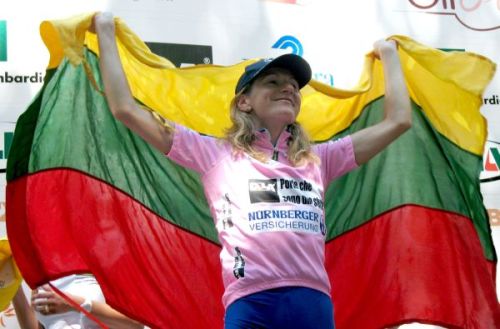

Edita Pučinskaitė
(image credit: Yay Cycling)
Edita Pučinskaitė, born on this day in 1975 in Naujoji Akmenė, is the most successful female cyclist to have yet come out of Lithuania. Her best years have been 2005 with stage wins at Giro del Trentino Alto Adige - Südtirol, the Thüringen-Rundfahrt der Frauen, the Tour de l'Ardèche and the Vuelta Ciclista Femenina a el Salvador and overall victory at the Berner Rundfahrt, Tour de l'Ardèche and Vuelta Ciclista Femenina a el Salvador and 2007 when she won the Berner Rundfahrt, the Giro del Trentino Alto Adige - Südtirol and, her best result so far - the Giro Donne.

Thea van Rijnsoever, Dutch National Champion in 1983 and 1985, was born on this day in 1956.

Iván Gutiérrez
(image credit: Adam Baker CC BY 2.0)
José Iván Gutiérrez Palacios, more commonly known as Iván Gutiérrez, was born in the Cantabrian town of Hinojedo on this day in 1978. While he's been highly successful in mass-start road races including a win at the National Championship in 2010, the Gran Premio de Llodio, the Giro dell'Emilia, the Tour Méditerranéen, the Eneco Tour of the Benelux and many others, he is primarily known as a time trial rider. His first big win in the discipline was the Under-23 World Championship in 2002 and he has gone on to be National Champion five times (2001, 2002, 2004, 2005 and 2007) along with winning the time trials at a series of stage races including the Vuelta a Murcia (2004and 2006) and the Vuelta a Burgos (2006). Like a surprisingly high number of time trial specialists (considering the differences between the two disciplines), Gutiérrez can also climb when required to do so - he won the King of the Mountains at the Critérium du Dauphiné in 2005.

Oksana Grishina, silver medalist in the 2000 Sydney Olympics for the Track Sprint, was born on this day in 1968.

Rudolf Mitteregger, winner of the Tour of Austria in 1970, 1974 and 1977, was born on this day in Gaal, Austria, in 1944.

Theo Eltink, like his nation's current most famous cyclist Marianne Vos and many others, showed promise as a speed skater before deciding to concentrate on cycling. He was born in Westelbeers, Eindhoven, Netherlands, in 1981 and would later become a member of Rabobank TT3, a team that served as a training ground for young riders hoping to be offered a contract with the professional Rabobank team. While still an amateur, he won stages at the Tour de l'Avenir and Tour des Pyrénées, also taking a bronze medal in the Under-17 class at the 1997 National Cyclo Cross Championships and then a silver in the Under-23 class in 2003. The team gave him his chance to turn professional in 2005 and he entered his first Grand Tour - the Giro d'Italia, at which he managed an impressive 29th in the overall General Classification. At the Giro the following year he was 53rd, but upped his best stage result from tenth to fifth, then managed an eighth place stage finish and 24th overall at the Vuelta a Espana. Oddly, he never did better than that - he was 95th at the Vuelta in 2007, 77th at both the Giro and the Vuelta in 2008, after which he left Rabobank and moved to Skil-Shimano. Following a year without good results, the team did not renew his contract and, unable to secure a position elsewhere, he retired.

On this day in 2006 in the early hours of the morning, Spanish rider Isaac Gálvez López died of injuries sustained when he hit crash barriers following a collision with Dimitri De Fauw during the Six Days of Ghent the previous day. He was 31 years old and had been married for three weeks. De Fauw suffered terrible depression after the accident and committed suicide on November the 6th, 2009.

Francesco Chicci
(image credit: johnthescone CC BY 2.0)
Happy birthday Francesco Chicci, stage winner at the Four Days of Dunkirk, Tour of Britain, Tour of Denmark, Tour of Qatar and Tour of California and Under-23 World Road Race champ in 2002. He was born in Camaiore, Italy, in 1980.

Jan Schur, son of the famous East German cyclist Gustav-Adolf Schur, was born on this day in 1962 in Leipzig. Now retired, he represented his country in the 1988 Olympics.

Other births: Carl Lorenz (Germany, 1913, died 1993); Ian Banbury (Great Britain, 1957); Dick Ploog (Australia, 1936, died 2002); Juan Brotto (Argentina, 1939, died 2009); Arnulfo Pozo (Ecuador, 1945); Batsükhiin Khayankhyarvaa (Mongolia, 1958); Brian Keast (Canada, 1953); Jonathan Garrido (Spain, 1973); Sirop Arslanian (Lebanon, 1966).

Tuesday, 27 November 2012

Daily Cycling Facts 27.11.2012

Happy birthday Wendy Houvenaghel!
(image credit: johnthescone CC BY 2.0)
Wendy Houvenaghel
Wendy Houvenaghel, the Northern Irish track cyclist, was born on this day in 1974. Houvernaghel  has won a vast collection of trophies during her illustrious six years as a professional including three gold medals in the UCI Track World Championships, four golds in the UCI Track World Cup and a silver at the 2008 Beijing Olympics.

Now based in Cornwall, Houvernaghel was interested in running, horse riding and hockey in her youth, only discovering her talent for cycling during her time with the Royal Air Force. Whilst in the RAF, she rose to the rank of Squadron Leader and qualified as a dentist - which would prove handy once she completed her commission as it allowed her to support herself before she gained a professional contract.

She took part in her first race in 2002 at a time when she had little cycling experience, yet one year later she became National Individual Time Trial Champion - a meteoric rise that left the cycling world in no doubt that a serious new talent had arrived and thankful that she had done so just in time for her best years when they could so easily have been swallowed up by military service. In 2004, she won every time trial she entered. However, it seems that now she's well into her late 30s, Houvenaghel's best years are far from behind her - in fact, 2011 was one of her best yet with two gold medals won at the World Track Championships and the Track World Cup (in both cases for the Team Pursuit event), a third gold at the National Circuit Time Trial Championships and a new 25 Mile Time Trial national record plus victory at the National Individual Time Trial Championship then in 2012 she on silver in the 3km Pursuit at the World Track Championships and gold at the Celtic Chrono, the Chrono Champenois and successfully defended her National Individual Time Trial Champion title.

Considering her continuing success, fans were surprised when Houvenaghel was not selected for the Pursuit team at the 2012 Olympics; she later claimed that she had been promised a place on the squad based on good performances during training and had been passed over in favour of Joanna Rowsell despite Rowsell being ill a few hours before the race.

Julien Moineau
Moineau in the 1935 Tour de France
Julien "The Sparrow" Moineau was born on this day in 1903. That he was a talented rider was evident as far back as 1924 when he won Paris-Le Havre and the Circuit de Bourgogne, victories he followed up by winning Stage 14, coming 3rd on Stage 15 and 2nd on Stage 19 at the Tour de France the next year. He won Stage 8 and came 2nd on Stage 13 the year after that, too, demonstrating that he was undoubtedly a man with impressive Tour ability.

More successes came in the following years: the Circuit du Forez, three Paris-Limoges, Paris-Tours - a palmares with of any professional would very rightfully feel proud. However, Moineau will be forever remembered not for these victories, but for the way in which he won his last Tour stage, Stage 17 from Pau to Bordeaux in 1935.

It wasn't an enormously long stage by the standards of the day, being 224km (four days previously, they'd faced a mountain stage more than 100km longer), it was also flat and came right after a rest day - in other words, it shouldn't have been difficult. But, when the riders woke that morning, it was already hot and the humidity was high: one of those sultry days that the French term a canicule that sometimes settle over south-western France like a hot, sticky blanket when the cooling winds stop blowing from the High Pyrenees and off the Atlantic and the air gets hotter and hotter until the wind starts up again.

Moineau - perhaps the most
popular cheat in cycling history
Understandably, nobody was much in the mood for racing and the peloton was ambling along at 20km; riders wanting to simply get through the day with as little effort as possible. Then, the leaders saw what they probably first assumed to be a mirage, either that or an early symptom of heatstroke: just up ahead, an entire village had turned out with trestle tables, erecting them at the side of the road and loading them up with abundant quantities of delicious, ice-cold beer for their intrepid heroes. Astounded by the hospitality of the local fans, the riders were of course more than happy to stop for a break, all of them thankful for the relief the refreshing liquid brought to their parched throats. Even after they'd all had as much as they wanted there was plenty of beer left, so they loaded themselves up with as many bottles as they could fit into their jersey pockets before thanking their benefactors and heading back onto the road.

They probably didn't even realise that one rider hadn't stopped and was now far away in front of them. Moineau, who had rolled up to the start line that morning with a 52-tooth chainring - in those days, when the Tour was more a contest of endurance rather than speed, unheard-of off the track and a seemingly insane choice in that terrible heat - had set the whole thing up at his own expense, and the "generous villagers" were in fact a group of his friends.

Strangely, Moineau was not penalised for his cheating. Perhaps the organisers thought that the other riders were thankful for a free drink on such a horrible stage and hence didn't  resent his stage win.


Edita Pučinskaitė
(image credit: Yay Cycling)
Edita Pučinskaitė, born on this day in 1975 in Naujoji Akmenė, is the most successful female cyclist to have yet come out of Lithuania. Her best years have been 2005 with stage wins at Giro del Trentino Alto Adige - Südtirol, the Thüringen-Rundfahrt der Frauen, the Tour de l'Ardèche and the Vuelta Ciclista Femenina a el Salvador and overall victory at the Berner Rundfahrt, Tour de l'Ardèche and Vuelta Ciclista Femenina a el Salvador and 2007 when she won the Berner Rundfahrt, the Giro del Trentino Alto Adige - Südtirol and, her best result so far - the Giro Donne.

Thea van Rijnsoever, Dutch National Champion in 1983 and 1985, was born on this day in 1956.

Iván Gutiérrez
(image credit: Adam Baker CC BY 2.0)
José Iván Gutiérrez Palacios, more commonly known as Iván Gutiérrez, was born in the Cantabrian town of Hinojedo on this day in 1978. While he's been highly successful in mass-start road races including a win at the National Championship in 2010, the Gran Premio de Llodio, the Giro dell'Emilia, the Tour Méditerranéen, the Eneco Tour of the Benelux and many others, he is primarily known as a time trial rider. His first big win in the discipline was the Under-23 World Championship in 2002 and he has gone on to be National Champion five times (2001, 2002, 2004, 2005 and 2007) along with winning the time trials at a series of stage races including the Vuelta a Murcia (2004and 2006) and the Vuelta a Burgos (2006). Like a surprisingly high number of time trial specialists (considering the differences between the two disciplines), Gutiérrez can also climb when required to do so - he won the King of the Mountains at the Critérium du Dauphiné in 2005.

Oksana Grishina, silver medalist in the 2000 Sydney Olympics for the Track Sprint, was born on this day in 1968.

Rudolf Mitteregger, winner of the Tour of Austria in 1970, 1974 and 1977, was born on this day in Gaal, Austria, in 1944.

Theo Eltink, like his nation's current most famous cyclist Marianne Vos and many others, showed promise as a speed skater before deciding to concentrate on cycling. He was born in Eindhoven, Netherlands, in 1981 and would later become a member of Rabobank TT3, a team that serves as a training ground for young riders hoping to be offered a contract with the professional Rabobank team. While still an amateur, he won stages at the Tour de l'Avenir and Tour des Pyrénées, also taking a bronze medal in the Under-17 class at the 1997 National Cyclo Cross Championships and then a silver in the Under-23 class in 2003. The team gave him his chance to turn professional in 2005 and he entered his first Grand Tour - the Giro d'Italia, at which he managed an impressive 29th in the overall General Classification

On this day in 2006 in the early hours of the morning, Spanish rider Isaac Gálvez López died of injuries sustained when he hit crash barriers following a collision with Dimitri De Fauw during the Six Days of Ghent the previous day. He was 31 years old and had been married for three weeks. De Fauw suffered terrible depression after the accident and committed suicide on November the 6th, 2009.

Francesco Chicci
(image credit: johnthescone CC BY 2.0)
Happy birthday Francesco Chicci, stage winner at the Four Days of Dunkirk, Tour of Britain, Tour of Denmark, Tour of Qatar and Tour of California and Under-23 World Road Race champ in 2002. He was born in Camaiore, Italy, in 1980.

Jan Schur, son of the famous East German cyclist Gustav-Adolf Schur, was born on this day in 1962 in Leipzig. Now retired, he represented his country in the 1988 Olympics.

Other births: Carl Lorenz (Germany, 1913, died 1993); Ian Banbury (Great Britain, 1957); Dick Ploog (Australia, 1936, died 2002); Juan Brotto (Argentina, 1939, died 2009); Arnulfo Pozo (Ecuador, 1945); Batsükhiin Khayankhyarvaa (Mongolia, 1958); Brian Keast (Canada, 1953); Jonathan Garrido (Spain, 1973); Sirop Arslanian (Lebanon, 1966).

Sunday, 17 July 2011

Tyler Farrar speaks to US News

We mentioned in the Stage 15 Debrief post earlier that Tyler Farrar had made a comment apparently questioning Mark Cavendish's performance in the final sprint of the stage. Is he trying to express suspicion, or did he just make a slightly poor choice of words? We're not convinced he meant anything by it, but you can make your own minds up - here it is:


0'25", Farrar: "Well, er, Cav made a really remarkable comeback after being dumped in the grupetto for about 70k yesterday..."
1'10", narrator: "...don't quite know what he was implying when he said Cav made a big comeback yesterday when he was dropped by the peloton..."


(Also, we'd like to state we don't believe Mark Cavendish cheated in any way whatsoever.)

Friday, 24 June 2011

Clean or not, Contador's presence in the Tour will not be an embarrassment

British hopeful Bradley Wiggins, who recently won the Critérium du Dauphiné and in doing so proved himself back to the form he displayed when he came fourth in the 2009 Tour de France, has said that "it is not a good thing [for cycling] that a bloke who tested positive four times is in the race" in reference to Alberto Contador who tested positive for the banned bronchodilator Clenbuterol during last year's Tour.

Contador, like any professional cyclist at the top of his game, is no stranger to the murky world of doping. In 2006 he became caught up in the notorious Operation Puerto which followed Jesus Manzano's exposure of widespread doping in his team and the shady practices of Doctor Eufemiano Fuentes, but was subsequently cleared of all charges by the Spanish courts and by the UCI. He was questioned again in connection with the case in December and rather inadvisably refused to submit to a DNA sample which would have either proved or disproved links to nearly a hundred bags of blood plasma - each with a cheeky shot of EPO for an added kick - that had been recovered by police during their investigation. In doing so, he probably did his career more harm than a conviction would have done - had he have been linked to it, he'd have received a suspension and once it had passed he could have returned to the sport. By refusing, he ensured that there was always going to be a great big question mark hanging over him. However, anyone who has ever found themselves the target of false charges will be well aware that once you're cleared you want to move on and continue with your life - Contador may regret refusing the DNA test now, but at the time he must have been heartily sick of the entire case and hoped to hear the last of it.

Contador is almost unique among climbers in that he can also perform at a very high level in time trials, a factor that has contributed to his success.
That question mark haunted him in the 2009 Tour when, following a spectacular climb up Verbier - the fastest in Tour history - in Stage 15, Greg LeMond wrote in a column for the Le Monde newspaper that Contador would have needed an oxygen transport rate in excess of that achieved "by any athlete in any sport" and demanded that he proved he was capable of such a feat "without falling back to the use of performance-enhancing products" and likened his victory to that of "a Mercedes sedan winning on a Formula 1 circuit." During a press conference the next day, Contador once again unwisely decided to side-step the issue, increasing suspicions further. LeMond had based his accusation on figures calculated by Antoine Vayer, the trainer of the rival Festina team, which were called into doubt by physiologists including the highly-respected Andrew Coggan. Vayer assumed that Contador would have needed to maintain an average power output of 490 watts which, in a man weighing 83kg, would equate to 99.5ml per hour per kg - which would be unusually high. Coggan criticised Vayer's calculations which he termed sloppy and noted several areas which could contribute to false results, such as failing to take in decreased air resistance at altitude. Furthermore, virtually all the top riders had climbed Verbier in record times that day - including Andy Schleck and Lance Armstrong, neither of whom have ever been proven to be involved in doping despite countless accusations and investigations in the case of Armstrong - suggesting that conditions on the mountain were simply conducive to high-speed cycling. He also noted an inconsistency between Vayer's given length of the climb, 8.6km, and the official length as given by the Tour de France organisers, 8.8km, more than sufficient to skew the results. Coggan concluded that the rider's average power would in fact have been more like 450 watts, equating to an oxygen transport rate of 80ml per hour per kg which could be expected for a man of his build and level of fitness.

As we all know, Contador gave a urine sample in September 2010 which tested positive for a drug called Clenbuterol, a sympathomimetic steroid and bronchodilator prescribed to asthmatics to ease breathing - thus enabling more oxygen to be absorbed into the blood - and the cycling press leapt on the case like starving wolves, in some cases predicting the end of his career. Once again, it was only a matter of time before doubts arose - what had at first seemed to be a case of an athlete being caught red-handed in the act of cheating turned out be rather more complicated. First of all, Contador failed one test only - his sample was declared clear in other tests to which it was subjected. Various people involved in cycling went on record stating that Clenbuterol is of little use as a performance-enhancer, especially in the miniscule amounts suggested by Contador's sample which were 40 times lower than would be required for any noticeable effect and Dr. Douwe van Boer (Contador's scientific advisor) claimed that it would have to be administered in amounts 180 times that discovered in the sample to have any chance of giving the recipient a competitive edge, supporting Contador's explanation that he had not deliberately taken the drug and that it had entered his system via contaminated food, most likely beef - it was used by veterinary surgeons to relax the uterus in cows and can be used illegally to promote the growth of lean meat in livestock destined to become food, which appears to add some credence, as does the support for the explanation given by Dr. Don Catlin, a highly-respected scientist and one of the driving forces behind modern anti-doping measures.

If he can repeat his 2008 Vuelta
success, Contador will be the
only cyclist to have won all
three Grand Tours in a single
season.

The incident led to the Spanish Cycling Federation proposing a one year ban for the cyclist but, following an appeal, all charges were subsequently dropped in early 2011 and he returned to professional racing in February. The independent World Anti-Doping Agency and UCI both appealed the Spanish decision to the Court for Arbitration in Sport in March and a hearing was scheduled for June but later put back after Contador's lawyers requested more time to prepare. It is now scheduled for early August later this year, until which time Contador is legally free to ride in professional events. If that's the case, there should be no reason that he should be singled out for a crime that in view of his current cleared status he should be considered not to have committed and banned from taking part in this year's Tour de France - during which he will doubtless be subjected to a barrage of tests and will, if he cheats, be found out. Bearing that in mind, the decision to enter the race if he is/has been doping would seem extraordinarily stupid because a positive test will ruin his chances with the Court.

The UCI supports this view, stating that until the Court finds him guilty, should it do so, Contador "has the right to be treated like every other rider who takes part in the Tour de France." Reporting on the case, Republican American says that his participation in the race could do great damage to the sport and compares it to Lance Armstrong's return from retirement in 2009. However, the opposite is more likely to be the case - if Contador consistently produces clean samples this year, his status as one of cycling's true heroes and an all-time great will be cemented and will pave the way for him to attempt victory in the Vuelta a Espana, which would make him the only cyclist ever to have won all three Grand Tours in a single season and which would generate enormous publicity for the sport. If he cheats and is found out - and there's little doubt he would be - then professional cycling can be shown to have got its act together following the scandals of a few years ago and the sport's reputation cane be repaired once the world is aware that those who obtain an unfair advantage by using performance-enhancing drugs will be caught and will be stripped of their titles.

"It is also bad for those teams that are fighting to be clean, as is the case with my team, Sky," says Wiggins, who has become Britain's best-ever hope of a Tour winner. If that's the case, he should welcome Contador's chance to prove that he too is clean, because if an athlete can perform in the way he does without resorting to drugs then that's one of the strongest arguments against doping anyone could ever want.