Showing posts with label Ricco. Show all posts

Sunday, 1 June 2014

Daily Cycling Facts 01.06.2014

Arthur Markham, with what probably wasn't a very
typical bike even in 1868
On this day in 1868, Britain's first organised bike race took place at the Welsh Harp Reservoir in North West London (correctly the Brent Reservoir), one day after "the world's first bike race" (it probably wasn't; see yesterday's Daily Cycling Facts for more) had been held in the Parc St. Cloud, Paris. The winner was Arthur Markham, who was awarded a silver cup supplied by the landlord of the Old Welsh Harp Hotel that gave the reservoir its popular name and used his prize money to travel by coach to Bath four weeks later, where he won another race (and saved a man from drowning). Coincidentally, the winner of the race at Parc St. Cloud, James Moore, is believed to be buried next to the reservoir.

The race was the beginning of a long association between cycling and the park surrounding the reservoir, which as a result became home to one of Britain's first cycle race tracks. Today, it's overgrown and almost forgotten, though it can just be made out from the air at the northern end of the reservoir, and cycling is banned almost everywhere within the park.

Michael Rasmussen
Born in Tølløse, Denmark on this day in 1974, Michael Rasmussen rose to fame in 1999 when he won the World Cross Country Mountain Biking Championships, then for abandoning mountain biking in favour of road racing, then for his two Tour de France King of the Mountains victories, then for being kicked out of the 2007 Tour by his own team due to irregularities concerning the details of his  whereabouts supplied to anti-doping officials and finally for the two-year ban he received as a result. His decision to resort to doping was unfortunate both for cycling and for him, because he would undoubtedly have remained a great talent had he have ridden clean.

Michael Rasmussen
Rasmussen's nickname is The Chicken, due to his scrawny physique - at just 60kg, he was the lightest rider in his category; the name dating from his mountain biking days when his team mates named him after a character in Danish TV show Bamses Billedbog, about a chicken and a bear (the team's large and hairy mechanic became The Bear). It's a build naturally suited to climbing, in which every excess gram of weight translates into unnecessary effort, reduced speed and, ultimately, pain on the challenging slopes found in races, something that he understood very well: he was obsessed with keeping his own weight down, counting the grains of rice he ate and pouring water rather than milk on his cereal at breakfast, as well a reducing that of his bike, from which he peeled stickers and removed a water carrier. The Colnago Extreme-C machine he favoured is a light bike anyway, but when he'd finished with it the weight was reduced to 6.91kg - 10g above the minimum limit set by the UCI.

Rasmussen was at the centre of a famous and much retold controversy dating from 2002, the year  mountain biker Whitney Richards claims Rasmussen asked him to take a box containing his favourite cycling shoes through customs and deliver them to an Italian training bases. Richards says he became suspicious and opened the box, finding within it numerous doses of Hemopure - a bovine haemoglobin-based oxygen carrier, at that time approved only for veterinary use in Europe and, since no test had been developed to detect it, of very obvious interest to those athletes willing to resort to doping. Richards also says that he destroyed the drug and that Rasmussen was angry when he found out, asking "Have you any idea how much that shit cost?" Whether the incident really  happened has never been proved nor disproved.

Alf Engers
Alfred Robert Engers, born in Southgate on this day in 1940, won numerous time trial titles from the late 1950s through to the late 1970s and set several world records - including being the first man to complete 25 miles (40km) on road in under fifty minutes.

Alf Engers
During childhood, Engers showed athletic promise as a runner but was forced to give the sport up after a bike crash left him minus one kneecap - finding that cycling, as a non-impact activity, suited him he joined Barnet CC in 1952. Fortunately, he turned out to be good enough to make some money from it because, a rebellious teen, he was expelled from school and turned out into the wide world without a qualification to his name. Of course, racing didn't bring in enough to live on and so he worked nightshifts in bakery to make ends meet; however, a dose of reality wasn't enough to prevent bad behaviour and he received the first of numerous warnings from the Road Time Trials Council (now known as Cycling Time Trials, the governing body of the sport in Britain) whilst still only sixteen.

His reputation as a trouble-maker would prove problematic - after spending two years as an independent (which permitted him to enter both amateur and professional races), he applied to British Cycling and the Road Time Trials Council for amateur status (ex-professionals were not allowed to compete against amateurs even after retirement, meaning that their racing days were effectively over when they could no longer remain competitive in the professional classes - a factor that seriously limited the number of professional cyclists Britain produced until the rule was eventually repealed); both would refuse for the next seven years. He stuck it out, finding a sponsor in bike shop Ted Gerrard (the first bike shop offer a mail order service), winning races and setting record times, until he was finally granted an amateur licence in 1968. Over the next ten years, during which he became the most respected rider in British time trialing, he would clash with organising bodies time and time again with most rows caused by his tendency to read rule books and form conclusions that varied considerably from theirs regarding what was and was not permitted in races. Nevertheless, his was a talent too great for them to push him out of racing - his 1978 25-mile record, the fifth he set for the distance - stood until 1990, and he was National 25-mile TT Champion six times.

Engers was added to the Golden Book of Cycling in 1991. He still competes in triathlons, but now spends more of his time fishing.

Marino Basso
Born in Italy on this day in 1945, Marino Basso was one of the most respected sprinters in professional cycling during the 1970s and won a total of 15 stages in his thirteen Giri d'Italia, six in a single edition of the Vuelta a Espana (1975) and six in his four Tours de France. He won the Giro' Points competition in 1971 and became World Road Race Champion in 1972.

Sylvester Howard Roper
Sylvester Howard Roper, who was born on the 24th of November in 1823, was an inventor and proponent of steam-powered bicycles and, later, cars. Something of a child prodigy, he built his first steam engine when he was twelve years old, despite having never seen one. On this day in 1896, he rode one of his own steam bikes to the Charles River racing track at Cambridge, Massachusetts, where some of the greatest track riders of the day attempted to beat it - among them was Tom Butler, who three years later would be beaten in the World 1-mile Championship by Marshall Taylor, but even he couldn't beat Roper's machine.

When he attempted to compete a flying mile (and recorded an average speed of 64kph), he got into difficulties and crashed, dying instantly from a head wound. A post mortem also discovered that he had suffered a heart attack, though it was not known if the heart attack caused or a result of the crash. His Steam Velocipede, built in 1867, is widely considered to be the world's first motorcycle.


The 1st of June is, it seems, a good day to aim for if you happen to be Swedish and hope that your offspring will become professional cyclists: Erik Bjurberg (1895, died 1976), Erik Bohlin (1897, died 1977) and Roger Persson (1974, still alive) were all born on this day.

On this day in 2011, just four months after a self-administered blood transfusion nearly killed him, it was reported in the press that Riccardo Ricco was about to sign a contract with the Meridiana-Kamen team and would ride for them at the Tour of Serbia - despite his previous claims to have given up cycling for good. Ten days later, he was formally suspended from competition by the Italian Olympic Committee and ten days after that he was banned from professional cycling for twelve years.

Sunday, 1 September 2013

Daily Cycling Facts 01.09.2013

Franco Bitossi
Franco Bitossi
Born in Camaioni di Carmignano on this day in 1940, the Italian Franco Bitossi became known to friends as Cuore Matto - "Crazy Heart," on account of the cardiac arrythmia that would frequently cause him to have to stop halfway through a race. His palmares, built up over the course of a 17-year professional career, is for that reason all the more impressive.

Bitossi had three successful years as an amateur, during which time he was noticed by 1960 Tour winner Gastone Nencini, who took him under his wing and gave him advice; then got picked up by Philco, managed by Fiorenzo Magni, as soon as he reached the age of 21, the minimum age for professionals at that time - which came as something of a surprise because his arrythmia had already been detected and he'd assumed he wouldn't be able to compete at the top level as a result. He won a stage at the Tre Giorni del Sud that year, 1961, then in 1963 he came second on Stage 20 at the Giro d'Italia and third overall in the King of the Mountains after arrythmia suffered in the first three stages suddenly cleared up. The year after that he attained five podium finishes (but no wins) as the season got under way, then went back to the Giro and won Stages 3, 16, 17 and 20, was second on four others, finished in tenth place overall and won the King of the Mountains. In 1965 he won the Tour de Suisse, then took one stage, seventh place overall and another King of the Mountains at the Giro. After six early-season victories in 1966, Bitossi won Stages 14 and 16 and a third King of the Mountains at the Giro (coming eighth overall this time) and went to the Tour de France where he won Stages 5 and 17; then he won Tirreno-Adriatico and the Giro di Lombardia in 1967.

One of the best-known truths in cycling is that climbers cannot sprint and vice versa. Climbers are usually finely-boned, sinewy greyhound-like creatures with body fat levels that, were professional cyclists normal human beings, would get doctors worried; their job being to get their bodies and their bikes up the great climbs as quickly as possible. Sprinters are heavy, heavily muscled; homo sapiens robustus compared to the climbers' h. sapiens gracile. They are highly specialised to their environments and do not trespass into one another's territory - except, that is, for Bitossi; who, in 1968 and after all those King of the Mountains trophies, came second in the Points competition at the Giro, then won it at the Tour (where he was also second on the Mountains); and he would win the Points at the Giro in 1969 and 1970. Interestingly, the only other male rider to have performed so well on the climbs and the sprints was Eddy Merckx, who won the General Classification in 1970 and the Points and GC in 1973 - and who also suffered from a heart defect that, had he have been riding as an amateur today, would have prevented his selection for a professional team.

Left: Marino Basso; right: Bitossi
Bitossi never did so well in the Grand Tours again after 1970 as his heart condition worsened, but he remained a force with which to be reckoned for many years. In 1971 he won twelve victories in addition to the National Road Race Championship, then nine victories in 1972 (when he was beaten by an infinitesimal amount by his team mate Marino Basso to the World Champiobship title) and 1973 respectively and 18 in 1974 including Stages 6, 8 and 18 at the Giro. He won six times the following year, the most prestigious being Stage 15 at the Giro and 11 times, including another National Championhip in 1976, and then ten times in total over 1977 and 1978 - a period during which he began to excel in cyclo cross as much as on the road, winning the National Championship in both years.

He is estimated to have won at least 158 races across the course of his career, not including amateur events, yet is frequently described by journalists who interview him as humble, welcoming, humourous and deeply respectful of the riders he raced against. Who knows what he might have achieved without his heart condition?

Riccardo Riccò
Born in Formigine on this day in 1983, Italian Riccardo Riccò is a former professional cyclist who became best known for his second place General Classification finish at the 2008 Giro d'Italia, when he also won the Youth category, but has since become more famous for doping.

Riccò at the 2008 Giro d'Italia
Riccò's first taste of success came in 2001 when he won the National Junior Cyclo Cross Championship. Two years later he won the Coppa della Pace and a stage at the Baby Giro, then in 2004 he became Under-23 National Road Race Champion and in 2005 the Settimana Ciclistica Lombarda and a stage at the U-23 Giro della Toscana. Professional teams began to take an interest that year and he settled on a contract with Saunier Duval-Prodir for 2006, riding his first Tour de France with them and then, late in the season, winning the Japan Cup. He remained with the team throughout 2007, when he won the Points competition at Tirreno-Adriatico and his first Grand Tour stage, Stage 15 at the Giro d'Italia, which he finished in sixth place overall; then when he returned to the Giro in 2008 he won Stages 2 and 8, was third overall on Points and second overall in the General Classification. The new star of Italian cycling, he was selected for Saunier's Tour de France squad later in the summer - and, after Stage 11, the news broke that a sample he'd provided following Stage 4 had tested positive for the EPO variant CERA. He was the third rider to be caught using the same drug that year and was thrown out of the race immediately, after which manager Mauro Gianetti withdrew the team voluntarily, then sacked the rider.

Riccò expressed his anger to journalists. "I spent a night in the police station and it was like being in prison," he said. "The magistrate listened to what I had to say. They searched my bags but only found some vitamins that we all use and so they decided to let me go home." He was being half-truthful - his hotel room had been searched and no illegal drugs were found, but a selection of unexplained medical equipment - including intravenous drips and syringes - had been; it was also revealed that he had sped away from Stage 4 apparently in an attempt to evade testers, but they had caught up with him in heavy traffic and obtained the sample (it was also revealed that CERA's manufacturer, Roche Pharmaceuticals, had been working in secret with WADA to develop and perfect a test for the drug, which had previously been undetectable). For once in his life, Riccò decided that honesty was the best policy and made a full confession, stating that he had used CERA to prepare himself for the Tour and that he had done so entirely independently and without the knowledge of anyone at Saunier. He also publicly apologised to the team and to fans and later told journalists that the drug had been supplied to him by Carlo Santuccione, whose licence to practice a a doctor had been suspended from 1995 to 2000 and would be removed for life in 2007 after the investigation into the Oil For Drugs doping ring, of which he was believed to have been ringleader (Santuccione, incidentally, had worked at the University of Ferrara's Biomedical Institute alongside Francesco Conconi, who is thought to have been the man who first brought EPO into cycling and who later served on the medical committee of the Italian Olympic committee CONI, which funded his research into new anti-doping tests - which he then used to devise new ways to get around the tests). It was expected that Riccò would be shown leniency on account of his compliance, but initially he was not and received the full two-year ban. Once again he expressed bitterness to journalists, whilst admitting "I made a mistake and it's fair that I pay;" in March 2009, the Court of Arbitration in Sport reduced the ban to 20 months. As the ban was backdated, he was free to return to competion in March the following year and did so with Irish-based Ceramica Flaminia.
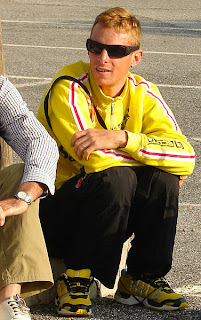
Riccò in 2007
When a rider returns from a doping ban, he or she will usually experience problems finding a contract to ride at the same level as prior to their ban - this is partially because of the loss of race experience and partially because the top teams can afford to be choosy and don't wish to be seen as providing a home for convicted dopers - hence his step back to ProContinental Ceramica. However, his results over the next five months, including overall victory at the Österreich-Rundfahrt, were sufficient to pique the interest of the ProTour teams. Riccò was not the sort of rider who felt that he should repay the second chance Ceramica had given him by riding a full season for them; so he appears to have had few of any qualms about terminating his contract with them in August and going to the ProTour team Vacansoleil-DCM. He won the Coppa Sabatini with them late in the year, then came seventh at the season-opening GP de Ouverture in 2011.

Seven days after the Ouverture, on the 6th of February, Riccò was rushed to hospital. He was in critical condition with acute kidney failure believed to have been caused by a non-medical autologous transfusion (ie, using his own blood) performed using blood that was 25 days old and had presumably been incorrectly stored, which he is alleged to have admitted to the doctor who treated him. He could very easily have died, but fortunately recovered well enough to be discharged after only two weeks. Vacansoleil sacked him, though he insisted that he had neither made the alleged admission to the doctor nor ever used blood doping (in October that year, reports were published that he had admitted it; these were quickly denied by his lawyer). He also claimed that he would be retiring from cycling and began a new life working in a bar, but later announced that he would make a return. According to reports Amore & Vita offered him a contract with the conditions that he worked with the Italian authorities to help end doping in sport and that he would be sacked if proof arose that he had in fact received an illegal transfusion - if such a contract was offered, he refused it and instead signed to Meridiana-Kamen. He was expected to make his return to racing with them at the Kroz Srbiju, beginning on the 19th of June; however, eight days before the race began CONI suspended him and launched an investigation. On the 19th of April 2012, the Tribunale Nazionale Antidoping found him guilty of the use and attempted use of prohibited methods and banned him from any involvement in professional cycling for a period of 12 years.


Émile Masson Jr., born in Hollogne-aux-Pierres, Belgium on this day in 1912, won La Flèche Wallonne and Stage 17a at the Tour de France in 1938 and Paris-Roubaix in 1939. After the Second World War he returned to cycling and became National Road Race Champion in 1946 (when he also won Bordeaux-Paris) and again in 1947. He died on 2nd of January 2011, aged 95. Masson was the son of Émile Masson Snr., who won Stages 11 and 12 at the Tour in 1922 and his own Bordeaux-Paris a year later.

Andrea Ferrigato, who was born in Schio, Italy on this day in 1969, won Stage 12 at the Giro d'Italia in 1994. Three years later, he won Stage 5 at Tirreno-Adriatico and first place at the GP Ouest-France.

Other cyclists born on this day: Arthur F. Andrews (USA, 1876); Giorgio Ursi (Italy, 1943); Jean Govaerts (Belgium, 1938); Erhard Neumann (USA, 1932, died 2002); Huub Duyn (Netherlands, 1984); Juho Jaakonaho (Finland, 1882, died 1964); Wayne Burgess (South Africa, 1971); Hong Seong-Ik (South Korea, 1940); Alfred Ebanks (Cayman Islands, 1953); Iñaki Lejarreta (Spain, 1983); André Bar (Belgium, 1935).

Saturday, 1 June 2013

Daily Cycling Facts 01.06.2013

Arthur Markham, with what probably wasn't a very
typical bike even in 1868
On this day in 1868, Britain's first organised bike race took place at the Welsh Harp Reservoir in North West London (correctly the Brent Reservoir), one day after the world's first bike race (or at least, the first we know definitely happened) had been held in the Parc St. Cloud, Paris. The winner was Arthur Markham, who was awarded a silver cup supplied by the landlord of the Old Welsh Harp Hotel that gave the reservoir its name and used his prize money to travel by coach to Bath four weeks later, where he won another race (and saved a man from drowning). Coincidentally, the winner of the race at Parc St. Cloud, James Moore, is believed to be buried next to the reservoir.

The race was the beginning of a long association between cycling and the park surrounding the reservoir, which as a result became home to one of Britain's first cycle race tracks. Today, it's overgrown and almost forgotten, though it can just be made out from the air at the northern end of the reservoir, and cycling is banned almost everywhere within the park.

Michael Rasmussen
Born in Tølløse, Denmark on this day in 1974, Michael Rasmussen rose to fame in 1999 when he won the World Cross Country Mountain Biking Championships, then for abandoning mountain biking in favour of road racing, then for his two Tour de France King of the Mountains victories, then for being kicked out of the 2007 Tour by his own team due to irregularities concerning the details of his  whereabouts supplied to anti-doping officials and finally for the two-year ban he received as a result. His decision to resort to doping was unfortunate both for cycling and for him, because he would undoubtedly have remained a great talent had he have ridden clean.

Michael Rasmussen
Rasmussen's nickname is The Chicken, due to his scrawny physique - at just 60kg, he was the lightest rider in his category; the name dating from his mountain biking days when his team mates named him after a character in Danish TV show Bamses Billedbog, about a chicken and a bear (the team's large and hairy mechanic became The Bear). It's a build naturally suited to climbing, in which every excess gram of weight translates into unnecessary effort, reduced speed and, ultimately, pain on the challenging slopes found in races, something that he understood very well: he was obsessed with keeping his own weight down, counting the grains of rice he ate and pouring water rather than milk on his cereal at breakfast, as well a reducing that of his bike, from which he peeled stickers and removed a water carrier. The Colnago Extreme-C machine he favoured is a light bike anyway, but when he'd finished with it the weight was reduced to 6.91kg - 10g above the minimum limit set by the UCI.

Rasmussen was at the centre of a famous and much retold controversy dating from 2002, the year  mountain biker Whitney Richards claims Rasmussen asked him to take a box containing his favourite cycling shoes through customs and deliver them to an Italian training bases. Richards says he became suspicious and opened the box, finding within it numerous doses of Hemopure - a bovine haemoglobin-based oxygen carrier, at that time approved only for veterinary use in Europe and, since no test had been developed to detect it, of very obvious interest to those athletes willing to resort to doping. Richards also says that he destroyed the drug and that Rasmussen was angry when he found out, asking "Have you any idea how much that shit cost?" Whether the incident really  happened has never been proved nor disproved.

Alf Engers
Alfred Robert Engers, born in Southgate on this day in 1940, won numerous time trial titles from the late 1950s through to the late 1970s and set several world records - including being the first man to complete 25 miles (40km) on road in under fifty minutes.

Alf Engers
During childhood, Engers showed athletic promise as a runner but was forced to give the sport up after a bike crash left him minus one kneecap - finding that cycling, as a non-impact activity, suited him he joined Barnet CC in 1952. Fortunately, he turned out to be good enough to make some money from it because, a rebellious teen, he was expelled from school and turned out into the wide world without a qualification to his name. Of course, racing didn't bring in enough to live on and so he worked nightshifts in bakery to make ends meet; however, a dose of reality wasn't enough to prevent bad behaviour and he received the first of numerous warnings from the Road Time Trials Council (now known as Cycling Time Trials, the governing body of the sport in Britain) whilst still only sixteen.

His reputation as a trouble-maker would prove problematic - after spending two years as an independent (which permitted him to enter both amateur and professional races), he applied to British Cycling and the Road Time Trials Council for amateur status (ex-professionals were not allowed to compete against amateurs even after retirement, meaning that their racing days were effectively over when they could no longer remain competitive in the professional classes - a factor that seriously limited the number of professional cyclists Britain produced until the rule was eventually repealed); both would refuse for the next seven years. He stuck it out, finding a sponsor in bike shop Ted Gerrard (the first bike shop offer a mail order service), winning races and setting record times, until he was finally granted an amateur licence in 1968. Over the next ten years, during which he became the most respected rider in British time trialing, he would clash with organising bodies time and time again with most rows caused by his tendency to read rule books and form conclusions that varied considerably from theirs regarding what was and was not permitted in races. Nevertheless, his was a talent too great for them to push him out of racing - his 1978 25-mile record, the fifth he set for the distance - stood until 1990, and he was National 25-mile TT Champion six times.

Engers was added to the Golden Book of Cycling in 1991. He still competes in triathlons, but now spends more of his time fishing.

Marino Basso
Born in Italy on this day in 1945, Marino Basso was one of the most respected sprinters in professional cycling during the 1970s and won a total of 15 stages in his thirteen Giri d'Italia, six in a single edition of the Vuelta a Espana (1975) and six in his four Tours de France. He won the Giro' Points competition in 1971 and became World Road Race Champion in 1972.

Sylvester Howard Roper
Sylvester Howard Roper, who was born on the 24th of November in 1823, was an inventor and proponent of steam-powered bicycles and, later, cars. Something of a child prodigy, he built his first steam engine when he was twelve years old, despite having never seen one. On this day in 1896, he rode one of his own steam bikes to the Charles River racing track at Cambridge, Massachusetts, where some of the greatest track riders of the day attempted to beat it - among them was Tom Butler, who three years later would be beaten in the World 1-mile Championship by Marshall Taylor, but even he couldn't beat Roper's machine.

When he attempted to compete a flying mile (and recorded an average speed of 64kph), he got into difficulties and crashed, dying instantly from a head wound. A post mortem also discovered that he had suffered a heart attack, though it was not known if the heart attack caused or a result of the crash. His Steam Velocipede, built in 1867, is widely considered to be the world's first motorcycle.


The 1st of June is, it seems, a good day to aim for if you happen to be Swedish and hope that your offspring will become professional cyclists: Erik Bjurberg (1895, died 1976), Erik Bohlin (1897, died 1977) and Roger Persson (1974, still alive) were all born on this day.

On this day in 2011, just four months after a self-administered blood transfusion nearly killed him, it was reported in the press that Riccardo Ricco was about to sign a contract with the Meridiana-Kamen team and would ride for them at the Tour of Serbia - despite his previous claims to have given up cycling for good. Ten days later, he was formally suspended from competition by the Italian Olympic Committee and ten days after that he was banned from professional cycling for twelve years.

Other cyclists born on this day: Mevlüt Bora (Turkey, 1947); Constantin Kabemba (Congo, 1943); Stoyan Georgiev Demirev (Bulgaria, 1932); Erin Hartwell (USA, 1969); Jozef Simons (Belgium, 1952); Kim Jung-Mo (South Korea, 1974); Daniel Butler (USA, 1944).

Saturday, 1 September 2012

Daily Cycling Facts 01.09.12

Franco Bitossi
Franco Bitossi
Born in Camaioni di Carmignano on this day in 1940, the Italian Franco Bitossi became known to friends as Cuore Matto - "Crazy Heart," on account of the cardiac arrythmia that would frequently cause him to have to stop halfway through a race. His palmares, built up over the course of a 17-year professional career, is for that reason all the more impressive.

Bitossi had three successful years as an amateur, during which time he was noticed by 1960 Tour winner Gastone Nencini, who took him under his wing and gave him advice; then got picked up by Philco, managed by Fiorenzo Magni, as soon as he reached the age of 21, the minimum age for professionals at that time - which came as something of a surprise because his arrythmia had already been detected and he'd assumed he wouldn't be able to compete at the top level as a result. He won a stage at the Tre Giorni del Sud that year, 1961, then in 1963 he came second on Stage 20 at the Giro d'Italia and third overall in the King of the Mountains after arrythmia suffered in the first three stages suddenly cleared up. The year after that he attained five podium finishes (but no wins) as the season got under way, then went back to the Giro and won Stages 3, 16, 17 and 20, was second on four others, finished in tenth place overall and won the King of the Mountains. In 1965 he won the Tour de Suisse, then took one stage, seventh place overall and another King of the Mountains at the Giro. After six early-season victories in 1966, Bitossi won Stages 14 and 16 and a third King of the Mountains at the Giro (coming eighth overall this time) and went to the Tour de France where he won Stages 5 and 17; then he won Tirreno-Adriatico and the Giro di Lombardia in 1967.

One of the best-known truths in cycling is that climbers cannot sprint and vice versa. Climbers are usually finely-boned, sinewy greyhound-like creatures with body fat levels that, were professional cyclists normal human beings, would get doctors worried; their job being to get their bodies and their bikes up the great climbs as quickly as possible. Sprinters are heavy, heavily muscled; homo sapiens robustus compared to the climbers' h. sapiens gracile. They are highly specialised to their environments and do not trespass into one another's territory - except, that is, for Bitossi; who, in 1968 and after all those King of the Mountains trophies, came second in the Points competition at the Giro, then won it at the Tour (where he was also second on the Mountains); and he would win the Points at the Giro in 1969 and 1970. Interestingly, the only other male rider to have performed so well on the climbs and the sprints was Eddy Merckx, who won the General Classification in 1970 and the Points and GC in 1973 - and who also suffered from a heart defect that, had he have been riding as an amateur today, would have prevented his selection for a professional team.

Left: Marino Basso; right: Bitossi
Bitossi never did so well in the Grand Tours again after 1970 as his heart condition worsened, but he remained a force with which to be reckoned for many years. In 1971 he won twelve victories in addition to the National Road Race Championship, then nine victories in 1972 (when he was beaten by an infinitesimal amount by his team mate Marino Basso to the World Champiobship title) and 1973 respectively and 18 in 1974 including Stages 6, 8 and 18 at the Giro. He won six times the following year, the most prestigious being Stage 15 at the Giro and 11 times, including another National Championhip in 1976, and then ten times in total over 1977 and 1978 - a period during which he began to excel in cyclo cross as much as on the road, winning the National Championship in both years.

He is estimated to have won at least 158 races across the course of his career, not including amateur events, yet is frequently described by journalists who interview him as humble, welcoming, humourous and deeply respectful of the riders he raced against. Who knows what he might have achieved without his heart condition?

Riccardo Riccò
Born in Formigine on this day in 1983, Italian Riccardo Riccò is a former professional cyclist who became best known for his second place General Classification finish at the 2008 Giro d'Italia, when he also won the Youth category, but has since become more famous for doping.

Riccò at the 2008 Giro d'Italia
Riccò's first taste of success came in 2001 when he won the National Junior Cyclo Cross Championship. Two years later he won the Coppa della Pace and a stage at the Baby Giro, then in 2004 he became Under-23 National Road Race Champion and in 2005 the Settimana Ciclistica Lombarda and a stage at the U-23 Giro della Toscana. Professional teams began to take an interest that year and he settled on a contract with Saunier Duval-Prodir for 2006, riding his first Tour de France with them and then, late in the season, winning the Japan Cup. He remained with the team throughout 2007, when he won the Points competition at Tirreno-Adriatico and his first Grand Tour stage, Stage 15 at the Giro d'Italia, which he finished in sixth place overall; then when he returned to the Giro in 2008 he won Stages 2 and 8, was third overall on Points and second overall in the General Classification. The new star of Italian cycling, he was selected for Saunier's Tour de France squad later in the summer - and, after Stage 11, the news broke that a sample he'd provided following Stage 4 had tested positive for the EPO variant CERA. He was the third rider to be caught using the same drug that year and was thrown out of the race immediately, after which manager Mauro Gianetti withdrew the team voluntarily, then sacked the rider.

Riccò expressed his anger to journalists. "I spent a night in the police station and it was like being in prison," he said. "The magistrate listened to what I had to say. They searched my bags but only found some vitamins that we all use and so they decided to let me go home." He was being half-truthful - his hotel room had been searched and no illegal drugs were found, but a selection of unexplained medical equipment - including intravenous drips and syringes - had been; it was also revealed that he had sped away from Stage 4 apparently in an attempt to evade testers, but they had caught up with him in heavy traffic and obtained the sample (it was also revealed that CERA's manufacturer, Roche Pharmaceuticals, had been working in secret with WADA to develop and perfect a test for the drug, which had previously been undetectable). For once in his life, Riccò decided that honesty was the best policy and made a full confession, stating that he had used CERA to prepare himself for the Tour and that he had done so entirely independently and without the knowledge of anyone at Saunier. He also publicly apologised to the team and to fans and later told journalists that the drug had been supplied to him by Carlo Santuccione, whose licence to practice a a doctor had been suspended from 1995 to 2000 and would be removed for life in 2007 after the investigation into the Oil For Drugs doping ring, of which he was believed to have been ringleader (Santuccione, incidentally, had worked at the University of Ferrara's Biomedical Institute alongside Francesco Conconi, who is thought to have been the man who first brought EPO into cycling and who later served on the medical committee of the Italian Olympic committee CONI, which funded his research into new anti-doping tests - which he then used to devise new ways to get around the tests). It was expected that Riccò would be shown leniency on account of his compliance, but initially he was not and received the full two-year ban. Once again he expressed bitterness to journalists, whilst admitting "I made a mistake and it's fair that I pay;" in March 2009, the Court of Arbitration in Sport reduced the ban to 20 months. As the ban was backdated, he was free to return to competion in March the following year and did so with Irish-based Ceramica Flaminia.

Riccò in 2007
When a rider returns from a doping ban, he or she will usually experience problems finding a contract to ride at the same level as prior to their ban - this is partially because of the loss of race experience and partially because the top teams can afford to be choosy and don't wish to be seen as providing a home for convicted dopers - hence his step back to ProContinental Ceramica. However, his results over the next five months, including overall victory at the Österreich-Rundfahrt, were sufficient to pique the interest of the ProTour teams. Riccò was not the sort of rider who felt that he should repay the second chance Ceramica had given him by riding a full season for them; so he appears to have had few of any qualms about terminating his contract with them in August and going to the ProTour team Vacansoleil-DCM. He won the Coppa Sabatini with them late in the year, then came seventh at the season-opening GP de Ouverture in 2011.

Seven days after the Ouverture, on the 6th of February, Riccò was rushed to hospital. He was in critical condition with acute kidney failure believed to have been caused by a non-medical autologous transfusion (ie, using his own blood) performed using blood that was 25 days old and had presumably been incorrectly stored, which he is alleged to have admitted to the doctor who treated him. He could very easily have died, but fortunately recovered well enough to be discharged after only two weeks. Vacansoleil sacked him, though he insisted that he had neither made the alleged admission to the doctor nor ever used blood doping (in October that year, reports were published that he had admitted it; these were quickly denied by his lawyer). He also claimed that he would be retiring from cycling and began a new life working in a bar, but later announced that he would make a return to cycling. According to reports Amore & Vita offered him a contract with the conditions that he worked with the Italian authorities to help end doping in sport and that he would be sacked if proof arose that he had in fact received an illegal transfusion - if such a contract was offered, he refused it and instead signed to Meridiana-Kamen. He was expected to make his return to racing with them at the Kroz Srbiju, beginning on the 19th of June; however, eight days before the race began CONI suspended him and launched an investigation. On the 19th of April 2012, the Tribunale Nazionale Antidoping found him guilty of the use and attempted use of prohibited methods and banned him from any involvement in professional cycling for a period of 12 years.


Émile Masson Jr., born in Hollogne-aux-Pierres, Belgium on this day in 1912, won La Flèche Wallonne and Stage 17a at the Tour de France in 1938 and Paris-Roubaix in 1939. After the Second World War he returned to cycling and became National Road Race Champion in 1946 (when he also won Bordeaux-Paris) and again in 1947. He died on 2nd of January 2011, aged 95. Masson was the son of Émile Masson Snr., who won Stages 11 and 12 at the Tour in 1922 and his own Bordeaux-Paris a year later.

Andrea Ferrigato, who was born in Schio, Italy on this day in 1969, won Stage 12 at the Giro d'Italia in 1994. Three years later, he won Stage 5 at Tirreno-Adriatico and first place at the GP Ouest-France.

Other cyclists born on this day: Arthur F. Andrews (USA, 1876); Giorgio Ursi (Italy, 1943); Jean Govaerts (Belgium, 1938); Erhard Neumann (USA, 1932, died 2002); Huub Duyn (Netherlands, 1984); Juho Jaakonaho (Finland, 1882, died 1964); Wayne Burgess (South Africa, 1971); Hong Seong-Ik (South Korea, 1940); Alfred Ebanks (Cayman Islands, 1953); Iñaki Lejarreta (Spain, 1983); André Bar (Belgium, 1935).

Friday, 1 June 2012

Daily Cycling Facts 01.06.12

Arthur Markham, with what probably wasn't a very
typical bike even in 1868
On this day in 1868, Britain's first organised bike race took place at the Welsh Harp Reservoir in North West London (correctly the Brent Reservoir), one day after the world's first bike race (or at least, the first we know definitely happened) had been held in the Parc St. Cloud, Paris. The winner was Arthur Markham, who was awarded a silver cup supplied by the landlord of the Old Welsh Harp Hotel that gave the reservoir its name and used his prize money to travel by coach to Bath four weeks later, where he won another race (and saved a man from drowning). Coincidentally, the winner of the race at Parc St. Cloud, James Moore, is believed to be buried next to the reservoir.

The race was the beginning of a long association between cycling and the park surrounding the reservoir, which as a result became home to one of Britain's first cycle race tracks. Today, it's overgrown and almost forgotten, though it can just be made out from the air at the northern end of the reservoir, and cycling is banned almost everywhere within the park.

Michael Rasmussen
Born in Tølløse, Denmark on this day in 1974, Michael Rasmussen rose to fame in 1999 when he won the World Cross Country Mountain Biking Championships, then for abandoning mountain biking in favour of road racing, then for his two Tour de France King of the Mountains victories, then for being kicked out of the 2007 Tour by his own team due to irregularities concerning the details of his  whereabouts supplied to anti-doping officials and finally for the two-year ban he received as a result. His decision to resort to doping was unfortunate both for cycling and for him, because he would undoubtedly have remained a great talent had he have ridden clean.

Michael Rasmussen
Rasmussen's nickname is The Chicken, due to his scrawny physique - at just 60kg, he was the lightest rider in his category; the name dating from his mountain biking days when his team mates named him after a character in Danish TV show Bamses Billedbog, about a chicken and a bear (the team's large and hairy mechanic became The Bear). It's a build naturally suited to climbing, in which every excess gram of weight translates into unnecessary effort, reduced speed and, ultimately, pain on the challenging slopes found in races, something that he understood very well: he was obsessed with keeping his own weight down, counting the grains of rice he ate and pouring water rather than milk on his cereal at breakfast, as well a reducing that of his bike, from which he peeled stickers and removed a water carrier. The Colnago Extreme-C machine he favoured is a light bike anyway, but when he'd finished with it the weight was reduced to 6.91kg - 10g above the minimum limit set by the UCI.

Rasmussen was at the centre of a famous and much retold controversy dating from 2002, the year  mountain biker Whitney Richards claims Rasmussen asked him to take a box containing his favourite cycling shoes through customs and deliver them to an Italian training bases. Richards says he became suspicious and opened the box, finding within it numerous doses of Hemopure - a bovine haemoglobin-based oxygen carrier, at that time approved only for veterinary use in Europe and, since no test had been developed to detect it, of very obvious interest to those athletes willing to resort to doping. Richards also says that he destroyed the drug and that Rasmussen was angry when he found out, asking "Have you any idea how much that shit cost?" Whether the incident really  happened has never been proved nor disproved.

Alf Engers
Alfred Robert Engers, born in Southgate on this day in 1940, won numerous time trial titles from the late 1950s through to the late 1970s and set several world records - including being the first man to complete 25 miles (40km) on road in under fifty minutes.

Alf Engers
During childhood, Engers showed athletic promise as a runner but was forced to give the sport up after a bike crash left him minus one kneecap - finding that cycling, as a non-impact activity, suited him he joined Barnet CC in 1952. Fortunately, he turned out to be good enough to make some money from it because, a rebellious teen, he was expelled from school and turned out into the wide world without a qualification to his name. Of course, racing didn't bring in enough to live on and so he worked nightshifts in bakery to make ends meet; however, a dose of reality wasn't enough to prevent bad behaviour and he received the first of numerous warnings from the Road Time Trials Council (now known as Cycling Time Trials, the governing body of the sport in Britain) whilst still only sixteen.

His reputation as a trouble-maker would prove problematic - after spending two years as an independent (which permitted him to enter both amateur and professional races), he applied to British Cycling and the Road Time Trials Council for amateur status (ex-professionals were not allowed to compete against amateurs even after retirement, meaning that their racing days were effectively over when they could no longer remain competitive in the professional classes - a factor that seriously limited the number of professional cyclists Britain produced until the rule was eventually repealed); both would refuse for the next seven years. He stuck it out, finding a sponsor in bike shop Ted Gerrard (the first bike shop offer a mail order service), winning races and setting record times, until he was finally granted an amateur licence in 1968. Over the next ten years, during which he became the most respected rider in British time trialing, he would clash with organising bodies time and time again with most rows caused by his tendency to read rule books and form conclusions that varied considerably from theirs regarding what was and was not permitted in races. Nevertheless, his was a talent too great for them to push him out of racing - his 1978 25-mile record, the fifth he set for the distance - stood until 1990, and he was National 25-mile TT Champion six times.

Engers was added to the Golden Book of Cycling in 1991. He still competes in triathlons, but now spends more of his time fishing.

Marino Basso
Born in Italy on this day in 1945, Marino Basso was one of the most respected sprinters in professional cycling during the 1970s and won a total of 15 stages in his thirteen Giri d'Italia, six in a single edition of the Vuelta a Espana (1975) and six in his four Tours de France. He won the Giro' Points competition in 1971 and became World Road Race Champion in 1972.

Sylvester Howard Roper
Sylvester Howard Roper, who was born on the 24th of November in 1823, was an inventor and proponent of steam-powered bicycles and, later, cars. Something of a child prodigy, he built his first steam engine when he was twelve years old, despite having never seen one. On this day in 1896, he rode one of his own steam bikes to the Charles River racing track at Cambridge, Massachusetts, where some of the greatest track riders of the day attempted to beat it - among them was Tom Butler, who three years later would be beaten in the World 1-mile Championship by Marshall Taylor, but even he couldn't beat Roper's machine.

When he attempted to compete a flying mile (and recorded an average speed of 64kph), he got into difficulties and crashed, dying instantly from a head wound. A post mortem also discovered that he had suffered a heart attack, though it was not known if the heart attack caused or a result of the crash. His Steam Velocipede, built in 1867, is widely considered to be the world's first motorcycle.


The 1st of June is, it seems, a good day to aim for if you happen to be Swedish and hope that your offspring will become professional cyclists: Erik Bjurberg (1895, died 1976), Erik Bohlin (1897, died 1977) and Roger Persson (1974, still alive) were all born on this day.

On this day in 2011, just four months after a self-administered blood transfusion nearly killed him, it was reported in the press that Riccardo Ricco was about to sign a contract with the Meridiana-Kamen team and would ride for them at the Tour of Serbia - despite his previous claims to have given up cycling for good. Ten days later, he was formally suspended from competition by the Italian Olympic Committee and ten days after that he was banned from professional cycling for twelve years.

Other births: Mevlüt Bora (Turkey, 1947); Constantin Kabemba (Congo, 1943); Stoyan Georgiev Demirev (Bulgaria, 1932); Erin Hartwell (USA, 1969); Jozef Simons (Belgium, 1952); Kim Jung-Mo (South Korea, 1974); Daniel Butler (USA, 1944).