Showing posts with label Cavendish. Show all posts

Wednesday, 21 May 2014

Daily Cycling Facts 21.05.2014

The Giro d'Italia began on this date six times - in 1919, 1949, 1954, 1972, 1976 and 1987. 1919 covered 2,984km in ten stages and saw an example of one of the greatest dominations by a single rider over any Grand Tour - Costante Girardengo led the General Classification throughout and won seven stages. Oscar Egg became the first Swiss rider to win a stage, the Belgian Marcel Buysse became the first non-Italian to stand on the podium when he took third place overall and Gaetano Belloni won a stage for the first time (Belloni would become known as Eterno Secondo, the implication being that he'd never beat Girardengo. However, he seems to have been happy enough with the races he did win - including the 1920 Giro, three editions of the Giro di Lombardia and a Milan-San Remo - and the two men were close friends). It was the first edition of the race since the First World War and was used to make a political point when it visited Trieste and Trento, annexed by Italy from the Austro-Hungarian Empire as it collapsed at the end of the conflict.

1949 brought Fausto Coppi's third win and saw him hammer home his status as the new master of Italian cycling when he score a spectacular victory after an extremely difficult Stage 17 that included Maddalena Pass, the Col de Vars, the Col d'Izoard, the Col de Montgenèvre and Sestriere - having escaped the peloton, he rode on alone over the mountains and finished the stage with an 11'52" lead on Gino Bartali. At the end of the race, after 19 stages and 4,088km, Coppi's advantage over his aging rival was 23'47". A new era, represented by Coppi, had begun when he won his first Giro back in 1940. Now the preceding one, represented by Bartali, finally came to an end.

Carlo Clerici
There seems to be some confusion as to how long it actually was (4,331, 4,337 and 4,396km are all commonly given figures), but 1954 is likely to forever be remembered as the longest edition ever - like the other Grand Tours, the trend for many years has been for total distance to equal around 3,500km. The surprise winner was the Swiss Carlo Clerici, who made full use of a serious tactical error by the favourites which allowed him and the Italian Nino Assirelli to finish Stage 6 with a 25' advantage, then the race with 24'16" over his nearest rival. "They never should have been allowed such a lead," said Fausto Coppi. "But, after that stage, the race was over." Assirelli soon tired and couldn't keep up with Clerici, finishing 26'28" behind him - still good enough for third and,more impressively, one place up on Coppi. Another Swiss, Hugo Koblet, was 2'12" faster than Assirelli; completing the parcours in 129h37'23" - had it not have been for Clerici's good fortune, it's probably safe to assume Koblet would have won a third Grand Tour.

Having stayed out of the 1971 edition as he concentrated on winning a third Tour de France, Eddy Merckx came back in 1972 and, being Eddy Merckx, thrashed the competition. Marino Basso started off with the General Classification leadership and held it for the first two stages, then passed it on to Ugo Colombo for Stage 3 before José Manuel Fuente took it for the next four stages. In Stage 7, Merckx joined forces with the previous year's winner Gösta Pettersson, who apparently had no illusions that he could beat Merckx and was happy to take the stage win - a rather uncharacteristic gesture of gratitude by The Cannibal. From that point onwards, the race was as good as won: Fuente attacked again and again and on every single climb but he couldn't even dent the surpremacy of Merckx, who led all the way to the end and finished the 23 stages (two split) and 3,725km with a 5'30" advantage.

1976 saw another record; set by the Spaniard Antonio Menendez Gonzalez, a lowly domestique riding with KAS-Campagnolo, broke away from the peloton the moment Stage 11 got underway in Terni and then rode solo all the way to victory in Gabbice Mare 222km away - the longest solo break in the history of the race. Whilst the middle of the race was dominated by Felice Gimondi, GC leader between Stages 8 and18, the final part broke down into a nervous duel between him and the Belgian Johan de Muynck who had taken the lead in Stage 19 and kept it until Gimondi got the better of him in Stage 22a, a 28km individual time trial and a discipline in which the Italian easily outclassed the Belgian. The race included 24 stages (two split) and covered 4,161km, Gimondi's winning time being 119h58'15" and de Muynck's 19" slower.

Giro 1987 - the Marmalade Massacre
1987 was a superb year from a Celtic point of view: Stephen Roche became the first (and to date, only) Irishman to win a Giro when he finished the 24 stages and 3,915km in 105h39'42" (he'd also win the Tour de France that year, then the World Championships; making him one of only two men to have won the fabled Triple Crown - cycling's most prestigious and entirely unofficial prize, for which there is no trophy) and the Scotsman Robert Millar was second - for many years, the best ever Grand Tour result by a British rider until Chris Froome equalled it at the 2011 Vuelta a Espana.

Stephen Roche
It was the year of one of the most vicious battles in the history of the race - the one that broke out between team mates Roche and Roberto Visentini, the 1986 winner and team leader.  Visentini arrived at the race with every intention of taking a second victory and looked more than capable of doing so in the Prologue and Stage 1a, but Roche beat him the Stage 1b individual time trial and then took the leadership when their Carrera Jeans-Vagabond won the Stage 3 team time trial. In Stage 13, by which time Visentini was again in the lead, Roche ignored an order from team management and attacked his leader to win back the GC.

He incurred the wrath of the tifosi for ever more, but earned the eternal friendship of many others - especially as he'd done so with virtually no support, Eddy Schepers being the only team member whom he could trust. Instead, he enlisted the aid of old friends Millar and Phil Anderson (both with Panasonic-Isostar, but with whom he had ridden when the trio were first trying to break into European cycling with the legendary Athletic Club de Boulogne-Billancourt. Schepers, Millar and Anderson broke ranks and encircled Roche on the ascent of Marmaloda, protecting him from attacks and ensuring that he finished with a time sufficient to guarantee his victory. The event, one of the most remarkable in Giro history, has become known as the Marmalade Massacre.

Mark Cavendish
Born in Douglas on the Isle of Man on this day in 1925, Mark Cavendish fell in love with cycling during childhood and immediately became involved racing - though by his own admission, BMX was not his area of excellence: "I was always riding a bike, getting dropped in little races," he says. After badgering his parents, he got a mountain bike for his 13th birthday and the next day was unable to find anyone capable of beating him.

As a young teenager Cav met David Millar who was then the great hope of British cycling, in the years before his arrest, disgrace and eventual rise to become one of the peloton's most trusted elder statesmen. Millar inspired him, bringing him to a realisation that if he trained hard enough his juvenile talent might prove to be the foundation upon which a professional cycling career could be built. When he left school, he found a job in a bank and stuck it out for two years, saving the money he knew he'd need in the future.

With his naturally compact yet powerful physique, Cav soon found a contract with the British Cycling Track Team and frequently rode Madisons with Rob Hayles; the two of them winning gold at the UCI World Championships in 2005, the same year that Cav became European Points Race Champion. Both would prove relatively unimportant when compared to a pivotal decision he made that year, however - to start road racing, which he did with Sparkasse at the Tours of Berlin and Britain. In 2006, Cav started to get fast. Seriously, blisteringly fast, as he proved when he won two stages and the Points competition at the Tour of Berlin and lapped Ashley Hutchinson, James McCallum and his old mate Rob Hayles at the Commonwealth Games. Sparkasse acted as a feeder squad for the legendary T-Mobile team and he was offered a trainee contract with them in August, which he accepted before going on to win the Points competition at the Tour of Britain - in 2007, he was a fully-professional member of the team and repaid the gesture by winning the Scheldeprijs Classic.

2008 was his real breakthrough year. In addition to winning the World Madison Championship with Bradley Wiggins, Cav won his first Grand Tour stage - Stage 4 at the Giro d'Italia. Then he won Stage 13 too; and then Stages 5, 8, 12 and 13 at the Tour de France. British fans began to hope that he might one day be a Tour winner, but Cav has never been under any illusion that he could be: "I'm an old-school sprinter," he says. "I can't climb a mountain but if I am in front with 200 metres to go then there's nobody who can beat me."

When HTC-Highroad came to an end at the close of the 2011 season, many people felt that Cav would not be able to continue his success without his lead-out man Mark Renshaw and predicted that the wins would dry up if they went separate ways; as indeed turned out to be the case when Cav - after much petty intrigue - went as everyone always knew he would to Sky and Renshaw went to Rabobank. However,  because the pair won so many races when they working together, people tend to forget that Cav was winning races long before riding with Renshaw - it wasn't until 2009 that the partnership was formed. Nevertheless, it would prove devastatingly effective and at the Tour that summer Cav won six stages; in doing so becoming the first British rider to wear the green jersey for two days in a row and equalled, then beat Barry Hoban's British record of eight stage wins in total.

Problems with his teeth caused a less than satisfactory start to 2010 and his growing number of detractors started to whisper that his career so far had been lucky, that his glory days were still over, which is why he famously stuck two fingers up as he won Stage 2 at the Tour de Romandie that year (in Britain, the gesture can be politely described as meaning "I disagree with what you have said, and disapprove of you in general" - or, more accurately, as "Fuck you!"). The UCI, with their customary tolerance, were less than impressed and the team were forced to withdraw him from the race. It would not be the last time he got in trouble - a common accusation is that he's uncouth and arrogant. Those who know him disagree: Cav is a rough diamond, they say (and many find his outspokeness and "passionate" language refreshing), and explain his supposed arrogance as being simply an awareness that he's the best in the world at was he does.

Cav still can't climb - he was twice docked points at the 2011 Tour when he finished outside the time limit for Stages 18 and 19 (escaping disqualification as both stages were mountainous, causing organisers to extend the original limits when 50% of the peloton also finished outside the allotted time) - and he never will be able to, but for a sprint specialist such as him the race is about the Points competition rather than the General Classification, and it was that year that he became the first British rider to have won it; in addition to winning five stages (for a total of 20 in his career, making him the most successful British Tour rider by some way) and  becoming the second man to have won the Tour's final stage for three years in a row. The only other rider to have done so was Eddy Merckx, widely considered the greatest cyclist to have ever lived.

He wasn't finished yet, though. When the Grand Tours were over, the World Championships took place in Copenhagen. The British team worked hard to retain control of the Road Race from start to finish, then succeeded in getting Cav to an ideal position within a few hundred metres of the finish line before they lit the blue touch paper and retired to await the inevitable... and Mark Cavendish became the first British World Road Racing Champion since Tom Simpson almost half a century earlier.

Mark Cavendish, World Champion 2011
As 2011 drew to a close, there was much discussion as to which team Cav would ride for in 2012, with Cav himself upping his profile by playing the media and refusing to reveal who he'd chosen. Despite several spurious rumours that appeared to confirm it definitely wouldn't be Sky, few people were surprised when it turned out he would be joining the British team after all, even though with Bradley Wiggins being hotly tipped to win the Tour de France that year (as he did, becoming the first ever British winner) it wasn't clear who'd be supporting Cav as he went for stage wins and the Points classification due to the rest of the team being geared up to support their leader. Nevertheless, he won three of the seven stages won by British riders, making him the joint most successful stage winner. He shared that claim with Peter Sagan but, having enjoyed the full support of Liquigas-Cannondale, Sagan amassed a total of 421 points and won the Points classification; Cav, who had won it with 334 in 2011, finished with 220 and had to settle for fourth place. Knowing that Sky would be supporting either Wiggins or Chris Froome (who had been second in the General Classification) in 2013, he decided to move on and was eagerly snapped up by Omega Pharma-QuickStep, making his debut for them at the Tour de San Luis in January where he won Stage 1. The following month he picked up a rare General Classification victory when he won four of six stages at the Tour of Qatar (only the first stage was won by another rider, Brent Bookwalter; with Stage 2 being a team time trial won by BMC). In April he began Scheldeprijs, a race he had already won three times, as a favourite but was beaten by Marcel Kittel of Argos-Shimano; nevertheless, Omega's superb if ultimately unsuccessful attempt to catch Kittel's break must have told Cav all he needed to know regarding the sort of support his new team mates were willing to give him.

Jean Stablinski
Born Jean Stablewski to Polish immigrant parents on this day, 1932, in Thun-Saint-Amand, France (in a region so close to Belgium that some inhabitants to this day speak French Flemish as their first language), Jean Stablinski was forced to find work in the coal mines to support his family when he was 14 after his father died. That same year, he won a bicycle when he came first in an accordion competition and fell so in love with it that his mother worried he'd skip work to ride it, so she vandalised it. He was not discouraged.

Jean Stablinski
She couldn't know, of course, that her son was destined for greatness and would earn a far better living from cycling than he ever could have done as a miner. When he was 16, he took French citizenship and began entering official amateur races, including the Peace Race - it was there that a journalist mis-spelled his surname, rendering it as Stablinski and creating the name by which he would become world famous. At the age if 21 he turned professional with Gitane-Hutchinson and remained with them for three seasons before departing for Helyet-Potin for a year, then Essor-Leroux for four years. In 1960, the team merged with Helyet-Fynsec to become Helyett-Leroux-Fynsec-Hutchinson-A.C.B.B and Stablinski found himself riding as a domestique for Jacques Anquetil. He was arguably wasted in this role - after all, he won four National Championships and took silver medals at two more in a six-year period, an achievement that remains unmatched, but by all accounts he seems to have been happy with the arrangement. Until, that is, Anquetil wrote a series of critical newspaper articles that appeared to target his team mates - Stablinski was not alone in believing that some of the worst attacks were directed specifically at him and in 1968 he left to join Mercier-BP-Hutchinson while Anquetil remained with Bic, but he retired from competition at the end of the year.

Stablinski was, it has to be said, far from the most graceful rider to have ever swung his leg over a bike. In fact, if anyone were to watch a video of him in action without knowing who he was nor what he achieved, they could be forgiven for thinking him a rank amateur and quite possibly a little drunk. However, he had a sharp mind and intuitively make detailed race plans, changing them on the road as necessary; and he displayed an almost supernatural knack of knowing which breakaway was going to survive to the end of a race, then attaching himself to it. He was, therefore, prime manager material and it was he in his role as Sonolor-Lejeune who recognised that two unknown young riders named Lucien van Impe and Bernard Hinault were worth signing up.

Unlike Hinault, who claims not to have ridden a bike since he retired, Stablinski never fell out of love with the simple joy of non-competitive cycling and continued to ride until the last days of his life. He had spent so many years riding flat out with his head down, he explained on French television, that he'd not had as much opportunity to view the countryide and enjoy riding for the sake of riding as he would have liked during his youth. Like all cyclists, a major contributing factor to his enjoyment of these rides was the cafes he found along the way and more than one unsuspecting stranger was surprised to find themselves in conversation with a four-time World Champion. He also became involved with Les Amis de Paris–Roubaix, the "friends" of the race who restore and repair the cobbled sections that have made it the most famous of the Monuments. It was he that alerted them to the existence of a road running through the forest over the mines he'd worked in all those years before; a harsh, dead-straight road that has come to symbolise the entire race - the Trouée d'Arenberg.

Stablinski died after a long illness on the 22nd of July, 2007.


Nicole Freedman is now a "bike czar,"
assisting architects and urban planners
in producing cycling-friendly town plans
Sprinter Nicole Freedman, born in Massachusetts on this day in 1972, discovered cycling whilst at university (she went to MIT and Stanford) as has been the case with many great female cyclists. She won numerous stages in North American races between 1999 and 2005, also taking one at the 2005 Tour of New Zealand and coming second on Stage 7 of the 2003 Holland Ladies' Tour. In 2000, she won the National Road Race and a year the National Criterium title. After being invited to compete for Israel and awarded dual citizenship, she won the silver medal in the Israeli National Championships in 2003.

Pierre Molinéris, who was born in Nice on this day in 1920, won the Boucles de Sospel and 30 other races including Stage 4 at the 1952 Tour de France before he retired in 1955. At the time of writing, he's 91 and very much alive.

Other cyclists born on this day: Lori-Ann Muenzer (Canada, 1966); Stephen Fairless (Australia, 1962); Martin Penc (Czechoslovakia, 1957); Evert Grift (Netherlands, 1922, died 2009); Mehari Okubamicael (Ethiopia, 1945); Roger Young (USA, 1953); Gianni Ghidini (Italy, 1930, died 1995); Mino de Rossi (Italy, 1931).

Tuesday, 21 May 2013

Daily Cycling Facts 21.05.2013

The Giro d'Italia began on this date six times - in 1919, 1949, 1954, 1972, 1976 and 1987. 1919 covered 2,984km in ten stages and saw an example of one of the greatest dominations by a single rider over any Grand Tour - Costante Girardengo led the General Classification throughout and won seven stages. Oscar Egg became the first Swiss rider to win a stage, the Belgian Marcel Buysse became the first non-Italian to stand on the podium when he took third place overall and Gaetano Belloni won a stage for the first time (Belloni would become known as Eterno Secondo, the implication being that he'd never beat Girardengo. However, he seems to have been happy enough with the races he did win - including the 1920 Giro, three editions of the Giro di Lombardia and a Milan-San Remo - and the two men were close friends). It was the first edition of the race since the First World War and was used to make a political point when it visited Trieste and Trento, annexed by Italy from the Austro-Hungarian Empire as it collapsed at the end of the conflict.

1949 brought Fausto Coppi's third win and saw him hammer home his status as the new master of Italian cycling when he score a spectacular victory after an extremely difficult Stage 17 that included Maddalena Pass, the Col de Vars, the Col d'Izoard, the Col de Montgenèvre and Sestriere - having escaped the peloton, he rode on alone over the mountains and finished the stage with an 11'52" lead on Gino Bartali. At the end of the race, after 19 stages and 4,088km, Coppi's advantage over his aging rival was 23'47". A new era, represented by Coppi, had begun when he won his first Giro back in 1940. Now the preceding one, represented by Bartali, finally came to an end.

Carlo Clerici
There seems to be some confusion as to how long it actually was (4,331, 4,337 and 4,396km are all commonly given figures), but 1954 is likely to forever be remembered as the longest edition ever - like the other Grand Tours, the trend for many years has been for total distance to equal around 3,500km. The surprise winner was the Swiss Carlo Clerici, who made full use of a serious tactical error by the favourites which allowed him and the Italian Nino Assirelli to finish Stage 6 with a 25' advantage, then the race with 24'16" over his nearest rival. "They never should have been allowed such a lead," said Fausto Coppi. "But, after that stage, the race was over." Assirelli soon tired and couldn't keep up with Clerici, finishing 26'28" behind him - still good enough for third and,more impressively, one place up on Coppi. Another Swiss, Hugo Koblet, was 2'12" faster than Assirelli; completing the parcours in 129h37'23" - had it not have been for Clerici's good fortune, it's probably safe to assume Koblet would have won a third Grand Tour.

Having stayed out of the 1971 edition as he concentrated on winning a third Tour de France, Eddy Merckx came back in 1972 and, being Eddy Merckx, thrashed the competition. Marino Basso started off with the General Classification leadership and held it for the first two stages, then passed it on to Ugo Colombo for Stage 3 before José Manuel Fuente took it for the next four stages. In Stage 7, Merckx joined forces with the previous year's winner Gösta Pettersson, who apparently had no illusions that he could beat Merckx and was happy to take the stage win - a rather uncharacteristic gesture of gratitude by The Cannibal. From that point onwards, the race was as good as won: Fuente attacked again and again and on every single climb but he couldn't even dent the surpremacy of Merckx, who led all the way to the end and finished the 23 stages (two split) and 3,725km with a 5'30" advantage.

1976 saw another record; set by the Spaniard Antonio Menendez Gonzalez, a lowly domestique riding with KAS-Campagnolo, broke away from the peloton the moment Stage 11 got underway in Terni and then rode solo all the way to victory in Gabbice Mare 222km away - the longest solo break in the history of the race. Whilst the middle of the race was dominated by Felice Gimondi, GC leader between Stages 8 and18, the final part broke down into a nervous duel between him and the Belgian Johan de Muynck who had taken the lead in Stage 19 and kept it until Gimondi got the better of him in Stage 22a, a 28km individual time trial and a discipline in which the Italian easily outclassed the Belgian. The race included 24 stages (two split) and covered 4,161km, Gimondi's winning time being 119h58'15" and de Muynck's 19" slower.

Giro 1987 - the Marmalade Massacre
1987 was a superb year from a Celtic point of view: Stephen Roche became the first (and to date, only) Irishman to win a Giro when he finished the 24 stages and 3,915km in 105h39'42" (he'd also win the Tour de France that year, then the World Championships; making him one of only two men to have won the fabled Triple Crown - cycling's most prestigious and entirely unofficial prize, for which there is no trophy) and the Scotsman Robert Millar was second - for many years, the best ever Grand Tour result by a British rider until Chris Froome equalled it at the 2011 Vuelta a Espana.

Stephen Roche
It was the year of one of the most vicious battles in the history of the race - the one that broke out between team mates Roche and Roberto Visentini, the 1986 winner and team leader.  Visentini arrived at the race with every intention of taking a second victory and looked more than capable of doing so in the Prologue and Stage 1a, but Roche beat him the Stage 1b individual time trial and then took the leadership when their Carrera Jeans-Vagabond won the Stage 3 team time trial. In Stage 13, by which time Visentini was again in the lead, Roche ignored an order from team management and attacked his leader to win back the GC.

He incurred the wrath of the tifosi for ever more, but earned the eternal friendship of many others - especially as he'd done so with virtually no support, Eddy Schepers being the only team member whom he could trust. Instead, he enlisted the aid of old friends Millar and Phil Anderson (both with Panasonic-Isostar, but with whom he had ridden when the trio were first trying to break into European cycling with the legendary Athletic Club de Boulogne-Billancourt. Schepers, Millar and Anderson broke ranks and encircled Roche on the ascent of Marmaloda, protecting him from attacks and ensuring that he finished with a time sufficient to guarantee his victory. The event, one of the most remarkable in Giro history, has become known as the Marmalade Massacre.

Mark Cavendish
Born in Douglas on the Isle of Man on this day in 1925, Mark Cavendish fell in love with cycling during childhood and immediately became involved racing - though by his own admission, BMX was not his area of excellence: "I was always riding a bike, getting dropped in little races," he says. After badgering his parents, he got a mountain bike for his 13th birthday and the next day was unable to find anyone capable of beating him.

As a young teenager Cav met David Millar who was then the great hope of British cycling, in the years before his arrest, disgrace and eventual rise to become one of the peloton's most trusted elder statesmen. Millar inspired him, bringing him to a realisation that if he trained hard enough his juvenile talent might prove to be the foundation upon which a professional cycling career could be built. When he left school, he found a job in a bank and stuck it out for two years, saving the money he knew he'd need in the future.

With his naturally compact yet powerful physique, Cav soon found a contract with the British Cycling Track Team and frequently rode Madisons with Rob Hayles; the two of them winning gold at the UCI World Championships in 2005, the same year that Cav became European Points Race Champion. Both would prove relatively unimportant when compared to a pivotal decision he made that year, however - to start road racing, which he did with Sparkasse at the Tours of Berlin and Britain. In 2006, Cav started to get fast. Seriously, blisteringly fast, as he proved when he won two stages and the Points competition at the Tour of Berlin and lapped Ashley Hutchinson, James McCallum and his old mate Rob Hayles at the Commonwealth Games. Sparkasse acted as a feeder squad for the legendary T-Mobile team and he was offered a trainee contract with them in August, which he accepted before going on to win the Points competition at the Tour of Britain - in 2007, he was a fully-professional member of the team and repaid the gesture by winning the Scheldeprijs Classic.

2008 was his real breakthrough year. In addition to winning the World Madison Championship with Bradley Wiggins, Cav won his first Grand Tour stage - Stage 4 at the Giro d'Italia. Then he won Stage 13 too; and then Stages 5, 8, 12 and 13 at the Tour de France. British fans began to hope that he might one day be a Tour winner, but Cav has never been under any illusion that he could be: "I'm an old-school sprinter," he says. "I can't climb a mountain but if I am in front with 200 metres to go then there's nobody who can beat me."

When HTC-Highroad came to an end at the close of the 2011 season, many people felt that Cav would not be able to continue his success without his lead-out man Mark Renshaw and predicted that the wins would dry up if they went separate ways; as indeed turned out to be the case when Cav - after much petty intrigue - went as everyone always knew he would to Sky and Renshaw went to Rabobank. However,  because the pair won so many races when they working together, people tend to forget that Cav was winning races long before riding with Renshaw - it wasn't until 2009 that the partnership was formed. Nevertheless, it would prove devastatingly effective and at the Tour that summer Cav won six stages; in doing so becoming the first British rider to wear the green jersey for two days in a row and equalled, then beat Barry Hoban's British record of eight stage wins in total.

Problems with his teeth caused a less than satisfactory start to 2010 and his growing number of detractors started to whisper that his career so far had been lucky, that his glory days were still over, which is why he famously stuck two fingers up as he won Stage 2 at the Tour de Romandie that year (in Britain, the gesture can be politely described as meaning "I disagree with what you have said, and disapprove of you in general" - or, more accurately, as "Fuck you!"). The UCI, with their customary tolerance, were less than impressed and the team were forced to withdraw him from the race. It would not be the last time he got in trouble - a common accusation is that he's uncouth and arrogant. Those who know him disagree: Cav is a rough diamond, they say (and many find his outspokeness and "passionate" language refreshing), and explain his supposed arrogance as being simply an awareness that he's the best in the world at was he does.

Cav still can't climb - he was twice docked points at the 2011 Tour when he finished outside the time limit for Stages 18 and 19 (escaping disqualification as both stages were mountainous, causing organisers to extend the original limits when 50% of the peloton also finished outside the allotted time) - and he never will be able to, but for a sprint specialist such as him the race is about the Points competition rather than the General Classification, and it was that year that he became the first British rider to have won it; in addition to winning five stages (for a total of 20 in his career, making him the most successful British Tour rider by some way) and  becoming the second man to have won the Tour's final stage for three years in a row. The only other rider to have done so was Eddy Merckx, widely considered the greatest cyclist to have ever lived.

He wasn't finished yet, though. When the Grand Tours were over, the World Championships took place in Copenhagen. The British team worked hard to retain control of the Road Race from start to finish, then succeeded in getting Cav to an ideal position within a few hundred metres of the finish line before they lit the blue touch paper and retired to await the inevitable... and Mark Cavendish became the first British World Road Racing Champion since Tom Simpson almost half a century earlier.

Mark Cavendish, World Champion 2011
As 2011 drew to a close, there was much discussion as to which team Cav would ride for in 2012, with Cav himself upping his profile by playing the media and refusing to reveal who he'd chosen. Despite several spurious rumours that appeared to confirm it definitely wouldn't be Sky, few people were surprised when it turned out he would be joining the British team after all, even though with Bradley Wiggins being hotly tipped to win the Tour de France that year (as he did, becoming the first ever British winner) it wasn't clear who'd be supporting Cav as he went for stage wins and the Points classification due to the rest of the team being geared up to support their leader. Nevertheless, he won three of the seven stages won by British riders, making him the joint most successful stage winner. He shared that claim with Peter Sagan but, having enjoyed the full support of Liquigas-Cannondale, Sagan amassed a total of 421 points and won the Points classification; Cav, who had won it with 334 in 2011, finished with 220 and had to settle for fourth place. Knowing that Sky would be supporting either Wiggins or Chris Froome (who had been second in the General Classification) in 2013, he decided to move on and was eagerly snapped up by Omega Pharma-QuickStep, making his debut for them at the Tour de San Luis in January where he won Stage 1. The following month he picked up a rare General Classification victory when he won four of six stages at the Tour of Qatar (only the first stage was won by another rider, Brent Bookwalter; with Stage 2 being a team time trial won by BMC). In April he began Scheldeprijs, a race he had already won three times, as a favourite but was beaten by Marcel Kittel of Argos-Shimano; nevertheless, Omega's superb if ultimately unsuccessful attempt to catch Kittel's break must have told Cav all he needed to know regarding the sort of support his new team mates were willing to give him.

Jean Stablinski
Born Jean Stablewski to Polish immigrant parents on this day, 1932, in Thun-Saint-Amand, France (in a region so close to Belgium that some inhabitants to this day speak French Flemish as their first language), Jean Stablinski was forced to find work in the coal mines to support his family when he was 14 after his father died. That same year, he won a bicycle when he came first in an accordion competition and fell so in love with it that his mother worried he'd skip work to ride it, so she vandalised it. He was not discouraged.

Jean Stablinski
She couldn't know, of course, that her son was destined for greatness and would earn a far better living from cycling than he ever could have done as a miner. When he was 16, he took French citizenship and began entering official amateur races, including the Peace Race - it was there that a journalist mis-spelled his surname, rendering it as Stablinski and creating the name by which he would become world famous. At the age if 21 he turned professional with Gitane-Hutchinson and remained with them for three seasons before departing for Helyet-Potin for a year, then Essor-Leroux for four years. In 1960, the team merged with Helyet-Fynsec to become Helyett-Leroux-Fynsec-Hutchinson-A.C.B.B and Stablinski found himself riding as a domestique for Jacques Anquetil. He was arguably wasted in this role - after all, he won four National Championships and took silver medals at two more in a six-year period, an achievement that remains unmatched, but by all accounts he seems to have been happy with the arrangement. Until, that is, Anquetil wrote a series of critical newspaper articles that appeared to target his team mates - Stablinski was not alone in believing that some of the worst attacks were directed specifically at him and in 1968 he left to join Mercier-BP-Hutchinson while Anquetil remained with Bic, but he retired from competition at the end of the year.

Stablinski was, it has to be said, far from the most graceful rider to have ever swung his leg over a bike. In fact, if anyone were to watch a video of him in action without knowing who he was nor what he achieved, they could be forgiven for thinking him a rank amateur and quite possibly a little drunk. However, he had a sharp mind and intuitively make detailed race plans, changing them on the road as necessary; and he displayed an almost supernatural knack of knowing which breakaway was going to survive to the end of a race, then attaching himself to it. He was, therefore, prime manager material and it was he in his role as Sonolor-Lejeune who recognised that two unknown young riders named Lucien van Impe and Bernard Hinault were worth signing up.

Unlike Hinault, who claims not to have ridden a bike since he retired, Stablinski never fell out of love with the simple joy of non-competitive cycling and continued to ride until the last days of his life. He had spent so many years riding flat out with his head down, he explained on French television, that he'd not had as much opportunity to view the countryide and enjoy riding for the sake of riding as he would have liked during his youth. Like all cyclists, a major contributing factor to his enjoyment of these rides was the cafes he found along the way and more than one unsuspecting stranger was surprised to find themselves in conversation with a four-time World Champion. He also became involved with Les Amis de Paris–Roubaix, the "friends" of the race who restore and repair the cobbled sections that have made it the most famous of the Monuments. It was he that alerted them to the existence of a road running through the forest over the mines he'd worked in all those years before; a harsh, dead-straight road that has come to symbolise the entire race - the Trouée d'Arenberg.

Stablinski died after a long illness on the 22nd of July, 2007.


Nicole Freedman is now a "bike czar,"
assisting architects and urban planners
in producing cycling-friendly town plans
Sprinter Nicole Freedman, born in Massachusetts on this day in 1972, discovered cycling whilst at university (she went to MIT and Stanford) as has been the case with many great female cyclists. She won numerous stages in North American races between 1999 and 2005, also taking one at the 2005 Tour of New Zealand and coming second on Stage 7 of the 2003 Holland Ladies' Tour. In 2000, she won the National Road Race and a year the National Criterium title. After being invited to compete for Israel and awarded dual citizenship, she won the silver medal in the Israeli National Championships in 2003.

Pierre Molinéris, who was born in Nice on this day in 1920, won the Boucles de Sospel and 30 other races including Stage 4 at the 1952 Tour de France before he retired in 1955. At the time of writing, he's 91 and very much alive.

Other cyclists born on this day: Lori-Ann Muenzer (Canada, 1966); Stephen Fairless (Australia, 1962); Martin Penc (Czechoslovakia, 1957); Evert Grift (Netherlands, 1922, died 2009); Mehari Okubamicael (Ethiopia, 1945); Roger Young (USA, 1953); Gianni Ghidini (Italy, 1930, died 1995); Mino de Rossi (Italy, 1931).

Sunday, 5 May 2013

Giro d'Italia 2013

Here's a taster of Chris Davies' excellent photography from the 2013 Giro d'Italia. You can speak to Chris about his work and to request licensing by emailing him at cmjdavies@gmail.com. Please do not reuse his images without his approval.


Monday, 21 May 2012

Daily Cycling Facts 21.05.12

The Giro d'Italia began on this date six times - in 1919, 1949, 1954, 1972, 1976 and 1987. 1919 covered 2,984km in ten stages and saw an example of one of the greatest dominations by a single rider over any Grand Tour - Costante Girardengo led the General Classification throughout and won seven stages. Oscar Egg became the first Swiss rider to win a stage, the Belgian Marcel Buysse became the first non-Italian to stand on the podium when he took third place overall and Gaetano Belloni won a stage for the first time (Belloni would become known as Eterno Secondo, the implication being that he'd never beat Girardengo. However, he seems to have been happy enough with the races he did win - including the 1920 Giro, three editions of the Giro di Lombardia and a Milan-San Remo - and the two men were close friends). It was the first edition of the race since the First World War and was used to make a political point when it visited Trieste and Trento, annexed by Italy from the Austro-Hungarian Empire as it collapsed at the end of the conflict.

1949 brought Fausto Coppi's third win and saw him hammer home his status as the new master of Italian cycling when he score a spectacular victory after an extremely difficult Stage 17 that included Maddalena Pass, the Col de Vars, the Col d'Izoard, the Col de Montgenèvre and Sestriere - having escaped the peloton, he rode on alone over the mountains and finished the stage with an 11'52" lead on Gino Bartali. At the end of the race, after 19 stages and 4,088km, Coppi's advantage over his aging rival was 23'47". A new era, represented by Coppi, had begun when he won his first Giro back in 1940. Now the preceding one, represented by Bartali, finally came to an end.

Carlo Clerici
There seems to be some confusion as to how long it actually was (4,331, 4,337 and 4,396km are all commonly given figures), but 1954 is likely to forever be remembered as the longest edition ever - like the other Grand Tours, the trend for many years has been for total distance to equal around 3,500km. The surprise winner was the Swiss Carlo Clerici, who made full use of a serious tactical error by the favourites which allowed him and the Italian Nino Assirelli to finish Stage 6 with a 25' advantage, then the race with 24'16" over his nearest rival. "They never should have been allowed such a lead," said Fausto Coppi. "But, after that stage, the race was over." Assirelli soon tired and couldn't keep up with Clerici, finishing 26'28" behind him - still good enough for third and,more impressively, one place up on Coppi. Another Swiss, Hugo Koblet, was 2'12" faster than Assirelli; completing the parcours in 129h37'23" - had it not have been for Clerici's good fortune, it's probably safe to assume Koblet would have won a third Grand Tour.

Having stayed out of the 1971 edition as he concentrated on winning a third Tour de France, Eddy Merckx came back in 1972 and, being Eddy Merckx, thrashed the competition. Marino Basso started off with the General Classification leadership and held it for the first two stages, then passed it on to Ugo Colombo for Stage 3 before José Manuel Fuente took it for the next four stages. In Stage 7, Merckx joined forces with the previous year's winner Gösta Pettersson, who apparently had no illusions that he could beat Merckx and was happy to take the stage win - a rather uncharacteristic gesture of gratitude by The Cannibal. From that point onwards, the race was as good as won: Fuente attacked again and again and on every single climb but he couldn't even dent the surpremacy of Merckx, who led all the way to the end and finished the 23 stages (two split) and 3,725km with a 5'30" advantage.

1976 saw another record; set by the Spaniard Antonio Menendez Gonzalez, a lowly domestique riding with KAS-Campagnolo, broke away from the peloton the moment Stage 11 got underway in Terni and then rode solo all the way to victory in Gabbice Mare 222km away - the longest solo break in the history of the race. Whilst the middle of the race was dominated by Felice Gimondi, GC leader between Stages 8 and18, the final part broke down into a nervous duel between him and the Belgian Johan de Muynck who had taken the lead in Stage 19 and kept it until Gimondi got the better of him in Stage 22a, a 28km individual time trial and a discipline in which the Italian easily outclassed the Belgian. The race included 24 stages (two split) and covered 4,161km, Gimondi's winning time being 119h58'15" and de Muynck's 19" slower.

Giro 1987 - the Marmalade Massacre
1987 was a superb year from a Celtic point of view: Stephen Roche became the first (and to date, only) Irishman to win a Giro when he finished the 24 stages and 3,915km in 105h39'42" (he'd also win the Tour de France that year, then the World Championships; making him one of only two men to have won the fabled Triple Crown - cycling's most prestigious and entirely unofficial prize, for which there is no trophy) and the Scotsman Robert Millar was second - for many years, the best ever Grand Tour result by a British rider until Chris Froome equalled it at the 2011 Vuelta a Espana.

Stephen Roche
It was the year of one of the most vicious battles in the history of the race - the one that broke out between team mates Roche and Roberto Visentini, the 1986 winner and team leader.  Visentini arrived at the race with every intention of taking a second victory and looked more than capable of doing so in the Prologue and Stage 1a, but Roche beat him the Stage 1b individual time trial and then took the leadership when their Carrera Jeans-Vagabond won the Stage 3 team time trial. In Stage 13, by which time Visentini was again in the lead, Roche ignored an order from team management and attacked his leader to win back the GC.

He incurred the wrath of the tifosi for ever more, but earned the eternal friendship of many others - especially as he'd done so with virtually no support, Eddy Schepers being the only team member whom he could trust. Instead, he enlisted the aid of old friends Millar and Phil Anderson (both with Panasonic-Isostar, but with whom he had ridden when the trio were first trying to break into European cycling with the legendary Athletic Club de Boulogne-Billancourt. Schepers, Millar and Anderson broke ranks and encircled Roche on the ascent of Marmaloda, protecting him from attacks and ensuring that he finished with a time sufficient to guarantee his victory. The event, one of the most remarkable in Giro history, has become known as the Marmalade Massacre.

Mark Cavendish
Born in Douglas on the Isle of Man on this day in 1925, fell in love with cycling during childhood and immediately became involved racing - though by his own admission, BMX was not his area of excellence: "I was always riding a bike, getting dropped in little races," he says. After badgering his parents, he got a mountain bike for his 13th birthday and the next day was unable to find anyone capable of beating him.

As a young teenager Cav met David Millar who was then the great hope of British cycling, in the years before his arrest, disgrace and eventual rise to become one of the peloton's most trusted elder statesmen. Millar inspired him, bringing him to a realisation that if he trained hard enough his juvenile talent might prove to be the foundation upon which a professional cycling career could be built. When he left school, he found a job in a bank and stuck it out for two years, saving the money he knew he'd need in the future.

With his naturally compact yet powerful physique, Cav soon found a contract with the British Cycling Track Team and frequently rode Madisons with Rob Hayles; the two of them winning gold at the UCI World Championships in 2005, the same year that Cav became European Points Race Champion. Both would prove relatively unimportant when compared to a pivotal decision he made that year, however - to start road racing, which he did with Sparkasse at the Tours of Berlin and Britain. In 2006, Cav started to get fast. Seriously, blisteringly fast, as he proved when he won two stages and the Points competition at the Tour of Berlin and lapped Ashley Hutchinson, James McCallum and his old mate Rob Hayles at the Commonwealth Games. Sparkasse acted as a feeder squad for the legendary T-Mobile team and he was offered a trainee contract with them in August, which he accepted before going on to win the Points competition at the Tour of Britain - in 2007, he was a fully-professional member of the team and repaid the gesture by winning the Scheldeprijs Classic.

2008 was his real breakthrough year. In addition to winning the World Madison Championship with Bradley Wiggins, Cav won his first Grand Tour stage - Stage 4 at the Giro d'Italia. Then he won Stage 13 too; and then Stages 5, 8, 12 and 13 at the Tour de France. British fans began to hope that he might one day be a Tour winner, but Cav has never been under any illusion that he could be: "I'm an old-school sprinter," he says. "I can't climb a mountain but if I am in front with 200 metres to go then there's nobody who can beat me."

When HTC-Highroad came to an end at the close of the 2011 season, many people felt that Cav would not be able to continue his success without his lead-out man Mark Renshaw and predicted that the wins would dry up if they went separate ways; as indeed turned out to be the case when Cav - after much petty intrigue - went as everyone always knew he would to Sky and Renshaw went to Rabobank. However,  because the pair won so many races when they working together, people tend to forget that Cav was winning races long before riding with Renshaw - it wasn't until 2009 that the partnership was formed. Nevertheless, it would prove devastatingly effective and at the Tour that summer Cav won six stages; in doing so becoming the first British rider to wear the green jersey for two days in a row and equalled, then beat Barry Hoban's British record of eight stage wins in total.

Problems with his teeth caused a less than satisfactory start to 2010 and his growing number of detractors started to whisper that his career so far had been lucky, that his glory days were still over, which is why he famously stuck two fingers up as he won Stage 2 at the Tour de Romandie that year (in Britain, the gesture can be politely described as meaning "I disagree with what you have said, and disapprove of you in general" - or, more accurately, as "Fuck you!"). The UCI, with their customary tolerance, were less than impressed and the team were forced to withdraw him from the race. It would not be the last time he got in trouble - a common accusation is that he's uncouth and arrogant. Those who know him disagree: Cav is a rough diamond, they say (and many find his outspokeness and "passionate" language refreshing), and explain his supposed arrogance as being simply an awareness that he's the best in the world at was he does.

Cav still can't climb - he was twice docked points at the 2011 Tour when he finished outside the time limit for Stages 18 and 19 (escaping disqualification as both stages were mountainous, causing organisers to extend the original limits when 50% of the peloton also finished outside the allotted time) - and he never will be able to, but for a sprint specialist such as him the race is about the Points competition rather than the General Classification, and it was that year that he became the first British rider to have won it; in addition to winning five stages (for a total of 20 in his career, making him the most successful British Tour rider by some way) and  becoming the second man to have won the Tour's final stage for three years in a row. The only other rider to have done so was Eddy Merckx, widely considered the greatest cyclist to have ever lived.

He wasn't finished yet, though. When the Grand Tours were over, the World Championships took place in Copenhagen. The British team worked hard to retain control of the Road Race from start to finish, then succeeded in getting Cav to an ideal position within a few hundred metres of the finish line before they lit the blue touch paper and retired to await the inevitable... and Mark Cavendish became the first British World Road Racing Champion since Tom Simpson almost half a century earlier.

Mark Cavendish, World Champion 2011
Jean Stablinski
Born Jean Stablewski to Polish immigrant parents on this day, 1932, in Thun-Saint-Amand, France (in a region so close to Belgium that some inhabitants to this day speak French Flemish as their first language), Jean Stablinski was forced to find work in the coal mines to support his family when he was 14 after his father died. That same year, he won a bicycle when he came first in an accordion competition and fell so in love with it that his mother worried he'd skip work to ride it, so she vandalised it. He was not discouraged.

Jean Stablinski
She couldn't know, of course, that her son was destined for greatness and would earn a far better living from cycling than he ever could have done as a miner. When he was 16, he took French citizenship and began entering official amateur races, including the Peace Race - it was there that a journalist mis-spelled his surname, rendering it as Stablinski and creating the name by which he would become world famous. At the age if 21 he turned professional with Gitane-Hutchinson and remained with them for three seasons before departing for Helyet-Potin for a year, then Essor-Leroux for four years. In 1960, the team merged with Helyet-Fynsec to become Helyett-Leroux-Fynsec-Hutchinson-A.C.B.B and Stablinski found himself riding as a domestique for Jacques Anquetil. He was arguably wasted in this role - after all, he won four National Championships and took silver medals at two more in a six-year period, an achievement that remains unmatched, but by all accounts he seems to have been happy with the arrangement. Until, that is, Anquetil wrote a series of critical newspaper articles that appeared to target his team mates - Stablinski was not alone in believing that some of the worst attacks were directed specifically at him and in 1968 he left to join Mercier-BP-Hutchinson while Anquetil remained with Bic, but he retired from competition at the end of the year.

Stablinski was, it has to be said, far from the most graceful rider to have ever swung his leg over a bike. In fact, if anyone were to watch a video of him in action without knowing who he was nor what he achieved, they could be forgiven for thinking him a rank amateur and quite possibly a little drunk. However, he had a sharp mind and intuitively make detailed race plans, changing them on the road as necessary; and he displayed an almost supernatural knack of knowing which breakaway was going to survive to the end of a race, then attaching himself to it. He was, therefore, prime manager material and it was he in his role as Sonolor-Lejeune who recognised that two unknown young riders named Lucien van Impe and Bernard Hinault were worth signing up.

Unlike Hinault, who claims not to have ridden a bike since he retired, Stablinski never fell out of love with the simple joy of non-competitive cycling and continued to ride until the last days of his life. He had spent so many years riding flat out with his head down, he explained on French television, that he'd not had as much opportunity to view the countryide and enjoy riding for the sake of riding as he would have liked during his youth. Like all cyclists, a major contributing factor to his enjoyment of these rides was the cafes he found along the way and more than one unsuspecting stranger was surprised to find themselves in conversation with a four-time World Champion. He also became involved with Les Amis de Paris–Roubaix, the "friends" of the race who restore and repair the cobbled sections that have made it the most famous of the Monuments. It was he that alerted them to the existence of a road running through the forest over the mines he'd worked in all those years before; a harsh, dead-straight road that has come to symbolise the entire race - the Trouée d'Arenberg.

Stablinski died after a long illness on the 22nd of July, 2007.


Nicole Freedman is now a "bike czar,"
assisting architects and urban planners
in producing cycling-friendly town plans
Sprinter Nicole Freedman, born in Massachusetts on this day in 1972, discovered cycling whilst at university (she went to MIT and Stanford) as has been the case with many great female cyclists. She won numerous stages in North American races between 1999 and 2005, also taking one at the 2005 Tour of New Zealand and coming second on Stage 7 of the 2003 Holland Ladies' Tour. In 2000, she won the National Road Race and a year the National Criterium title. After being invited to compete for Israel and awarded dual citizenship, she won the silver medal in the Israeli National Championships in 2003.

Pierre Molinéris, who was born in Nice on this day in 1920, won the Boucles de Sospel and 30 other races including Stage 4 at the 1952 Tour de France before he retired in 1955. At the time of writing, he's 91 and very much alive.

Other births: Lori-Ann Muenzer (Canada, 1966); Stephen Fairless (Australia, 1962); Martin Penc (Czechoslovakia, 1957); Evert Grift (Netherlands, 1922, died 2009); Mehari Okubamicael (Ethiopia, 1945); Roger Young (USA, 1953); Gianni Ghidini (Italy, 1930, died 1995); Mino de Rossi (Italy, 1931).

Monday, 14 May 2012

Cav gets a hand from the tifosi

The boy Cavendish has always said he loves the Italian fans and the support they've shown him since he got to wear the rainbow jersey. Who wouldn't when they give you a bit of typical tifosi treatment, usually reserved solely for their own riders?


Sunday, 6 May 2012

Cycling Evening News 06.05.12

Giro d'Italia (video) - Two Days of Bedford - Tour of the Gila - The 100mph bike designed in the bath and made from genius - Nibali to leave Liquigas - US start for future Giro? - Other News (links) - Cycling

Giro d'Italia Stage 2
Sunday brought the first road race stage, a 206km loop from Bjarne Riis' hometowen Herning up to the Limfjorden (an enormous, brackish fjord that cuts off the north of the country rom the south, effectlively turning it into an island) north of Holsterbro, then south along the western coastline including a ride along the 13.2km Bøvling Klit isthmus separating Nissumfjord from the North Sea. Having travelled as far as Ringkobingfjord, they headed inland again for a straight 50km run back to Herning. This being Denmark, the parcours was flat all the way - a situation that looked likely to encourage the likes of Mark Cavendish (Sky), Theo Bos (Rabobank) and the other sprint specialists to show what they're capable of doing at the long, straight final section to the finish line.

The first half of the race was ruled by a three-man break consisting of Olivier Kaisen (Lotto-Belisol), Alfredo Balloni (Farnese Vini-Selle Italia.) and Miguel Rubiano (Androni Giacattoli-Venezuela), who managed to push their lead up to thirteen minutes for a while and had the race have been a few days further in, they might have been allowed to get away with it. However, with the teams seeking to assert their authority at this stage of the proceedings, they were all caught with 40km to go. Taylor Phinney, who gained the pink jersey yesterday with his individual time trial win, had a lot of work to do today to hang onto it - and he'll be more surprised than most that he still gets to wear it tomorrow after his chain came off with 8km to go leaving him with around half a minute to make up if he was to remain in contention. That he did so is testament to just how fast he is, and just how useful Danilo Wyss, who dropped back to assist him, can be.

We all knew that, barring disaster, this stage was going to end in a sprint and so the teams had already got their sprinters into position before the final corner with around 150m left. That proved fortunate because at that point Bos touched the wheel of the rider in front of him and then collided with Alexander Kristoff, who hit the barriers and finished with a bleeding face. Of course, the accident had no influence on the eventual outcome because the end of this stage might as well have been made for the Manxman, and he was the first of a bunch of sixteen over the line. Orica-GreenEDGE's Matt Goss followed him while Geoffrey Soupe (FDJ-Bigmat) hung on or dear life and an unexpected third. Cav's Sky team mate Geraint Thomas took tenth.


Cav - could it have been any different?
Top Ten
  1.  Mark Cavendish Sky 4h53'12"
  2.  Matthew Goss Orica-Green Edge ST
  3.  Geoffrey Soupe FDJ-BigMat ST
  4.  Tyler Farrar Garmin-Barracuda ST
  5.  Roberto Ferrari Androni Giocattoli-Venezuela ST
  6.  Mark Renshaw Rabobank ST
  7.  Thor Hushovd BMC ST
  8.  Daniele Bennati RadioShack-Nissan ST
  9.  William Bonnet FDJ-BigMat ST
  10.  Geraint Thomas Sky ST
(Full results and GC when available)

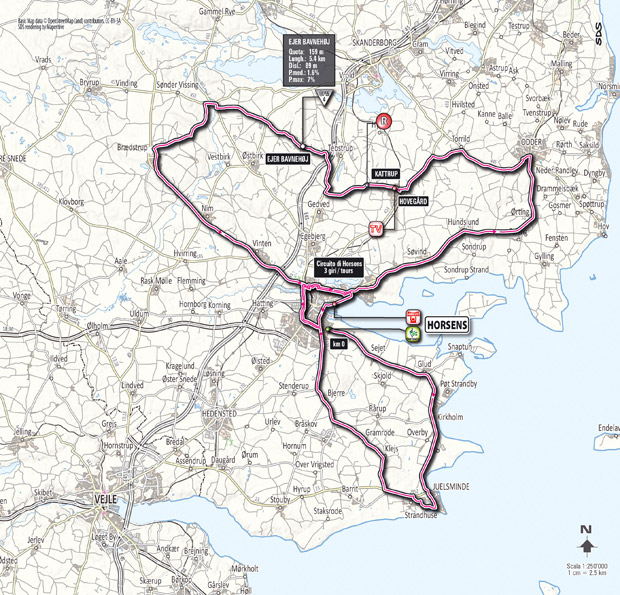
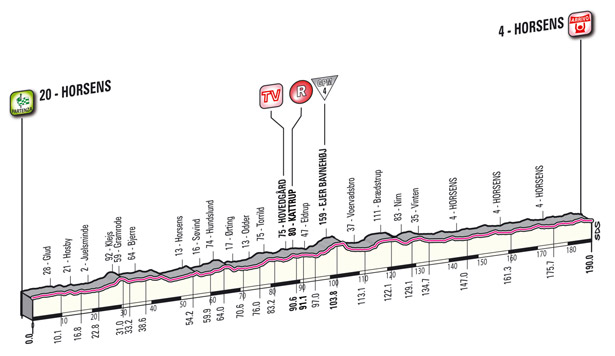
On Monday, Stage 3 (map, profile) is the last in Denmark before a "rest day," actually spent traveling down to Italy for the remainder of the race. 190km in length, starting and ending in Horsens on the east of the country, it's another flat parcours liable to finish once again with a sprint. The riders will pass through Horsens three times along the way.

As far as the weather goes on Monday, the factor that will most cheer the riders is a notable drop in windspeed between morning and afternoon - from 22kph down to around 10kph, which is insufficient to give any problems. It's enough to take the edge off the temperature early in the day - with 4C in sheltered spots near the start feeling more like 2C. When it drops, the maximum 11C will be unaffected. There's a 30% chance of rain, but if it comes it'll be in fast-moving showers that will end almost as soon as they begin.


Stages 1 / 2 / 3 / 4 / 5 / 6 / 7 / 8 / 9 / 10 / 11 / 12 / 13 / 14 / 15 / 16 / 17 / 18 / 19 / 20 / 21


Two Days of Bedford
Giro got you in the mood for some hardcore bike action? Craving the sweet scent of chain oil and the thrill of lycra flashing past your face at 45kph? Can't quite stretch to filling up the tanks on the Gulfstream IV for a jolly over to Denmark? Well then - if you live anywhere in the British South-East or southern part of the Midlands, you might be interested to know about the Two Days of Bedford.

The long-running event consists of four stages over two days (6th and 7th of May) with a 7.4km team time trial followed by an 80km road race on the Sunday, then a 6.4km individual time trial and an 85km race made up of nine laps of the Milbrook Vehicle Testing Facility - and believe me, you will not get more excitement for what it'll cost you to get to this race anywhere in the country (and you won't even have to change your pounds for krone). (More information here)

Sarah Storey crashed with 2km to go, landing in a patch of nettles which she said prevented her from losing skin. On Twitter after the race, she blamed the crash on the rider in front of her after turning "left+right on herself to avoid a tiny hole in the tarmac," then thanked well-wishers:
Sarah Storey ‏ @MrsSarahStorey
Thanks for the messages peeps,I'm fine just shocked at amount of unnecessary swerving+hard braking going on by a v small minority of riders.
Nikola Butler also crashed:
Nikola Butler ‏ @nik_tweet
one minute I was trying to sprint up the hill and the next minute I was on my face. Someone rode into my back wheel :-( sore 
Nikola Butler ‏ @nik_tweet
no idea whose fault it was. Just one of those bunch sprint things maybe
Stage 1 (Team Time Trial)
  1.  Node 4-Giordana 10'08"
  2.  For Viored +1"
  3.  Scott Contessa Epic +8"
  4.  Matrix Fitness-Prendas +14"
  5.  Abergavenny RC +30"

Stage 2 Top Ten
  1.  Amy Roberts Scott Contessa Epic  2h09'30"
  2.  Ciara Horne Node 4-Giordana ST
  3.  Lucy Garner Node 4-Giordana +15"
  4.  Sarah Reynolds Matrix Fitness-Prendas ST
  5.  Corrinne Hall Node 4-Giordana ST
  6.  Emily Kay Scott Contessa Epic ST
  7.  Laura Massey Vivelo Bikes ST
  8.  Lauren Creamer Abergavenny RC ST
  9.  Tamina Oliver Abergavenny RC ST
  10.  Harriet Owen Node 4-Giordana ST

Tour of the Gila
Stage 4 was an urban criterium race around a 1.74km square Silver City parcours with three bonus sprints and course hazards that include, according to the race bible, "rough pavement and errant pedestrians." The Pro Women completed 25 laps to make a total of 43.5km, the Pro Men 40 laps for 69.5km - precisely the sort of race in which a rider such as Kristin Armstrong (Exergy Twenty12), who at 38 specialises in the sort of endurance athleticism necessary on long stages (and which has seen her win the three stages prior to this one) might lose time to the younger women.

Loren Rowney
That turned out to be the case, though far less so than expected: while Armstrong came ninth, she was only 4" behind winner Loren Rowney (FCS Rouse presented by Mr. Restore, loaned by Specialized-Lululemon) and thus sees her General Classification lead only drop to 4'46" (from 5'01" after Stage 3) once bonification times have been taken into account. She was at the front for the first half of the race but, perhaps realising that she stood little chance of winning, chose to work for her team by chasing down attacks - not an entirely selfless decision, as it also enabled her to save some juice for the final Gila Monster stage. FCS Rouse guessed what she was up to,  simply waited until the final part of the race when they knew she'd be tired and made sure they had a rider ready to respond each and every time it looked like someone might make a break for the line. The plan was to tag along with an Exergy or Now and Novartis sprint train and see what they could do, but when Rowney found herself six riders back at the final corner she thought her chance was lost. Then, in a turn of good luck, the seven leaders took a fraction of a second longer than she'd expected to launch, allowing her to the velocity she'd carried through the bend to power into the lead and hold them off to the line.

Top Ten
  1.  Loren Rowney FCS Rouse p/b Mr. Restore 1h04'45"
  2.  Carmen Small Optum p/b Kelly Benefit ST
  3.  Christina Gokey-Smith Now & Novartis for MS ST
  4.  Alison Powers Now & Novartis for MS ST
  5.  Joanie Caron Colavita-ESPNW ST
  6.  Olivia Dillon Now & Novartis for MS ST
  7.  Jade Wilcoxson Optum p/b Kelly Benefit ST
  8.  Emma Grant Optum p/b Kelly Benefit ST
  9.  Kristin Armstrong Exergy Twenty12 +04"
  10.  Janel Holcomb Optum p/b Kelly Benefit ST
(Full results and GC)

Alejandro Borrajo
Marlon Alirio Perez Arango (Colombia-Comcel) pleased his team's sponsors and the spectators alike with a superb solo break, attacking the peloton and getting away only a few minutes from the start and then riding alone with an advantage hovering about the minute mark until Bissel decided enough was enough and got their hooks into him with twelve laps to go - he finished 65th in the end, but he's the man the fans will have been talking about on the way home. As the race neared its conclusion, Jamis-Sutter Home took the opportunity to show us all how a lead-out train ought to be conducted with all their men at the front of the pack protecting their top sprinters, brothers Alejandro and Anibal Borrajo, and getting them into perfect position - Alejandro proved fastest of a bunch of 21 while Anibal was right behind him for second place. Afterwards, Anibal dedicated the victory to an older brother who died a few days ago. Rory Sutherland took eleventh place and retains his GC lead, his overall advantage now up to 33" from 26".

Top Ten
  1.  Alejandro Alberto Borrajo Jamis/Sutter Home 1h33'40"
  2.  Anibal Andres Borrajo Jamis/Sutter Home ST
  3.  Luca Damiani Kenda/5-Hour Energy ST
  4.  Eric Young Bissel ST
  5.  Francisco Mancebo Competitive Cyclist ST
  6.  Weimar Roldan GW-Shimano ST
  7.  Avila Vanegas Edwin ST
  8.  Chad Beyer Competitive Cyclist ST
  9.  Gavin Mannion Bontrager Livestrong ST
  10.  Shawn Milne Kenda/5-Hour Energy ST
(Full results and GC)


Sunday brings the climax of the race, and what a climax it is - the 170.1km Gila Monster (map and profile) is almost certainly the toughest stage in North American professional cycling with two Category 4 climbs (16.1km, 2,070m; 166km, same), two Cat 2s (Anderson Vista, 83km, 2,284m; Wild Horse Mesa/Meadow Creek, 89km, 2,278m) and a Cat 1(Anderson Vista climbed from the opposite direction, 120km).

The 100mph bike - designed in the bath and made from genius
The remarkable Graeme Obree
Anyone who knows the story of Graeme Obree's Hour Record will know that the bike upon which he broke it, Old Faithful, used washing machine bearings. Anybody who knows a little more will know that the Scotsman later regretted telling anyone that, because it was all the newspapers cared about.

Obree is now planning to set a new record by becoming the first man to travel on a bicycle - on road and without pacing - at 100mph (161kph) aboard a new bike which, in characteristic Obreean style, he dreamed up while lying in the bath and later sketched out on bits of wallpaper. Once again, the ever-resourceful Obree has used items found about the house: this time, the rests that will support his shoulders as he lays prone on the carbon fibre-skinned machine have been made from an old saucepan. Hence Sunday's Telegraph headline: "The 100mph bike – designed in the bath and made from an old saucepan."

Hopefully, this time around, more people will look beyond that one single fact and remember that Obree is a remarkable engineer who builds his bikes from a wide range of remarkable materials, not only old washing machines and pots and pans; the most important being ingenuity and genius.

Nibali to leave Liquigas
Tuttobiciweb reports that Vincenzo Nibali has chosen not to sign an extended contract with Liquigas-Cannondale - said to be worth 1.8 million euros per year. According to rumour the 27-year-old, who already has one Grand Tour under his belt after winning the 2010 Vuelta a Espana, is being courted by BMC and Astana, both of which are said to be offering him 2.5 million euros per year.

"We made an offer, we gave him time to think it over, he has not responded. For us, the matter is closed," says Liquigas directeur sportif Paolo Dal Lago.

Giro may start in USA - one day
Organisers of the Tour de France looked seriously into the possibility of taking the race to the USA in the past but concluded that, at the time, the expense of doing so was simply too great. Nevertheless, it's an idea that has remained on a back-burner ever since. After all, American companies have been pouring sums of money into the sport that make the majority of European contributions look relatively puny, and American and Canadian riders are a fixture in the Grand Tour pelotons - in fact, it sometimes looks as though the old prediction that the USA would turn out to be the future home of cycling might eventually prove true.

Michele Acquarone
Now Giro d'Italia director Michele Acquarone has turned up the heat, because he wants his race to be the first Grand Tour to cross the Atlantic.

"To do this would be very expensive - at the present time, with the world's economy in the state it is, it's simply not an option," he admitted to Sportwereld. "But cycling is now global, increasingly so, and the Giro should be a driving force in that evolution. When we're through the financial crisis and cycling has dealt with its problems, this dream should be achievable. Imagine: we start in the US, have a few stages on Amercian soil, then the riders fly buiness class overnight to Italy... I really think this is possible."

Other News and Features
"Stephen Roche: Triple Crown 25 years on" (Cyclosport.org)

"Irish Para-cycling world champion Colin Lynch reveals dazzling new gold prosthetic" (Inside World Parasport)

"Top collegiate cyclists make their move in Ogden" (Standard-Examiner, Utah)

"Rwanda: Soras Boost Ascension De Mille Collines Cycling Tour" (AllAfrica)

Cycling
Newswire
Britain
"Cyclist knocked down on Gosport to Fareham bus route praises driver for saving his life" (The News, Portsmouth)

"Cycling in Leicester is just too dangerous" (This Is Leicestershire)

Worldwide
"Cyclists gear up for cross-Canada trek" (Times Colonist)

"A blessing for those who brave city streets on two wheels" (New York Times)

"Kids join the cycling fun at bike rodeo" (Silver City Sun-News)

"Santa Barbara Bicycle Coalition to Honor Three Women for Cycling Volunteerism" (NoozHawk)

"It's wedding bells and bikes for this couple" (AsiaOne)