Monday, 1 April 2013

Daily Cycling Facts 01.04.2013

Heiri Suter
Paris-Roubaix was held on this date in 1923 and again in 1934. The 1923 race was the first to be won by Heiri Suter - the first by a Swiss rider, as Swiss-born Lucien Lesna - winner in 1901 and 1902 - had taken French nationality during the 19th Century. Switzerland would have a long wait for their next win, which would not happen until Fabian Cancellara's victory 83 years later in 2006. It was not such a good year for the French, meanwhile - for the first time in the 28 year history of the race, there were no Frenchmen on the podium.

1934 was won by Gaston Rebry - in that same year, he also won Ronde van Vlaanderen and Paris-Nice. His victory was won as much through luck as skill: Roger Lapébie was disqualified after being declared winner when officials received word that he'd been spotted swapping to a different bike during the race. The new bike was identical but for one sticker, which an eagle-eyed judge noticed and so second place Rebry was declared winner.

The Ronde van Vlaanderen was held on this day in 1951, 1962, 1973, 1979, 1984, 1990 and 2012. 1951 was the year that Fiorenzo Magni became the second man to win three editions, but it was a year of firsts for the rider and for the race: he was the first man to have won three consecutive editions (and, to date, remains the only man to have done so), with 2nd and 3rd places going to the Frenchmen Bernard Gauthier and Attilio Redolfi it was the first year that no Belgian riders stood on the winner's podium, for the first time since the event began in 1913 riders were permitted to receive limited mechanical assistance from mechanics following the race in team cars and team tactics were allowed. For the second time, Magni won enough intermediate prizes to have been able to buy a house.

Fiorenzo Magni
In 1962, the race was won by Rik van Looy for a second time, his previous victory having been in 1959. The peloton had been split up by a strong crosswind on the coastal sections which had seen van Looy working in partnership with 1961 winner Tom Simpson. Simpson remained with him all the way into a five-man final sprint from which the Belgian escaped, crossing the line 9" ahead of Michel Van Aerde, Norbert Kerckhove, Noël Foré and the British rider. The race ended for the first time at Gentbrugge, which would host the finish line until 1972, after which it changed to Mariakerke where it has remained up to the present. That year it was won by Eric Leman who, having won in 1970 and 1972, became the third man to have won three times. The race featured the 2.4km cobbled Paddestraat for the first time; a beautiful road in use since Roman times with much architectural and archaeological heritage and, nowadays, a monument to the event's past victors.

The 1979 edition was the first win by the Netherlands' Jan Raas, who made his name on the short and harsh climbs of the Flemmish Classics (he won this race again in 1983) but suffered on the long climbs of the Grand Tours, yet still won ten stages at the Tour de France. The race once again lived up to its hard reputation - of 180 starters, only 34 finished. Like Raas, 1984 winner Johan Lammerts rode for the legendary TI-Raleigh team, then at the height of its reign and well on the way to becoming one of the most successful outfits in the sport's history. 1990 winner Moreno Argentin was that rare thing - an Italian rider who excelled in the tough Northern Classics. That same year, he won the first of his three La Flèche Wallonne victories and year later he would win a fourth Liège–Bastogne–Liège - the highest number achieved by any rider with the exception of Eddy Merckx who won five.

In 2012 drastic changes to the parcours proved generally unpopular among fans, who were especially unhappy that the Muur was left out and accused organisers of pandering to the needs of TV crews rather than making the race as hard as they felt the Ronde ought to be. Some riders were equally unimpressed with Stijn Devolder claiming the race was "no longer the Ronde van Vlaanderen;" retired three-time winner Johan Museeuw also didn't like it, but in his opinion the parcours had been made too hard - "Three times up the Oude Kwaremont and Paterberg can blow you away. The course didn't really need to be made harder," he told the press. However, favourite Fabian Cancellara approved, saying that the new route would eliminate "dead sections" where the race became boring. Oude Kwaremont saw the first serious attacks and a group of potential winners got away, then competition heated up 10km further on when Cancellara crashed and had to abandon - x-rays revealed that he had broken his collarbone in four places. Tom Boonen, Alessandro Ballan and Filippo Pozzato got away on the final ascent of Paterberg and raced together towards the line with Ballan making numerous unsuccessful attempts to gain an advantage, while Pozzato revealed the reason he's nicknamed "The Shadow" by wheel-sucking Boonen all the way to the final sprint - he was unable, however, to equal his two rivals in the sprint and Boonen beat Ballan by a bike length for a record-equaling third victory.

The 2012 Ronde van Vlaanderen voor Vrouwen took place on the same day as the men's race; Marianne Vos, the favourite, was unable to take part due to illness. Judith Arndt won following a duel with Kristin Armstrong, beating her rival by 2" while third place Joelle Numainville came in at +30".

Erik Breukink
Erik Breukink
(image credit: McSmit CC BY-SA 3.0)
Erik Breukink, who was born in Rheden, Netherlands on this day in 1964, seemed to have the best start in life a cyclist could ever hope for - his father was the director of the famous Gazelle bicycle company, the largest in the Netherlands, including its Special Racing Division where some of the world's finest racing bikes were hand-built by talented craftsmen. Yet, in his youth, Erik eschewed cycling in favour of football - perhaps cycling never forgave him for that and that's why his career, though not without considerable success, was also marked by regular bad luck and misfortune.

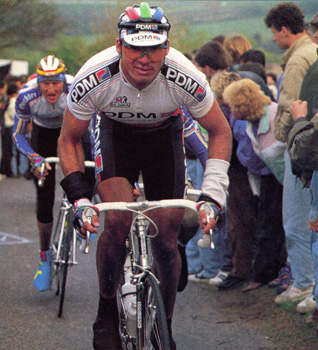
Fortunately, he saw the error of his ways in 1980 and became a cyclist; winning the National Juniors Pursuit Championship two years later. He turned professional - unsurprisingly with Skala-Gazelle - in 1986 and won Stage 4 at the Tour de Suisse, then added Stage 1a at the Giro d'Italia and Stage 13 at the Tour de France in 1987, revealing himself to be a rare time trial specialist who could also climb. Then in 1988, he proved himself to be a climber with real potential and earned international acclaim when he won on the Gavia Pass in a blizzard during the 1988 Giro d'Italia - a victory that reminded more than a few observers of Charly Gaul, widely recognised as one of the greatest climbers of all time and perhaps the greatest of them all in adverse conditions. He won the Youth Classification at the 1988 Tour, too.

In the 1989 Giro he lost a large amount of time after failing to eat properly during a stage in the Dolomites, falling back from the lead as his body weakened - his eventual fourth place overall result suggests that, had be only have avoided that mistake, he'd have been on the podium and might possibly even have won. In the Tour that year, he once again demonstrated his abilities by winning the prologue time trial, which allowed him to negotiate a new contract with PDM so that he could concentrate on that race in future. He may have won in 1990, but bad luck struck again and he required no fewer than three bike changes on the way up Tourmalet; meaning he had to settle for third place overall. The next year was a total disaster, with the entire team falling ill and being forced to abandon the race: this was originally put down to food poisoning, but was later connected to interalipid - a fat emulsion banned in competition and which, notably, is used in medicine as a means of providing nutrients to those unable to eat in sufficient amounts.
(image credit: The Washing Machine Post)
1992 wasn't much better - he was obviously not on good form and rode weakly. He signed to ONCE for 1993 and immediately began doing better, displaying similar good form to earlier years in the run-up to the Tour but was then hit by a car shortly before the race and sustained injuries to his knee that kept good results out of his reach and eventually forced him to abandon. He rode every Tour for the next four years, but his best days were gone and he retired in 1997.

In retirement, Breukink became a press officer for the Rabobank team and then a Tour commentator for NOS, the Dutch television broadcaster. The GP Erik Breukink was named in his honour, but was run for just two years before it fell victim to lack of finance. On the 13th of January 2004, Rabobank announced that he had been given the position of general manager to the team and under his leadership it has gone from strength to strength.

Paolo Bettini
Paolo Bettini is known for being the strongest Classics specialist of his time and, in the opinion of many, one of the strongest in the long history of the Classics. Born in Cecina, Italy on this day in 1974, Bettini began racing when he was sever years old on an orange-painted bike built for him by his father from an old second-hand frame and any components he could beg, borrow or find - and he won 23 of his first 24 races on it.

Bettini at the Giro d'Italia, 2008
(image credit: Mirko Macari CC BY 2.0
In 1997 he turned professional with MG Maglificio-Technogym, riding as a humble domestique for Michele Bartoli - himself a noted Classics rider and winner of three of the five Monuments - who recognised the younger rider's potential and mentored him. However, when a 1999 knee injury put Bartoli out of competition for a while, Bettini was permitted to spread his wings. Freed of his responsibilities in 2000, he won Stage 9 at the Tour de France and Liège–Bastogne–Liège, then Züri-Metzgete the following year. At this point, Bartoli began to wonder of the pupil was about to succeed the master and a feud of the type that only Italian riders can create began. The rivalry between the two men was so heated that at the World Championships that year, when Bartoli realised Bettini was the best-placed man to win, he refused point blank to lead him out to the finish line, allowing the Spaniard Óscar Freire to win. The 2003 World Championship led to another feud, this time with the Basque rider Igor Astaloa. As the two riders neared the finish, Bettini appeared to hesitate and Astarloa won (a victory that would later become controversial when it was revealed he had been subject to an investigation into suspected doping at the time). Afterwards, Astarloa claimed that the Italian had offered him money to let him win, but he had refused and taken the opportunity to attack while Bettini was making the offer. The row was bitter for a while, but Astarloa eventually conceded that he had misunderstood Bettini's Italian. He won the World Championship in 2006 and 2007.

Paolo Bettini in 2007
(image credit: Coda2 CC BY-SA 2.0
Bettini won a second Liège–Bastogne–Liège in 2002; Milan-San Remo  in 2003 and the Giro di Lombardia in 2005 and 2006; a total of five Monuments that puts him on an equal footing with Bartoli and even Bernard Hinault. Only thirteen riders have won more - six have won six (Moser, Argentin, Museeuw, de Bruyne, H. Pélissier, Binda), one has won seven (Bartali), one has won eight (van Looy), three have won nine (Coppi, Kelly, Girardengo), one has won eleven (de Vlaeminck) and one has won nineteen (Merckx, of course). Like many, he took up track racing in the winter. However, he didn't do it so he'd have something to live on during the road off-season because winning Classics - as well as all the other races he won - brings in cash. "I didn't do it for the money. I had that already. I did it through my love of racing, to see what it's like to race on a track," he explained. At his first meet, it looked for a while as though his talent on the road wasn't going to translate into track success - Tour de France stage winner Charly Mottet was there to see it: "I saw him at the start of the evening and he worried me. Two hours later, I can tell you, he had won the respect of the others. He was making proper changes, he was taking part in the race and he was going better and better. The others couldn't believe their eyes," he remembers.

In 2000, Bettini married Monica Orlandini and the couple moved into a house on an olive farm that has been owned by Orlandini's family since her great-grandparents purchased it. 2008 proved to be a disappointing plagued with illness and injury (though for Bettini, a year described as "disappointing" can include stage wins at the Tour of Austria, Tour de Wallonie and the Vuelta a Espana, as well as winning the Trofeo Matteoti). At the Vuelta, he informed reporters that he would be leaving Quick Step - with whom he'd ridden for a decade - due to a dispute over his salary, then on the 27th of September he announced his decision to retire at the end of the season. On the 4th of November, a crash at the Six Days of Milan left him unconscious with a broken rib. Since the 17th of June 2010, Bettini has been coach to the Italian National Team


Irish cyclist Heather Wilson, born on this day in 1982, was 2nd in the National Time Trial Championship and 3rd in the Road Race in 2006, 3rd in the Time Trial in 2007 and 2nd in the Time Trial and 3rd in the Road Race in 2008. 2009 saw her achieve the result she'd been after with the gold medal for the Road Race and 2nd in the Time Trial. Since then, she seems to have been concentrating on the Time Trial to be able to complete the set, coming 2nd in 2010 and 2011 when she didn't compete for the Road Race.

On this day in 1928, Charles Holland - who in 1937 became one of the first two British riders to compete in the Tour de France - won a race for the first time, the Walsall Road Club 10-Mile.

Czech René Andrle was National Champion in 1995 and won the Tour of Slovakia in 2000. He was born in Litomerice on this day in 1974.

Matthew Stephens, born in 1970 on this day, won the Junior Tour of Wales in both 1987 and 1988 - thus becoming one of only two riders to have won the race twice. He has also won two Tom Simpson Memorials, the first in 1995 and the second in 1999, a bronze medal in the National Road Race Championships of 1997 and the Manx Trophy in 2001. He turned professional with the Ambrosia team in 1996, later moving up to Harrods and Linda McCartney, but both teams failed and he was left in the wilderness for some time. As of 2010, he returned to professional racing with Sigmasport. On the 17th of March 2011, Stephens was involved in a horrific crash during the Paris-Troyes race, fracturing his tibia and suffering internal bleeding after he hit a road sign. He explained later that he had lost control after skidding on wet, recently-laid tarmac.

Recumbents with fairings are much faster than upright bikes
On this day in 1934, the UCI introduced a new rule preventing recumbent bikes from competing with upright bikes for the Hour Record. Two new categories - one for HPVs [human-powered vehicles] without special aerodynamic features and another for HPVs fitted with fairings, nosecones and so on - were created. The reason? Upright bikes - then classified by the ICI as bikes with bottom bracket between 24 and 30 centimeters above the ground, the front of the saddle no more than 12 centimeters behind the bottom bracket and a distance from bottom bracket to front axle of between 58 and 75 centimeters - were getting absolutely hammered. If they still competed against HPVs/recumbents, no upright bike would have held the record since then as the new record set by a recumbent in 1933 (49.99km) remained unbeaten by an upright as of 2011 (but uprights are now only 0.29km behind). The HPV record in 2011 stood at 91.562km.

Other cyclists born on this day: Nico Sijmens (Belgium, 1978); Sandie Clair (France, 1988); Wilfred Waters (Great Britain, 1923); Sucheep Likitrak (Thailand, 1952); John Watson (Great Britain, 1947); Lothar Stäber (Germany, 1936); Gerrit Glomser (Austria, 1975); Jørgen Jørgensen (Denmark, 1936); Salvador Meliá (Spain, 1977); François Ombanzi (Congo, 1947); Giorgio Rossi (Italy, 1948); Michal Prokop (Czechoslovakia, 1981); Yury Melikhov (USSR, 1937, died 2000); Rachel Heal (Great Britain, 1973); Ramón Echegaray (Venezuela, 1935); Neil Martin (Great Britain, 1960); Tarwon Jirapan (Thailand, 1939); Guo Xinghong (China, 1970); Adolf Böhm (Germany, 1871); Alain Vasseur (France, 1948).

Sunday, 31 March 2013

Daily Cycling Facts 31.03.2013

Paris-Roubaix was held on this date in 1907 and 1929. In 1907, Georges Passerieu attacked a small breakaway group as they neared the end of the race in an effort to tire them out and build up a lead because he knew they'd be too strong for him to beat if the race ended in a sprint. He managed to get a lead and was first to reach the Chatou velodrome, hosting the finish, where word quickly spread among the waiting spectators that he had arrived. They waited for him to ride out onto the track, but he didn't appear. It turned out that, just as he had been about to ride into the building, an over-officious gendarme had decided that it was the perfect moment to stop him and check his bike for the tax disc that was legally required to be displayed on all bikes at that time. Having just ridden for 270km on the treacherous, rough roads of the era (worse then than anything in Paris-Roubaix now), Passerieu was understandably not at all happy about this and began shouting at the policeman, the situation rapidly developing into a heated argument. Finally, he was permitted to go on - fortunately, the lead he'd built was sufficient to still allow him to win.

In 1929, the start moved back to Porte Maillot for the first time since 1913 an the finish was moved to the Stade Amédée Prouvost in Wattrelos for the first and only time. The winner was Charles Meunier.

The Ronde van Vlaanderen was held on this day in 1940, 1957, 1963, 1974 and 2013. 1940 was the first edition to be held during the Second World War, a little over a month before Belgium was invaded and, eighteen days later, occupied by the Nazis. Achiel Buysse - who was not related to the 1914 winner Marcel Buysse but was the father-in-law of Michel Vaarten, who was a successful professional criterium and keirin rider, and grandfather to Pascal Elaut and Luc Coljn who also became professional cyclists - was the winner with a time of 6h2'0", and he would win again in 1941 and 1943 to become the first man to have won three editions (since repeated by three others: Eric Leman, Fiorenzo Magni and Johan Museeuw).

The race was again held on this day in 1957, when it was won by Fred De Bruyne who became one of the few cyclists to have won the Ronde and Paris-Roubaix in a single year a week later - he also won Milan – San Remo, Liège–Bastogne–Liège and  Paris–Nice in 1956, Paris-Tours in 1957 and Liège–Bastogne–Liège again in both 1958 and 1959, making him among the most successful Classics specialists in the the history of cycling. For the first time in 1957, the Berg ter Stene became part of the race. Climbing from 32m to 100m, its maximum gradient is 9%.

In 1963, Noël Foré (who had won Paris-Roubaix in 1959) was victorious with a time of 6h8'42", setting an average speed of 40.68kph - a new record. Tom Simpson took 3rd, the best result by a British rider in the race's history with the exception of his win two years previously.

1974 was won by Cees Bal when he beat Frans Verbeek, Walter Godefroot and Eddy Merckx by 19" - Godefroot would later be disqualified after he failed an anti-doping test - one of three similar disqualifications during his career. Two new climbs were introduced that year: Oude Kwaremont, which rises from 18m to 111m with a maximum gradient of 11% and the infamous Taaienberg which, while rising only 45m in total, does so in a sufficiently short stretch to give it a maximum gradient of 18%.

In 2013 the race ran for 256km from Bruges to Oudenaarde and was competed by 26 teams rather than 25, as had been the case in previous years - Katusha, which had lost its ProTour licence, had been reinstated following an appeal; organisers requested permission from the UCI to increase the numbers of participating teams rather than revoke one of the seven wildcard teams' right to take part. With 15km to go, Swiss rider Fabian Cancellara (RadioShack-Leopard) launched a solo attack and successfully dropped a lead group while Peter Sagan (Cannondale) and Jurgen Roelandts (Lotto-Belisol) escaped the lead group nearer to the line, Cancellara won 6h06'01", Sagan finished +1'27, Roelandts +1'29" with the rest of the group at 1'39" - it was Cancellara's second victory, the first having been in 2010.

The 2013 Ronde van Vlaanderen voor Vrouwen took place on the same day as the men's race and ran for 127.4km in wintry conditions that discouraged breaks. Paterberg, 23km from the finish line, was expected to prove decisive with any group or individual that could get to the climb at the front of the peloton, remain ahead as the pack began to break up and then maintain their lead over the Hoogberg being in with a very good chance of staying in front to the end; as indeed was the case - Marianne Vos (Rabobank-Liv/Giant), Emma Johansson (Orica-AIS) and Elisa Longo Borghini (Hitec Products-UCK) escaped on Oude Kwaremont and worked together to build up a comfortable lead, which was bridged by Ellen van Dijk following a superhuman solo effort. Johansson tried to attack Vos at the top of the climb but found Longo Borghini and van Dijk unable to assist; then more attacks came as Oudenaarde approached, driving the pace so high that the Orica rider found herself temporarily dropped until she made an effort every bit as superhuman as van Dijk's and managed to rejoin, setting the scene for a classic sprint finish. Vos, the most successful cyclist of the time, was widely expected to win and didn't disappoint, finally adding the last major event she had not previously won to her extensive palmares.


Bob Maitland
Bob Maitland
(image credit: Birmingham History)
Bob Maitland, who was born in Birmingham on this day in 1924, developed an interest in cycling during his teens when he collected autographed photographs of the famous British riders of the day - his most treasured being one depicting Charles Holland, who had become one of the first British men to ride in the Tour de France.

In 1955, Britain sent a team to the Tour. At this time, the National Cycling Union and Percy Stallard's British Legaue of Racing Cyclists were locked in a bitter battle over whether or not bicycle races should be permitted (the NCU had banned them since the late 19th Century when a group of racing cyclists frightened a horse which them turned over the carriage it was pulling, causing the occupant to make an official complaint to the police and leading to a belief that races would lead to a ban on all cycling on the roads, the BLRC - of which Maitland was a member - had been formed to support races and, when they organised the inaugural Tour of Britain, found that in fact the police supported them). Since the rival organisations couldn't work together without fighting, it was decided that riders would be selected to the team by a committee of journalists.

Some other journalists, meanwhile, foretold disaster. "We cannot send a team to the Tour unless we are willing to gamble heavily with men's reputations, our future in the race, and Britain's sporting prestige," said Ken Bowden in Cycling, and he turned out to be correct. Completely unused to the high standard of racing on the Continent and to the sheer demands placed upon riders by an event such as the Tour de France, the team was rapidly whittled away. "None of the British cyclists had experienced one of the northern spring classics, so they had no idea that the Tour could be so much harder and faster than the races they had known. The early stages were a shock. And then, between Roubaix and Namur, the British had the jolting first experience of the northern French and Belgian roads. One by one they left the race," remembered writer Tim Hilton and the cycling historian and journalist William Fotheringham says that Maitland told him, "They were not a happy team, more 'a lot of individuals put together, just a shambles" - not least of all because roughly half raced at home for Hercules and the other half for bitter rivals BSA. From a team that originally numbered ten men, only Brian Robinson (29th place) and Tony Hoar (69th place and Lanterne Rouge) would finish the race.

Maitland became World Road Race Champion in the 65-69 age category in 1989 and died on the 26th of August 2010 in Metz, France, at the age of 86.


Gustaaf van Cauter, born in Mechelen, Belgium on this day in 1948, won a stage at the Tour de la Province de Namur in 1970, was part of the winning team in the 1971 100km World Team Trial Championship and won a bronze medal in the 100km Team Road Race at the 1972 Olympics. He is now the president of Bioscan, a molecular imaging laboratory.

Manuel Vázquez Hueso, born in Spain on this day in 1981, received a two-year suspension on the 14th of January 2011 after an out-of-season test showed positive for EPO. The ban was backdated so as to begin on the 26th of April 2010 and all his results since the 20th of March 2010 (the date he provided the positive samples) have been disqualified.

On this day in 1869, The Times newspaper carried a report on three cyclists who had ridden between Liverpool and London in three days. The report ran as follows:

Monique Knol (right, pictured with Dutch TV presenter Bart
de Graaf) was born on this day in 1964
(image credit: Herman Harens CC BY 3.0)
"Their bicycles caused no little astonishment on the way, and the remarks passed by the natives were almost amusing. At some of the villages the boys clustered round the machines, and, where they could, caught hold of them and ran behind until they were tired out. Many enquiries were made as to the name of 'them queer horses', some called them 'whirligigs', 'menageries' and 'valparaisons'. Between Wolverhampton and Birmingham, attempts were made to upset the riders by throwing stones."
Other cyclists born on this day: Monique Knol (Netherlands, 1964); Yvonne Elkuch (Liechtenstein, 1968); Fumiharu Miyamoto (Japan, 1969); Joe Laporte (Canada, 1907, died 1983); Rasa Mažeikytė (Lithuania, 1976); Jakob Schenk (Switzerland, 1921, died 1951); Stoyan Petrov (Bulgaria, 1956); Ferry Dusika (Austria, 1908, died 1984); Primo Magnani (Italy, 1892, died 1969); Tang Xuezhong (China, 1969); Gustav Kristiansen (Norway, 1904, died 1988); Ernst Christl (Germany, 1964); Arvid Pettersson (Sweden, 1893, died 1956); Hans Lutz (Germany, 1949); Roger Pirotte (Belgium, 1910); Jules Béland (Canada, 1948).

Saturday, 30 March 2013

Daily Cycling Facts 30.03.2013

Lucien Lesna
Paris-Roubaix was held on this date in 1902. Having begun at Saint-Germain in 1900 and Porte Maillot in 1901, the race returned to its previous starting point at Chatou - where the start line would remain until 1914. The winner, Lucien Lesna, was born in Switzerland in 1863 but had taken French nationality before the turn of the century and as such is not considered the first Swiss Paris-Roubaix winner (they had to wait until 1923).

The Ronde van Vlaanderen was held on this day in 1958, 1959, 1969 and 1980. The 1958 winner was Germain Derycke - nowadays it's always one week before Paris-Roubaix, which Derycke won in 1953, but was two weeks before that year. The winning time of 6h7'00" was shared by all ten riders first over the line. Derycke had won Stage 23 at the Tour de France in 1951, but then became a Classics specialist - in between his Paris-Roubaix  and Ronde successes, he won La Flèche Wallonne and the Dwars door Vlaanderen in 1954, Milan-San Remo in 1955 and Liège–Bastogne–Liège in 1957.

Michel Pollentier - the last man who will
ever win the Ronde van Vlaanderen in
March.
(image credit: Rynoventoux)
The Ronde was held on the same date the following year, 1959, when Rik Van Looy won despite a crash on the Muur van Geraardsbergen. He too was a Classics specialist, but went further than Derycke by becoming the first man to win all five Monuments - a feat achieved since by only two other men, Roger de Vlaeminck (perhaps the greatest Classics rider of them all) and Eddy Merckx (widely claimed to have been the greatest cyclist of all time). Out of 143 starters, only 58 finished the race that year; one of the main reasons for that being the Valkenburg, featured in the race for the first time: climbing from 45m to 98m, the hill has a maximum gradient of 15%.

1969 brought the first of two victories in this race for Eddy Merckx, the Belgian superstar who is widely regarded as the most successful cyclist of all time. The race was run in awful weather with heavy rain and strong winds which proved too much for lesser men, so Merckx led for much of the race. Then - in search of revenge against the other riders who, like much of the cycling world at the time, spent a great deal of time jealously sniping at him because of  how many races he won - he launched a solo breakaway on the Muur van Geraardsbergen and rode the remaining 70km alone. When he crossed the finish line, he did so 5'36" ahead of 2nd place Felice Gimondi and 8'08" ahead of the chasing group that included the British rider Barry Hoban. However, this race was a challenge even for him and it would be six years before he won for a second time.

In 1980 Michel Pollentier beat some of the greatest Classics riders of all time, defeating Francesco Moser, Jan Raas, Roger de Vlaeminck, Marc Demeyer, Freddy Maertens and Gilbert Duclos-Lassalle in a final sprint. Oddly, Pollentier was not himself known as a Classics man, having performed best in long stage races and the Grand Tours - he won a total of six Grand Tour stages, twice finished the Tour de France in 7th place, finished the Vuelta a Espana in 6th position in 1977 and 2nd five years later and won the Giro d'Italia in  1977. 1980, the 64th held, was the last time the race was held in March. Since the race is now held on the 14th Sunday of the year to ensure it falls one week prior to Paris-Roubaix, it will never be held in March again as the earliest possible date is the 1st of April.

Mari Holden
Mari Holden
(image credit: James F. Perry
CC BY-SA 3.0)
Mari Holden, born in Ventura, California on this day in 1971, was twice selected to compete with the US National Junior Triathlon team in the early 1990s and was elected Junior Triathlete of the Year in 1991, coming 7th on the Junior Triathlon World Championships that same year.

Gradually - as has often been the case with athletes who compete in other sports - Holden found that she enjoyed her cycling training more than any other part, and she became better on the bike as a result. However, it wasn't until 1992 when she relocated to Colorado and began training with the US Cycling Team that she decided to concentrate on cycle racing rather than triathlon. The next year, she entered the National Time Trial Championship and finished in 6th place.

In 1994 she sustained a spinal compression fracture, thus bringing a temporary halt to her new career, but a year later she won the National Time Trial and set a new American 40km time trial record at 51'36.24", also winning the Louisville Criterium and the Point Mogu Criterium and coming third in the presitigious Redlands Bicycle Classic. She won the Time Trial Championship again in 1996 and in 1998, 1999 and 2000, thus becoming the first US female cyclist to win the title for three consecutive years - and she won the Road Race Championship as well in 1999. She won the World Time Trial Championship in 2000.

In 1998, she won the Mountains Classification at the Women's Challenge, repeating that result in 1999 and developing her abilities so far that she was able to win the Mountains at the 2001 Giro Donne. Today, Holden uses her considerable expertise to run cycling training camps and clinics, also acting as a consultant to companies manufacturing women-specific bikes and components and to the cycle racing world in general. She has also served as athlete's ambassador to USADA.


Bill Bradley
Bill Bradley, born on his day in 1933, received a suspension from the National Cycling Union in 1958 after he was found to have competed abroad without their permission, but was then invited back to take part in the Berlin-Warsaw-Prague race later than year. He won the Tour of Britain - at that time known as the Milk Race as it was sponsored by the Milk Marketing Board in return for the words "Drink More Milk" embroidered n the jersey of every rider - in 1959 and again in 1960.

Bradley is notable in that he remained an amateur - probably so that he could avoid the NCU rule stating that once a rider had been a professional he could never race against amateurs again, even after retirement - for ten years until he was finally tempted by an offer from Falcon Cycles, and for his Stage 6 victory at the 1957 Österreich-Rundfahrt when he set a race record time for climbing Austria's highest mountain the Großglockner in 56'53" - a record that stood for many years and which beat one set six years earlier by none other than Charly Gaul, perhaps the greatest climber to have ever lived.. He died on the 30th of June 1997.


Laurens Schmitz Meintjes, born in Aberdeen, South Africa on the 12th of July 1868, was the winner of the first ever World Stayers Championship at the ICA Track Cycling World Championships in Chicago, 1893. He died on this day in 1931.

Jean Fischer, born in France on this day in 1867, was nicknamed Le Grimpeur, which suggests he specialised in climbing. However, he won the Paris-Tours, a race over relatively flat parcours that had first been held in 1896 and was originally run every five years, in 1901. In 1903, he finished the first ever Tour de France in 5th place, 4h58'44" behind winner Maurice Garin.

Rebecca Romero
(© johnthescone CC2.0)
On this day in 2007, Rebecca Romero - who had already enjoyed a successful career as a professional rower - made her international competitive cycling debut at the UCI Track World Cup in Moscow. She won a silver medal in the 3km Pursuit.

Other cyclists born on this day: Jens-Erik Madsen (Denmark, 1981); Ensio Nieminen (Finland, 1930); Klaus-Jürgen Grünke (East Germany, 1951); Bengt Asplund (Sweden, 1957); Tamotsu Chikanari (Japan, 1929); Cor Schuuring (Netherlands, 1942); William Kund (USA, 1946); Mohamed Ali Acha-Cheloi (Iran, 1951); René Rouffeteau (France, 1926); Ben Luckwell (Great Britain, 1966); Sven Hamrin (Sweden, 1941); Darren Lawson (Australia, 1968); Fabien Sanchez (France, 1983); Anton Tkáč (Czechoslovakia, 1951); Manuel Fumic (Germany, 1982).

Friday, 29 March 2013

Daily Cycling Facts 29.03.2013

The Ronde van Vlaanderen was held in this day in 1925 and the winner was Julien Delbecque, who would also win Paris-Roubaix a year later.


Igor Astarloa
Igor Astarloa in 2006
(image credit: Heidas CC BY-SA 3.0)
Igor Astarloa, born in Ermua, Euskadi on this day in 1976, turned professional in 2000 with Mercatone Uno-Albacom and remained with them for two seasons before spending two more with Saeco. In 2004, he joined Cofidis after winning the World Road Race Championship the year before, but secured his release in April following the David Millar doping scandal and moved to Lampre. He then moved to the British-based Barloworld for the 2005 and 2006 seasons.

In 2007 he'd moved again to Milram but was dramatically sacked from the team on the 29th of May 2008 after an anti-doping test revealed irregular blood values. He found a new contract with Amica Chips-Knauf, but that team folded in May 2009. One month later, he became one of the first riders to fall victim to the UCI's newly-introduced Biological Passport, a programme that keeps an accurate record of haematocrit counts, steroid profiles, whereabouts and other data in an effort to make it almost impossible for riders to use performance-enhancing drugs without detection. This left him unable to find a new contract and he announced his retirement at the beginning of 2010.

On the 1st of December 2010, the Spanish Cycling Federation handed Astarloa a €35,000 fine and a two year ban which, since he was approaching the age of 35, effectively ended his career even if he decided to come out of retirement should a team be willing to take him on. Cycling News later revealed that the rider had been under suspicion since as long ago as his 2003 World Championships victory with his test results becoming subject to considerable scrutiny during 2008 and 2009 in the wake of the results that led to his dismissal from Milram, but investigation had not found sufficient evidence at that time to prosecute.

Other than his World Champion title, Astarloa's best results were overall General Classification wins at the Flèche Wallonne in 2003 and Milano-Torino in 2006.


Evy van Damme, born in Lokeren, Belgium on this day in 1980, won the Novices National Road Race Championship in 1996, later becoming National Road Race Champion in 2000 and 2001 and National Time Trial Champion in 2003. She is married to Nick Nuyens, winner of the 2005 Tour of Britain and 2011 Tour of Flanders, and her younger sister Charlotte is also a professional cyclist.

Pasquale Fornara, born in Borgomanero, Italy on this day in 1925, won his fourth Tour de Suisse in 1958 - a record not yet broken (others: 1952, 1954, 1957 - when he also won the King of the Mountains). He rode well in the Grand Tours, coming 3rd overall and the Mountains Classification in the 1953 Giro d'Italia, 2nd overall at the 1958 Vuelta a Espana and 4th overall at the 1955 Tour de France.

Hyderabad Bicycling Club Enduro Team
On this day in 2009, the Hyderabad Bicycling Club held its first ever cross country cycle race over three laps of 5km and featuring rocks, mud and a stream crossing. The race was open to all, regardless of gender, age or bike

Other cyclists born on this day: Jon Norfolk (Great Britain, 1975); Milton Wynants (Uruguay, 1972); Jozef Regec (Czechoslovakia, 1965); Erik Cent (Netherlands, 1962); Weng Yu-Yi (Taipei, 1973); Benjamin Evangelista (Philippines, 1949); Jenning Huizenga (Netherlands, 1984); Jalil Eftekhari (Iran, 1965); Jan Bos (Netherlands, 1975); Lionel Coleman (Canada, 1918, died 1941); Michelle Hyland (New Zealand, 1984); José Castañeda (Mexico, 1952); Jarich Bakker (Netherlands, 1974); Les Haupt (South Africa, 1939).

Thursday, 28 March 2013

Daily Cycling Facts 28.03.2013

Paris-Roubaix was held on this date in 1937, the last time it would be held in March. Jules Rossi became the first Italian rider to win the race. The finish line was located on the Avénue Gustave Delory (formerly the Avénue des Villas) in Roubaix for the first time.

Ivan Gotti
Ivan Gotti, born in San Pellegrino Terme, Italy on this day in 1969, won the Giro d'Italia in 1997 and 1999 having come to the attention of the cycling world when he finished the 1995 Tour de France in 5th place. Unfortunately, Gotti may not have won his two Grand Tours entirely fairly - he was caught out in a doping control in 2001, which brought his career to an end; then shortly afterwards his marriage broke up too. Today, Gotti is a sales agent for Ferrero, the well-known chocolate manufacturer. When discussing the way his cycling days ended and the way in which the cycling world went after dopers in the early years of the 21st Century, he sounds bitter; however, he seems happy enough in his new life. (See "Do you remember Ivan Gotti?" La Repubblica)

Salvatore Commesso, born in Torre del Greco, Italy on this day in 1975, won Stage 13 at the 1999 Tour de France and then later that year won the National Road Race Championship. He also won Stage 18 of the 2002 Tour and a second National Championship in 2002.

Giovanni Pettenella, who was born in Caprino Veronese, Italy on this day in 1943 and died on the 20th of February 2010, won one gold and one silver medal at the 1964 Olympics. He also had perhaps the strangest claim to fame of any cyclist: he was the inspiration for a character named Pettenella Giovanni (do you see what they did there?) in a computer game called Mother 2, released in 1995. In the game, Pettenella has lost a contact lens in the sand of a desert. If the player can find it and keep it until reaching a bakery in a town later in the game, they will again meet Pettenella and can return the lens to him. To show his gratitiude, he rewards the player with a pair of stinky socks that can be used to overcome enemies in fights. He also appears in EarthBound, a game created by the same developer, as Penetella Giovanni.

Other cyclists born on this day: Aiga Zagorska (Lithuania, 1970); Giordano Turrini (Italy, 1942); Daniele Righi (Italy, 1976); Bjorn Hoeben (Netherlands, 1980); Ignatius Gronkowski (USA, 1897, died 1981); Józef Beker (Poland, 1937); Jacques Majerus (Luxembourg, 1916, died 1972); Chan Fai Lui (Hong Kong, 1955); Zhou Lingmei (China, 1968); Katsuo Nakatake (Japan, 1964); Martin Rittsel (Sweden, 1971); Ralph Berner (Germany 1968); Keith Harrison (Great Britain, 1933); Pedro Simionato (Argentina, 1938); Sidney Ramsden (Australia, 1901, died 1975 - not to be confused with Sydney Ramsden, another Australian cyclist born in 1902); Francisco Funes (El Salvador, 1950); Lloyd Binch (Great Britain, 1931).

Wednesday, 27 March 2013

Daily Cycling Facts 27.03.2013

Lapize in the Tour de France, 1910
Paris-Roubaix was held on this day in 1910, 1911, 1921 and 1932. In 1910, the first year that pacing by bicycles or tandems was banned from the race (motorpacing had been banned in 1901), Octave Lapize won for the second consecutive year. Lapize won again in 1911, the first man to win in three consecutive years and, for nearly seven decades until Italian Francesco Moser equalled the achievement in 1980, the only man to have done so. 1921 finished for the second consecutive year at the Stadium Jean Dubrulle. The winner was Henri Pélissier, who had also won in 1919 and would win the Tour de France in 1923. Twelve years later, Pélissier was shot and killed by his lover Camille Therault after he attacked her with a knife - the gun she used was the same one with which  Pélissier's wife Léonie had committed suicide two years earlier after he drove her into a deep despair. The race was again held on this date in 1932, when it was won by Romain Gijssels.

Bobet
(image credit: Polygoon Hollands Nieuws
 CC BY-SA 3.0)
The Ronde van Vlaanderen - which is now always held one week before Paris-Roubaix - was held on this day in 1955 (when Paris-Roubaix was two weeks later on the 10th of April and won by Jean Forestier). The winner was Louison Bobet - the next year, the two men swapped positions: Forestier won the Ronde and Bobet won Paris-Roubaix. Bobet had been accused of being a crybaby by other riders in his early career, but his success in hard races such as the Monuments and the Tour de France (which he won in three consecutive years from 1953 to 1955) reveals him to have been one of the toughest, strongest men in the history of cycling. Hugo Koblet took 2nd place to become only the second Swiss rider to stand on the podium, the first having been Heiri Suter in 1923 - it was one of his last major successes before declining health and probable clinical depression led to his retirement and tragic death, possibly a suicide.

Tony Rominger at Paris-Nice, 1993
(image credit: Eric Houdas CC BY-SA 3.0)
Tony Rominger
Tony Rominger was born in Vejle, Denmark on this day in 1961, but is of Swiss nationality. On the 22nd of October 1994, he set a new Hour Record of 53.832km at the Velodrome du Lac in Bordeaux, then beat it with 55.291km two weeks later on the same track.

In addition to his success on track, Rominger was a road cyclist of considerable repute who won the Vuelta al País Vasco three times (1992, 1993, 1995), the Tour de Romandie twice (1991, 1995), the Giro di Lombardia twice (1989, 1992), the Tirrenio-Adriatico twice (1989, 1990), Paris-Nice twice (1991-1994) and the Grand Prix des Nations twice (1991, 1994). In addition, he won one edition of the Setmana Catalana de Ciclisme (1993), the GP Eddy Merckx (1994), the Giro dell'Emilia (1988) and the Subida a Urkiola (1993).

Rominger's Grand Tour performance is legendary, despite never winning the Tour de France (best result 2nd overall, 1st in the King of the Mountains and wins for Stages 10, 11 and 19 in 1993). He won the General Classification and the Points competition at the 1995 Giro d'Italia, but it was at the Vuelta a Espana that he really shone with a total of 13 stage wins and the Mountains, Points and General Classifications in 1993. He also won the General Classification in 1992 and 1994 - a record that still stands, Roberto Heras' fourth win in 2005 having been disqualified after he tested positive for EPO.

Rominger retired in 1997 after breaking his collarbone at the Tour de France.


Kieran Modra with pilot Kerry Golding
(image credit: John Sherwell CC BY-SA 3.0)
Kieran Modra, a visually-impaired Australian cyclist born in Port Lincoln on this day in 1972, set a new Paralympic tandem record of 4:21.451 in the B3 class with Robert Crowe. Three years later, he beat the world record with Tyson Lawrence, setting a time of 4:20.891. He has also represented Australia in athletics and swimming.

Blake Caldwell, a cyclist born in Boulder, Colorado on this day in 1984, rode at the top level of the sport between 2007 and 2009 with the Garmin-Chipotle team, winning a stage at the Tour of Utah. In 2010, he was forced to leave the team and join Team Holowesko Partners so that he could race at a less competitive level due to the onset of the "brittle bone disease" osteoporosis.

Lon Haldeman was born in Harvard, Illinois on this day in 1953. He won the Race Across America - a 4,800km multi-day, single-stage ultra marathon bike race - in 1982 (the first year the event was held) and 1983, doing so on a diet of junk food, little water and even less sleep.

The Charlotteville Cycling Club, once home to record-breaker Sid Ferris and Vic Jenner (the man who brought Louison Bobet to Britain in 1954), was founded on this day in 1903 in Surrey, England. It had grown out of the Guildford Bicycle Club that started in 1877.

Other cyclists born on this day: Herman Ponsteen (Netherlands, 1953); Gary Sutton (Australia, 1955); Alick Bevan (Great Britain, 1915, died 1945); Nebojša Jovanović (Serbia, 1983); Daiva Čepelienė (Lithuania, 1970); Ismael Torres (Argentina, 1952, died 2003); Hendrik Brocks (Indonesia, 1942); Kelvin Poole (Australia, 1958); Oscar von Büren (Switzerland, 1933); Pablo Hurtado (Colombia, 1932); Bernhard Britz (Sweden, 1906, died 1935).

Tuesday, 26 March 2013

Daily Cycling Facts 26.03.2013

Vietto at the Tour de France, 1933
Paris-Nice began on this day in 1935, the latest start in the history of the race. The winner was René Vietto - the very same rider who had become a hero at the Tour de France a year earlier after newspapers published a (skillfully clipped) photograph of his crying, apparently all alone (in fact, a sizable crowd of fans was taking care of him) after he'd ridden back up a mountain to give his bike to his team leader Antonin Magne - and the same rider who according to cycling legend, would demand that his domestique chopped off a toe after he'd lost one of his own in 1947.

Laurent Brochard
Born in Le Mans on this day in 1968, Laurent Brochard spent much of his career riding as a domestique for - among others - Richard Virenque. Like Virenque, he was implicated in the Festina Affair.

Brochard's professional career began in 1992 with a Stage 3 victory at the Tour Méditerranéen, but he had also been a successful amateur. He won another stage - 1b - at the Tour Méditerranéen the following year and rode his first Tour de France, coming 44th overall. In 1995, he was 4th in the Tour prologue and then a year later 4th in the Mountains Classification, revealing himself as a super-domestique - a rider who, when given opportunity, can ride for himself and pick up glory for the team as he does so. He confirmed this by winning Stage 9 in 1997 and Stage 7 at the 1999 Vuelta a Espana. In 2002, he won the General Classification at the Tour of Poland, in 2003 the same at the Criterium International.

At the time of the Festina Affair, a reliable test for EPO did not yet exist and so officials had to rely on a haematocrit reading, a measure of the blood's red cell population. 50% or above was considered likely indication of either EPO use or a blood transfusion. Brochard's was found to be 50.3%, according to results published on the 28th of November 1998. Three weeks later, on the 15th of December, he, Christophe Moreau and Didier Rous, Festina team mates, were each banned from competition for six months.

Rebecca Twigg
(image credit: James F. Perry CC BY-SA 3.0)
Rebecca Twigg
Born in Seattle on this this day in 1963, Rebecca Twigg became one of the most successful cyclists in US history during the 1980s with two Olympic medals, six Individual Pursuit World Championships and sixteen National Championships victories to her name. She also won the first three Women's Challenge races, a record that was never broken in the race's 19 year history.

Twigg's last Olympic appearance was in 1986 when she retired from the team due to disagreements with the US Cycling Federation over the so-called SuperBike which, having ridden a few times in training, she refused to ever ride again and the Federation's treatment of the legendary coach Eddie Borysewicz.

Alessio Galletti
Alessio Galletti, born on this day in 1968, suffered a heart attack during the Subida al Naranco on the 15th of June 2005 and died shortly afterwards in hospital. In 2000, he received a four month suspension after investigators discovered a vial of Eprex - a commercial name for EPO - and a box that had contained testosterone at his Tuscan home. In 2004, he was sacked by his Domina Vacanze team immediately before the Tour de France - police had raided his hotel room and found nothing, but had phone tap evidence that apparently revealed him buying banned doping products.

Alessio Galletti, 1968-2005
(image credit: My Name Is Elin)
Galletti was also under police surveillance due to suspected links to a blood doping gang that stole equipment from hospitals and investigators had built up a large glossary of what they believed to be code words for various illicit objects and activities - requesting a ten-spoke wheel for a time trial meant that the person asking for it wanted 10,000 doses of EPO, while asking for a car to undergo an oil change meant that a rider wanted a blood transfusion. His name had also been connected to that of Dr. Carlo Santuccione in what became known as the Oil For Drugs Affair, a scandal that uncovered a large doping ring and resulted in the suspension of several riders and Dr. Santuccione's lifetime ban from working with athletes.

A post mortem didn't find conclusive evidence that Galletti had been using EPO at the time of his death, but his track record and the fact that at 37 he was well into his career and seemingly past the age when young athletes tragically fall victim to undiagnosed heart defects certainly suggests that the drug had a part to play. He left a nine-month-old son and his wife who was carrying their second child.

Sérgio Paulinho
Sérgio Paulinho, born in Oeiras, Portugal on this day in 1980, drew attention to himself by winning a bronze medal in the Under-23 Time Trial at the 2002 World Championships. National Time Trial Championship victory at Elite level and a silver medal at the Olympics in 2004 confirmed that he was a rider with a future.

Then, in 2006, he was implicated in Operación Puerto, the doping case surrounding Dr. Eufemiano Fuentes that almost tore professional cycling apart. During that season Discovery Team boss Johan Bruyneel publicly announced that he had signed Paulihno for 2007 despite the fact that the rider was potentially facing a lengthy ban. However, Bruyneel stated that it was his opinion that Paulinho was innocent of all charges - as proved to be the case when he was cleared of any involvement with doping on the 26th of July, 2006.

Discovery folded at the end of 2007, leaving Paulinho in need of a new home which he subsequently found with Astana - and he spent the following two years with them. Then in 2010, perhaps to show thanks to the manager who had shown faith in him, he joined Bruyneel's new Radioshack team at the end of the 2009 season. He won Stage 10 at the Tour de France for them the next year, then put in some good performances in 2011 including fifth place on Stage 8 at the Vuelta a Espana, which enabled him to secure a contract with SaxoBank for 2012. That year, he took sixth place in the GP Miguel Indurain and finished Stage 14 at the Tour de France in sixth place; he remains with SaxoBank for the 2013 season.


French cyclist Léon Level, born on the 12th of July 1910, died after a crash at the Parc des Princes velodrome in Paris on this day in 1949. He had come 7th overall in the 1933 Tour de France and won Stage 9 before coming 10th overall in 1936.

Dante Gianello was born in Italy on this day in 1912 but adopted French nationality in 1931, before becoming a professional cyclist in 1935 with the Peugeot-Hutchinson team. Three years later, he won Stage 13 and finished 10th verall at the 1938 Tour de France. In 1939 he was 3rd on Stage 15, then he won the Criterium du Midi in 1941 and 1945. However, on the 15th of August that year, his career was brought to an end when he was hit by a Jeep at the GP del Desembarcament del Sud.

On this day in 1936, L'Union Vélocipédique de France published a new set of rules for bicycle polo - a sport that many of those who have begun playing during its recent resurgence in Britain don't realise goes back as far as 1891, the year that Irishman Richard J. Mecredy apparently invented it and when, in October, the first known match took place.

Other cyclists born on this day: Enrico Paolini (Italy, 1945); Alessio Galletti (Italy, 1968, died 2005); Lucien Choury (France, 1898, died 1987); Martin Martinov (Bulgaria, 1950); Cliff Burvill (Australia, 1937); Tony Graham (New Zealand, 1962); José Sanchis (Spain, 1963); Edmond Luguet (France, 1886, died 1974); Roberto Calovi (Italy, 1963).