Monday, 28 July 2014

Daily Cycling Facts 28.07.2014

Théodore Vienne
Théodore Vienne
Born in Roubaix on this day in 1864, Théodore Vienne was an amateur cyclist himelf, but he is primarily remembered as one of the men who established a race that has become perhaps the most famous in the world after the Tour de France - Paris-Roubaix, the Hell of the North. Having become fabulously wealthy through his textile factories, he became involved in sports promotion (and of events that are sometimes mistaken for sport, such as bull-fighting; he built Roubaix's torodrome and, on Bastille Day 1899, promoted a fight between a lion and a bull - which, pleasingly, descended into farce when the two animals refused to fight) after offering the grounds of one his factories to a bike race organised by the town's socialist-collectivist mayor Henri Carette, who saw sporting events as a way to improve the lives of the populace; it was such a success that Vienne recruited business associate and fellow amateur cyclist Maurice Perez and built a velodrome on a 46,000 square metre site. Among the many famous riders to compete there was "Major" Marshall Taylor, who made his first appearance before a wildly supportive French crowd at a time when he was banned from many velodromes at home in the USA because he was black.

The velodrome was enormously successful but, being entrepreneurs, Vienne and Perez wanted more. They soon hit upon the idea of holding a road race from Paris - where all the big races of the day began - to Roubaix, but this came with a problem: Roubaix had grown dramatically from 8,500 inhabitants in 1800 to more than 125,000 by 1890, but it remained a provincial industrial town, little known throughout the rest of the country and very much lacking the glamour of the capital. They also felt that they lacked the experience to organise both the start and end of the race, but realised that their event would immediately become more famous if it could be associated with an established race; so they contacted Louis Minart, editor of Le Vélo, suggesting that his newspaper might like to become involved with the race and enjoy a sales boost like that experienced by Véloce Sport through its Bordeaux-Paris. Minart was immediately keen but explained that the decision to back the race rested with the paper's director Paul Rousseau; he was, apparently, not entirely convinced that Rousseau would be convinced because Vienne and Perez changed their sales pitch, emphasising an idea that their race could be run as a preparation for Bordeaux-Paris. "The distance between Paris and Roubaix is roughly 280km, so it would be child's play for the future participants of Bordeaux–Paris," they told him, also mentioning that they had already arranged a prize of 1,000 francs.

Arenberg didn't feature in Paris-Roubaix until 1968; however,
as roads were built like this in those days, Breyer probably
experienced many similar cobbles on his way to Roubaix
Rousseau was as favourable as Minart and sent his cycling editor Victor Breyer with a driver to reconnoitre a route; Breyer went as far as Amiens by car, then continued by bike. As has happened so many times in the race's future history, the weather turned unpleasant and he arrived at Roubaix  covered in mud and soaked through after a painful day on the treacherous cobbles that would later give the race its unique character. At first, he planned to send a telegram to Minart advising him that the roads to Roubaix were simply too hard, too dangerous for the race to go ahead; fortunately, once he'd had a bath, a hot meal and some good wine, he realised what a spectacle it could be (Breyer, incidentally, must have had a sadistic streak - it was he who, in 1910, persuaded Henri Desgrange to include the Tourmalet in the Tour de France) and the race went ahead on the 19th of April, 1896. More than half the riders that applied to take part didn't show up; among those that did were Desgrange, who failed to finish, and Maurice Garin - who did finish and would win the first ever Tour de France seven years later. The winner, Josef Fischer, remains the only German victor.

Vienne died on the 1st of March 1921. His race still takes place each year, whereas Bordeaux-Paris has not been held since 1988.

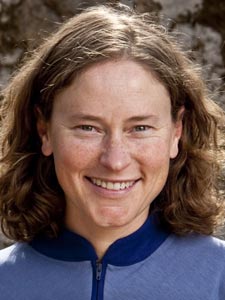
Julia Shaw
Julia Shaw, born in The Wirral, Great Britain on this day in 1965, took part in no sport after she left school and no longer had to do physical education lessons - in fact, it wasn't until she'd graduated from university and begun working that she began to take an interest, inspired by a triathlete colleague. She says that it was the friendliness of the other triathletes she met that kept her interested, but it would be another ten years before she began to take a serious interest in cycling. By that time, she was already in her thirties.

Fortunately, female athletes retain their ability to perform well in endurance sports for longer than their male counterparts, hence the relatively high numbers of riders in the late 30s in women's cycling when compared to the men's sport. Shaw was no different - she won the Best British All-Rounder competition in 2006, 2007, 2009 and 2010; only the legendary Beryl Burton has won it more times. She also won the Beryl Burton Champion of Champions Trophy for four consecutive years between 2007 and 2010, and she was National Time Trial Champion in 2005 (and third in 2009, then second in 2010 and 2011). Still racing at the age of 47, she came fifth behind Wendy Houvenaghel, Olga Zabelinskaia, Hanka Kupfernagel and Pia Sundstedt at the 2012 Celtic Chrono in Ireland.

Shaw was not considered for the 2006 Commonwealth Games but was selected for 2010 Games after her second place at the Time Trial Nationals, and won a bronze medal, finishing 10" behind Tara Whitten and 5" behind Linda Villumsen. Shaw's 2010 50-mile British TT record, 1h46'49", still stands; as does her 100-mile record of 3h45'22" from the same year. She also holds a degree and master's degree in physics and is involved in fibre optic research science.


Rik van Linden, born in Wilrijk on this day in 1949, won the Belgian Junior Road Race Championship in 1968, the Under-23 Ronde van Vlaanderen in 1969, Paris-Tours in 1971 and 1973 and Milano-Torino in 1977. He also rode well in stages races, including the Grand Tours - he won Stage 2 and second place in the Points competition at the 1972 Tour de France, Stages 7 and 17 at the 1973 Giro d'Italia, Stage 5 at the 1975 Giro, Stages 1b, 19, 21 and first place in the Points competition at the 1975 Tour, Stages 3 and 15 at the 1976 Giro, Stage 2 at the 1977 Giro and  Stages 1, 5 and 6 at the 1978 Giro.

Iker Flores
Born in Galdakao, Euskadi on this day in 1976, Iker Flores turned professional with Euskaltel-Euskadi in 1999, then won the Tour de l'Avenir in his second year with the team. Flores was a rider who spent his entire career on the verge of becoming great, coming 18th overall at the Vuelta a Espana in 2003 and finishing Stage 7 at the 2004 Tour de France in second place, but somehow never quite found the little extra he needed to break through. Finally, Euskaltel let him go; he spent his last professional season with ProContinental Fuerteventura-Canarias, then retired in 2007. Flores was Lanterne Rouge at the Tour in 2005 - as was his older brother brother Igor three years earlier.

Vasil Kiryienka, born in Rechytsa, Belarus (then USSR) on this day in 1981, was National Time Trial Champion in 2002, 2005 and 2006. He also won the Points competition at the Critérium International in 2011 and was second overall, then came sixth overall at the same event in 2012. At the end of that year he left Movistar and signed up to Team Sky, going on to win Stage 18 at the Vuelta a Espana; he is still with Sky as of 2014.

Chepe González, born in Sogamoso, Colombia on this day in 1968, won Stage 11 at the Tour de France in 1996, Stage 20 and the King of the Mountains at the Giro d'Italia in 1997 and Stage 5 and a second King of the Mountains at the Giro in 1999.

Walter Bénéteau, born in Les Essarts on this day in 1972, competed in and finished every Tour de France between 2000 and 2006. His best result was 42nd, in 2001.

Jeanne Deley, long-term partner of Tour de France director Henri Desgrange following his divorce, was born in Creusot on this day in 1878. Deley was a rather bohemian artist, known for the spirited parties she held at their villa and to which she invited cyclists, artists, actors, eccentrics and - most exotic of all - Americans; Desgrange seems not to have disapproved, an interesting contrast to the stern, pompous character he is usually portrayed as having been.

Cyclists born on this day: Maurice Moucheraud (France, 1933); Will Davis (France, 1877); Constantin Ciocan (Romania, 1943); Jan Bo Petersen (Denmark, 1970); Joe Waugh (Great Britain, 1952); František Kundert (Bohemia, now Czech Republic, 1891); Donald Eagle (New Zealand, 1936); Yvonne Schnorf (Switzerland, 1965); Viktor Manakov (USSR, 1960); Norbert Kostel (Austria, 1966); Baba Ganz (Switzerland, 1964); Adrian Prosser (Canada, 1956); Franco Gandini (Italy, 1936).

Sunday, 27 July 2014

Daily Cycling Facts 27.07.2014

Willy Kanis
Willy Kanis
One of the most successful Dutch track riders of all time, Willy Kanis - who was born in Kampen on this day in 1984 - began her cycling career at the age of six, riding in BMX competitions, and became a World Champion in that discipline in 2005 and 2006. She started track cycling in her teens and won two silver medals at the National Championships of 2003, then took two more in 2004 and another two in 2005 - and in 2006, won the 500m, Keirin and Sprint National titles to go with her second BMX gold medal.

Since 2007, Kanis has concentrated on the track, winning nine gold medals (including the 500m, Keirin and Sprint for a second time in 2008), silver and bronze at the Worlds in 2009, a third 500m National Championship in 2010 and a fourth 500m and third Keirin title at the Nationals in 2011. In 2010 she joined AA Drink-Leontien.nl, one of the strongest teams ever seen in women's cycling, but one that would come to an end in 2012 when owner Leontien van Moorsel announced that she would be retiring from team management; Kanis ended her own career at the same time.

Colin Lewis
Born in Torquay, Great Britain on this day in 1942, Colin Lewis began racing in his late teens and finished his first big race - the 1960 Milk Race (now the Tour of Britain) - in seventh place. Good results in French races earned him a place in the traditional home of all promising riders from nations other than those that traditionally do well in cycling, the AC Boulogne-Billancourt, and in 1964 he was the best-placed British rider at the Olympics.

In 1967 Lewis faced a tough decision - go to the prominent French Peugeot team, with its big budget and good salaries, or go to the financially poorer British Mackeson-Whitbread team, which was offering him a salary of £4 a week (less than a fifth the average weekly wage in Britain at that time). He went to Mackeson-Whitbread, then got a pay rise to £8 a week by winning the National Championship and finishing the Tour de France in 84th place..

Lewis became the first rider to win the British road race champion title for two consecutive years in 1968 and took second place in the very first Tom Simpson memorial - had he have chosen Peugeot instead of Mackeson, he'd have ridden alongside Tom; as it was he rode with him on the Great Britain team at the Tour, then contested by national rather than trade teams. The two men were friends; they shared hotel rooms at the Tour in 1968, and Lewis was in bed wondering if Tom would be released from hospital to ride the next day when the news reached him that his room mate was dead.

Lewis realised that one of the main things holding back British riders was the culture shock they experienced when first racing in Europe, pointing out that the British amateur racing scene was decades behind its French, Belgian and Italian counterparts; British riders were therefore at a disadvantage right from the start and only the most exceptional - such as Simpson - stood any chance of catching up. He understood too that snaring a household name race sponsor was not always a good thing as more often than not they pulled out again after a year or so, deciding that cycling didn't give the returns they'd hoped, and that this created a feeling in the the mind of the public that the race had failed. Following his retirement, he became manager of Hackney's Eastway Cycle Circuit, since demolished to make way for the Olympic Velopark, and worked for seven years as training director at the South-East Centre of Excellence, using his experience to assist numerous young athletes develop into world-class competitors. He still owns Colin Lewis Cycles in Paignton, Devon, and is president of the Mid-Devon CC.

Allan Davis
Allan Davis
Allan Davis, born in Queensland, Australia on this day in 1980, started racing at the age of 10 and turned professional with Mapei-QuickStep in 2002 after being taken on as a trainee the year before. He began winning stages immediately.

In 2004, Davis rode his first Tour de France and took a handful of decent stage finishes; in 2005 he returned and came fifth in the Points competition, then won the Points at the Benelux Tour later in the year. 2006 got off to a superb start with second place on three stages at Paris-Nice, but his season was ruined when he was one of the riders implicated in Operacion Puerto and his Astana team was blocked from the Tour de France; all five riders from the team were subesquently cleared by the Spanish Federation and salvaged the year with victory at the Noosa International Criterium.

Davis began 2007 with the Discovery team, came second at Milan-San Remo and then won five stages (1, 3, 5, 6 and 9) at the Tour of Qinghai Lake. He also came within a hair's breadth of a Grand Tour when he came fourth, third and second on Stages 1, 3 and 7 at the Vuelta a Espana; oddly, he experienced some difficulty in securing a contract at the end of the season and had to settle for a ProContinental Mitsubishi-Jartazi for six months until ProTour QuickStep came knocking; he repaid them in 2009 with the General Classification and the Points competition at the Tour Down Under, then at the Giro d'Italia he again came close to a Grand Tour stage win with third place on Stage 6 and second on Stage 9.

In 2010, riding for Astana, he won the Points competition at the Tour of Poland and later took a gold medal at the Commonwealth Games. 2011, during which he remained with Astana, proved to be a quieter year without victories; nevertheless his results remained good enough to win him a place with the new Australian GreenEDGE team for 2012 and he won the Jayco Bay Classic for them. He stayed with the team, now known as Orica-AIS, in 2013, but when his contract was not extended into 2014 he retired.

Alison Dunlap
Alison Dunlap
American mountain biker Alison Dunlap is one of the most successful riders in the history of the sport, with eight World MTB Championships (1994, 1997, 1998, 1999, 2000, 2001, 2002 and 2004), three National MTB Cross-Country Championships (1999, 2002 and 2004), three National Short-Track MTB Cross-Country Championships (1999, 2002 and 2004) and one MTB World Cup (2002) to her name. She was born in Denver on this day in 1969.

Dunlap also excels in cyclo cross and on road; she has been National Cyclo Cross Champion six times (1997, 1998, 1999, 2000, 2001 and 2003), was National Road and Omnium Collegiate Champion in 1993, the year she also won the bronze medal at the National Road Race Championships. She now runs Alison Dunlap Adventure Camps in Moab, offering MTB coaching and holidays.


Jean-Marie Leblanc, born in Nueil-les-Aubiers (then Nueil-les-Argent) on this day in 1944, rode the Tour de France in 1968 and 1970. He finished both times, coming 58th overall the first time around and then 83rd the second, when he also managed his best stage result - tenth, on Stage 5a. Following his retirement in 1971 he became a cycling journalist; and in 1989 it turned out that the Tour wasn't quite finished with him yet - he became the race Director, a position he held until reaching retirement age in 2005, when he was replaced by Christian Prudhomme. He was the man responsible for the abolition of the red Intermediate Sprint and Combination jerseys and is remembered as a moderniser - his decisions, though not always popular with riders and fans, have stood the test of time.

Sep Vanmarcke
Sep Vanmarcke, born in Kortrijk, Belgium on this day in 1988, came second at Gent-Wevelgem in 2010, fourth at the E3 Prijs Vlaanderen-Harelbeke in 2011 and first at the Omloop het Nieuwsblad in 2012. In 2013, riding for the new Belkin team, he aimed to concentrate on the Classics but injured his knee at Tirreno-Adriatico and was in obvious pain when he finished the Ronde van Vlaanderen three minutes behind winner Fabian Cancellara; however, he regained form remarkably quickly and was second behind Cancellara at Paris-Roubaix only a week later. His Classics campaign in 2014 was better still with fifth at the E3 Harelbeke, fourth at the Omloop het Nieuwsblad, Gent-Wevelgem and Paris-Roubaix and third at Kuurne-Brussels-Kuurne.

Alessanddro Bertolini, born in Rovereto, Italy on this day in 1971, won Paris-Brussels in 1997. Ten years later, he had a superb year in which he won the Giro dell'Appennino, the Coppa Agostoni, the Trittico Lombardo, the Giro del Veneto and the Coppa Placci and first place overall for points won in the UCI Europe Tour; the year after that he won his only Grand Tour stage victory, Stage 11 at the Giro d'Italia.

Swiss rider Hugo Schär, born on this day in 1948, participated in the Road Race at the 1972 Olympics but did not finish. In 1984, he filed a patent (US 4,458,556) for a new type of pedal that did away with the old-fashioned toe strap, using instead a specially-shaped pedal body and a strap that crossed the foot over the Lisfranc joint complex. This was intended to provide similar benefits to the clipless pedal that first became popular at about the same time and would prevent Schär's pedal becoming a success.

Other cyclists born on this day: Martijn Maaskant (Netherlands, 1973); Twan Poels (Netherlands, 1963); Nicola Loda (Italy, 1971); Julien Bérard (France, 1987); John Henry Lake (USA, 1878); Glauco Servadei (Italy, 1973); Omer Taverne (Belgium, 1904); Luis Alberto González (Colombia, 1965); Bohumil Kubrycht (Bohemia, now Czech Republic, 1886); Ludwik Turowski (Poland, 1901, died 1973); Robert Downs (Great Britain, 1954); Dieter Berkmann (West Germany, 1950); Karl Link (Germany, 1942); Claudio Vandelli (Italy, 1961); José Sánchez (Costa Rica, 1941); Rubén Placanica (Argentina, 1943); Massimo Brunelli (Italy, 1961); Erwin Tischler (West Germany, 1951).