Wednesday, 7 November 2012

Daily Cycling Facts 07.11.12


Happy birthday to Tanya Dubnicoff, the retired Canadian track cyclist who represented her country in three Olympics and won four gold medals in the Pan-American Games. She now lives in California where she works as a cycling coach, training the Canadian national squad among many other teams.

Happy birthday to Hilton Clarke, the Australian professional of the United Healthcare team. This year he became the first rider to win the Clarendon Cup (formerly the CSC Invitational) twice. Known as a sprinter, he rode for Toyota-United Pro Cycling Team in 2012.

The first Paris-Rouen race took place on this day in 1869, making it among the first official and organised bicycle races in history. James Moore, born in Bury St. Edmunds in Suffolk in 1849 (but lived in France since childhood) beat more than 200 opponents (including four women) to win (he may have also won a race the previous year, but there is no reliable evidence for this).

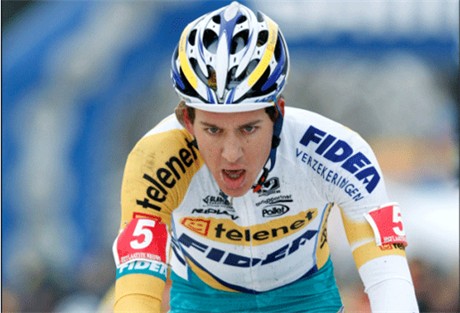
Happy birthday to Tom Meeusen, the Belgian road, mountain bike and cyclo cross rider from the Telenet-Fidea team.

This day in 2004 the inauguration of Sri Lanka's Cyclone, a mass participation bicycle rally aimed at establishing cyclist's rights and promoting the bike as a means of transport in the Asian nation.

James Moore (right) with an 1869 model Specialized Venge
On this day in 1942, Fausto Coppi set a new Hour Record at 45.798km at the Vigorelli Track.

Tuesday, 6 November 2012

Daily Cycling Facts 06.11.12

Today would have been Frank Vandenbroucke's 38th birthday. Frank, nicknamed VDB, was a bad boy but a colourful one - in 2006, while banned from professional racing, we was caught out while competing in an Italian race using a licence made out to Francesco del Ponte with a photograph of Tom Boonen. His cocaine addiction was a likely contributor to his long-standing depression and the pulmonary embolism that killed him when he was just 34 years of age.

It's the 48th anniversary of the death of Tour de France (1951) and Giro d'Italia (1950) winner Hugo Koblet, another colourful character whose career might have brought more success had he not have succumbed to a playboy lifestyle featuring a number of beautiful women, countless parties and, eventually, debt. He died in a car crash that many eye-witnesses believe was a deliberate suicide, having seen him drive his Alfa Romeo past a roadside pear tree three times before apparently deliberately steering into it at high speed. He was 39 years old.

Not so well known nowadays is Heiri Suter, another Swiss cyclist who became the first man to ever win Paris-Roubaix and the Tour of Flanders in a single year in 1923. Suter was also unofficial world champion in 1922 and 1925 after winning the Grand Prix, official Swiss road champion five times during the 1920s and multiple winner of several Classics including the now defunct Züri-Metzgete (six times in ten years) and Paris-Tours (twice) and the first non-Belgian to win the Tour of Flanders. He died aged 79 in 1978.

In 2005, Marianne Vos won the Elite European Cyclo Cross.

On this day in 2007, bike component manufacturer SRAM purchased the wheel and component manufacturer ZIPP Speed Weaponry.

Monday, 5 November 2012

Daily Cycling Facts 05.11.2012

Cyclists born on this day: Tommy Godwin (USA, 1920, died 2012); Ben Swift (Great Britain, 1987); Matthew Harley Goss (Tasmania, 1986); Martin Mortensen (Denmark, 1984); George Artin (Iraq, 1941); Paula Gorycka (Poland, 1990); Bruno Pellizzari (Italy, 1907, died 1991); Giuseppe Ogna (Italy, 1933, died 2010); Claudio Iannone (Argentina, 1963); Marcos Mazzaron (Brazil, 1963); Maarten Tjallingii (Netherlands, 1977); Bob Broadbent (Australia, 1904, died 1986); Spyros Agrotis (Cyprus, 1961); Liu Xin (China, 1986); Lyndelle Higginson (Australia, 1978); Richard Pascal (Cayman Islands, 1967); Geoffery Burnside (Bahamas, 1950); Koos Moerenhout (Netherlands, 1973).

Sunday, 4 November 2012

Daily Cycling Facts 04.11.2012


Dirk Demol
He may not have won Paris-Roubaix the most glorious way,
but win it he did - Dirk Demol's pavé
Dirk Demol, born in Kuurne, Belgium on this day in 1959, won Paris-Roubaix in 1988 after breaking away on the cobbles just outside Roubaix from a lead group made up of relatively unknown riders that had itself broken away from the peloton 27km into the race and then stayed out in front all the way without challenge.

It was, however, not a glorious victory. When he left the lead group, Thomas Wegmuller of KAS-Canal 10 went with him but then got a plastic bag entangled in his gears just as arrived at Roubaix. The team car came to his aid and a mechanic was able to remove the bag, but his gears still didn't work. Knowing that if he stopped to change bikes Demol would sprint away to certain victory, Wegmuller decided to carry on; Demol took full advantage of this by wheel-sucking him all the way to the velodrome and then accelerated away to win.


Born in Kuldīga, Latvia on this day in 1939, Emīlija Sonka won the Road Race at the 1964 World Championships at Salanches in France. She beat Galina Yudina, also riding for the USSR, and Rosa Sels of Belgium.

Uwe Peschel, who was born in Berlin on this day in 1968, won the National Individual Time Trial Championship in 2002 and was second at the World Individual Time Trial Championship a year later.

Born in Oyannax on this day in 1960, Éric Barone is a French cyclist who has set a number of downhill speed records and, at the time of writing, holds the World Records on gravel (172kph; set on Cerro Negro volcana, Nicaragua in 2002 - Barone crashed shortly after reaching the record speed and was badly injured) and on snow (222kph; set at Les Arcs, France in 2000).

Other cyclists born on this day: Wesley Kreder (Netherlands, 1990); John Otto (USA, 1900, died 1966); Lal Bakhsh (Pakistan, 1943); Evgeniya Radanova (Bulgaria, 1977); Leo Karner (Austria, 1952); Luis Díaz (Colombia, 1945); Jamie Wong (Hong Kong, 1986); Vasileios Reppas (Greece, 1988); Róbert Nagy (Slovakia, 1972); Lauri Aus (Estonia, 1970, died 2003); Federico Ramírez (Costa Rica, 1975); Ken Caves (Australia, 1926, died 1974); Ferenc Pelvássy (Hungary, 1910, died 1980); Joe Kopsky (USA, 1882, died 1974); Gary Thomson (Ireland, 1963); Palle Lykke Jensen (Denmark, 1936).

Saturday, 3 November 2012

Daily Cycling Facts 03.11.12

Brian Robinson
Today, British cyclists have made their mark forever on cycling's greatest race the Tour de France - Tom Simpson was the first to play the media and become a star, then became an even bigger star when he died on Mont Ventoux; Barry Hoban won eight stages; Robert Millar came fourth and won the King of the Mountains; David Millar earned time in all the different classification leaders' jerseys; Cav shattered Hoban's record with 23 stage wins, set a host of records, was declared the greatest sprinter the Tour had ever known and became a pin-up and then in 2012 Bradley Wiggins became the first British winner in the 109 year history of the race. Brian Robinson, born in Huddersfield on this day in 1930, wasn't the first Briton to enter the race (that had been Charles Holland and Bill Burls, who took part and failed to finish when Robinson was six years old in 1937) but he was the first to become a true Tour rider and the first to finish the race; in so doing blazing a trail that all those who came after him would follow.

Robinson was born into a cycling family, his father and older brother being members of the Huddersfield Road Club. He was permitted to join them for strictly non-competitive club rides from the age of thirteen and became a member when he reached the minimum age of fourteen; however, his father didn't allow him to begin racing for another four years. His father relented: Robinson's first attempt was a 25-mile individual time trial on a hilly parcours in March 1948 when he was seventeen and he completed in 1h14'50", a very respectable time for any rider making his debut, but he had already fallen for the glamour of European racing by this time and dreamed of a future in mass-start stage events - unfortunately, at that time the British League of Racing Cyclists (formed by Percy Stallard to establish and promote mass-start road racing in Britain) was still waging war with the National Cycling Union (which had banned mass-start road racing in Britain ever since the late 19th Century, fearing police would ban all bicycles from public roads). Robinson was an NCU member and was thus limited to the few NCU mass-start events that took place, all of them in very restricted circumstances such as on roads in public parks during the hours when the park was closed; he raced many times at Sutton Park in Birmingham where races had to stop before 09:30 when the public were allowed in.

Road racing was not banned on the Isle of Man, which as a self-governing nation had its own cycling union, and after taking third place in the Road Time Trials Council's National Hill Climb Championships and fifth in the NCU's mass-start closed circuit championships the previous year, Robinson went there in 1951 to come seventh at the prestigious Manx International. It wasn't banned in Ireland either; that same year he won Dublin-Galway-Dublin. In 1952 he entered the Route de France as part of a joint NCU/Army team whilst completing his mandatory national military service and did well, taking fifth place overall until the race reached the Pyrenees with three days to go - "I'd never seen mountains like that before" he said afterwards, having fallen into 40th place. That summer he and older brother Des were selected for the British team going to the Olympics; Brian finished in 27th place and Des in 26th. Jacques Anquetil, who would go on to become the first man to win the Tour five times and is still considered by many to be the greatest cyclist France has ever produced, was 12th; a month later at the World Championships Robinson raced against him again and they tied for eighth place. In 1954, having finished his national service, he signed to a team sponsored by Ellis Briggs as an independent; he was second overall in the Tour of Britain and won Stage 6 at the Tour d'Europe, a race held that year and again two years later before vanishing.

Later in 1954, Robinson was invited to join Hercules, a team that had originally been set up to break cycling records with riders including Eileen Sheridan but had later been approached by Derek Buttle who had been racing in France since 1952 with a plan to set up a road racing team. He accepted and, in 1955, he formed part of the first British team in the history of the Tour de France (Holland and Burl, back in 1937, had ridden for a British Empire team that included a Canadian rider). With many members of the team having little or no experience of racing in Europe and none at all of a Grand Tour, the race soon proved itself to be much, much harder than any of them had expected: only Robinson and Tony Hoar could finish, and Hoar was Lanterne Rouge. Robinson, meanwhile, proved himself - he was a respectable 29th, yet Hercules were not encouraged by his success to continue their racing program and the team dissolved at the end of the 1955 season. The following year, he demonstrated that he really was a rider able to take on the best Europe had to offer by performing well at the Vuelta a Espana (where he rode with a Swiss-British team led by le pédaleur de charme, 1951 Tour victor Hugo Koblet), then went to the Tour with a mixed-nationality team that included Charly Gaul, who had been third overall in 1955. Robinson finished Stage 1 in third place before taking 14th in the overall General Classification; Gaul, who won two editions of the Giro d'Italia and one of the Tour in spectacular style and who is still considered by many to have been the greatest climber cycling has ever seen, beat him by just one place.

If anyone now doubted that British cyclists couldn't hold their own at the very top of their sport, they were about to have their illusions shattered because early in 1957, having become the first british rider to sign a contract with a top continental team, Saint Raphael-R. Geminiani, Robinson beat Louison Bobet by almost a minute to win the Nice criterium. A short while later he took second and third place stage finishes at Paris-Nice, then he came third at Milan-San Remo ("by far the greatest achievement by a British roadman in a single-day race since the halcyon 19th-century days of George Pilkington Mills and the Bordeaux–Paris," said Cycling magazine). He crashed out of the Tour that year, but in 1958 he was second behind Arigo Padovan on Stage 7 - until Padovan was relegated to second after judges declared him to have twice tried to force Robinson into the crowd during the final sprint and, for the first time and more than half a century after the Tour began, a British rider had won a stage. It has been said that Stage 7 was the least important stage of the 1958, and those who say so are correct: the Pyrenees and - more important still - the Alps, where the TV crews that were for the first time that year broadcasting live from the mountain stages captured for posterity the incredible climbing abilities that won Gaul his Tour, were still far away and the General Classification contenders were saving their legs for the time trial the next day (and riders needed to think even more carefully than usual about when and where they spent energy, because in 1958 there were no rest days). Yet as far as British cycling fans - and fans of British cycling; an ever-growing number of whom, thanks to Robinson and Simpson (who was offered a contract with Saint Raphael the following year on Robinson's recommendation) and all those who followed the trail they blazed, are not British - it is one of the most important stages in the history of stage racing.

In 1959 Robinson won Stage 20. It was, once again, not a very important stage - the final Alpine stage had been the day before and Federico Bahamontes, who was the only rider able to even get near to Gaul when conditions suited the Luxembourger, had as good as won overall already. The other big names, competing for second and third place in the General Classification, were not concerned when Robinson broke away; however, with only two stages to go plenty of domestiques and also-rans would have been looking to grab any limelight that was available. That Robinson won by 20'06" - second place was taken by Arigo Padovan of all people - is therefore an impressive result. He continued racing for another three years, winning a stage at the GP du Midi-Libre and the Tour de l'Aude in 1960 and the General Classification at the Critérium du Dauphiné in 1961. 1962 passed without victory, then he was third at a criterium in Chaumont; he retired from competition in 1933 but still rides today.

John Tomac
John Tomac
If anyone can be said to have lived their life in cycling, it's John Tomac. Born in Michigan on this day in 1967, Tomac began BMX racing when he was 7 and had won a National Championship by his mid-teens; then after moving to California in 1986 he took up mountain biking and won races in that discipline too. Before long, a combination of race results and personality had made him one of the most famous riders in the world - Mongoose, the bike company for whom he had ridden throughout his professional career, marketed a "John Tomac Edition" mountain bike in 1987 and he starred in one of the first mountain biking videos that same year.

Between 1988 and 1991, Tomac also competed in road racing, winning the National Criterium Championship in his first year as a professional before going on to compete in several prestigious European events including Paris-Roubaix and the Giro d'Italia without notable success, leading to a decision to concentrate on mountain biking after 1991. Towards the end of the decade he formed a partnership with Doug Bradbury, the founder of the Manitou MTB suspension company, and set up Tomac Cycles. He no longer owns the brand - which passed through the hands of the American Bicycle Group conglomerate before being bought by Joel Smith, a businessman who had made his name in mountain biking as brand manager with components manufacturer Answer - but still takes an active role in running it and is involved in the design of new bikes.


Jules Rossi, who was born in Acquanera di San Giustin, Italy on this day in 1914 and went to France to live with relatives when he was orphaned at the age of 6, became a professional rider with Alcyon-Dunlop in 1935. He remained with them for most of his career, which lasted for sixteen years; in 1937 he became the first Italian to win Paris-Roubaix (unless - as is possible - Maurice Garin was still Italian when he won), in 1938 he won Stage 6a at the Tour de France and then first place at Paris-Tours after maintaining an average speed sufficient to also win him the Ruban Jaune.

Bobbie Traksel, born in Tiel, Netherlands on this day in 1981, won the 2010 Kuurne-Brussels-Kuurne after battling through weather so bad that 169 of the riders to start the race abandoned.

Other riders born on this day: Arnaud Labbe (France, 1976); Udo Hempel (Germany, 1946); Maxime Bouet (France, 1986); Anneliese Heard (GB, 1981); Chris Jenner (New Zealand, 1974); Armin Meier (Switzerland, 1969); Oscar Zeissner (Germany, 1928); Javier Suárez (Colombia, 1943); Tacettin Öztürkmen (Turkey, 1913); Alan Bannister (Great Britain, 1922, died 2007); Georges Lutz (France, 1884, died 1915); Børge Mortensen (Denmark, 1921); Peder Pedersen (Denmark, 1945); Joann Burke (New Zealand, 1969); Clarence Kingsbury (Great Britain, 1882, died 1949); Galip Cav (Turkey, 1912); Mario Margalef (Uruguay, 1943).

Friday, 2 November 2012

Daily Cycling Facts 02.11.12

Cees Stam
Born in Koog aan de Zaan, Netherlands on this day in 1945, Cees Stam was Amateur National Stayers Champion from 1968 to 1970, then turned professional with the Ketting team and remained with them for most of his career. His Stayers success continued - he was Elite National Champion from 1971 to 1974 and again in 1978, European Champion in 1974 and 1975, World Champion in 1973, 1974 and 1977 and usually took second or third place whenever he didn't win, including at the German National Championships in 1975 where he won silver.

Stam set a new derny-paced Hour Record in 1974 when he covered 82.998km at Utrecht's Galgenwaard stadium, since demolished and replaced with a newer stadium; he was also a remarkably persistent six-day racer, entering almost fifty as a professional yet winning none of them. When he retired from competition, Stam became coach of the national stayers' team and ran a sports clothing business, then retired from it in 2008. He still works as a derny rider at track events to this day.

Miguel María Lasa Urquía
Born in Oiartzun, Euskadi on either this day, the 1st of November or the 4th of November (depending on the source) in 1947, Miguel Lasa turned professional with Fagor in 1967 and won the National Hill Climb and Individual Time Trial Championships; then two years later won the Hill Climb title again and finished two stages at the Tour de l'Avenir in third place. In 1970 he won the Sprints classification at the Vuelta a Espana and Stage 12 at the Giro d'Italia, where he finished in eighth place overall.

Lasa would win the Hill Climb Championship again in 1971 and 1972; however, excellent results in those two years - including four second place stage finishes at the Vuelta a Espana, victory at the Vuelta a Mallorca and three stage wins plus third place overall at the Tour of the Basque Country in 1971 and two stage wins at the Vuelta a Espana, one at the Giro d'Italia and overall victory at the Vuelta a Menorca in 1972 encouraged him to concentrate on stage racing. In 1973 he won the Vuelta a Mallorca for a second time, then in 1974 he won the Tour of the Basque Country and finished six stages at the Tour de France in the top ten before coming 17th overall. In 1975 he won Stages 2 and 7 at the Vuelta a Espana and was first in the Points competition, later coming ninth overall at the Giro d'Italia, and in 1976 he won Stage 5b - a 144km parcours in Belgium - at the Tour de France. The following year he was second overall at the Giro d'Italia and in 1978 he won Stage 9 at the Tour de France, then Stage 18a at the Vuelta a Espana in 1979 and Stage 17 at the Vuelta and Stage 18 at the Giro d'Italia in 1981, his final professional year.


Jana Belomoina, born in Ukraine on this day in 1992, took third place in the Elite National Hill Climb in March 2010 when she was only 17 years old.

Eberado Pavesi, who was born in Colturano, Italy on this day in 1883, became a professional cyclist in 1904. In 1907 he finished the Tour de France in sixth place, becoming the second Italian rider to have completed the race (Rudolfo Muller was fourth in 1903); in 1910 he won Stages 5 and 9 and was second overall at the Giro d'Italia, then in 1912 he formed a part of the Atala team that won (the General Classification was contested by teams for that one edition - had it have been contested by individuals, decided on points or time, Pavesi's team mate Carlo Galetti would have won) and in 1913 he won Stages 2 and 9 and was once again second overall. Following his retirement in 1919, Pavesi became a directeur sportif and worked with a young Gino Bartali who would go on to win the Tour and the Giro several times. Pavesi died on the 11th of November in 1974, aged 91.

Bruce Biddle, born in Warkworth, New Zealand on this day in 1949, was National Road Race Champion in 1969 and won the Road Race at the 1970 Commonwealth Games. At the 1972 Olympics he was fourth in the Road Race behind third place Jaime Huelado of Spain, who subsequently failed an anti-doping test and was disqualified; however, as Biddle had not also been subjected to a test he could not be upgraded to a medal-winning position. In 1976 he finished two stages at the Tour de Suisse in second place and one at Tirreno-Adriatico in third and in 1978 he was 34th overall at the Giro d'Italia.

Raymond Bilney, born in Australia on this day in 1945, took fourth place in the Road Race at the 1964 Olympics - his time of 4h39'51.74" was equal to that recorded by Walter Godefroot, Gösta Pettersson, Eddy Merckx and several other big-name riders of the era. In 1970 he was second in the Road Race at the Commonwealth Games, finishing one second behind Bruce Biddle of New Zealand (see above).

Christos Winter, born in Mount Gambier, Australia on this day in 1989, enjoyed a very short cycling career during which he became Junior National Duo Time Trial Champion (with Jack Bobridge) and rode with the winning Junior National Championships Team Pursuit squad, both in 2007. Aged 20, he took an internship at Channel 9 News and later became presenter of nationwide music show Hit List TV.

Other cyclists born on this day: John Devine (USA, 1985); Ricardo Guedes (Uruguay, 1972); Olga Gayeva (Belarus, 1982); Shue Ming-Fa (Taipei, 1950); Feng Chun-Kai (Taipei, 1988).

Thursday, 1 November 2012

Daily Cycling Facts 01.11.12

Igor González de Galdeano
Born in Vitoria-Gasteiz, Euskadi on this day in 1973, Igor González de Galdeano signed his first professional contract with Equipo Euskadi in 1995. At that time, the team was in its second season and experiencing financial hardship due to sponsorship problems; the results he achieved during his three years with them helped to attract new backers, setting the team on the road to becoming the legendary Euskaltel-Euskadi that is still racing today and has become the default National Team of the cycling-mad Basque people.

Igor González de Galdeano at Paris-Nice in
2005, his final professional season
In 1999, his breakthrough year, he moved to Vitalico Seguros-Grupo Generali and won a stage before finishing fifth overall at Tirreno-Adriatico; he then took part in his first Grand Tour, the Vuelta a Espana, where he won the Prologue and Stage 12 to finish second overall and third in the Points competition. In 2001 he went to ONCE-Eroski and rode his first Tour de France, finishing the Prologue and Stage 18 in second place before coming fifth overall. A Stage 9 win - setting an average speed of 55.17kph over the 179.2km parcours which was, at that time, a Grand Tour record - later in the year at the Vuelta proved he was a worthy opponent to Lance Armstrong, who had won the Tour for a third time a few months previously; in 2002 he confirmed it with another fifth place at the Tour after wearing the maillot jaune between Stages 4 and 10, a victory at the National Individual Time Trial Championship and a bronze medal at the World ITT Championship.

González de Galdeano could not race at the Tour in 2003 after an anti-doping test revealed traces of salbutamol - this was not considered a positive result by the UCI and he was not banned from competition by them, but the French cycling federation banned him from racing in France for a six-month period that included the Tour. At the Vuelta that year he won Stage 1 and was fourth overall; however, in 2004 when ONCE had become Liberty Seguros, it became apparent that he had reached the end of his best years - he came 44th at the Tour and 96th at the Vuelta. 2005 was no better and he failed to finish the Tour before taking 89th at the Vuelta. A month and a half later, on this date - his 32nd birthday - he announced his immediate retirement. "I realised in the last Tour de France that I lost my motivation," he said.


Born in Bülach, Switzerland on this day in 1944, Louis Pfenninger won the Tour de Suisse in 1968 and 1972. In 1967 he was second overall at the Tour de Romandie and later becamee National Individual Time Trial Champion (1970) and National Road Race Champion (1971). As well as Romandie, he rode the Tour de France in 1967 and finished two stages in the top 20 before coming 70th overall.

Hendrik Redant, born in Ninove, Belgium on this day in 1962, was a professional rider between 1987 and 1997; during which time he won Kuurne-Brussels-Kuurne (1988 and 1990), the Colombian National Cross Country Mountain Bike Championship of 1990, Paris-Tours and the Japan Cup (1992) and the GP Briek Schotte (1994). He also took part in the Tour de France in 1990 (when he finished three stages in the top 20 and came 150th overall), 1991 (three stages in the top ten, 140th overall), 1992 (three top 20 stages, 122nd overall), 1994 (six stages top 20, 93rd overall) and 1995 when he didn't finish. Following his retirement from racing, Redant became a directeur sportif at Omega Pharma-Lotto and remained with them until 2010 when he moved on to the ill-fated Pegasus team based in Australia - the team folded due to financial difficulties before the start of the 2011 season

Raymond Mastrotto, born in Auch, France on this day in 1934, won the Under-23 Route de France in 1956 and 1957, then came sixth overall at the Tour de France in 1960. In 1961 he was second at the Critérium du Dauphiné and the following year he won it; he then went for several years without major victories until the Tour de France in 1967, where he won Stage 17 - which would prove to be the last win of his career because, in 1968 while out on a training ride, he was hit by a car and had to give up cycling. He died only 16 years later, aged 49, in 1984.

Astrid Danielsen, born in Trondheim on this day in 1968, was Norwegian Individual Time Trial Champion in 1987 and rode with the winning time trial team at the National Championships in 1987, 1988, 1989 and 1999.

Elina Sofokleous, born on this day in 1978, was National Road Race and Individual Time Trial Champion of Cyprus in 2001 and National Cross Country Mountain Bike Champion from 2004 to 2007.

Henk Vogels Sr., born in Haarlem, Netherlands on this day in 1942, came second at the Australian National Road Race Championships in 1973. His son, Henk Vogels Jnr., was also a professional cyclist who rode between 1995 and 2008.

Jef Lowagie, who was born in Brussels on this day in 1903, was Amateur National Road Race Champion of Belgium in 1933.

Alexander González Peña, a road and track rider born in Cali, Colombia on this day in 1979, was National Pursuit Champion in 2003.

Paul Esposti, born in Cardiff on this day in 1972, is able to claim to have finished top ten in the National Championships of three different countries - once in his native Wales when he won the National Championships in 1995 (all Championships are for road racing unless otherwise stated), five times in the National Championships of the United Kingdom (of which Wales is a constituent nation; 7th in 1994, 8th in 1995, 9th in 1997, 4th at the National Circuit Race Championship of 1999, 10th in 2010) and, having taken dual USA/UK citizenship, 8th at the US Criterium Championships of 2008 and 5th at the US Road Race Championships in 2009.

Other cyclists born on this day: Tony Hurel (France, 1987); Bert Scheirlinckx (Belgium, 1974); Martin Polák (Czechoslovakia, 1978); Somchai Chantarasamrit (Thailand, 1944); Carmel Muscat (Malta, 1961); Antonio Montilla (Venezuela, 1935); Cárlos Koller (Chile, 1890); Rihards Veide (Latvia, 1991); Jo Deok-Haeng (South Korea, 1966); Ad Dekkers (Netherlands, 1953); Fabrizio Bontempi (Italy, 1966); Victor Morales (Ecuador, 1943); James Lauf (USA, 1927); Toussaint Fouda (Cameroon, 1958).